Positional Information and Embryonic Patterning: From Information Theory to Synthetic Embryo Models
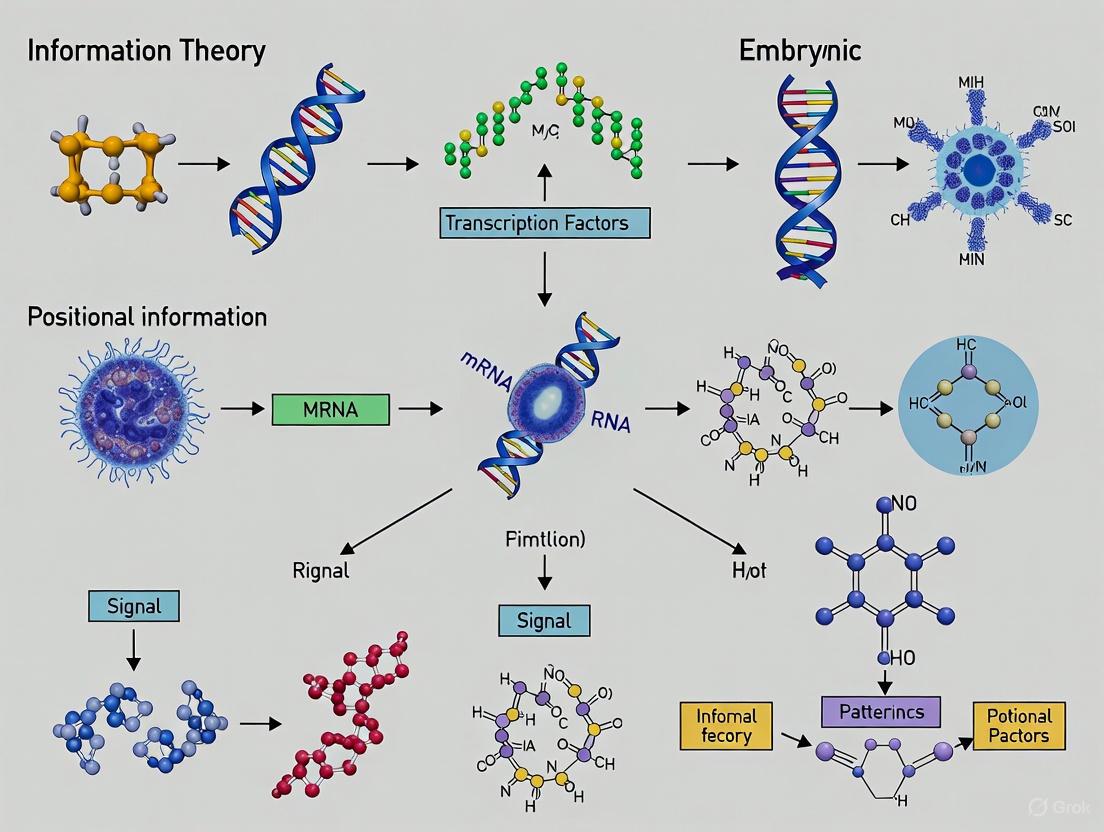
This article synthesizes classical concepts and cutting-edge research on the role of information theory in understanding embryonic patterning.
Positional Information and Embryonic Patterning: From Information Theory to Synthetic Embryo Models
Abstract
This article synthesizes classical concepts and cutting-edge research on the role of information theory in understanding embryonic patterning. We explore the foundational principle of positional information, from Wolpert's French Flag model to modern information-theoretic formalizations. The review covers methodological advances including stem cell-derived embryoid models, CRISPR-based programming of developmental pathways, and computational frameworks for analyzing pattern formation. We address key challenges in optimizing pattern reproducibility and fidelity, and compare validation strategies across different model systems. This resource is designed for researchers and drug development professionals seeking to understand how information is encoded, processed, and interpreted during embryonic development, with implications for regenerative medicine and developmental disorder research.
The French Flag to Information Theory: Conceptual Foundations of Positional Information
The concept of Positional Information, formally introduced by Lewis Wolpert in his seminal 1969 paper "Positional Information and the Spatial Pattern of Cellular Differentiation," represents a cornerstone of modern developmental biology [1] [2]. This theoretical framework provides a universal model for understanding how cells in a developing embryo determine their spatial identity and subsequently differentiate into specific patterns of tissues and organs. Wolpert's ingenious conceptual advance was to propose that cells effectively know their position within a developing field through the interpretation of molecular cues, and this positional value dictates their developmental fate [3]. To illustrate this abstract concept, Wolpert employed the French Flag analogy, wherein a field of cells reliably organizes itself into three distinct regions (blue, white, and red) in precise proportions, regardless of the overall size of the embryonic field [4] [5]. This model has profoundly influenced five decades of research in embryonic patterning, regeneration studies, and evolutionary developmental biology, establishing a conceptual vocabulary that continues to guide inquiry into how genetic information translates into spatial patterns of cellular differentiation.
Core Principles of the French Flag Model
Fundamental Postulates of Positional Information
Wolpert's model rests on several foundational principles that distinguish it from previous conceptualizations of pattern formation. First, it posits that the specification of positional information precedes and is independent of molecular differentiation [1]. This means that cells first acquire their positional identity based on their location within a coordinate system, and only subsequently interpret this identity through their genome and developmental history to undergo specific differentiation programs. Second, the model introduces the concept of the developmental field, defined as a group of cells that have their positional information specified with respect to the same set of points [1]. Third, polarity is defined as the direction in which positional information is specified or measured, establishing an axis along which positional values vary [1].
A key innovation of Wolpert's framework was its ability to explain pattern regulation—the remarkable ability of embryonic systems to form normal patterns even when parts are removed or added, and to maintain size invariance as exemplified by the French Flag problem [1] [5]. This regulatory capability implies that cells can change their positional information in response to perturbations and interpret these changes to achieve proper patterning. Wolpert estimated that the mechanism for specifying positional information must be capable of reliably specifying the position of approximately 50 cells in a line within about 10 hours, noting that most embryonic fields are surprisingly small, typically less than 50 cells in any direction [1].
The Morphogen Gradient as a Mechanism for Encoding Position
Although Wolpert's original conceptual model did not explicitly specify the molecular mechanism, the morphogen gradient soon emerged as the predominant biological implementation of positional information [4] [5]. A morphogen is defined as a signaling molecule that acts directly on cells to produce specific cellular responses dependent on its local concentration [4]. These molecules are typically secreted from a localized source and form a concentration gradient across developing tissue. Cells respond to particular concentration thresholds by activating specific genetic programs, effectively translating their position into distinct cellular fates.
Table 1: Key Morphogens in Developmental Patterning
| Morphogen | Organism | Role in Patterning | Discovery Timeline |
|---|---|---|---|
| Bicoid | Drosophila melanogaster | Anterior-posterior axis patterning | Identified as first morphogen in 1988 [4] [3] |
| Decapentaplegic (Dpp) | Drosophila melanogaster | Dorsal-ventral patterning; limb development | Demonstrated as morphogen in later Drosophila development [4] |
| Sonic Hedgehog (Shh) | Vertebrates | Neural tube patterning; limb bud patterning | Identified as key vertebrate morphogen [4] |
| Wnt | Multiple organisms | Multiple patterning events including limb development | Well-studied morphogen family [4] |
| Fibroblast Growth Factor (FGF) | Vertebrates | Limb development; axial patterning | Secreted protein morphogen [4] |
The French Flag model visually represents this threshold-dependent response: high morphogen concentrations activate a "blue" gene, intermediate concentrations activate a "white" gene, and low concentrations (or the absence of signal) permit the default "red" state [4]. This mechanism allows a single graded signal to generate multiple distinct cell types in a spatially organized manner. Francis Crick later provided theoretical support for this model by proposing that diffusion could serve as the physical mechanism establishing morphogen gradients, particularly feasible within the small dimensions of embryonic fields [5].
Quantitative Framework: Information Theory and Positional Information
From Conceptual Model to Quantitative Formalism
Half a century after Wolpert's seminal work, the field has witnessed a shift toward quantitative, systems-level approaches to positional information [3]. Modern interpretations increasingly leverage Shannon information theory to formalize the colloquial concept that "a cell determines its position from noisy patterning cues in the form of low-concentration molecular gradients" [3]. This mathematical framework allows researchers to address fundamental questions about where positional information resides, how it is transformed and accessed during development, and what fundamental limits it encounters.
In information-theoretic terms, positional information quantifies the statistical dependence between a cell's physical location and the molecular cues it detects. The mutual information, I(X;Y), between a cell's position (X) and the concentration of patterning molecules (Y) measures how much uncertainty about position is reduced by measuring the local morphogen concentration [3]. This approach generalizes beyond linear correlation coefficients to capture nonlinear dependencies between position and molecular signals, providing a more comprehensive measure of the information encoded in developmental cues.
Measuring Positional Information in Biological Systems
Experimental quantification of positional information faces significant technical challenges due to the inherent stochasticity of biological systems. In the early Drosophila embryo, where morphogen gradients have been most precisely quantified, studies have revealed that despite molecular noise, developmental patterning occurs with remarkable precision and reproducibility [3]. The Bicoid gradient, for instance, encodes sufficient information to specify multiple distinct expression boundaries despite concentration fluctuations, particularly at low morphogen levels where stochastic effects are most pronounced [4] [3].
Table 2: Quantitative Measures of Positional Information
| Parameter | Significance | Measurement Approaches |
|---|---|---|
| Mutual Information | Quantifies statistical dependence between position and molecular cues | Calculated from expression level distributions across positions [3] |
| Morphogen Concentration Threshold | Defines boundary between distinct cellular fates | Determined through genetic and biochemical assays [4] |
| Gradient Scaling | Ability to maintain proportional patterning across different sizes | Size manipulation experiments; modeling [4] |
| Precision and Reproducibility | Consistency of pattern formation across individuals | Quantitative imaging of multiple embryos [3] |
| Number of Distinguishable Fates | Maximum number of distinct cell types supportable by a gradient | Theoretical calculations based on thresholding [3] |
Recent advances in quantitative imaging, single-cell transcriptomics, and computational modeling have enabled unprecedented measurements of positional information in developing systems. These approaches reveal that developmental systems employ various strategies to maximize the extraction of positional information from noisy morphogen gradients, including temporal averaging, spatial integration, and multiple gradient integration [3].
Figure 1: Information Flow in Positional Information Systems. The diagram illustrates how positional information is encoded in morphogen gradients, interpreted through threshold mechanisms, and ultimately translated into spatial patterns of cellular differentiation.
Experimental Validation and Methodologies
Classic Experimental Evidence
The conceptual framework of positional information received crucial validation from several landmark experimental systems. Key evidence came from regeneration studies in hydra and flatworms, where removal of tissue triggered re-establishment of positional values and normal patterning [6] [2]. Similarly, Wolpert's own work with chick limbs demonstrated that manipulating tissue positioning led to predictable changes in digit patterning, consistent with cells interpreting their position within a coordinate system [2].
One of the most compelling validations came from Drosophila development. Christiane Nüsslein-Volhard's identification of Bicoid as the first morphogen in 1988 provided molecular proof for Wolpert's conceptual model [4] [3]. Bicoid protein forms a concentration gradient along the anterior-posterior axis of the fruit fly embryo, with different concentrations activating distinct target genes in a threshold-dependent manner, precisely as predicted by the French Flag model [4]. Subsequent work by Gary Struhl and Stephen Cohen demonstrated that Decapentaplegic (Dpp), a secreted signaling protein, acted as a morphogen during later stages of Drosophila development, further establishing the generality of the mechanism [4].
Detailed Methodological Approaches
Embryonic Manipulation Techniques: Classic experiments involved microsurgical manipulations of embryonic tissues, including transplantation of cells between different positions, removal of tissue fragments, and rotation of tissue segments [1] [2]. These approaches tested key predictions of positional information theory, particularly that cells would reinterpret their positional value after manipulation. In the developing chick limb, for instance, grafting tissue from posterior to anterior positions resulted in mirror-image digit duplications, demonstrating that cells responded to their new position by activating different genetic programs [2].
Genetic and Molecular Analysis: The identification of specific morphogens relied on genetic screens for patterning mutants, followed by meticulous molecular characterization of gene expression patterns in response to morphogen concentration variations [4]. Critical methodologies included:
- In situ hybridization to visualize spatial expression patterns of putative target genes
- Antibody staining to quantify morphogen protein distribution
- Misexpression studies using inducible promoters to create ectopic morphogen sources
- Reporter gene constructs with wild-type and mutated regulatory elements to identify morphogen response sequences
Quantitative Imaging and Analysis: Modern validation of positional information concepts employs sophisticated quantitative approaches, including:
- Live imaging of morphogen gradient formation using fluorescent tags
- Single-molecule detection techniques to quantify low-abundance morphogens
- Image correlation spectroscopy to analyze gradient dynamics
- Computational modeling to simulate gradient formation and interpretation
Contemporary Research and Alternative Models
Critiques and Limitations of the Classic Model
Despite its profound influence, the French flag model has faced theoretical and empirical challenges. Critics have noted several difficulties with gradient-based models of morphogenesis [4]. These include the sink requirement (the need for mechanisms to remove morphogens to maintain steady-state gradients), temperature dependence of diffusion (problematic for organisms developing across temperature ranges), scaling limitations (maintaining proportional patterning across different embryo sizes), and the superposition principle (constraining how gradients can form two-dimensional patterns) [4]. Additionally, fluctuations in gradients at low concentrations may complicate reliable threshold reading by individual cells, though developmental boundaries typically exhibit remarkable precision [4].
Beyond Morphogens: Local Signaling and Emergent Patterning
Recent research has explored alternative mechanisms for generating positional information that do not rely solely on long-range morphogen gradients. Computational models using cellular automata have demonstrated that local cell-cell signaling can produce robust French flag-like patterns without global signaling [7]. These models employ evolutionary algorithms to discover local rules that enable cells to self-organize into precise spatial patterns based only on communication with immediate neighbors [7].
This local signaling approach addresses several limitations of diffusion-based models, particularly for patterning in large multicellular systems where long-range diffusion becomes challenging. Successful local patterning strategies often incorporate modules for pattern propagation, boundary sharpening, and proportion regulation [7]. These mechanisms potentially operate in parallel with classical morphogen gradients, providing redundancy and robustness to embryonic patterning.
Figure 2: Comparison of Classic and Alternative Patterning Mechanisms. Contemporary research has identified local cell-cell communication strategies that can generate French flag patterns without long-range morphogen gradients.
The Scientist's Toolkit: Research Reagent Solutions
Table 3: Essential Research Tools for Studying Positional Information
| Reagent/Method | Function | Example Applications |
|---|---|---|
| Morphogen Antibodies | Quantifying protein distribution and gradient formation | Immunostaining of Bicoid in Drosophila embryos [4] |
| In Situ Hybridization Probes | Detecting spatial patterns of gene expression | Visualizing expression domains of threshold response genes [4] |
| Fluorescent Reporter Constructs | Monitoring gene expression dynamics in live cells | Real-time observation of pattern formation [3] |
| Cellular Automata Models | Simulating local signaling-based patterning | Exploring self-organizing patterning rules [7] |
| Mutant Lines | Dissecting genetic requirements for patterning | Analyzing patterning defects in morphogen pathway mutants [4] |
| Information Theory Metrics | Quantifying precision of positional specification | Calculating mutual information in gradient systems [3] |
More than fifty years after its introduction, Wolpert's French flag model continues to provide a fundamental conceptual framework for understanding pattern formation in developmental biology. The enduring legacy of positional information theory is evident in its continued evolution to incorporate quantitative approaches from information theory and systems biology [3]. Contemporary research has expanded beyond the original morphogen gradient concept to include diverse mechanisms such as local cell-cell communication, temporal coding strategies, and multi-gradient integration systems [7].
The most significant evolution in the field has been the shift from qualitative to quantitative frameworks, particularly the application of information theory to formalize and measure how positional information is encoded, transmitted, and interpreted in developing systems [3] [8]. This mathematical formalization has enabled researchers to address fundamental questions about the precision, reliability, and capacity of developmental patterning systems. Future research will likely focus on integrating multiple patterning strategies, understanding how positional information is maintained during tissue growth and regeneration, and applying these principles to synthetic biology and tissue engineering. As we continue to decipher the molecular implementation of positional information, Wolpert's elegant conceptual framework remains as relevant today as when it was first proposed.
The development of a complex multicellular organism from a single fertilized egg is one of the most remarkable processes in biology. This process requires precise spatial organization, where cells adopt specific fates based on their position within the embryo. The concept of positional information, first formally proposed by Lewis Wolpert in his seminal French flag model, provides a powerful theoretical framework for understanding this phenomenon [3]. According to this model, cells acquire positional values from a morphogen gradient—a graded distribution of a signaling molecule—and then interpret this information to enact specific genetic programs resulting in distinct cell fates [9] [3].
The principle that the fate of cells depends on their spatial position enables an organized pattern to arise across a developmental field. Wolpert envisaged spatial gradients of a chemical's concentration over a field of cells as one of the potential signals providing this positional information: cells sensing a low amount of chemical are more distant from the reference point (the source) than cells sensing a higher amount [10]. This review explores how two paradigmatic molecules—the transcription factor Bicoid in Drosophila and the signaling molecule Retinoic Acid (RA) in vertebrates—embody the principles of morphogen gradient formation and function, bridging conceptual models with molecular reality in embryonic patterning.
Theoretical Foundations: From French Flags to Information Theory
The French Flag Model and Morphogen Gradients
Wolpert's French flag model elegantly formalizes how positional information can be established [3]. The model proposes:
- A morphogen is produced from a localized source and forms a concentration gradient across a field of cells.
- Cells are pre-programmed to respond to different concentration thresholds of the morphogen.
- Above the first threshold, cells adopt the "blue" fate; between the first and second thresholds, the "white" fate; and below the second threshold, the "red" fate.
- This mechanism allows for the proportioning of patterns despite changes in the size of the developmental field.
The first molecular demonstration of this concept was provided by the transcription factor Bicoid in the Drosophila syncytium, which forms a gradient expanding from the anterior pole and regulates downstream gene expression in a concentration-dependent manner [10].
Quantitative Foundations of Gradient Formation
The formation of morphogen gradients can be described mathematically. A simple yet powerful model involves diffusion from a localized source combined with uniform degradation. This dynamic can be formalized by the reaction-diffusion equation:
[\frac{\partial c}{\partial t} = D \frac{\partial^2 c}{\partial x^2} - kc]
Where (c) is concentration, (t) is time, (x) is position, (D) is the diffusion coefficient, and (k) is the degradation rate [9]. At steady state ((\partial c/\partial t = 0)), the solution takes an exponential form:
[c(x) = c_0 e^{-x/\lambda}]
where (\lambda = \sqrt{D/k}) is the characteristic length of the gradient, defining how far the morphogen typically travels before being degraded [10]. This theoretical framework provides testable predictions about gradient dynamics and shape.
Information-Theoretic Perspectives
Recently, the concept of positional information has been formalized using Shannon information theory [3]. In this framework, the mutual information (I(X;Y)) between position (X) and morphogen concentration (Y) quantifies how precisely position can be inferred from concentration measurements in the presence of noise. This approach shifts the focus from biological mechanisms to quantitative, systems-level questions: where does positional information reside, how is it transformed during development, and what fundamental limits is it subject to? This mathematical formalization allows researchers to move beyond qualitative descriptions to quantitative predictions about patterning precision and robustness [3].
Bicoid: A Transcription Factor Morphogen Paradigm
Gradient Formation and Dynamics
Bicoid represents a paradigm for transcription factor morphogens. In the early Drosophila embryo, Bicoid mRNA is localized to the anterior pole, and upon translation, the protein diffuses through the syncytium to form an exponential concentration gradient along the anterior-posterior axis [11] [10]. Recent studies using protein-age measurements via tandem fluorescent timers have provided direct evidence that the Bicoid gradient forms through a synthesis-diffusion-degradation mechanism, ruling out alternative hypotheses for gradient formation [11].
Quantitative measurements have revealed that the Bicoid gradient has a characteristic length of approximately 100 μm, substantially larger than gradients of secreted morphogens like Dpp and Wingless in the fly wing, which have characteristic lengths of 20 μm and 6 μm, respectively [10]. This extensive range enables Bicoid to pattern nearly half of the embryo length.
Table 1: Key Quantitative Parameters of the Bicoid Gradient
| Parameter | Value | Measurement Technique | Biological Significance |
|---|---|---|---|
| Characteristic length (λ) | ~100 μm | Fluorescence fitting of protein gradient [10] | Defines patterning range across anterior-posterior axis |
| Diffusion coefficient (D) | Not directly measured | Inference from dynamics [10] | Determines speed of gradient formation |
| Degradation rate (k) | Not directly measured | Inference from dynamics [10] | Controls gradient stability and response time |
| Number of target thresholds | Multiple | Gene expression boundaries [10] | Encodes different cell fates along the axis |
Genomic Interpretation and Target Gene Regulation
Bicoid functions as a transcription factor containing a homeodomain that binds to specific DNA sequences in the regulatory regions of target genes such as hunchback [11]. Different target genes have distinct activation thresholds, allowing the single Bicoid gradient to initiate multiple expression domains along the anterior-posterior axis.
Recent research has revealed unexpected complexity in how Bicoid regulates transcription. Rather than following simple thermodynamic models of regulation, Bicoid appears to act as a catalyst for chromatin accessibility, possibly through histone acetylation, working in concert with pioneer-like transcription factors such as Zelda [11]. This mechanism enables the robust transcriptional activation of target genes despite the nuclear concentration fluctuations inherent in a graded distribution.
Evolution and Variation
The evolution of Bicoid from a Zerknüllt-like ancestral protein involved a multi-step pathway with intermediate sequences exhibiting suboptimal activities [11]. Studies of the Bicoid homeodomain have revealed significant epistatic interactions between substitutions in different subdomains (N-terminal arm, H1, and Recognition Helix), with robust patterning activity only emerging when combinations of substitutions are present [11].
Interestingly, embryonic geometry serves as a key factor predetermining patterning outcomes under decanalizing conditions such as altered Bicoid dosage [11]. While wild-type Bicoid patterning is robust to variations in embryonic geometry, under mutant conditions, geometry becomes highly predictive of individual patterning defects, revealing hidden constraints on the evolvability of this system.
Retinoic Acid: A Versatile Signaling Morphogen
Chemistry and Biosynthesis
Retinoic Acid (RA) is a lipophilic molecule derived from vitamin A (retinol) [12]. Its basic structure consists of three parts: a trimethylated cyclohexene ring (hydrophobic group), a conjugated tetraene side chain (linker unit), and a polar carbon-oxygen functional group (typically carboxylic acid) [12]. The biochemical conversion of dietary vitamin A to RA occurs successively in the intestine, liver, and finally in target cells, facilitated by various binding proteins including cellular retinol-binding proteins (CRBPs), retinol-binding proteins (RBPs), and cellular retinoic acid binding proteins (CRABPs) [12].
The conversion to active RA involves two critical enzymatic steps: first, retinol is oxidized to retinal by retinol dehydrogenases (RDHs), and then retinal is irreversibly converted to RA by retinaldehyde dehydrogenases (RALDHs) [12]. RA is catabolized by cytochrome P450 enzymes (CYP26), providing crucial regulation of its active concentrations [12].
Signaling Mechanisms and Receptor Diversity
RA exerts its effects primarily by binding to nuclear receptors, functioning as a ligand-dependent transcription factor [12]. There are two main classes of retinoid receptors: retinoic acid receptors (RARs) and retinoid X receptors (RXRs), each with three subtypes (α, β, and γ) and multiple isoforms [12]. RARs can be activated by both all-trans RA and 9-cis RA, while RXRs are exclusively activated by 9-cis RA [12].
These receptors form RAR-RXR heterodimers that bind to specific DNA sequences known as retinoic acid response elements (RAREs), recruiting co-activators or co-repressors to regulate target gene transcription [12]. The modular structure of these receptors includes distinct functional domains: the N-terminal A/B domain containing autonomous transcriptional activation function (AF-1); the highly conserved C domain with zinc fingers for DNA binding; the D hinge region; and the multifunctional E domain responsible for ligand binding, dimerization, and coactivator interaction (AF-2) [12].
Experimental Evidence for Morphogen Function
Recent research has established RA as a true morphogen in multiple developmental contexts. In the mouse olfactory epithelium (OE), RA signaling is tightly confined to the dorsomedial zone (D-zone), where it acts as an upstream morphogen regulating D-zone-specific gene expression and ensuring proper regional identity [13]. The establishment of OE zones is driven by interactions between the RA morphogen signal and transcriptional programs involving Foxg1, providing a molecular basis for innate and learned olfactory circuits [13].
In zebrafish heart development, RA signaling plays critical roles at multiple stages. Inhibition of RA production during second heart field addition results in smaller ventricles with fewer cardiomyocytes, revealing requirements for RA in promoting addition of ventricular cardiomyocytes and establishing proper ventral aorta anterior-posterior patterning [14].
Table 2: Retinoic Acid Functions in Different Developmental Contexts
| Developmental Context | RA Function | Experimental Evidence | References |
|---|---|---|---|
| Olfactory epithelium (OE) patterning | Confined to D-zone; regulates zonal specification | Conditional knockout and RA signaling analysis [13] | [13] |
| Second heart field addition | Promotes ventricular cardiomyocyte addition | RA inhibition studies in zebrafish [14] | [14] |
| Early mammalian development | Critical during totipotency window | Addendum on early mouse embryos [15] | [15] |
| Limb and organ development | Embryonic patterning | Genetic loss-of-function studies [15] | [15] [12] |
Methodological Approaches: Experimental Toolkit
Visualizing and Quantifying Gradients
A critical advancement in morphogen research has been the development of techniques to visualize and quantify gradients with high spatial and temporal resolution. For Bicoid, antibody staining and GFP fusion proteins have been used to provide static images of the gradient, while more recent approaches using fluorescent timers have enabled measurements of protein age and dynamics [11] [10].
For RA signaling, detection often relies on indirect methods due to technical challenges in direct RA measurement. Approaches include:
- LacZ reporter mice for visualizing RA signaling activity [13]
- In situ hybridization for enzymes involved in RA synthesis (RALDHs) and degradation (CYP26s) [13]
- HPLC and mass spectrometry for direct quantification, though these are challenging with limited biological material [15] [12]
Genetic and Molecular Perturbations
Loss-of-function studies are essential for establishing morphogen function. However, genetic analyses of RA synthesis enzymes reveal complexities in interpretation, as loss of function does not prevent development past the 2-cell stage but leads to embryonic or postnatal lethality [15]. Importantly, all genetic knock-outs targeting RA-producing enzymes and their receptors studied to date are zygotic knock-outs, leaving potential maternal contributions unaddressed [15].
Recent technological advances have enabled more precise interventions:
- Conditional knockouts using Cre-lox systems for spatiotemporal control of gene deletion [13]
- Pharmacological inhibition of RA synthesis or signaling [14]
- Maternal germline depletion to address maternal contributions [15]
Theoretical and Computational Approaches
Mathematical modeling has been indispensable for testing hypotheses about gradient formation mechanisms [9] [10]. The synthesis-diffusion-degradation model for Bicoid was confirmed through quantitative analysis of protein age distribution [11]. Similarly, models of RA gradient formation must account for its complex metabolism, including synthesis by RALDHs and degradation by CYP26s [12].
Information-theoretic approaches provide a framework for quantifying positional information in bits, allowing researchers to ask how much information morphogen gradients can reliably convey and how this information is degraded by noise [3].
Research Reagent Solutions
Table 3: Essential Research Reagents for Morphogen Studies
| Reagent/Category | Specific Examples | Function/Application | References |
|---|---|---|---|
| Genetic Tools | Foxg1 conditional knockout mice; Sox2-CreER line | Cell-type specific and temporal gene deletion; lineage tracing | [13] |
| Chemical Inhibitors | CYP26 inhibitors; BMS-493 (RAR inverse agonist) | Perturb RA signaling at specific points | [12] [14] |
| Detection Methods | RARB-lacZ reporter; RNA probes for Foxg1, Raldh2, Raldh3 | Visualize RA signaling activity and gene expression patterns | [13] |
| Protein Analysis | CRABP antibodies; RAR/RXR antibodies | Detect RA-binding proteins and receptors | [12] |
| Synthetic Retinoids | Bexarotene (RXR agonist); Tazarotene (RARβ/γ agonist) | Receptor-specific signaling activation | [16] |
Signaling Pathway Diagrams
Bicoid Gradient Formation and Function
Retinoic Acid Synthesis and Signaling Pathway
Comparative Analysis: Principles and Variations
While Bicoid and RA represent different classes of morphogens—Bicoid as a transcription factor acting in a syncytium and RA as a diffusible signal acting between cells—they share fundamental principles while exhibiting important differences in their mechanisms.
Table 4: Comparative Analysis of Bicoid and Retinoic Acid as Morphogens
| Characteristic | Bicoid | Retinoic Acid |
|---|---|---|
| Molecular Nature | Transcription factor | Small lipophilic molecule |
| Gradient Formation | Synthesis-diffusion-degradation in syncytium [11] | Synthesis-diffusion-degradation with complex metabolism [12] |
| Spatial Range | ~100 μm characteristic length [10] | Variable, tissue-dependent |
| Reception Mechanism | Direct DNA binding | Nuclear receptor activation |
| Target Response | Direct transcriptional regulation | Direct transcriptional regulation |
| Evolutionary Conservation | Insect-specific | Evolutionarily conserved across vertebrates |
| Experimental Evidence | Direct visualization and manipulation [11] | Genetic and pharmacological perturbations [13] [14] |
The study of Bicoid and retinoic acid as paradigmatic morphogens has provided profound insights into how positional information is established and interpreted during embryonic development. From Wolpert's theoretical French flag model to the molecular realities of gradient formation and interpretation, these systems reveal both shared principles and unique adaptations.
Future research will likely focus on several key areas:
- Understanding the molecular noise in gradient formation and interpretation using information-theoretic approaches [3]
- Developing more precise tools for visualizing and manipulating morphogen gradients in real-time
- Exploring the interplay between multiple overlapping gradients in complex patterning events
- Addressing outstanding questions about maternal contributions to early patterning events, particularly for RA signaling [15]
As technical advances continue to provide increasingly quantitative data, the integration of experimental and theoretical approaches will remain essential for unraveling the complexities of morphogen-mediated patterning. The principles emerging from the study of Bicoid and RA continue to illuminate the elegant mechanisms by which embryos transform molecular gradients into precise anatomical structures.
The application of information theory to developmental biology has revolutionized our quantitative understanding of how embryonic patterns form with high precision. This whitepaper examines the conceptual framework and experimental evidence establishing how morphogen gradients encode positional information through the lens of Shannon information theory. We explore how a cell's location within a developing tissue is encoded in molecular concentrations, transmitted through noisy channels, and decoded to specify cell fates. Through quantitative models and experimental validation primarily in Drosophila embryogenesis, we demonstrate how information-theoretic measures provide powerful tools to analyze the precision, reliability, and fundamental limits of biological pattern formation. This synthesis offers researchers a rigorous foundation for investigating patterning robustness and its implications for developmental disorders and regenerative medicine.
The concept of positional information originated with Lewis Wolpert's seminal "French Flag Model" in 1969, proposing that cells determine their positional identity through concentration thresholds of diffusible morphogen molecules [3] [17]. This abstract framework postulated that spatial patterns of cellular differentiation emerge from cells interpreting their position within a coordinate system defined by morphogen gradients. Wolpert's conceptual advance separated the problem of pattern formation into two distinct components: the specification of positional values through morphogen concentrations and the interpretation of these values through genetic regulatory networks [3].
Half a century later, this conceptual framework has evolved into a quantitative discipline through the integration of Shannon information theory [3] [18]. The modern interpretation treats positional information as a true physical variable encoded in local concentrations of patterning molecules, with this mapping being inherently stochastic due to biological noise at molecular, cellular, and tissue levels [18]. This approach shifts focus from qualitative descriptions of biological mechanisms to quantitative, systems-level questions: where does positional information reside within developing systems, how is it transformed and accessed during development, and what fundamental physical limits constrain its accuracy and transmission? [3]
The integration of information theory provides developmental biology with rigorous mathematical tools to address these questions. By treating position as information encoded in molecular concentrations and transmitted through developmental processes, researchers can quantify the precision and reliability of patterning systems, analyze error propagation, and identify optimal design principles evolved in biological systems [19] [17].
Theoretical Foundations: From French Flag to Shannon Information
Wolpert's French Flag Model and Morphogen Gradients
Wolpert's original French Flag model addressed the "French Flag Problem" of patterning, wherein a field of initially identical cells develops into precisely positioned stripes of different colors [3]. The model proposed that a concentration gradient of a diffusible morphogen provides positional cues, with cells adopting different fates based on threshold concentrations of the morphogen. This framework elegantly separated the source of patterning information (the gradient) from its interpretation (cellular response), providing a universal mechanism for generating spatial patterns [3].
The French Flag model made several key predictions that have since been experimentally validated:
- Asymmetric morphogen sources establish concentration gradients through diffusion
- Cellular interpretation machinery detects local morphogen concentrations
- Concentration thresholds determine boundary positions between different fates
- Pre-patterning independence where the same gradient can generate different patterns depending on interpretation systems [3]
The molecular validation came with the discovery of the anterior determinant Bicoid in Drosophila embryos, which displayed all characteristics of Wolpert's conceptual morphogen [3]. Subsequent discoveries in vertebrate systems, including frog growth factors and zebrafish morphogens, confirmed the broad applicability of this conceptual framework across metazoans [3].
Shannon Information Theory in Biological Patterning
Shannon information theory provides a mathematical framework to quantify how much a cell can infer about its position from molecular cues despite biological noise [3]. In this framework, positional information is formally defined through mutual information between position and morphogen concentration, measuring the reduction in uncertainty about a cell's position when morphogen concentrations are known [3] [19].
The key mathematical foundations include:
- Entropy: S(X) = -Σ P(X) log₂P(X), measuring uncertainty about position X
- Mutual Information: I(X;Y) = S(X) + S(Y) - S(X,Y), quantifying how much information morphogen concentrations Y provide about position X
- Fisher Information: Iᵢⱼ(x) = E[(∂logP/∂xᵢ)(∂logP/∂xⱼ)], providing the upper limit of positional precision [3] [19]
This formal approach generalizes beyond linear correlation coefficients to capture nonlinear statistical dependencies between position and morphogen concentrations [3]. The mutual information between position and morphogen concentration directly quantifies the number of distinct positional states that can be reliably distinguished despite noise, typically ranging from 3-5 bits in early embryonic patterning systems [3].
Table 1: Key Information-Theoretic Measures in Developmental Patterning
| Measure | Mathematical Definition | Biological Interpretation | Application Example |
|---|---|---|---|
| Shannon Entropy | S(X) = -Σ P(X) log₂P(X) | Uncertainty in cell position | Tissue-level positional disorder |
| Mutual Information | I(X;Y) = S(X) + S(Y) - S(X,Y) | Positional information conveyed by morphogens | Bicoid gradient in Drosophila |
| Fisher Information | Iᵢⱼ(x) = E[(∂logP/∂xᵢ)(∂logP/∂xⱼ)] | Upper limit of positional precision | Boundary formation precision |
| Structural Entropy | Complex topological measure | Anatomical complexity through development | Mouse embryo anatomical complexity [20] |
Quantitative Models of Positional Information
Information-Theoretic Positional Encoding
From an engineering perspective, positional information coding in development follows principles similar to classical communication systems [19]. The process involves:
Encoding: Position x = (x₁,...,xN) is converted into morphogen concentrations u = (u₁,...,uM) through spatial profiles u(x) determined by morphogen production, diffusion, and degradation.
Transmission: The encoded information passes through noisy channels, with cells detecting concentrations u' that deviate from ideal values u(x) due to intrinsic and extrinsic noise.
Decoding: Cells estimate their position x̂ from detected concentrations u' using specific decoding rules, typically implementing maximum likelihood estimation to achieve optimal precision [19].
The precision of positional information is fundamentally limited by the Cramér-Rao bound: det[Var(x̂)] ≥ 1/det[I(x)], where I(x) is the Fisher information matrix [19]. This mathematical formalism establishes the theoretical maximum precision achievable for a given encoding scheme and noise characteristics, providing a benchmark for biological systems.
For multidimensional patterning (e.g., two-dimensional tissues patterned by multiple morphogens), the orthogonality principle demonstrates that orthogonal morphogen gradient vectors provide highest positional precision by minimizing cross-talk between different positional coordinates [19]. The optimal coding design depends on noise correlations between morphogens, with opposite gradients optimal for anti-correlated noise and identical gradients for correlated noise [19].
Structural Entropy in Embryonic Development
Beyond molecular-level positional information, anatomical structure itself can be quantified through information-theoretic measures. Structural Entropy applies Shannon's concept of uncertainty to the topological organization of embryonic tissues [20].
This approach models embryo anatomy as tagged 3D structures, where each spatial position is labeled with its tissue identity. Rather than simple random sampling, Structural Entropy considers random paths through the embryo, generating probability distributions of transitions between different tissue types [20]. This captures the rich spatial organization of tissues beyond simple volume fractions.
Application to the Edinburgh Mouse Atlas reveals that Structural Entropy generally decreases almost linearly throughout development (days 4-18), indicating increasing anatomical order [20]. Interestingly, a transient increase in Structural Entropy occurs during gastrulation (days 7-8), corresponding to this critical period of tissue reorganization and increased complexity [20].
Table 2: Quantitative Measures of Biological Pattern Formation
| Measure | System | Quantitative Findings | Biological Significance |
|---|---|---|---|
| Positional Information | Early Drosophila embryo | 3-5 bits of information | Enough to specify ~8-32 distinct positional values along anterior-posterior axis |
| Structural Entropy | Developing mouse embryo | Decreases linearly from days 4-18, with transient increase during gastrulation (days 7-8) | Measures increasing anatomical order during development, disrupted during tissue reorganization |
| Genetic Noise | Monoallelic vs. biallelic expression | 47% increase in genetic noise for PEG10 during differentiation; 126% increase in genetic entropy | Monoallelic expression increases variability, potentially facilitating probabilistic differentiation |
| Boundary Precision | Morphogen gradient models | SUM rule combining global and local signaling produces most accurate boundaries | Local cell-cell signaling enhances boundary precision beyond morphogen gradients alone |
Experimental Validation and Model Systems
Drosophila Embryonic Patterning
The early Drosophila embryo represents a paradigm for quantitative analysis of positional information [3] [18]. The Bicoid gradient along the anterior-posterior axis provides a clear example of positional encoding, with concentration thresholds activating specific target genes (e.g., hunchback, giant, Krippel) in precise spatial domains [3].
Experimental measurements demonstrate that positional information in the Bicoid gradient reaches approximately 3-5 bits, sufficient to specify 8-32 distinct positional values along the embryo length [3]. This precision emerges despite significant embryo-to-embryo variability in absolute Bicoid concentrations, achieved through mechanisms that include:
- Time integration of noisy concentration signals
- Cross-repressive interactions between target genes
- Feedback mechanisms that sharpen initial patterns
- Robust decoding strategies implemented by gene regulatory networks [3] [17]
The gap gene system in Drosophila implements a sophisticated decoding strategy where multiple morphogens (Bicoid, Caudal, Torso) are integrated through dynamic gene regulatory networks to achieve precise boundary formation despite significant noise in individual components [17].
Vertebrate Patterning Systems
Vertebrate systems provide examples of more complex multidimensional patterning. In the vertebrate neural tube, opposing gradients of Sonic Hedgehog (ventral) and BMP/TGF-β (dorsal) provide positional information along the dorso-ventral axis [17]. The precision of this system arises from:
- Morphogen antagonism creating sharper effective gradients
- Temporal integration of signaling activities
- Combinatorial code of transcription factor expression
- Local cell-cell communication refining initial patterns [17]
Limb bud patterning demonstrates two-dimensional positional encoding by multiple morphogens (FGFs, SHH, BMPs, WNTs), with orthogonal gradient directions maximizing positional information according to the orthogonality principle [19]. The optimal encoding strategy depends on noise correlations between morphogen pathways.
Diagram 1: Boundary formation mechanisms combining global morphogen gradients with local cell-cell signaling, implementing different logical rules for signal integration [21].
Research Tools and Methodologies
Experimental Approaches for Quantifying Positional Information
Modern analysis of positional information employs sophisticated imaging, genetic, and computational tools:
- Quantitative fluorescence microscopy for measuring morphogen concentration gradients with high spatial and temporal resolution
- Single-molecule FISH for counting individual mRNA molecules in fixed tissues
- Live imaging of reporter genes for tracking gene expression dynamics in real time
- Image correlation microscopy for quantifying noise and precision in patterning systems
- Single-cell RNA sequencing for comprehensive transcriptomic profiling of cell states [3] [22]
These techniques enable direct measurement of the key parameters required for information-theoretic analysis: mean concentration profiles, variability between embryos, and noise distributions at single-cell resolution.
Computational and Mathematical Tools
Computational approaches complement experimental measurements:
- Stochastic modeling of morphogen gradient formation and interpretation
- Information-theoretic calculations of mutual information and Fisher information
- Bayesian inference frameworks for optimal decoding strategies
- Machine learning approaches for pattern analysis and classification
- Graph theory applications for anatomical complexity quantification [20] [19]
These mathematical tools enable researchers to move beyond qualitative descriptions to quantitative predictions about patterning precision, optimal design principles, and the fundamental limits of biological information processing.
Table 3: Essential Research Reagent Solutions for Positional Information Studies
| Reagent/Category | Function/Application | Example Uses |
|---|---|---|
| Fluorescent Reporter Genes | Visualizing morphogen gradients and gene expression domains | Live imaging of Bicoid-GFP fusions in Drosophila |
| Single-Molecule FISH Probes | Quantifying absolute mRNA concentrations with single-cell resolution | Measuring transcript distribution noise in mouse embryos |
| CRISPR/Cas9 Genome Editing | Precise manipulation of regulatory elements and coding sequences | Testing information coding predictions in vertebrate models |
| Monoclonal Antibodies | Specific detection and quantification of protein morphogens | Immunostaining for SHH in neural tube patterning studies |
| Transcriptional Reporters | Measuring enhancer/promoter activities | Testing decoding logic of gene regulatory networks |
| Optogenetic Control Systems | Spatiotemporally precise perturbation of signaling pathways | Testing noise robustness mechanisms in developing tissues |
Experimental Protocols for Positional Information Analysis
Quantifying Positional Information in Morphogen Gradients
This protocol outlines the procedure for measuring positional information in the Bicoid gradient of early Drosophila embryos, adaptable to other morphogen systems:
Sample Preparation:
- Collect 0-2 hour Drosophila embryos expressing Bicoid-GFP fusion protein
- Fix embryos in 4% formaldehyde for 25 minutes at room temperature
- Permeabilize embryos using heptane/methanol extraction
- Mount embryos in imaging chambers with appropriate orientation
Image Acquisition and Processing:
- Acquire fluorescence images using confocal microscopy with standardized settings
- Image multiple embryos (n ≥ 20) to capture population variability
- Convert fluorescence intensities to protein concentrations using calibration standards
- Align embryos using landmark registration based on anatomical features
- Normalize positional coordinates to percentage embryo length (0-100% A-P axis)
Information-Theoretic Analysis:
- Calculate mean concentration profile b₀(x) along A-P axis
- Quantify embryo-to-embemy variance σ²_b(x) at each position
- Compute noise distribution P(b|x) assuming Gaussian statistics
- Calculate positional error σx(b) using Cramér-Rao bound: σ²x(b) ≥ 1/I(x)
- Compute mutual information: I(X;B) = ∫∫ P(x,b) log₂[P(x,b)/(P(x)P(b))] dx db
Validation and Controls:
- Compare with target gene expression boundaries
- Test perturbation conditions (altered gene dosage, temperature shifts)
- Analyze temporal evolution of information content through nuclear cycles [3]
Structural Entropy Analysis of Embryonic Anatomy
This protocol describes the methodology for quantifying anatomical complexity using Structural Entropy applied to 3D embryonic atlas data:
Data Acquisition:
- Obtain 3D tagged anatomical models from digital embryo atlases (e.g., eMouseAtlas)
- Verify tissue annotation accuracy and consistency across developmental stages
- Convert anatomical models to voxel-based representations with tissue labels
Graph Construction:
- Represent embryo as graph G = (V,E) where vertices V correspond to voxels
- Connect adjacent voxels with edges E based on 26-voxel neighborhood
- Assign tissue type labels T(v) to each vertex v ∈ V
- Define transition probabilities between adjacent voxels
Random Walk Simulation:
- Initialize random walker at starting vertex v₀ with tissue type T(v₀)
- Execute random walk for L steps (typically L = 100-1000)
- Record sequence of tissue types encountered: S = (T₀, T₁, ..., T_L)
- Repeat for N walks (typically N = 10,000-100,000) with different starting points
Entropy Calculation:
- Construct probability distribution P(S) over tissue type sequences
- Compute Structural Entropy: H = -Σ_S P(S) log₂P(S)
- Normalize by maximum possible entropy for given number of tissue types
- Calculate entropy values across developmental time series
Statistical Analysis:
- Compare entropy trends across developmental stages
- Identify transition points in anatomical complexity
- Correlate with key developmental events (gastrulation, organogenesis) [20]
Diagram 2: Workflow for Structural Entropy analysis of embryonic anatomical complexity using random walks through tagged 3D tissue models [20].
Future Directions and Therapeutic Implications
The integration of information theory with developmental biology opens several promising research directions with potential therapeutic applications:
Precision Medicine Applications: Understanding the fundamental limits of biological information processing provides insights into developmental disorders caused by impaired patterning precision. Mutations affecting morphogen gradient formation, interpretation, or noise suppression mechanisms can lead to congenital abnormalities, offering new diagnostic and therapeutic targets [17].
Tissue Engineering and Regenerative Medicine: Quantitative principles of positional information guide the design of synthetic patterning systems for tissue engineering. Implementing optimal encoding strategies in artificial morphogen gradients could enhance the precision of stem cell differentiation and organoid development [19] [21].
Evolutionary Developmental Biology: Information-theoretic measures enable quantitative comparison of patterning strategies across species, revealing evolutionary constraints and innovations in biological information processing. Structural Entropy analysis provides a framework for understanding the evolution of anatomical complexity [20].
Synthetic Developmental Biology: The conceptual framework of positional information coding informs the engineering of synthetic patterning systems in programmable substrates. Recent work on "programmable pattern formation" demonstrates how local signaling rules can generate complex spatial patterns, with applications in bio-inspired computing and materials science [21].
Noise Engineering in Cellular Differentiation: Emerging evidence suggests that biological systems actively regulate noise levels, with monoallelic expression increasing genetic noise and Shannon entropy in specific developmental contexts [22]. Understanding how developmental systems balance precision and variability could lead to novel strategies for controlling stem cell differentiation and tissue regeneration.
The continued integration of information theory with developmental biology promises to transform our understanding of how biological forms emerge with remarkable reproducibility despite molecular stochasticity, advancing both fundamental knowledge and therapeutic applications in developmental disorders and regenerative medicine.
The Polar Coordinate Model (PCM) represents a foundational theory in developmental biology that explains how organisms regenerate precise patterns in structures like limbs. Published in 1976, the PCM proposes that cells in a developing or regenerating appendage possess positional information defined within a two-dimensional polar coordinate system, with one axis representing the circumferential position and the other the proximal-distal axis [23] [24]. This model provides a unified framework for interpreting a wide range of regenerative phenomena—including the regeneration of missing structures, duplication, and the formation of supernumerary limbs—in insects, crustaceans, and amphibians through local cellular interactions governed by simple rules [23]. This whitepaper details the core principles, experimental validation, and modern computational tools supporting the PCM, framing it within the broader context of information theory and its applications to understanding embryonic patterning and regenerative medicine.
The concept of positional information is central to developmental biology. It postulates that cells sense their location within a developing organ and differentiate accordingly, a process guided by organizers at key locations that establish local coordinate systems [25] [26]. In essence, these coordinate systems allow a cell to obtain its "address" within the developing tissue, and then execute a genetic program appropriate for that location.
The Polar Coordinate Model is a specific and influential incarnation of this concept, idealizing the epimorphic field of a developing limb bud as a two-dimensional polar coordinate grid [24]. In this model, positional value is specified along two primary axes:
- A circumferential sequence of positional values arranged around the limb in a circle.
- A radial (proximal-distal) sequence of values running from the base to the tip of the limb [23].
This model successfully accounted for the outcomes of numerous classic experiments on limb regeneration through a minimal set of rules governing cellular behavior after disturbance, offering a simple, unified interpretation based on local cellular interactions [23] [24].
Core Principles of the Polar Coordinate Model
The PCM is built upon a specific spatial representation of the developmental field and a set of rules that dictate how pattern is restored following disruption.
The Coordinate System
The model posits that every cell in the epimorphic field (such as the mature imaginal disc or larval leg in insects) is characterized by its coordinates within a two-dimensional polar grid [23]:
- Circumferential Coordinate (φ): A complete circle of positional values, often idealized as 0-12 in a clock-face manner, representing values around the limb's circumference.
- Radial Coordinate (r): A sequence of positional values running from the center (most proximal) to the periphery (most distal).
This system is analogous to the mathematical polar coordinate system used to specify points in a plane using a distance and an angle [27]. The complete two-dimensional map of positional values provides each cell with a unique identity based on its location.
The Rules of Cellular Intercalation
Following amputation or grafting, the model proposes that pattern regulation occurs through cellular interaction and local growth, governed by two fundamental rules:
- The Shortest Intercalation Rule: When cells with non-adjacent positional values are brought into contact (e.g., via a wound or graft), they interact, provoking local growth. This growth generates new cells with intermediate positional values, following the shortest route along the circumferential circle [23].
- The Distalization Rule: The rule states that whenever a complete circumference of positional values is present, intercalation will produce cells with more distal values. This rule is crucial for initiating regeneration along the proximal-distal axis [23].
Diagram: Logical workflow of the two core rules in the Polar Coordinate Model that drive regeneration.
Experimental Validation and Key Findings
The PCM was derived from and explained a wide array of experimental data from insect and vertebrate appendages. The following table summarizes the primary experimental manipulations and their outcomes as interpreted by the PCM.
Table 1: Key Experimental Manipulations and Outcomes Explained by the Polar Coordinate Model
| Experiment Type | Experimental Manipulation | Observed Outcome | PCM Interpretation | Key References |
|---|---|---|---|---|
| Distal Regeneration | Amputation of a limb at any level along the proximal-distal axis. | Regeneration of all missing distal structures from the amputation plane. | The amputation surface possesses a complete circumference, triggering distalization and regeneration of the missing distal sequence. | [23] [24] |
| Proximal-Distal Duplication | Grafting of a distal piece to a proximal wound site. | Formation of a complete, symmetrical limb with duplicated structures. | Interaction between non-adjacent radial values leads to intercalation, regenerating the intermediate structures and resulting in a full limb. | [23] |
| Circumferential Intercalation | Grafting a piece of tissue with a different circumferential value into a host limb. | Formation of a supernumerary limb (or part of a limb) at the graft-host junction. | Interaction between the disparate circumferential values triggers intercalary growth via the shortest route, potentially creating a new organizing region. | [23] [24] |
| Supernumerary Formation | Grafting a piece of tissue into a host with a 180° rotational discrepancy. | Formation of two supernumerary outgrowths. | The graft-host interfaces create two regions with large circumferential disparities (>180°), triggering intercalation via the long route and generating two new distal organizing centers. | [23] |
Detailed Experimental Protocol: Circumferential Grafting
To validate the principles of circumferential intercalation, the following grafting protocol can be employed, as derived from experiments on insect imaginal discs or larval legs [23].
Objective: To test the shortest intercalation rule by introducing a specific circumferential disparity and observing the resulting pattern.
Materials:
- Biological Model: Late-instar larval cockroach or cricket legs, or mature Drosophila imaginal discs.
- Microsurgical Tools: Fine glass needles, micromanipulator, and micro-scalpels.
- Anesthesia: CO₂ or ice-anesthesia for insects.
- Staging Slide: A slide with a depression for holding the specimen during surgery.
- Culture Medium: Insect Ringer's solution or appropriate tissue culture medium to maintain tissue viability during the procedure.
Methodology:
- Preparation: Anesthetize the donor and host larvae. Isolate the donor leg or imaginal disc in culture medium.
- Graft Harvest: Using microsurgical tools, excise a rectangular piece of tissue from a specific circumferential position (e.g., the anterior quadrant, designated as positional value "3" on a 0-12 clock face) of the donor leg.
- Host Preparation: Create a corresponding wound in the host leg at a different circumferential position (e.g., the posterior quadrant, designated as positional value "9").
- Grafting: Implant the donor graft into the host wound site, ensuring good contact between the graft and host tissues.
- Recovery and Incubation: Allow the host larva to recover and continue development through subsequent molts or to the pupal stage.
- Analysis: Fix the resulting regenerated structure and analyze its morphology through microscopy. Stain for specific molecular markers if available.
Expected Results: According to the PCM, the interaction between the graft (value 3) and host (value 9) creates a large circumferential disparity. Intercalation via the shortest route should regenerate values 4-8, leading to the formation of a supernumerary limb outgrowth at the graft-host junction.
The PCM as an Information-Theoretic Framework
The Polar Coordinate Model can be powerfully reframed through the lens of information theory. The positional values assigned to cells constitute a biological code, and the process of pattern regulation is one of information storage, transmission, and processing.
- Positional Entropy and Information Content: A uniform field of cells with identical positional values has low informational content (high entropy in terms of positional diversity). A wound or graft that creates a discontinuity (e.g., juxtaposing values 3 and 9) creates a state of lower entropy, providing the informational impetus for pattern restoration. The intercalation process is a localized, energy-driven process that increases the informational complexity of the system, restoring the high-information state of a complete pattern.
- Local vs. Global Information Processing: The PCM is a quintessential example of a system that generates global order from local rules. It does not require a "global blueprint" to be stored anywhere; instead, the consistent application of the shortest intercalation and distalization rules at the cellular level is sufficient to reliably regenerate the complex structure of an entire limb [23]. This mirrors decentralized computation in information theory.
- Error Correction and Robustness: The model provides a built-in mechanism for error correction. Minor discontinuities in the coordinate map will be intercalated away, ensuring the stability of the final pattern against small perturbations. This robustness is a hallmark of a well-designed information system.
Modern Computational Tools and the PCM
While the PCM was formulated based on physical grafting experiments, modern computational tools now allow for the quantification and analysis of positional information in developing systems.
Table 2: Research Reagent Solutions for Analyzing Positional Information
| Tool / Reagent | Type | Primary Function in Research |
|---|---|---|
| MorphoGraphX 2.0 | Software Platform | Quantifies cellular-level data (growth, gene expression) and annotates it with positional information relative to organ coordinate systems [25] [26]. |
| Bezier Splines | Computational Method | Defines curved central axes within curved organs (e.g., roots, sepals) to accurately calculate distances from organizers for positional context [25]. |
| Distance Field Mapping | Algorithm | Calculates the shortest path through tissue from a reference cell selection, naturally following organ curvature to assign proximal-distal coordinates [25] [26]. |
| Convolutional Neural Networks (CNNs) | Machine Learning | Improves cell boundary prediction in 3D image stacks, leading to more accurate segmentation and lineage tracking for positional analysis [25]. |
A typical workflow for analyzing positional information in a developing plant organ using MorphoGraphX is outlined below.
Diagram: A modern computational workflow for annotating and analyzing positional information in developing organs using software like MorphoGraphX.
Implications for Regenerative Medicine and Drug Discovery
Understanding the principles of positional information and models like the PCM is critical for advancing regenerative medicine and drug discovery.
- Therapeutic Strategies: The ultimate goal of regenerative medicine is to trigger the controlled regeneration of complex tissues and organs in humans. While humans have limited regenerative capacity, the conservation of core signaling pathways (e.g., Wnt, FGF) involved in patterning suggests that the logic of systems like the PCM may still be latent. Reactivating these programs therapeutically requires a deep understanding of how positional information is established and maintained [28].
- In Vitro Tissue Engineering: Engineering complex, functional organs in the lab requires more than just the correct cell types; it requires the spatial organization of those cells into a specific 3D architecture. Applying the principles of the PCM—such as establishing coordinate systems and leveraging intercalary growth—could provide a blueprint for achieving this structural complexity.
- Drug Discovery Platforms: Modern drug discovery, particularly for diseases involving tissue damage or degeneration, can leverage these concepts. For instance, the OpenVS virtual screening platform uses advanced computational methods to screen billions of compounds for binding to therapeutic targets [29]. If a key target is a receptor or signaling molecule in a pathway that establishes or interprets positional information (e.g., a component of the Wnt pathway), then identifying molecules that modulate its activity could be a strategy to promote controlled regeneration.
The Polar Coordinate Model remains a powerful and influential framework for understanding regenerative patterning. By positing a simple two-dimensional coordinate system of positional values and a minimal set of rules for local cellular interaction, it provided a unified explanation for a vast array of regenerative phenomena in diverse species. While the molecular mechanisms underlying the proposed coordinate system remain an area of active research, the core conceptual strength of the model endures.
Framed within information theory, the PCM illustrates how biological systems efficiently encode and process spatial information to build and rebuild complex forms. The advent of sophisticated computational tools like MorphoGraphX now allows researchers to quantitatively test and refine these principles by directly annotating positional information in developing organs. As regenerative medicine and drug discovery strive to address the challenge of tissue loss and repair, the insights from the PCM—emphasizing local rules, coordinate systems, and emergent complexity—will continue to provide an essential theoretical foundation for future breakthroughs.
The emergence of complex, multi-cellular life from a single fertilized egg is one of biology's most profound phenomena. This process of embryonic patterning relies on cells acquiring a positional value—a fundamental parameter encoding a cell's location within a tissue and dictating its developmental fate. This whitepaper frames positional value within a broader thesis of information theory, examining how reproducible patterns form despite the stochastic noise inherent to biological systems. The precise specification of positional value enables cells to self-organize into intricate structures, a process that is both instructed by external signals and self-organized through internal cellular interactions [30]. The reproducibility of these patterns across embryos suggests that developmental systems have evolved to efficiently transmit positional information, allowing cells to make reliable fate decisions critical for forming a functional body plan [30].
Theoretical Framework: An Information-Theoretic Perspective
Marr's Three Levels of Analysis for Patterning
The process of patterning can be productively analyzed using David Marr's three levels of analysis, which range from the abstract computational goal to the concrete physical implementation [30].
Table 1: Marr's Three Levels of Analysis Applied to Developmental Patterning
| Level of Analysis | Core Question | Formalization in Patterning | Example Concepts |
|---|---|---|---|
| Computational (Level I) | What is the fundamental problem the system solves? | Normative, information-theoretic optimization principles [30] | Maximizing positional information [30]; Optimal Bayesian decisions [30] |
| Algorithmic (Level II) | What representations and processes are used? | Signal transformation algorithms formalized by dynamical systems [30] | Thresholding [30]; Lateral inhibition [30]; French Flag Model [30] |
| Implementation (Level III) | How is the algorithm physically realized? | Mechanistic biophysical and gene regulatory network models [30] | Reaction-diffusion systems [30]; Transcription factor networks [30] |
At the computational level, the core problem is transforming an aggregate of identical cells into a patterned array of distinct cell types with minimal variability across embryos. This can be formalized as maximizing the mutual information between a cell's positional value and its ultimate fate, a measure known as positional information [30]. Algorithmic levels involve specific strategies like the French Flag model, where a morphogen gradient is interpreted by cells using discrete thresholds to assign one of several possible fates [31] [30]. The final level concerns the molecular hardware—the gene regulatory networks and signaling pathways like Wnt—that physically implement these algorithms [30] [32].
Quantifying Positional Information
Positional information (I) can be quantified in bits using information theory. It is the mutual information between a cell's position (x) and the concentration of a fate-determining signaling molecule (c):
I = Σ_x Σ_c P(x, c) log₂ [ P(x, c) / (P(x)P(c)) ]
where P(x) is the probability of a cell being at position x, P(c) is the probability of observing concentration c, and P(x, c) is their joint probability. Higher values of I indicate a more reproducible pattern, where a cell's fate can be more reliably predicted from its position [30]. The challenge for cells is to maximize the extraction of this information from noisy signals, a constraint that shapes the design of patterning systems.
Quantitative Models and Data for Positional Specification
Information Transmission in Key Signaling Pathways
Signaling pathways are the channels through which positional information is communicated. Quantitative studies reveal their capacities and limitations.
Table 2: Information Transmission Capacities of Developmental Signaling Pathways
| Signaling Pathway | Measured Output | Key Input Signal | Reported Information (Bits) | Implications for Patterning |
|---|---|---|---|---|
| Canonical Wnt [32] | TopFlash (Luciferase) reporter gene expression | Signal duration (0-20 hours) | Can exceed 1 bit with optimal encoding [32] | Supports control beyond a simple binary switch; optimal encoding uses discrete signal levels. |
| Wnt Pathway (Theoretical) [32] | Gene expression (g) |
Signal duration (t) |
Varies with noise; approaches continuous limit with low noise [32] | Pathway response is linear in mean (μg(t) ∝ t), variance scales quadratically (σg²(t) ∝ t²). |
| General Morphogen Gradients [30] | Target gene expression | Morphogen concentration | Quantified as "Positional Information" [30] | Measures reproducibility of fate patterns across an ensemble of embryos. |
The data show that information transmission is not fixed but can be optimized. For the Wnt pathway, the input signal distribution can be engineered to maximize mutual information, transitioning from a discrete to a continuous encoding as effective noise decreases [32]. This demonstrates that the capacity of a pathway to specify positional value is not absolute but depends on the statistical structure of the inputs and the noise characteristics of the system.
Topological Data Analysis for Quantifying Spatial Patterns
Moving beyond single cells, the spatial organization of cell colonies is a key readout of positional value. Topological Data Analysis (TDA) provides powerful, multiscale descriptors to quantify this organization [33].
Table 3: Quantitative Descriptors from Topological Data Analysis (TDA) of Cell Patterns
| Descriptor | Spatial Scale | Mathematical Basis | Biological Interpretation |
|---|---|---|---|
| Persistence Homology [33] | Multiscale | Tracks appearance/disappearance of topological features (e.g., loops, voids) across scales [33] | Captifies complex, heterogeneous organization and interactions across multiple spatial scales. |
| Persistence Diagram [33] | Multiscale | Stable output of persistence homology; plots "birth" and "death" scales of features [33] | A stable summary of the multiscale shape of the data, robust to small perturbations. |
| Persistence Landscapes [33] | Multiscale | Vectorized representation of persistence diagrams suitable for statistical testing and machine learning [33] | Enables quantitative comparison of patterning between different conditions (e.g., healthy vs. diseased). |
Applied to human induced pluripotent stem cell (hiPSC) colonies, TDA has detected subtle patterning differences associated with the loss of pluripotency, revealing spatial organization driven by neighbor-to-neighbor signaling and tissue-level biochemical gradients [33]. This method captures structural features that fixed-scale statistical methods might miss.
Experimental Protocols for Measuring Positional Value
A Computational Pipeline for Quantifying Multicellular Patterning
The following protocol, adapted from studies on hiPSC colonies, provides a workflow for deriving quantitative, multiscale descriptors of patterning from microscopy images [33].
Figure 1: Computational pipeline for pattern quantification [33].
Module 1: Cell Segmentation
- Objective: Identify individual cell locations and biomarker signal intensities from immunofluorescence microscopy images [33].
- Method: A general-purpose, histogram-thresholding based segmentation algorithm is applied to all images in the set [33]. This step outputs the spatial coordinates (
X,Y) and signal intensities fornbiomarkers for each detected cell. - Note: Users may substitute this module with more advanced segmentation tools (e.g., deep learning-based) if required for their specific data [33].
Module 2: Cell Type Identification
- Objective: Categorize each cell into one of
2^npotential cell types based on multi-channel biomarker intensity [33]. - Method: For each of the
nfluorescence channels, a user-selected percentile threshold is applied. A cell is considered "positive" for a biomarker if its intensity in that channel exceeds the threshold. The combination of positive/negative states across all channels assigns a definitive cell type to each cell [33]. - Note: This is a general-purpose, untrained method. Alternative classification methods (e.g., supervised learning) can be integrated if training data is available [33].
Module 3: Topological Data Analysis (TDA)
- Objective: Generate multiscale, topological descriptors of spatial organization for a user-specified combination of cell types [33].
- Method:
- Point Cloud Generation: The spatial coordinates (
X,Y) of all cells belonging to the type(s) of interest are used to form a point cloud. - Persistence Homology: The point cloud is analyzed using persistence homology, which tracks the appearance ("birth") and disappearance ("death") of topological features (connected components, loops, voids) across a range of spatial scales [33].
- Descriptor Calculation: The output is converted into a persistence diagram and then into a persistence landscape, a vectorized descriptor that resides in a Banach space, enabling subsequent statistical inference and machine learning [33].
- Point Cloud Generation: The spatial coordinates (
Protocol: Optogenetic Control for Wnt Pathway Information Capacity
This protocol details an experimental method for quantifying information transmission in the Wnt signaling pathway, a key mediator of positional value [32].
Figure 2: Workflow for measuring Wnt information capacity [32].
- Cell Line & Reporter: Use a clonal human embryonic kidney cell line (HEK293T) engineered with an optogenetic actuator for the canonical Wnt pathway and a live-cell luciferase reporter (TopFlash) for downstream gene expression [32].
- Signal Input: The input signal is the duration of optogenetic Wnt activation (
t), varied systematically from 0 to 20 hours. Stimulation is performed using a high-throughput light stimulation device (e.g., LITOS plate) [32]. - Critical Post-Stimulation Step: After signal termination, include a 4-hour "cool-down" period before measurement. This allows Wnt pathway effectors like
β-catenin to return to baseline, ensuring the measured fluorescence reflects stable gene expression and not residual signaling dynamics [32]. - Output Measurement: Measure the output gene expression level (
g) from the TopFlash reporter for approximately 1500 ± 800 individual cells per signal duration condition, typically using flow cytometry or high-throughput microscopy [32]. - Data Fitting & Information Calculation:
- For each signal duration
t, the distribution of outputgis empirically observed to be a Gamma distribution:p(g|t) = 1 / [Γ(k)(θt)^k] * g^(k-1) * e^(-g/θt)[32]. - Fit the shape parameter
kand the scale parameterθusing maximum likelihood estimation across all data. - The mutual information between the input signal duration
tand the output expression levelgis computed to determine the information capacity of the pathway under the tested conditions [32].
- For each signal duration
The Scientist's Toolkit: Essential Research Reagents
Table 4: Key Reagents for Investigating Positional Value and Information
| Reagent / Tool | Function in Patterning Research | Example Application |
|---|---|---|
| Optogenetic Wnt Actuator [32] | Enables precise, temporal control of Wnt signaling duration and intensity in live cells. | Quantifying information transmission capacity of the Wnt pathway in response to varied input signals [32]. |
| TopFlash Luciferase Reporter [32] | A synthetic fluorescent reporter reflecting the activation of Wnt/β-catenin target genes. | Measuring downstream transcriptional output of Wnt signaling at single-cell resolution [32]. |
| hiPSC Line with Synthetic Inducer [33] | A human induced pluripotent stem cell line where differentiation can be induced synthetically. | Studying spatial patterning and loss of pluripotency in an in vitro model of early development [33]. |
| LITOS Plate [32] | A high-throughput light stimulation device for optogenetic activation across multiple conditions. | Simultaneously applying different optogenetic signal durations to many cell samples in a single experiment [32]. |
| Computational Pipeline for TDA [33] | Automated image analysis toolset for generating multiscale topological descriptors from microscopy data. | Detecting subtle, statistically significant differences in multicellular spatial organization between experimental conditions [33]. |
Positional value is the foundational cell parameter that bridges the gap between genetic information and emergent anatomical form. Framing its establishment and interpretation through the lens of information theory and Marr's levels of analysis provides a powerful, unifying framework. This perspective allows researchers to move beyond qualitative descriptions to quantitative predictions about the precision, robustness, and capacity of developmental systems. The experimental and computational tools detailed here—from optogenetic perturbation and TDA to information-theoretic analysis—provide a modern toolkit for deciphering how cells decode their positional value to build complex, functional tissues. This approach not only deepens our understanding of embryonic development but also informs strategies in regenerative medicine and drug development, where controlling cell fate and spatial organization is paramount.
Programming Development: Stem Cell Models and Computational Frameworks
Synthetic embryology represents a paradigm shift in developmental biology, enabling the study of early embryogenesis through stem cell-derived models. These structures, often termed "stembryos," are engineered to recapitulate the self-organization principles of natural embryos, providing an unprecedented window into previously inaccessible stages of mammalian development [34]. The field is driven by two complementary objectives: reconstitution of embryogenesis for studying fundamental processes and drug discovery, and reconstruction by culturing cells in novel contexts to probe underlying mechanisms [34]. These models are particularly valuable for investigating how positional information is encoded and interpreted during embryonic patterning—a fundamental question intersecting developmental biology and information theory.
Central to these models is the remarkable capacity of stem cells to self-organize, coordinating differential cellular activities at a global scale to undergo both cell-fate patterning and morphogenetic transitions [34]. The ability to generate these structures from genetically unmodified human naive embryonic stem cells has opened new avenues for investigating human post-implantation development, a period traditionally difficult to study due to ethical and technical challenges associated with intrauterine development [35]. This technical guide explores the core principles, methodologies, and applications of synthetic embryo models, with particular emphasis on their utility for decoding the biophysical and molecular basis of self-organization.
Theoretical Foundations: Principles of Self-Organization in Embryonic Systems
Biophysical Mechanisms of Self-Organization
The self-organization of synthetic embryos progresses through two sequential stages governed by distinct biophysical principles. The initial stage involves reversible lineage sorting driven by a cell-type-specific cadherin code, followed by a tissue consolidation stage stabilized by differential cortical tension [36] [37].
Research on ETX (ES, TS, XEN) synthetic embryo models has revealed that differential adhesion conferred by specific cadherins facilitates initial cell sorting: E-cadherin (Cdh1) in ES/epiblast cells, P-cadherin (Cdh3) in TS/trophectoderm cells, and K-cadherin (Cdh6) in XEN/primitive endoderm cells [37]. Atomic force microscopy measurements confirm differential adhesion forces between these cell types, with ES-ES (1.94 ± 0.54 nN) and TS-TS (2.20 ± 0.85 nN) couples exhibiting significantly stronger adhesion than XEN-XEN couples (0.55 ± 0.11 nN) [37].
As development proceeds, progressively accumulated tension decreases cell mobility, locking cells into position during the tissue consolidation stage [36]. This stage represents a point of no return where both correctly and incorrectly consolidated groups of cells become fixed in position. The efficiency of complete self-organization depends on the system's ability to escape "local minima"—locally correct neighborhoods within globally incorrect patterns—through a balance between tissue fluidity during sorting and solidification during consolidation [36].
Information Encoding in Embryonic Patterning
From an information theory perspective, embryonic patterning involves the robust encoding of dynamical information into spatial patterns. Geometric models of development suggest that transitions from dynamic to static genetic regimes occur through specific bifurcation types, with global bifurcations proving more generic, robust, and better at preserving dynamical information than local bifurcations [38].
In anterior-posterior patterning, for instance, a gradual transition from oscillatory gene expression to stable spatial patterns encodes positional information through a "speed-gradient" mechanism [38]. This process can be mathematically described using ordinary differential equations where the system smoothly switches between transcriptional modules:
[ \dot{P} = \thetaD(g)D(P) + \thetaS(g)S(P) + C(P) + \eta(g,P) ]
Where (P) represents protein concentrations, (D(P)) and (S(P)) represent dynamic and static transcriptional modules, (g) is an external control parameter (e.g., morphogen concentration), and (C(P)) and (\eta(g,P)) represent additional terms for signaling and noise [38].
Table 1: Quantitative Adhesion Forces Between Stem Cell Types in ETX Embryos
| Cell Couple Type | Mean Adhesion Force (nN) | Standard Deviation |
|---|---|---|
| ES-ES | 1.94 | ± 0.54 |
| TS-TS | 2.20 | ± 0.85 |
| XEN-XEN | 0.55 | ± 0.11 |
| ES-TS | 0.57 | ± 0.36 |
| XEN-ES | 0.83 | ± 0.96 |
| XEN-TS | 0.46 | ± 0.24 |
Experimental Models: From Mouse to Human Systems
Murine ETX Embryo Models
Mouse synthetic embryos provide a foundational model system for investigating self-organization principles. ETX embryos are constructed from three stem cell types: embryonic stem cells (ESCs, representing epiblast), trophoblast stem cells (TS cells, representing trophectoderm), and extra-embryonic endoderm cells (XEN cells, representing primitive endoderm) [36] [37].
When combined in vitro, these stem cells self-assemble into structures that recapitulate post-implantation mouse embryo organization, with ESCs generating an epiblast-like compartment, TS cells generating an extra-embryonic ectoderm-like compartment, and XEN cells forming an enveloping visceral-endoderm-like layer [36]. The self-assembly process mimics the natural developmental sequence, bypassing preimplantation structure to directly form a postimplantation embryo organization [37].
Table 2: Key Stem Cell Types for Synthetic Embryo Models
| Stem Cell Type | Natural Counterpart | Key Markers | Characteristic Cadherin |
|---|---|---|---|
| ES Cells | Epiblast | Nanog, Oct4 | E-cadherin (Cdh1) |
| TS Cells | Trophectoderm | Cdx2, Eomes | P-cadherin (Cdh3) |
| XEN Cells | Primitive Endoderm | Gata4, Gata6, Sox17 | K-cadherin (Cdh6) |
Human Embryo Models
Recent advances have enabled the generation of complete human post-implantation embryo models from naive embryonic stem cells [35]. These human complete SEMs (stem-cell-based embryo models) demonstrate developmental growth dynamics resembling key hallmarks of post-implantation stage embryogenesis up to 13-14 days after fertilization (Carnegie stage 6a) [35].
These models recapitulate embryonic disc and bilaminar disc formation, epiblast lumenogenesis, polarized amniogenesis, anterior-posterior symmetry breaking, primordial germ-cell specification, polarized yolk sac formation, extra-embryonic mesoderm expansion, and trophoblast compartment development with syncytium and lacunae formation [35]. The ability to model these stages provides unprecedented opportunities for investigating previously inaccessible windows of human early post-implantation development up to peri-gastrulation stages.
Human embryo models can be categorized as either non-integrated or integrated models. Non-integrated models mimic specific aspects of development, such as 2D micropatterned colonies that reflect gastrulation processes or 3D post-implantation amniotic sac embryoids (PASE) [39]. Integrated models contain both embryonic and extra-embryonic cell types and are designed to model the integrated development of the entire early human conceptus [39].
Figure 1: Workflow for Generating Self-Organizing Neuromuscular Junction Model from hPSCs. This protocol utilizes delayed dual SMAD inhibition after NMP induction to enable concurrent development of neural and mesodermal lineages [40].
Core Methodologies: Protocols for Generating Synthetic Embryos
ETX Embryo Assembly Protocol
The generation of ETX embryos involves several critical steps to ensure proper self-organization:
Stem Cell Preparation: Maintain high-quality ES, TS, and XEN cells in their respective culture conditions. ES cells should be cultured in 2i/LIF medium for naive state maintenance, TS cells in FGF4-containing medium, and XEN cells in RPMI-based medium [37].
Cadherin Code Optimization: Verify cadherin expression profiles before assembly. ES cells should express Cdh1, TS cells should express Cdh1 and Cdh3, and XEN cells should express Cdh6. Overexpression of the appropriate cadherins can improve sorting efficiency—for example, cadherin overexpression increased the efficiency of complete self-organization from ~15% to ~42% [36] [37].
Cell Aggregation: Prepare single-cell suspensions of each cell type and combine in a ratio approximating natural embryos (typically 10:5:5 ES:TS:XEN). Seed the mixture into microwell plates to promote aggregation [37].
Culture Conditions: Culture aggregates in advanced stem cell medium supplemented with appropriate signaling molecules to support multi-lineage development. The culture system should allow for three-dimensional growth and self-organization.
Monitoring and Analysis: Track cell mobility and sorting behavior through time-lapse microscopy. Typically, cells remain mobile during the initial 24-hour sorting phase before becoming relatively immobile during the tissue consolidation stage [37].
Human Complete SEM Generation
For generating human complete SEMs from naive ES cells:
Naive State Stabilization: Culture human ES cells in human enhanced naive stem cell medium (HENSM) conditions to maintain naive pluripotency [35].
Extra-embryonic Lineage Induction: Prime naive ES cells toward extra-embryonic lineages using RCL medium (RPMI-based medium with CHIR99021 and LIF, without activin A). This protocol efficiently induces PDGFRA+ cells representing both primitive endoderm and extra-embryonic mesoderm lineages without requiring transgenic manipulation [35].
Self-Organization Phase: Allow the induced cells to self-organize in a 3D culture system that supports the development of complex embryonic structures.
Developmental Progression: Culture the structures for extended periods (up to 14 days) to observe progression through key developmental milestones, including symmetry breaking and germ layer specification.
Table 3: Efficiency of Synthetic Embryo Models
| Model Type | Success Rate | Key Limiting Factors |
|---|---|---|
| Mouse ETX Embryos | 15.4% (base); 42% with cadherin optimization | Incomplete ES-TS sorting, local minima |
| Human Complete SEMs | Varies by protocol | Lineage fidelity, developmental arrest |
| Human Neuromuscular Model | Reproducible across multiple hPSC lines | Cell line-specific differentiation biases |
The Scientist's Toolkit: Essential Research Reagents
Table 4: Key Research Reagent Solutions for Synthetic Embryology
| Reagent/Category | Example Specific Items | Function in Protocol |
|---|---|---|
| Stem Cell Media | HENSM, 2i/LIF, RCL medium, N2B27 | Maintain pluripotent states; induce lineage specification [35] [40] |
| Signaling Molecules | CHIR99021, FGF4, RA, SAG, BMP4 | Direct lineage patterning; anterior-posterior axis specification [35] [40] |
| Inhibitors | 2SMADi (Dorsomorphin, SB431542) | BMP/TGFβ pathway inhibition; enhance neural/mesodermal differentiation [40] |
| Extracellular Matrices | Matrigel, Laminin, Fibronectin | Support 3D structure; provide biomechanical cues for self-organization [39] |
| Cell Line Tags | Fluorescent reporters (GFP, RFP) | Live tracking of lineage contributions; sorting behavior analysis [37] |
Applications in Biomedical Research
Disease Modeling and Drug Development
Stem cell-based embryo models are transforming pharmaceutical research by providing models that more accurately reflect human physiology, genetic variability, and disease mechanisms [41]. These systems outperform traditional 2D cultures and animal models in replicating human-specific pathophysiology, enabling personalized drug testing and improving predictions of therapeutic efficacy and safety [41].
Patient-derived organoids (PDOs) have demonstrated particular utility in predicting individual responses to anticancer therapies, enabling personalized therapeutic strategies [41]. For example, patient-derived tumor organoids (PDTOs) retain histological and genomic features of original tumors, including intratumoral heterogeneity and drug resistance patterns, making them valuable for medium-throughput drug screening [41].
Neuromuscular Disease Modeling
The generation of self-organizing neuromuscular junction (soNMJ) models from human pluripotent stem cells provides a robust platform for studying neuromuscular disorders [40]. This model demonstrates self-organized bundles of aligned muscle fibers surrounded by innervating motor neurons that form functional neuromuscular junctions, with spinal neurons actively instructing synchronous skeletal muscle contraction [40].
When generated from spinal muscular atrophy (SMA) patient-specific iPSCs, the soNMJ model reveals severe reduction in NMJ number and compromised muscle contraction, resembling patient pathology [40]. High-throughput analysis showed that muscle pathology develops prior to motor neuron loss, suggesting novel therapeutic strategies targeting early muscle pathology in SMA patients [40].
Figure 2: Therapeutic Applications Pipeline Using Patient-Specific Synthetic Embryo Models. Patient-derived cells can be reprogrammed into iPSCs for generating various disease models that enable drug screening and personalized therapy development [41] [40].
Current Limitations and Future Perspectives
Despite significant advances, synthetic embryo models face several challenges. Variability in culture conditions, batch-to-batch reproducibility, and limited scalability remain technical hurdles [41]. Organoid cultures often lack components of the native microenvironment, such as immune cells, vasculature, and stromal elements, which can influence therapeutic responses [41].
The remarkable self-organization capacity of stem cells highlights that the instructions for embryonic assembly are largely intrinsic to the cells themselves [36]. However, during natural development, the embryo is embedded within the maternal environment, which provides crucial external cues that are difficult to fully recapitulate in vitro [36].
Future directions will likely focus on integrating multiple technological advances, including microfluidic "organ-on-chip" systems to provide dynamic microenvironments, improved biomaterials to better mimic extracellular contexts, and advanced imaging and computational tools to quantitatively analyze self-organization processes [34] [41]. These improvements will enhance the physiological relevance of synthetic embryo models and strengthen their utility for decoding the fundamental principles of embryonic self-organization.
As the field progresses, ethical guidelines continue to evolve. The International Society for Stem Cell Research has categorized attempts to transfer human stem cell-based embryo models to the uterus of either a human or animal host as ethically prohibited research activities [39]. Establishing clear boundaries and oversight mechanisms will be essential for responsible advancement in this rapidly progressing field.
The emergence of a complex organism from a single fertilized cell represents one of biology's most profound processes. Traditional embryonic research, often constrained by the inaccessibility of the uterus and ethical considerations surrounding natural embryos, has faced significant bottlenecks. The advent of stem cell-based embryo models (SEMs) has begun to transform this landscape, offering an in vitro platform to deconstruct developmental principles [42]. Concurrently, the field of developmental biology is increasingly adopting frameworks from information theory to quantitatively describe how cells in a developing embryo acquire and process spatial information to determine their fate [30] [43]. This whitepaper explores the convergence of these two frontiers, detailing how CRISPR-based epigenome engineering is being used to program stem cells to form embryoids, thereby providing a programmable system to test fundamental hypotheses about positional information in embryonic patterning.
At its core, the process of embryonic patterning can be conceptualized as a flow of information. A cell's position must be encoded, transmitted through molecular signals, and reliably decoded to execute a specific fate decision. This flow can be rigorously analyzed using "Marr's three levels of analysis" [30]:
- Computational Theory (Level I): The fundamental goal is to transform an aggregate of identical cells into a patterned array of distinct cell types in a manner that is reproducible across embryos, despite intrinsic stochasticity. Normative, information-theoretic principles, such as maximizing positional information, formalize this problem [30] [43].
- Algorithm (Level II): This level describes the specific strategies and transformations used. Developmental algorithms include operations like thresholding, temporal integration, and lateral inhibition, often formalized using dynamical systems theory [30].
- Implementation (Level III): This encompasses the physical hardware—the biophysical and molecular mechanisms. CRISPR-based epigenome editors and endogenous gene regulatory networks represent the implementational level that executes the developmental algorithms [44] [30] [42].
CRISPR-based epigenome engineering provides a direct means to interrogate this information-processing hierarchy. By directly programming gene expression in stem cells, scientists can probe the algorithms of development, while the resulting embryoids serve as a testbed for quantifying the flow of positional information.
Core Methodology: Engineering Programmable Embryo Models
A critical advancement in generating embryoids has been the shift from using extrinsic chemical signals to intrinsic genetic programming. The method outlined by Shariati et al. and Lodewijk et al. leverages a CRISPR-based epigenome editor to precisely control the endogenous genetic programs within mouse embryonic stem cells, guiding them to self-organize into embryo-like structures [44] [42].
Key Reagents and Experimental Components
The following toolkit is essential for implementing this programmable embryoid formation protocol.
Table 1: Research Reagent Solutions for CRISPR-Programmed Embryoid Formation
| Reagent / Tool | Function / Explanation |
|---|---|
| Mouse Embryonic Stem Cells (mESCs) | A "blank canvas" of unspecialized cells that retain the potential to form all cell types of the embryo, including extraembryonic lineages [44] [42]. |
| CRISPR-dCas9 Epigenome Editor | The core programmable device. A catalytically "dead" Cas9 (dCas9) is fused to an epigenetic modulator (e.g., an activator) and targeted to specific DNA sequences without cutting the genome [44] [42] [45]. |
| CRISPR Activation (CRISPRa) | An approach using dCas9 fused to transcriptional activators (e.g., p300) to increase expression of target genes by modifying local histone marks, such as increasing H3K27ac [42] [45]. |
| Guide RNAs (gRNAs) | RNA molecules that programmatically direct the dCas9-epigenetic effector complex to specific genomic loci encoding cell fate-determining factors [42] [45]. |
| Epigenome Editing Targets | Genomic regions involved in early lineage specification. Precise gRNA design enables co-development of multiple embryonic cell types from the stem cell population [44]. |
Detailed Experimental Workflow and Protocol
The protocol for generating programmable embryoids involves a sequence of key steps, from initial cell preparation to the final analysis of the self-organized structures.
Figure 1: Experimental workflow for generating programmable embryoids via CRISPR-based epigenome editing.
- Cell Culture Preparation: Maintain mouse embryonic stem cells (mESCs) under standard conditions that preserve their pluripotency [42].
- gRNA Design and Vector Construction: Design guide RNAs (gRNAs) to target the CRISPR-dCas9 activator system to promoter or enhancer regions of key genes involved in the specification of the pluripotent epiblast, trophoblast, and hypoblast lineages. These gRNAs are cloned into appropriate expression vectors [42] [45].
- Stem Cell Transfection: Co-transfect the mESCs with plasmids or mRNAs encoding the dCas9-activator protein (e.g., dCas9-p300) and the synthesized gRNA library [44] [42].
- Endogenous Gene Activation and Co-Development: The transfected CRISPR machinery localizes to the target genomic sites and deposits activating histone marks, such as H3K27ac. This epigenome editing prompts the transcriptional activation of endogenous developmental genes without altering the underlying DNA sequence. A key advantage of this method is that it allows different cell types to co-develop together, establishing natural neighbor-neighbor interactions, rather than being induced separately and combined later [44].
- Self-Organization into Embryoids: The collectively behaving stem cells, with their intrinsic programs activated, begin to self-organize. Researchers observe rotational migration and spatial reorganization, leading to the formation of a structure that mimics the basic building blocks of an early embryo after a few days. Notably, this process requires minimal external input, with approximately 80% of the stem cells successfully forming these embryoid structures [44].
- Phenotypic and Molecular Analysis: The resulting embryoids are analyzed using imaging to assess morphological structure and molecular techniques (e.g., RNA sequencing, immunostaining) to quantify gene expression and characterize the cell types present [44].
Quantitative Data and Information-Theoretic Analysis
The success and utility of programmable embryoids are evaluated through quantitative metrics that bridge molecular biology and information theory.
Key Performance Metrics of Programmable Embryoids
The efficiency and fidelity of the embryoid formation process can be summarized as follows.
Table 2: Quantitative Metrics of CRISPR-Programmed Embryoid Formation
| Metric | Value / Finding | Experimental Context & Significance |
|---|---|---|
| Formation Efficiency | ~80% | Percentage of stem cell aggregates that successfully self-organized into an embryoid structure, indicating high robustness of the method [44]. |
| Key Epigenetic Mark | H3K27ac | Acetylation of histone H3 at lysine 27; a strong predictive mark for gene activation. Machine learning models show it significantly increases expression levels when deposited near the transcription start site [45]. |
| Gene Expression Prediction | Spearman's ρ ~0.8 | Correlation achieved by models in ranking relative gene expression fold-changes among different genes in response to dCas9-p300 editing [45]. |
| Primary Advantage | Co-development | Different embryonic cell types develop together from the start, establishing a natural developmental history and neighbor interactions, unlike chemically induced methods [44]. |
Positional Information in Developmental Patterning
The concept of positional information provides a mathematical framework to quantify the reproducibility of cell fate patterns. It is formally defined as the mutual information between a cell's gene expression levels and its spatial position within the embryo [43]. In a perfectly reproducible system, knowing a cell's gene expression profile would precisely specify its location (high mutual information). However, stochastic fluctuations in gene expression and signaling molecules limit this precision, posing a fundamental constraint on development [30] [43].
Programmable embryoids are an ideal system to measure and perturb positional information. For instance, in the early Drosophila embryo, the information distributed among just four gap genes is sufficient to determine developmental fates with nearly single-cell resolution [43]. By using CRISPRa to manipulate the expression levels of analogous genes in embryoids, researchers can directly test how specific genes and their variances contribute to the overall positional information of the system. This allows for the experimental quantification of positional error—the uncertainty in a cell's inferred location—and its relationship to the underlying gene regulatory network [43].
Research Applications and Future Directions
The integration of CRISPR-based engineering with an information-theoretic perspective opens up several transformative research avenues.
- Decoding Developmental Bottlenecks: A primary application is investigating the causes of early reproductive failure. A significant number of human embryos fail to implant or establish proper organization. Programmable embryoids can be used to model pathological conditions by perturbing specific genes and quantitatively measuring the resulting decline in the system's positional information and patterning fidelity [44].
- Cross-Species Developmental Principles: This platform allows for the comparative study of embryogenesis across different mammalian species without the need for actual embryos. By programming stem cells from various species with conserved or species-specific gRNAs, scientists can explore the evolution of developmental algorithms and the flow of positional information [44].
- Predictive Model Building: A major challenge in epigenome editing is the inability to perfectly predict the quantitative outcome of a perturbation. While models can predict that H3K27ac increases expression, their performance in ranking fold-changes within individual genes needs improvement [45]. Large-scale experiments using programmable embryoids will generate the high-quality data needed to build better predictive models that connect gRNA design to epigenetic changes, gene expression, and ultimately, morphological outcomes [45].
CRISPR-based epigenome engineering has ushered in a new era for developmental biology. The ability to program stem cells to form embryoids provides a powerful, scalable, and ethical model system to dissect the complex process of embryonic patterning. When viewed through the lens of information theory, this platform transcends mere mimicry and becomes a quantitative tool for measuring the flow of positional information. The synergy between precise molecular manipulation and rigorous theoretical frameworks promises to unravel the intricate algorithms that guide the journey from a single cell to a structured embryo, offering profound insights into the fundamental principles of life and the pathological underpinnings of developmental disorders and infertility.
This technical guide explores the application of David Marr's three levels of analysis—computational, algorithmic, and implementational—to the study of developmental information processing. We demonstrate how this framework provides a powerful approach for understanding embryonic patterning, bridging theoretical concepts from information theory with experimental developmental biology. By formalizing developmental processes as information processing systems, researchers can dissect the flow of positional information from computational problems through algorithmic transformations to physical implementation in gene regulatory networks. The integration of this framework with modern computational tools and experimental techniques offers promising avenues for advancing regenerative medicine and therapeutic development.
David Marr's foundational framework for understanding information processing systems has transcended its origins in neuroscience to provide powerful insights into developmental biology [46]. Marr proposed that complex information processing systems must be analyzed at three distinct but complementary levels: (1) the computational level (what problem is being solved and why), (2) the algorithmic level (what representations and transformations are used), and (3) the implementational level (how these processes are physically instantiated) [46] [47] [48]. This tripartite framework offers a structured approach to dissecting the intricate processes of embryonic development, where cells must interpret positional information to form precise spatial patterns despite biological noise and environmental variability.
Developmental patterning encompasses a continuum from purely instructed systems (where external signals specify cell fates) to fully self-organized patterns (emerging autonomously through cellular interactions) [30]. Marr's levels provide a unifying perspective for this diversity, conceptualizing both extremes—and intermediate cases—as information processing systems [49] [30]. The framework is particularly valuable for understanding how reproducible body plans emerge from stochastic cellular processes, offering a common language for theorists and experimentalists to bridge the gap between molecular mechanisms and systems-level phenotypes.
The Computational Level: Normative Theories for Developmental Problems
Formalizing the Computational Problem of Patterning
At Marr's highest level of analysis, the computational theory defines what problem a system solves and why [46] [30]. In developmental biology, this corresponds to identifying the fundamental objectives of patterning processes—the "goal" that evolution has selected for in embryonic development. The primary computational problem in development is the transformation of a homogeneous aggregate of cells into a spatially organized array of distinct cell types with minimal variability across embryos, despite ubiquitous stochastic fluctuations at cellular and molecular scales [30].
This computational problem can be formalized through normative theories based on optimization principles. These theories propose that developmental systems have evolved to maximize performance according to specific objective functions, similar to least-action principles in physics [30]. For embryonic patterning, a central computational objective is to maximize the reproducibility of spatial patterns—a requirement for the reliable formation of functional body plans across individuals.
Information Theory as a Computational Framework
Information theory provides the mathematical foundation for formalizing the computational problems of development. The concept of positional information—quantified as the mutual information between gene expression (or other cell fate markers) and spatial position—offers a precise measure of patterning precision [30]. This approach frames development as an information transmission problem, where signals must carry sufficient information for cells to make reliable fate decisions despite noise constraints.
The following table summarizes key computational-level theories in developmental biology:
Table 1: Computational-Level Theories in Developmental Biology
| Computational Theory | Formalization | Biological Application |
|---|---|---|
| Positional Information Maximization | Mutual information between position and fate | Precision of morphogen gradient interpretation [30] |
| Optimal Control of Temporal Inputs | Dynamic optimization | Timing of fate decisions in sequential patterning |
| Optimal Bayesian Decisions | Bayesian inference | Cellular fate decisions under uncertainty [30] |
| Morphogenetic Action Principles | Variational principles | Global coordination of tissue morphogenesis [30] |
The Algorithmic Level: Developmental Representations and Processes
Algorithmic Building Blocks of Patterning
Marr's algorithmic level addresses how developmental systems represent and process information—the specific rules and procedures that transform inputs into outputs [46] [48]. In developmental contexts, this encompasses the diverse strategies cells employ to interpret positional signals and execute fate decisions. These algorithms operate on timescales from minutes to hours, translating transient signals into stable phenotypic outcomes.
The following table catalogs fundamental algorithmic building blocks in developmental patterning:
Table 2: Algorithmic Building Blocks in Developmental Patterning
| Algorithm | Representation | Function | Examples |
|---|---|---|---|
| Thresholding | Morphogen concentration | Binary fate decisions | French Flag Model [30] |
| Temporal Integration | Signal duration | Fate specification based on exposure time | BMP signaling in neural patterning |
| Spatial Averaging | Local concentration measurements | Noise reduction in signal interpretation | Community effects in somitogenesis |
| Lateral Inhibition | Notch-Delta signaling | Generation of spacing patterns | Neuroblast selection in Drosophila [30] |
| Adaptation | Reset mechanisms | Response to signal changes rather than absolute levels | Chemotaxis in migrating cells [30] |
Dynamical Systems as Formal Algorithms
Dynamical systems theory provides the mathematical language for formalizing developmental algorithms [30]. Gene regulatory networks can be modeled as dynamical systems where gene expression states evolve according to specific rules, often exhibiting multi-stability that corresponds to discrete cell fates. The French Flag Model represents an early algorithmic approach to patterning, where cells adopt fates based on threshold concentrations of a morphogen [30]. More sophisticated algorithms include the Clock-and-Wavefront Model for segmentation, which combines temporal oscillations with a progressing wavefront to create periodic structures [30].
Diagram 1: Algorithmic Processing of Positional Information. This workflow illustrates how cells algorithmically process noisy morphogen signals through multiple operations to reach stable fate decisions.
The Implementation Level: Biological Hardware for Developmental Algorithms
Molecular Implementation of Patterning
The implementation level addresses how developmental algorithms are physically instantiated in biological components—the "hardware" of gene regulatory networks, signaling pathways, and biophysical mechanisms [46] [30]. This level connects abstract algorithms to measurable molecular entities and their interactions, providing the mechanistic basis for pattern formation.
At this level, specific network motifs—recurring circuit patterns in biochemical networks—implement fundamental algorithmic operations [30]. For example, lateral inhibition is physically implemented through the Delta-Notch signaling pathway, where cells expressing higher Delta levels activate Notch signaling in neighbors, inhibiting them from adopting the same fate [30]. Feedback loops implemented through transcription factor interactions create bistable switches that lock in fate decisions, while reaction-diffusion systems implemented through morphogen interactions can generate self-organizing patterns.
Experimental Approaches for Studying Implementation
Modern experimental technologies enable detailed investigation of implementation mechanisms. Neural organoid systems provide particularly powerful platforms for studying developmental implementation in human-specific contexts [50]. These 3D structures recapitulate spatial organization and cell-cell interactions critical for developmental patterning, allowing researchers to observe implementation processes in vitro.
The following table outlines key research reagents and platforms for developmental implementation studies:
Table 3: Research Reagent Solutions for Developmental Implementation Studies
| Reagent/Platform | Function | Application Examples |
|---|---|---|
| SFEBq (Serum-free Floating Culture EB-like aggregates) | 3D neural differentiation | Cerebral cortex self-organization [50] |
| SpinΩ Bioreactor | Miniaturized spinning bioreactor | Scalable organoid generation with reduced media requirements [50] |
| BMP/TGF-β Inhibitors | Neural induction | Rapid neural commitment in organoid protocols [50] |
| Matrigel Droplets | Extracellular matrix support | Enhanced organoid growth and organization [50] |
| Digital Sorting Algorithm (DSA) | Computational cell type identification | Identification of neural progenitor gene signatures [51] |
Integrated Case Studies: Connecting Levels in Experimental Systems
Case Study 1: Positional Information in the Drosophila Embryo
The early Drosophila embryo represents a paradigmatic system for analyzing developmental information processing across Marr's levels. At the computational level, the system must establish precise anterior-posterior patterning despite molecular noise in the morphogen gradient [30]. At the algorithmic level, cells implement a thresholding operation where different concentration ranges of Bicoid and other morphogens activate distinct gene expression programs. At the implementation level, this is physically instantiated through the diffusion of maternally-deposited mRNAs and proteins, with regulatory elements in target genes that respond to specific concentration thresholds through transcription factor binding affinities and cooperative interactions.
Case Study 2: Self-Organization in Mammalian Embryos
In contrast to the instructed patterning of Drosophila, early mammalian embryos exhibit self-organized patterning where algorithms for symmetry breaking operate without pre-existing spatial cues [30]. At the computational level, the system must break initial homogeneity to establish the body axes with correct orientation. At the algorithmic level, this involves feedback amplification of small stochastic inhomogeneities, potentially through mechanical or chemical signaling. At the implementation level, this is physically realized through cell polarity pathways, cytoskeletal reorganization, and signaling centers that emerge from collective cell behaviors.
Diagram 2: Information Flow Across Marr's Levels. This diagram illustrates how computational objectives constrain algorithmic strategies, which in turn are physically implemented in biological hardware.
Experimental Protocols for Developmental Information Processing Research
Protocol 1: Quantifying Positional Information in Developing Tissues
Objective: Measure the mutual information between spatial position and gene expression states in a developing tissue.
Materials:
- Fixed tissue samples at appropriate developmental stages
- Multiplexed fluorescent in situ hybridization reagents
- High-resolution confocal microscopy system
- Image segmentation and analysis software
Procedure:
- Perform multiplexed FISH to simultaneously detect multiple spatially patterned mRNAs.
- Acquire high-resolution 3D image stacks of entire embryonic structures.
- Segment individual cells and assign precise spatial coordinates.
- Quantify expression levels of target genes in each cell.
- Calculate mutual information between position and expression state using: I(Position;Expression) = H(Position) + H(Expression) - H(Position,Expression), where H represents entropy.
- Compare observed positional information to theoretical maxima given noise constraints.
Protocol 2: Perturbation Analysis of Patterning Algorithms
Objective: Determine the algorithmic rules of pattern formation through targeted perturbations.
Materials:
- Inducible gene expression or CRISPR inhibition system
- Live imaging setup for developmental time courses
- Morphogen signaling pathway inhibitors/activators
- Computational tools for dynamical systems analysis
Procedure:
- Implement precise perturbations of signaling pathways at specific developmental timepoints.
- Monitor patterning outcomes using live reporters of cell fate decisions.
- Quantify the dynamics of pattern establishment and refinement.
- Compare observed responses to predictions from alternative algorithmic models.
- Iteratively refine mathematical models of the underlying algorithms based on perturbation responses.
Applications in Drug Discovery and Therapeutic Development
The Marr framework provides a powerful approach for streamlining drug discovery, particularly in neurological disorders where developmental processes may be recapitulated in regeneration [52] [51]. By understanding the computational objectives and algorithmic processes of neural development, researchers can better identify molecular targets and design interventions that work with, rather than against, inherent biological information processing.
Computational approaches have dramatically accelerated ligand discovery, with structure-based virtual screening now capable of surveying billions of compounds [52]. These methods leverage implementation-level knowledge of protein structures to algorithmically identify potential therapeutics. The integration of machine learning with Marr's framework is particularly powerful—deep learning models can predict ligand properties and target activities, effectively operating at the algorithmic level to solve the computational problem of identifying compounds that modulate developmental pathways [52].
Recent advances in neural organoid technology enable more physiologically relevant drug screening by providing model systems that better implement native developmental processes [50]. These 3D culture systems recapitulate spatial patterning algorithms and cell-cell interactions critical for proper neural function, offering a more accurate platform for evaluating therapeutic candidates. The combination of organoid models with computational approaches creates a powerful feedback loop for understanding and manipulating developmental information processing in therapeutic contexts.
Marr's three levels of analysis provide an enduring framework for understanding developmental information processing, from abstract computational principles to concrete molecular mechanisms. The integration of this framework with emerging technologies in single-cell analysis, live imaging, and computational modeling promises to unlock deeper insights into how embryos solve the complex information processing challenges of pattern formation.
Future research should focus on further bridging Marr's levels through quantitative models that explicitly connect implementation mechanisms to algorithmic processes and computational objectives. The application of information theory to developmental patterning is still in its early stages, with significant opportunities for advancing our understanding of how biological systems optimize information transmission under physical constraints. As synthetic biology advances, the ability to engineer developmental circuits will provide the ultimate test of our understanding, enabling the design of systems that implement specific algorithms to achieve desired computational outcomes.
For drug development professionals, the Marr framework offers a structured approach to target identification and validation, connecting molecular interventions to systems-level outcomes through their effects on developmental algorithms. This perspective is particularly valuable for regenerative medicine, where the goal is often to reactivate developmental patterning processes in adult tissues. By considering not just what to target but how that target fits into the broader information processing architecture of development, researchers can develop more effective and specific therapeutic strategies.
In conclusion, Marr's three levels of analysis continue to provide a powerful conceptual framework for understanding developmental information processing. As technical capabilities advance, this perspective will increasingly enable researchers to connect molecular mechanisms to systems-level phenotypes, ultimately supporting more rational approaches to therapeutic intervention in developmental disorders and regenerative medicine.
Embryonic development represents one of the most complex and precisely executed biological processes, wherein a single fertilized cell transforms into a intricately patterned multicellular organism. This process is fundamentally governed by gene regulatory networks (GRNs)—complex systems of molecular interactions that control spatial and temporal gene expression patterns. Within the context of information theory and positional information, developing embryos face the core computational challenge of transforming an aggregate of initially identical cells into a patterned array of distinct cell types with minimal variability across embryos, despite ubiquitous stochastic fluctuations at cellular and molecular scales [30]. The precision of this process can be quantified through positional information—the mutual information between gene expression markers and cell position—which provides a statistical framework for understanding how reproducible body plans emerge from noisy molecular processes [30].
The conceptual framework for understanding GRNs has evolved significantly, with current research adopting perspectives from information processing systems. David Marr's three levels of analysis—computational theory, algorithm, and implementation—provide a powerful structure for analyzing developmental patterning [30]. At the highest level, the computational problem involves optimizing information transmission to ensure reproducible pattern formation. At the algorithmic level, developmental processes implement specific signal transformations through operations like thresholding, temporal integration, and lateral inhibition. Finally, at the implementation level, these algorithms are physically instantiated through molecular mechanisms involving transcription factors, enhancers, and signaling pathways [30].
Theoretical Foundations: From Information Theory to Dynamical Systems
Normative Theories for Developmental Patterning
Normative theories in developmental biology formalize the computational problems solved during embryogenesis through mathematical objective functions. These theories do not presuppose that evolution has achieved perfect optimality, but rather provide quantitative hypotheses about system performance under fundamental physical and biological constraints [30]. A primary normative principle suggests that developmental systems maximize positional information—the mutual information between gene expression states and spatial location within the embryo [30]. This optimization occurs within physical constraints such as thermodynamic noise limits in molecule numbers and the inherent trade-offs between pattern precision, speed, and energetic costs.
The continuum of developmental patterning strategies ranges from fully instructed systems, where external signals specify cell fates, to completely self-organized systems where spatial patterns emerge autonomously through cellular interactions [30]. The French Flag model exemplifies the instructed paradigm, where pre-established morphogen gradients provide positional information that cells interpret through threshold-based mechanisms [53] [30]. In contrast, mammalian embryonic development often demonstrates self-organization, with initially indistinguishable cells spontaneously generating patterns through amplification of stochastic fluctuations and local cell-cell interactions [30]. Most real developmental processes combine elements of both paradigms, creating hierarchical systems where initial patterns provide instructional inputs for subsequent self-organizing processes.
Dynamical Systems Framework for GRN Algorithms
Gene regulatory networks implement specific algorithms for processing positional information through dynamical systems governed by ordinary differential equations. A common mathematical formulation for GRN dynamics is:
τẋ = -x + H(x, Win, u)
Where x represents gene expression levels, τ is a timescale parameter, Win represents the network connectivity weights, and H is a nonlinear activation function that captures regulatory logic [54]. This formulation can incorporate biologically realistic nonlinearities such as Hill functions to represent cooperative binding and biochemical activation/inhibition processes.
At the algorithmic level, development employs core information processing operations including:
- Thresholding: Binary fate decisions based on morphogen concentration thresholds [30]
- Temporal integration: Accumulation of signal over time to make commitment decisions
- Adaptation: Response to signal changes while ignoring constant backgrounds [30]
- Lateral inhibition: Local competition between cells to generate spaced patterns [30]
- Spatial averaging: Noise reduction through integration of signals from neighboring cells [30]
These algorithmic building blocks combine to form higher-level patterning strategies such as the Clock-and-Wavefront model for somitogenesis, where oscillatory gene expression interacting with a slowly moving wavefront creates periodic anatomical structures [30].
Figure 1: Marr's Three Levels of Analysis Framework for Developmental Patterning
Computational Methodologies for GRN Inference
Advanced Machine Learning Approaches
Modern GRN inference has been revolutionized by deep learning approaches that leverage single-cell RNA sequencing data. Graph representation learning methods have demonstrated particular success in predicting regulatory relationships by integrating prior network knowledge with gene expression profiles [55]. The GRLGRN framework exemplifies this approach, employing a graph transformer network to extract implicit links from prior GRNs and a convolutional block attention module to refine gene embeddings [55]. This method achieved performance improvements of 7.3% in AUROC and 30.7% in AUPRC compared to previous approaches across seven cell-line datasets [55].
Another innovative framework combines graph autoencoders with mechanistic ordinary differential equation models [54]. This approach uses a GraphSAGE-based encoder to learn node embeddings from single-cell data, then decodes an adjusted adjacency matrix representing regulatory relationships [54]. The resulting network structure informs parameterizable ODE models that can simulate network dynamics under perturbation, creating a bridge between data-driven network inference and mechanistic dynamical modeling.
Neural ordinary differential equations (nODEs) represent another significant advancement, where neural networks parameterize the right-hand side of differential equations describing gene expression dynamics [54]. Methods like RNAForecaster leverage this approach to predict temporal gene expression trajectories from static single-cell snapshots, enabling in silico experiments of developmental processes [54].
Integrative Network Inference Methods
Moving beyond correlation-based networks, integrative methods combine multiple data types to reconstruct more accurate GRNs. The PANDA (Passing Attributes between Networks for Data Assimilation) algorithm uses message-passing to optimize an initial regulatory network by integrating it with gene co-expression and protein-protein interaction information [56]. Unlike correlation-based approaches, PANDA edges reflect the overall consistency between a transcription factor's canonical regulatory profile and its target genes' co-expression patterns [56].
When applied to GTEx data across 38 human tissues, PANDA revealed that network edges (transcription factor to target gene connections) exhibit higher tissue specificity than network nodes (genes) [56]. This analysis identified over five million tissue-specific edges (26.1% of all possible edges), with 65.7% showing uniqueness to single tissues [56]. This edge-level specificity reveals that tissue identity is encoded not merely through which genes are expressed, but through specific regulatory interactions that connect them.
Table 1: Performance Comparison of GRN Inference Methods on Benchmark Datasets
| Method | Approach | AUROC Range | AUPRC Range | Key Innovation |
|---|---|---|---|---|
| GRLGRN [55] | Graph Transformer | 0.78-0.92 | 0.45-0.68 | Implicit link extraction via graph transformer network |
| Graph Autoencoder + ODE [54] | Graph Neural Network + Mechanistic Modeling | N/A | N/A | Combines GAE with parameterizable ODE models |
| PANDA [56] | Message Passing + Integration | N/A | N/A | Integrates PPI and co-expression with prior network |
| SCENIC [57] | Random Forest + cis-Regulatory Analysis | N/A | N/A | Identifies regulons through TF binding motif analysis |
Experimental Validation and Tissue-Specific Regulation
Analyzing Tissue-Specific Regulatory Patterns
Comprehensive analysis of GRNs across tissues reveals fundamental principles of tissue-specific regulation. Studies of GTEx data across 38 human tissues demonstrate that regulating nodes (transcription factors) are less likely to be expressed in a tissue-specific manner compared to their target genes [56]. While 41.6% of all genes show tissue-specific expression patterns, only 30.6% of transcription factors exhibit such specificity [56]. This suggests that tissue identity emerges primarily from context-dependent regulatory paths rather than from tissue-restricted transcription factor expression.
Tissue-specific genes assume bottleneck positions in GRNs due to variability in transcription factor targeting and non-canonical regulatory interactions [56]. Rather than being highly targeted in their corresponding tissue network, these genes occupy strategic positions that influence information flow. Analysis of shared tissue-specific edges reveals modular organization of regulatory programs, with digestive tissues (sigmoid colon, transverse colon, small intestine) sharing significant regulatory architecture, while other tissues like the aorta exhibit complex sharing patterns across multiple tissue types [56].
Protocol for GRN Inference from scRNA-seq Data
A standard workflow for GRN inference from single-cell RNA sequencing data involves these key steps:
Data Preprocessing: Filter cells based on quality metrics, normalize expression values using log(1+x) transformation, and identify highly variable genes to reduce computational complexity [57].
Transcription Factor Annotation: Compile a comprehensive list of transcription factors relevant to the biological system. For human data, resources like allTFs_hg38.txt provide curated lists, with typical coverage of ~65% of TFs detected in quality-filtered scRNA-seq data [57].
Network Inference: Apply GRN inference tools like SCENIC, which combines GRNBoost2 for initial network inference with cis-regulatory analysis to identify regulons—groups of genes controlled by the same transcription factor [57]. The critical command for this step is:
pyscenic grn [input.loom] [TFs.txt] -o adj.csv --num_workers [cores]Regulon Analysis: Calculate regulon activity per cell using AUCell, which determines whether the regulator's target genes are enriched in each cell's expressed genes [57].
Validation: Compare inferred networks against ground truth references such as STRING, cell type-specific ChIP-seq, or non-specific ChIP-seq networks [55].
Figure 2: GRN Inference Workflow from Single-Cell RNA Sequencing Data
The Scientist's Toolkit: Research Reagent Solutions
Table 2: Essential Research Reagents and Resources for GRN Analysis
| Reagent/Resource | Type | Function | Example Sources |
|---|---|---|---|
| scRNA-seq Datasets | Data | Profile gene expression across thousands of individual cells | GTEx Consortium [56], BEELINE [55] |
| Transcription Factor Databases | Reference | Curated lists of TFs for network inference | allTFs_hg38.txt [57], DoRothEA [57] |
| Prior GRN Databases | Reference | Known regulatory interactions for integrative methods | STRING [55], ChIP-seq databases [55] |
| SCENIC Pipeline | Software | Comprehensive GRN inference from scRNA-seq data | Python implementation [57] |
| PANDA Algorithm | Software | Message-passing approach integrating multiple data types | MATLAB/Python implementation [56] |
| GRLGRN Framework | Software | Graph transformer-based GRN inference | Python implementation [55] |
| BEELINE Benchmark | Platform | Standardized evaluation of GRN methods across cell lines | Seven cell lines with three ground-truth networks each [55] |
Future Directions and Computational Challenges
The field of GRN modeling faces several ongoing challenges that guide future research directions. A primary limitation is the sparsity and heterogeneity of GRN graphs, which complicates the extraction of meaningful topological features [55]. Advanced graph representation learning approaches, particularly graph transformer networks, show promise in addressing this challenge by better capturing implicit links between genes [55]. Additionally, most current methods struggle with network dynamism—regulatory relationships change across developmental time, cellular contexts, and environmental conditions.
Future methodologies will likely focus on temporal GRN inference that can capture these dynamic rewiring events. Approaches that combine neural ODEs with graph neural networks offer particular promise for learning time-varying regulatory relationships [54]. Another critical frontier involves multi-scale modeling that connects GRNs to tissue-level patterning through mechano-chemical feedback, bridging molecular regulation with emergent morphological processes [30].
Interpretability remains a significant challenge for deep learning-based GRN methods. While these approaches often achieve high predictive accuracy, understanding the biological basis of their predictions requires additional analytical frameworks. The integration of mechanistic modeling with data-driven approaches—such as combining graph autoencoders with parameterizable ODE models—represents a promising path toward maintaining predictive power while preserving biological interpretability [54].
Figure 3: Evolution of GRN Modeling Approaches from Current State to Future Directions
Gene regulatory network models provide an essential framework for understanding how molecular regulation gives rise to tissue patterning during embryonic development. Through the lens of information theory, developmental processes can be conceptualized as optimized systems for transmitting positional information despite molecular noise and stochastic fluctuations. The integration of sophisticated computational approaches—from graph neural networks to mechanistic ODE models—with high-resolution single-cell data has dramatically advanced our ability to infer accurate GRNs and understand their dynamical properties.
The emerging paradigm recognizes that tissue specificity arises not merely from which genes are expressed, but from context-dependent regulatory paths that connect them. As computational methods continue to evolve, particularly through temporal network inference and multi-scale modeling, GRN analysis will increasingly bridge the gap between molecular regulation and emergent tissue patterning, ultimately providing deeper insights into the fundamental principles governing embryonic development.
Information theory, established by Claude Shannon in the 1940s, provides a mathematical framework for quantifying information, storage, and communication [58]. In the context of embryonic patterning, this framework allows researchers to measure how much positional information cells possess about their location within a developing embryo and how reliably this information is transmitted through signaling pathways. The fundamental problem of communication—reproducing at one point a message selected at another point—parallels the biological challenge where embryonic cells must interpret molecular signals to determine their fate and position within the overall tissue pattern [58].
Positional information can be conceptualized as the reduction in uncertainty about a cell's location based on molecular signals. When a cell can precisely determine its position, it possesses high positional information, enabling correct fate decisions. Conversely, low positional information results in patterning errors and developmental defects. Shannon's core measures—entropy, conditional entropy, and mutual information—provide the mathematical tools to quantify this information transfer in developmental systems [59].
Core Information-Theoretic Measures
Entropy and Conditional Entropy
Entropy (H) quantifies the uncertainty in the value of a random variable. For a discrete random variable X representing a signaling molecule concentration with possible values x₁, x₂, ..., xₙ occurring with probabilities p(x₁), p(x₂), ..., p(xₙ), the entropy H(X) is defined as:
H(X) = -Σ p(xᵢ) log₂ p(xᵢ)
The unit of entropy is bits when using base-2 logarithms, with higher values indicating greater uncertainty [58]. In developmental biology, H(X) could represent the uncertainty about positional value before any signaling information is received.
Conditional entropy H(X|Y) measures the remaining uncertainty about variable X when variable Y is known. For positional information, this represents the uncertainty about a cell's position given the received molecular signals. The conditional entropy is always less than or equal to the unconditional entropy, with equality only when X and Y are independent [59].
Mutual Information
Mutual information I(X;Y) quantifies the information that one random variable provides about another. It is defined as:
I(X;Y) = H(X) - H(X|Y) = H(Y) - H(Y|X)
This symmetric measure equals zero if X and Y are statistically independent and reaches its maximum when one variable completely determines the other [59]. In embryonic patterning, I(X;Y) measures how much information signaling molecule concentrations (Y) provide about positional values (X).
For signaling pathways, the mutual information between input signal S and positional outcome P can be calculated using the distributions p(s), p(p), and the conditional distribution p(p|s) that defines the channel characteristics of the signaling process:
I(S;P) = Σ p(s,p) log₂ [p(p|s)/p(p)]
The maximum mutual information achievable for a given signaling pathway, known as the channel capacity C, represents the theoretical upper limit of positional information transfer:
C = max I(S;P) * p(s)*
Transfer Entropy
Transfer entropy extends mutual information to temporal processes, measuring the information transfer from one time series to another while accounting for their own histories. For two time-varying signals X and Y in a developing embryo, transfer entropy from X to Y is defined as:
TEₓ→ᵧ = I(yₜ₊₁; xₜ | yₜ) = Σ p(yₜ₊₁, xₜ, yₜ) log₂ [p(yₜ₊₁ | xₜ, yₜ) / p(yₜ₊₁ | yₜ)]
This measure effectively quantifies Granger causality for non-linear relationships and is particularly valuable for analyzing information flow in dynamic patterning processes where signaling and response occur over time [59].
Table 1: Key Information-Theoretic Measures for Positional Information
| Measure | Formula | Biological Interpretation | Units |
|---|---|---|---|
| Entropy H(X) | H(X) = -Σ p(xᵢ) log₂ p(xᵢ) | Uncertainty in positional value | bits |
| Conditional Entropy H(X|Y) | H(X|Y) = -Σ p(x,y) log₂ p(x|y) | Remaining positional uncertainty after receiving signal | bits |
| Mutual Information I(X;Y) | I(X;Y) = H(X) - H(X|Y) | Positional information conveyed by signaling molecule | bits |
| Channel Capacity C | C = max I(S;P) p(s) | Maximum possible positional information transfer | bits |
| Transfer Entropy TEₓ→ᵧ | TEₓ→ᵧ = I(yₜ₊₁; xₜ | yₜ) | Information flow between signaling components over time | bits |
Methodologies for Quantifying Positional Information
Experimental Workflow for Positional Information Measurement
The quantification of positional information in embryonic systems requires integrated experimental and computational approaches. The following workflow outlines the key steps from data collection to information calculation:
Data Collection and Signal Quantification
Modern approaches utilize live imaging of fluorescent reporters, single-molecule RNA FISH, and mass cytometry to quantify signaling activity and gene expression at single-cell resolution across embryonic tissues [59]. For robust information estimation, sufficient sample sizes are critical—typically hundreds to thousands of cells across multiple embryos. The resulting data consists of paired measurements of (1) cellular position within the embryo and (2) concentrations of relevant signaling molecules or expression levels of target genes.
For position representation, embryonic coordinates can be parameterized using normalized positional values (0-100% along body axes) or Cartesian coordinates relative to morphological landmarks. Signaling activities are quantified as fluorescence intensities normalized to internal standards, with careful attention to background subtraction and photobleaching correction.
Distribution Estimation and Information Calculation
From the experimental data, the joint probability distribution p(position, signal) must be estimated. Direct estimation via normalized histograms is simplest but sensitive to bin size selection [59]. Kernel density estimation provides more robust results, particularly for continuous signaling measures. For N cellular measurements, the mutual information between position P and signal S is estimated as:
Î(P;S) = Ĥ(P) + Ĥ(S) - Ĥ(P,S)
where Ĥ(·) represents the estimated entropy. Bias correction methods (such as jackknife or quadratic extrapolation) are essential due to finite sample effects, particularly for high-dimensional data [59].
The channel capacity is estimated by maximizing mutual information over possible input distributions:
Ĉ = max Î(P;S) * p̂(position)*
This optimization typically employs numerical methods, with the resulting value representing the maximum positional information the signaling system can transmit.
Table 2: Research Reagent Solutions for Positional Information Studies
| Reagent/Category | Specific Examples | Function in Positional Information Research |
|---|---|---|
| Fluorescent Reporters | GFP, RFP tagged morphogens; FRET biosensors | Live visualization of signaling activity and gradient formation |
| In Situ Hybridization Probes | Single-molecule RNA FISH probes | Quantification of gene expression at single-cell resolution |
| Biosensors | PKA, ERK, BMP activity reporters | Real-time monitoring of signaling pathway activation |
| Perturbation Tools | CRISPR/Cas9, morpholinos, small molecule inhibitors | Experimental manipulation of signaling to test information transfer |
| Fixed Tissue Stains | Antibodies for phospho-proteins, nuclear markers | Spatial mapping of signaling activity in fixed specimens |
| Live Imaging Dyes | Membrane dyes, vital stains | Cell boundary delineation and tracking in live embryos |
Case Study: Positional Information in Morphogen Gradients
Bicoid Gradient in Drosophila Embryo
The Bicoid morphogen gradient in the early Drosophila embryo represents a paradigmatic system for quantitative analysis of positional information. In this system, Bicoid protein forms an anterior-posterior concentration gradient that activates target genes at specific threshold concentrations.
The positional information provided by Bicoid can be quantified by measuring the mutual information between nuclear Bicoid concentration and the eventual expression patterns of target genes such as hunchback. Experimental data collection involves:
- Immunofluorescence or live imaging of Bicoid-GFP in fixed or live embryos
- Simultaneous quantification of nascent transcript levels of target genes
- Registration of positions along the anterior-posterior axis (0-100%)
- Computational alignment of multiple embryos to build composite distributions
The signaling pathway for Bicoid-mediated positional information can be represented as:
Quantitative Analysis of Bicoid Information Transmission
Studies measuring the Bicoid-to-target gene information transmission have revealed several key principles:
The Bicoid gradient itself provides approximately 1.5-2 bits of positional information, sufficient to specify at least 3-4 distinct positional values along the anterior-posterior axis.
Target genes with sharper expression boundaries typically have higher mutual information with the Bicoid gradient, demonstrating how downstream processing can enhance positional precision.
The channel capacity of the Bicoid system is estimated at approximately 2 bits, suggesting physical limits to positional specification by a single morphogen gradient.
Temporal integration of Bicoid signaling increases mutual information, as cells effectively average over noise in instantaneous measurements.
Table 3: Experimental Results from Bicoid Positional Information Studies
| Measurement Type | Mutual Information Value (bits) | Biological Interpretation | Experimental Conditions |
|---|---|---|---|
| Bicoid concentration to position | 1.7 ± 0.3 bits | ~3 distinct positional values can be specified | Fixed embryos, immunofluorescence |
| Bicoid to hunchback expression | 1.9 ± 0.2 bits | Enhanced information through threshold processing | Live imaging, MS2-MCP system |
| Channel capacity estimate | 2.1 bits | Theoretical maximum for Bicoid system | Computational optimization |
| Early nuclear cycle 14 | 1.4 ± 0.3 bits | Lower information due to ongoing nuclear divisions | Live imaging, frame 1-3 of cycle 14 |
| Late nuclear cycle 14 | 1.8 ± 0.2 bits | Increased information with temporal integration | Live imaging, frame 6-8 of cycle 14 |
Advanced Applications and Future Directions
Multi-Dimensional Positional Information
Most developmental systems utilize multiple overlapping signaling gradients rather than single morphogens. The combined positional information from N independent signaling pathways is theoretically additive:
I(P; S₁, S₂, ..., Sₙ) ≈ Σ I(P; Sᵢ)
However, significant correlations between pathways (as commonly observed in reality) reduce the total information below this theoretical maximum. The information-theoretic framework naturally extends to these multi-dimensional cases through multivariate mutual information measures.
For the practical estimation of multi-dimensional positional information, dimensionality reduction techniques are often necessary due to the "curse of dimensionality"—the exponential increase in data requirements for high-dimensional distribution estimation [59]. Recent approaches utilize machine learning methods to directly estimate mutual information without explicit distribution modeling, potentially overcoming these limitations.
Information Processing in Gene Regulatory Networks
Cells not merely receive positional information but process it through complex gene regulatory networks. Transfer entropy analysis reveals directional information flow between network components, mapping the computational logic of developmental decision-making.
For example, in the Drosophila gap gene network, transfer entropy analysis has demonstrated:
- Bidirectional information flow between overlapping gap gene expression domains
- Time-varying information transfer during pattern refinement
- The role of cross-regulatory interactions in noise suppression and information enhancement
The regulatory network for positional information processing can be represented as:
Therapeutic Applications and Future Directions
Quantifying positional information has significant implications for regenerative medicine and therapeutic development. Information-theoretic measures can:
- Assess the quality of stem cell-derived tissues by measuring the precision of positional patterning
- Identify critical breakdown points in positional information transfer in congenital disorders
- Guide the design of synthetic morphogen gradients for tissue engineering
- Provide quantitative benchmarks for evaluating in vitro pattern formation protocols
Future methodological developments will likely focus on overcoming the current bottlenecks in information estimation from limited biological data, particularly for high-dimensional signaling systems and complex temporal processes. Integration with physical models of embryo development will further enhance our understanding of how positional information emerges from the interplay between signaling, regulation, and tissue mechanics.
Noise, Robustness, and Scaling: Optimizing Developmental Precision
The reliable formation of complex biological structures during embryonic development hinges on the precise communication of positional information—a concept formally articulated by Wolpert's French flag model [3] [10]. In this paradigm, morphogen gradients provide a coordinate system, conveying positional values through varying concentrations of signaling molecules. Cells interpret these concentrations to adopt specific fates, creating organized patterns from initially homogeneous tissues. However, this elegant system operates fundamentally at the molecular scale, where stochastic fluctuations are inevitable. The intrinsic randomness of biochemical reactions—including morphogen production, diffusion, and degradation—introduces noise that fundamentally limits the precision of positional specification [60] [61].
Modern interpretations reframe this problem through the lens of information theory, asking not merely which genes are activated, but how much positional information stochastic gradients can reliably encode [3] [62]. Shannon's mutual information provides a mathematical framework to quantify this information, measuring the statistical dependence between a cell's position and the molecular concentrations it detects [3]. This review synthesizes current understanding of how stochastic fluctuations constrain this informational capacity, examining both theoretical principles and experimental evidence across model systems. We explore how developmental systems mitigate noise through network architectures and single-cell decoding mechanisms, and how these fundamental limits shape evolutionary constraints on embryonic patterning.
Theoretical Foundations: From Deterministic Gradients to Stochastic Frameworks
The French Flag Model and Its Mathematical Extensions
Wolpert's foundational French flag model proposed that cells acquire positional values from a morphogen concentration gradient, with discrete fates emerging through concentration thresholds [3] [10]. This deterministic framework has been formalized mathematically through reaction-diffusion models describing morphogen distribution:
| Model Component | Mathematical Representation | Biological Interpretation |
|---|---|---|
| Production | Source term ( p ) (molecules/cell/time) | Synthesis and secretion from localized source cells |
| Diffusion | ( D \nabla^2 C ) | Extracellular movement between cells |
| Linear Decay | ( -d C ) | Constant per-capita degradation rate |
| Non-linear Decay | ( -d C^n / C_{\text{ref}}^{n-1} ) | Concentration-dependent degradation (e.g., receptor-mediated uptake) |
The steady-state solution for linear decay yields an exponential profile ( C(x) = C0 e^{-x/\lambda} ), where ( \lambda = \sqrt{D/d} ) represents the characteristic decay length, determining gradient spread [61] [10]. Non-linear decay (( n > 1 )), as observed in Hedgehog signaling, produces shifted power-law gradients ( C(x) = C0 (1 + x/(m\lambda_m))^{-m} ) with different robustness properties [61].
Formalizing Stochasticity in Gradient Formation
Stochastic models extend these deterministic frameworks by recognizing that morphogen kinetics involve probabilistic events with inherent fluctuations. The Chemical Langevin Equation incorporates noise terms into reaction-diffusion equations, transforming gradient formation into a stochastic process [60] [63]. Key noise sources include:
- Production noise: Bursts of morphogen synthesis from individual genes
- Transport noise: Random walk of molecules through extracellular space
- Degradation noise: Probabilistic clearance mechanisms
These fluctuations create embryo-to-embryo variations in gradient profiles, making the readout position ( x\theta ) for a fixed concentration threshold ( C\theta ) a random variable [61]. The positional error ( \sigmax = \text{stddev}[x\theta] ) quantifies patterning precision, with fundamental limits described by ( \sigmax \approx |\partial C/\partial x|^{-1} \sigmaC ), where ( \sigma_C ) represents local concentration noise [61].
Information-Theoretic Reformulation
Information theory provides a unified framework to quantify how stochasticity limits positional specification. The mutual information ( I(X;Y) ) between position ( X ) and morphogen concentration ( Y ) measures the reduction in uncertainty about a cell's position given its molecular readout [3]. For a Gaussian concentration distribution at each position, this simplifies to:
[ I(X;Y) = H(X) - \frac{1}{2} \log2 \left( 2 \pi e \frac{\sigmaC^2}{|\partial C/\partial x|^2} \right) ]
where ( H(X) ) represents the positional entropy. This formulation reveals that gradient steepness ( |\partial C/\partial x| ) and noise magnitude ( \sigma_C ) equally determine informational capacity [3]. The Bicoid gradient in Drosophila embryos, for example, encodes approximately 4 bits of positional information—sufficient to specify ~16 distinct positional values along the anterior-posterior axis [3].
Stochastic fluctuations in morphogen gradients originate from distinct mechanistic sources with different statistical properties and biological implications:
| Noise Category | Physical Origin | Mathematical Properties | Impact on Patterning |
|---|---|---|---|
| Intrinsic (Dynamic) Noise | Random production, degradation events | Poissonian statistics, scales with ( 1/\sqrt{N} ) | Limits minimum achievable precision |
| Extrinsic (Systematic) Noise | Embryo-to-embryo variation in source strength | Log-normal distribution of amplitude ( C_0 ) | Shifts entire gradient profile |
| Transport Noise | Stochastic diffusion paths | Correlated fluctuations across positions | Creates local concentration variations |
Intrinsic noise emerges from the fundamentally probabilistic nature of biochemical reactions, where morphogen molecules are produced, diffuse, and are degraded in discrete random events [60]. This noise is irreducible in principle, though its impact diminishes with increasing molecule numbers according to ( \sigma_C / C \propto 1/\sqrt{N} ) [60]. Extrinsic noise, by contrast, represents systematic variations between embryos, such as differences in morphogen production rates or tissue size [61].
Numerical Estimates Across Model Systems
Quantitative measurements reveal how noise magnitudes vary across biological systems:
| Morphogen System | Tissue/Organism | Estimated Positional Error | Primary Noise Source |
|---|---|---|---|
| Bicoid | Drosophila embryo | ~1% embryo length [3] | Production bursts |
| Hedgehog | Mouse neural tube | 1-2 cell diameters [61] | Non-linear decay |
| FGF8 | Mouse brain | ~4% tissue length [61] | Amplitude variations |
| Dpp/Wingless | Drosophila wing | <1 cell diameter [10] | Transport limitations |
These quantitative measurements reveal a consistent pattern: developmental systems achieve positional errors of approximately 1-5% of the patterned tissue length, regardless of absolute size or molecular identity [61]. This consistency suggests evolutionary convergence on fundamental physical limits to patterning precision.
The Role of Morphogen Decay Dynamics
The functional form of morphogen degradation profoundly impacts noise susceptibility. Linear decay (( n = 1 )) produces exponential gradients where relative positional shifts ( \Delta x / \lambda ) depend only on relative amplitude variations ( \Delta C0 / C0 ) [61]. Non-linear decay (( n > 1 )), as observed in Hedgehog signaling, generates power-law gradients where:
[ \frac{\Delta x}{\lambdam} \approx \frac{1}{m} \frac{\Delta C0}{C0} \left( \frac{C0}{C_{\text{ref}}} \right)^{(n-1)/n} ]
For large amplitudes ( C0 \gg C{\text{ref}} ), this dependence weakens, theoretically reducing sensitivity to production fluctuations [61]. However, cell-based simulations reveal this robustness comes at a cost: power-law gradients exhibit shallower tails, increasing positional uncertainty far from the source [61]. The net precision benefit depends on threshold position and relative noise magnitudes.
Experimental Approaches and Methodologies
Quantitative Imaging and Gradient Measurement
Modern analysis of morphogen noise employs sophisticated imaging approaches to quantify gradient statistics:
Protocol 1: Fluorescent Morphogen Tracking
- Create functional GFP-tagged morphogen constructs (e.g., Dpp-GFP)
- Perform live imaging of developing tissues at high temporal resolution
- Quantify fluorescence intensity profiles across multiple embryos
- Calculate mean concentration ( \muC(x) ) and variance ( \sigmaC^2(x) ) at each position
- Distinguish intrinsic vs. extrinsic noise through correlation analysis between embryos
This approach revealed the Bicoid gradient characteristic length of ~100μm, compared to 20μm for Dpp and 6μm for Wingless in Drosophila tissues [10]. The Bicoid gradient's larger spatial extent reflects its syncytial mode of action without membrane barriers.
Stochastic Simulations and Parameter Inference
Computational approaches complement experimental measurements:
Protocol 2: Cell-Based Stochastic Simulation
- Discretize tissue domain into individual cells with variable parameters
- Draw kinetic parameters (production ( pi ), degradation ( di ), diffusivity ( D_i )) from log-normal distributions for each cell
- Numerically solve reaction-diffusion equations with stochastic terms
- Generate ensemble of gradient realizations (( N > 1000 ))
- Identify threshold positions ( x_{\theta,j} ) for each realization
- Calculate positional error ( \sigmax = \text{stddev}[x{\theta,j}] )
This methodology enabled the demonstration that purported precision benefits of non-linear decay become marginal under physiological noise levels [61]. The simulations incorporate realistic cell-to-cell variability in all kinetic parameters, moving beyond simplified amplitude-variation models.
Information-Theoretic Analysis of Patterning Precision
Protocol 3: Mutual Information Calculation
- Measure position ( X ) and morphogen concentration ( Y ) across multiple embryos
- Estimate joint distribution ( P(X,Y) ) using kernel density methods
- Compute marginal distributions ( P(X) ), ( P(Y) )
- Calculate mutual information: [ I(X;Y) = \sum{x,y} P(x,y) \log2 \frac{P(x,y)}{P(x)P(y)} ]
- Compare to theoretical maximum set by noise statistics
Application to the Drosophila blastoderm revealed how the Bicoid gradient efficiently encodes positional information despite molecular noise, achieving near-optimal decoding through downstream network processing [3].
Noise Mitigation Strategies in Developmental Systems
Network-Level Solutions: Bistable Switches and Temporal Integration
Genetic regulatory circuits transform noisy analog morphogen concentrations into discrete, robust fate decisions:
The genetic toggle switch—composed of cross-repressing transcriptional determinants—converts graded morphogen signals into discrete domains through bistability [60]. In the vertebrate neural tube, transcription factors Irx3 and Pax6 form cross-repressive interactions with Olig2 and Nkx2.2, controlled by the Shh morphogen gradient [60]. This architecture generates hysteresis, where transient noise cannot flip the switch once committed, effectively filtering stochastic fluctuations.
Notably, intrinsic noise profoundly alters switch dynamics: rather than the dramatic patterning time increase near boundaries predicted deterministically, stochastic switching accelerates boundary propagation away from the morphogen source [60]. The resulting patterning wave sharpens as it advances, potentially never reaching steady state within biologically relevant timeframes [60].
Single-Cell Decoding Strategies
Individual cells employ multiple mechanisms to extract accurate positional information from noisy morphogen fields:
| Decoding Mechanism | Physical Implementation | Noise Filtering Principle |
|---|---|---|
| Time Averaging | Slow transcription factor dynamics | Low-pass filtering of high-frequency noise |
| Spatial Averaging | Multiple receptors per cell | Statistical averaging of independent sensors |
| Internal Feedback | Phosphorylation cycles | Signal amplification with noise suppression |
| Ligand Rebinding | Extracellular matrix trapping | Increased effective sampling time |
These strategies exploit the statistical properties of noise—particularly its decorrelation across time and space—to improve signal-to-noise ratios. For example, the Bicoid gradient in Drosophila achieves precise positional information despite ~10% concentration noise through temporal integration during the extended nuclear division cycle [3].
System-Level Design Principles
Evolution has shaped developmental systems with architectural features that mitigate noise impacts:
- Scale invariance: Gradient precision relative to tissue size rather than absolute dimensions
- Redundancy: Multiple morphogen systems providing complementary positional cues
- Threshold positioning: Fate boundaries located at gradient regions with favorable noise-to-slope ratios
- Dynamic compensation: Feedback loops that adjust sensitivity based on signal strength
The French flag problem thus finds solution not in noiseless gradients, but in systems designed to operate reliably despite fundamental stochastic limitations.
Research Toolkit: Essential Reagents and Methodologies
| Research Tool | Function/Application | Example Implementation |
|---|---|---|
| GFP-tagged morphogens | Live visualization of gradient dynamics | Dpp-GFP in Drosophila wing imaginal disc |
| Chemical Langevin Equation | Stochastic simulation of gradient formation | Exact numerical simulation of kinetic reactions [60] |
| Minimum Action Path theory | Theoretical analysis of stochastic switching | Identification of gene expression trajectories between states [60] |
| Cell-based stochastic simulations | Modeling inter-cellular variability | Log-normal parameter distributions for each cell [61] |
| Spatial transcriptomics | Mapping gene expression patterns | seqFISH in mouse organogenesis [64] |
| Graph neural networks | Identifying cell niches from spatial data | NicheCompass for signaling-based niche characterization [64] |
| Mutual information estimation | Quantifying positional information | Kernel density methods for I(position; concentration) [3] |
This toolkit enables researchers to quantify noise characteristics across biological systems, test theoretical predictions, and identify novel noise mitigation mechanisms. Recent advances in spatial transcriptomics [64] and graph-based analysis of cellular niches provide unprecedented resolution for examining how noise propagates through developmental networks.
Stochastic fluctuations impose fundamental limits on morphogen gradient precision, constraining the informational capacity available for embryonic patterning. Rather than eliminating noise, developmental systems employ sophisticated network architectures and single-cell decoding strategies to operate reliably within these physical constraints. The genetic toggle switch exemplifies this principle, exploiting bistability to filter noise while paradoxically leveraging stochasticity to accelerate boundary formation [60].
Future research must bridge scales—connecting molecular-level noise to tissue-level outcomes through multi-scale models that incorporate realistic cellular architectures and signaling feedback. Information theory provides a unifying framework for this enterprise, quantifying how much positional information systems extract from stochastic cues [3] [62]. Emerging technologies for manipulating noise magnitudes—while holding signals constant—will enable direct tests of theoretical predictions about noise impacts on developmental robustness.
Ultimately, understanding stochastic fluctuations in morphogen gradients reveals not merely biological implementation details, but fundamental design principles governing how reliable structures emerge from noisy components. These principles extend beyond embryogenesis to tissue regeneration, engineering synthetic patterning systems, and understanding developmental disorders originating from compromised precision in cell fate specification.
The formation of precise biological patterns during embryonic development is a remarkably robust process, occurring reliably despite the inherent stochasticity of molecular interactions. This precision is central to the concept of positional information—the mechanism by which cells determine their location within a multicellular structure and consequently their developmental fate [43]. The foundational model for understanding this process posits that cells acquire positional information by measuring local concentrations of morphogens, which are signaling molecules that form concentration gradients across developing tissues [43] [65].
However, these systems face significant challenges. Biochemical processes such as gene expression are inherently stochastic, with noise arising from both intrinsic factors (random timing of biochemical reactions) and extrinsic factors (variability in cellular components or environment) [66]. Furthermore, developing tissues are highly dynamic, with cellular movements potentially disrupting morphogen gradients and introducing additional noise during cell fate specification [65]. This review examines the sophisticated error correction and noise filtering mechanisms that enable robust pattern formation despite these challenges, framed within the mathematical principles of information theory.
Theoretical Foundation: Information Theory in Patterning
Positional Information and Mutual Information
From an information-theoretic perspective, positional information can be quantitatively defined as the mutual information between spatial gene expression patterns and position in the embryo [43]. Mutual information, a central concept in information theory developed by Claude Shannon, measures the reduction in uncertainty about one random variable (e.g., position) through knowledge of another (e.g., gene expression levels) [58].
In the context of embryonic patterning, if we consider a one-dimensional embryo where position x is represented by values from 0 (anterior) to 1 (posterior), and the expression level of a patterning gene is denoted by g, the positional information carried by this gene about location x can be expressed as:
I(g; x) = H(x) - H(x|g)
where H(x) represents the entropy (initial uncertainty about position), and H(x|g) represents the conditional entropy (uncertainty about position after measuring gene expression level g) [43] [58]. The maximum entropy occurs when all positions are equally likely, while measuring gene expression levels reduces this uncertainty, with the mutual information quantifying this reduction precisely.
Positional Error and Its Relationship to Information
Positional error (σ_x) defines the minimum resolution of the patterning system—the uncertainty in determining position based on molecular cues. This error is mathematically related to mutual information through the Cramér-Rao bound, which establishes a fundamental limit on the precision of any unbiased estimator [43]. In practical terms, the mutual information I(g;x) puts mathematical limits on how precisely cells in a developing embryo can infer their position by simultaneously reading the concentrations of multiple gene products [43].
Table 1: Key Information-Theoretic Quantities in Developmental Patterning
| Quantity | Mathematical Definition | Biological Interpretation |
|---|---|---|
| Entropy, H(x) | -Σ p(x) log p(x) | Uncertainty about cell position before measuring molecular cues |
| Conditional Entropy, H(x|g) | -Σ p(x,g) log p(x|g) | Remaining uncertainty about position after measuring gene expression |
| Mutual Information, I(g;x) | H(x) - H(x|g) | Reduction in positional uncertainty gained from molecular measurements |
| Positional Error, σ_x | (⟨(δx)²⟩)^{1/2} | Precision of position determination from molecular cues |
Molecular-Level Noise Filtering Mechanisms
At the molecular level, several specialized mechanisms filter noise to ensure reliable interpretation of positional cues.
Linear Molecular Filters
The simplest molecular noise filters are implemented through linear biochemical reactions. A fundamental linear filter can be represented by the reaction network:
A → A + B (production) B → ∅ (degradation)
where species A represents a noisy input signal, and species B is the filtered output [66]. This network functions as a low-pass filter, attenuating high-frequency fluctuations while transmitting slower, more meaningful signals. In frequency domain analysis, this system has a transfer function equivalent to a first-order low-pass filter with cutoff frequency ω̄ = k₁ (the production rate constant) [66].
However, linear filters face fundamental limitations in noise suppression. The Fano factor (variance-to-mean ratio) of the output B at steady state follows the exact relation:
V[B]∞ = E[B]∞ + (k₁/k₂)Cov[A,B]∞
This establishes that the output variance is lower-bounded by the Poisson noise level (E[B]∞), with limited capability to reduce noise below this fundamental floor [66].
Nonlinear Filtering Through Molecular Annihilation
To overcome the limitations of linear filters, biological systems employ nonlinear mechanisms. The annihilation module represents a powerful nonlinear filtering strategy, implemented through the co-expression of two species that bind and annihilate each other [66]. This mechanism can reduce noise below Poisson levels, a significant advantage over linear filters.
The enhanced performance of nonlinear filters stems from several properties:
- Co-expression and correlated production: Simultaneous production of interacting species creates intrinsic correlation that facilitates noise cancellation
- Nonlinear degradation: The annihilation reaction provides a state-dependent degradation mechanism that actively suppresses fluctuations
- Differential noise sensitivity: The system responds differently to correlated versus uncorrelated noise sources
Table 2: Comparison of Molecular Noise Filtering Mechanisms
| Filter Type | Reaction Network | Noise Reduction Capability | Key Limitations |
|---|---|---|---|
| Linear Filter | A → A+B; B → ∅ | Limited by Poisson noise floor | Cannot reduce Fano factor below 1 |
| Annihilation Module | ∅→X; ∅→Y; X+Y→∅ | Can achieve sub-Poisson noise levels | Requires coordinated expression |
| Annihilation Filter | Combination of both | Superior noise reduction | Increased biochemical complexity |
Biological Implementation: microRNA as Noise Filters
These theoretical filtering principles find biological implementation in natural systems. Evidence suggests that microRNAs can function as molecular noise filters, particularly when co-expressed with their target genes [66]. In this configuration, microRNAs reduce noise in gene expression by attenuating stochastic fluctuations, thereby increasing the robustness of developmental patterning.
Tissue-Level Strategies for Robust Patterning
Beyond molecular mechanisms, tissue-scale properties contribute significantly to patterning robustness.
Dynamic Compensation for Cellular Movements
In developing tissues, cellular movements present a significant challenge to pattern formation by potentially disrupting morphogen gradients and altering signaling exposure [65]. Several biophysical strategies address this challenge:
- Tissue material properties: The rheological state of tissues (ranging from fluid-like to solid-like) regulates the extent of cellular rearrangements, with more solid-like states reducing disruptive movements [65]
- Adhesion-mediated patterning: Differential expression of cadherins and other adhesion molecules guides cell sorting, maintaining the coherence of emerging pattern boundaries despite cellular flows [65]
- Phase transition control: Abrupt transitions in tissue material properties (jamming/unjamming transitions) can stabilize patterns after initial specification [65]
Morphogen Gradient Robustness
Morphogen gradients, the primary carriers of positional information, incorporate specific design features that enhance robustness against fluctuations:
- Decay mechanisms: Specific decay processes can increase the robustness of morphogen gradients against variations in production rates [67]
- Multi-layer regulation: Hierarchical networks of interacting genes (maternal gradients → gap genes → pair-rule genes) progressively refine positional information [43]
- Temporal integration: Cells often decode the temporal dynamics (duration, frequency, fold-change) of morphogen signals rather than instantaneous concentrations, providing inherent noise averaging [65]
Experimental Analysis of Positional Information
Quantitative Framework for Measuring Positional Information
The information-theoretic framework for positional information can be directly applied to experimental data through these key steps [43]:
- Quantitative measurement of gene expression patterns using fluorescently labeled antibodies or other precise quantification methods across multiple embryos
- Data normalization to account for embryo-to-embryo variability in staining intensity and size
- Estimation of probability distributions p(g|x) from measured expression levels conditional on position
- Computation of mutual information using the relationship I(g;x) = H(x) - H(x|g)
This approach was successfully applied to the Drosophila gap gene system, demonstrating that the information distributed among only four gap genes is sufficient to determine developmental fates with nearly single-cell resolution [43].
Protocol: Measuring Positional Information from Experimental Data
Materials and Methods:
- Fix and stain embryos for target patterning genes (e.g., Drosophila gap genes)
- Acquire high-resolution fluorescence images along the patterning axis
- Process images to extract quantitative expression profiles G(μ)(x) for each embryo μ
- Normalize data to account for technical variability while preserving biological signals
- Estimate conditional distributions p(g|x) using kernel density estimation or binning approaches
- Compute position distribution p(x) – typically uniform for standardized coordinates
- Calculate mutual information using discrete or continuous formulations
Critical Considerations:
- Sample size requirements increase exponentially with desired resolution due to the curse of dimensionality
- Normalization must preserve biologically relevant variability while removing technical artifacts
- Controls needed to verify that measured information reflects developmental precision rather than measurement noise
Emerging Technologies and Computational Approaches
Stem Cell-Based Embryo Models
Synthetic embryo models (SEMs) created from pluripotent stem cells provide powerful experimental platforms for studying patterning mechanisms [68]. These models recapitulate key developmental events in vitro, enabling:
- Controlled perturbation of specific patterning mechanisms
- High-resolution imaging of pattern formation dynamics
- Systematic analysis of noise sources and their impact on robustness
These models demonstrate that stem cells self-organize into embryo-like structures through cadherin-mediated cell adhesion and cortical tension regulation, revealing how mechanical forces contribute to robust patterning [68].
Artificial Intelligence and Automated Analysis
Machine learning approaches are revolutionizing the analysis of patterning systems. Tools like deepBlastoid use deep learning to classify embryo models with speed and accuracy surpassing human experts [69]. This enables:
- High-throughput screening of patterning perturbations
- Detection of subtle phenotypes that might be missed by manual scoring
- Quantitative analysis of large-scale patterning experiments
In benchmark tests, deepBlastoid achieved 87% accuracy matching expert annotations, increasing to 97% with uncertain cases referred to human reviewers, while processing images approximately 1,000 times faster than human experts [69].
The Scientist's Toolkit: Essential Research Reagents
Table 3: Key Research Reagents for Studying Patterning Mechanisms
| Reagent/Category | Function in Patterning Research | Example Applications |
|---|---|---|
| Pluripotent Stem Cells (PSCs) | Generate synthetic embryo models for studying early development | Human and mouse embryonic stem cells, induced PSCs (iPSCs) [68] |
| Fluorescent Antibodies | Quantitative visualization of morphogen gradients and gene expression patterns | Immunofluorescence staining of Drosophila gap genes [43] |
| CRISPR-Cas9 Systems | Precise genome editing to test gene function in patterning | Knockout of adhesion molecules to study cell sorting mechanisms [68] |
| MicroRNA Modulators | Investigate noise filtering functions in gene regulatory networks | Overexpression/knockdown to test effects on expression variability [66] |
| Signaling Pathway Agonists/Antagonists | Perturb specific patterning pathways to test robustness | Lysophosphatidic acid (LPA) to study blastoid cavitation [69] |
Visualizing Patterning Mechanisms
Information Flow in Developmental Patterning
Molecular Noise Filtering Mechanisms
Robust patterning in embryonic development emerges from the integration of multiple error correction and noise filtering mechanisms operating across different scales—from molecular interactions to tissue-level properties. The information-theoretic framework provides a powerful quantitative foundation for understanding these processes, with mutual information serving as a precise measure of positional information. Molecular filters, including linear circuits and nonlinear annihilation mechanisms, suppress stochastic fluctuations at the biochemical level, while tissue-scale properties such as regulated adhesion and material states provide additional robustness against mechanical perturbations. Emerging technologies in stem cell modeling and artificial intelligence are dramatically accelerating our ability to dissect these mechanisms, promising new insights into developmental disorders and novel strategies for regenerative medicine. As these tools mature, they will enable increasingly precise manipulation of patterning systems, with potential applications in tissue engineering and therapeutic interventions.
Embryonic development has traditionally been viewed as an inductive process primarily directed by exogenous maternal inputs and extra-embryonic signals. However, increasing evidence demonstrates that development involves a sophisticated integration of these external cues with endogenous self-organizing processes [70]. This paradigm shift redefines embryogenesis as a "guided self-organizing process" where patterning and morphogenesis are controlled by the dynamic interplay between external signals and internal self-organization capabilities [70]. Within the framework of information theory and positional information, this represents a sophisticated biological system where pre-patterned external information interacts with emergent internal information generated by the system's own feedback mechanisms.
The fundamental components of this guided self-organization framework can be categorized as follows:
- Exogenous Inputs: External signals that guide development, categorized as:
- Instructive signals: Heterogeneous, directional inputs that steer developmental trajectories
- Permissive signals: Homogeneous inputs required for developmental progression
- Endogenous Processes: Internal self-organizing capabilities, categorized as:
- Hierarchical processes: Open-loop regulation under external control
- Self-organizing processes: Feedback-driven regulation that autonomously generates order [70]
Theoretical Framework: Information and Self-Organization
The Information Theory Perspective
From an information theory standpoint, embryonic patterning represents a complex system where positional information is both imposed externally and generated internally. The traditional hierarchical view suggests that all positional information originates from external pre-patterns, resembling a biological form of preformationism [70]. In contrast, the guided self-organization framework recognizes that the embryo possesses intrinsic capabilities to generate and refine positional information through internal feedback mechanisms.
This perspective aligns with the concept of guided self-organization, where endogenous self-organizing processes are modulated by exogenous instructive inputs [70]. The system maintains autonomy in generating patterns while remaining responsive to external guidance cues, creating a sophisticated information processing system where external and internal information sources interact dynamically.
Mechanisms of Self-Organization
Several distinct mechanisms underlie the self-organizing capabilities observed in embryonic systems:
- Reaction-Diffusion Systems: Turing-type mechanisms where morphogens react and diffuse to generate periodic patterns [70]
- Self-Assembly: Energy-minimizing processes driven by differential cell adhesion and sorting [70]
- Mechanical Feedback: Systems where contractility self-activates and tension acts as long-range inhibitor [71]
- Autonomous Oscillation Coordination: Temporal patterning through synchronized cellular oscillations [70]
These mechanisms operate across multiple scales and can function simultaneously during development, creating complex regulatory networks that integrate chemical, mechanical, and temporal information.
Experimental Models and Key Findings
Embryoid and Gastruloid Systems
Stem cell-derived models have been instrumental in demonstrating self-organizing capabilities. These include:
- Embryoid bodies: Three-dimensional cultures that spontaneously form embryo-like structures
- Gastruloids: Models that recapitulate multi-axial organization of embryonic body plans [70]
- Micropattern colonies: Geometrically confined systems that control asymmetric patterning [70]
These models highlight the remarkable autonomous capacity of stem cells to generate complex biological structures with minimal external guidance, providing compelling evidence for the intrinsic self-organizing potential of embryonic cells.
Mechanical Regulation of Embryonic Patterning
Recent research has revealed that mechanical forces play a fundamental role in embryonic self-organization. In avian embryos, a supracellular actomyosin ring assembles at the embryo margin with graded contractile activity (decaying from posterior to anterior) that powers large-scale rotational tissue motion shaping the early embryo [71].
A minimal 1D model of this process demonstrates that contractility locally self-activates while the induced tension acts as a long-range inhibitor, creating a mechanical analogue of Turing reaction-diffusion systems [71]. This mechanical feedback governs both tissue flows and gene expression, ensuring robust formation of a single embryo under normal conditions while allowing multiple well-proportioned embryos to emerge after perturbations.
Table 1: Quantitative Analysis of Mechanical Regulation in Quail Embryos
| Parameter | Control Embryos | Calyculin A (Increased Contractility) | H1152 (Decreased Contractility) |
|---|---|---|---|
| Myosin Activity | Normal | Increased | Decreased |
| Apical Cell Areas | Normal | Reduced | Increased |
| Tissue Flow | Normal directional flow | Stalled due to even contraction | Margin expansion, no contraction |
| GDF1 Expression | Posterior restriction | Expanded expression | Abolished expression |
| Brachyury Expression | Normal primitive streak | Expanded expression | Abolished expression |
Exogenous vs. Endogenous Signaling Paradigms
Classic examples of exogenous signaling include:
- Drosophila anterior-posterior patterning with maternal gradient Bicoid as an instructive morphogen [70]
- Mouse anterior-posterior axis formation controlled by inhibitory signals from anterior visceral endoderm [70]
In contrast, self-organizing processes are observed in:
- Blastocyst lineage segregation in mice, potentially driven by self-organization [70]
- Periodic structure formation including hair follicles, feathers, pigmentation patterns, and digits [70]
Table 2: Comparative Analysis of Patterning Mechanisms
| Patterning Type | Representative Examples | Regulatory Logic | Role of External Signals |
|---|---|---|---|
| Hierarchical | Drosophila A-P patterning, Mouse AVE signaling | Feedforward, open-loop | Instructive, essential |
| Self-Organization | Blastocyst lineage segregation, Periodic patterning | Feedback, closed-loop | Permissive, modulatory |
| Guided Self-Organization | Gastruloid formation, Embryonic regulation | Combined feedback and feedforward | Both instructive and permissive |
Experimental Methodologies
Key Experimental Protocols
Embryoid and Gastruloid Culture Protocols
Objective: To generate in vitro models of embryonic development that recapitulate self-organizing behaviors.
Methodology:
- Stem Cell Preparation: Culture embryonic stem cells (mouse or human) under defined conditions to maintain pluripotency
- 3D Aggregation: Transfer cells to low-adhesion plates or use micropatterned substrates to promote self-organization
- Defined Media: Apply specific growth factor combinations (BMP, WNT, NODAL) to steer differentiation
- Time-Lapse Imaging: Monitor self-organization dynamics using live-cell imaging systems
- Endpoint Analysis: Fix at specific timepoints for immunostaining, in situ hybridization, or single-cell RNA sequencing
Key Parameters:
- Initial cell number and density
- Geometric constraints (for micropatterned systems)
- Growth factor concentrations and timing
- Mechanical properties of extracellular matrix
Mechanical Perturbation Experiments
Objective: To test the role of mechanical forces in embryonic patterning.
Methodology:
- Tissue Manipulation: Perform precise cuts in epiblast tissue (avian embryos) to separate regions
- Pharmacological Modulation: Apply inhibitors (H1152) or activators (calyculin A) of myosin activity
- Quantitative Live Imaging: Track tissue flows and deformation using membrane-bound fluorescent proteins
- Force Measurements: Utilize traction force microscopy or laser ablation to quantify mechanical properties
- Correlative Analysis: Combine mechanical data with gene expression patterns via fixed sample analysis
Key Parameters:
- Timing of mechanical perturbations relative to developmental stage
- Concentration and duration of pharmacological treatments
- Spatial precision of tissue manipulations
- Integration of mechanical and molecular data
The Scientist's Toolkit: Essential Research Reagents
Table 3: Key Research Reagents for Studying Guided Self-Organization
| Reagent/Category | Specific Examples | Function/Application |
|---|---|---|
| Stem Cell Models | Mouse ESCs, Human ESCs, iPSCs | Foundation for embryoid and gastruloid systems |
| Extracellular Matrix | Matrigel, Laminin, Fibronectin | Provide structural support and biochemical cues |
| Morphogen Modulators | Recombinant BMP4, WNT3A, NODAL | Steer differentiation and patterning |
| Mechanical Perturbation Tools | Calyculin A (myosin activator), H1152 (ROCK inhibitor) | Modulate tissue contractility |
| Live Imaging Tools | memGFP, LifeAct, Fucci cell cycle reporters | Visualize dynamic processes in real-time |
| Signaling Inhibitors | DMH1 (BMP inhibitor), IWP2 (WNT inhibitor) | Dissect specific pathway contributions |
Visualization of Key Concepts
Guided Self-Organization Framework
Diagram 1: Framework of Guided Self-Organization
Mechanical Feedback in Embryonic Regulation
Diagram 2: Mechanical Feedback Circuit
Discussion: Implications for Research and Therapeutics
The paradigm of guided self-organization has profound implications for both basic research and therapeutic applications. For developmental biology, it provides a more nuanced understanding of how robustness and plasticity are balanced during embryogenesis. From a biomedical perspective, this framework offers new approaches for regenerative medicine and organoid engineering, where controlling self-organization could enable more precise generation of tissues and organoids for drug screening and transplantation.
The integration of information theory concepts helps formalize how positional information is processed during development, potentially enabling more predictive models of developmental outcomes. Furthermore, understanding the balance between exogenous signals and endogenous patterning provides insights into developmental disorders and potential intervention strategies.
Future research directions should focus on:
- Quantifying information flow during pattern formation
- Developing more sophisticated computational models integrating mechanical and biochemical signaling
- Engineering precise tools to manipulate self-organization in therapeutic contexts
- Exploring evolutionary conservation of guided self-organization mechanisms
A defining feature of biological systems is their ability to maintain proportional relationships across widely varying tissue sizes, a phenomenon known as scaling. During embryonic development, tissue growth, and regenerative processes, organisms must precisely coordinate patterning signals to ensure that functional structures form with correct spatial relationships, regardless of absolute size. This capacity for proportional growth presents a fundamental puzzle: how do molecular signaling systems encode positional information that remains reliable across scales that can vary more than three-fold depending on animal size [72]. The concept of positional information, first articulated by Lewis Wolpert half a century ago, proposed that cells determine their fates by interpreting local concentrations of signaling molecules called morphogens [3]. These morphogens form concentration gradients across developing tissues, providing a coordinate system that cells can interpret through intracellular signaling networks. Within the framework of information theory, these morphogen gradients represent a communication channel where a physical variable (position) is encoded in local concentrations of patterning molecules, and this information is subsequently decoded by cells to determine their developmental fates [3]. The stochastic nature of biochemical signaling imposes fundamental limits on the precision of this positional information, presenting both challenges and elegant solutions for maintaining proportional patterning across different tissue sizes.
Theoretical Foundations: Positional Information and Scaling
Information-Theoretic Perspective on Morphogen Gradients
Wolpert's foundational concept of positional information has evolved from a qualitative model to a quantitative framework grounded in information theory. From this perspective, morphogen gradients encode positional values through concentration levels, and cells act as information processing units that decode these values to determine their spatial fates. The French Flag model illustrates this concept, where cells respond to threshold concentrations of a morphogen to establish discrete territories [3]. Shannon's mutual information provides a mathematical basis for quantifying the precision of this positional specification, measuring the statistical dependence between position and morphogen concentration despite inherent biochemical noise [3]. This formal approach allows researchers to ask systems-level questions about where positional information resides, how it is transformed during development, and what fundamental limits constrain its accuracy.
Scaling Mechanisms: Dynamic versus Static Strategies
Biological systems employ distinct strategies to achieve size-invariant patterning, primarily through two conceptual frameworks:
- Dynamic scaling: Morphogen gradient parameters change continuously during tissue growth, maintaining constant relative concentration thresholds across different tissue sizes.
- Static scaling: Morphogen gradient parameters remain constant during tissue growth but are initially established according to the overall size of the organism [72].
The distinction between these mechanisms has profound implications for how proportional growth is achieved. In dynamic scaling, the morphogen system continuously adapts as the tissue expands, while in static scaling, the initial conditions are predetermined based on the final target size. Theoretical models indicate that static scaling provides a more robust solution for ensuring proportional growth, as it directly links morphogen gradient parameters to animal size from the outset of the patterning process [72].
Table 1: Comparison of Scaling Mechanisms
| Feature | Dynamic Scaling | Static Scaling |
|---|---|---|
| Gradient parameters during growth | Change continuously | Remain constant |
| Dependence on tissue size | Adjusts to current size | Pre-set according to final size |
| Theoretical robustness | Lower | Higher |
| Experimental evidence | Limited | Found in axolotl limb regeneration |
| Implementation complexity | Requires continuous sensing | Requires initial size assessment |
Experimental Paradigms and Key Findings
Limb Regeneration in Axolotl: A Model for Proportional Patterning
The axolotl's capacity for limb regeneration throughout life, while continuing to grow, provides an exceptional model for studying scaling mechanisms. During regeneration, a blastema forms and grows to recreate the missing limb structures, with the final size precisely matched to the animal's body size. Research has revealed that two interacting signaling molecules—Sonic Hedgehog (SHH) and Fibroblast Growth Factor 8 (FGF8)—play crucial roles in this process. These morphogens are produced at opposite sides of the regenerating limb and sustain tissue growth through a pair of oppositely oriented signaling gradients [72].
Experimental quantification of SHH and FGF8 morphogen gradient parameters at different time points during regeneration in different-sized animals has provided evidence for static scaling. Some morphogen parameters remain constant during blastema growth while depending on animal size, a mechanism sufficient to ensure proportional growth according to theoretical models [72]. In this system, tissue growth increases the spatial distance between the two morphogen gradients, which eventually arrests morphogen activity and growth through a self-limiting feedback mechanism.
Early Drosophila Embryo: Precision in Positional Information
The early Drosophila embryo represents another paradigm for understanding scaling and positional information. In this system, the morphogen Bicoid forms a concentration gradient along the anterior-posterior axis, providing positional information that patterns the embryonic segments [3]. The precision of this system is remarkable, with morphological features developing reproducibly across wild-type embryos despite the stochastic nature of molecular interactions.
Quantitative studies in Drosophila have revealed several strategies for enhancing the reliability of positional information:
- Temporal averaging: Cells time-average morphogen concentrations to reduce noise
- Multiple gradient interpretation: Cells integrate information from several overlapping morphogen gradients
- Cross-repressive interactions: Neighboring cells communicate to sharpen boundaries
These mechanisms collectively ensure that positional information remains robust despite variations in absolute embryo size and the inherent stochasticity of biochemical signals.
Methodological Approaches: Measuring and Modeling Scaling Phenomena
Quantitative Analysis of Morphogen Gradients
Precise quantification of morphogen gradients is essential for understanding scaling mechanisms. Experimental approaches include:
- Immunofluorescence: Antibody-based detection of morphogen distribution
- In situ hybridization: Spatial localization of morphogen mRNA
- Live imaging: Fluorescent reporter constructs for dynamic gradient analysis
- Transcriptional reporters: Readouts of morphogen signaling activity
These techniques enable researchers to measure key gradient parameters, including amplitude, length scale, and shape, across different tissue sizes and developmental time points. Quantitative analysis of these parameters allows discrimination between dynamic and static scaling models.
Table 2: Key Parameters for Quantifying Morphogen Gradients
| Parameter | Description | Measurement Approach | Significance for Scaling |
|---|---|---|---|
| Amplitude | Maximum concentration | Fluorescence intensity | Determines threshold positions |
| Length constant (λ) | Distance over which concentration decays | Curve fitting to spatial profile | Defines gradient range |
| Threshold positions | Locations where specific concentrations occur | Boundary marker analysis | Direct readout of proportionality |
| Noise level | Cell-to-cell variability in concentration | Statistical analysis of multiple samples | Limits positional precision |
Computational Modeling of Scaling Mechanisms
Theoretical models play a crucial role in understanding scaling phenomena by formalizing hypotheses and generating testable predictions. Common modeling approaches include:
- Reaction-diffusion models: Describe morphogen production, diffusion, and degradation
- Feedback circuits: Model regulatory interactions that control gradient scaling
- Information-theoretic analyses: Quantify the precision of positional specification
- Mechanical models: Explore the role of tissue mechanics in scaling
Computational models have been particularly valuable for demonstrating that static scaling mechanisms can reliably produce proportional growth, as evidenced by recent work on axolotl limb regeneration [72].
Advanced Spatial Transcriptomics with iSCALE
Recent advances in spatial transcriptomics have revolutionized our ability to profile gene expression while maintaining spatial context. The iSCALE framework addresses critical limitations of conventional spatial transcriptomics platforms, which are constrained by small capture areas, low resolution, and high costs [73] [74]. This method leverages histology images to predict gene expression across large tissue sections, enabling the study of scaling phenomena in complete biological structures.
The iSCALE workflow integrates information from multiple small training regions ("daughter captures") aligned to a comprehensive histology image ("mother image"). A neural network then learns the relationship between histological features and gene expression, enabling prediction of super-resolution gene expression across the entire tissue section [74]. This approach has been successfully applied to human brain samples and gastric cancer tissues, revealing cellular characteristics undetectable by conventional methods.
The Scientist's Toolkit: Essential Research Reagents and Methods
Table 3: Key Research Reagents and Experimental Tools
| Reagent/Method | Function | Application in Scaling Research |
|---|---|---|
| Sonic Hedgehog (SHH) inhibitors | Perturb SHH signaling pathway | Test necessity of SHH in limb regeneration scaling [72] |
| FGF8 expression constructs | Manipulate FGF8 signaling levels | Investigate FGF8 role in proportional growth [72] |
| Spatial transcriptomics (Visium) | Genome-wide expression with spatial context | Map gene expression patterns across tissues [74] |
| iSCALE computational framework | Predict gene expression from histology | Analyze large tissues beyond conventional platform limits [73] [74] |
| Immunohistochemistry markers | Visualize protein localization | Detect morphogen distribution and gradient parameters |
| scRNA-seq reference data | Cell type identification | Annotate cell types in spatial data [74] |
| H&E stained histology slides | Tissue structure visualization | Provide input for iSCALE predictions [73] [74] |
Future Directions and Applications
The study of scaling and size-invariance continues to evolve with emerging technologies and conceptual frameworks. Future research directions include:
- Multi-scale modeling: Integrating molecular, cellular, and tissue-level dynamics
- Single-cell morphogen sensing: Developing novel reporters for live imaging of gradient interpretation
- Evolutionary comparisons: Investigating how scaling mechanisms diverge across species
- Synthetic biology approaches: Engineering synthetic circuits to test design principles
- Clinical applications: Applying scaling principles to tissue engineering and regenerative medicine
The integration of information theory with experimental biology promises to reveal fundamental principles governing proportional patterning across diverse biological systems. As methods like iSCALE become more widely adopted [74], researchers will be able to address longstanding questions about how size information is encoded, communicated, and interpreted during biological pattern formation.
Scaling and size-invariance represent a solution to one of biology's most fundamental challenges: maintaining functional proportions across different tissue sizes. Through a combination of theoretical models, experimental paradigms, and advanced technologies, researchers have made significant progress in understanding how morphogen gradients encode positional information that scales with tissue size. The framework of information theory provides a powerful approach for quantifying the precision and reliability of this positional information, while methods like iSCALE enable comprehensive analysis of gene expression patterns across large tissues [74]. As research in this field advances, it continues to reveal the elegant mechanisms through which biological systems achieve proportional patterning, with implications for developmental biology, evolution, and regenerative medicine.
The pursuit of high-fidelity embryoid models represents a frontier in developmental biology and regenerative medicine. These synthetic systems, derived from pluripotent stem cells (PSCs), aim to recapitulate the spatial and temporal complexity of early embryogenesis in vitro [68]. A central challenge in this field remains achieving consistent pattern formation—the process by which naïve cells acquire distinct identities in a spatially organized manner, mirroring the embryonic body plan. The concept of positional information (PI), first articulated by Lewis Wolpert, provides a critical theoretical framework for understanding this process [3]. According to this paradigm, cells determine their fate by interpreting molecular cues that convey information about their position within a developing structure. In embryoids, the faithful reconstruction of PI remains technically challenging, limiting their reliability for research and therapeutic applications.
Recent advances in stem cell biology and bioengineering have produced increasingly sophisticated models, including synthetic embryo models (SEMs) and embryoid bodies that can self-organize and undergo key developmental events [68]. However, the reproducibility of patterning outcomes across different batches and experimental conditions varies significantly. This whitepaper examines the principles of positional information in embryonic patterning and provides a technical guide to enhancing pattern reproducibility in synthetic systems through engineered signaling environments, computational approaches, and rigorous quality assessment protocols.
Theoretical Framework: Positional Information in Developmental Systems
Foundations of Positional Information
The concept of positional information proposes that cells within a developing field obtain spatial coordinates through morphogen gradients—concentration gradients of signaling molecules that provide spatial information [3]. Cells respond to specific threshold concentrations of these morphogens, activating distinct genetic programs that lead to differentiation into specific cell types. This "French Flag" model elegantly explains how a simple linear gradient can generate multiple discrete domains of gene expression and cellular fate [3] [75].
In classical developmental systems, such as the early Drosophila embryo, the Bicoid protein gradient establishes anterior-posterior patterning through a precise concentration-dependent activation of target genes like Hunchback and Krüppel [3] [75]. Similarly, in vertebrate limb development, Sonic Hedgehog (Shh) gradients pattern the anterior-posterior axis of the limb bud [75]. These biological systems demonstrate the core principles that must be replicated in synthetic embryoids: the establishment of stable, reproducible morphogen gradients and appropriate cellular responses to specific concentration thresholds.
Quantitative Principles and Information Theory
A modern interpretation of positional information incorporates information theory to quantify the precision and reliability of patterning systems. According to this framework, positional information can be mathematically defined using Shannon mutual information, which measures the statistical dependence between a cell's position and its gene expression response [3]. This quantitative approach allows researchers to characterize fundamental limits of patterning systems, including:
- Encoding efficiency: How much positional information is contained within morphogen concentrations
- Noise limitations: How stochastic fluctuations in morphogen distributions and cellular responses affect patterning fidelity
- Channel capacity: The maximum number of distinct cell fates that can be reliably specified along a patterning axis
Experimental measurements in Drosophila embryos have demonstrated that the Bicoid gradient can reliably specify at least four distinct boundaries, corresponding to approximately 2 bits of positional information [3]. Similar principles apply to mammalian systems, where gradient properties directly influence patterning outcomes in synthetic embryoids.
Current Technologies for Engineering Patterned Embryoids
Synthetic Embryo Models from Pluripotent Stem Cells
Stem cell-based embryo models (SCBEMs) represent the most advanced approach for recapitulating embryogenesis in vitro. These models leverage the self-organization capacity of PSCs to form structures that mimic key aspects of early embryonic development [68]. The foundation of SCBEM technology is the directed differentiation of pluripotent stem cells (PSCs), including both embryonic stem cells (ESCs) and induced pluripotent stem cells (iPSCs), through the careful manipulation of signaling pathways and biophysical environments [68].
Recent protocols have enabled the generation of blastoid structures that resemble early blastocysts, as well as more advanced models that undergo symmetry breaking, germ layer specification, and even early organogenesis events [68]. The pioneering work of researchers like Magdalena Zernicka-Goetz and Jacob Hanna has demonstrated that stem cells can create embryo-like structures that closely resemble natural embryos in their spatial organization and gene expression patterns [68]. These models provide unprecedented opportunities to study human development while circumventing ethical constraints associated with natural embryos.
Engineering Synthetic Organizer Cells
A breakthrough approach for enhancing patterning fidelity involves the creation of synthetic organizer cells—engineered cells programmed to self-assemble around progenitor cells and provide spatially defined biochemical signals [76]. This technology directly addresses the limitation of conventional differentiation protocols, which typically rely on homogeneous, media-borne morphogens that lack spatial information.
The synthetic organizer approach integrates principles from the classic Spemann-Mangold organizer experiments with modern synthetic biology tools [76]. By engineering fibroblasts to express specific cell adhesion molecules (CAMs) and inducible morphogens, researchers have created designer signaling centers that adopt predefined spatial architectures around embryonic stem cells. These synthetic organizers can be programmed to secrete specific combinations of morphogens, such as WNT3A and its antagonist DKK1, in precise spatial patterns [76].
Table 1: Key Morphogen Systems for Engineering Positional Information
| Morphogen System | Role in Development | Engineering Applications | Patterning Outcomes |
|---|---|---|---|
| WNT/β-catenin | Anterior-Posterior Patterning [76] | Synthetic organizers expressing WNT3A [76] | Full anterior-posterior axis specification; cardiac chamber formation [76] |
| BMP | Dorsal-Ventral Patterning | Media supplementation; engineered expressing cells | Mesoderm and neural crest differentiation |
| FGF | Mesoderm Patterning; Axis Elongation | Gradient-generating devices | Trunk and posterior structures |
| Nodal/Activin | Mesendoderm Induction | Small molecule inducers; local release systems | Endoderm and mesoderm specification |
The power of this approach was demonstrated in a recent study where different organizer architectures generated WNT activity gradients of varying range and steepness, which in turn produced distinct patterning outcomes [76]. A wide dynamic range of WNT signaling induced a comprehensive progression of anterior-to-posterior (A-P) cell lineages, while shallower gradients resulted in more complex tissue morphologies, including beating, chambered cardiac-like structures associated with endothelial networks [76].
Cadherin-Mediated Self-Organization
Beyond soluble morphogens, cadherin-mediated cell adhesion plays a fundamental role in the spatial organization of embryoids. Research has shown that differential expression of cadherins (calcium-dependent cell adhesion molecules) drives the self-organization of stem cells into embryo-like structures [68]. In these systems, the spatial arrangement of different cell types is determined by their specific cadherin expression profiles:
- Trophoblast stem (TS) cells express cadherins that guide their positioning around embryonic stem cells, mimicking the trophectoderm's natural position
- Extraembryonic endoderm (XEN) cells exhibit a distinct cadherin profile that orients them beneath ES cells, recapitulating the primitive endoderm arrangement [68]
This cadherin-mediated sorting, combined with cortical tension generated by the actomyosin cytoskeleton, establishes the basic architecture of the developing embryoid [68]. Experimental manipulation of both cadherin expression and cortical tension can significantly enhance the efficiency of well-organized synthetic embryo formation [68].
Quantitative Assessment of Patterning Fidelity
Molecular Characterization of Embryoid Patterning
Rigorous assessment of patterning fidelity requires quantitative measurement of gene expression patterns with spatial and temporal resolution. For anterior-posterior patterning, key marker genes include:
- Anterior markers: Otx2, FoxG1
- Posterior markers: Cdx2, Brachyury
- Mid-axis markers: Hoxb1, Hoxa5
Table 2: Quantitative Methods for Assessing Patterning Fidelity
| Method | Application | Information Obtained | Throughput |
|---|---|---|---|
| Single-molecule FISH | Spatial mapping of mRNA expression | Absolute transcript counts with subcellular resolution | Low |
| Immunofluorescence | Protein localization and quantification | Protein expression levels and modification states | Medium |
| Spatial transcriptomics | Genome-wide expression profiling | Complete transcriptome with spatial context | Medium |
| Live imaging of reporter lines | Dynamics of pattern formation | Real-time visualization of gene expression | High |
| Single-cell RNA-seq | Heterogeneity analysis | Cell-type composition and lineage relationships | High |
Advanced image analysis pipelines, such as those used for Drosophila embryos, can generate three-dimensional atlases of gene expression with cellular resolution [77]. These approaches enable quantitative comparison of expression patterns between embryoids and natural embryos, as well as statistical analysis of patterning variability across experimental batches.
Information-Theoretic Metrics
Applying information theory to embryoid systems enables quantitative evaluation of patterning precision and reproducibility. The mutual information between position and gene expression provides a model-free measure of patterning fidelity that can be compared across different systems and experimental conditions [3]. Key metrics include:
- Positional error: The standard deviation in actual position for cells with a specific gene expression level
- Pattern precision: The reproducibility of expression boundaries across multiple embryoids
- Information capacity: The number of distinct cell states that can be reliably specified
In Drosophila patterning, these approaches have revealed that the Bicoid gradient achieves a positional error of approximately 1% of embryo length [3]. Similar analyses can be applied to embryoids to benchmark their performance against natural systems and identify specific sources of variability.
Experimental Protocols for Enhanced Pattern Reproducibility
Protocol: Generating Embryoid Bodies with Enhanced Patterning
This protocol outlines the generation of embryoid bodies with improved anterior-posterior patterning using a combination of engineered signaling centers and media-borne morphogens.
Materials:
- Pluripotent stem cells (mouse or human ESCs/iPSCs)
- Engineered synthetic organizer cells expressing WNT3A and DKK1 [76]
- Base medium (DMEM/F12 with GlutaMAX)
- Morphogen supplements (CHIR99021, FGF4, BMP4)
- Low-adhesion plates for suspension culture
- Gelatin solution (0.2%) for coating [78]
Procedure:
- Prepare synthetic organizer cells by transducing fibroblasts with inducible WNT3A and DKK1 constructs, along with synaptic adhesion molecules (synCAMs) for controlled self-assembly [76].
- Harvest and count PSCs using standard trypsinization protocols [78]. Ensure cells are in log-phase growth and at optimal viability.
- Mix PSCs with synthetic organizer cells at a 10:1 ratio (PSCs:organizer cells) in base medium.
- Plate cell mixture in low-adhesion plates at a density of 50,000 cells per well in 100μL medium.
- After 24 hours, induce morphogen expression from organizer cells using small molecule inducers (e.g., doxycycline for Tet-On systems).
- At 48 hours, supplement with media containing a pulse of CHIR99021 (3μM) for 6 hours to prime WNT response.
- At 72 hours, refresh with media containing FGF4 (20ng/mL) and BMP4 (10ng/mL) to support mesoderm and endoderm specification.
- Culture for 5-7 days with daily medium changes, monitoring morphology daily.
- Fix and analyze a subset of embryoids for marker gene expression via immunostaining for anterior (OTX2) and posterior (CDX2) markers.
Quality Control:
- Assess embryoid size distribution; exclude outliers beyond ±2 standard deviations from mean diameter
- Quantify the proportion of embryoids showing clear anterior-posterior polarity
- Measure the angle of expression boundaries relative to the embryoid axes
Protocol: Rapid Assessment of Extraembryonic Endoderm Differentiation
The ability to differentiate into extraembryonic lineages is a key indicator of embryoid potency. This protocol enables rapid assessment of extraembryonic endoderm (ExEn) differentiation potential [78].
Materials:
- mESC lines (wild-type control and test lines)
- ESC medium: DMEM with 15% FBS, LIF (1,000 U/mL), 0.1mM 2-β-mercaptoethanol, penicillin/streptomycin [78]
- Gelatin-coated culture vessels
- Differentiation medium: RPMI 1640 with retinoic acid (1μM)
- Fixation solution: 4% paraformaldehyde
- Antibodies for ExEn markers: GATA6, SOX17, FOXA2 [78]
Procedure:
- Culture mESCs on gelatin-coated flasks in ESC medium, passaging every 2-3 days to maintain 80% confluency [78].
- Harvest cells using 0.05% Trypsin-EDTA and resuspend in ESC medium without LIF.
- Form embryoid bodies by plating 1,000 cells per 10μL hanging drop on Petri dish lids.
- After 3 days, transfer EBs to gelatin-coated plates in differentiation medium with retinoic acid.
- Culture for 4 additional days with medium change every other day.
- Fix cells with 4% PFA for 15 minutes at room temperature.
- Perform immunostaining for ExEn markers (GATA6, SOX17, FOXA2) following standard protocols.
- Image and quantify the percentage of positively stained cells using automated image analysis.
Troubleshooting:
- Poor EB formation: Optimize cell density and ensure uniform single-cell suspension
- Low differentiation efficiency: Verify retinoic acid activity and test fresh aliquots
- High variability: Standardize cell passage number and confluency at harvest
Computational and AI Approaches for Enhanced Fidelity
Predictive Modeling of Pattern Formation
Computational models provide powerful tools for predicting patterning outcomes and optimizing experimental parameters. Quantitative models of developmental pattern formation have been successfully applied to fruit fly development to test the feasibility of proposed mechanisms and characterize system-level properties [79]. These approaches include:
- Reaction-diffusion models that simulate morphogen gradient formation
- Gene regulatory network models that capture the logic of cellular fate decisions
- Mechanical models that integrate tissue mechanics with biochemical signaling
For embryoid systems, models can predict how morphogen dose, timing, and spatial presentation influence the resulting pattern, reducing the need for extensive trial-and-error experimentation.
Artificial Intelligence for Quality Assessment
Artificial intelligence (AI) approaches are increasingly being applied to assess and improve embryoid quality. Recent research has demonstrated that deep learning models can classify embryo developmental stages with high accuracy (up to 97% when combining synthetic and real image data) [80]. Similar approaches can be adapted for automated quality control of embryoids:
- Convolutional neural networks (CNNs) for morphological assessment
- Generative adversarial networks (GANs) and diffusion models for synthetic image generation to expand training datasets [80]
- Semi-supervised learning approaches to leverage both labeled and unlabeled data
Incorporating synthetic embryo images generated by AI models alongside real images has been shown to improve classification performance, achieving 97% accuracy compared to 94.5% when trained solely on real data [80]. These AI tools can provide standardized, objective assessment of patterning fidelity across large numbers of embryoids.
Research Reagent Solutions
Table 3: Essential Research Reagents for Embryoid Patterning Studies
| Reagent Category | Specific Examples | Function | Application Notes |
|---|---|---|---|
| Pluripotent Stem Cells | Mouse ESCs (E14Tg2a), human iPSCs | Foundation for embryoid formation | Quality control for pluripotency essential; monitor karyotype stability [78] |
| Morphogens | CHIR99021 (WNT activator), FGF4, BMP4, Retinoic Acid | Direct cell fate specification | Concentration and timing critically important; use small molecule inducers for precise temporal control [76] |
| Engineered Organizer Cells | Fibroblasts with inducible WNT3A/DKK1 | Provide spatial morphogen signals | Co-culture with ESCs at defined ratios; control self-assembly with synCAMs [76] |
| Cell Adhesion Molecules | N-cadherin, P-cadherin, E-cadherin, synCAMs | Mediate self-organization and spatial arrangement | Differential expression drives cell sorting; can be engineered for controlled assembly [68] [76] |
| Detection Antibodies | Anti-Nanog, Anti-FOXA2, Anti-GATA6, Anti-SOX17 | Characterization of cell identities | Validate specificity for intended targets; optimize staining conditions [78] |
Signaling Pathways and Experimental Workflows
Diagram 1: Synthetic Organizer Patterning Workflow. This diagram illustrates the core process by which engineered organizer cells guide embryoid patterning through controlled self-assembly and spatial morphogen signaling.
Diagram 2: WNT Patterning Network. This diagram shows the core WNT signaling pathway that patterns the anterior-posterior axis in embryoids, including the antagonistic action of DKK1 that shapes the morphogen gradient.
Enhancing the fidelity and reproducibility of patterning in synthetic embryoid systems requires a multidisciplinary approach that integrates developmental biology, bioengineering, and computational modeling. The strategic implementation of synthetic organizer cells, cadherin-mediated self-organization, and quantitative assessment methods provides a pathway to more reliable and predictive in vitro models of development.
Future advances will likely come from several directions: First, the integration of multiple patterning axes (anterior-posterior, dorsal-ventral, left-right) within single embryoids to achieve more comprehensive embryonic models. Second, the incorporation of mechanical cues and extracellular matrix signaling to better mimic the native embryonic microenvironment. Third, the development of high-throughput screening platforms to systematically optimize patterning conditions across thousands of parallel embryoid cultures.
As these technologies mature, they will provide increasingly powerful platforms for studying human development, modeling congenital diseases, and screening therapeutic compounds. The application of information theory principles to quantify and optimize positional information will be essential for benchmarking progress and guiding future innovation in this rapidly advancing field.
Validating Models: From Drosophila to Mammalian Systems
The early Drosophila embryo has established itself as a preeminent model system for quantitative developmental biology, providing unparalleled insights into how microscopic cellular decisions give rise to macroscopic patterns of gene expression and tissue morphology. This technical guide explores the foundational principles and methodologies that make this system uniquely powerful for quantitative analysis, with particular emphasis on information theoretical approaches to understanding positional information in embryonic patterning. We examine how precise quantitative imaging, genetic manipulation, and computational modeling have revealed fundamental design principles of development, from morphogen gradient interpretation to transcriptional bursting dynamics. The integration of physical principles with biological mechanism in this system continues to drive advances in our understanding of developmental precision, robustness, and the fundamental laws governing pattern formation.
The early Drosophila embryo offers exceptional advantages for quantitative investigation of developmental processes. Its syncytial structure during initial developmental stages eliminates cell membranes, creating a shared cytoplasmic environment ideal for studying gradient formation and dynamics [81]. The exceptional reproducibility of embryonic development across individuals enables rigorous statistical analysis and modeling [81]. Additionally, the availability of comprehensive genetic tools permits precise manipulation of gene function, while the optical transparency of embryos facilitates live imaging of developmental processes in real time [82] [83].
Perhaps most significantly, the Drosophila embryo represents one of the few systems where quantitative measurements have successfully connected molecular-scale events to tissue-level patterning outcomes, establishing a paradigm for how positional information is encoded, interpreted, and transformed during development [3] [81]. This review examines the experimental and theoretical frameworks that enable this systems-level understanding.
Theoretical Framework: Positional Information and Information Theory
Historical Foundations of Positional Information
The conceptual foundation for quantitative analysis of embryonic patterning was established by Lewis Wolpert's theory of positional information [3]. Wolpert postulated that cells determine their fates by interpreting their position within a developmental field through the concentrations of morphogen gradients [3] [62]. This "French Flag Model" proposed that cells respond to threshold concentrations of morphogens to establish precise patterns, with the morphogen concentration providing a coordinate system for cellular decision-making [3].
The theoretical framework gained experimental validation with the discovery of the first morphogen, Bicoid, in Drosophila embryos [3]. Bicoid demonstrated all the characteristics predicted by Wolpert: it forms a gradient along the anterior-posterior axis, its concentration correlates with positional value, and experimental manipulation of its concentration produces predictable alterations in patterning outcomes [3].
Information-Theoretic Formulation
Modern quantitative approaches have reformulated positional information using Shannon information theory [3] [62]. In this framework, positional information is quantified as the mutual information between a cell's physical location and the readout of patterning molecules:
I(position; concentration) = S(position) + S(concentration) - S(position, concentration)
where S represents the entropy or uncertainty in each variable [3]. This approach allows rigorous quantification of how much information about position is encoded in molecular concentrations, and how much is lost due to biological noise [3] [62].
Experimental measurements in the early Drosophila embryo have demonstrated that the Bicoid gradient encodes approximately 1.1 bits of positional information along the anterior-posterior axis, sufficient to specify at least 2^1.1 ≈ 2.1 distinct positions [3]. This quantitative framework has revealed fundamental limits to patterning precision and how developmental systems evolve to maximize information transfer while accommodating inevitable stochasticity in molecular processes.
Quantitative Imaging Approaches
Live Imaging of Transcription Dynamics
Advanced imaging technologies have enabled direct observation of transcriptional dynamics in living Drosophila embryos. The MS2/MCP system has been particularly transformative, allowing real-time visualization of transcriptional activity at single loci [84] [85] [83]. This system involves engineering genes to contain repeats of the MS2 RNA stem-loop sequence in their 5' UTR, which are bound by a maternally supplied MCP-GFP fusion protein [85]. Transcription results in the accumulation of GFP foci at sites of active transcription, enabling quantitative tracking of transcriptional kinetics [84] [85].
Table 1: Quantitative Imaging Approaches in Drosophila Embryogenesis
| Technique | Application | Spatial Resolution | Temporal Resolution | Key Measurable Parameters |
|---|---|---|---|---|
| MS2/MCP-GFP Live Imaging | Real-time transcription dynamics | Single transcription site | 3-10 seconds | Polymerase initiation rates, burst dynamics [84] [85] |
| Single-molecule FISH | Absolute mRNA counts | Single mRNA molecules | Fixed time points | mRNA spatial distributions, copy numbers [85] |
| Fluorescence Correlation Spectroscopy | Protein concentration & dynamics | Diffraction-limited | Microseconds to milliseconds | Diffusion coefficients, binding kinetics [81] |
| Light Sheet Microscopy | Long-term 3D development | Subcellular | Minutes to hours | Morphogenetic movements, cell tracking [81] |
Analysis of Transcriptional Bursting
Quantitative analysis of MS2 imaging data has revealed that transcription occurs through stochastic bursting - intermittent periods of promoter activity (ON state) separated by periods of inactivity (OFF state) [84]. Surprisingly, for patterning genes such as rhomboid and Krüppel, the duration of individual bursts (τON ≈ 1 minute) and the intervals between bursts (τOFF ≈ 3 minutes) remain remarkably constant across the expression domain [84]. Instead, spatial patterning is primarily regulated by the activity time - the duration between the first and last transcriptional burst in a nuclear cycle [84].
This discovery challenges simple models of gradient interpretation and suggests that patterning precision emerges from temporal integration of stochastic bursting events rather than precise control of individual burst parameters [84] [83]. The consistent bursting dynamics across spatial domains indicates that enhancers may set overall transcriptional competence rather than fine-tuning individual burst characteristics.
Key Signaling Pathways and Their Quantitative Properties
Core Patterning Pathways
The early Drosophila embryo employs a relatively small set of conserved signaling pathways to establish its body plan. Quantitative studies have revealed how these pathways interact to generate precise patterns:
Diagram 1: Patterning Pathways in Drosophila Embryo
Promoter-Level Control of Transcription
Quantitative imaging has revealed how core promoter elements influence transcriptional dynamics. Studies comparing promoters with different motifs (TATA box vs. Initiator/INR) have demonstrated distinct kinetic properties:
Diagram 2: Promoter Motif Effects on Transcription Dynamics
TATA-containing promoters exhibit longer active states, higher polymerase initiation rates, and shorter inactive periods, resulting in more sustained transcription [85]. In contrast, INR-containing promoters require a three-state model with an additional inactive state associated with promoter-proximal polymerase pausing [85]. This pausing occurs stochastically for a subset of polymerases and creates an additional regulatory checkpoint during transcription [85].
Experimental Protocols for Quantitative Analysis
MS2/MCP Live Imaging Protocol
Objective: To visualize and quantify real-time transcription dynamics in living Drosophila embryos.
Key Reagents:
- Transgenic fly lines with MS2-tagged genes of interest (24x MS2 repeats in 5' UTR)
- Maternally provided MCP-GFP fusion protein
- Appropriate Gal4 drivers for tissue-specific expression [82]
Procedure:
- Collect embryos from appropriate crosses at desired developmental stages
- Mount embryos on glass coverslips with halocarbon oil
- Image using confocal or light-sheet microscopy at high temporal resolution (3-10 second intervals)
- Track fluorescent foci in individual nuclei over time
- Quantify signal intensity to derive polymerase loading rates
- Apply state-finding algorithms to identify active and inactive promoter states [84]
Data Analysis:
- Extract fluorescence trajectories from individual nuclei
- Infer promoter states using threshold-based or model-based approaches
- Calculate burst parameters: duration (τON), interval (τOFF), frequency, and amplitude
- Correlate bursting parameters with spatial position in the embryo [84]
Quantitative Analysis of Transcriptional Bursting
Algorithm for Promoter State Inference:
- Preprocess fluorescence trajectories to correct for background and bleaching
- Identify periods of signal increase (active states) and decrease (inactive states)
- Apply linear fitting to determine loading rates during active periods
- Set thresholds for state transitions based on signal derivative
- Extract timing of burst initiation and termination
- Calculate statistics across multiple nuclei and embryos [84]
Table 2: Key Quantitative Parameters from Transcriptional Bursting Analysis
| Parameter | Symbol | Typical Values | Spatial Variation | Biological Significance |
|---|---|---|---|---|
| Burst Duration | τON | ~1 minute | Minimal across pattern | Promoter transition kinetics [84] |
| Interburst Interval | τOFF | ~3 minutes | Minimal across pattern | Promoter residence in inactive state [84] |
| Activity Time | Tactivity | 10-40 minutes | Significant variation | Primary determinant of spatial pattern [84] |
| Polymerase Loading Rate | λ* | Variable by gene | Moderate variation | Promoter escape efficiency [85] |
| Burst Frequency | fburst | 0.2-0.3 min⁻¹ | Minimal across pattern | Enhancer-controlled initiation rate [84] |
The Scientist's Toolkit: Essential Research Reagents
Table 3: Essential Research Reagents for Quantitative Drosophila Embryogenesis Studies
| Reagent/Tool | Function | Key Applications | References |
|---|---|---|---|
| GAL4/UAS System | Targeted gene expression | Spatiotemporal control of gene manipulation [82] | [82] |
| MS2/MCP System | Live RNA imaging | Real-time visualization of transcription [84] [85] | [84] [85] |
| Drosophila Genetic Reference Panel (DGRP) | Natural variation mapping | Genetic analysis of developmental timing [86] | [86] |
| Core Promoter Motif Library | Promoter function analysis | Dissection of transcriptional control elements [85] | [85] |
| Single-cell Multi-omics Atlas | Spatiotemporal gene expression | Comprehensive developmental profiling [87] | [87] |
Case Study: Temporal Control of Developmental Timing
Beyond spatial patterning, Drosophila embryogenesis also exhibits precise temporal control. Recent research has identified Gαq signaling as a critical regulator of developmental timing [88]. When overexpressed in wing imaginal discs, Gαq activates calcium signaling through IP₃ receptors, leading to secretion of Drosophila insulin-like peptide 8 (Dilp8) [88]. Dilp8 functions as a hormone that coordinates growth between tissues and delays developmental progression, ensuring synchronized development across organs [88].
This mechanism demonstrates how local signaling events are integrated into systemic temporal control, with quantitative perturbations in Gαq activity producing measurable changes in developmental timing that impact overall embryogenesis [88]. Genetic variation in the duration of embryogenesis (DOE) has been documented across Drosophila strains, with differences of up to 15% between the slowest and fastest developing strains [86].
The future of quantitative analysis in Drosophila embryogenesis lies in integrating multiple scales of analysis - from single-molecule dynamics to tissue-level morphogenesis. Emerging technologies such as single-cell multi-omics now enable comprehensive profiling of gene expression and chromatin accessibility across entire embryos with spatial context [87]. The Flysta3D-v2 atlas provides a resource that integrates single-cell transcriptomic, chromatin accessibility, and spatial data across development from embryo to pupa [87].
The application of information theory to developmental patterning continues to yield insights into how biological systems overcome stochasticity to achieve remarkable reproducibility [3] [62]. Future challenges include understanding how positional information is transformed across sequential developmental stages and how multiple patterning systems are integrated to specify complex three-dimensional structures.
Drosophila embryogenesis remains the gold standard for quantitative developmental biology, providing a framework for understanding fundamental principles that extend to vertebrate systems and human development. The combination of precise genetic tools, quantitative imaging, and theoretical frameworks ensures that this model system will continue to drive advances in our understanding of how complexity emerges during embryonic development.
Embryonic patterning research has long been polarized between two principal paradigms: instructed patterning, where pre-existing spatial cues guide cell fate, and self-organization, where patterns emerge spontaneously from local cellular interactions. This technical review examines these mechanisms through the lens of information theory and positional information, comparing their operational principles, molecular implementations, and evolutionary implications across model organisms. We synthesize quantitative data from seminal studies, provide detailed experimental protocols for distinguishing these mechanisms, and visualize core signaling pathways. Our analysis reveals that most biological systems employ hybrid strategies, with self-organization providing pattern generation capacity and instructed elements providing evolutionary stability. This framework has significant implications for regenerative medicine, organoid engineering, and therapeutic development.
The formation of periodic structures—from digit patterns in limbs to hair follicles in skin—represents a fundamental process in embryonic development. Two dominant paradigms explain how initially homogeneous tissues become spatially organized: instructed patterning (top-down control via pre-established molecular gradients) and self-organization (bottom-up emergence from local cellular interactions) [89] [90]. From an information theory perspective, these mechanisms represent distinct strategies for encoding positional information within developing tissues.
Instructed patterning follows Wolpert's "positional information" model, where cells detect their position within a global morphogen gradient and adopt fates accordingly—analogous to cells in a French flag responding to different morphogen concentration thresholds [90]. This mechanism requires pre-patterned information established by initial conditions or boundaries. In contrast, self-organization employs Turing-type reaction-diffusion (RD) systems, where short-range activators and long-range inhibitors spontaneously generate periodic patterns through local interactions, effectively creating positional information de novo [90].
Contemporary research reveals that most embryonic patterns emerge through hybrid mechanisms that integrate both principles. This review provides a comparative analysis of these patterning modes across species, examining their molecular implementations, theoretical foundations, and experimental distinctions.
Molecular Mechanisms and Comparative Analysis
Core Patterning Mechanisms
Table 1: Fundamental Mechanisms of Embryonic Patterning
| Mechanism | Key Principles | Molecular Components | Theoretical Basis |
|---|---|---|---|
| Instructed Patterning | Pre-established gradients provide positional information; Top-down control; Fate determination by threshold concentrations | Morphogens (BMP, SHH, FGF); Transcription factor gradients; Signaling centers | French Flag Model; Positional Information [90] |
| Self-Organization | Local interactions generate global patterns; Bottom-up emergence; Symmetry breaking | WNT/β-catenin, FGF, BMP pathways; Cell adhesion molecules; Mechanical forces | Turing Reaction-Diffusion; Mechanocellular Models [90] |
| Hybrid Systems | Initial conditions constrain self-organizing systems; Hierarchical organization | Combined signaling pathways; Epithelial-mesenchymal interactions | Constrained Turing Systems; Mechanochemical Models [89] [90] |
Comparative Analysis Across Species and Tissues
Table 2: Patterning Mechanisms Across Biological Systems
| Species/System | Patterning Type | Key Signaling Pathways | Spatial Scale | Temporal Pattern |
|---|---|---|---|---|
| Mouse Hair Follicles | Self-organization with epithelial pre-pattern | WNT (activator), DKK (inhibitor), FGF, BMP [90] | ~500μm spacing [89] | Simultaneous initiation [90] |
| Avian Feathers | Hybrid: Mechanical wave with RD | FGF20 (activator), BMP4 (inhibitor), EDA/EDAR [90] | Hexagonal arrangement [90] | Wave propagation from midline [90] |
| Zebrafish Stripes | Self-organization via cellular interactions | Melanophore-xanthophore interactions [89] | ~1mm stripe wavelength [89] | Dynamic refinement over time [89] |
| Mammalian Digits | Turing-type reaction-diffusion | BMP-SOX9-WNT signaling network [90] | Digit spacing ~200-500μm [90] | Sequential emergence [90] |
| Intestinal Villi | Mechanocellular patterning | BMP-SHH signaling gradient [90] | ~100-200μm spacing [89] | Periodic buckling pattern [90] |
| Lizard Skin Scales | Cellular automaton refinement | Unknown pigment cell interactions [89] | Single scale unit | Color switching over lifespan [89] |
Experimental Approaches and Methodologies
Distinguishing Patterning Mechanisms: Experimental Framework
Protocol 1: Identifying Reaction-Diffusion Systems
- Molecular Pre-pattern Detection: Perform RNA in situ hybridization for putative activator/inhibitor pairs (e.g., WNT/DKK, FGF/BMP) prior to morphological pattern manifestation [90]
- Diffusion Coefficient Measurement: Use fluorescence recovery after photobleaching (FRAP) to quantify morphogen diffusion rates through extracellular space
- Parameter Perturbation: Experimentally manipulate expression levels of putative activators (e.g., WNT agonists) and inhibitors (e.g., BMP4) and quantify pattern wavelength changes [90]
- Mathematical Modeling: Implement partial differential equations to test if candidate molecules satisfy Turing instability conditions (short-range activation, long-range inhibition)
Protocol 2: Testing Mechanocellular Patterning
- Tension Inhibition: Apply cytoskeletal inhibitors (e.g., ROCK inhibitor Y-27632) to disrupt cellular contractility and observe pattern disruption [90]
- Substrate Stiffness Manipulation: Culture tissues on hydrogels with tunable elastic moduli to test mechanical influence on patterning [90]
- Cell Shape Analysis: Quantify cellular anisotropy and orientation relative to emerging pattern using phalloidin staining and computational morphology
- ECM Alignment Assessment: Visualize collagen fiber organization via second harmonic generation microscopy during pattern initiation
Protocol 3: Establishing Instructed Patterning
- Signaling Center Ablation: Microsurgically remove putative organizing centers (e.g., neural tube, somites) and assess pattern persistence [89]
- Ectopic Gradient Application: Implant controlled-release beads soaked in candidate morphogens to test sufficiency for pattern induction
- Genetic Fate Mapping: Use Cre-lox systems to trace lineage commitment relative to initial positional landmarks
- Threshold Response Characterization: Quantify dose-response relationships between morphogen concentration and cell fate specification
Research Reagent Solutions
Table 3: Essential Research Reagents for Patterning Studies
| Reagent/Category | Specific Examples | Function/Application | Example Use Cases |
|---|---|---|---|
| Signaling Agonists | CHIR99021 (WNT activator), FGF20 recombinant protein, EDAR agonist antibodies | Pathway activation; Rescue experiments | Stimulating placode formation [90] |
| Signaling Antagonists | DKK1 (WNT inhibitor), BMP4 (inhibitor in some contexts), Noggin (BMP antagonist) | Pathway inhibition; Testing necessity | Disrupting periodic patterning [90] |
| Lineage Tracing Systems | Cre-lox reporters (ROSA26-lacZ, Confetti), Tamoxifen-inducible systems | Cell fate mapping; Clonal analysis | Tracking pigment cell lineages [89] |
| Mechanical Manipulation | ROCK inhibitors (Y-27632), Myosin inhibitors (Blebbistatin), Tunable hydrogels | Disrupting cellular contractility; Modifying substrate mechanics | Testing mechanocellular patterning [90] |
| Live Imaging Tools | FUCCI cell cycle reporters, Membrane-targeted GFP, Genetically-encoded calcium indicators | Real-time visualization of dynamics | Monitoring pattern propagation [90] |
| Gene Editing Systems | CRISPR-Cas9, shRNA knockdown, Conditional knockout models | Functional genetic analysis | Testing necessary components [89] [90] |
Signaling Pathway Visualizations
Information Theory Perspectives on Patterning
Biological pattern formation can be analyzed through information theoretic measures, particularly Shannon entropy and positional information encoding. Self-organizing systems initially exhibit high entropy (disorder) that decreases as patterns emerge, representing a spontaneous increase in organizational information [91]. From this perspective, instructed patterning utilizes pre-existing informational templates, while self-organization generates new information through local interactions.
The robustness of patterned tissues stems from their distributed information storage. In instructed systems, information is centralized within morphogen sources, making patterns vulnerable to source disruption. Self-organized patterns distribute information across the tissue, creating fault tolerance—explaining why loss of individual hair follicles requires ~50% density reduction before becoming clinically perceptible [89].
Turing himself recognized that "Most of an organism, most of the time is developing from one pattern into another, rather than from homogeneity into a pattern" [89]. This insight highlights that patterning mechanisms operate throughout life, not just embryogenesis, with adult tissues maintaining self-organizing capacities for homeostasis and regeneration.
Implications for Biomedical Applications
Drug Discovery and Development Challenges
Understanding patterning mechanisms has profound implications for therapeutic development, particularly for central nervous system disorders where drug development success rates are dramatically lower (8.2%) than other drug classes (15% average) [92]. The extensive time required for neurological drug development (up to 18 years from discovery to approval) necessitates better mechanistic understanding of patterning processes in disease and regeneration [92].
Computational Approaches and Organ Engineering
Recent advances in computational methods, particularly automatic differentiation algorithms adapted from machine learning, enable reverse-engineering of cellular self-organization rules [93]. These approaches frame morphological control as an optimization problem, potentially enabling predictive models for organ engineering. By computing how small changes in genetic networks affect collective cellular behavior, researchers can theoretically program cells to self-assemble into specific structures—the foundation for future organ design technologies [93].
The comparative analysis of instructed patterning and self-organization reveals a biological reality where hybrid mechanisms dominate. Evolution has selected for systems that combine the reproducibility of instructed patterning with the adaptability of self-organization, creating tissues that are both robust and plastic. The emerging synthesis recognizes that initial conditions and boundaries often constrain self-organizing systems, creating stereotyped outputs from dynamic processes.
Future research directions include quantitative mapping of information flow during patterning events, developing more sophisticated hybrid models that integrate both mechanistic and computational approaches, and applying these principles to organoid engineering and regenerative medicine. As our understanding of these principles deepens, so too does our potential to harness them for therapeutic applications, from repairing patterned tissues to engineering new ones.
Validating Computational Predictions Against Experimental Embryoid Data
The core challenge in developmental biology and toxicology—predicting how complex multicellular systems respond to genetic or chemical perturbations—is fundamentally a problem of information encoding and decoding. The concept of positional information (PI), first formally articulated by Lewis Wolpert, posits that cells in a developing embryo determine their fate by interpreting the concentrations of morphogens, which form spatial gradients [3]. This abstract notion of PI can be mathematically formalized using Shannon information theory, providing a quantitative framework to measure how much information a cell's molecular readings (e.g., morphogen concentrations) carry about its spatial position and eventual fate [3]. In this framework, mutual information, I(X;Y), serves as the unique measure capturing the statistical dependence between a physical variable (position, X) and the molecular cues (e.g., local morphogen concentration, Y) that encode it [3].
Validating computational models of development therefore requires demonstrating that the model accurately captures this flow of positional information from molecular inputs to cellular fate outputs. Embryoid bodies (EBs)—three-dimensional aggregates of spontaneously differentiating stem cells—have emerged as a powerful in vitro experimental system for this task. They contain a multitude of cell types in dynamic states, recapitulating aspects of early development and providing a complex, biologically relevant platform against which to test computational predictions [94]. This guide outlines the principles and detailed methodologies for rigorously validating computational predictions against experimental data derived from EB systems.
Computational Predictions: Models and Outputs
Computational models in this field generate specific, testable predictions about embryonic development and toxicity. The validation of these models against EB data bridges the digital and biological realms.
Types of Predictive Models
- Morphokinetic Predictors: Deep learning models, such as the one described by Gomez et al., can automatically annotate the timings of key morphokinetic events (e.g., tPNa: pronuclei appearance; t2-t9+: cleavage stages; tSB: start of blastulation) from time-lapse imaging of developing embryos [95]. These models use architectures like EfficientNet-V2-Large and can achieve high accuracy (F1-score of 0.881 across 17 stages), providing a quantitative baseline for comparing the developmental progression of EBs [95].
- Ploidy and Viability Predictors: Models like BELA (Blastocyst Evaluation Learning Algorithm) utilize time-lapse imaging to predict critical quality metrics, such as blastocyst score and ploidy status (euploidy vs. aneuploidy), which are crucial for assessing developmental potential [96]. BELA employs a multitask learning approach, first predicting a model-derived blastocyst score (MDBS) from video data, then using this score alongside maternal age to predict ploidy, achieving an AUC of up to 0.76 [96].
- Toxicity Predictors: The Embryoid Body Test (EBT) is a computational toxicology model that predicts developmental toxicity by measuring changes in the area of EBs after exposure to a compound [97]. This offers a simpler, more reproducible alternative to the more complex Embryonic Stem Cell Test (EST), which relies on observing changes in heartbeat after cardiac differentiation [97].
Key Model Outputs for Validation
Table 1: Quantitative Outputs from Computational Models for Experimental Validation
| Model Category | Primary Output | Quantitative Readout | Experimental Validation Correlate |
|---|---|---|---|
| Morphokinetic Model [95] | Timing of developmental events | Frame number or hours post-insemination for each morphokinetic stage (tPNa, t2, t3, etc.) | Manual annotation of time-lapse videos; Gene expression at specific stages |
| Ploidy/Viability Model [96] | Ploidy status & quality score | Probability of euploidy/aneuploidy; Blastocyst score (ICM, TE, expansion) | Preimplantation Genetic Testing for Aneuploidy (PGT-A); Embryologist morphology scores |
| Toxicity Prediction (EBT) [97] | Developmental toxicity | Change in embryoid body area; IC50 values for growth inhibition | Histological analysis; Germ layer-specific marker expression (e.g., SOX17, HAND1, PAX6) |
| Regulatory Dynamics Model [94] | Dynamic eQTLs & cell fate | Expression Quantitative Trait Loci (eQTLs) active in specific cell types/times; Pseudotime trajectory | scRNA-seq of EBs from multiple individuals; Immunostaining for protein expression |
Experimental System: The Embryoid Body Platform
The embryoid body serves as the experimental ground truth for validation. Standardizing its formation and characterization is paramount.
Standardized EB Formation Protocols
To ensure reproducibility and quantitative accuracy, EB formation must be highly controlled. Key methodologies include:
- Mass-Production of Uniform EBs: A critical advancement is the strategy to mass-produce thousands of uniformly sized spheroids of human ESCs. This is achieved using forced aggregation methods in specialized microwell plates (e.g., Aggrewell plates) to generate EBs of a consistent, predetermined size, which promotes synchronous differentiation [98]. This eliminates the confounding variable of stochastic EB size and shape found in traditional, uncontrolled aggregation methods.
- Protocol Comparison: Two prevalent starting methods are:
- Clumps Protocol (CP): Involves partially dissociating pluripotent stem cell colonies into small clumps using agents like EDTA [99].
- Single-Cell Protocol (SCP): Involves full dissociation into a single-cell suspension using enzymes like Accutase, followed by aggregation, often with the aid of a Rho kinase inhibitor (ROCKi) to enhance cell survival [99].
- Size Control: EB size is a crucial parameter. Studies show that EBs larger than 300 μm in diameter can have reduced oxygen transport, and size can bias germ layer differentiation (small EBs towards endoderm, larger EBs towards mesoderm) [99]. Optimizing initial cell seeding density, such as 250 cells per well for the SCP, can yield highly homogeneous EBs with an average diameter of ~235 μm, making outcomes more comparable and quantitative [99].
Characterization of the EB System
A validation campaign must first establish that the EBs themselves recapitulate expected developmental patterns.
- Cell Type Composition: EBs spontaneously differentiate into cells of all three germ layers. This can be validated by detecting markers of endoderm (e.g., SOX17, FOXA2), mesoderm (e.g., HAND1), and ectoderm (e.g., PAX6) via immunostaining or scRNA-seq [94]. The retention of some pluripotent cells (expressing POU5F1/OCT4, NANOG) is also common [94].
- Inter-Individual Variation: A significant advantage of EBs is their utility for population-level studies. EBs derived from induced pluripotent stem cells (iPSCs) from multiple genetically distinct individuals consistently produce diverse cell types, allowing for the study of how genetic background influences gene regulation and differentiation efficiency [94].
- Developmental Trajectories: Single-cell RNA sequencing (scRNA-seq) can be used to infer differentiation trajectories and confirm that the gene expression dynamics within EBs align with known in vivo developmental pathways [94].
Diagram 1: Experimental EB workflow from stem cells to characterized organoids.
The Validation Workflow: Integrating Prediction and Experiment
The core of the process is a cyclic workflow where computational predictions guide experimental design, and experimental results refine the computational models.
Detailed Methodological Protocols
Protocol 1: Validating a Toxicity Prediction using the EBT This protocol tests computational predictions of developmental toxicity [97] [98].
- EB Formation & Compound Exposure: Generate standardized, uniformly sized EBs using a forced aggregation system. At the onset of differentiation (Day 0), expose experimental groups to a range of concentrations of the test compound (e.g., Valproic Acid, Retinoic Acid). Include a negative control (vehicle only) and a positive control (a known teratogen like Thalidomide) [97] [98].
- Primary Quantitative Readout: After a defined period (e.g., 7 days), capture brightfield images of the EBs. Use high-content image analysis software to automatically measure the cross-sectional area of each EB. Normalize the area of each treated EB to the average area of the control EBs [97].
- Secondary Biological Validation: Fix a subset of EBs and process them for:
- Histology: Perform hematoxylin and eosin (H&E) staining to assess overall cytoarchitecture and signs of necrosis [99].
- Gene Expression Analysis: Use qPCR or scRNA-seq to quantify the expression of key lineage markers (e.g., SOX17 for endoderm, HAND1 for mesoderm, PAX6 for ectoderm). A teratogen may selectively inhibit or enhance specific lineages [97] [94].
- Data Integration: Compare the dose-response curve of EB area reduction to the computationally predicted toxicity. Correlate the IC50 for growth inhibition with the transcriptional changes observed in the germ layer markers.
Protocol 2: Validating a Morphokinetic or Cell Fate Prediction This protocol validates models predicting the timing of developmental events or the emergence of specific cell types [95] [94].
- Time-Lapse Imaging: Culture EBs in a time-lapse imaging incubator (e.g., Embryoscope), capturing images every 5-20 minutes for several days or weeks [95].
- Computational Annotation: Process the entire time-lapse sequence with the morphokinetic deep learning model to generate a predicted timeline of developmental events (e.g., cavitation, emergence of neuroepithelial structures) [95].
- Experimental Ground Truthing: At time points corresponding to key predicted events, extract EBs for fixation and immunostaining. For example, if cavitation is predicted at Day 6, stain for primitive endoderm markers (e.g., GATA4) to confirm the formation of a hypoblast-like layer lining the cavity [99].
- Single-Cell Analysis: For cell fate predictions, dissociate EBs at multiple time points and perform scRNA-seq. Construct a computational trajectory (e.g., using pseudotime analysis) of differentiation. Compare the model-predicted sequence of cell states and their associated gene regulatory networks to the trajectory inferred from the experimental scRNA-seq data [94].
Diagram 2: The iterative cycle of computational prediction and experimental validation.
The Scientist's Toolkit: Essential Reagents and Materials
Table 2: Key Research Reagent Solutions for EB-based Validation Studies
| Item | Function / Application | Example Usage / Note |
|---|---|---|
| hESC/iPSC Lines | Starting cellular material for EB formation. | Use well-characterized lines (e.g., WA01/H9). iPSCs from diverse donors enable study of genetic effects [99] [94]. |
| Aggrewell Plates | Microwell plates for mass-producing uniformly sized EBs. | Critical for standardizing EB size and ensuring synchronous differentiation, improving reproducibility [98]. |
| Rho Kinase Inhibitor (ROCKi) | Enhances survival of single cells after dissociation. | Typically used in Single-Cell Protocols (SCP) to prevent anoikis during the aggregation phase [99]. |
| Time-Lapse Incubator | Automated, continuous imaging of developing EBs. | Enables collection of morphokinetic data for direct comparison with deep learning model predictions [95]. |
| Lineage-Specific Antibodies | Detection of germ layer formation via immunostaining. | Validate cell fate predictions (e.g., SOX17 for endoderm, HAND1 for mesoderm, PAX6 for ectoderm/neural) [94]. |
| scRNA-seq Reagents | Profiling cellular heterogeneity and transcriptional states. | The gold standard for comprehensively characterizing EB cell types and validating predicted differentiation trajectories [94]. |
The validation of computational models against embryoid body data represents a powerful synergy between theoretical biology and experimental science. By leveraging the principles of information theory to frame the problem of cell fate specification, and by employing standardized, quantitative EB platforms as a experimental proxy for early development, researchers can rigorously test and refine predictive models of development and toxicity. This iterative cycle of prediction and validation, powered by the tools and protocols outlined herein, promises to accelerate our understanding of developmental biology and improve the safety assessment of pharmaceuticals and chemicals.
The phylotypic stage, a period of maximal morphological and transcriptional similarity among embryos within a phylum, represents a pivotal point in animal development. This stage is governed by deeply conserved genetic and biochemical networks that provide positional information to pattern the embryonic body plan. Recent advances in comparative genomics, transcriptomics, and synthetic embryology have revealed that positional signaling at these stages exhibits remarkable conservation across large evolutionary distances, often maintained through both sequence-conserved and sequence-diverged regulatory elements. This technical guide synthesizes current understanding of the mechanisms underlying cross-species conservation of positional signaling, with emphasis on information-theoretic principles, experimental methodologies for identifying conserved regulatory elements, and the integration of mechanical forces with biochemical signaling. We provide detailed protocols for analyzing positional conservation and present a framework for quantifying information content in embryonic patterning systems.
Embryonic patterning comprises processes that transform initially identical cells into spatially organized distinct cell fates, establishing the body plan through precisely regulated positional information. This patterning occurs along a spectrum from purely instructed systems (where external signals specify cell fates) to fully self-organized systems (where spatial patterns emerge autonomously through cellular interactions) [30]. Across this spectrum, a fundamental computational problem must be solved: generating reproducible spatial patterns of cell fates despite stochastic fluctuations at cellular and subcellular scales [30].
The phylotypic stage represents a developmental period when embryos of different species within a phylum display maximal similarity, characterized by conserved anatomical features and gene expression patterns. Positional signaling at this stage establishes the basic body architecture through deeply conserved transcription factors and signaling molecules that control tissue patterning, cell fates, and morphogenesis [100]. For example, in the developing heart, patterning and morphological changes are conserved across vertebrates, with the same key transcription factors in cardiac mesoderm required in both fish and mammalian hearts [100].
From an information-theoretic perspective, developmental systems must ensure that positional signals carry sufficient information for cells to make precise fate decisions [30]. The spatial precision of cell fate patterns can be quantified as positional information—the mutual information between gene expression and cell position [30]. This framework allows researchers to estimate the information content of morphogen gradients and reveal constraints under which cells make developmental decisions.
Table 1: Key Concepts in Positional Signaling and Conservation
| Concept | Definition | Theoretical Framework |
|---|---|---|
| Phylotypic Stage | Developmental period of maximal morphological similarity among embryos within a phylum | Hourglass model of development |
| Positional Information | Mutual information between gene expression and cell position | Information theory |
| Indirect Conservation | Functional conservation of regulatory elements despite sequence divergence | Synteny-based alignment |
| Mechanical Competence | Physical priming required for cells to respond to developmental signals | Mechanobiology |
Theoretical Framework: Information Theory and Patterning Systems
Marr's Levels of Analysis for Developmental Systems
A comprehensive framework for analyzing positional signaling in development applies David Marr's three levels of analysis to embryonic patterning [30]. This approach enables researchers to connect evolutionary conservation across different levels of biological organization:
- Computational Level: The fundamental problem being solved—generating reproducible spatial patterns of cell fates despite noise and environmental fluctuations. Normative theories, such as information-theoretic optimization principles, formalize this computational problem [30].
- Algorithmic Level: The specific strategies employed for processing positional information, including thresholding, temporal integration, filtering, adaptation, spatial averaging, and lateral inhibition [30].
- Implementation Level: The physical implementation of developmental algorithms through gene regulatory networks, reaction-diffusion systems, and mechano-chemical models [30].
Information-Theoretic Principles
The information-theoretic approach to developmental patterning quantifies how much information signaling molecules convey about position and how reliably cells can interpret this information. Positional information formalizes the reproducibility of patterning outcomes across an ensemble of embryos, providing a quantitative measure of patterning precision [30]. This approach is particularly powerful for comparing conservation across species, as it focuses on functional outcomes rather than specific molecular implementations.
Diagram 1: Information flow in developmental patterning
Conserved Regulatory Architecture
Sequence vs. Positional Conservation of Regulatory Elements
Comparative analyses of regulatory genomes across distantly related species reveal a paradox: while developmental gene expression is deeply conserved, most cis-regulatory elements lack obvious sequence conservation, especially at larger evolutionary distances [100]. Profiling the regulatory genome in mouse and chicken embryonic hearts at equivalent developmental stages shows that fewer than 50% of promoters and only approximately 10% of enhancers are sequence-conserved between these species [100].
This apparent contradiction is resolved through the concept of indirect conservation—regulatory elements that maintain orthologous function and genomic position despite sequence divergence. When mouse heart CREs are analyzed against chicken genomes, only 22% of promoters and 10% of enhancers show direct sequence conservation. However, synteny-based algorithms that identify positionally conserved orthologs reveal a threefold increase for promoters and fivefold increase for enhancers in conserved regulatory elements [100].
Table 2: Conservation of Cis-Regulatory Elements Between Mouse and Chicken
| Element Type | Direct Sequence Conservation | Indirect Positional Conservation | Fold Increase with IPP |
|---|---|---|---|
| Promoters | 18.9% | 65% | 3.4x |
| Enhancers | 7.4% | 42% | 5.7x |
Synteny-Based Algorithms for Identifying Conservation
The Interspecies Point Projection algorithm identifies orthologous genomic regions independent of sequence divergence by leveraging two key features: synteny and functional genomic data [100]. The method operates on the principle that nonalignable elements located between flanking blocks of alignable regions will maintain the same relative position in another genome.
Experimental Protocol 1: Identifying Indirectly Conserved Regulatory Elements
- Generate chromatin profiles from equivalent developmental stages across species using ATAC-seq, ChIPmentation, or similar methods.
- Call high-confidence CREs by integrating predictions from multiple approaches with chromatin accessibility and gene expression data.
- Select bridging species representing evolutionary intermediates between target species.
- Build anchor point collections from pairwise alignments between all species.
- Project CREs from one species to another using interpolation relative to adjacent alignable regions.
- Classify projections by confidence based on distance to bridged or direct alignments:
- High-confidence: <300bp from direct alignment
- Medium-confidence: >300bp but <2.5kb summed distance to anchor points
- Low-confidence: >2.5kb from anchor points
This approach significantly improves ortholog detection in distantly related species. For example, within placental mammals, 50-70% of CREs show direct conservation, but this drops dramatically in non-mammalian vertebrates [100].
Case Studies in Cross-Species Conservation
Brain Patterning Across Phyla
Comparative analysis of neuroectoderm patterning reveals profound conservation of positional signaling between insect and vertebrate brains. Molecular mapping demonstrates that the protocerebrum in insects is non-segmental and homologous to the vertebrate fore- and midbrain, while the boundary between antennal and ocular regions corresponds to the vertebrate mid-hindbrain boundary [101].
The deutocerebrum represents the anterior-most ganglion with serial homology to the trunk, and the insect head placode shares common embryonic origin with the vertebrate adenohypophyseal placode [101]. These homologies are established through conserved expression patterns of key transcription factors including otd/otx, optix/six3, and others that define positional identities along the anterior-posterior axis.
Experimental Protocol 2: Molecular Mapping of Neuroectoderm
- Select equivalent developmental stages based on morphological landmarks rather than absolute timing.
- Perform whole-mount in situ hybridization for key patterning genes across multiple species.
- Generate high-resolution expression maps with cellular resolution where possible.
- Compare expression domains relative to anatomical boundaries and signaling centers.
- Verify functional conservation through genetic perturbation in model systems.
This approach reveals that the phylotypic stage for brain development corresponds to the period when the neuroectoderm is patterned but complex morphogenesis has not yet begun, minimizing subsequent evolutionary diversification that could obscure homology relationships [101].
The Hourglass Model in Plant Embryogenesis
Phylotranscriptomic analyses in plants reveal hourglass-shaped ontogeny-phylogeny correlations, with the strongest conservation at intermediate developmental stages. In Arabidopsis zygotic embryogenesis, the torpedo stage expresses the most evolutionarily conserved transcriptome [102]. Surprisingly, somatic embryogenesis in grapevine shows a similar hourglass pattern but with maximal conservation at the heart stage, suggesting this may represent a primordial embryogenic program in plants with stronger system-level analogies to animal development [102].
Diagram 2: Hourglass model of developmental conservation
Integration of Mechanical and Biochemical Signaling
Mechanical Forces in Self-Organization
Traditional models of positional signaling have emphasized biochemical morphogens, but recent work demonstrates that mechanical forces play equally essential roles in embryonic self-organization. Gastrulation—the process that establishes the three body axes—requires precise interplay between biochemical signals and physical forces [103].
Optogenetic activation of BMP4 signaling in human stem cells reveals that chemical cues alone are insufficient to drive gastrulation. Only when cells are under appropriate mechanical tension does proper axis formation occur [103]. The mechanosensory protein YAP1 acts as a molecular brake on gastrulation, preventing premature transformation until mechanical conditions are appropriate.
Experimental Protocol 3: Optogenetic Control of Gastrulation
- Engineer human embryonic stem cells with optogenetic switches controlling BMP4 expression.
- Culture cells in either unconfined (low-tension) or confined (high-tension) environments.
- Activate BMP4 signaling with specific light patterns using digital micromirror devices.
- Monitor nuclear localization of YAP1 as a readout of mechanical tension.
- Analyze resulting patterns through immunostaining for mesoderm, endoderm, and ectoderm markers.
- Quantify gene expression changes in WNT and Nodal pathways.
This approach demonstrates that cells must be both chemically prepared and physically primed—a state termed mechanical competence—to execute developmental programs [103].
Mechanical Stabilization of Morphogenesis
Evolutionary innovations in morphogenesis often address mechanical challenges. The cephalic furrow in Drosophila, an evolutionary novelty of dipteran flies, functions to prevent mechanical instability during gastrulation [104]. The head-trunk boundary experiences increased compressive stress from concurrent formation of mitotic domains and germ band extension, and the cephalic furrow counteracts these stresses.
Mutant analyses (btd, eve, prd) reveal that absence of the cephalic furrow leads to ectopic folding with substantial variability in position and morphology [104]. Laser ablation experiments confirm compressive stresses at the trunk-germ interface, where tissues "collapse on themselves" when released [104]. This demonstrates how novel patterning mechanisms can evolve to stabilize morphogenesis against mechanical challenges.
The Scientist's Toolkit: Research Reagent Solutions
Table 3: Essential Research Reagents for Studying Positional Signaling
| Reagent/Tool | Function | Example Application |
|---|---|---|
| Optogenetic BMP4 | Light-activated control of key developmental signaling | Precise spatiotemporal activation of gastrulation [103] |
| CMap Pipeline | Automated segmentation of cell membranes in late embryogenesis | 3D morphological mapping of C. elegans embryogenesis [105] |
| Interspecies Point Projection | Synteny-based identification of orthologous regulatory elements | Detecting indirectly conserved CREs between distant species [100] |
| EDT-DMFNet | Adaptive deep convolutional neural network for membrane recognition | High-quality segmentation of densely packed cells [105] |
| Light-Sheet Microscopy | High-resolution real-time imaging of embryonic development | Systematic tracking of cellular behaviors during morphogenesis [105] |
| Synthetic Embryos | Stem-cell based models of early development | Studying human gastrulation without embryo use [103] |
The conservation of positional signaling at phylotypic stages represents a fundamental principle of evolutionary developmental biology. This conservation operates through multiple mechanisms—from sequence conservation of key regulatory elements to positional conservation of diverged elements maintaining similar function, and extends to the integration of mechanical and biochemical signaling.
Future research directions will need to:
- Develop more sophisticated information-theoretic measures of positional information that account for both biochemical and mechanical signals
- Expand comparative analyses to non-model organisms representing key phylogenetic positions
- Create integrated models that simultaneously incorporate biochemical signaling, mechanical forces, and tissue geometry
- Develop more precise tools for manipulating and measuring mechanical forces in developing embryos
The emerging synthesis of information theory, evolutionary biology, and mechanobiology provides a powerful framework for understanding how positional information is encoded, processed, and conserved across animal phylogeny. This approach has practical implications for regenerative medicine, tissue engineering, and understanding the developmental basis of evolutionary innovations.
The emergence of complex multicellular structures from a single fertilized egg is one of the most remarkable processes in biology. This process is fundamentally guided by positional information (PI)—a conceptual framework proposing that cells acquire spatial identity through interpreting molecular gradients, ultimately determining their developmental fates [3]. In Wolpert's seminal "French Flag" model, cells respond to morphogen concentration thresholds to establish patterned tissue domains [3]. When this precise spatial encoding fails, developmental disorders can occur. Synthetic systems, including embryo models and organoids, now provide unprecedented experimental platforms for deciphering these mechanisms and modeling associated disorders.
Advances in quantitative information theory have refined Wolpert's original conceptual framework. By applying Shannon information theory to developmental patterning, researchers can now mathematically quantify how much positional information is encoded in morphogen gradients and how reliably it is transmitted to specify cell fates [3]. This formalization allows researchers to measure fundamental limits of developmental precision and identify where these processes become disrupted in disease states. The integration of computational modeling with synthetic developmental biology creates a powerful framework for understanding the mechanistic basis of developmental disorders and screening potential therapeutic interventions [106] [107].
Theoretical Foundations: Positional Information and Developmental Patterning
Mathematical Formalization of Positional Information
The concept of positional information can be mathematically formalized using information theory. When a cell's position (X) is encoded in local morphogen concentrations (Y), their statistical relationship can be quantified through mutual information, I(X;Y) [3]. This measure captures how much uncertainty about a cell's position is reduced by measuring morphogen levels. Mutual information is derived from the more fundamental quantity of entropy S(X) = -Σ P(X) log₂P(X), which measures the dynamic range or uncertainty of a probability distribution [3]. The mathematical relationship is expressed as:
I(X;Y) = S(X) + S(Y) - S(X,Y)
This equation quantifies the statistical dependence between position and morphogen concentration, generalizing beyond linear correlations to capture nonlinear relationships. The resulting value, measured in bits, represents the precision with which position can be specified from molecular cues [3]. This quantitative framework enables researchers to compare patterning precision across different systems, genetic backgrounds, and environmental conditions relevant to developmental disorders.
Synthetic Embryo Systems as Experimental Platforms
Synthetic embryo models (SEMs) are in vitro three-dimensional structures derived from pluripotent stem cells that recapitulate key aspects of early embryonic development [108]. These systems bypass ethical constraints associated with natural human embryos while providing experimentally accessible platforms for studying developmental processes. Unlike natural embryos derived from gametes, SEMs are generated from pluripotent stem cells (PSCs), including embryonic stem cells (ESCs) and induced pluripotent stem cells (iPSCs) [108].
These models demonstrate remarkable self-organization capabilities, driven by precisely regulated biochemical and biophysical cues. Critical mechanical and adhesive forces guiding this self-organization include cadherin-mediated cell adhesion and cortical tension generated by the actomyosin cytoskeleton [108]. Different stem cell types (ES, TS, and XEN cells) express distinct cadherin profiles that determine their spatial arrangement, effectively mimicking the sorting of embryonic lineages [108].
Table 1: Synthetic Embryo Model Platforms and Applications
| Model Type | Stem Cell Components | Developmental Stage Modeled | Applications in Disease Modeling |
|---|---|---|---|
| Blastoids | ES, TS, XEN cells | Pre-implantation blastocyst | Implantation failures, early developmental defects |
| Gastruloids | PSCs | Post-implantation (gastrulation) | Germ layer specification disorders, axial patterning defects |
| Embryoids | ES cells + engineered extraembryonic cells | Post-implantation | Tissue-tissue interaction defects, early organogenesis anomalies |
| Neural Organoids | Neural progenitor cells | Cerebral cortex development | Neurodevelopmental disorders (ASD, epilepsy, MCDs) |
Computational Approaches for Modeling Developmental Disorders
Connectionist Models of Developmental Deficits
Connectionist models have emerged as valuable tools for simulating developmental processes and their disruptions. These computational approaches implement simplified neural networks that learn processing tasks through experience, mimicking developmental trajectories [106]. When applied to developmental disorders, these models simulate how initial computational constraints result in behavioral deficits resembling clinical phenotypes.
These models differ fundamentally from models of acquired deficits in adults. Rather than damaging established functionality, developmental models introduce atypical constraints during the learning process, such as reduced computational resources, altered learning algorithms, or noisy input processing [106]. This allows researchers to simulate complex developmental cascades, timing effects, and plastic compensation mechanisms that characterize neurodevelopmental disorders.
A key insight from connectionist modeling is that compensated outcomes are possible, where apparently typical behavioral performance masks atypical underlying processing strategies [106]. This helps explain discrepancies between observed behavior and underlying neurological impairments in disorders such as dyslexia and specific language impairment.
Population-Based Mechanistic Modeling for Cross-System Predictions
A significant challenge in modeling developmental disorders is translating findings between experimental models and human systems. Population-based mechanistic modeling addresses this by simulating heterogeneous populations that reflect biological variability, then applying statistical approaches to predict responses across systems [109].
This approach has been successfully applied to predict drug responses in human adult cardiac myocytes based on recordings in induced pluripotent stem cell-derived cardiomyocytes (iPSC-CMs) [109]. By combining mechanistic mathematical models with multivariable regression, researchers can quantitatively translate physiological responses across cell types, overcoming limitations of individual model systems.
Table 2: Computational Modeling Approaches in Developmental Disorder Research
| Modeling Approach | Key Features | Applications in Developmental Disorders | Technical Requirements |
|---|---|---|---|
| Connectionist Models | Learning-based networks, developmental trajectories | Reading disorders, language impairments, cognitive development | Task-specific training data, parameter optimization |
| Agent-Based Models | Individual cell/cell component tracking, spatial interactions | Tissue patterning disorders, morphogenetic defects | High computational resources, parameter estimation methods |
| Population-Based Models | Heterogeneous populations, statistical predictions | Individual variation in treatment response, cross-system translation | Multiplex quantitative data, regression techniques |
| Mechanistic Signaling Models | Biochemical pathway simulation, parameter sensitivity analysis | RASopathies, receptor signaling disorders | Pathway kinetics data, parameter estimation |
Experimental Protocols for Synthetic System Analysis
Standardized Quantitative Data Generation
Reliable computational modeling requires high-quality quantitative data. Standardized experimental protocols are essential for generating reproducible, modeling-ready data [110]. Key considerations include:
- Defined cellular systems: Use genetically stable cell lines with thorough documentation of passage number and culture conditions [110].
- Controlled environmental parameters: Record and standardize temperature, pH, and other relevant experimental conditions [110].
- Reagent documentation: Track lot numbers for critical reagents like antibodies, as quality can vary between batches [110].
- Automated data processing: Implement computational pipelines for data normalization and integration to reduce arbitrary processing decisions [110].
For synthetic embryo systems, additional standardization is required for 3D culture conditions, extracellular matrix composition, and differentiation protocols. The use of minimum information standards and common data formats facilitates data exchange between research groups and enables the assembly of large integrated models [110].
Protocol for Modeling Neurodevelopmental Disorders Using Cerebral Organoids
The following detailed protocol enables the investigation of neurodevelopmental disorders using human cerebral organoids:
iPSC Generation and Quality Control:
- Derive iPSCs from patient fibroblasts using non-integrating reprogramming methods.
- Perform karyotyping, pluripotency marker staining (Oct4, Nanog, SSEA-4), and trilineage differentiation potential assessment.
- Confirm absence of residual reprogramming factors.
Neural Induction:
- Transfer iPSCs to low-attachment plates to form embryoid bodies in neural induction medium containing SMAD inhibitors (LDN-193189, SB431542).
- Culture for 5-7 days with daily medium changes until neural epithelial structures emerge.
Organoid Maturation:
- Embed organoids in Matrigel droplets at day 7 and transfer to differentiation medium.
- After 5 days, transfer to spinning bioreactors with neural differentiation medium.
- Culture for up to 90 days with medium changes every 3-4 days.
Perturbation Experiments:
- At day 30-40, introduce genetic perturbations using CRISPR-Cas9 or pharmacological treatments.
- Include appropriate controls (scrambled guides, vehicle treatments).
Quantitative Phenotyping:
- Process organoids for single-cell RNA sequencing to assess transcriptional profiles.
- Perform immunostaining for neural markers (PAX6, SOX2, TBR2, CTIP2) and cortical layer markers.
- Use calcium imaging or multielectrode arrays to assess neuronal activity.
- Apply image analysis tools to quantify organoid size, ventricular-like structure organization, and neural rosette formation.
This protocol enables the investigation of disease-specific phenotypes and provides quantitative data for computational modeling of neurodevelopmental processes [111].
Signaling Pathways Governing Cell Fate Decisions in Development
The formation of complex structures from pluripotent cells requires precise spatial and temporal regulation of multiple conserved signaling pathways. Understanding how these pathways interact provides critical insights into the mechanistic basis of developmental disorders.
Diagram 1: Signaling Pathways in Early Lineage Specification. The Hippo/YAP pathway drives trophectoderm differentiation, while FGF/ERK and TGFβ/Nodal pathways show species-specific functions in epiblast and primitive endoderm specification.
The diagram above illustrates three critical signaling pathways that guide early cell fate decisions, with notable species-specific differences that must be considered when modeling human developmental disorders:
Hippo/YAP Pathway: Regulates trophectoderm specification through control of Cdx2 expression. When the Hippo pathway is inactive, YAP translocates to the nucleus and binds Tead4, inducing Cdx2 expression and promoting trophectoderm differentiation [112].
FGF/ERK Pathway: Exhibits species-specific functions in inner cell mass (ICM) lineage specification. In mice, FGF/ERK signaling promotes primitive endoderm formation, while inhibiting epiblast differentiation [112]. Conversely, in humans, FGF/ERK signaling appears important for primitive endoderm formation, though some contradictory findings exist [112].
TGFβ/Nodal Pathway: Critical for epiblast development across humans, monkeys, and pigs, contrasting with mice where this pathway becomes important only after implantation [112]. This highlights crucial species differences that must be considered when extrapolating from model systems.
Table 3: Species-Specific Differences in Developmental Signaling Pathways
| Signaling Pathway | Mouse Embryo Function | Human/Primate Embryo Function | Relevance to Developmental Disorders |
|---|---|---|---|
| FGF/ERK | Necessary for trophectoderm formation; promotes primitive endoderm | Conflicting evidence; may promote primitive endoderm | RASopathies, craniosynostosis syndromes |
| TGFβ/Nodal | Important post-implantation for epiblast development | Critical for early epiblast development before implantation | Laterality defects, cardiovascular malformations |
| BMP | Important for epiblast development | Limited data available | Bone and cartilage disorders, pulmonary hypertension |
| Wnt | Essential for primitive streak formation and gastrulation | Required for axial patterning and germ layer specification | Tetra-amelia, neural tube defects |
Research Reagent Solutions for Synthetic System Engineering
The following table details essential reagents and their applications in synthetic embryo research:
Table 4: Essential Research Reagents for Synthetic Embryo Modeling
| Reagent Category | Specific Examples | Function in Synthetic Systems | Application Notes |
|---|---|---|---|
| Pluripotent Stem Cells | Embryonic stem cells (ESCs), induced pluripotent stem cells (iPSCs) | Foundational cell source for all synthetic embryo models | Quality control for pluripotency essential; patient-derived iPSCs enable disease modeling |
| Extracellular Matrix | Matrigel, synthetic PEG hydrogels, collagen | Provides 3D scaffolding and biomechanical cues | Matrix stiffness influences lineage specification; commercial batch variation concerns |
| Signaling Agonists | CHIR99021 (Wnt activator), LPA (YAP activator) | Directs lineage specification and self-organization | Concentration-dependent effects require titration; temporal control critical |
| Signaling Inhibitors | LDN-193189 (BMP inhibitor), SB431542 (TGF-β inhibitor), PD0325901 (MEK/ERK inhibitor) | Inhibits alternative fates to guide patterning | Multiple inhibitors often combined; vehicle controls essential |
| Cell Adhesion Modulators | E-cadherin antibodies, RGD peptides | Disrupts cell-cell adhesion to study mechanical forces | Critical for studying compaction and polarization mechanisms |
| Lineage Reporters | Cdx2-GFP (trophectoderm), SOX2-mCherry (epiblast), GATA6-YFP (primitive endoderm) | Live tracking of lineage specification decisions | Enables real-time monitoring of patterning outcomes |
| Gene Editing Tools | CRISPR-Cas9 systems, siRNA, shRNA | Introduces disease-relevant mutations | Enables isogenic control generation; off-target effects must be monitored |
Integration of Synthetic Models with Computational Approaches
The true power of synthetic systems emerges when they are integrated with computational modeling approaches. This synergy creates a bidirectional pipeline where models generate testable predictions and experimental data refine computational frameworks.
Diagram 2: Integrated Computational-Experimental Pipeline. This iterative cycle combines quantitative experimental data with mathematical modeling to generate and test biological hypotheses, refining both understanding and predictive models.
This integrated approach addresses several key challenges in developmental disorder research:
Parameter estimation: Complex models contain many parameters that must be estimated from experimental data. New mathematical tools are being developed to calibrate these parameters using multiplex quantitative data [113].
Model selection: When multiple models could explain experimental observations, statistical approaches help identify which model best matches the data [113].
Cross-system prediction: Population-based modeling approaches enable translation of findings between synthetic systems and human development, addressing limitations of individual model systems [109].
The integration of artificial intelligence with multi-omics technologies (single-cell transcriptomics, epigenetics, proteomics) further enhances this pipeline, enabling predictive analyses of developmental trajectories and optimization of experimental conditions [108].
Future Directions and Ethical Considerations
As synthetic embryo technologies advance, several emerging directions and ethical considerations merit attention:
Technical Advancements:
- Enhanced model fidelity: Current efforts focus on incorporating extraembryonic tissues, immune cells, and vascular systems to create more complete developmental models [108].
- Metabolic integration: Most synthetic systems lack proper metabolic support; integrating perfusable vascular networks would enable longer culture periods and more advanced development.
- High-throughput screening: Scaling synthetic systems for drug discovery applications requires standardization and miniaturization approaches.
Ethical Framework Development: The rapid progress in SEM research raises significant ethical questions, particularly as models become more complete. Key considerations include:
- Developmental potential: While current SEMs lack full developmental potential, establishing clear boundaries remains critical [108].
- Regulatory alignment: International consensus on classification, use limitations, and oversight frameworks for human SEMs is needed [112] [108].
- Public engagement: Transparent dialogue with diverse stakeholders ensures responsible development of these technologies [108].
Synthetic developmental biology represents a powerful approach for deciphering the mechanisms underlying developmental disorders. By combining engineering-controlled microenvironments with computational modeling and quantitative information theory, researchers can systematically investigate how positional information is encoded, interpreted, and disrupted in disease states. These integrated approaches promise not only fundamental insights into developmental mechanisms but also new avenues for therapeutic intervention in congenital disorders.
Conclusion
The integration of information theory with developmental biology has transformed our understanding of embryonic patterning, providing quantitative frameworks to analyze how positional information is encoded in morphogen gradients, processed by gene regulatory networks, and interpreted to generate precise spatial patterns. The emergence of synthetic embryo models represents a paradigm shift, enabling unprecedented experimental access to early developmental processes while raising important ethical considerations. Future research directions include developing more sophisticated multiscale models that integrate molecular, cellular, and tissue-level dynamics, improving the fidelity of embryoid systems for disease modeling, and exploring the therapeutic potential of guided self-organization for regenerative medicine. As these fields converge, they promise to unlock new strategies for addressing developmental disorders and advancing tissue engineering approaches.
References
- 1. Positional information and the spatial pattern of cellular ... [https://www.sciencedirect.com/science/article/pii/S0022519369800160]
- 2. Positional Information-A concept underpinning our ... [https://pubmed.ncbi.nlm.nih.gov/31566855/]
- 3. The many bits of positional information - PMC - PubMed Central [https://pmc.ncbi.nlm.nih.gov/articles/PMC7875500/]
- 4. French flag model [https://en.wikipedia.org/wiki/French_flag_model]
- 5. The French Flag Model | Embryo Project Encyclopedia [https://embryo.asu.edu/pages/french-flag-model]
- 6. Positional Information and Pattern Formation [https://pubmed.ncbi.nlm.nih.gov/26970003/]
- 7. The French flag problem revisited: Creating robust and ... [https://elifesciences.org/reviewed-preprints/94699]
- 8. The many bits of positional information [https://hal.science/pasteur-03213416/]
- 9. Morphogen Gradient Formation - PMC [https://pmc.ncbi.nlm.nih.gov/articles/PMC2773637/]
- 10. Theoretical and experimental approaches to understand ... [https://pmc.ncbi.nlm.nih.gov/articles/PMC2290935/]
- 11. Bicoid [https://www.sdbonline.org/sites/fly/segment/bicoid1.htm]
- 12. Retinoic Acid Signaling Pathways in Development and Diseases [https://pmc.ncbi.nlm.nih.gov/articles/PMC4447240/]
- 13. Foxg1 and Retinoic Acid Signaling Regulate Zonal ... [https://pmc.ncbi.nlm.nih.gov/articles/PMC12373574/]
- 14. Retinoic acid promotes second heart field addition and ... [https://www.sciencedirect.com/science/article/pii/S0012160625000752]
- 15. Retinoic acid signaling is critical during the totipotency ... [https://www.nature.com/articles/s41594-025-01661-y]
- 16. Advances and challenges in retinoid delivery systems ... [https://www.nature.com/articles/s41467-020-18042-2]
- 17. Patterning mechanism versus precision in gradient-driven ... [https://www.sciencedirect.com/science/article/abs/pii/S0070215319301048]
- 18. The many bits of positional information - PubMed - NIH [https://pubmed.ncbi.nlm.nih.gov/33526425/]
- 19. Coding Design of Positional Information for Robust ... [https://pmc.ncbi.nlm.nih.gov/articles/PMC3218323/]
- 20. Emergence of structure in mouse embryos [https://pmc.ncbi.nlm.nih.gov/articles/PMC6742931/]
- 21. Physics of Pattern Formation [https://www.bio.nat.tum.de/en/qbio/research-1/physics-of-pattern-formation/]
- 22. Monoallelic gene expression in developing cells increases ... [https://www.nature.com/articles/s42003-025-08128-2]
- 23. regulation and Pattern regeneration [https://pubmed.ncbi.nlm.nih.gov/6117914/]
- 24. “ Pattern regulation in epimorphic fields”, aka the polar ... coordinate [https://researchportal.bath.ac.uk/en/publications/pattern-regulation-in-epimorphic-fields-aka-the-polar-coordinate-/]
- 25. Using positional information to provide context for biological ... [https://pmc.ncbi.nlm.nih.gov/articles/PMC9159754/]
- 26. Using positional information to provide context for ... [https://elifesciences.org/articles/72601]
- 27. Polar coordinate system [https://en.wikipedia.org/wiki/Polar_coordinate_system]
- 28. Advancing the understanding of alveolar regeneration: Global ... [https://pmc.ncbi.nlm.nih.gov/articles/PMC12513304/]
- 29. An artificial intelligence accelerated virtual screening ... [https://www.nature.com/articles/s41467-024-52061-7]
- 30. Marr's three levels for embryonic development [https://arxiv.org/html/2510.24536v1]
- 31. From genes to patterns: a framework for modeling ... [https://www.frontiersin.org/journals/cell-and-developmental-biology/articles/10.3389/fcell.2025.1522725/full]
- 32. Optimizing information transmission in the canonical Wnt ... [https://arxiv.org/html/2506.22633v1]
- 33. Topological data analysis of pattern formation of human ... [https://www.nature.com/articles/s41598-025-90592-1]
- 34. Unifying synthetic - PMC embryology [https://pmc.ncbi.nlm.nih.gov/articles/PMC8257322/]
- 35. Complete human day 14 post-implantation embryo models ... [https://www.nature.com/articles/s41586-023-06604-5]
- 36. Self-organization principles in stem-cell-derived synthetic ... [https://pmc.ncbi.nlm.nih.gov/articles/PMC9817161/]
- 37. Stem cell-derived synthetic embryos self-assemble by ... [https://www.nature.com/articles/s41556-022-00984-y]
- 38. Geometric models for robust encoding of dynamical information into... [https://elifesciences.org/articles/55778]
- 39. Stem cell-based human embryo models: current knowledge ... [https://stemcellres.biomedcentral.com/articles/10.1186/s13287-025-04581-2]
- 40. Efficient generation of a self-organizing neuromuscular ... [https://www.nature.com/articles/s41467-023-43781-3]
- 41. Stem Cells and Organoids: A Paradigm Shift in Preclinical ... [https://pmc.ncbi.nlm.nih.gov/articles/PMC12299584/]
- 42. Application of CRISPR-Based Epigenome Editing Tools for ... [https://pubmed.ncbi.nlm.nih.gov/40397277/]
- 43. Positional Information, Positional Error, and Readout ... [https://pmc.ncbi.nlm.nih.gov/articles/PMC4286692/]
- 44. Scientists program stem cells to mimic first days of ... [https://news.ucsc.edu/2025/03/scientists-program-stem-cells-to-mimic-first-days-of-embryonic-development/]
- 45. Predicting the effect of CRISPR-Cas9-based epigenome ... [https://pmc.ncbi.nlm.nih.gov/articles/PMC10592942/]
- 46. Marr's three levels of inquiry - Computational Neuroscience [https://apsc450computationalneuroscience.com/marrs-three-levels-of-inquiry/]
- 47. Marr's levels of analysis [https://notes.andymatuschak.org/zQnTUMfm4YPLyi8GFA1Ym1e]
- 48. Is there a 'social' brain? Implementations and algorithms - PMC [https://pmc.ncbi.nlm.nih.gov/articles/PMC7501252/]
- 49. [2510.24536] Marr's three levels for embryonic development [https://arxiv.org/abs/2510.24536]
- 50. Neural organoids for disease phenotyping, drug screening ... [https://pmc.ncbi.nlm.nih.gov/articles/PMC5389930/]
- 51. Computational approach meets biology to connect neural ... [https://www.bcm.edu/news/computational-approach-meets-biology-to-connect-neural-progenitor-cells-with-human-disorders]
- 52. Computational approaches streamlining drug discovery [https://www.nature.com/articles/s41586-023-05905-z]
- 53. From genes to patterns: a framework for modeling ... [https://pubmed.ncbi.nlm.nih.gov/40181827/]
- 54. Identification of models describing gene expression data ... [https://pmc.ncbi.nlm.nih.gov/articles/PMC12371343/]
- 55. GRLGRN: graph representation-based learning to infer gene ... [https://bmcbioinformatics.biomedcentral.com/articles/10.1186/s12859-025-06116-1]
- 56. Understanding Tissue-Specific Gene Regulation - PMC [https://pmc.ncbi.nlm.nih.gov/articles/PMC5828531/]
- 57. 20. Gene regulatory networks [https://www.sc-best-practices.org/mechanisms/gene_regulatory_networks.html]
- 58. Information theory [https://en.wikipedia.org/wiki/Information_theory]
- 59. Application of information theory in systems biology - PMC [https://pmc.ncbi.nlm.nih.gov/articles/PMC7242537/]
- 60. Intrinsic Noise Profoundly Alters the Dynamics and Steady ... [https://pmc.ncbi.nlm.nih.gov/articles/PMC5074595/]
- 61. Patterning precision under non-linear morphogen decay ... [https://elifesciences.org/articles/84757]
- 62. The many bits of positional information - Thomas Gregor [https://tglab.princeton.edu/publications/the-many-bits-of-positional-information/]
- 63. Stochastic process [https://en.wikipedia.org/wiki/Stochastic_process]
- 64. Quantitative characterization of cell niches in spatially ... [https://www.nature.com/articles/s41588-025-02120-6]
- 65. challenges for robust pattern formation in dynamical tissues [https://pmc.ncbi.nlm.nih.gov/articles/PMC12402173/]
- 66. Molecular Filters for Noise Reduction - PMC [https://pmc.ncbi.nlm.nih.gov/articles/PMC6026371/]
- 67. Exploring robust pattern formation [https://www.nature.com/articles/s43588-023-00463-w]
- 68. Stem Cell and Synthetic Embryo Models [https://pmc.ncbi.nlm.nih.gov/articles/PMC12356733/]
- 69. AI speeds up human embryo model research [https://discovery.kaust.edu.sa/en/article/26022/ai-speeds-up-human-embryo-model-research/]
- 70. From embryos to embryoids: How external signals and self ... [https://pmc.ncbi.nlm.nih.gov/articles/PMC8185431/]
- 71. Self-organized tissue mechanics underlie embryonic ... [https://www.nature.com/articles/s41586-024-07934-8]
- 72. Static morphogen scaling enables proportional growth in a ... [https://pubmed.ncbi.nlm.nih.gov/41264240/]
- 73. Scaling up spatial transcriptomics for large-sized tissues [https://pmc.ncbi.nlm.nih.gov/articles/PMC11888418/]
- 74. Scaling up spatial transcriptomics for large-sized tissues [https://www.nature.com/articles/s41592-025-02770-8]
- 75. Positional Information - an overview [https://www.sciencedirect.com/topics/mathematics/positional-information]
- 76. Synthetic organizer cells guide development via spatial ... [https://www.sciencedirect.com/science/article/abs/pii/S0092867424013230]
- 77. Quantitative Comparison of the Anterior-Posterior Patterning ... [https://pmc.ncbi.nlm.nih.gov/articles/PMC6643877/]
- 78. Fast In Vitro Procedure to Identify Extraembryonic ... [https://pmc.ncbi.nlm.nih.gov/articles/PMC7756973/]
- 79. Quantitative Models of Developmental Pattern Formation [https://www.sciencedirect.com/science/article/pii/S1534580706003522]
- 80. Merging synthetic and real embryo data for advanced AI ... [https://www.nature.com/articles/s41598-025-94680-0]
- 81. Review The early Drosophila embryo as a model system ... [https://www.sciencedirect.com/science/article/pii/S2667290121000565]
- 82. Quantitative analysis of gene function in the Drosophila embryo [https://pmc.ncbi.nlm.nih.gov/articles/PMC1460918/]
- 83. Quantitative imaging of transcription in living Drosophila ... [https://pubmed.ncbi.nlm.nih.gov/24139738/]
- 84. Regulation of Transcriptional Bursting and Spatial ... [https://elifesciences.org/reviewed-preprints/107610]
- 85. Quantitative imaging of transcription in living Drosophila ... [https://www.nature.com/articles/s41467-021-24461-6]
- 86. A novel method for quantifying the rate of embryogenesis ... [https://bmcecolevol.biomedcentral.com/articles/10.1186/s12862-016-0776-z]
- 87. A Drosophila single-cell 3D spatiotemporal multi-omics ... [https://www.sciencedirect.com/science/article/pii/S0092867425006294]
- 88. Gαq controls organ size and developmental timing in Drosophila [https://biosignaling.biomedcentral.com/articles/10.1186/s12964-025-02449-9]
- 89. Parsing Patterns: Emerging Roles of Tissue Self-organization ... [https://pmc.ncbi.nlm.nih.gov/articles/PMC11299420/]
- 90. Periodic pattern formation during embryonic development [https://pmc.ncbi.nlm.nih.gov/articles/PMC10903485/]
- 91. Self-organizing systems: what, how, and why? [https://www.nature.com/articles/s44260-025-00031-5]
- 92. Drug discovery and development: Role of basic biological ... [https://pmc.ncbi.nlm.nih.gov/articles/PMC5725284/]
- 93. Optimizing How Cells Self-Organize [https://seas.harvard.edu/news/2025/08/optimizing-how-cells-self-organize]
- 94. Human embryoid bodies as a novel system for genomic ... [https://elifesciences.org/articles/71361]
- 95. Accurate machine learning model for human embryo ... [https://pmc.ncbi.nlm.nih.gov/articles/PMC12640390/]
- 96. Automatic ploidy prediction and quality assessment of ... [https://www.nature.com/articles/s41467-024-51823-7]
- 97. Embryoid Body Test: A Simple and Reliable Alternative ... [https://pmc.ncbi.nlm.nih.gov/articles/PMC11676132/]
- 98. A standardized human embryoid body platform for the ... [https://journals.plos.org/plosone/article?id=10.1371/journal.pone.0171101]
- 99. The Analysis of Embryoid Body Formation and Its Role ... [https://pmc.ncbi.nlm.nih.gov/articles/PMC10855324/]
- 100. Conservation of regulatory elements with highly diverged ... [https://www.nature.com/articles/s41588-025-02202-5]
- 101. Gene expression mapping of the neuroectoderm across ... [https://elifesciences.org/articles/92242]
- 102. Developmental phylotranscriptomics in grapevine suggests an ... [https://pmc.ncbi.nlm.nih.gov/articles/PMC11839975/]
- 103. Mechanical forces are key to embryonic self-organization [https://www.rockefeller.edu/news/38639-mechanical-forces-are-key-to-embryonic-self-organization/]
- 104. Patterned invagination prevents mechanical instability ... [https://www.nature.com/articles/s41586-025-09480-3]
- 105. Cell lineage-resolved embryonic morphological map ... [https://pmc.ncbi.nlm.nih.gov/articles/PMC12008310/]
- 106. Computational Modeling of Interventions for Developmental ... [https://pmc.ncbi.nlm.nih.gov/articles/PMC6776073/]
- 107. Synthetic developmental biology: Engineering approaches ... [https://www.sciencedirect.com/science/article/pii/S2213671122000935]
- 108. Stem Cell and Synthetic Embryo Models [https://link.springer.com/article/10.1007/s12015-025-10890-z]
- 109. Population-based mechanistic modeling allows for ... [https://www.nature.com/articles/s41540-018-0047-2]
- 110. Standardizing experimental protocols [https://www.sciencedirect.com/science/article/abs/pii/S0958166908000773]
- 111. Research models of neurodevelopmental disorders [https://www.frontiersin.org/journals/neuroscience/articles/10.3389/fnins.2022.1031075/full]
- 112. Current Status of Synthetic Mammalian Embryo Models [https://www.mdpi.com/1422-0067/25/23/12862]
- 113. Next generation approaches to connect models ... [https://gtr.ukri.org/projects?ref=BB%2FR000816%2F1]