Gene Tree-Species Tree Discordance: Causes, Methods, and Solutions for Evolutionary Genomics
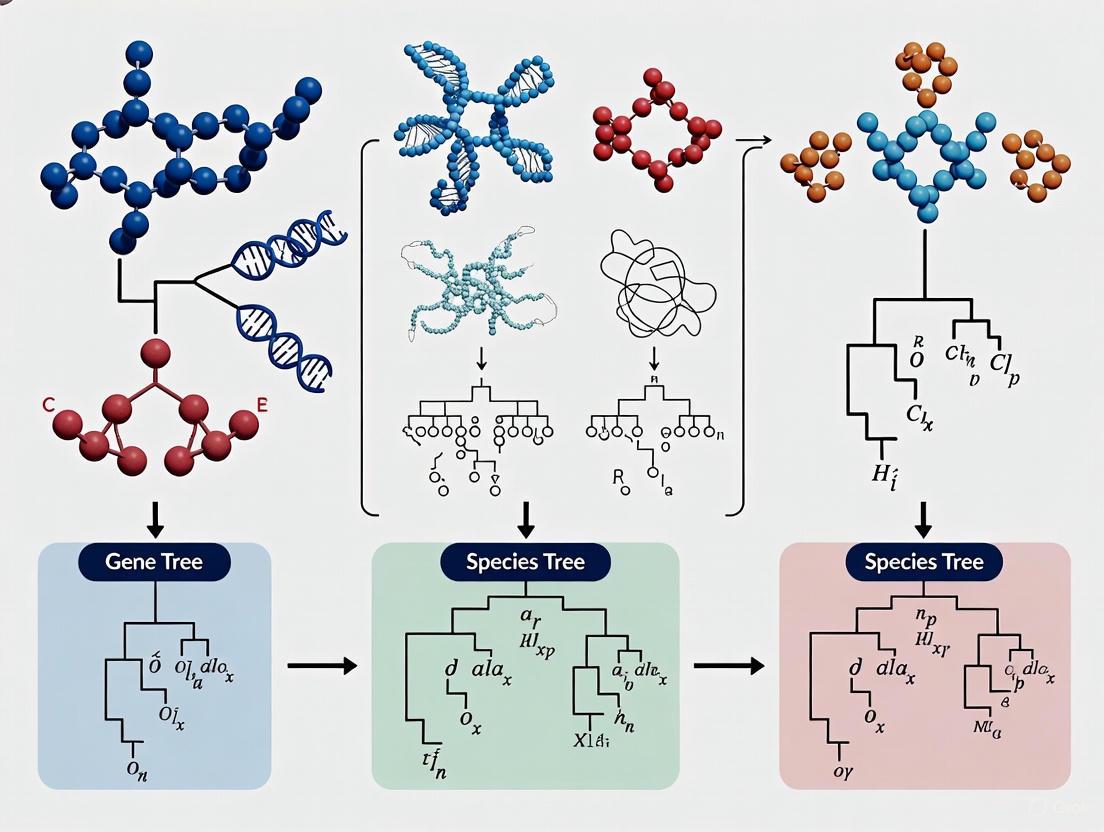
This article provides a comprehensive overview of gene tree-species tree discordance, a central challenge in modern phylogenomics.
Gene Tree-Species Tree Discordance: Causes, Methods, and Solutions for Evolutionary Genomics
Abstract
This article provides a comprehensive overview of gene tree-species tree discordance, a central challenge in modern phylogenomics. We explore the fundamental biological causes of this incongruence, including incomplete lineage sorting (ILS), hybridization, and gene flow, which are prevalent across diverse taxa from plants to Drosophila. The piece details state-of-the-art methodological approaches for species tree inference, such as coalescent-based models and network analyses, that account for these discordant signals. Furthermore, we present a practical workflow for troubleshooting high-conflict scenarios, common in rapid radiations, and evaluate strategies for validating phylogenetic hypotheses. Aimed at researchers and scientists, this synthesis equips readers with the knowledge to accurately interpret complex evolutionary histories from genomic data, a critical foundation for fields like comparative genomics and drug discovery.
Unraveling the Sources of Phylogenetic Conflict: ILS, Hybridization, and Beyond
Defining Gene Tree Discordance and Its Impact on the Tree of Life
Gene tree discordance, the phenomenon where gene trees inferred from different genomic regions display conflicting evolutionary histories, presents a fundamental challenge and opportunity in modern phylogenomics. This discordance, far from being mere analytical noise, captures the complex biological processes shaping genome evolution. As genomic data sets expand, researchers are moving beyond simply estimating a single species tree to instead investigating the patterns and causes of conflicting genealogical signals across the genome. Understanding these discordances is crucial for researchers and drug development professionals who rely on accurate evolutionary frameworks to identify legitimate taxonomic groups, understand trait evolution, and identify genetic resources. This guide provides a comparative examination of how different biological processes and analytical approaches contribute to our understanding of gene tree discordance, equipping scientists with the methodological framework needed to navigate this complex landscape.
What is Gene Tree Discordance?
Gene tree discordance occurs when phylogenetic trees reconstructed from different DNA sequences contradict each other or the species tree. Rather than reflecting simple estimation error, such discordance often captures meaningful biological complexity. The primary biological processes generating these conflicts include incomplete lineage sorting (ILS), gene flow (hybridization/introgression), and gene duplication and loss [1] [2].
Under the multispecies coalescent model, ILS occurs when genetic lineages from successive speciation events fail to coalesce, causing ancestral polymorphisms to persist through multiple branching events [3] [4]. This creates a situation where gene trees may reflect historical relationships that differ from the species divergence pattern. The surprising consequence is that for species trees with five or more taxa, the most likely gene tree topology may differ from the species tree topology under certain branch length conditions—a phenomenon termed anomalous gene trees [4].
Meanwhile, gene flow between diverging populations or species through hybridization leads to different genomic regions inheriting conflicting phylogenetic histories due to introgression [2] [5]. The third major process, gene duplication and loss, creates discordance through the birth and death of gene copies across the genome, potentially leading to hidden paralogy if undetected [1].
Table 1: Relative Contributions to Gene Tree Discordance in Fagaceae
| Source | Contribution (%) | Description |
|---|---|---|
| Gene Tree Estimation Error | 21.19% | Incorrect gene trees inferred due to limited phylogenetic signal or model misspecification |
| Incomplete Lineage Sorting | 9.84% | Stochastic deep coalescence in rapidly diverging lineages |
| Gene Flow | 7.76% | Introgression between related species through hybridization |
| Other/Uncharacterized | 61.21% | Includes hidden paralogy, recombination, and additional analytical artifacts |
Recent research in Fagaceae provides one of the first quantitative decompositions of these factors, revealing that while biological processes contribute significantly, analytical challenges represent the largest identifiable source of conflict [5]. This decomposition highlights the critical importance of distinguishing biological from technical sources of discordance in phylogenomic studies.
Table 2: Characteristics of Genes with Consistent vs. Conflicting Signals
| Characteristic | Consistent Genes | Inconsistent Genes |
|---|---|---|
| Percentage of Data Set | 58.1-59.5% | 40.5-41.9% |
| Phylogenetic Signal | Stronger | Weaker |
| Recovery of Species Tree | More likely | Less likely |
| Sequence/Tree Characteristics | No significant difference | No significant difference |
Notably, studies have found that excluding inconsistent genes—those displaying strongly conflicting phylogenetic signals—can significantly reduce disagreements between concatenation- and coalescent-based approaches, suggesting a path toward more robust species tree estimation [5].
Experimental Protocols for Dissecting Discordance
Multimethod Phylogenetic Interference Framework
To effectively tease apart alternative sources of gene tree conflict, researchers have developed integrated analytical workflows that combine evidence from multiple approaches:
Data Acquisition and Orthology Determination: Generate transcriptomic or genomic data, followed by careful orthology inference to minimize hidden paralogy [2]. For the Amaranthaceae study, this involved 88 transcriptomes and 7 reference genomes across 13 subfamilies.
Gene Tree Estimation: Reconstruct individual gene trees using standard phylogenetic methods, assessing support values and potential sources of error [2] [5].
Species Tree and Network Analyses: Apply both concatenation and coalescent-based species tree methods alongside phylogenetic network approaches that simultaneously account for ILS and hybridization [2].
Tests for Introgression: Implement site pattern-based statistics (e.g., D-statistics) and phylogenetic invariants to detect signatures of gene flow between lineages [2] [5].
Topology Testing and Coalescent Simulations: Compare alternative species tree hypotheses using statistical tests and simulate gene trees under coalescent models to assess the expected distribution of discordance under ILS alone [2].
Synteny and Additional Genomic Analyses: Examine genomic context and collinearity to identify potential structural variations contributing to discordance [2].
This multifaceted approach was successfully applied in Amaranthaceae s.l., where researchers tested hypotheses of ancient hybridization by distinguishing introgression signals from other sources of conflict [2]. Similarly, in Fagaceae, this framework revealed that cytoplasmic and nuclear genomes told conflicting stories, with chloroplast and mitochondrial data dividing species into New World and Old World clades, while nuclear data supported different relationships—patterns best explained by ancient interspecific hybridization [5].
Visualizing Experimental Workflow
Diagram 1: Experimental workflow for analyzing gene tree discordance, showing the multi-step process from data collection to biological interpretation.
Table 3: Key Research Reagents and Computational Tools for Discordance Research
| Tool/Resource | Function | Application Example |
|---|---|---|
| Whole Genomes/Transcriptomes | Provides comprehensive locus sampling across lineages | Tinamou study used 80 whole genomes across all 46 species [6] |
| Reference Genomes | Anchor for orthology assessment and synteny analysis | Amaranthaceae study used 7 reference genomes across subfamilies [2] |
| Coalescent-Based Species Tree Methods | Estimates species trees accommodating ILS | Used in Fagaceae to account for stochastic lineage sorting [5] |
| Phylogenetic Network Methods | Models both ILS and hybridization simultaneously | TESTED alternative hybridization hypotheses in Amaranthaceae [2] |
| Site Pattern Tests (D-statistics) | Detects introgression based on allele patterns | Identified gene flow in Fagaceae and tinamous [2] [6] |
| Orthology Inference Tools | Distinguishes orthologs from paralogs | Critical step in data processing to avoid hidden paralogy [2] |
Biological Implications and Research Applications
The implications of gene tree discordance extend throughout evolutionary biology and comparative genomics. Different types of genes and genomic regions experience distinct evolutionary histories, creating a mosaic genome where evolutionary relationships vary across chromosomal segments. This recognition has fundamentally changed how we conceptualize species relationships, moving from strictly bifurcating trees to evolutionary networks that better capture complex histories [2].
For drug discovery professionals, these insights are particularly valuable when studying gene families involved in bioactive compound synthesis or disease resistance. Genes transferring between lineages through introgression can rapidly spread adaptive traits, including those with pharmacological relevance. Understanding these patterns helps researchers identify evolutionary innovations and track the movement of functionally important genetic elements across taxa.
In conservation genetics, recognizing discordance patterns is essential for defining legitimate species boundaries and understanding historical demography. The tinamou bird study exemplifies how whole-genome analyses can reveal both phylogenetic relationships and pervasive introgression patterns, informing conservation prioritization [6].
Gene tree discordance represents both a challenge and an opportunity for evolutionary biologists. While complicating species tree inference, the patterns of discordance across genomes provide valuable insights into the evolutionary forces that have shaped species histories. Successful navigation of this complex landscape requires:
- Methodological pluralism - employing multiple complementary approaches to tease apart different sources of conflict [2]
- Biological realism - developing models that incorporate multiple processes simultaneously [1]
- Data quality awareness - recognizing and mitigating analytical artifacts that can mimic biological signals [5]
As phylogenomic data sets continue to grow in both size and taxonomic breadth, researchers are increasingly equipped to distinguish meaningful biological discordance from analytical artifacts. This progression promises not only more accurate species trees but also deeper insights into the complex evolutionary processes that have generated the remarkable diversity of life.
Incomplete Lineage Sorting (ILS) represents a fundamental evolutionary phenomenon in population genetics that causes discordance between gene trees and species trees. This discordance arises when ancestral genetic polymorphisms persist through multiple speciation events and become randomly sorted across descendant lineages [7]. Unlike complete lineage sorting, where all gene copies coalesce more recently than the speciation event, ILS occurs when gene coalescence precedes speciation events, creating topological conflicts that complicate phylogenetic inference [7] [8]. The probability of ILS increases when speciation events occur rapidly relative to population size, preventing ancestral polymorphisms from fully sorting into distinct lineages [7] [9].
The persistence of ancestral polymorphism through ILS has profound implications for understanding evolutionary relationships, particularly in rapidly diversifying lineages. When creating phylogenetic trees based on single or limited genetic markers, researchers risk reconstructing gene histories that do not reflect the true species relationships [7]. This biological reality, rather than methodological error, can create persistent challenges for phylogenetic reconstruction and requires specialized analytical approaches to distinguish from other sources of discordance like hybridization or horizontal gene transfer [7] [5]. The phenomenon of ILS is widespread across the tree of life, with documented cases in primates, marsupials, plants, and viruses, making it a critical consideration for evolutionary biologists and geneticists [7] [9].
Mechanisms and Theoretical Framework: How ILS Creates Discordance
The Population Genetic Basis of ILS
The core mechanism of ILS operates through the retention and stochastic sorting of ancestral polymorphisms across successive speciation events. In a typical scenario, an ancestral population contains multiple alleles at a given locus. When a speciation event occurs, each daughter species inherits a sample of these alleles. If the time between speciation events is too short for any single allele to become fixed in a population (a process taking approximately 4Ne generations for diploid organisms), then polymorphisms will persist through subsequent speciation events [7] [8]. This creates a situation where the coalescence of gene copies traces back to a common ancestor that predates the most recent speciation event.
The mathematical probability of ILS is directly influenced by population parameters and timing of speciation events. The probability that two lineages fail to coalesce in a population of effective size Ne over a time period t is approximately e^(-t/Ne). When successive speciation events occur rapidly (short t intervals) in large populations (large Ne), the probability of ILS increases substantially [7]. This explains why ILS is particularly prevalent in lineages that have undergone adaptive radiations or rapid diversification, where multiple speciation events occur in quick succession [9] [8].
Visualizing the ILS Mechanism
The following diagram illustrates the fundamental mechanism of incomplete lineage sorting and how it creates discordance between gene trees and species trees:
This diagram illustrates the core problem: the species tree shows species B and C as most closely related, but the gene tree constructed from the G locus shows species A and B as most closely related due to the persistence and stochastic sorting of ancestral polymorphisms (G0 and G1 alleles) through multiple speciation events [7].
Phylogenetic discordance can arise from multiple biological processes, and distinguishing among them is crucial for accurate evolutionary inference. The following table compares ILS with other major sources of gene tree-species tree discordance:
Table 1: Comparative Analysis of Gene Tree Discordance Mechanisms
| Mechanism | Basis of Discordance | Typical Impact | Detection Methods | Biological Context |
|---|---|---|---|---|
| Incomplete Lineage Sorting (ILS) | Stochastic sorting of ancestral polymorphisms during rapid speciation [7] | Genome-wide, random distribution of discordant signals [8] | Coalescent-based methods (ASTRAL, MP-EST), site pattern frequencies [10] [11] | Rapid radiations, large ancestral populations [9] |
| Introgression/Hybridization | Transfer of genetic material between separately evolving lineages [5] | Localized, non-random genomic regions showing excess affinity [5] | D-statistics, branch-length tests, phylogenetic network methods [8] [5] | Secondary contact, hybrid zones, closely related species [5] |
| Gene Duplication and Loss | Creation of paralogs via duplication and subsequent loss of copies [12] | Gene tree-species tree incongruence due to paralogy [12] | Reconciliation methods, synteny analysis, gene tree pruning [10] [12] | Gene families, whole genome duplications [10] |
| Horizontal Gene Transfer | Lateral movement of genetic material between distantly related organisms | Isolated transfer events creating outlier gene histories | Compositional methods, phylogenetic incongruence, donor-recipient signals | Most common in microbes, occasionally in multicellular eukaryotes |
Distinguishing ILS from Introgression
While both ILS and introgression can produce similar patterns of phylogenetic discordance, they originate from fundamentally different evolutionary processes. ILS represents the failure to coalesce due to preserved ancestral variation, creating discordance that is generally distributed randomly across the genome [8]. In contrast, introgression results from post-speciation gene flow, which typically affects specific genomic regions through selective processes or chance, creating localized signals of excess allele sharing between non-sister taxa [5].
Empirical studies in Fagaceae have quantified the relative contributions of different discordance sources, finding that gene tree estimation error accounted for 21.19% of variation, ILS for 9.84%, and gene flow for 7.76% [5]. This demonstrates that multiple processes often operate simultaneously, requiring sophisticated analytical approaches for disentanglement.
Empirical Evidence and Case Studies: ILS Across the Tree of Life
Primate Evolution and Human Origins
Research on great apes and hominids has revealed extensive ILS, particularly in the branching patterns of humans, chimpanzees, and gorillas. Genomic analyses show that approximately 23% of alignments from the Hominidae family contradict the established sister relationship between humans and chimpanzees, primarily due to ILS during their rapid diversification [7]. This discordance reflects ancestral polymorphisms that persisted through the speciation process, creating a complex mosaic of genealogical histories across the genome.
Notably, studies of bonobos and chimpanzees reveal that 1.6% of the bonobo genome shows closer affinity to human homologs than to chimpanzee sequences, despite the sister relationship between bonobos and chimpanzees [7]. This pattern exemplifies how ILS can create regions of the genome where non-sister species appear more closely related due to shared ancestral polymorphisms rather than recent gene flow.
Marsupial Phylogeny and Morphological Evolution
A landmark study on marsupials demonstrated both the prevalence and phenotypic consequences of ILS. Genomic analyses revealed that the South American monito del monte represents the sister lineage to all Australian marsupials, yet over 31% of its genome shows closer affinity to Diprotodontia (a group including kangaroos and koalas) than to other Australian marsupial groups [9]. This extensive discordance resulted from ILS during an ancient radiation approximately 60 million years ago.
Crucially, this research provided empirical evidence that ILS can affect phenotypic evolution through hemiplasy - where traits that appear homologous actually arose independently in non-sister lineages due to shared ancestral genetic variation. The study identified hundreds of genes that experienced stochastic fixation during ILS, encoding identical amino acids in non-sister species, and confirmed through functional experiments that ILS directly contributed to incongruent morphological traits among extant marsupials [9].
Plant Evolution and Phylogenetic Conflict
Research on the oak family (Fagaceae) illustrates how ILS interacts with other discordance sources in plant systems. Phylogenomic analyses of 90 Fagaceae species revealed substantial conflict between cytoplasmic (chloroplast and mitochondrial) and nuclear gene trees [5]. While cytoplasmic discordance primarily resulted from ancient hybridization, nuclear gene tree variation was attributed to a combination of ILS (9.84%), gene flow (7.76%), and gene tree estimation error (21.19%) [5].
Studies on Aspidistra plants in Taiwan further demonstrate ILS in action, with phylogenetic analyses revealing substantial ILS despite a well-supported species tree. Approximately 20.8% of genes supported alternative topologies, with evidence of convergent evolution in photosynthesis-related genes creating additional complexity [8]. This highlights how natural selection can interact with ILS to produce conflicting phylogenetic signals.
Methodological Approaches: Detecting and Accounting for ILS
Species Tree Estimation Methods
Modern phylogenomics has developed sophisticated analytical frameworks to account for ILS when inferring species trees. The following table compares major approaches for species tree estimation in the presence of ILS:
Table 2: Comparative Analysis of Species Tree Estimation Methods Addressing ILS
| Method | Theoretical Basis | ILS Modeling | Data Requirements | Scalability | Key Applications |
|---|---|---|---|---|---|
| CASTLES-Pro | Coalescent-based branch length estimation [10] | Accounts for ILS and gene duplication/loss [10] | Single-copy or multi-copy gene trees [10] | Thousands of species/genes [10] | Branch length estimation in substitution units [10] |
| ASTRAL Family | Quartet-based summary method [10] | Statistical consistency under ILS [10] | Gene tree topologies [10] | High (thousands of taxa) [10] | Species tree topology estimation [11] |
| *BEAST | Full multi-species coalescent [11] | Explicit coalescent process [11] | Sequence alignments or gene trees [11] | Moderate (limited by computation) [11] | Species tree with divergence times [11] |
| MP-EST/STAR | Summary statistics [11] | Coalescent-based [11] | Gene tree topologies [11] | High [11] | Species tree from gene trees [11] |
Experimental and Computational Workflow
The following diagram illustrates a comprehensive workflow for detecting and analyzing ILS in phylogenomic studies:
Table 3: Essential Research Reagents and Computational Tools for ILS Research
| Tool/Category | Specific Examples | Function in ILS Research | Key Applications |
|---|---|---|---|
| Sequencing Technologies | Illumina, PacBio, Oxford Nanopore | Generate genomic/transcriptomic data for multiple individuals and species [9] [8] | Whole genome sequencing, transcriptome sequencing, targeted capture [9] |
| Alignment Tools | MAFFT, MUSCLE, PRANK | Create multiple sequence alignments for orthologous loci [11] | Preprocessing for phylogenetic analysis [11] |
| Gene Tree Estimation | RAxML, IQ-TREE, MrBayes | Infer phylogenetic trees for individual genes/loci [5] [11] | Generating input gene trees for species tree methods [11] |
| Species Tree Methods | ASTRAL, MP-EST, STAR, *BEAST | Estimate species trees accounting for ILS [10] [11] | Primary species tree inference from multi-locus data [11] |
| Discordance Analysis | Dsuite, PhyloNet, HyDe | Detect and quantify introgression versus ILS [8] [5] | Distinguishing among discordance sources [5] |
| Coalescent Simulation | MS, SIMCOAL, SLiM | Simulate genomic data under evolutionary scenarios | Method validation, power analysis [11] |
Implications for Drug Development and Biomedical Research
While the direct connection between ILS and pharmaceutical development may not be immediately apparent, understanding this evolutionary phenomenon has significant implications for drug development professionals, particularly those working with animal models and comparative genomics.
In primate research, the extensive ILS documented in hominid genomes [7] informs our understanding of genetic variation in animal models and its potential impact on drug response. When specific genetic variants associated with drug metabolism or disease susceptibility show discordant phylogenetic patterns due to ILS, this knowledge helps researchers select appropriate model systems and interpret cross-species comparisons more accurately.
Furthermore, the demonstration that ILS can directly affect phenotypic evolution through hemiplasy [9] suggests that some apparently conserved traits across non-sister species might reflect shared ancestral polymorphisms rather than independent adaptations. This distinction is crucial when extrapolating physiological or metabolic responses from model organisms to humans in pharmaceutical research.
The methodological advances driven by ILS research, particularly coalescent-based approaches for analyzing genomic data [10], also provide powerful tools for studying the evolution of pathogens and cancer lineages, where phylogenetic relationships are often complicated by rapid diversification and persistent polymorphisms.
In phylogenomics, a fundamental assumption has been that the most frequently observed gene tree topology represents the true species evolutionary history. The Anomalous Gene Tree (AGT) problem challenges this assumption by demonstrating that under certain conditions, gene trees with topologies different from the species tree can be more probable than congruent gene trees [4]. This counterintuitive phenomenon occurs due to the stochastic nature of lineage sorting during speciation, particularly when internal branches of the species tree are short and external branches are long [13]. First formally characterized by Degnan and Rosenberg in 2006, AGTs present a serious obstacle for species tree inference, rendering the "democratic vote" procedure of using the most common gene tree topology statistically inconsistent and potentially positively misleading [4]. As researchers increasingly rely on phylogenomic approaches, understanding and addressing the AGT problem has become essential for accurate evolutionary inference.
Understanding the Mechanisms Behind AGT
The Coalescent Model and Lineage Sorting
The AGT phenomenon is rooted in the coalescent process, which models the genealogy of genetic lineages within a population framework. Under this model, gene lineages moving backward in time eventually coalesce to common ancestors, with coalescence events being equiprobable for each pair of lineages [4]. When speciation events occur in rapid succession (creating short internal branches in the species tree), gene lineages may not have sufficient time to coalesce within the population where they originated. Consequently, coalescence events may occur deeper in the species tree, potentially producing gene trees that differ from the species topology [13] [4].
The probability of AGTs is directly influenced by effective population size (θ) and branch lengths in the species tree. As θ approaches 0, gene trees will match the species tree with probability close to 1, as all genetic lineages coalesce rapidly. However, as θ increases (representing larger population sizes), a greater proportion of gene trees become incongruent with the species tree due to increased lineage sorting [13].
The Anomaly Zone
The anomaly zone is defined as the set of species tree branch length parameters for which at least one anomalous gene tree exists [4]. Research has established that:
- AGT cannot occur with 3 taxa - the most likely gene tree always matches the species tree [4]
- AGT becomes possible with 4 or more taxa - anomalous gene trees can emerge when internal branches are sufficiently short [13] [4]
- All species trees with 5 or more taxa can produce AGTs given specific branch length conditions [13]
For a 4-taxon asymmetric species tree with topology (((AB)C)D), let x represent the length of the deeper internal branch and y the length of the shallower internal branch. The species tree produces [4]:
- 0 AGTs if y ≥ a(x)
- 1 AGT if b(x) ≤ y < a(x)
- 3 AGTs if y < b(x)
Table: Conditions for AGT in 4-Taxon Asymmetric Species Trees
| Number of AGTs | Branch Length Condition | Probability Relationship |
|---|---|---|
| 0 AGTs | y ≥ a(x) | f(x,y) ≥ h(x,y) |
| 1 AGT | b(x) ≤ y < a(x) | g(x,y) ≤ f(x,y) < h(x,y) |
| 3 AGTs | y < b(x) | f(x,y) < g(x,y) |
Where f(x,y) = probability of topology (((AB)C)D), g(x,y) and h(x,y) = probabilities of symmetric topologies
Figure 1: Mechanism of AGT Formation. Short internal branches combined with large effective population size promote deep coalescence, leading to AGTs.
Comparative Analysis of Species Tree Inference Methods
Traditional Approaches and Their Limitations
Traditional species tree reconstruction methods often rely on consensus techniques that assume the most common gene tree represents the true species relationship. These approaches become problematic in the anomaly zone, where they can be positively misleading [4].
Majority Rule Extended (MRe) Consensus: This method extends beyond the 50% majority rule to resolve polytomies, but its performance deteriorates in the presence of AGTs. Simulation studies show that while MRe benefits from increasing numbers of genes with low θ-values, it shows little improvement with very large numbers of loci when θ is large and AGTs are prevalent [13].
Concatenation Approaches: Combining all sequence data into a single "supermatrix" for phylogenetic analysis can also produce misleading results in the presence of lineage sorting. AGTs can cause concatenation methods to converge on an incorrect species tree as more data are added [13].
AGT-Robust Methods
Triple Construction Method (TCM): This approach leverages the observation that rooted three-taxon trees (triplets) do not exhibit AGTs [13] [4]. The method involves:
- Estimating individual gene trees using traditional phylogenetic methods
- Extracting all rooted three-taxon trees from each gene tree
- Taking the most frequently occurring triplets as species triplet trees
- Combining the rooted triples to produce a species tree using quartet-based heuristics
TCM outperforms MRe consensus, particularly with larger θ-values and increasing numbers of genes [13].
Coalescent-Based Model Methods: These methods explicitly model the coalescent process to estimate species trees and parameters simultaneously [13]. While theoretically powerful, they face computational challenges with large numbers of taxa and loci, and require careful consideration of model assumptions such as constant population size [13].
Table: Performance Comparison of Species Tree Methods in AGT Conditions
| Method | Theoretical Basis | Handles AGT? | Computational Scalability | Key Limitations |
|---|---|---|---|---|
| Majority Rule (MRe) | Democratic vote | No | High | Positively misleading in anomaly zone |
| Concatenation | Supermatrix analysis | No | High | Incorrect with high lineage sorting |
| TCM | Rooted triples | Yes | Moderate | Information loss from full gene trees |
| Full Coalescent | Coalescent model | Yes | Low (large datasets) | Model assumptions, computational demands |
Simulation Studies and Performance Metrics
Simulation studies under the coalescent model provide critical insights into method performance. Using species trees generated from a Yule process with varying θ-values and dataset sizes (10-10,000 loci), researchers have demonstrated:
- With small θ-values (minimal lineage sorting), both TCM and MRe perform well with sufficient data
- As θ increases, TCM maintains or improves accuracy with more genes, while MRe shows limited improvement
- With very large numbers of genes, TCM continues to benefit from additional data, while MRe plateaus due to AGT influence [13]
These findings confirm the asymptotic performance advantage of AGT-robust methods like TCM in challenging phylogenetic scenarios.
Experimental Protocols for AGT Research
Standard Simulation Framework
Species Tree Generation:
- Simulate species trees under a Yule process with specified birth rate (e.g., birth rate = 5) [13]
- Alternatively, use predefined species tree topologies with controlled branch lengths
Gene Tree Simulation:
- Generate gene trees from species trees using coalescent model simulations [13] [4]
- Parameterize by θ (population size parameter) to control degree of lineage sorting
- For each species tree, simulate multiple independent gene trees (typically 10-10,000) [13]
Method Evaluation:
- Apply multiple species tree inference methods to simulated gene trees
- Compare reconstructed trees to true species tree topology
- Report proportion of correct reconstructions across multiple replicates
Empirical Data Analysis Protocol
When applying AGT detection methods to empirical data:
Data Collection and Gene Tree Estimation:
- Collect sequence alignments from multiple genomic loci
- Estimate individual gene trees using maximum likelihood or Bayesian methods [13]
- For phylogenomic datasets, extract low-copy nuclear genes from transcriptomes or genomes [2]
Gene Tree Discordance Analysis:
- Examine gene-tree discordance using coalescent-based species trees and network inference [2]
- Apply site pattern tests of introgression and topology tests [2]
- Conduct synteny analyses where applicable [2]
AGT Detection:
- Compare gene tree frequencies to identify potential AGTs
- Test whether frequently observed topologies differ from coalescent expectations
- Use TCM to reconstruct species tree from rooted triples [13]
Figure 2: Experimental Workflow for AGT Detection in Phylogenomic Studies
Case Study: AGT Analysis in Amaranthaceae
A comprehensive study of the plant family Amaranthaceae s.l. illustrates the practical challenges of detecting AGTs in empirical data [2]. Researchers employed a phylotranscriptomic approach combining reference genomes with transcriptome data to test hypotheses of ancient hybridization.
Experimental Design:
- Sampled 92 ingroup species representing 53 genera across 13 subfamilies
- Combined 88 newly generated transcriptomes with 4 available genomes
- Generated thousands of low-copy nuclear genes for analysis
Methodological Approach:
- Examined gene-tree discordance using multiple approaches
- Applied site pattern tests for introgression
- Conducted topology tests and synteny analyses
- Performed simulations to assess potential sources of conflict
Key Findings:
- High levels of gene tree discordance were found at deep nodes
- Three consecutive short internal branches produced anomalous trees
- Multiple processes (ILS, hybridization, estimation error) contributed to discordance
- The rapid ancient radiation made resolution difficult despite extensive data
This case highlights the importance of using multiple approaches to disentangle sources of conflict in phylogenomic analyses, particularly for ancient, rapid radiations where AGTs are likely [2].
Table: Key Research Tools for AGT Studies
| Tool/Resource | Function | Application Context |
|---|---|---|
| Coalescent Simulators | Simulate gene trees under coalescent model | Method testing, power analysis |
| ASTRAL | Species tree inference from gene trees | Coalescent-based estimation |
| PhyML/RAxML | Maximum likelihood gene tree estimation | Gene tree reconstruction |
| TCM Implementation | Triple-based species tree reconstruction | AGT-robust inference |
| Bootstrap Analysis | Assess support for phylogenetic relationships | Method validation |
Computational Tools:
- Coalescent simulators (e.g., MS, SIMCOAL) for generating gene trees under the coalescent process
- Species tree inference packages (e.g., ASTRAL, MP-EST, STAR) for coalescent-based estimation
- Gene tree estimation software (e.g., PhyML, RAxML, MrBayes) for reconstructing individual gene trees
- Discordance analysis tools for detecting and quantifying gene tree conflict
Analytical Approaches:
- Branch support metrics (bootstrap, aLRT) for identifying dubiously resolved gene tree branches [14]
- Branch-collapsing methods to address arbitrary resolution in gene trees [14]
- Network inference methods to detect hybridization signals [2]
- Topology testing frameworks for comparing alternative phylogenetic hypotheses
Future Directions and Research Opportunities
Methodological Advancements
Current research priorities in AGT methodology include:
- Developing methods that simultaneously model multiple sources of conflict (ILS, hybridization, gene duplication/loss) [2]
- Creating more computationally efficient coalescent-based approaches for large genomic datasets
- Improving gene tree estimation accuracy to reduce error propagation to species trees [14]
- Extending AGT theory to models beyond the standard coalescent, such as gene duplication and loss models [15]
Future work must better integrate AGT detection with analysis of other discordance sources:
- Hybridization and introgression: Developing methods to distinguish ILS from hybridization signals [2]
- Gene duplication and loss: Extending AGT theory to models incorporating gene family evolution [15]
- Model misspecification: Accounting for heterogeneity in molecular evolutionary processes
- Orthology inference: Improving detection of true orthologs to reduce paralogy confounding
The Anomalous Gene Tree problem represents a fundamental challenge for phylogenomic inference, demonstrating that the most likely gene tree topology may not match the species tree under certain conditions. Research has established that AGTs exist for species trees with four or more taxa when internal branches are sufficiently short, creating "anomaly zones" where traditional consensus methods become statistically inconsistent. The Triple Construction Method and other AGT-robust approaches provide promising solutions by leveraging the theoretical property that rooted three-taxon trees are immune to AGTs. As phylogenomic datasets continue to grow in size and complexity, recognizing and accounting for the AGT problem will remain essential for accurate reconstruction of evolutionary relationships. Future methodological developments that integrate multiple sources of gene tree discordance will further enhance our ability to infer species trees reliably across the tree of life.
Gene Flow and Hybridization as Drivers of Cytonuclear Discordance
Cytonuclear discordance, the incongruence between evolutionary histories inferred from mitochondrial (mtDNA) and nuclear (nuDNA) genomes, is a widespread phenomenon that challenges accurate reconstruction of species relationships [16] [17]. This discordance obscures species boundaries and complicate phylogenetic estimates, with implications for understanding evolutionary trajectories and biodiversity patterns [17]. While multiple processes can contribute to such discordance, gene flow and hybridization represent crucial drivers that can systematically create mismatches between cytoplasmic and nuclear genealogies [5] [16] [17].
The prevalence of phylogenomic data has revealed that cytonuclear discordance is far more common than previously appreciated, occurring across diverse taxa including plants, birds, mammals, and insects [5] [16] [18]. This guide compares the primary biological mechanisms and analytical approaches for investigating hybridization-driven discordance, providing researchers with a framework for evaluating conflicting phylogenetic signals within their study systems.
Comparative Analysis of Discordance Mechanisms
Biological Processes Driving Discordance
Table 1: Biological Mechanisms Contributing to Cytonuclear Discordance
| Mechanism | Key Characteristics | Taxonomic Examples | Genetic Signature |
|---|---|---|---|
| Ancient Introgression | Past hybridization with backcrossing, often following secondary contact | Fagaceae oaks, Iberian scorpions (Buthus) [5] [17] | Regional mtDNA haplotype replacement with nuclear admixture gradients |
| Range Expansion-Mediated Introgression | Neutral demographic process during colonization; local genes introgress into invading taxon | Otospermophilus ground squirrels [16] | Asymmetric discordance with sex-biased patterns |
| Incomplete Lineage Sorting (ILS) | Deep coalescence of ancestral polymorphisms during rapid speciation | Asian Lappula plants, Cavitaves birds [18] [19] | Random distribution of discordance across phylogeny |
| Mitochondrial Capture | Complete replacement of one mitochondrial lineage by another through hybridization | Iberian scorpions, fire salamanders [17] | Full mitogenome discordance with minimal nuclear introgression |
Relative Contributions to Gene Tree Variation
Recent research has quantified the proportional contributions of different factors to phylogenetic discordance. In the Fagaceae family, decomposition analyses revealed that gene tree estimation error accounted for 21.19% of gene tree variation, while incomplete lineage sorting contributed 9.84%, and gene flow was responsible for 7.76% of observed discordance [5]. This study further classified genes into two categories: approximately 58.1-59.5% were "consistent genes" with strong phylogenetic signals supporting the species tree, while 40.5-41.9% were "inconsistent genes" with conflicting signals [5].
Experimental Approaches for Detection and Analysis
Genomic Data Collection and Processing
Table 2: Essential Research Reagents and Analytical Tools
| Category | Specific Tools/Reagents | Primary Function | Key Considerations |
|---|---|---|---|
| DNA Extraction & Sequencing | Qiagen DNeasy Blood & Tissue kits [16] [17] | High-quality DNA isolation from tissue samples | Critical for degraded samples from museum specimens |
| Mitogenome Assembly | GetOrganelle [5] | De novo organelle genome assembly | Optimized for mitochondrial and chloroplast genomes |
| Sequence Alignment & Mapping | BWA [5], Bowtie2 [5] | Read mapping to reference genomes | Mapping quality thresholds essential for SNP calling |
| Variant Calling | GATK HaplotypeCaller [5] | SNP and indel identification | Filtering for depth, quality, and removal of heterozygotes (mtDNA) |
| Phylogenetic Reconstruction | IQ-TREE [5], MrBayes [5], BPP [20] | Species tree and gene tree estimation | Concatenation vs. coalescent approaches; model selection critical |
| Introgression Detection | HyDe [19], SNaQ [20], BPP [20] | Test for hybridization signals | Varying power to detect directionality and sister-lineage gene flow |
Methodological Workflows
The following workflow diagram illustrates a standardized pipeline for detecting and analyzing cytonuclear discordance:
Mitochondrial Genome Assembly Protocol
The Fagaceae study provides a detailed protocol for mitochondrial genome assembly and analysis [5]:
- Extract Illumina reads and assemble mitochondrial genome using GetOrganelle v1.7.1
- Filter contigs by depth (<25× discarded) and length (<100 bp discarded) to eliminate nuclear contamination
- Improve assembly by realigning reads to contigs using Bowtie2, then reassemble with Unicycler
- Annotate final mitochondrial genome using IPMGA online tool to identify functional genes
- Call mitochondrial SNPs by mapping 3 million randomly sampled paired-end reads per individual using BWA
- Filter SNPs using GATK with quality thresholds (base quality ≥30, mapping quality ≥30) and depth filters (10-300×)
- Exclude heterozygotes and blast mitochondrial genome against nuclear and chloroplast genomes to remove transferred sequences (identity ≥95%, length ≥150 bp)
Analytical Framework Comparison
Method Performance in Detecting Gene Flow
Table 3: Comparison of Analytical Methods for Detecting Gene Flow
| Method | Statistical Approach | Power to Detect Sister-Taxon Gene Flow | Directionality Inference | Key Limitations |
|---|---|---|---|---|
| Summary Methods (HyDe, SNaQ) | Site patterns/gene tree frequencies [20] | Low/None [20] | No [20] | Limited to specific hybridization scenarios; sensitive to gene tree error |
| Full-Likelihood (BPP) | Multispecies coalescent with introgression [20] | High [20] | Yes [20] | Computationally intensive; requires specified introgression model |
| Quartet-Based (QS) | Quartet concordance across genome [5] | Moderate | Partial | May miss specific pairwise introgression events |
| Concatenation | Combined supermatrix analysis [5] | Variable (can be misled by ILS) | No | Assumes shared evolutionary history; violates with ILS/gene flow |
A comparative analysis of Drosophila data revealed strikingly different conclusions depending on methodological approach. Summary methods (DCT, BLT) applied by Suvorov et al. (2022) detected widespread introgression but failed to identify gene flow between sister lineages and could not determine directionality [20]. In contrast, reanalysis using the full-likelihood BPP program detected strong signatures of sister-lineage introgression while rejecting several previously inferred gene-flow events [20]. Simulation studies confirmed BPP's superior power and accuracy in estimating introgression rates, highlighting how methodological choice directly impacts biological interpretation [20].
Biological Context and Evolutionary Implications
Interplay of Mechanisms in Natural Systems
The following diagram illustrates how multiple biological processes interact to produce cytonuclear discordance:
Taxonomic and Ecological Patterns
Cytonuclear discordance manifests differently across taxonomic groups and ecological contexts. In Iberian Buthus scorpions, complex topography and glacial history created repeated cycles of isolation and secondary contact, facilitating mitochondrial capture events that obscured true species relationships [17]. For Otospermophilus ground squirrels, range instability during Pleistocene climate fluctuations caused contrasting patterns: stable northern populations maintained cytonuclear concordance, while southern expanding populations experienced mitochondrial introgression into nuclear backgrounds [16]. In plants like Fagaceae oaks and Asian Lappula, hybridization appears to play a crucial role in diversification, with significant gene tree discordance resulting from both ILS and hybridization [5] [19].
Gene flow and hybridization represent fundamental drivers of cytonuclear discordance across diverse taxonomic groups. The methodological framework presented here enables researchers to distinguish between biological and analytical sources of phylogenetic conflict, with important implications for species delimitation and understanding evolutionary history. As genomic datasets expand, integration of multiple evidence types—morphological, ecological, and molecular—will be essential for accurately reconstructing evolutionary trajectories in groups with complex histories of divergence and gene flow.
The phylogenetic relationships within the Drosophila melanogaster species subgroup have long been a subject of scientific controversy, with different studies supporting conflicting evolutionary histories. This case study examines the widespread gene tree-species tree discordance observed in this group, focusing on the evidence for incomplete lineage sorting (ILS) as a primary mechanism. The analysis is particularly relevant for researchers investigating rapid evolutionary radiations where short internal branches in species trees can lead to extensive phylogenetic incongruence across the genome.
Quantitative Evidence of Phylogenetic Discordance
Genome-wide analyses of multiple Drosophila species reveal substantial phylogenetic conflict across different types of molecular characters. The table below summarizes the support for three possible species tree topologies based on various data types from comparative genomic studies [21] [22].
Table 1: Genome-Wide Support for Alternative Species Tree Topologies in Drosophila
| Molecular Character | Tree 1 Support (Dere,Dyak) | Tree 2 Support (Dmel,Dere) | Tree 3 Support (Dmel,Dyak) |
|---|---|---|---|
| Amino acid substitutions | 53.8% | 26.9% | 19.2% |
| Nucleotide substitutions | 50.9% | 28.0% | 21.1% |
| Insertion/Deletion events | 46.6% | 32.8% | 20.7% |
| Maximum likelihood gene trees | 43.0% | 32.0% | 25.0% |
Though Tree 1 (grouping D. erecta and D. yakuba as sister species) receives the strongest support across all character types, the substantial support for alternative topologies (26.9-32.8% for Tree 2 and 19.2-25.0% for Tree 3) demonstrates pervasive phylogenetic incongruence [21]. This pattern is statistically significant and robust to model and species choice, indicating a biological rather than methodological phenomenon [21] [22].
Experimental Protocols for Discordance Analysis
Genomic Annotation and Orthology Prediction
The foundational methodology for these phylogenetic analyses involved comparative annotation across seven fully sequenced species in the subgenus Sophophora [21] [22]. The experimental workflow proceeded through these key steps:
Reference Gene Mapping: 19,186 D. melanogaster (Dmel) coding sequences were mapped to potential orthologous regions in each target species using TBLASTN.
Gene Model Construction: GeneWise was employed to build gene models based on the Dmel gene structure in each identified genomic region.
Orthology Verification: These GeneWise models were matched back to Dmel translations using BLASTP to identify clear orthologs for downstream analysis.
Sequence Alignment: Peptide sequences from verified orthologs were aligned using TCoffee, with cDNA alignments mapped onto the peptide alignments.
This pipeline identified 9,405 genes with clear orthologs across D. melanogaster, D. erecta, D. yakuba, and D. ananassae (as outgroup), providing the comprehensive dataset for phylogenetic analysis [21].
Phylogenetic Inference Methods
Researchers employed multiple complementary approaches to assess phylogenetic support [21] [22]:
Character-Based Support Counting: Direct enumeration of amino acid substitutions, nucleotide substitutions, and indel events informative for each possible tree topology.
Maximum Likelihood Gene Trees: Partitioned genome-wide analysis using maximum likelihood methods implemented with complex models of sequence evolution.
Spatial Clustering Analysis: Assessment of whether substitutions supporting the same tree were clustered in genomic regions with low recombination.
Lineage Sorting Tests: Evaluation of whether incongruence patterns matched predictions under the coalescent model with short speciation intervals.
Diagram 1: Phylogenomic analysis workflow for detecting gene tree discordance.
Mechanisms of Discordance: Incomplete Lineage Sorting
Theoretical Framework
Incomplete lineage sorting occurs when genetic polymorphisms persist through successive speciation events, leading to discordance between gene trees and species trees. This phenomenon is particularly pronounced during rapid evolutionary radiations where the time between speciation events is shorter than the coalescence time for ancestral polymorphisms [21] [22].
The Drosophila data supports ILS as the primary mechanism through several consistent patterns [21]:
Temporal Plausibility: The branch separating the split of D. melanogaster from the split of D. erecta and D. yakuba is sufficiently short that incomplete lineage sorting is mathematically plausible under coalescent theory.
Spatial Clustering: Substitutions supporting the same tree are spatially clustered in the genome, with adjacent genes supporting the same tree most often in regions of low recombination.
Linkage Disequilibrium Scale: The enrichment of substitutions supporting the same tree occurs on roughly the same scale as linkage disequilibrium estimates, consistent with lineage sorting predictions.
Diagram 2: Incomplete lineage sorting mechanism creating phylogenetic discordance.
Alternative Mechanisms: Introgression
While ILS appears dominant in the D. melanogaster species complex, recent phylogenomic analyses across 155 Drosophila genomes reveal that introgression has also played a substantial role in Drosophila evolution more broadly [23]. Key findings include:
- Widespread Gene Flow: Evidence of both phylogenetically deep and recent introgression events across multiple Drosophila clades
- Complementary Detection: Conservative detection methods based on discordant gene tree counts and branch lengths
- Reticulate Evolution: The evolutionary history of Drosophila involves both divergence and post-divergence gene flow
This broader context indicates that multiple mechanisms—including both ILS and introgression—can contribute to phylogenetic discordance in Drosophila, with their relative importance varying across different evolutionary timescales and species groups [23].
The Scientist's Toolkit: Research Reagent Solutions
Table 2: Essential Research Resources for Phylogenomic Discordance Studies
| Resource Category | Specific Tools/Species | Research Application |
|---|---|---|
| Reference Genomes | D. melanogaster, D. erecta, D. yakuba, D. ananassae | Foundation for comparative genomics and orthology prediction |
| Alignment Software | TCoffee | Multiple sequence alignment of orthologous genes |
| Gene Prediction | GeneWise | Construction of gene models in non-annotated genomes |
| Tree Inference | Maximum Likelihood algorithms | Gene tree estimation with complex evolutionary models |
| Orthology Detection | TBLASTN, BLASTP | Identification of corresponding genes across species |
Implications for Comparative Genomics
The widespread discordance observed in Drosophila has significant implications for comparative genomics research [21] [22]:
Methodological Development: Accurate phylogenetic inference requires methods that account for incomplete lineage sorting and can infer the correct species tree despite widespread gene tree conflict.
Genome History Mapping: Understanding the history of every base in the genome, not just the species tree, is essential for fully leveraging comparative genomics datasets.
Comparative Method Adaptation: Comparative methods must control for and/or utilize information about phylogenetic incongruence to avoid biased inferences about evolutionary processes.
These findings are particularly relevant for researchers studying rapid evolutionary radiations across diverse taxa, where similar patterns of widespread discordance likely occur due to the same population genetic processes that affect Drosophila phylogenies [21].
The case of widespread phylogenetic discordance in the D. melanogaster species complex provides a powerful example of how rapid evolutionary radiations can leave complex genomic signatures. The evidence supports incomplete lineage sorting resulting from short time intervals between speciation events as the primary mechanism, though gene flow also contributes to discordance patterns across the Drosophila phylogeny. These findings underscore the necessity of approaches that can distinguish between alternative causes of phylogenetic conflict and accurately reconstruct evolutionary history despite widespread gene tree variation.
Distinguishing Biological Conflict from Analytical Artifacts
In the field of phylogenomics, a fundamental challenge is the widespread observation that gene trees—evolutionary histories inferred from individual genes—often conflict with each other and with the hypothesized species tree. This phenomenon, known as gene tree discordance, presents a significant obstacle to reconstructing the true evolutionary history of species. Discordance can arise from two primary categories of sources: genuine biological conflicts and analytical artifacts introduced during the research process. Biological conflicts result from actual evolutionary processes such as incomplete lineage sorting (ILS), hybridization, and gene flow, where the evolutionary history genuinely varies across the genome. In contrast, analytical artifacts emerge from methodological limitations, including gene tree estimation error (GTEE) caused by factors like insufficient phylogenetic signal or model misspecification. Understanding and distinguishing between these sources is crucial for researchers, scientists, and drug development professionals who rely on accurate evolutionary relationships to inform their work, from target identification to understanding disease evolution.
Biological Conflicts
Biological conflicts represent true differences in evolutionary history across genomic regions, primarily driven by three key processes:
Incomplete Lineage Sorting (ILS): This occurs when ancestral genetic polymorphisms persist through multiple speciation events and are randomly sorted in descendant lineages. During rapid radiations, where speciation events occur in quick succession, ancient polymorphisms may coalesce (find a common ancestor) more recently with non-sister species than with sister species, creating genuine gene tree conflicts that do not match the species tree [5]. ILS is particularly common during rapid speciation events where insufficient time has elapsed for alleles to coalesce.
Gene Flow and Hybridization: Interspecific hybridization allows genes to move between species, leading to conflicting phylogenetic signals. Different genomic regions may exhibit evolutionary histories that reflect these hybridization events rather than the primary species divergence. A notable example is cytoplasmic-nuclear discordance, where organellar genomes (chloroplast and mitochondrial) tell a different evolutionary story than nuclear genomes due to past hybridization and chloroplast capture events [5]. Gene flow creates a heterogeneous landscape of introgression across the genome, shaped by natural selection, recombination rates, and gene density [5].
Gene Duplication and Loss: While less emphasized in the provided studies, gene families that undergo duplication and subsequent loss in different lineages can also contribute to gene tree discordance, as the history of the gene copies may not match the species history.
Analytical Artifacts
Analytical artifacts are methodological rather than biological in nature, arising from limitations in data quality or analytical methods:
Gene Tree Estimation Error (GTEE): This error occurs when the inferred gene tree does not reflect the true evolutionary history of the gene due to methodological limitations. GTEE can result from insufficient phylogenetic signal (e.g., short gene sequences or limited accumulation of substitutions during short speciation intervals), model misspecification in phylogenetic analyses, or alignment errors [5]. The distribution of phylogenetic signal across sites significantly impacts the reliability of inferred trees.
Systematic Biases: These include issues such as compositional heterogeneity, heterotachy (site-specific rate variation), and other factors that violate the assumptions of phylogenetic models, potentially leading to incorrect tree inference.
Reference Bias in Genomic Analyses: As seen in the Fagaceae study, mapping reads to a reference genome from a non-representative species can introduce biases, particularly for divergent lineages, resulting in higher missing data rates and potentially skewed phylogenetic signals [5].
Table 1: Key Characteristics of Discordance Sources
| Feature | Biological Conflicts | Analytical Artifacts |
|---|---|---|
| Primary Causes | Incomplete Lineage Sorting (ILS), hybridization, gene flow | Gene Tree Estimation Error (GTEE), model misspecification, limited signal |
| Genomic Distribution | Heterogeneous, often clustered in specific regions | More random, associated with low-information sites or genes |
| Expected Support Values | Generally high support for alternative topologies | Often characterized by low bootstrap support or posterior probabilities |
| Potential Resolution | Requires model-based approaches (e.g., multispecies coalescent) | Improved with better data quality, model selection, or increased sequencing depth |
| Biological Meaning | Reflects true evolutionary processes | Lacks biological meaning, represents methodological limitation |
Recent phylogenomic studies have attempted to quantify the relative contributions of different factors to gene tree discordance. The 2025 Fagaceae study provides particularly insightful data, employing decomposition analysis to partition the sources of variation among nuclear gene trees [5].
Table 2: Quantitative Contributions to Gene Tree Discordance in Fagaceae
| Source of Discordance | Percentage Contribution | Description |
|---|---|---|
| Gene Tree Estimation Error (GTEE) | 21.19% | Error generated during data analyses due to limited signal or model misspecification |
| Incomplete Lineage Sorting (ILS) | 9.84% | Random sorting of ancestral polymorphisms during rapid speciation |
| Gene Flow | 7.76% | Introgression and hybridization between species |
| Consistent Phylogenetic Signals | 58.1-59.5% | Genes exhibiting consistent phylogenetic signals ("consistent genes") |
| Conflicting Phylogenetic Signals | 40.5-41.9% | Genes displaying conflicting signals ("inconsistent genes") |
The Fagaceae research revealed that consistent genes—those exhibiting stable phylogenetic signals—showed stronger phylogenetic signals and were more likely to recover the species tree topology than inconsistent genes. However, the study notably found that consistent and inconsistent genes did not significantly differ in terms of sequence- and tree-based characteristics, making them difficult to distinguish without detailed analysis [5].
This quantitative framework demonstrates that analytical artifacts (GTEE) can constitute a substantial portion of observed discordance, even exceeding biological factors in some cases. By excluding a subset of inconsistent genes, the Fagaceae study significantly reduced inconsistencies between concatenation- and coalescent-based approaches, highlighting the importance of identifying and addressing analytical artifacts [5].
Supporting evidence comes from tinamou birds (Aves: Tinamidae), where whole-genome analyses identified "pervasive genome-wide introgression" contributing to species-tree discordance [6]. The distribution of introgression across the genome was dependent on the assumed phylogeny applied to the f-branch model, illustrating how analytical decisions can interact with biological signals.
Experimental Protocols for Discrimination
Genome Sequencing and Assembly
The foundation for discriminating biological conflicts from artifacts lies in robust genome sequencing and assembly protocols. The Fagaceae study employed:
Mitochondrial Genome Assembly: For mtDNA data, researchers used GetOrganelle v1.7.1 with depth filtering (<25× coverage) to eliminate nuclear genome contamination. Short contigs (<100 bp) were discarded, and the initial 25 contigs were refined by realigning Illumina reads using Bowtie2, followed by extraction of relevant reads with SAMtools and final assembly with Unicycler [5]. The completed mitochondrial genome of Castanopsis eyrei spanned 568,352 bp across four scaffolds.
SNP Calling and Filtering: For mitochondrial SNP calling, three million paired-end reads per individual were mapped to the reference mitochondrial genome using BWA v0.7.17. SNPs were called using "HaplotypeCaller" in GATK v4.2, with filtering for minimum base quality score (Q30) and minimum mapping quality (Q30). SNPs with extremely high (>300) or low (<10) depth were removed, and all heterozygous sites were excluded (as plant mitochondrial genomes are haploid) [5].
Contamination Exclusion: To mitigate nuclear and chloroplast-derived sequences in mitochondrial analyses, the assembled mitochondrial genome was blasted against nuclear and chloroplast genomes using BLASTN (E-value < 1E−5). Fragments with ≥95% identity and length ≥150 bp were excluded as potential contamination [5].
Phylogenetic Analysis Methods
Discriminating conflict sources requires multiple phylogenetic approaches:
Concatenation vs. Coalescent Methods: Researchers should employ both concatenation-based methods (combining all gene alignments into a supermatrix) and coalescent-based methods (accounting for ILS) to infer species trees. Significant differences in results between these approaches can indicate biological conflicts like ILS [5].
Maximum Likelihood and Bayesian Inference: For mitochondrial data, the Fagaceae study used IQ-TREE v2.3.6 for Maximum Likelihood analysis (with 1000 bootstrap replicates) and MrBayes v3.2.6 for Bayesian inference (with 10 million generations MCMC runs) [5]. Comparison of results from these methods helps identify robust nodes versus those potentially affected by analytical artifacts.
Data Type Comparisons: Analyzing different genomic regions (nuclear, chloroplast, mitochondrial) can reveal biological conflicts. In Fagaceae, cpDNA and mtDNA divided species into New World and Old World clades, sharply contrasting with nuclear genome relationships—a pattern suggesting ancient interspecific hybridization [5].
Diagram 1: Experimental workflow for distinguishing discordance sources.
Visualization of Biological Conflict Mechanisms
Understanding the mechanisms behind biological conflicts is essential for proper interpretation of gene tree discordance. The following diagram illustrates how incomplete lineage sorting and hybridization create conflicting phylogenetic signals across the genome.
Diagram 2: Biological conflict mechanisms creating gene tree discordance.
The Scientist's Toolkit: Essential Research Reagents and Materials
Successfully discriminating biological conflicts from analytical artifacts requires specific computational tools and analytical frameworks. The following table details essential resources mentioned in the cited research.
Table 3: Research Reagent Solutions for Discordance Analysis
| Tool/Resource | Function | Application Context |
|---|---|---|
| GetOrganelle | Genome assembly of organellar genomes | Used for assembling mitochondrial genome from Illumina reads [5] |
| BWA | Read mapping to reference genome | Mapping sequencing reads to reference genomes for variant calling [5] |
| GATK | Variant discovery and genotyping | SNP calling with "HaplotypeCaller" function [5] |
| IQ-TREE | Maximum likelihood phylogenetic inference | Phylogenetic analysis with model selection and branch support [5] |
| MrBayes | Bayesian phylogenetic inference | Bayesian MCMC methods for phylogenetic reconstruction [5] |
| SAMtools | Processing alignment files | Sorting and manipulating sequence alignment files [5] |
| BUSCO | Assessment of genome completeness | Benchmarking Universal Single-Copy Orthologs for data quality [6] |
| Ultraconserved Elements (UCEs) | Phylogenomic markers | Targeted sequencing for phylogenetic studies [6] |
| KEGG Pathway Database | Canonical pathway information | Source of manually confirmed human pathways for conflict analysis [24] |
| f-branch model | Detection of introgression | Quantifying introgression for genomic windows [6] |
Analytical Framework for Discordance Investigation
A systematic approach to investigating gene tree discordance involves multiple steps designed to distinguish biological conflicts from analytical artifacts. The following workflow provides a structured methodology for researchers tackling this challenge.
Diagram 3: Analytical framework for investigating discordance sources.
Distinguishing biological conflict from analytical artifacts in gene tree discordance research requires a multifaceted approach combining rigorous data generation, multiple analytical methods, and careful interpretation of conflicting signals. The quantitative findings from recent studies indicate that both biological processes (ILS, gene flow) and analytical artifacts (GTEE) contribute substantially to observed discordance, with their relative importance varying across biological systems. By implementing the experimental protocols, analytical frameworks, and toolkits outlined in this guide, researchers can more accurately reconstruct evolutionary histories, leading to more reliable insights for fundamental evolutionary biology and applied drug development research. The field continues to evolve with advancements in sequencing technologies and analytical methods, promising ever more refined discrimination between true biological conflicts and methodological artifacts in phylogenomic studies.
Phylogenomic Toolkits: From Multispecies Coalescent to Phylogenetic Networks
The Multispecies Coalescent (MSC) Process is a stochastic process model that describes the genealogical relationships of DNA sequences sampled from several species, representing the application of coalescent theory to multiple species. [25] This model provides the primary theoretical framework for understanding Incomplete Lineage Sorting (ILS), a fundamental evolutionary process and a major cause of gene tree-species tree discordance. [26] Under the MSC, the genealogical relationships for an individual gene (the gene tree) can differ from the broader history of the species (the species tree), creating challenges for phylogenetic inference and having important implications for understanding genome evolution. [25]
The MSC serves as a null model in phylogenomics - to be considered before invoking more complex processes like hybridization, lateral gene transfer, or gene duplication and loss. [27] This framework not only enables inference of species phylogenies but also provides methods for estimating species divergence times, population sizes of ancestral species, species delimitation, and cross-species gene flow. [25] Understanding the MSC is particularly crucial for researchers investigating evolutionary histories marked by rapid diversification, where ILS is prevalent.
Theoretical Foundations of the Multispecies Coalescent
Core Model Assumptions and Parameters
The basic multispecies coalescent model operates under several key assumptions: the species phylogeny is known and fixed; complete isolation occurs after species divergence with no migration, hybridization, or introgression; and no recombination occurs so that all sites within a locus share the same gene tree. [25] These assumptions can be relaxed in extended models to accommodate phenomena such as migration, population size changes, and recombination.
The parameters in the MSC model include:
- Divergence times (τ): Time in generations between speciation events
- Population sizes (θ): Effective population size parameters, where θ = 4Nₑμ for diploid organisms (Nₑ is effective population size, μ is mutation rate per site per generation) [25]
For a simple rooted three-taxon tree, the probability that a gene tree will be congruent with the species tree is given by: P(congruence) = 1 - (2/3)exp(-T) = 1 - (2/3)exp(-t/2Nₑ) where T is the branch length in coalescent units, also written as t/2Nₑ (t being number of generations). [25]
Mathematical Framework of Gene Tree Distributions
The MSC model provides the probability distribution of gene trees (both topology and coalescent times) given a species tree. The joint distribution f(Tᵢ, tᵢ|Θ) for a gene tree within a population depends on the number of lineages and time to coalescence events. [25] For a population with m lineages reduced to n lineages over time τ, the coalescence times tⱼ for j = m, m-1, ..., n+1 follow a probability density function:
f(tⱼ) = [j(j-1)/2] × (2/θ) × exp{-[j(j-1)/2] × (2/θ) × tⱼ}
The probability of no coalescence events over a time interval is modeled as an exponential decay process with rate λ = n(n-1)/θ. [25] When a coalescent event occurs in a sample of j lineages, the probability of a particular pair coalescing is 1/((j \choose 2)) = 2/j(j-1).
Table 1: Key Parameters in the Multispecies Coalescent Model
| Parameter | Symbol | Description | Biological Significance |
|---|---|---|---|
| Effective population size | Nₑ, θ | Genetic diversity parameter | Determines rate of coalescence; θ = 4Nₑμ |
| Divergence time | τ, t | Time between speciation events | Measured in generations; affects ILS probability |
| Coalescent unit | T | Branch length scaled by population size | T = t/2Nₑ; determines discordance probability |
| Gene tree topology | G | Evolutionary history of a gene | May differ from species tree due to ILS |
| Species tree topology | S | Evolutionary history of species | The true phylogenetic relationships being inferred |
Quantitative Assessment of Gene Tree Discordance
Probability of Discordance in Rooted Triple Trees
For the simplest non-trivial case of a rooted three-taxon tree, there are three possible species tree topologies but four distinct gene trees when coalescent times are considered. [25] The type 1 tree occurs when alleles in species A and B coalesce after the speciation event that separated the A-B lineage from C, while the type 2 tree occurs when this coalescence happens before the speciation event (deep coalescence). Type 1 and type 2 gene trees are congruent with the species tree, while the other two gene trees represent discordant deep coalescence trees.
The probability distribution of rooted triple topologies under the MSC follows specific formulas. For species A, B, and C with topology ((A,B),C), where x = ℓᵥ/Nᵥ is the internal branch length in coalescent units:
P(((A,B),C)) = 1 - (2/3)e⁻ˣ P(((A,C),B)) = (1/3)e⁻ˣ P(((B,C),A)) = (1/3)e⁻ˣ
This demonstrates that as the internal branch length decreases (approaching 0), the probability of congruence approaches 1/3, meaning all three topologies become equally likely. [25] [27]
The Anomaly Zone and Statistical Inconsistency
A critical concept in MSC theory is the anomaly zone - regions of species tree parameter space where a discordant gene tree topology has higher probability than the topology matching the species tree. [26] This occurs primarily when internal branches of the species tree are very short, creating conditions where ILS is extreme.
Research has demonstrated that concatenation methods, including concatenated parsimony, can be statistically inconsistent under the MSC for certain tree sizes and parameter ranges. While concatenated parsimony is consistent for the rooted 4-taxa case under an infinite-sites mutation model, it shows regions of statistical inconsistency for rooted 5+ taxa cases and unrooted 6+ taxa cases. [26] This inconsistency persists even when homoplasy is negligible, challenging the reliability of parsimony-based approaches under the MSC.
Table 2: Gene Tree Discordance Probabilities for Different Tree Configurations
| Tree Size | Probability of Congruence | Primary Factors | Consistency of Concatenated Parsimony |
|---|---|---|---|
| Rooted 3-taxa | 1 - (2/3)exp(-T) | Internal branch length | Consistent |
| Rooted 4-taxa | Complex function of branch lengths | Multiple internal branches | Consistent across parameter space [26] |
| Rooted 5+-taxa | Complex function of branch lengths | Anomaly zone conditions | Inconsistent in some parameter regions [26] |
| Unrooted 6+-taxa | Complex function of branch lengths | Anomaly zone conditions | Inconsistent in some parameter regions [26] |
Experimental Framework for MSC Analysis
Standardized Testing of MSC Simulators
With the proliferation of MSC-based analysis tools, testing the validity of MSC simulators has become crucial. Specialized methods have been developed to check whether collections of gene trees align with the MSC model on a given species tree. [27] These tests examine both topological and metric properties of gene tree samples.
The MSCsimtester package implements validation approaches based on:
- Pairwise distance distributions: Comparing empirical distributions of pairwise distances on gene trees to theoretical expectations
- Rooted triple counts: Examining frequencies of rooted triple topologies on gene trees against predicted probabilities [27]
Application of these tests to popular simulators revealed that several produce flawed samples. From five well-known simulators evaluated (SimPhy, Phybase, Hybrid-Lambda, Mesquite, and DendroPy), only SimPhy and DendroPy initially produced valid samples under the MSC. [27] This highlights the importance of rigorous validation in phylogenomic workflows.
Workflow for Phylogenomic Analysis Under MSC
Research Reagent Solutions for MSC Studies
Table 3: Essential Research Tools for MSC-based Phylogenomic Studies
| Tool/Resource | Type | Primary Function | Application Context |
|---|---|---|---|
| Whole-genome sequencing | Data generation | Comprehensive variant detection | Genome-wide ILS assessment [6] |
| Ultraconserved Elements (UCEs) | Genomic markers | Phylogenetically informative regions | Target capture for divergent taxa [6] |
| BUSCO genes | Genomic markers | Universal single-copy orthologs | Species tree inference [6] |
| MSCsimtester | Validation package | Simulator verification | Testing MSC compliance [27] |
| ASTRAL | Software tool | Species tree estimation | Coalescent-based consensus [26] |
| IQ-TREE | Software tool | Maximum likelihood phylogenetics | Gene tree estimation [5] |
| BWA/GATK | Bioinformatics tools | Read mapping & variant calling | SNP identification [5] |
Empirical Case Studies in MSC Analysis
Tinamou Bird Diversification
A comprehensive study of tinamous (Aves: Tinamidae) using 80 whole-genomes from all 46 recognized species demonstrated the power of MSC-based approaches. [6] Researchers compared coding (BUSCO) and ultraconserved element (UCE) loci, along with sex-linked and autosomal markers, to reconstruct tinamou phylogeny. The analysis revealed:
- Tinamous diverged from their sister-group, the extinct moas, 50-60 million years ago
- Crown group diversification occurred approximately 30-40 million years ago
- Constant diversification rates persisted until the present
- Only one clade in genus Crypturellus displayed substantial species-tree discordance
- Pervasive genome-wide introgression was identified through f-branch analysis [6]
This study provided the most complete tinamou phylogeny to date and identified a previously unrecognized species, showcasing MSC methods for species-level phylogenomic analysis.
Oak Family (Fagaceae) Phylogenomics
Research on Fagaceae investigated sources of phylogenetic discordance across three genomes (nuclear, chloroplast, and mitochondrial). [5] The study revealed:
- Highly supported but conflicting topologies between cytoplasmic and nuclear genomes
- Chloroplast DNA (cpDNA) and mitochondrial DNA (mtDNA) divided species into New World and Old World clades, contrasting with nuclear data
- Ancient interspecific hybridization as the primary cause of cytoplasmic-nuclear discordance
- Decomposition analysis quantified contributions to gene tree variation:
- Gene tree estimation error: 21.19%
- Incomplete lineage sorting: 9.84%
- Gene flow: 7.76% [5]
The study identified that 58.1-59.5% of genes exhibited consistent phylogenetic signals, while 40.5-41.9% showed conflicting signals. Filtering inconsistent genes significantly reduced conflicts between concatenation- and coalescent-based approaches.
Primate Phylogenetics
The great ape phylogeny (humans, chimpanzees, gorillas, and orangutans) provides a classic example for MSC parameterization. For topology (((H,C),G),O), the parameters include:
Θ = {θH, θC, θHC, θHCG, θHCGO, τHC, τHCG, τHCGO}
where θ represents population size parameters and τ represents divergence times. [25] The probability density of gene genealogies follows the MSC distribution across successive populations, with specific coalescence probabilities dictating expected gene tree patterns.
Table 4: Relative Contributions to Gene Tree Discordance in Empirical Studies
| Biological Process | Tinamous (Aves) | Oaks (Fagaceae) | Analytical Factors |
|---|---|---|---|
| Incomplete Lineage Sorting | Present but limited | 9.84% of variation | Gene tree estimation error: 21.19% [5] |
| Introgression/Hybridization | Pervasive genome-wide | 7.76% of variation | Model misspecification |
| Deep Coalescence | Detected in Crypturellus | Significant component | Limited phylogenetic signal |
| Cytoplasmic Capture | Not assessed | Primary cause of organellar-nuclear discordance | - |
| Anomaly Zone Effects | Possible in rapid diversification | Likely in rapid radiations | Statistical inconsistency |
Methodological Comparisons and Best Practices
Coalescent vs. Concatenation Approaches
A key methodological consideration in MSC-based phylogenetics is the choice between coalescent-based species tree methods and traditional concatenation approaches. Each has distinct strengths and limitations:
Coalescent-based methods (e.g., ASTRAL, MP-EST) explicitly account for ILS by modeling gene tree heterogeneity, providing statistical consistency under the MSC model. However, they can be sensitive to gene tree estimation error and typically require independent loci. [26]
Concatenation approaches combine all sequence data into a supermatrix, increasing phylogenetic signal but assuming a shared evolutionary history across genes. This assumption is violated under ILS and gene flow, potentially leading to inconsistent estimates, particularly in anomaly zones. [5] [26]
Recommendations for Phylogenomic Study Design
Based on empirical studies and theoretical developments, current best practices for MSC-based phylogenomics include:
- Genome-scale data: Utilize hundreds to thousands of loci to adequately sample genealogical history [6]
- Multiple inference methods: Apply both coalescent-based and concatenation approaches to assess robustness [5]
- Incongruence assessment: Systematically evaluate conflicts between gene trees and species trees [5]
- Model testing: Validate simulator implementations when conducting simulation studies [27]
- Biological realism: Consider multiple sources of discordance (ILS, introgression, estimation error) in interpretation [5]
The multispecies coalescent model has fundamentally transformed phylogenetics by providing a rigorous statistical framework for understanding and accounting for gene tree discordance. As phylogenomic datasets continue to grow in scale and taxonomic breadth, the MSC remains essential for reconstructing evolutionary history accurately, particularly for lineages with complex histories of rapid diversification and hybridization.
Coalescent-based Species Tree Methods (ASTRAL, MP-EST)
The reconstruction of species phylogenies has been fundamentally transformed by genomics, leading to the routine use of data from hundreds or thousands of genes. However, a critical challenge in phylogenomics is the frequent observation of gene tree discordance, where evolutionary histories conflict across different genomic regions [28] [29]. A major biological cause of this discord is incomplete lineage sorting (ILS), which occurs when ancestral genetic polymorphisms persist through successive speciation events [28] [30]. The multi-species coalescent (MSC) model provides a mathematical framework for modeling ILS, and coalescent-based species tree methods have been developed to estimate species trees from multi-locus data while accounting for this process [29] [31]. This guide focuses on two prominent coalescent-based methods—ASTRAL and MP-EST—objectively comparing their methodologies, statistical properties, and performance under various conditions as demonstrated in experimental studies.
The Multi-Species Coalescent Model and Species Tree Estimation
The MSC model describes the evolution of individual genes within a population-level species tree. A species tree (\mathcal{T} = (T,\Theta)) with topology (T) and branch lengths (\Theta) (in coalescent units) is given. This species tree parameterizes a probability distribution for a random variable (G(\mathcal{T})) over all possible gene trees. The generation of a random gene tree involves lineages growing backward in time through the species tree. At speciation events, lineages enter common populations where they may coalesce, with coalescence times following exponential distributions. The result is that gene trees can differ from each other and from the species tree topology, with the probability of discordance increasing as branch lengths (in coalescent units) decrease [31].
Both ASTRAL and MP-EST operate within a two-step summary method framework. First, gene trees are estimated independently from sequence data for each locus. Second, these gene trees are summarized into a species tree [28] [32]. This approach contrasts with concatenation (which combines all data into a single analysis) and co-estimation methods (which simultaneously estimate gene and species trees, e.g., *BEAST) [29]. Summary methods are generally more computationally scalable than co-estimation approaches, making them feasible for genome-scale datasets with hundreds to thousands of genes [28] [29].
Method Comparison: ASTRAL vs. MP-EST
Core Algorithms and Optimization Objectives
| Feature | ASTRAL | MP-EST |
|---|---|---|
| Input Tree Type | Unrooted gene trees [28] | Rooted gene trees [29] |
| Optimization Objective | Maximizes quartet agreement with input gene trees [28] [32] | Maximizes a pseudo-likelihood function based on rooted triplets [29] |
| Theoretical Basis | Quartets avoid the anomaly zone [28] | Rooted triplets avoid the anomaly zone [29] |
| Statistical Consistency | Consistent under MSC [28] [32] | Consistent under MSC [29] |
| Computational Complexity | Polynomial time [32] | Computationally intensive for large numbers of species [29] |
ASTRAL (Accurate Species TRee ALgorithm) seeks the species tree that shares the maximum number of induced quartet topologies with the input set of gene trees [28] [32]. It achieves this through a dynamic programming algorithm that searches trees constrained to a set of bipartitions, which helps make the problem tractable [28] [32].
MP-EST (Maximum Pseudo-likelihood for Estimating Species Trees) maximizes a pseudo-likelihood estimate based on the underlying distribution of rooted triplets (3-taxon trees) in the input gene trees [29]. It leverages the fact that for rooted three-taxon species trees, the most frequent gene tree topology matches the species tree topology (i.e., there is no anomaly zone) [29].
Performance Comparison Under Various Conditions
Accuracy and Scalability
Experimental studies consistently show that ASTRAL matches or surpasses MP-EST in accuracy across a range of simulated conditions. ASTRAL has been shown to be "more accurate than MP-EST" and other methods under many conditions [28], and more recent evaluations indicate that newer triplet-based methods like STELAR (which shares a similar optimization philosophy with ASTRAL but uses triplets) "match the accuracy of ASTRAL and improve on MP-EST" [29].
A key advantage of ASTRAL is its scalability. ASTRAL can handle datasets with "thousands of genes" [28] and has been scaled to up to 10,000 species [32], while MP-EST "cannot handle large dataset containing hundreds of species" [29]. This makes ASTRAL more suitable for contemporary phylogenomic studies with extensive taxonomic sampling.
Handling of Missing Data
Both methods have been evaluated under models of missing data, where not all genes are present in all species. Studies show that ASTRAL and other summary methods can maintain statistical consistency under certain taxon deletion models, specifically when the deletion process is independent and identically distributed (Miid model) or when all subsets of species have non-zero probability of being represented (Mfsc model) [31].
Empirical evaluations demonstrate that ASTRAL, ASTRID, and MP-EST "improved in accuracy as the number of genes increased and often produced highly accurate species trees even when the amount of missing data was large" [31]. This robustness is particularly valuable for empirical datasets where incomplete gene sequences are common.
Resistance to Gene Tree Estimation Error
Gene tree estimation error is a significant challenge for summary methods. Research suggests that weighted approaches that account for gene tree uncertainty can improve species tree estimation. For instance, weighting quartets based on their reliability (as in wASTRAL) "outperforms the unweighted version of ASTRAL on simulated data" [33]. Similarly, using distributions of gene trees from Bayesian sampling or bootstrapping, rather than single best-maximum likelihood trees, yields "far superior results" [33]. This suggests that the fundamental approaches of both ASTRAL and MP-EST can be enhanced by incorporating measures of uncertainty.
Experimental Protocols and Evaluation Metrics
Standard Simulation Framework
Evaluations of coalescent-based methods typically employ the following workflow to assess performance under controlled conditions:
Typical simulation parameters include:
- Species trees: Generated under birth-death processes with varying numbers of taxa (e.g., 8-500 species) [30]
- Branch lengths: Varied to control levels of ILS (shorter branches produce more ILS)
- Gene trees: Simulated under the MSC model using tools like SimPhy [30]
- Sequence data: Evolved along gene trees using substitution models (e.g., GTR) with varying sequence lengths to control gene tree estimation error [33] [31]
- Missing data: Incorporated under various models (e.g., i.i.d. missingness) [31]
Key Evaluation Metrics
| Metric | Description | Interpretation |
|---|---|---|
| Species Tree Error | RF distance (or similar) between true and estimated species tree | Lower values indicate better accuracy |
| Quartet/Triplet Score | Proportion of quartets (ASTRAL) or triplets (MP-EST) in true tree recovered by estimate | Higher values indicate better performance |
| Running Time | Computational time required | Practical consideration for large datasets |
| Support Values | Measures of reliability for branches (e.g., local posterior probabilities) | Higher values indicate more confident inferences |
Advanced Considerations and Emerging Methods
Handling Multi-Allele Datasets
Many species tree methods, including the original ASTRAL implementation, were designed for single individual per species. However, multi-allele datasets with multiple individuals per species can help account for polymorphisms in present-day species [30]. Extensions to ASTRAL now enable it to handle multi-individual data by naturally extending the quartet optimization problem, with performance comparisons to NJst (another method handling such data) showing comparable accuracy [30]. Interestingly, empirical studies suggest that "sampling more genes is more effective than sampling more individuals" for accuracy improvement [30].
Visualization and Diagnostic Tools
Quartet concordance factors—the frequencies of each of the three possible quartet topologies across genes—provide valuable insights into gene tree discordance [34]. Simplex plots (ternary plots) can visualize these concordance factors for all sets of four taxa in a single diagram, helping researchers assess whether observed discordance patterns fit MSC expectations or suggest more complex processes [34].
Emerging Methodological Developments
Recent research has explored weighted quartet approaches that assign confidence weights to quartets rather than treating them equally. Methods like wQFM that "leveraging all possible quartet topologies, along with their respective weights, yield better results compared to considering only the dominant quartet topologies" [33]. Additionally, triplet-based approaches like STELAR (Species Tree Estimation by maximizing tripLet AgReement) have been developed, showing accuracy matching ASTRAL while using rooted triplets instead of quartets [29].
| Tool/Resource | Function | Application Context |
|---|---|---|
| ASTRAL Software | Species tree estimation from unrooted gene trees via quartet amalgamation | Primary species tree inference [28] [32] |
| MP-EST Software | Species tree estimation from rooted gene trees via pseudo-likelihood | Comparative species tree inference [29] |
| SimPhy | Simulate species and gene trees under MSC | Method validation and benchmarking [30] |
| PAUP* | Phylogenetic analysis with SVDquartets implementation | Quartet-based species tree estimation [33] |
| R (with MSCquartets) | Analyze and visualize quartet concordance factors | Discordance diagnosis and model fit assessment [34] |
| RAxML | Maximum likelihood gene tree estimation | Gene tree inference step in pipeline [33] |
| MrBayes | Bayesian phylogenetic inference | Generate gene tree distributions for weighting [33] |
ASTRAL and MP-EST represent two important approaches to species tree estimation under the multi-species coalescent model. ASTRAL generally offers advantages in scalability and accuracy under conditions with moderate to high ILS, particularly for large datasets with hundreds or thousands of genes and taxa. Its ability to use unrooted gene trees also simplifies input requirements. MP-EST provides a statistically consistent alternative based on rooted triplets but faces computational limitations with increasing numbers of species.
The choice between these methods—or emerging alternatives like STELAR and weighted quartet approaches—should consider specific dataset characteristics, including taxonomic scope, expected ILS levels, gene tree estimation quality, and data completeness. As phylogenomic datasets continue growing in both gene and taxon sampling, methods with polynomial time complexity and demonstrated accuracy across diverse conditions, like ASTRAL, will remain essential tools for resolving deep evolutionary relationships in the presence of gene tree discordance.
In the endeavor to reconstruct the Tree of Life, phylogenomic analyses have become the standard for inferring evolutionary relationships. The supermatrix approach, or concatenation, where multiple gene sequences are combined into a single large data matrix for analysis, has been widely used due to its conceptual simplicity and perceived power [35]. However, this method carries a fundamental assumption—that all genes share a single, common genealogical history.
Increasingly, studies reveal that this assumption is frequently violated in nature, leading to significant misinterpretations of evolutionary history. This guide objectively compares the supermatrix approach with alternative methods, particularly those based on the multispecies coalescent, and details the specific conditions under which concatenation can produce misleading results, providing researchers with the data needed to select appropriate methodologies.
The Core Problem: Why Gene Trees Discord
A primary challenge in modern systematics is gene tree discordance—the widespread phenomenon where phylogenetic trees from different genes have conflicting topologies. The supermatrix approach essentially treats all sequence data as if it originated from a single evolutionary history, which can be an oversimplification.
The major biological processes and analytical issues causing this discordance are summarized below.
Table 1: Sources of Gene Tree Discordance and Their Impact on Phylogenetic Inference
| Source of Discordance | Description | Effect on Supermatrix Analysis |
|---|---|---|
| Incomplete Lineage Sorting (ILS) | The failure of gene lineages to coalesce in a species tree's ancestral population, leaving ancient polymorphisms to be randomly sorted into descendant species [2]. | Assumes a single tree history, potentially overestimating support for an incorrect species tree when ILS is high [36]. |
| Gene Flow (Hybridization/Introgression) | The transfer of genetic material between species through hybridization, leading to a mosaic of genealogies across the genome [5]. | Forces a single topology, which may not reflect the complex, reticulate history of the group, potentially creating a chimeric "consensus" tree [6]. |
| Gene Tree Estimation Error (GTEE) | Error in inferring individual gene trees due to factors like short sequence length, weak phylogenetic signal, or model misspecification [5]. | Amplifies errors by concatenating noisy data, which can be misinterpreted as a strong, but incorrect, phylogenetic signal [2]. |
Recent empirical studies have quantified the relative contributions of these factors. In the oak family (Fagaceae), gene tree estimation error was the largest source of variation (21.19%), followed by incomplete lineage sorting (9.84%) and gene flow (7.76%) [5]. In a rapid radiation of tinamous (Aves), researchers identified pervasive genome-wide introgression as a key driver of discordance [6]. These findings confirm that multiple processes often operate simultaneously, creating a perfect storm of conflict that misleads supermatrix methods.
When Concatenation Fails: Key Evidence from Comparative Studies
Simulation and empirical studies consistently demonstrate that the performance of concatenation is highly dependent on specific evolutionary parameters. Its pitfalls are most acute under certain conditions.
The Challenge of Short Internal Branches and Rapid Radiations
A primary weakness of the supermatrix approach is its handling of rapid speciation events, which result in short internal branches on the species tree. A seminal simulation study compared the fully Bayesian multispecies coalescent method, implemented in *BEAST, with concatenation across a range of branch lengths [36] [37]. The study found that the statistical performance of *BEAST relative to concatenation improved both as branch length was reduced and as the number of loci was increased [36]. In some cases, using *BEAST with only tens of loci was preferable to using concatenation with thousands of loci [36] [37].
Table 2: Statistical Performance of *BEAST vs. Concatenation Under Different Branch Length Scenarios
| Branch Length Scenario | Phylogenetic Context | Performance of Concatenation | Performance of *BEAST (MSC) |
|---|---|---|---|
| Short internal branches | Simulated rapid radiations; empirical example: Cyathophora plant clade (shallow) [36]. | Poor; inconsistent estimator, high error rate. | Superior; maintains high accuracy by modeling ILS. |
| Long internal branches | Simulated slow diversifications; empirical example: Primates (deep) [36]. | Good; generally accurate when ILS is low. | Accurate; but computational cost may not be justified. |
This demonstrates that concatenation is not a statistically consistent estimator of the species tree when gene tree heterogeneity exists, a finding supported by multiple studies [36] [37].
The Problem of Sparse Matrices and Uninformative Genes
Many phylogenomic studies, especially those involving non-model organisms, result in "sparse supermatrices" where data is missing for many genes in many taxa. A simulation study found that with matrices of 50 taxa × 50 genes and data coverage of only 10-30%, maximum likelihood tree reconstructions on the full supermatrix failed to recover the correct trees [38]. Simply selecting taxa and genes with high data coverage is suboptimal, as it ignores the phylogenetic signal of the data. Instead, a heuristic approach (implemented in the mare software) that selects optimal data subsets based on both data coverage and a measure of potential signal increased the chance of recovering correct trees more than tenfold [38].
Methodological Deep Dive: Experimental Protocols for Comparison
To objectively evaluate the pitfalls of concatenation, researchers rely on carefully designed simulation studies and robust analyses of empirical data.
Simulation-Based Comparison Protocol
A standard protocol for comparing species tree methods involves the following steps [36]:
- Species Tree Simulation: Generate a model species tree using a birth-death process (e.g., with speciation rate
λ=1and extinction rateμ=0.2). - Gene Tree Simulation: Simulate multiple gene trees within the species tree under the multispecies coalescent model using software like
biopy. Key parameters include the number of species (n), individuals per species (ni), loci (nl), and effective population size (Ne). - Sequence Simulation: Evolve DNA sequence alignments along each gene tree using a program like
Seq-Genunder a specified substitution model (e.g., HKY) and a strict molecular clock. - Phylogenetic Inference: Analyze the simulated sequence data using both the method under test (e.g., supermatrix concatenation) and alternative methods (e.g., *BEAST). For concatenation, all gene alignments are combined into a single supermatrix.
- Accuracy Assessment: Compare the estimated trees from each method to the known, simulated species tree. Accuracy is measured by the proportion of correct topologies recovered or the Robinson-Foulds distance to the true tree.
Empirical Data Analysis Workflow
For empirical data, a comprehensive analysis to tease apart sources of discordance, as seen in a 2025 study of Fagaceae, involves a multi-step process [5]:
- Data Collection: Assemble genomic data (e.g., nuclear loci, chloroplast genomes, mitochondrial genomes) for the taxon set.
- Separate Genome Analysis: Reconstruct phylogenies from each genome (nuclear, cpDNA, mtDNA) using both concatenation (Maximum Likelihood in IQ-TREE, Bayesian Inference in MrBayes) and coalescent-based methods (e.g., ASTRAL).
- Incongruence Detection: Identify strongly supported conflicts between the trees from different genomes, which may point to ancient hybridization (e.g., cytoplasmic-nuclear discordance).
- Variance Decomposition: Use statistical decomposition analyses to quantify the relative contributions of gene tree estimation error (GTEE), incomplete lineage sorting (ILS), and gene flow to the total gene tree variation.
- Signal Assessment: Classify genes as "consistent" or "inconsistent" based on their phylogenetic signals and evaluate the impact of filtering out inconsistent genes on the final species tree estimate.
The following workflow diagram summarizes this process for assessing method performance and sources of error.
The Scientist's Toolkit: Key Reagents and Computational Solutions
Successfully navigating phylogenetic discordance requires a suite of methodological tools and software.
Table 3: Essential Research Toolkit for Assessing Gene Tree Discordance
| Tool / Reagent | Type | Primary Function |
|---|---|---|
| IQ-TREE [5] | Software | Performs fast and efficient Maximum Likelihood phylogenetic analysis on concatenated supermatrices. |
| *BEAST [36] [37] | Software | A fully Bayesian implementation of the multispecies coalescent for co-estimating gene trees and the species tree. |
| ASTRAL [5] | Software | A "summary method" that estimates the species tree from a set of pre-estimated gene trees, accounting for ILS. |
| Seq-Gen [36] | Software | Simulates the evolution of DNA sequence alignments along a specified phylogenetic tree under a evolutionary model. |
| Phylogenomic Data | Reagent | Multi-locus sequence data (e.g., from transcriptomes, UCEs, RAD-seq); the raw material for analysis. |
| Reference Genomes [5] [2] | Reagent | High-quality genomes used for read mapping, orthology assessment, and evolutionary analyses. |
The supermatrix approach, while computationally efficient and powerful when gene tree heterogeneity is low, carries significant risks. Concatenation can mislead by overestimating support for an incorrect species tree in the face of substantial incomplete lineage sorting, gene flow, and gene tree estimation error—conditions now known to be common. For researchers, the key is to first assess the potential for discordance in their system and then choose a method fit for purpose. When studying rapid radiations or groups with a history of hybridization, coalescent-based methods like *BEAST, while computationally demanding, are statistically superior and necessary for producing robust, accurate evolutionary hypotheses.
Integrating Phylogenetic Networks to Model Hybridization and Introgression
The reconstruction of evolutionary history has long been rooted in the paradigm of bifurcating trees. However, the advent of phylogenomics has revealed widespread gene tree discordance—where gene trees inferred from different genomic regions display conflicting evolutionary histories—that cannot be adequately explained by tree-like models alone [39]. This recognition has propelled the development and application of phylogenetic networks, which incorporate reticulate branches to model evolutionary processes such as hybridization and introgression that create complex relationships beyond simple divergence [40]. For researchers and drug development professionals working with rapidly evolving pathogens or studying evolutionary relationships in recently diverged taxa, accurately modeling these processes is not merely theoretical—it directly impacts the identification of drug targets, understanding of host-pathogen coevolution, and tracing of transmission pathways.
The multispecies coalescent model provides the foundational framework for understanding how genealogical histories evolve within species phylogenies [39]. Under this model, gene tree discordance arises naturally from incomplete lineage sorting (ILS), where ancestral polymorphisms persist through successive speciation events [39]. However, when hybridization and introgression occur—processes collectively termed gene flow—they create additional pathways for discordance that require explicit modeling through phylogenetic networks [41] [42]. The concept of xenoplasy has recently been introduced to describe trait patterns that result from inheritance across species boundaries through hybridization or introgression, distinguishing these patterns from those caused by ILS (hemiplasy) or convergent evolution (homoplasy) [41]. Accurately modeling these processes requires sophisticated methodological approaches that can distinguish between biological phenomena and analytical artifacts—a challenge at the forefront of modern phylogenomics.
Methodological Framework: Categories of Phylogenetic Network Methods
Phylogenetic network methods can be broadly categorized based on their underlying principles, data requirements, and biological assumptions. The table below systematizes the major approaches, their theoretical foundations, and their applicability to different evolutionary scenarios.
Table 1: Classification and Characteristics of Phylogenetic Network Methods
| Method Category | Representative Methods | Theoretical Foundation | Handles ILS? | Models Reticulation Explicitly? |
|---|---|---|---|---|
| Concatenation-Based | Neighbor-Net, SplitsNet | Distance matrices, parsimony | No | No (summarizes conflict) |
| Parsimony-Based Multi-Locus | MP (Minimize Deep Coalescence) | Gene tree parsimony | Yes | Yes |
| Probabilistic Multi-Locus (Full Likelihood) | MLE, MLE-length | Multispecies network coalescent | Yes | Yes |
| Probabilistic Multi-Locus (Pseudo-likelihood) | MPL, SNaQ | Quartet concordance, coalescent theory | Yes | Yes |
Concatenation-Based Approaches
Concatenation methods such as Neighbor-Net and SplitsNet combine sequence data from all loci into a single supermatrix before inferring relationships [40] [43]. These approaches implicitly represent phylogenetic conflict as uncertainty in splitting patterns but do not attribute this conflict to specific biological processes. While computationally efficient and useful for initial exploratory analyses, they cannot distinguish between gene flow and ILS, potentially leading to misleading interpretations when these processes have shaped genome evolution [40] [43].
Multi-Locus Methods Accounting for Reticulation
Multi-locus methods utilize a two-phase approach: first estimating gene trees from individual loci, then reconciling these trees to infer a species network [40]. Parsimony-based methods like MP (Minimize Deep Coalescence) seek the species phylogeny that minimizes the number of deep coalescences needed to explain a given set of gene trees [40]. Probabilistic approaches, including maximum likelihood estimation (MLE) methods and pseudo-likelihood approximations (MPL, SNaQ), implement explicit evolutionary models that combine coalescent theory with nucleotide substitution models [40]. These methods can jointly account for ILS and gene flow but differ substantially in their computational demands and scalability.
Comparative Performance Analysis: Accuracy and Scalability
Understanding the performance characteristics of different network inference methods is essential for selecting appropriate tools for specific research contexts. The following table synthesizes empirical findings from method comparison studies.
Table 2: Performance Comparison of Phylogenetic Network Methods Under Different Conditions
| Method | Accuracy Without Recombination | Accuracy With Recombination | Computational Scalability | Key Limitations |
|---|---|---|---|---|
| Statistical Parsimony | High at low substitution rates [43] | Moderate [43] | High | Performance declines with many missing intermediates [43] |
| Neighbor-Net | High with low substitution rates [43] | Halved with recombination [43] | High | Cannot estimate branch lengths accurately with recombination [43] |
| Maximum Parsimony | High, even with higher substitution rates [43] | Halved with recombination [43] | Moderate | Cannot estimate branch lengths accurately with recombination [43] |
| MLE/MLE-length | High | High | Low (prohibitive >25 taxa) [40] | Runtime and memory prohibitive for larger datasets [40] |
| MPL/SNaQ | High | High | Moderate (scales to ~30 taxa) [40] | Accuracy degrades with increasing taxa and mutation rate [40] |
Impact of Evolutionary Parameters on Method Performance
Simulation studies have demonstrated that methodological performance is significantly influenced by evolutionary parameters. In conditions without recombination, most methods recover correct topologies and branch lengths with high frequency when substitution rates are low [43]. However, at higher substitution rates, maximum parsimony and union of maximum parsimony trees generally achieve highest accuracy [43]. When recombination is present, the ability of all methods to infer correct topologies is substantially reduced—approximately halved in comparative studies—with no method able to accurately estimate branch lengths under these conditions [43].
The scalability of phylogenetic network methods presents a significant challenge for contemporary phylogenomics. Probabilistic methods that maximize likelihood under coalescent-based models (MLE, MLE-length) or employ pseudo-likelihood approximations (MPL, SNaQ) generally provide the highest accuracy but face severe computational constraints [40]. These methods become computationally prohibitive as dataset size increases past approximately 25 taxa, with analyses of datasets with 30 or more taxa often failing to complete after extended runtime [40]. This scalability limitation is particularly problematic given that modern phylogenomic studies routinely involve dozens to hundreds of taxa.
Experimental Protocols for Method Validation
Simulation-Based Performance Assessment
Simulation protocols for evaluating phylogenetic network methods typically involve generating sequence alignments under the neutral coalescent with varying parameters [43]. Standardized approaches include:
- Parameter Variation: Testing different sequence lengths (500-1000 bp), taxon sampling (10-50 taxa), substitution rates (e.g., 6.25×10⁻⁶ to 6.25×10⁻⁷ substitutions/site/generation), and recombination rates (0 to 4×10⁻⁶ events/site/generation) [43]
- Model Conditions: Implementing both simple nucleotide substitution models (e.g., Jukes-Cantor) and more complex models with rate heterogeneity (e.g., gamma-distributed site rates) [43]
- Performance Metrics: Comparing inferred networks to true simulated histories by calculating the frequency of correct subtrees, topological accuracy, and branch length estimation error [43]
For studies focusing on gene flow, the birth-death-hybridization process provides a more specialized simulation framework that models diversification scenarios where hybridization rates may depend on genetic distance between lineages [42]. This approach allows researchers to explore how different macroevolutionary patterns of gene flow—which can add, maintain, or remove lineages—affect network inference and class membership of resulting phylogenies [42].
Empirical Validation Frameworks
Empirical validation of phylogenetic network methods requires carefully designed comparative analyses using biological datasets with known or suspected reticulate evolution. The Fagaceae family (oaks and relatives) has served as an important model system due to its extensive history of hybridization [5]. A comprehensive protocol includes:
- Multi-Genome Sequencing: Generating data from nuclear, chloroplast, and mitochondrial genomes to capture different inheritance histories [5]
- Incongruence Assessment: Quantifying discordance between gene trees from different genomic compartments [5]
- Variance Decomposition: Partitioning gene tree variation into components attributable to gene flow, ILS, and gene tree estimation error [5]
In a recent Fagaceae study, this approach revealed that gene tree estimation error, ILS, and gene flow accounted for 21.19%, 9.84%, and 7.76% of gene tree variation, respectively [5]. Such decomposition analyses provide critical benchmarks for evaluating method performance on biological datasets.
Biological Applications: Case Studies in Phylogenomic Discordance
Plant Systematics: Fagaceae Phylogenomics
The oak family (Fagaceae) provides a compelling case study of complex evolutionary history involving both ancient and recent hybridization. Phylogenomic analyses of 90 Fagaceae species revealed stark incongruence between cytoplasmic (chloroplast and mitochondrial) and nuclear gene trees [5]. While cpDNA and mtDNA divided species into New World and Old World clades, nuclear genome data supported alternative relationships, suggesting extensive ancient interspecific hybridization [5]. This cytonuclear discordance highlights the limitations of single-marker phylogenetics and underscores the importance of multi-genome analyses for reconstructing complex evolutionary histories.
Beyond cytonuclear discordance, nuclear gene trees within Fagaceae exhibit substantial conflict, with 40.5-41.9% of genes displaying conflicting phylogenetic signals ("inconsistent genes") compared to 58.1-59.5% exhibiting consistent signals [5]. Notably, consistent and inconsistent genes did not significantly differ in sequence- or tree-based characteristics, making a priori identification of misleading loci challenging [5]. This distribution of phylogenetic signal across the genome illustrates the complex interplay of evolutionary forces that shape genealogical histories and necessitates methods that can accommodate such heterogeneity.
Avian Evolution: Tinamou Diversification
Whole-genome analysis of tinamous (Aves: Tinamidae) illustrates how phylogenetic networks elucidate diversification patterns in rapidly radiating lineages. Analysis of 80 whole-genomes from all 46 recognized tinamou species revealed that while most relationships were robust across methods and datasets, one clade in the genus Crypturellus displayed substantial species-tree discordance [6]. Subsequent investigation identified pervasive genome-wide introgression, with distribution patterns dependent on the assumed phylogenetic topology applied to the f-branch model [6]. This case demonstrates how network approaches can reveal biological processes that remain obscured under strictly bifurcating models, even in groups with relatively constant diversification rates over deep evolutionary timescales (30-40 million years) [6].
Table 3: Key Computational Tools and Analytical Resources for Phylogenetic Network Inference
| Tool/Resource | Function | Application Context |
|---|---|---|
| PhyloNet | Implement MLE, MPL methods | Probabilistic inference of phylogenetic networks [40] |
| SNaQ | Pseudo-likelihood network inference | Species network inference using quartet concordance [40] |
| IQ-TREE | Maximum likelihood tree inference | Gene tree estimation from sequence alignments [5] |
| BWA/GATK | Read mapping and variant calling | SNP identification from whole-genome data [5] |
| GetOrganelle | Organelle genome assembly | Reconstruction of mitochondrial and chloroplast genomes [5] |
Effective phylogenetic network analysis requires specialized computational tools capable of handling genomic-scale data while accounting for complex evolutionary processes. PhyloNet provides implementations of key probabilistic methods (MLE, MPL) for network inference under the multispecies network coalescent [40]. SNaQ combines pseudo-likelihood approximations with quartet-based concordance analysis, offering a balance between accuracy and computational efficiency for moderate-sized datasets [40]. For empirical analyses incorporating organelle genomes, tools like GetOrganelle enable efficient assembly of mitochondrial and chloroplast genomes, which are critical for detecting cytonuclear discordance indicative of past hybridization [5].
Future Directions and Methodological Challenges
The field of phylogenetic network inference faces several critical challenges that must be addressed to meet the demands of contemporary phylogenomics. Scalability remains the primary limitation, with the most accurate probabilistic methods becoming computationally prohibitive beyond approximately 25 taxa [40]. This is particularly problematic given that empirical studies increasingly involve hundreds of taxa and thousands of loci [40]. New algorithmic approaches that maintain accuracy while improving computational efficiency are urgently needed.
Statistical consistency represents another fundamental challenge. As network methods increase in complexity, ensuring that they converge on correct evolutionary histories with sufficient data becomes increasingly difficult. The development of robust model selection frameworks that can automatically determine the appropriate level of network complexity—including the number of reticulation events—without overfitting represents an active area of methodological research [40] [42].
Finally, biological interpretation of phylogenetic networks requires careful consideration. Not all reticulations represent hybridization events; some may reflect more complex patterns of ILS or other biological processes [41]. The recently introduced global xenoplasy risk factor (G-XRF) provides a statistical framework for assessing the role of introgression in trait evolution, offering a principled approach for moving beyond mere pattern description to process inference [41]. As these methods mature and computational barriers are overcome, phylogenetic networks will undoubtedly become standard tools for reconstructing evolutionary history across the tree of life.
The Power of D-Statistics (ABBA-BABA) for Detecting Introgression
The study of evolutionary history has been revolutionized by the recognition that gene trees (phylogenies of individual loci) and species trees (phylogenies representing population divergence histories) are frequently discordant. This discordance arises from several evolutionary processes, with incomplete lineage sorting (ILS) and introgression representing two primary mechanisms. ILS occurs when gene lineages fail to coalesce before subsequent speciation events, creating random discrepancies between gene trees and species trees. In contrast, introgression involves the transfer of genetic material between species through hybridization, creating systematic patterns of discordance that reflect historical gene flow. Within this conceptual framework, Patterson's D-statistic, commonly known as the ABBA-BABA test, has emerged as a powerful and computationally efficient method for distinguishing introgression from other sources of phylogenetic discordance, thereby providing critical insights into the complex network-like evolutionary relationships among species [44] [45].
The D-statistic occupies a crucial niche in modern phylogenomics by enabling researchers to test for introgression without requiring computationally intensive model-based approaches. Its development was instrumental in providing the first conclusive evidence of Neanderthal introgression into modern human populations, and it has since been applied to diverse taxonomic groups, from butterflies to bears [46] [44] [45]. This guide provides a comprehensive comparison of the D-statistic and its derived metrics, evaluating their performance, underlying assumptions, and appropriate applications within the broader context of gene tree-species tree discordance research.
Theoretical Foundation and Core Methodology
The ABBA-BABA Conceptual Framework
The D-statistic operates on a four-taxon system (or quartet) with an established phylogeny: (((P1, P2), P3), O), where O is an outgroup used to polarize alleles into ancestral (A) and derived (B) states [46] [47] [44]. The method tests for deviations from the expected distribution of two discordant site patterns under a scenario of no gene flow:
- ABBA Sites: Sites where P2 and P3 share a derived allele ('B'), while P1 has the ancestral allele ('A').
- BABA Sites: Sites where P1 and P3 share a derived allele, while P2 has the ancestral allele.
Under a strict bifurcating species tree with only ILS, the genealogies producing ABBA and BABA patterns are equally probable, and the two site patterns should occur with approximately equal frequency. The D-statistic quantifies the asymmetry between these patterns, with a significant deviation from zero indicating potential introgression [47] [44]. A positive D-value suggests gene flow between P2 and P3, while a negative value suggests gene flow between P1 and P3 [45].
Calculation and Statistical Testing
The D-statistic is calculated as: D = (ΣABBA - ΣBABA) / (ΣABBA + ΣBABA) [47]
Where the sums represent counts of ABBA and BABA patterns across the genome. For population-level data with allele frequency information, the binary counts can be replaced with probabilities calculated from derived allele frequencies (p) in each population [47]:
ABBA = (1 - p₁) × p₂ × p₃ BABA = p₁ × (1 - p₂) × p₃
Statistical significance is typically assessed using a block jackknife procedure to account for non-independence among linked sites, with a Z-score greater than 3 or less than -3 generally considered significant [47] [45]. The following diagram illustrates the logical workflow and calculation of the D-statistic:
Comparative Performance Analysis of D and Related Statistics
Limitations of the Standard D-Statistic
Despite its widespread utility, the D-statistic has several important limitations, particularly when applied to genomic windows rather than genome-wide:
Biased Estimator: The D-statistic is not an unbiased estimator of the proportion of introgression (f). Its expected value increases non-linearly with f and is influenced by effective population size and divergence times, making quantitative comparisons across different systems problematic [48] [44].
Variance in Small Windows: When calculated in small genomic regions, D exhibits high variance and gives inflated values in regions of reduced diversity (low Ne), causing outliers to cluster in low-diversity regions independent of actual introgression [48].
Confounding with Ancestral Structure: D cannot reliably distinguish recent introgression from ancestral population structure, as both processes can produce similar excesses of ABBA or BABA patterns [48] [45].
Enhanced Metrics: f_d and Distance Fraction (df)
To address these limitations, researchers have developed improved statistics specifically designed for quantifying introgression in genomic windows:
Table 1: Comparison of Key Statistics for Detecting Introgression
| Statistic | Formula | Optimal Application | Key Advantages | Major Limitations |
|---|---|---|---|---|
| D-statistic [47] [44] | D = (ABBA - BABA) / (ABBA + BABA) | Genome-wide detection of introgression | Simple, computationally efficient, works with minimal samples | Biased estimator, high variance in small windows, sensitive to population size |
| f_d Statistic [48] [49] | f_d = (ABBA - BABA) / (BBAA + ABBA + BABA) variants | Quantifying introgression in genomic windows | Less biased than D, better performance in regions of low diversity | Accuracy depends on timing of gene flow |
| Distance Fraction (df) [49] | df = (d13 - d23) / (d13 + d23) | Detecting and quantifying introgression in small genomic regions | Incorporates genetic distance (dXY), ranges from -1 to 1, symmetric solutions | More complex calculation requiring pairwise distances |
The f_d statistic, a modified version of statistics developed to estimate the genome-wide fraction of admixture, demonstrates superior performance for identifying introgressed loci compared to the standard D-statistic. It is not subject to the same biases and better handles regions of reduced diversity [48]. Meanwhile, the distance fraction (df) statistic represents a novel approach that combines D-statistic principles with pairwise nucleotide diversity (dXY), creating a metric specifically designed to simultaneously detect and quantify introgression while avoiding the pitfalls of Patterson's D in small genomic regions [49].
Experimental Protocols and Implementation
Standard D-Statistic Analysis Workflow
A typical D-statistic analysis follows this methodological pipeline:
Data Preparation: Obtain genotype or sequence data for at least four populations/species with a known phylogenetic relationship. The outgroup should be sufficiently divergent to reliably determine ancestral states.
Variant Calling: Identify biallelic SNPs across the genome, ensuring data quality through appropriate filtering (e.g., for depth, missingness, quality scores).
Allele Frequency Calculation: For population-level analyses, compute derived allele frequencies at each SNP site using the outgroup to define the ancestral state [47]. This can be accomplished using tools like
python genomics_general/freq.pyas described in practical protocols [47].Pattern Counting: For each SNP, calculate the contribution to ABBA and BABA patterns. With frequency data, this involves computing:
ABBA = (1 - p₁) × p₂ × p₃andBABA = p₁ × (1 - p₂) × p₃for each site [47].D-Statistic Calculation: Sum ABBA and BABA patterns across the genome or genomic windows and compute D = (ΣABBA - ΣBABA) / (ΣABBA + ΣBABA) [47].
Significance Testing: Perform block jackknife resampling (typically with 1 Mb blocks) to estimate the variance and calculate a Z-score. A |Z| > 3 is generally considered significant evidence of introgression [47] [45].
Software Implementation Options
Several software packages implement D-statistic calculations, each with different features and capabilities:
Table 2: Software Solutions for D-Statistics and Related Analyses
| Software | Input Format | Key Statistics | Special Features | Best Use Cases |
|---|---|---|---|---|
| Dsuite [46] | VCF | D, f4-ratio, f-branch, fd, fdM | Handles many populations efficiently, first implementation of f-branch | Large-scale datasets with tens to hundreds of populations |
| ADMIXTOOLS [46] | EIGENSTRAT | D, f4-ratio | Established package with various ancestry tools | Standard analyses with converted format data |
| PopGenome [46] [49] | VCF | D, fd, df | R package with comprehensive population genetics statistics | R-based workflows, distance-based methods |
| Custom R/Python Scripts [47] | VCF/TSV | D, fd | Maximum flexibility for specific analytical needs | Custom analyses, educational purposes |
Dsuite represents a particularly efficient implementation for modern genomic datasets, as it directly accepts VCF files and can compute statistics across all combinations of tens or hundreds of populations in a computationally efficient manner [46].
The Scientist's Toolkit: Essential Research Reagents and Materials
Table 3: Essential Research Reagents and Computational Tools for D-Statistic Analyses
| Item/Resource | Function/Purpose | Implementation Notes |
|---|---|---|
| Whole-Genome Sequencing Data | Provides variant information for ABBA-BABA pattern detection | High coverage recommended; multiple individuals per population ideal for frequency estimates |
| VCF File | Standard format storing genotype calls across populations | Should be properly filtered for quality, missingness, and minimum allele frequency |
| Reference Genome | Genomic coordinate system for alignment and variant calling | Enables window-based analyses and identification of genomic regions with introgression |
| Outgroup Genome | Polarizes ancestral vs. derived alleles | Should be sufficiently divergent but alignable; critical for accurate pattern identification |
| Dsuite Software | Efficient calculation of D and related statistics | Handles large datasets; combines genome-wide and window-based analyses [46] |
| PopGenome R Package | Comprehensive population genomic analyses including D and df | Implements distance-based statistics; good for R-based workflows [49] |
| High-Performance Computing | Computational resources for genome-scale analyses | Necessary for jackknife resampling and large dataset processing |
Discussion and Research Applications
The D-statistic and its derivatives have illuminated introgression across diverse biological systems. In Heliconius butterflies, these methods revealed adaptive introgression of wing patterning loci between co-mimetic species, explaining their remarkable phenotypic convergence [48] [46]. In hominin evolution, the D-statistic provided the first conclusive evidence of Neanderthal introgression into modern human populations outside Africa [44] [45]. In geese species, D-statistic analyses identified significant introgression between Cackling Goose (Branta hutchinsii) and Canada Goose (B. canadensis), corresponding to known hybrid zones [45].
A critical consideration in applying these methods is the fundamental challenge of distinguishing introgression from ancestral population structure. The Smith and Kronforst test proposes using absolute divergence (dXY) to differentiate these scenarios: introgression should reduce dXY in outlier regions due to more recent coalescence, while ancestral structure should show no such reduction [48]. However, this approach assumes D accurately identifies regions with excess shared variation and that D outliers don't inherently co-occur with low-dXY regions due to other biases [48].
For researchers investigating gene tree-species tree discordance, the D-statistic provides a crucial first line of evidence for introgression, but should be supplemented with additional methods such as phylogenetic network approaches, coalescent-based model testing, and ancestry segment detection to build a comprehensive understanding of historical gene flow. As genomic datasets continue to grow in size and taxonomic scope, the efficient computation and thoughtful interpretation of D-statistics and related metrics will remain essential tools for unraveling the complex web of life's evolutionary history.
Understanding the evolutionary history of plant lineages requires untangling complex phylogenetic signals, a challenge particularly pronounced in families with a history of hybridization and polyploidy. This guide compares the specialized experimental workflows and reagent solutions developed to resolve ancient hybridization events in two economically and ecologically important plant families: Annonaceae (the custard apple family) and Amaranthaceae (which includes grain amaranths and weedy species). The recurring theme across both families is significant gene tree-species tree discordance, driven by biological processes such as hybridization, polyploidization, and incomplete lineage sorting. Researchers have addressed these challenges by developing tailored phylogenomic kits and integrated workflows, moving beyond universal sequencing approaches to resolve complex evolutionary histories [50] [51].
The following sections provide a detailed comparison of the specific methodologies, reagent solutions, and experimental data generated for these two plant families, offering a practical framework for researchers investigating similar reticulate evolutionary patterns.
Workflow Comparison: Targeted Sequencing Approaches
Annonaceae: Merging Lineage-Specific and Universal Probes
Researchers addressing phylogenetic conflicts in Annonaceae developed a novel Annonaceae799 probe kit. This kit strategically combines 469 genes from an earlier, family-specific probe set with 334 genes from the universal Angiosperms353 panel. This hybrid design establishes a connection between family-specific projects and broader angiosperm phylogenomic efforts, while simultaneously increasing the number of putatively single-copy nuclear genes for more robust phylogenetic estimates [50].
The laboratory protocol involves a dual hybridization approach using both the custom Annonaceae bait kit and the Angiosperms353 kit. Library preparation is performed on 48 samples simultaneously, with DNA shearing optimized to produce fragments between 150-600 bp, followed by target capture and sequencing. This method has been successfully applied to resolve relationships within the genera Asimina and Deeringothamnus, where previous phylogenetic analyses were blurred by putative gene flow and introgression [50] [52].
Amaranthaceae: A Taxon-Specific Solution for Complex Genomes
For Amaranthaceae, researchers created the Amaranthaceae1000 kit, targeting 1,000 orthologous exons. This workflow employed a tree-based orthology inference approach to accurately identify orthologous loci without relying on reference databases, which is crucial given the family's complex history of at least three whole-genome duplication events and polyploidization levels reaching up to 12x in some taxa [51].
The kit was designed to overcome challenges posed by large and polyploid genomes, with genome sizes in the clade ranging from 1 C = 0.48 pg (Amaranthus palmeri) to 1 C = 4.9 pg (Celosia whitei). The selection of long exons avoided the assembly of chimeric loci, and the resulting kit showed high locus recovery rates across all major clades of Amaranthaceae, generating a robust phylogenetic tree that clarified previously ambiguous relationships of the genera Bosea and Charpentiera [51].
Table 1: Comparative Overview of Phylogenomic Kits
| Feature | Annonaceae799 Kit [50] | Amaranthaceae1000 Kit [51] |
|---|---|---|
| Target Genes | 799 nuclear genes | 1,000 orthologous exons |
| Probe Design | Hybrid: 469 original Annonaceae genes + 334 Angiosperms353 genes | Novel selection from 12,775 orthologous genes |
| Orthology Method | Not specified | Tree-based inference |
| Key Innovation | Bridges family-specific and universal angiosperm studies | Avoids chimeric loci assembly by targeting long exons |
| Primary Application | Species-level phylogenomics and population studies | Phylogeny across Amaranthaceae, systematics, genome evolution |
Generalized Workflow Diagram
The following diagram illustrates the core conceptual workflow shared by phylogenomic studies investigating ancient hybridization, integrating the specific approaches used for both Annonaceae and Amaranthaceae.
Key Research Reagent Solutions
Successful resolution of ancient hybridization requires specialized reagents and kits designed for complex genomic regions. The table below details essential research solutions used in the featured studies.
Table 2: Essential Research Reagent Solutions for Phylogenomics
| Research Reagent | Specific Function | Application in Featured Studies |
|---|---|---|
| Annonaceae799 Bait Kit [50] | Hybridization capture of 799 nuclear genes | Combines lineage-specific markers with universal Angiosperms353 genes for Annonaceae phylogenomics |
| Amaranthaceae1000 Bait Kit [51] | Target enrichment of 1,000 orthologous exons | Designed specifically to handle complex genome evolution in Amaranthaceae, including polyploidy |
| Angiosperms353 Kit [50] [52] | Universal bait set for flowering plants | Provides standardized gene set for broad phylogenetic comparisons; used in dual hybridization |
| AMPure XP Beads [52] | Solid-phase reversible immobilization (SPRI) for DNA size selection and purification | Used in library preparation for size selection and clean-up steps; critical for working with degraded DNA from herbarium specimens |
| KAPA HiFi HS Real-Time Master Mix [52] | High-fidelity PCR amplification with real-time monitoring | Ensures accurate amplification of target regions during library preparation for Illumina sequencing |
| MyBaits Kit Platform [52] | In-solution sequence capture for targeted NGS | Platform for both custom (Annonaceae799, Amaranthaceae1000) and universal (Angiosperms353) bait sets |
Case Study Data and Experimental Outcomes
Resolving Ancient Hybridization in Amaranthaceae
Genomic evidence from RADseq data revealed that Chenopodium album s. str., a globally widespread weed, originated through multiple, independent hybridization events rather than a single origin. The study identified 16 distinct subgenomic combinations within the species, confirming its polytopic and repeated origin across geographic regions. This complex evolutionary history explains the remarkable morphological and ecological plasticity observed across its range [53] [54].
The research demonstrated that this allohexaploid (2n = 6x = 54) does not genetically align with contemporary diploid or tetraploid taxa, suggesting its origin from extinct ancestors rather than ongoing hybridization. Both its 'BB' and 'CCDD' subgenomes show a higher or comparable number of genetic lineages than its extant diploid and tetraploid relatives, implying conservation of ancestral variation in the allohexaploid. This research underscores C. album s. str. as an ancient, stabilized, and globally invasive polyploid, shaped by multiple hybridization events and fixed heterozygosity [53] [54].
Advancing Phylogenomics in Annonaceae
The development and application of the Annonaceae799 kit has enabled higher-resolution phylogenetic studies within Annonaceae. When evaluating size, proportion of on- and off-target regions, and number of parsimony-informative sites, the genes incorporated from the Angiosperms353 panel generally outperformed the genes from the original Annonaceae probe kit [50].
This enhanced resolution is particularly valuable for studying genera with known hybridization challenges. In Asimina and Deeringothamnus, for example, phylogenetic relationships have been blurred by putative gene flow and introgression. The new sequences from the integrated probe set have proven sufficiently variable and relevant for species-level phylogenomics and within-species studies, demonstrating the effectiveness of the probe kit for resolving complex evolutionary relationships [50].
Table 3: Experimental Outcomes from Featured Studies
| Study System | Key Genomic Finding | Impact on Phylogenetic Resolution |
|---|---|---|
| Chenopodium album(Amaranthaceae) [53] [54] | 16 distinct subgenomic combinations identified; conservation of ancestral variation in allohexaploid | Confirmed multiple independent origins explain morphological/ecological plasticity; no alignment with extant diploid/tetraploid taxa |
| Amaranthaceae Backbone [51] | High locus recovery across major clades; clarification of Bosea and Charpentiera relationships | Generated robust phylogenetic tree despite complex WGD history; revealed high gene tree concordance with specific exceptions |
| Annonaceae Genera(Asimina & Deeringothamnus) [50] | Angiosperms353-derived genes showed higher variability and recovery rates than original Annonaceae genes | Enabled resolution of species-level relationships previously blurred by putative gene flow and introgression |
The comparative data presented in this guide demonstrates that resolving ancient hybridization requires carefully tailored methodological approaches. For Annonaceae, the hybrid solution of merging lineage-specific and universal probes (Annonaceae799) creates a bridge between specialized and broad-scale phylogenetic studies. For Amaranthaceae, with its exceptionally complex genomic history including multiple whole-genome duplications, a custom-designed, taxon-specific kit (Amaranthaceae1000) using rigorous tree-based orthology inference was the optimal path forward.
Both approaches have successfully addressed significant gene tree-species tree discordance in their respective plant families, providing robust phylogenetic frameworks that account for reticulate evolutionary processes. These case studies offer valuable models for researchers investigating ancient hybridization in other challenging plant lineages, highlighting the importance of selecting appropriate genomic tools and workflows based on the specific biological complexities of the system under study.
Navigating the Anomaly Zone: Strategies for Resolving Recalcitrant Phylogenies
Identifying and Filtering Gene Tree Estimation Error (GTEE)
In phylogenomics, the reconstruction of species relationships from molecular data is fundamentally complicated by widespread gene tree discordance—the phenomenon where gene trees inferred from different genomic regions display conflicting evolutionary histories. While biological processes like incomplete lineage sorting (ILS), hybridization, and horizontal gene transfer contribute substantially to this discordance, a significant portion stems from methodological artifacts, primarily Gene Tree Estimation Error (GTEE) [5] [55]. GTEE arises when the inferred gene tree does not represent the true evolutionary history of the sequences due to analytical shortcomings, such as inadequate modeling of sequence evolution, short alignment lengths, limited phylogenetic informativeness, or errors in sequence assembly and alignment [55] [56]. As phylogenomic datasets grow to encompass thousands of genetic markers, distinguishing the confounding effects of GTEE from genuine biological discordance has become a critical bottleneck, making effective identification and filtration of GTEE an essential step in robust species tree inference [55] [56].
Gene tree discordance arises from a complex interplay of biological and methodological factors. Disentangling these sources is paramount for accurate phylogenetic inference.
- Incomplete Lineage Sorting (ILS): ILS occurs when genetic polymorphisms from an ancestral population fail to coalesce (merge into a common ancestor) before subsequent speciation events. This results in gene genealogies that do not match the species tree, particularly when internal branches of the species tree are short [55] [56]. ILS is a pervasive source of discordance across the tree of life.
- Gene Flow and Hybridization: Hybridization involves the successful reproduction between individuals from two distinct species, combining their genomes. This can lead to phylogenetic conflicts, especially when comparing trees from cytoplasmic genomes (e.g., chloroplasts, mitochondria) with nuclear gene trees, a pattern well-documented in plant families like Fagaceae [5].
- Horizontal Gene Transfer (HGT): Primarily significant in prokaryotes and some eukaryotic lineages, HGT is the lateral movement of genetic material between unrelated organisms, creating a patchwork phylogeny [55].
GTEE represents discordance that is not biological in origin but stems from inaccuracies in the gene tree inference process itself. Its primary drivers include:
- Model Violations: Phylogenetic models make simplifying assumptions about the evolutionary process (e.g., stationarity, reversibility). Real data often violate these assumptions due to branch length heterogeneity (leading to long-branch attraction), compositional heterogeneity, and site saturation, which can mislead inference and produce strongly supported but incorrect topologies [57] [55].
- Data Quality Issues: Gene alignments that are too short, contain too few parsimony-informative sites (PIS), or have high proportions of missing data provide insufficient phylogenetic signal, making them highly susceptible to estimation error [56].
- Misassigned Data: The inadvertent inclusion of paralogous sequences (related by gene duplication) in a set presumed to be orthologous (related solely by speciation) will produce a gene tree that reflects a mixture of speciation and duplication history, confounding species tree inference [55].
Table 1: Key Sources of Gene Tree Discordance and Their Characteristics
| Source | Description | Impact on Gene Trees |
|---|---|---|
| Incomplete Lineage Sorting (ILS) | Failure of gene lineages to coalesce before a speciation event. | Produces a well-defined distribution of discordant trees under the multispecies coalescent model. |
| Hybridization/Introgression | Exchange of genetic material between separately evolving lineages. | Leads to localized conflict, often with specific topological signatures. |
| Gene Tree Estimation Error (GTEE) | Inference error due to model violation or low-quality data. | Introduces random and systematic error; often reduces the accuracy of species tree methods. |
Comparative Analysis of GTEE Filtering and Correction Methods
Several strategies have been developed to identify, filter, or correct for GTEE. The performance of these methods varies, and the optimal choice often depends on the specific dataset and its properties, such as the relative levels of ILS and GTEE.
Alignment and Gene Tree Filtration
This common approach involves filtering out genes or taxa based on metrics correlated with GTEE before species tree inference.
- Principle: Removing gene alignments that are short, have low phylogenetic informativeness, or high missing data can reduce the prevalence of Erroneous Gene Trees (EGTs) [56].
- Empirical Performance: A study on Hylidae tree frogs using ~9,000 exons, introns, and UCEs found that filtering out shorter, less informative alignments successfully reconciled conflicts between concatenation and summary species tree methods. This filtration increased gene concordance and produced topologies consistent with prior studies [56].
- Impact: Filtering is particularly effective in conditions of low-to-moderate ILS and high GTEE. It helps prevent the conflation of ILS and GTEE, where EGTs, rather than biological processes, become the primary driver of discordance [56].
TreeShrink: Outlier Long-Branch Detection
TreeShrink is an algorithm designed to detect and filter out sequences that create unexpectedly long branches, which are often indicative of errors like contamination, misalignment, or mistaken orthology [58].
- Principle: Instead of examining sequence alignments, TreeShrink analyzes the distribution of branch lengths in a set of inferred gene trees. It solves the "k-shrink" problem, identifying the set of leaves (taxa) whose removal maximally reduces the tree's diameter (the longest path between any two leaves) [58].
- Statistical Tests: The method employs statistical tests to identify outlier taxa that have a disproportionate impact on the tree diameter, which can be applied to a single tree or a set of gene trees. It can also learn species-specific patterns of branch length variation to avoid unfairly penalizing entire clades with genuinely high evolutionary rates [58].
- Performance: Tests on multiple phylogenomic datasets showed that TreeShrink effectively detects and removes long branches. It performs more conservatively than rogue taxon removal and often reduces gene tree discordance more effectively when the amount of filtering is controlled [58].
Method Comparison and Relative Merits
Each filtering strategy has its strengths and ideal use cases, as summarized in the table below.
Table 2: Comparison of Primary GTEE Filtering and Correction Methods
| Method | Core Approach | Key Advantages | Key Limitations | Best-Suited Conditions |
|---|---|---|---|---|
| Alignment & Gene Tree Filtration [56] | Filters gene alignments based on metrics like length, PIS, and missing data. | Simple to implement; directly targets low-signal data; shown to improve concordance between analysis methods. | Risk of discarding useful phylogenetic signal; filtering thresholds can be arbitrary. | Large datasets (>1000 loci) with high GTEE and low-to-moderate ILS. |
| TreeShrink [58] | Identifies and removes taxa that are outlier long branches in gene trees. | Targets a specific, common symptom of error (long branches); uses tree topology and branch lengths; accounts for rate variation. | May remove fast-evolving, but error-free sequences; requires pre-inferred gene trees. | Datasets where contamination, misalignment, or other errors create outlier branches. |
| Site- and Full-Likelihood Methods [56] | Uses sequence alignments directly in coalescent models, avoiding the gene tree estimation step. | Bypasses GTEE by not relying on pre-estimated gene trees; potentially more statistically powerful. | Computationally intensive, limiting application to very large datasets (e.g., >1000 loci). | Smaller datasets (tens to hundreds of loci) where computational cost is manageable. |
The following workflow diagram illustrates a recommended pipeline for integrating these GTEE filtering methods into a phylogenomic study:
Experimental Protocols for GTEE Assessment
Implementing robust experimental protocols is crucial for empirically assessing and mitigating GTEE. The following sections detail key methodologies cited in recent literature.
Protocol 1: Decomposition Analysis of Gene Tree Variation
This protocol, adapted from a Fagaceae study, quantifies the relative contributions of GTEE, ILS, and gene flow to overall gene tree discordance [5].
- Objective: To statistically decompose the observed variation among gene trees into proportions caused by gene tree estimation error, incomplete lineage sorting, and gene flow/introgression.
- Methodological Steps:
- Multi-method Tree Inference: Infer phylogenetic trees using multiple approaches (e.g., concatenation-based maximum likelihood, summary species tree methods, and site-based coalescent methods).
- Incongruence Quantification: Measure the degree of topological incongruence between the resulting trees from different methods and datasets (e.g., nuclear vs. organellar).
- Statistical Modeling: Use statistical models (e.g., ANOVA-like frameworks for phylogenetic trees or the
BPPprogram's analysis of gene tree discordance) to attribute proportions of the observed variance to different factors.
- Key Findings: In the Fagaceae example, decomposition analysis revealed that GTEE accounted for 21.19% of gene tree variation, while biological processes like ILS (9.84%) and gene flow (7.76%) played smaller but significant roles [5].
Protocol 2: Filtration and Concordance Analysis
This protocol, based on a study of Hylidae tree frogs, tests the impact of data filtration on reducing methodological conflict [56].
- Objective: To evaluate whether filtering gene alignments based on quality metrics improves concordance between different phylogenetic methods.
- Methodological Steps:
- Dataset Curation: Assemble a large phylogenomic dataset (e.g., thousands of exons, introns, or UCEs).
- Alignment Characterization: Calculate metrics for each gene alignment, including:
- Alignment length (number of base pairs).
- Number of parsimony-informative sites (PIS).
- Proportion of missing data.
- Data Filtration: Create filtered datasets by removing alignments below specified thresholds (e.g., shortest 10-20% by length or PIS).
- Comparative Phylogenetics: Infer species trees from both unfiltered and filtered datasets using concatenation and summary species tree methods (e.g., ASTRAL).
- Concordance Assessment: Compare the resulting topologies and measures of branch support (e.g., gene concordance factors) to assess if filtration reduces conflict.
- Key Findings: Filtering shorter, less informative alignments reconciled the conflict between concatenation and summary species tree methods, resulting in higher gene concordance and topologies that matched expected results from past studies [56].
Table 3: Key Experimental Findings on GTEE Filtration Efficacy
| Experiment | Filtering Strategy | Key Metric for Success | Result |
|---|---|---|---|
| Hylidae Tree Frogs [56] | Removal of gene alignments with short length and low PIS. | Concordance between concatenation and coalescent (ASTRAL) species trees. | Conflict was resolved; gene concordance factors increased post-filtration. |
| Fagaceae Family [5] | Identification and separation of "consistent" vs. "inconsistent" genes based on phylogenetic signal. | Reduction in incongruence between analytical approaches. | Exclusion of inconsistent genes (40.5-41.9% of the data) significantly reduced inconsistencies. |
| TreeShrink Validation [58] | Removal of taxa identified as outlier long branches across gene trees. | Reduction in gene tree discordance and tree diameter. | Effectively detected and removed long branches; reduced gene tree discordance more than rogue taxon removal. |
Successfully navigating GTEE requires a suite of computational tools and resources. The table below details key solutions used in the featured experiments.
Table 4: Research Reagent Solutions for GTEE Identification and Filtering
| Tool/Resource | Primary Function | Role in GTEE Management | Example Use Case |
|---|---|---|---|
| PhyloConfigR [56] | R package for phylogenetic workflow management. | Facilitates software setup, summarizes alignment metrics (length, PIS), and provides tools for filtering alignments and gene trees. | Standardizes and automates the data filtration protocol described in Section 4.2. |
| TreeShrink [58] | Python tool for detecting outlier long branches in phylogenetic trees. | Identifies sequences (taxa) that are likely contaminated, misaligned, or misassigned based on their branch lengths. | Applied to a collection of gene trees to prune suspicious taxa before summary species tree inference. |
| IQ-TREE [5] | Software for maximum likelihood phylogeny inference. | Used for accurate gene tree and concatenation-based species tree estimation, with model testing to minimize model violation. | Infers gene trees from individual alignments; infers the concatenated species tree. |
| ASTRAL | Software for summary species tree inference under the multispecies coalescent. | Infers the species tree from a set of gene trees while accounting for ILS. Performance improves with accurate input gene trees. | Used to infer the species tree from the set of gene trees, both before and after filtration. |
| GetOrganelle [5] | Tool for de novo assembly of organellar genomes. | Assembles mitochondrial and chloroplast genomes, which are used to identify potential contamination in nuclear data and to study cytonuclear discordance. | Assembled the mitochondrial genome of Castanopsis eyrei used as a reference for SNP calling in the Fagaceae study. |
| GATK [5] | Genome Analysis Toolkit. | Calls single nucleotide polymorphisms (SNPs) from sequencing data mapped to a reference genome, generating data for phylogenetic analysis. | Used to call mitochondrial SNPs from mapped reads in the Fagaceae study. |
The accurate reconstruction of species trees in the phylogenomic era is inextricably linked to the effective management of Gene Tree Estimation Error. While biological sources of discordance like ILS and hybridization are intrinsic and informative, GTEE represents a confounding analytical artifact that can severely mislead inference. Empirical studies consistently demonstrate that proactive identification and filtration of GTEE—through alignment quality filtering, outlier branch detection with tools like TreeShrink, and the use of robust statistical protocols—are not merely optional steps but essential components of a rigorous phylogenomic workflow. By systematically implementing these strategies, researchers can significantly improve the concordance between different analytical methods and increase confidence in the resulting evolutionary hypotheses, thereby illuminating the branches of the tree of life with greater clarity and accuracy.
In the field of phylogenomics, a simple bifurcating Tree of Life is often insufficient to describe the complex evolutionary histories of many taxa. Gene tree-species tree discordance—where genealogies from individual genes conflict with the overarching species tree—is a common and widespread phenomenon [59] [60]. Disentangling the biological processes responsible for this discordance is a primary focus of modern evolutionary research. Two principal biological forces are often at play: Incomplete Lineage Sorting (ILS), the failure of genetic lineages to coalesce within a species divergence time, and gene flow (introgression), the transfer of genetic material between species through hybridization [60] [61]. While these processes can produce similar patterns of phylogenetic conflict, distinguishing them is critical for accurately reconstructing evolutionary history. This guide compares the leading methodologies for decomposing and quantifying the relative contributions of ILS and gene flow, providing researchers with a framework for selecting and implementing the appropriate analytical approaches.
Quantitative Comparison of Contributing Factors
Different biological and analytical factors contribute to gene tree variation to varying degrees. The table below summarizes quantitative findings from empirical studies across diverse plant and animal groups.
Table 1: Quantified Contributions of Different Factors to Gene Tree Discordance
| Study System | Incomplete Lineage Sorting (ILS) | Gene Flow / Hybridization | Gene Tree Estimation Error (GTEE) | Other Factors | Primary Evidence |
|---|---|---|---|---|---|
| Fagaceae (Oaks & relatives) [59] | 9.84% | 7.76% | 21.19% | Not Specified | Nuclear, chloroplast, and mitochondrial genome comparisons; decomposition analysis. |
| Campanuleae (Bellflowers) [62] | Marginal role | Major driver (with allopolyploidization) | Minimized via orthology inference | Polyploidization | Multi-source genomic data (Hyb-Seq, RNA-Seq, DGS, WGS). |
| Prunellidae (Accentors) [61] | 40-54% of gene trees (intronic)36-75% of gene trees (exonic) | Extensive introgression complicates analysis | Included in gene tree variation | Anomalous gene trees (anomaly zone) | Exonic and intronic loci; recombination rate variation. |
| Peatmoss (Sphagnum) [60] | Extensive (primary driver) | Low recent gene flow; ancient introgression | Not quantified | Ancestral polymorphism | Whole nuclear, plastid, and organellar genomes. |
| Pandanales [63] | Not the primary source | Primary source of conflict at key nodes | Not Quantified | Whole-Genome Duplication (WGD) | Transcriptomic/genomic data; gene flow analysis (HyDe). |
A key insight from these studies is that the relative importance of ILS and gene flow is highly system-dependent. In rapidly radiated groups with large ancestral populations, such as peatmosses, ILS is often the dominant cause of genome-wide discordance [60]. In contrast, in groups with a known history of hybridization, like oaks and bellflowers, gene flow can be a more significant driver of phylogenetic conflict, sometimes interacting with polyploidization [59] [62] [64]. Furthermore, analytical error (GTEE) can be a substantial component of perceived discordance, underscoring the need for high-quality data and appropriate model selection [59].
Experimental Protocols for Disentangling ILS and Gene Flow
Integrated Phylogenomic Workflow
A robust decomposition analysis requires an integrated workflow that leverages multiple data types and analytical frameworks. The following protocol, synthesized from recent studies, outlines the key steps.
Graphviz diagram: A workflow for decomposing phylogenetic discordance.
Detailed Methodological Steps
The workflow above consists of several critical stages, each with specific methodological requirements.
Comprehensive Data Collection and Orthology Inference
- Objective: Assemble high-quality, multi-source genomic datasets to minimize sampling gaps and non-biological discordance.
- Protocol: Integrate data from various sequencing technologies, such as Hyb-Seq, RNA-Seq, Whole-Genome Sequencing (WGS), and Deep Genome Skimming (DGS) [62] [64]. Assemble single-copy nuclear (SCN) genes and plastid protein-coding sequences (CDS). A critical step is the use of tree-based orthology inference methods (e.g., 1to1, Monophyletic Outgroups) to generate multiple orthologous datasets, which helps mitigate the effects of paralogy and gene tree estimation error (GTEE) [62].
Multi-Genealogy Phylogenetic Inference
- Objective: Reconstruct independent phylogenetic trees from different genomic compartments to identify conflicting signals.
- Protocol: Construct separate phylogenies using concatenation-based (Maximum Likelihood, Bayesian Inference) and coalescent-based (ASTRAL, MP-EST) methods for nuclear data [59] [61]. Additionally, generate phylogenies from chloroplast (cpDNA) and mitochondrial (mtDNA) genomes. Cytonuclear discordance—where organellar phylogenies conflict with the nuclear species tree—is a classic signature of historical hybridization and chloroplast capture [59] [64].
Quantitative Decomposition of Discordance
- Objective: Statistically quantify the proportion of gene tree variation attributable to ILS, gene flow, and GTEE.
- Protocol:
- Test for Gene Flow: Use D-statistics (ABBA-BABA tests) and network-based algorithms like HyDe to detect signatures of introgression between specific lineages [63]. These tests evaluate if alleles are shared between non-sister taxa more frequently than expected under a pure ILS model.
- Model-Based Decomposition: Employ software that fits different evolutionary models to the genome-wide gene tree distribution. For example, some analyses can partition the variation, revealing the percentage of discordance best explained by ILS, gene flow, and GTEE, as demonstrated in the Fagaceae study [59].
- Coalescent Simulations: Simulate gene trees under a pure ILS model (without gene flow). If the observed level of discordance in the empirical data is significantly higher than the simulated expectation, it provides strong evidence for the action of gene flow beyond ILS [60] [61].
Integration of Contextual Evidence
- Objective: Corroborate phylogenomic findings with independent evidence to build a plausible biological narrative.
- Protocol: Integrate results with historical biogeography, fossil data, and paleoclimatic reconstructions to determine if putative hybridizing lineages were in sympatry during their initial radiation [64]. For example, the ancient hybridization in oaks was supported by fossil evidence showing the co-occurrence of ancestral lineages in North America and Eurasia during the Eocene [64].
The Scientist's Toolkit: Key Research Reagents & Solutions
Successful decomposition analysis relies on a suite of bioinformatics tools and genomic resources. The following table catalogues essential solutions for researchers in this field.
Table 2: Essential Research Reagents and Computational Solutions for Decomposition Analysis
| Category / Function | Solution / Software | Specific Role in Analysis |
|---|---|---|
| Sequence Assembly & Processing | GetOrganelle [59], Trimmomatic [63], Trinity [63], HybPiper [62] | Assembles organellar genomes; trims sequencing reads; performs de novo transcriptome assembly; targets and assembles loci from Hyb-Seq data. |
| Orthology Inference | Proteinortho [63], Tree-based Inference (1to1, MO, RT) [62] | Identifies groups of orthologous genes across species; uses phylogenetic criteria to minimize paralog inclusion. |
| Phylogenetic Inference | IQ-TREE [59] [61], MrBayes [59], ASTRAL [61], MP-EST [61] | Infers maximum likelihood trees; performs Bayesian inference; estimates species trees from gene trees under the multispecies coalescent. |
| Gene Flow Detection | HyDe [63], D-statistics [60] | Detects and quantifies hybridization in a phylogenetic context; tests for allele sharing indicative of introgression. |
| Genomic Data Sources | Hyb-Seq, RNA-Seq, WGS, DGS [62] [64] | Provides different types of genomic data for assembling nuclear and organellar loci, allowing for robust multi-genealogy comparisons. |
Decomposition analysis represents a frontier in phylogenomics, moving beyond the simple inference of relationships to model the complex processes that shape genomic evolution. No single methodology is universally superior; instead, a pluralistic approach that combines multiple data types, phylogenetic methods, and statistical tests is essential. The emerging consensus is that both ILS and gene flow are pervasive forces, and their relative contributions are best quantified by leveraging the distinct phylogenetic signals embedded in different genomic compartments—especially when contextualized by the fossil record and biogeography. As methods continue to advance, particularly in modeling more complex scenarios of reticulation and selection, our ability to accurately reconstruct the intricate Web of Life will be greatly enhanced.
Paralogy Detection and Orthology Assessment Best Practices
In evolutionary genomics, accurately distinguishing between orthologs—genes separated by speciation events—and paralogs—genes separated by duplication events—is fundamental to reliable functional annotation and species tree reconstruction [65] [66]. This distinction lies at the heart of interpreting gene tree-species tree discordance, a widespread phenomenon where evolutionary histories inferred from different genes conflict with each other and with the species tree [39]. Such discordance arises from fundamental biological processes including incomplete lineage sorting (ILS), gene flow (hybridization/introgression), and gene duplication [5] [6] [39]. Robust detection of orthology and paralogy relationships is therefore not merely a computational exercise but a critical prerequisite for drawing accurate conclusions about evolutionary history, gene function, and the genetic underpinnings of trait diversity [66] [67].
Computational Methodologies for Inference
Orthology and paralogy detection methods can be broadly classified into two major paradigms: graph-based and tree-based approaches. A third category, hybrid methods, leverages strengths from both.
Graph-Based Methods
Graph-based methods are computationally efficient and scale well for large genomic datasets [66]. The workflow typically involves a graph construction phase, where genes are connected based on sequence similarity, followed by a clustering phase to form orthologous groups.
Core Algorithms and Workflows: The most basic unit is the Reciprocal Best Hit (RBH) or Bidirectional Best Hit (BBH), which connects pairs of genes from two genomes that are each other's most similar match [66]. This approach was extended by InParanoid, which introduces the concept of in-paralogs—paralogs that arose from duplication events after a given speciation event [66]. This allows the identification of many-to-many orthologous relationships (co-orthologs). For analyses involving multiple species, algorithms like OrthoMCL and its successors use Markov Cluster (MCL) algorithms on graphs of reciprocal best hits to partition genes into orthologous groups across many genomes [65] [68].
Strengths and Limitations: The primary strength of graph-based methods is their computational efficiency, making them suitable for analyzing hundreds or thousands of genomes [66]. However, their reliance on sequence similarity can be a weakness. They may struggle to distinguish recent paralogs from true orthologs in the presence of complex gene family histories with multiple duplications and losses [65] [69].
Tree-Based Methods
Tree-based methods, also known as phylogeny-based or reconciliation-based methods, aim to infer orthology and paralogy by comparing a gene tree to a species tree [66].
The Reconciliation Framework: This process involves annotating each node in the gene tree as either a speciation or duplication event [66] [67]. A pair of genes is inferred to be orthologous if their least common ancestor (LCA) in the gene tree is a speciation node; if the LCA is a duplication node, they are paralogs [66]. This approach directly implements the evolutionary definitions of orthology and paralogy.
Strengths and Limitations: Tree-based methods provide a more evolutionarily realistic and fine-grained interpretation of gene histories, capable of resolving complex relationships in gene families with numerous duplications [69]. The main drawbacks are their high computational cost and sensitivity to gene tree estimation error (GTEE), which can be significant when sequence data is limited or evolutionary models are mis-specified [65] [5].
Hybrid Approaches
Hybrid methods seek a balance between accuracy and scalability. For instance, PHOG (Phylogenetic Orthologous Groups) combines reciprocal best hits with phylogenetic tree-building to improve accuracy [65]. EnsemblCompara GeneTrees uses sophisticated pipelines involving tree building and reconciliation to generate duplication-aware phylogenetic trees [65] [69].
Table 1: Comparison of Orthology and Paralogy Detection Methodologies
| Feature | Graph-Based Methods | Tree-Based Methods | Hybrid Methods |
|---|---|---|---|
| Core Principle | Sequence similarity and clustering | Gene tree / species tree reconciliation | Combines similarity and phylogenetic signals |
| Example Tools | OrthoMCL, InParanoid, OrthoDB [65] [68] [69] | TreeFam, RIO, Orthostrapper [65] [68] [69] | PHOG, EnsemblCompara GeneTrees [65] [69] |
| Key Strength | High computational efficiency and scalability [66] | High specificity and evolutionary accuracy [68] [69] | Balanced performance between speed and accuracy [65] |
| Key Limitation | Can conflate recent paralogs with orthologs [65] | Computationally intensive; sensitive to gene tree error [65] [5] | Implementation complexity |
| Ideal Use Case | Initial, large-scale ortholog clustering across many genomes | Detailed analysis of specific gene families with complex histories | Genome-wide projects requiring robust orthology calls |
The logical workflow for selecting and applying these methods often depends on the biological question and data scale, as summarized below:
Performance Benchmarking and Experimental Data
Evaluating the performance of orthology detection methods is challenging due to the absence of a perfect "gold standard" for genomic-scale data. However, benchmarking studies using statistical approaches and functional consistency metrics provide critical insights.
Quantitative Performance Comparisons
A landmark study by Chen et al. (2007) applied Latent Class Analysis (LCA), a statistical technique that estimates sensitivity and specificity without a known truth, to compare methods on a dataset of six eukaryotic genomes [68].
Table 2: Performance Metrics of Orthology Detection Methods from Latent Class Analysis (LCA)
| Method | Sensitivity | Specificity | Overall Balance | Key Characteristics |
|---|---|---|---|---|
| BLAST-based (general) | High | Lower | Sensitivity-focused | Fast but less precise [68] |
| Tree-based (general) | Lower | High | Specificity-focused | Accurate but computationally intense [68] |
| INPARANOID | >80% | >80% | Good balance | Excellent for pairwise species comparison [68] |
| OrthoMCL | >80% | >80% | Good balance | Best for multi-species clustering; good functional consistency [68] |
The study revealed a fundamental trade-off between sensitivity and specificity, with BLAST-based methods achieving high sensitivity and tree-based methods achieving high specificity [68]. OrthoMCL and INPARANOID were identified as achieving the best overall balance for their respective use cases (multi-species vs. pairwise analysis) [68].
Impact on Downstream Analyses: The Gene Tree Discordance Context
The choice of orthology detection method directly influences the interpretation of gene tree discordance. A 2025 study on Fagaceae illustrated this by quantifying the contributions of different biological processes to phylogenetic conflict [5]. Using genomic data from 90 species, the researchers decomposed the variation in nuclear gene trees, finding that:
- Gene Tree Estimation Error (GTEE) accounted for 21.19% of variation.
- Incomplete Lineage Sorting (ILS) accounted for 9.84% of variation.
- Gene Flow (introgression) accounted for 7.76% of variation [5].
This study highlights that a significant portion of apparent discordance (over 20%) can stem from analytical error rather than biological processes, underscoring the need for robust orthology and gene tree inference methods [5]. Furthermore, by identifying and filtering out "inconsistent genes" (those with strongly conflicting signals), the researchers significantly reduced incongruence between different phylogenetic methods [5].
Detailed Experimental Protocols
To ensure reproducible and reliable results, adherence to well-defined experimental protocols is essential. Below are generalized protocols for two common scenarios.
Protocol for Tree-Based Orthology Inference via Gene Tree-Species Tree Reconciliation
This protocol is used for high-accuracy inference of orthology/paralogy relationships for a specific gene family [66] [67].
- Gene Sequence Collection: Gather coding sequences for the gene family of interest from all target species. Sources can include Ensembl, Phytozome, or NCBI.
- Multiple Sequence Alignment: Align the sequences using a tool like MAFFT or MUSCLE. Critical: inspect and refine the alignment manually or with tools like GUIDANCE2 to remove unreliably aligned regions.
- Gene Tree Construction: Infer a phylogenetic tree from the alignment using a maximum likelihood method (e.g., RAxML, IQ-TREE) or Bayesian inference (e.g., MrBayes). Use model selection to find the best-fit substitution model.
- Species Tree Acquisition: Obtain a well-established species tree for the taxa in question from resources like the Open Tree of Life.
- Tree Reconciliation: Reconcile the gene tree with the species tree using software like NOTUNG, RANGER-DTL, or the algorithm embedded in TreeFam. This step annotates duplication and speciation nodes on the gene tree.
- Orthology/Paraology Extraction: From the reconciled tree, extract all pairwise relationships. Genes whose last common ancestor is a speciation node are orthologs; those whose last common ancestor is a duplication node are paralogs [66] [67].
Protocol for Graph-Based Ortholog Clustering with OrthoMCL
This protocol is suitable for genome-wide ortholog group identification across multiple species [68].
- Input Dataset Preparation: Compile a comprehensive protein dataset from all target genomes.
- All-vs-All BLAST: Perform an all-against-all BLASTP search of the entire protein dataset. This is the most computationally intensive step.
- Similarity Matrix Parsing: Parse the BLAST outputs to extract pairwise similarity scores (E-values and percent identity).
- Normalization and Graph Construction: Use the OrthoMCL script to normalize similarity scores against the distribution of scores within each genome (to correct for evolutionary rate variations). Construct a graph where nodes are proteins and edges represent reciprocal best hits or significant similarity between in-paralogs.
- Markov Clustering (MCL): Apply the MCL algorithm to the similarity graph to inflate strong connections and deflate weak ones, resulting in the partitioning of the graph into distinct clusters.
- Cluster Validation: Assess the quality of the resulting ortholog groups by checking for enrichment of shared functional annotations (e.g., Gene Ontology terms) or conserved domain architectures [68].
Successful orthology assessment and discordance research relies on a suite of computational tools and databases.
Table 3: Key Research Resources for Orthology Assessment and Discordance Analysis
| Resource Name | Type | Primary Function | Relevance to Best Practices |
|---|---|---|---|
| OrthoMCL / OrthoMCL-DB | Database & Algorithm | Graph-based ortholog group clustering across multiple species [68] [69] | Benchmark tool for balanced sensitivity/specificity; good starting point for multi-genome studies [68]. |
| EnsemblCompara GeneTrees | Database | Provides pre-computed gene trees and orthology/paralogy predictions via tree reconciliation [65] [69] | High-quality, readily available predictions for many species, especially vertebrates; reduces computational burden. |
| PhylomeDB | Database | A repository of genome-wide collections of phylogenetic trees and inferred orthology/paralogy predictions [65] [69] | Useful for accessing evolutionary histories of genes across a wide range of taxa and for meta-analyses. |
| InParanoid | Database & Algorithm | Specialized in pairwise orthology detection, accounting for in-paralogs [66] [68] [69] | Best-in-class for detailed orthology analysis between two species. |
| TreeFam | Database | Database of phylogenetic trees of animal gene families with manual curation [65] [69] | Provides a manually curated "gold standard" for animal gene families, valuable for validation. |
| NOTUNG | Software Tool | Platform for gene tree-species tree reconciliation and analyzing duplication/loss history [67] | Essential software for implementing tree-based orthology/paralogy inference protocols. |
| IQ-TREE | Software Tool | Software for maximum likelihood phylogenomic inference with extensive model selection [5] | Critical for reducing gene tree estimation error (GTEE) by building more accurate gene trees. |
| ProteinOrtho | Software Tool | Orthology detection tool based on reciprocal blast hits, suitable for smaller projects [67] | Can be used in combination with constraint-satisfaction algorithms to extract robust orthology relationships [67]. |
The accurate detection of orthologs and paralogs remains a cornerstone of comparative genomics and evolutionary analysis. As genomic data continues to grow in scale and complexity, the challenges of gene tree discordance will only become more prominent. This guide underscores that there is no single "best" method; rather, the choice depends on the specific biological question, the number of genomes, and the available computational resources. Graph-based methods like OrthoMCL offer an efficient and well-balanced solution for large-scale clustering, while tree-based reconciliation methods provide the highest accuracy for dissecting complex gene family histories, provided that gene trees can be accurately estimated. Future methodological developments will need to further integrate these approaches and explicitly account for the myriad sources of discordance—ILS, introgression, and GTEE—to fully leverage the power of genomics for understanding the tree of life.
In the field of phylogenomics, a fundamental challenge is the widespread presence of gene tree discordance, where evolutionary histories inferred from different genes contradict one another and often diverge from the species tree [70]. This incongruence can stem from various biological processes such as incomplete lineage sorting (ILS), hybridization, and gene flow, as well as analytical artifacts like gene tree estimation error (GTEE) [5]. The selection of genomic loci for phylogenetic analysis is therefore not a neutral exercise; it fundamentally shapes the resulting evolutionary inferences. Within a genome, genes can be broadly categorized as either "consistent" or "inconsistent" based on the phylogenetic signals they carry. Consistent genes exhibit signals that align with the dominant species tree topology, while inconsistent genes display conflicting signals due to the aforementioned processes [5]. This guide provides a comparative framework for differentiating these gene categories, evaluating the performance of selection methods, and outlining standardized protocols for locus selection in phylogenomic studies.
Defining Gene Consistency: Key Concepts and Biological Drivers
The classification of genes as consistent or inconsistent hinges on the congruence of their phylogenetic signal with a reference species tree. Understanding the biological forces that create this dichotomy is crucial for informed locus selection.
- Consistent Genes: These loci produce gene tree topologies that are congruent with the species tree. They are characterized by stronger, more unambiguous phylogenetic signals and are more likely to accurately recover the underlying species phylogeny when used in analysis [5].
- Inconsistent Genes: These loci produce gene trees that conflict with the species tree. The incongruence can arise from several biological realities:
- Incomplete Lineage Sorting (ILS): During rapid speciation events, ancestral genetic polymorphisms may fail to coalesce (find a common ancestor) in the immediate ancestral species, leading to gene trees that diverge from the species tree [5] [70].
- Gene Flow/Hybridization: Interspecific hybridization and subsequent introgression can transfer genetic material between lineages, creating phylogenetic signals that reflect the history of gene flow rather than species divergence. This is a frequent cause of cytonuclear discordance, where organellar (e.g., chloroplast, mitochondrial) and nuclear genomes tell different evolutionary stories [5] [70].
- Gene Tree Estimation Error (GTEE): Analytical limitations, such as limited phylogenetic signal, model misspecification, or sequencing errors, can lead to the inference of an incorrect gene tree, creating artificial inconsistency [5].
The distribution of these genes is not trivial. A phylogenomic study on Fagaceae found that approximately 58.1–59.5% of genes were consistent, while 40.5–41.9% were inconsistent, demonstrating that a substantial fraction of the genome can convey conflicting evolutionary histories [5].
Table 1: Characteristics of Consistent and Inconsistent Genes
| Feature | Consistent Genes | Inconsistent Genes |
|---|---|---|
| Definition | Genes whose tree topology matches the species tree. | Genes whose tree topology conflicts with the species tree. |
| Phylogenetic Signal | Stronger, more definitive [5]. | Weaker, conflicting [5]. |
| Impact on Species Tree Inference | High probability of recovering the species tree [5]. | Introduces discordance and conflict [5]. |
| Primary Biological Causes | Vertical inheritance without hybridization or ILS. | Incomplete Lineage Sorting (ILS), gene flow/hybridization [5] [70]. |
| Analytical Causes | Minimal gene tree estimation error. | Gene Tree Estimation Error (GTEE) due to weak signal or model violation [5]. |
| Typical Proportion in a Genome | ~58-60% (as observed in Fagaceae) [5]. | ~40-42% (as observed in Fagaceae) [5]. |
Comparative Analysis of Locus Selection and Tree Inference Methods
Different phylogenetic pipelines handle consistent and inconsistent genes in various ways, with significant implications for accuracy and reliability.
The Impact of Gene Filtering
The strategic removal of inconsistent genes can significantly improve phylogenetic analysis. Research on Fagaceae has shown that excluding a subset of inconsistent genes significantly reduced conflicts between two major phylogenetic approaches: concatenation-based and coalescent-based methods [5]. This suggests that filtering inconsistent loci can lead to more robust and congruent species tree estimates. However, such filtering must be done cautiously to avoid introducing bias, particularly if the inconsistency is due to biological processes like introgression that are of intrinsic interest.
Comparison of Phylogenetic Inference Approaches
No single method performs optimally across all scenarios, and the best choice often depends on the prevalence of consistent versus inconsistent genes and the primary cause of discordance.
Table 2: Performance Comparison of Tree Inference Methods with Consistent vs. Inconsistent Genes
| Method | Underlying Principle | Performance with Consistent Genes | Performance with Inconsistent Genes | Key Findings |
|---|---|---|---|---|
| Concatenation | Combines all gene alignments into a single "supermatrix" [5]. | High accuracy; strong signal reinforces the species tree [5]. | Vulnerable to generating a misleading "species tree" when incongruence is widespread [5]. | Assumes a single evolutionary history, which is violated by ILS and gene flow [5]. |
| Coalescent-based Summary Methods | Infers a species tree from a set of individual gene trees, accounting for ILS [5]. | Robust and accurate species tree inference [5]. | More robust to ILS than concatenation; performance can be degraded by high levels of GTEE [5]. | Effective at handling discordance from ILS but can be misled by widespread gene flow [70]. |
| Structure-based Methods | Uses protein structural alignments instead of sequences for tree inference [71]. | Can be useful for detecting highly divergent homologs [71]. | Underperforms compared to state-of-the-art sequence-based methods; higher false-positive homology risk [71]. | Not yet recommended as a default; sequence methods (e.g., IQ-TREE with LG model) currently outperform them [71]. |
Experimental Protocols for Differentiating Gene Categories
The following workflow provides a standardized protocol for identifying and analyzing consistent and inconsistent genes, derived from established phylogenomic studies [5] [70].
Step-by-Step Workflow for Gene Classification
The process of differentiating genes begins with data acquisition and proceeds through a series of analytical steps to classify loci and quantify the drivers of discordance.
Protocol Details and Reagent Solutions
Step 1: Data Acquisition. Generate whole-genome or transcriptome sequencing data for the taxon set of interest. For nuclear phylogenies, target enrichment for Ultraconserved Elements (UCEs) or transcriptome sequencing (RNA-seq) are common methods to obtain hundreds to thousands of homologous loci [70].
Step 2: Locus Selection and Alignment. Identify and extract homologous sequences across all samples.
- For nuclear data: Use tools like
phylucefor UCE data orOrthoFinderfor transcriptomic data to identify orthologous loci [70]. - For organellar data: Assemble plastomes or mitogenomes and extract individual gene sequences using annotated reference genomes [5].
- Alignment: Align sequences for each locus using multiple sequence alignment programs such as
MAFFT[71].
Step 3: Gene Tree Inference. Reconstruct a phylogenetic tree for each individual gene alignment. This is typically done using Maximum Likelihood methods implemented in software like IQ-TREE or RAxML [5] [71]. Use model selection tools to find the best-fit substitution model for each gene.
Step 4: Species Tree Estimation. Infer a reference species tree using all genes.
- Concatenation Approach: Combine all gene alignments into a single supermatrix and infer a tree using Maximum Likelihood (
IQ-TREE,RAxML) [5]. - Coalescent Approach: Use a summary method like
ASTRALorASTRAL-Pro(which handles multi-copy genes) to infer the species tree from the set of individual gene trees [72] [5].
Step 5: Gene Tree Comparison. Compare each gene tree to the reference species tree to quantify discordance. Common metrics include Robinson-Foulds (RF) distance or the Path-Label Reconciliation (PLR) distance, the latter being a newer measure that accounts for differences in topology, ancestral maps, and evolutionary events in reconciled gene trees [73].
Step 6: Classify Loci. Genes are classified based on their degree of discordance with the species tree. A common operational definition is to classify genes with a RF distance of zero (or below a certain threshold) as "consistent" and those above the threshold as "inconsistent" [5].
Step 7: Quantify Drivers of Discordance. Perform decomposition analysis to partition the variance in gene trees among different factors. For example, the BPP program or methods based on D-statistics can be used to quantify the relative contributions of Gene Tree Estimation Error (GTEE), Incomplete Lineage Sorting (ILS), and gene flow to the observed phylogenetic discordance [5]. One study quantified these contributions at 21.19% for GTEE, 9.84% for ILS, and 7.76% for gene flow [5].
Table 3: Research Reagent Solutions for Phylogenomic Workflows
| Item/Tool | Function | Application in Protocol |
|---|---|---|
| IQ-TREE | Maximum Likelihood tree inference with model selection [5] [71]. | Steps 3 & 4: Gene tree and concatenated species tree inference. |
| ASTRAL-Pro | Coalescent-based species tree inference from multi-copy gene trees [72]. | Step 4: Species tree estimation without requiring orthology detection. |
| MAFFT | Multiple sequence alignment of nucleotide or amino acid sequences [71]. | Step 2: Alignment of homologous loci. |
| ROADIES | Automated pipeline for reference-free, annotation-free species tree inference from genomes [72]. | An alternative integrated pipeline for Steps 2-4. |
| Robinson-Foulds (RF) Distance | Measures topological differences between two trees [73] [74]. | Step 5: Quantifying gene tree discordance. |
| Path-Label Reconciliation (PLR) | A newer semi-metric measuring differences in topology, species maps, and events [73]. | Step 5: A more nuanced alternative to RF distance for reconciled trees. |
| PhyloNet | Software for inferring and analyzing phylogenetic networks. | Step 7: Modeling reticulate evolution (hybridization). |
A Framework for Informed Locus Selection
The dichotomy between consistent and inconsistent genes is a reflection of the complex evolutionary forces shaping genomes. There is no one-size-fits-all approach to locus selection. The choice between using all genes, versus filtering for a consistent subset, must be guided by the biological question. If the goal is to infer the predominant species phylogeny, focusing on consistent genes or using coalescent methods robust to inconsistency is prudent. However, if the goal is to understand the complete evolutionary history, including hybridization and ILS, then analyzing the patterns of inconsistency itself becomes the primary objective. The experimental protocols and comparisons outlined here provide a foundational toolkit for researchers to make these critical decisions, thereby improving the accuracy and interpretability of phylogenomic studies.
A Practical Workflow for Tackling Discordance in Rapid Radiations
The phylogenomics era has revealed that gene tree discordance—incongruence between evolutionary histories inferred from different genes—is a pervasive challenge, especially in rapidly radiating groups. These radiations, characterized by short internal branches and successive speciation events, are evolutionary hotspots where incomplete lineage sorting (ILS), hybridization, and other biological processes create a complex mosaic of genealogical histories [75]. Tackling this discordance is not merely an academic exercise; accurately resolving species relationships is fundamental for understanding adaptation, biogeography, and the very units of biodiversity. This guide provides a practical, data-driven workflow for assessing and interpreting the sources of phylogenetic discordance, equipping researchers with strategies to move beyond simply documenting incongruence to understanding its biological underpinnings.
Understanding the relative contributions of different factors to gene tree discordance is a critical first step. A 2025 study on Fagaceae provides a valuable model, quantitatively decomposing the sources of variation among nuclear gene trees. The findings offer a benchmark for what researchers might expect in other systems.
Table: Quantitative Contributions to Gene Tree Discordance in Fagaceae [5]
| Source of Variation | Contribution to Discordance | Key Characteristics |
|---|---|---|
| Gene Tree Estimation Error (GTEE) | 21.19% | Arises from analytical limitations, scarce phylogenetic signal, or model misspecification. |
| Incomplete Lineage Sorting (ILS) | 9.84% | Caused by the random sorting of ancestral polymorphisms during rapid speciation. |
| Gene Flow (Hybridization) | 7.76% | Results in phylogenetic signals that conflict with the species tree due to introgression. |
| Consistent Phylogenetic Signal | 58.1% - 59.5% | Genes exhibiting signals that align with the dominant species tree topology. |
| Inconsistent Phylogenetic Signal | 40.5% - 41.9% | Genes exhibiting signals that conflict with the dominant species tree topology. |
This decomposition reveals that analytical error can be a major contributor, sometimes surpassing biological causes like ILS. Furthermore, the study demonstrated that removing inconsistent genes—those exhibiting conflicting signals—significantly reduced the incongruence between concatenation- and coalescent-based phylogenetic approaches [5]. This highlights a key strategy for improving phylogenetic resolution.
A Practical Workflow for Discordance Analysis
Building on the quantitative insights, researchers can implement a structured workflow to dissect discordance. The following diagram and subsequent steps outline a generalized protocol, synthesizing approaches from studies on plant radiations [75] [5].
Diagram 1: A practical workflow for analyzing phylogenetic discordance, integrating data from multiple genomic compartments and analytical approaches.
Multi-Method Species Tree Inference
The initial phase involves inferring species relationships using multiple analytical frameworks. This is essential because different methods have varying sensitivities to the processes causing discordance.
- Coalescent-based Species Tree Inference: Methods such as ASTRAL and SVDquartets explicitly model the multi-species coalescent process and are statistically consistent estimators of the species tree even in the presence of ILS [39]. They do not assume a single underlying gene tree and are therefore more reliable for recent radiations where ILS is prevalent [75].
- Concatenation-based Phylogeny: The traditional approach of combining all gene alignments into a "supermatrix" for a single analysis is powerful for increasing phylogenetic signal. However, it assumes all genes share the same evolutionary history, an assumption frequently violated in rapid radiations, which can lead to strongly supported but incorrect topologies (the "anomaly zone" problem) [5] [39].
Comparison of the topologies and support values from these two approaches provides the first measure of overarching discordance. A well-supported conflict between them suggests that processes like ILS or hybridization are substantial [75] [5].
Inter-Genomic Incongruence Tests
A powerful source of evidence for hybridization comes from comparing genomes with different inheritance patterns.
- Plastome Phylogeny: The chloroplast genome (cpDNA) is typically maternally inherited in flowering plants and can be sequenced from off-target reads in hybrid-capture datasets [75]. Inferring a plastome tree and comparing it to the nuclear species tree can reveal cytonuclear discordance. Strong incongruence, where the plastome tree groups species differently from the nuclear tree, is a classic signature of past hybridization and chloroplast capture [75] [5].
- D-Statistics (ABBA-BABA Tests): This population-level test is used to detect signatures of gene flow between closely related species that are not sister taxa. It assesses an excess of shared derived alleles between non-sister groups, which is unlikely under a pure bifurcating model with ILS and is instead indicative of introgression [75]. This provides a statistical test to confirm hypotheses raised by visual discordance.
Gene Tree Curation and Impact Evaluation
Given that Gene Tree Estimation Error (GTEE) can be a major source of discordance [5], proactively addressing data quality is crucial.
- Identifying "Consistent" and "Inconsistent" Genes: Researchers can bin genes based on their phylogenetic signal. "Consistent" genes are those whose topologies align with the dominant species tree, while "Inconsistent" genes show conflicting signals [5].
- Filtering and Re-analysis: As demonstrated in the Fagaceae study, excluding a subset of inconsistent genes can significantly reduce analytical conflicts and lead to a more robust and stable species tree estimate [5]. This step helps to mitigate the effects of GTEE and isolate the phylogenetic signal driven by biological processes.
Detailed Experimental Protocols
To ensure reproducibility and facilitate implementation, this section outlines core methodologies cited in the workflow.
Phylogenomic Dataset Assembly via Hyb-Seq
The Loricaria study utilized the Hyb-Seq protocol (target enrichment sequencing), which is highly effective for generating hundreds of nuclear loci from potentially degraded DNA samples, such as those from herbarium specimens [75].
- Probe Design: Design biotinylated RNA probes based on a conserved, low-copy nuclear gene set for the plant family or group of interest.
- Library Preparation & Enrichment: Prepare standard Illumina sequencing libraries from genomic DNA. Hybridize the libraries with the probe set to enrich target loci.
- Sequencing & Processing: Sequence the enriched libraries on an Illumina platform. Process raw reads for quality control (e.g., using Trimmomatic or FastP).
- Orthology Assessment: A critical step is to account for paralogy. The workflow in [75] involved:
- Using tools like HybPiper to assemble all gene copies from target regions.
- Creating orthologous alignments by carefully separating gene copies into different alignments before gene tree inference. This avoids the bias that can arise from alignments containing undetected paralogs [75].
D-Statistics for Introgression Detection
The D-statistic (or ABBA-BABA test) is a widely used method to test for gene flow [75].
- Taxon Set Definition: Define a four-taxon phylogeny (or "test quadrilateral") in the form ((P1, P2), P3), Outgroup. The hypothesis is gene flow between P3 and P2.
- Variant Calling: Identify single-nucleotide polymorphisms (SNPs) across the genome or targeted loci. For each SNP, determine the ancestral (via the outgroup) and derived states.
- Site Pattern Counting: Count the occurrences of two site patterns:
- ABBA: Sites where P1 has the ancestral allele (A), but P2, P3, and the outgroup have the derived allele (B).
- BABA: Sites where P2 has the ancestral allele (A), but P1, P3, and the outgroup have the derived allele (B).
- Calculation & Significance Testing: Calculate the D-statistic as D = (ABBA - BABA) / (ABBA + BABA). A significant deviation from zero (assessed via a block jackknife procedure) indicates an excess of shared derived alleles between P2 and P3, supporting introgression.
Gene Tree Discordance Decomposition Analysis
The 2025 Fagaceae study provides a framework for quantifying the sources of discordance [5].
- Generate Genome-Scale Gene Trees: Infer a maximum likelihood tree for each of the thousands of nuclear loci.
- Estimate a Reference Species Tree: Use a coalescent-based method on all genes to establish a baseline species topology.
- Calculate Internode Certainty: Compare each gene tree to the reference species tree to quantify the degree of conflict or certainty for each internode.
- Correlate with Genomic Features: Analyze whether genes with conflicting signals (inconsistent genes) are associated with specific genomic features, such as regions of low recombination or proximity to centromeres, which might be more prone to introgression or GTEE.
- Model-Based Decomposition: Use statistical models to partition the observed variance in gene tree topologies into components attributable to ILS, gene flow, and GTEE, as shown in Table 1.
The Scientist's Toolkit: Essential Research Reagents & Materials
Successful phylogenomic analysis requires a suite of computational tools and biological resources. The following table details key solutions used in the featured studies.
Table: Essential Toolkit for Discordance Research [75] [5]
| Tool/Resource | Function | Application in Workflow |
|---|---|---|
| HybSeq Probe Set | A set of biotinylated RNA probes designed to capture conserved nuclear loci. | Enables sequencing of hundreds of orthologous nuclear genes from diverse samples, including historical specimens. [75] |
| Reference Plastome | An assembled and annotated chloroplast genome. | Used as a reference for mapping off-target reads to assemble complete plastomes for cytonuclear comparison. [5] |
| Orthology Assessment Pipeline (e.g., HybPiper) | Software that assembles targeted genes and identifies orthologs and paralogs. | Critical for preventing phylogenetic bias by ensuring alignments contain only orthologous sequences. [75] |
| Coalescent-based Species Tree Software (e.g., ASTRAL) | Infers the species tree from a set of gene trees using the multi-species coalescent model. | The primary method for estimating species trees that accounts for Incomplete Lineage Sorting (ILS). [75] [39] |
| Introgression Test Software (e.g., Dsuite) | A tool for calculating D-statistics and related tests for gene flow. | Provides a statistical test for hybridization and introgression between non-sister lineages. [75] [5] |
| Phylogenetic Network Software (e.g., PhyloNet) | Infers evolutionary networks rather than strictly bifurcating trees. | Models evolutionary histories that include both divergence and hybridization events. [75] |
Resolving phylogenetic relationships in rapid radiations requires a shift from seeking a single "true" tree to embracing and interpreting the complex patterns of discordance in genomic data. The practical workflow outlined here—integrating coalescent theory, tests for hybridization, and careful data curation—provides a robust framework for this task. By quantitatively assessing the contributions of ILS, gene flow, and analytical error, as demonstrated in recent studies, researchers can move beyond topological conflict to uncover the rich biological processes that shape the evolution of rapidly diversifying groups.
Addressing Short Internal Branches and Anomalous Signals
Accurately inferring species evolutionary history is a fundamental goal in evolutionary biology. However, a significant obstacle arises from the pervasive observation of gene tree species tree discordance, where gene trees reconstructed from different genomic regions display conflicting evolutionary histories. This discordance presents a substantial challenge for researchers, particularly in drug development, where understanding precise evolutionary relationships can inform target identification and validate biological models. The field has increasingly recognized that this incongruence is not merely statistical noise but arises from distinct biological and analytical processes.
Two major contributors to this discordance are short internal branches and anomalous gene trees (AGTs). Short internal branches represent rapid speciation events in evolutionary history, leaving insufficient time for genetic lineages to coalesce, leading to Incomplete Lineage Sorting (ILS). Meanwhile, AGTs represent a counterintuitive phenomenon where the most probable gene tree topology differs from the species tree topology. This article provides a comparative guide to the experimental methods and analytical frameworks used to detect, quantify, and mitigate the effects of these confounding factors, providing scientists with a structured approach to achieving more robust phylogenetic estimates.
Defining the Problems: Short Branches and Anomalous Signals
The Impact of Short Internal Branches
Short internal branches on a species tree correspond to brief time intervals between successive speciation events. During these rapid radiations, genetic polymorphisms from an ancestral population can persist and be randomly sorted into the new descendant species. This means that some gene lineages may coalesce more recently with non-sister species than with their actual sister species, causing the gene tree to differ from the species tree. The probability of such discordance increases as branch lengths (measured in coalescent units) decrease. This process, known as ILS, is a major source of gene tree heterogeneity, particularly in groups known for adaptive radiations.
The Anomalous Gene Tree (AGT) Problem
The AGT problem presents a more profound challenge to conventional phylogenetic inference. The foundational premise of using the most frequently observed gene tree topology as the species tree estimate can be asymptotically guaranteed to produce an incorrect estimate [76]. This "democratic vote" procedure becomes positively misleading in the "anomaly zone"—a region of species tree branch length space where the gene tree topology most likely to evolve is different from the true species tree topology [76].
For any species tree topology with five or more species, there exist branch lengths for which gene tree discordance is so common that the most likely gene tree topology differs from the species phylogeny [76]. While AGTs do not exist for the simplest three-taxon case and require an asymmetric species tree in the four-taxon case, they become a universal concern for larger phylogenies, impacting even highly symmetric topologies.
Table 1: Key Characteristics of Discordance Sources
| Feature | Short Internal Branches (ILS) | Anomalous Gene Trees (AGTs) |
|---|---|---|
| Primary Cause | Rapid succession of speciation events | A specific combination of branch lengths under the coalescent model |
| Effect on Gene Trees | Increases the probability of any discordance | Makes a specific incorrect topology the most probable |
| Impact on "Majority Vote" | Reduces accuracy; more genes needed | Can cause convergence on an incorrect species tree |
| Minimum Taxa | Can occur with 3 or more taxa | Requires 4+ taxa for asymmetric species trees; 5+ for all topologies |
The following diagram illustrates the primary biological and analytical factors that contribute to the conflict between gene trees and the species tree, highlighting the interactions between them.
Diagram 1: Sources of phylogenetic tree discordance across three genomes in the oak family (Fagaceae), simplified from Zhou et al. (2025) [5].
Comparative Analysis of Methodologies and Experimental Data
A 2025 study on Fagaceae (the oak family) provides a compelling empirical case study to quantify the relative contributions of different discordance sources. This research leveraged data from three genomes—nuclear, chloroplast (cpDNA), and mitochondrial (mtDNA)—to decompose the underlying factors [5].
Experimental Workflow and Protocol
The methodological approach for such a decomposition analysis typically follows a multi-stage process:
- Genomic Data Acquisition and Processing: The Fagaceae study assembled a mitochondrial genome reference (Castanopsis eyrei) to call mitochondrial SNPs. Reads were mapped, filtered for quality, and potential nuclear or chloroplast-derived sequences were excluded using BLASTN to ensure data purity [5].
- Multi-locus Phylogenetic Inference: For each genomic dataset (nuclear, cpDNA, mtDNA), individual gene trees and a species tree are inferred. The Fagaceae study used both concatenation-based methods (Maximum Likelihood in IQ-TREE, Bayesian Inference in MrBayes) and coalescent-based methods [5].
- Incongruence Detection and Quantification: Topological conflicts among gene trees and between gene trees and the species tree are systematically identified. Software like PhyParts or similar custom analyses can be used to quantify discordance at each node.
- Variance Decomposition Analysis: Statistical models are applied to partition the observed gene tree variation into components attributable to ILS, gene flow, and GTEE. This often involves comparing observed discordance patterns to expectations under a coalescent model with and without gene flow.
Quantitative Results from a Model Study
The Fagaceae study yielded highly supported but conflicting topologies between cytoplasmic (cpDNA/mtDNA) and nuclear genomes, a pattern indicative of ancient interspecific hybridization [5]. The decomposition analysis provided a clear, quantitative breakdown of the factors driving nuclear gene tree variation.
Table 2: Quantitative Decomposition of Gene Tree Variation in a Fagaceae Study [5]
| Source of Variation | Percentage Contribution | Brief Description and Implication |
|---|---|---|
| Gene Tree Estimation Error (GTEE) | 21.19% | The largest single contributor, highlighting the impact of limited phylogenetic signal and analytical uncertainty. |
| Incomplete Lineage Sorting (ILS) | 9.84% | Represents the historical signal of rapid radiations within the family. |
| Gene Flow | 7.76% | Provides direct evidence of hybridization and introgression as an evolutionary force. |
| Consistent Genes | ~59% | Genes exhibiting consistent phylogenetic signals; more likely to recover the species tree. |
| Inconsistent Genes | ~41% | Genes displaying conflicting signals; their removal can reduce methodological inconsistencies. |
The study further demonstrated that excluding a subset of the "inconsistent genes" significantly reduced topological inconsistencies between concatenation- and coalescent-based approaches, offering a practical strategy for improving phylogenetic resolution [5].
The Scientist's Toolkit: Essential Research Reagents and Solutions
Successfully navigating phylogenetic discordance requires a suite of analytical tools and biological resources. The table below details key solutions used in modern phylogenomic studies like the Fagaceae research.
Table 3: Key Research Reagent Solutions for Phylogenomic Discordance Studies
| Tool / Resource | Category | Primary Function in Analysis | Example from Fagaceae Study [5] |
|---|---|---|---|
| GetOrganelle | Genome Assembly | Assembles organellar (mitochondrial/chloroplast) genomes from sequencing reads. | Used to assemble the C. eyrei mitochondrial genome reference. |
| BWA / Bowtie2 | Sequence Alignment | Maps short sequencing reads to a reference genome. | Used to map Illumina reads from each individual to the reference genome. |
| GATK | Variant Calling | Identifies single nucleotide polymorphisms (SNPs) from aligned reads. | "HaplotypeCaller" was used to call mitochondrial SNPs. |
| IQ-TREE | Phylogenetic Inference | Infers maximum likelihood (ML) trees and assesses branch support with bootstrapping. | Used for concatenation-based ML analysis of the mtDNA dataset. |
| MrBayes | Phylogenetic Inference | Infers phylogenetic trees using Bayesian Markov Chain Monte Carlo (MCMC) methods. | Used for Bayesian analysis of the mtDNA dataset. |
| Multi-Species Coalescent Model | Analytical Model | Models the evolution of gene trees within a species tree, explicitly accounting for ILS. | The theoretical foundation for understanding and quantifying AGTs and ILS [76]. |
| High-Quality Reference Genome | Biological Resource | Provides a accurate framework for read mapping and variant calling, minimizing reference bias. | The de novo assembled C. eyrei mtDNA genome served this purpose. |
Visualizing the Anomalous Gene Tree Concept
The following diagram illustrates the core concept of the anomaly zone, showing how branch lengths in a species tree can lead to a situation where an incorrect gene tree becomes the most probable outcome.
Diagram 2: The logical pathway leading to the anomalous gene tree problem.
Discussion and Strategic Guidance for Researchers
The empirical data and theoretical frameworks demonstrate that a multi-faceted approach is essential for addressing phylogenetic discordance. Relying on a single gene, a single methodological approach, or ignoring the potential for AGTs can lead to strongly supported but incorrect evolutionary conclusions.
For researchers in drug development, where evolutionary insights might guide the selection of model organisms or the interpretation of comparative genomics, these findings underscore several critical points:
- Embrace Data Integration: Incongruence between different genomes (e.g., nuclear vs. cytoplasmic) is not a failure but a source of evolutionary insight, potentially revealing past hybridization events that may have shaped genetic diversity [5].
- Go Beyond Concatenation: While concatenation of genes increases data matrix size, it can be misleading in the presence of significant ILS or gene flow. Coalescent-based species tree methods that explicitly model these processes are a necessary component of a robust pipeline.
- Acknowledge and Model Error: A significant portion of gene tree variation (over 20% in the Fagaceae study) stems from Gene Tree Estimation Error [5]. This highlights the need for high-quality data and methods that account for, or are robust to, phylogenetic uncertainty.
- Be Aware of the Anomaly Zone: For studies involving five or more taxa, the AGT phenomenon is a theoretical certainty for some branch lengths [76]. This invalidates the simple "most common gene tree" approach and necessitates the use of model-based species tree inference methods that are statistically consistent even in the anomaly zone.
In conclusion, addressing the challenges posed by short internal branches and anomalous signals requires a shift from seeking a single true tree to understanding a distribution of possible gene trees. By applying the methodologies and insights outlined in this guide—including multi-genome data, decomposition analysis, and coalescent-aware tools—scientists can better navigate the complexities of evolutionary history, leading to more accurate and reliable phylogenetic inferences.
Benchmarking Phylogenetic Accuracy: Coalescent Simulations and Topology Tests
In the era of phylogenomics, the simple equation of a gene tree with the species tree has been rendered obsolete. Genomic analyses consistently reveal widespread gene tree discordance, where different genes tell conflicting evolutionary stories within the same group of organisms [39]. This heterogeneity arises from both biological processes—including incomplete lineage sorting (ILS), hybridization, and gene flow—and analytical challenges such as gene tree estimation error (GTEE) [5] [2].
Navigating this complex landscape requires robust statistical measures to evaluate phylogenetic support. Three principal metrics have emerged as standards: bootstrap values from maximum likelihood inference, posterior probabilities from Bayesian analysis, and the more recently developed quartet concordance factors [77]. Understanding the strengths, limitations, and appropriate contexts for applying these metrics is fundamental to drawing accurate evolutionary inferences from genomic data.
Understanding Gene Tree Discordance
Gene tree discordance presents a fundamental challenge for phylogeneticists. The multispecies coalescent model provides a theoretical framework for understanding how stochastic lineage sorting in ancestral populations can lead to gene trees that differ from the species tree, even in the absence of other complicating factors [39]. When speciation events occur in rapid succession (a "rapid radiation"), the time between splits is insufficient for ancestral polymorphisms to completely sort, making incomplete lineage sorting a predominant source of discordance [39].
Beyond ILS, hybridization and introgression can create conflicting signals, particularly when different genomic regions show varying patterns of ancestry due to differential selection against introgressed alleles [5] [2]. The Fagaceae study demonstrated this starkly, finding that cytoplasmic (chloroplast and mitochondrial) genomes supported a New World/Old World split, while nuclear data told a different story—a pattern best explained by ancient hybridization events [5]. Additionally, analytical artifacts and gene tree estimation errors can further contribute to perceived discordance, particularly with limited phylogenetic signal or model misspecification [5] [2].
Table 1: Quantified Contributions to Gene Tree Discordance in Fagaceae
| Source of Discordance | Percentage Contribution | Biological/Analytical Nature |
|---|---|---|
| Gene Tree Estimation Error (GTEE) | 21.19% | Analytical |
| Incomplete Lineage Sorting (ILS) | 9.84% | Biological |
| Gene Flow/Hybridization | 7.76% | Biological |
| Consistent Phylogenetic Signal | 58.1-59.5% | N/A |
| Inconsistent Phylogenetic Signal | 40.5-41.9% | N/A |
The Metrics: Theory and Application
Bootstrap Support
The bootstrap method, introduced by Felsenstein (1985), assesses support by resampling sites from the original alignment with replacement to create pseudoreplicates [77]. For each resampled dataset, a new tree is inferred, and the proportion of replicates that contain a particular clade represents the bootstrap support value. While widely used, bootstrap values primarily measure the consistency of phylogenetic signal across different samplings of the data rather than directly addressing underlying genealogical discordance [77].
Posterior Probabilities
Posterior probabilities in Bayesian inference represent the probability that a clade is true given the model, prior distributions, and data. These values are generated through Markov Chain Monte Carlo (MCMC) sampling from the posterior distribution of trees [39]. Posterior probabilities naturally incorporate uncertainty in parameter estimates but can be sensitive to model misspecification and prior choices. Unlike bootstrap, posterior probabilities directly estimate branch probabilities rather than measuring sampling variability.
Quartet Concordance Factors
Quartet concordance factors represent a more recent innovation specifically designed for the phylogenomic era [77]. These metrics come in two forms:
- Gene Concordance Factor (gCF): For a branch in a reference tree, gCF is the percentage of "decisive" gene trees containing that branch [77].
- Site Concordance Factor (sCF): The percentage of decisive alignment sites supporting a branch, calculated by sampling quartets of taxa around the branch and assessing site patterns [77].
Unlike bootstrap and posterior probabilities, concordance factors directly quantify the underlying agreement and disagreement among loci and sites, providing a more complete picture of genealogical variation [77]. The gCF is particularly valuable for identifying branches affected by processes like ILS or introgression, while sCF helps distinguish between weak signal and strong conflicting signal.
Comparative Analysis of Support Metrics
Empirical studies across diverse taxa reveal how these support metrics perform in real-world scenarios with substantial gene tree discordance.
Table 2: Empirical Performance of Support Metrics Across Studies
| Study System | Metric Performance | Key Findings | Citation |
|---|---|---|---|
| Fagaceae (Oak family) | Concordance Factors | Identified 40.5-41.9% of genes with conflicting signals; GTEE accounted for 21.19% of discordance | [5] |
| Tinamous (Birds) | Whole-genome discordance | Revealed pervasive genome-wide introgression despite robust phylogenetic reconstructions | [6] |
| Amaranthaceae (Plants) | Multiple concordance measures | Found combination of processes (ILS, hybridization, short branches) generated high discordance | [2] |
| Angiosperm Plastids | MSC vs. Concatenation | Plastid genes not fully linked; MSC produced accurate phylogenies despite gene tree variation | [78] |
The Fagaceae research demonstrated that filtering inconsistent genes (those showing conflicting signals) significantly reduced disagreements between concatenation- and coalescent-based approaches [5]. This suggests that quantifying and accounting for gene tree variation through concordance factors can improve phylogenetic accuracy.
In plant systems, studies of plastid genomes have revealed that even genes within the same organelle can exhibit substantial discordance, challenging the assumption that plastid genomes evolve as a single locus [78]. This has important implications for classification systems based primarily on plastid data.
Experimental Protocols for Quantifying Support
Protocol: Calculating Bootstrap Support
Bootstrap analysis typically follows these steps:
- Generate a sequence alignment for the gene or concatenated dataset
- Perform phylogenetic inference under the maximum likelihood criterion to obtain the best-scoring tree
- Create multiple (typically 100-1000) pseudoreplicate alignments by sampling sites with replacement
- Reconstruct trees for each pseudoreplicate using the same inference method
- Calculate the proportion of pseudoreplicate trees containing each clade from the best-scoring tree
Implementation in IQ-TREE:
Protocol: Bayesian Posterior Probabilities
Bayesian MCMC analysis requires:
- Select appropriate substitution models and prior distributions
- Run multiple independent MCMC chains for sufficient generations (typically millions)
- Periodically sample trees from the posterior distribution after discarding burn-in
- Check for chain convergence and adequate effective sample sizes (>200)
- Generate a majority-rule consensus tree from post-burn-in trees
- Posterior probabilities equal the frequency of each clade across sampled trees
MrBayes implementation:
Protocol: Concordance Factor Analysis
The IQ-TREE package provides integrated concordance factor calculation:
- Generate gene trees: Infer individual trees for each locus
- Infer reference tree: Use concatenation or coalescent methods for species tree
- Calculate gCF: For each branch, compute percentage of decisive gene trees containing it
- Calculate sCF: Sample quartets around each branch, compute percentage of supporting sites
- Discordance factors: Quantify alternative resolutions (gDF1, gDF2, gDFP)
IQ-TREE implementation:
Visualizing Phylogenetic Support Workflows
The following diagram illustrates the integrated workflow for quantifying phylogenetic support using the three metrics, from data preparation to final interpretation:
Research Reagent Solutions for Phylogenomic Analysis
Table 3: Essential Tools for Phylogenomic Support Analysis
| Tool/Resource | Function | Application Context |
|---|---|---|
| IQ-TREE 2 | Phylogenetic inference with built-in concordance factors | ML tree inference, bootstrap, gCF/sCF calculation [77] |
| MrBayes | Bayesian phylogenetic analysis | Posterior probability estimation [5] |
| BWA/GATK | Read mapping and variant calling | SNP calling from genomic data [5] |
| GetOrganelle | Organelle genome assembly | Mitochondrial and chloroplast genome data [5] |
| ASTRAL | Coalescent-based species tree inference | Species tree estimation accounting for ILS [2] |
| PhyloNet | Phylogenetic network inference | Modeling hybridization and introgression [2] |
The comparative analysis of bootstrap, posterior probabilities, and concordance factors reveals a critical evolution in phylogenetic support assessment. While bootstrap and posterior probabilities remain valuable for measuring robustness to sampling and model-based uncertainty, quartet concordance factors provide unique insights into the patterns and prevalence of genealogical discordance itself [77].
Empirical studies across diverse lineages demonstrate that these metrics are complementary rather than mutually exclusive. The most robust phylogenetic inferences emerge from their integrated application, enabling researchers to distinguish between weak signal and strong conflicting signal, and ultimately leading to more accurate reconstructions of evolutionary history [5] [77] [78]. As phylogenomics continues to grapple with complex evolutionary histories marked by rapid radiations and hybridization, the sophisticated quantification of support through these metrics will remain essential for untangling the branches of the tree of life.
The reconstruction of evolutionary history through genomic data is a cornerstone of modern biology, yet phylogenies inferred from different genomic compartments—specifically plastid (chloroplast) and nuclear genomes—frequently present conflicting signals. This cytonuclear discordance presents a significant challenge for researchers investigating plant evolution and requires rigorous validation approaches to distinguish genuine biological phenomena from analytical artifacts. The process of cross-validation with independent data serves as a critical methodology for assessing the reliability of evolutionary inferences and uncovering the biological mechanisms driving genomic conflicts.
Cytonuclear discordance is widespread across plant phylogenies and can arise from multiple biological processes, including ancient hybridization, incomplete lineage sorting (ILS), horizontal gene transfer, and organellar capture [5]. For instance, studies in Fagaceae have demonstrated substantial conflict between cytoplasmic (plastid and mitochondrial) and nuclear gene trees, often resulting from ancient interspecific hybridization [5]. Similarly, phylogenomic analyses of tinamous birds revealed pervasive genome-wide introgression contributing to gene tree discordance [6]. These biological complexities necessitate validation approaches that can test the robustness of evolutionary inferences across different genomic contexts and data treatments.
Cross-Validation Fundamentals: Concepts and Terminology
Cross-validation encompasses a family of techniques used to assess how the results of a statistical analysis will generalize to an independent dataset, providing crucial protection against overfitting and spurious findings. In genomic research, several validation approaches are employed with distinct objectives:
- Internal Cross-Validation: Techniques such as k-fold cross-validation and leave-one-out cross-validation partition the original dataset into training and test sets to provide initial performance estimates without collecting new data [79].
- External Validation: The process of testing a finalized model on completely independent data that played no role in model development, providing the most rigorous assessment of generalizability [79].
- Clustering-Based Cross-Validation (CCV): A non-standard approach that creates partitions by first clustering experimental conditions and including entire clusters as one cross-validation fold, providing a more realistic estimate of performance on qualitatively distinct samples [80].
- Simulated Annealing Cross-Validation (SACV): A method to construct partitions with gradually increasing distinctness between training and test sets, allowing evaluation of methods across a spectrum of dissimilarity conditions [80].
The distinction between these approaches is crucial, as standard random cross-validation (RCV) often produces over-optimistic performance estimates compared to CCV, particularly when test samples are qualitatively distinct from training data [80]. This is especially relevant for genomic studies where evolutionary relationships may vary across different taxonomic groups or environmental contexts.
Methodological Framework: Experimental Protocols for Genomic Validation
Phylogenomic Analysis with Evolutionary Rate Covariation (ERC)
Objective: To identify co-evolving genes across plastid and nuclear genomes through correlated evolutionary rates.
Protocol:
- Species Selection: Sample diverse taxa with known differences in evolutionary rates for plastid genes, including both accelerated and slow-evolving lineages as operational units for comparison [81].
- Gene Family Curation: Carefully filter gene families to account for frequent gene and whole-genome duplication events in plants, extracting subtrees that represent mostly orthologs [81].
- Evolutionary Rate Calculation: Calculate genetic distances or branch lengths of gene trees using root-to-tip strategies while minimizing pseudoreplication caused by shared internal branches [81].
- Covariation Analysis: Scan nuclear genomes for genes that exhibit evolutionary rate covariation (ERC) with plastid genes, identifying suites of co-evolving and co-functional genes [81].
- Functional Enrichment: Analyze identified gene sets for enrichment of specific functional categories, particularly plastid-targeted proteins and those involved in post-transcriptional regulation and protein homeostasis [81].
Cross-Validation for Gene Expression Prediction Models
Objective: To assess the generalizability of gene regulatory network models across different experimental conditions.
Protocol:
- Data Partitioning: Implement both random cross-validation (RCV) and clustering-based cross-validation (CCV) schemes to partition gene expression data [80].
- Distinctness Scoring: Define a 'distinctness' score for test experimental conditions based on predictor variables (e.g., transcription factor expression values) independent of the target gene's expression levels [80].
- Model Training: Train expression-to-expression models (e.g., using LARS, Support Vector Regression, or Elastic Net) to predict gene expression as a function of transcription factor expression [80].
- Performance Assessment: Compare prediction accuracy across different cross-validation schemes and distinctness levels to evaluate model robustness [80].
- Controlled Partitioning: Use simulated annealing methods to construct partitions spanning a spectrum of distinctness scores for more controlled method comparisons [80].
Independent Validation for Molecular Classifiers
Objective: To test the performance and generalizability of molecular classifiers in independent datasets.
Protocol:
- Classifier Development: Develop molecular classifiers using high-dimensional molecular data (e.g., gene expression, proteomic, or genomic data) [79].
- Internal Validation: Perform internal cross-validation using appropriate methods that maintain the integrity of test sets, particularly during feature selection [79].
- External Validation: Apply the finalized classifier to completely independent datasets that played no role in classifier development [79].
- Performance Comparison: Compare sensitivity, specificity, and diagnostic odds ratios between internal and external validation phases [79].
- Power Assessment: Ensure validation samples have sufficient power to detect meaningful differences in classifier performance (e.g., a 20% decrease in sensitivity or specificity) [79].
Table 1: Performance Comparison Between Internal and External Validation for Molecular Classifiers
| Metric | Internal Cross-Validation (Median) | Independent Validation (Median) | Relative Change |
|---|---|---|---|
| Sensitivity | 94% | 88% | -6.4% |
| Specificity | 98% | 81% | -17.3% |
| Diagnostic Odds Ratio | 3.26 (95% CI: 2.04-5.21) | - | - |
Comparative Analysis: Validation Approaches Across Genomic Contexts
Plastid-Nuclear Coevolution Studies
Evolutionary rate covariation (ERC) analysis across angiosperms has revealed genome-wide signatures of plastid-nuclear coevolution, with the strongest hits highly enriched for genes encoding plastid-targeted proteins [81]. These analyses identified nuclear genes functioning in post-transcriptional regulation and maintenance of protein homeostasis, including:
- Protein translation mechanisms in both plastid and cytosol
- Protein import systems for plastid localization
- Quality control pathways for protein folding and repair
- Protein turnover mechanisms for degraded proteins
ERC analyses face particular challenges in plant systems due to frequent gene and whole-genome duplication events, requiring novel approaches that accommodate this recurring evolutionary history [81]. These methodologies must carefully account for orthology and paralogy relationships to avoid spurious covariation signals.
Phylogenomic Discordance Studies
Investigations into the biological and analytical factors driving phylogenetic discordance have quantified the relative contributions of different processes to gene tree variation:
Table 2: Relative Contributions to Gene Tree Discordance in Fagaceae
| Factor | Contribution to Gene Tree Variation | Biological Context |
|---|---|---|
| Gene Tree Estimation Error | 21.19% | Analytical limitation due to insufficient phylogenetic signal |
| Incomplete Lineage Sorting (ILS) | 9.84% | Random sorting of ancestral polymorphisms during rapid speciation |
| Gene Flow (Introgression) | 7.76% | Ancient hybridization between species |
| Uncharacterized Factors | Remaining variation | Potentially including selection, additional biological processes |
These decomposition analyses illustrate how diverse factors contribute to gene tree incongruence, with gene tree estimation error representing a substantial portion of the variation, highlighting the importance of validation in distinguishing biological signals from analytical artifacts [5].
Organellar Genome Recovery and Analysis
The recovery and characterization of plastid genomes from metagenomic data presents unique validation challenges. The plastiC workflow addresses these through:
- Plastid Contig Identification: Using Tiara to identify putative plastid sequences in metagenomic assemblies [82].
- Bin Refinement: Applying metaBAT2 with reduced bin size thresholds to ensure plastid bins are retained [82].
- Completeness Estimation: Employing machine learning models trained on KEGG module completeness to estimate plastid genome completeness [82].
- Taxonomic Classification: Using CAT, hmmer (for rbcL), and barrnap (for rRNA loci) to identify potential eukaryotic sources of plastids [82].
Comparative evaluations of machine learning models for completeness estimation have demonstrated that random forest regression outperformed AdaBoost and gradient boosting for differentiating between plastid and mitochondrial genomes [82].
Case Studies: Validation in Practice
Fagaceae Phylogenomics
A comprehensive study of Fagaceae species investigated incongruities among mitochondrial, chloroplast, and nuclear gene trees, revealing that cpDNA and mtDNA divided species into New World and Old World clades—a pattern sharply contrasting with phylogenetic relationships inferred from nuclear genome data [5]. This cytonuclear discordance likely resulted from ancient interspecific hybridization, demonstrating how independent validation across genomic compartments can reveal complex evolutionary histories.
The study further classified genes into "consistent genes" (58.1-59.5% of genes) exhibiting consistent phylogenetic signals and "inconsistent genes" (40.5-41.9% of genes) displaying conflicting signals [5]. Consistent genes showed stronger phylogenetic signals and were more likely to recover the species tree topology, though they did not significantly differ from inconsistent genes in sequence- and tree-based characteristics. By excluding a subset of inconsistent genes, researchers significantly reduced inconsistencies between concatenation- and coalescent-based approaches [5].
Tinamou Bird Diversification
Whole-genome analysis of tinamous revealed pervasive genome-wide introgression contributing to gene tree discordance [6]. The distribution of introgression across the genome was dependent on the assumed phylogeny applied to the f-branch model, illustrating how validation approaches must account for methodological assumptions in phylogenomic reconstruction.
When assuming particular topologies in the f-branch model, patterns of introgression matched theoretical predictions about genome architecture, providing independent validation for the proposed phylogenetic relationships [6]. This case study demonstrates how different genomic features (e.g., coding regions, ultraconserved elements, sex-linked markers) can provide complementary lines of evidence for validation.
Visualizing Methodological Frameworks
Diagram 1: Integrated Workflow for Genomic Cross-Validation. This diagram illustrates the sequential process from data collection through independent validation, highlighting the complementary nature of different validation approaches in resolving gene tree discordance.
Table 3: Essential Research Tools for Genomic Cross-Validation Studies
| Tool/Resource | Primary Function | Application Context | Key Features |
|---|---|---|---|
| plastiC | Identification and evaluation of plastids in metagenomic samples | Plastid genome recovery from metagenomic data | Snakemake workflow; KEGG-based completeness estimation; taxonomic classification [82] |
| GetOrganelle | Organelle genome assembly | Plastome and mitogenome assembly from WGS data | Integrated assembly pipeline; handles both Illumina and Nanopore data [83] |
| PLpred | Prediction of plastid-targeted proteins | Functional annotation of plastid proteomes | Machine learning-based; classification of various plastid types [84] |
| TargetP | Subcellular localization prediction | Identification of organellar targeting signals | Neural network-based; prediction of transit peptides [85] |
| IQ-TREE | Maximum likelihood phylogenetic inference | Phylogenomic analysis and tree reconstruction | Model selection; high performance computing [5] |
| Tiara | Identification of plastid contigs | Metagenomic binning and classification | Deep learning-based; organellar sequence identification [82] |
Cross-validation with independent data represents a critical methodology for advancing our understanding of cytonuclear evolution and genomic discordance. The empirical assessment of validation practices reveals that inappropriate application of cross-validation frequently leads to inflated performance estimates, with median classification performance decreasing from 94% sensitivity and 98% specificity in cross-validation to 88% and 81%, respectively, in independent validation [79]. This performance gap underscores the necessity of rigorous validation protocols.
Future progress in the field will require the adoption of several key practices: (1) routine external validation of genomic classifiers and evolutionary inferences in independent datasets; (2) increased sample sizes in validation studies to provide sufficient power for detecting meaningful performance differences; (3) explicit consideration of distinctness between training and test conditions; and (4) development of specialized tools and workflows for organellar genome analysis that account for their unique evolutionary dynamics [80] [79]. By implementing these robust validation frameworks, researchers can more reliably distinguish genuine biological signals from analytical artifacts, ultimately leading to more accurate reconstructions of evolutionary history and more confident interpretations of cytonuclear discordance.
Coalescent Simulations to Test for Incomplete Lineage Sorting
In phylogenomics, a fundamental challenge is the widespread observation of gene tree-species tree discordance, where evolutionary histories inferred from different genes contradict the established species phylogeny. This discordance arises from several biological processes, primarily incomplete lineage sorting (ILS) and hybridization/introgression [5]. ILS occurs when ancestral genetic polymorphisms persist through multiple speciation events, causing some gene genealogies to reflect histories that differ from the species tree. This phenomenon is particularly common during rapid radiations where short internodes in the species tree provide insufficient time for ancestral polymorphisms to coalesce [8]. Coalescent simulations have emerged as essential computational tools for testing the role of ILS in generating observed phylogenetic discordance, allowing researchers to distinguish it from other processes such as hybridization.
The statistical framework of the multispecies coalescent (MSC) provides the foundation for these simulations, modeling how gene trees evolve within species trees. By simulating gene trees under the MSC, researchers can establish expected distributions of topological discordance, estimate divergence times, and evaluate the relative contributions of ILS versus other factors to observed phylogenetic patterns [86]. These approaches have transformed our understanding of evolutionary history across diverse taxa, from flowering plants to birds, revealing that ILS is a pervasive force shaping genomic variation.
Methodological Approaches for Testing ILS
Core Analytical Framework
The standard approach for testing ILS involves comparing observed gene tree discordance with null distributions generated under the MSC model. This typically follows a multi-step process: (1) estimating gene trees from multiple loci; (2) inferring a species tree using coalescent-based methods; (3) simulating gene trees under the inferred species tree; and (4) comparing observed and simulated patterns of discordance [5]. Key metrics for comparison include gene tree heterogeneity, quartet concordance factors, and site concordance factors.
Advanced implementations now incorporate additional complexities, including population size changes, migration events, and selection pressures. For example, the PhyParts software analyzes gene tree conflicts relative to a reference species tree, while Quartet Sampling assesses branch support by examining quartets of taxa around each branch [87]. These methods collectively enable researchers to quantify the proportion of discordance attributable to ILS versus other processes.
Distinguishing ILS from Introgression
A critical application of coalescent simulations lies in distinguishing ILS from introgression, as both processes can produce similar patterns of gene tree discordance. The D-statistic (ABBA-BABA test) provides a framework for testing ancient introgression, with coalescent simulations establishing significance thresholds [86]. More recently, methods such as QuIBL (Quartet-based Introgression and Branch Lengths) have been developed to simultaneously test for both ILS and introgression by examining branch length patterns across gene trees [87].
For example, in studies of Stewartia evolution in East Asian forests, QuIBL analysis revealed co-occurring introgression and ILS in 98 of 105 tested triplets in deciduous clades and 318 of 360 triplets in evergreen clades (ΔBIC < -10), demonstrating how both processes can jointly shape phylogenetic patterns [87]. Similarly, in Fagaceae, decomposition analyses quantified that ILS accounted for 9.84% of gene tree variation, while gene flow contributed 7.76% [5].
Table 1: Quantitative Contributions to Gene Tree Discordance in Fagaceae
| Source of Discordance | Contribution (%) | Method of Quantification |
|---|---|---|
| Gene Tree Estimation Error | 21.19% | Decomposition analysis |
| Incomplete Lineage Sorting | 9.84% | Decomposition analysis |
| Gene Flow/Introgression | 7.76% | Decomposition analysis |
| Consistent Phylogenetic Signal | 58.1-59.5% | Gene categorization |
Emerging Machine Learning Approaches
Recent advances incorporate machine learning (ML) with coalescent simulations to improve demographic inference. Simulation-based supervised ML methods—including multilayer perceptron (MLP), random forests, and XGBoost—are trained on summary statistics computed from simulated genomic data to infer demographic parameters [88]. These approaches can handle complex models involving divergence with migration and secondary contact with population size changes, outperforming traditional approximate Bayesian computation (ABC) methods in accuracy [88].
Experimental Protocols for ILS Testing
Standard Workflow for Phylogenomic Analysis
The typical workflow for testing ILS begins with dataset construction, proceeding through phylogenetic reconstruction, and culminating in coalescent-based testing. For transcriptome-based studies like those in Liliaceae tribe Tulipeae, researchers first assemble nuclear orthologous genes (OGs) and plastid protein-coding genes (PCGs) from sequencing data [86]. These datasets then undergo multiple phylogenetic reconstruction methods, including maximum likelihood (ML) and multispecies coalescent (MSC) approaches.
Following initial tree building, researchers calculate site concordance factors (sCF) and discordance factors (sDF1/sDF2) to identify nodes with high or imbalanced discordance [86]. Nodes displaying significant discordance become targets for specialized analyses, including phylogenetic network reconstruction and polytomy tests to determine whether ILS or reticulate evolution better explains the observed incongruence.
Table 2: Key Software Tools for Coalescent-based ILS Testing
| Software/Method | Primary Function | Application Context |
|---|---|---|
| ASTRAL | Species tree inference under MSC | Genome-scale gene trees |
| SNaQ/NANUQ | Phylogenetic network inference | Detecting hybridization |
| QuIBL | Testing ILS vs. introgression | Quartet-based analysis |
| D-statistics | Testing introgression | ABBA-BABA test |
| PhyParts | Gene tree conflict analysis | Comparing gene vs. species trees |
| IQ-TREE | Maximum likelihood phylogeny | Tree inference with sCF |
Case Study: Ancient Radiation in Mesangiospermae
A recent large-scale analysis of 177 angiosperm genomes illustrates the application of coalescent simulations to deep evolutionary radiations [89] [90]. Researchers employed multiple orthology inference approaches, character coding schemes, and data filtering criteria to reconstruct mesangiosperm phylogeny. Coalescent simulation analyses revealed that a combination of ILS and ancient hybridization explained extensive discordance among nuclear genes along the mesangiosperm backbone [89].
The study further identified cytonuclear discordance—incongruence between nuclear and plastid genomes—as evidence of ancient hybridization events [89]. These findings demonstrate that deep phylogenetic discordance among major angiosperm lineages results from multiple factors, with pervasive ancient hybridization playing a particularly significant role alongside ILS.
Case Study: Rapid Diversification in Tinamous
In avian phylogenetics, whole-genome analysis of tinamous (Tinamidae) revealed how coalescent simulations illuminate diversification patterns [6]. Researchers analyzed 80 whole genomes across 46 species, employing both coding (BUSCO) and non-coding (UCE) loci. Fossil-calibrated tip-dating estimated divergence times, while analyses of autosomal versus Z-chromosome markers helped identify regions with differential histories due to ILS [6].
The study revealed constant diversification rates following a crown divergence 30-40 million years ago, with most relationships robust across methods and datasets [6]. However, one clade within Crypturellus displayed substantial species-tree discordance, leading researchers to quantify introgression using 100kb non-overlapping windows. This revealed pervasive genome-wide introgression, with distributions dependent on the assumed phylogeny in the f-branch model [6].
Successful implementation of coalescent simulations requires specialized computational tools and biological resources. The following table summarizes key components of the research pipeline for testing ILS:
Table 3: Research Reagent Solutions for Coalescent-Based ILS Studies
| Resource Type | Specific Examples | Function in ILS Research |
|---|---|---|
| Sequence Data Types | Whole genomes, transcriptomes, UCEs, target capture | Provides multi-locus data for gene tree estimation |
| Orthology Inference | Easy353, OrthoFinder, HybPiper | Identifies orthologous loci for phylogeny |
| Tree Inference | IQ-TREE, MrBayes, RAxML | Estimates gene trees and species trees |
| Coalescent Simulation | msprime, SNaQ, ASTRAL | Models gene tree distributions under MSC |
| Introgression Tests | D-statistic, QuIBL, PhyNetwork | Distinguishes hybridization from ILS |
| Divergence Dating | MCMCTree, BEAST2 | Estimates temporal framework for ILS |
Workflow Visualization
The following diagram illustrates the logical workflow for testing incomplete lineage sorting using coalescent simulations:
Comparative Performance of Methodologies
Different methodological approaches yield varying insights into the relative contributions of ILS to phylogenetic discordance. The table below synthesizes findings from multiple studies across diverse taxonomic groups:
Table 4: Methodological Comparisons Across Taxonomic Groups
| Study System | Primary Method | ILS Detection Rate | Key Findings |
|---|---|---|---|
| Fagaceae (Oaks) [5] | Decomposition analysis | 9.84% of discordance | Gene tree error accounted for 21.19% of variation |
| Stewartia [87] | QuIBL analysis | 318/360 triplets showed ILS | Co-occurrence with introgression in evergreen clade |
| Aspidistra [8] | Gene genealogy interrogation | High proportion of ILS | Non-monophyletic varieties despite morphological similarity |
| Tulipeae (Tulips) [86] | Site concordance factors | Pervasive ILS | Obscured relationships among genera |
| Tinamous [6] | Whole-genome analysis | Significant ILS signals | Pervasive introgression complicated ILS detection |
Coalescent simulations provide an essential framework for testing incomplete lineage sorting and distinguishing its effects from other evolutionary processes. As phylogenomic datasets expand, integration of these simulations with emerging machine learning approaches will enhance parameter estimation for complex demographic models [88]. The continued development of these methods will further illuminate the evolutionary histories of rapidly radiating lineages across the tree of life.
Comparative Analysis of Concatenation vs. Coalescent-Based Support Values
The reconstruction of species evolutionary history from molecular data is a cornerstone of modern biology. However, a significant challenge arises from the widespread phenomenon of gene tree-species tree discordance, where gene trees inferred from different genomic regions conflict with the overall species phylogeny [91]. This discordance can stem from biological processes like incomplete lineage sorting (ILS), gene flow, and hybridization, as well as analytical issues such as gene tree estimation error [5] [92]. To account for these complexities, two primary computational strategies have emerged: the traditional concatenation approach and the more recent coalescent-based methods.
The concatenation approach combines all genetic data into a single "supermatrix" and infers a species tree under the assumption of a single underlying evolutionary history [91] [93]. In contrast, coalescent-based methods, also known as "summary methods," first estimate individual gene trees and then summarize them into a species tree, explicitly modeling processes like ILS that cause gene tree heterogeneity [31] [93]. The choice between these paradigms has profound implications for the accuracy of the inferred phylogeny, especially in contexts of rapid radiations, deep phylogenies, and high levels of discordance. This guide provides an objective comparison of their performance, supported by current experimental data and detailed methodologies.
Theoretical Foundations and Key Concepts
- Incomplete Lineage Sorting (ILS): This is a population-genetic process where ancestral genetic polymorphisms persist through multiple speciation events, causing deep coalescence. The gene trees generated by this process can differ from the species tree even in the absence of other complicating factors [91] [31]. ILS is particularly prevalent during rapid radiations, where short times between speciation events prevent lineages from fully coalescing [92].
- Gene Flow and Hybridization: Interspecific hybridization can lead to the transfer of genomic regions between species, resulting in phylogenetic conflicts. This often manifests as cytonuclear discordance, where trees from cytoplasmic genomes (e.g., chloroplasts, mitochondria) conflict with those from the nuclear genome [5].
- Gene Tree Estimation Error (GTEE): Analytical error, stemming from limited phylogenetic signal in short gene sequences or inadequate evolutionary models, can lead to inaccurate gene tree estimations. This error is a significant source of discordance that is not biological in origin [5] [92].
The Coalescent vs. Concatenation Debate
The core of the debate lies in how each method handles the aforementioned sources of discordance. Coalescent-based methods are statistically consistent under the Multi-Species Coalescent (MSC) model, meaning they converge to the true species tree as the number of genes increases, even in the presence of ILS [31] [93]. Concatenation, however, assumes all sites evolve from a single tree. When its underlying assumptions are violated—for instance, when high levels of ILS are present—it can be positively misleading, converging on an incorrect tree with high support [93] [92]. The argument for coalescent methods is that they better reflect biological reality by accommodating expected gene tree heterogeneity.
Performance Comparison: Empirical and Simulation-Based Evidence
The relative performance of concatenation and coalescent methods depends heavily on specific dataset characteristics, particularly the level of ILS, gene tree estimation error, and the number of sites per locus. The following table synthesizes key findings from recent empirical and simulation studies.
Table 1: Comparative Performance of Concatenation vs. Coalescent Methods Under varying Conditions
| Condition / Metric | Concatenation (e.g., RAxML) | Coalescent Methods (e.g., ASTRAL, SVDquartets) | Key Supporting Evidence |
|---|---|---|---|
| Low ILS Levels | High accuracy, often superior to coalescent methods [93]. | Good, but can be less accurate than concatenation [93]. | Simulation studies show concatenation is most accurate under low ILS [93]. |
| High ILS Levels | Can be positively misleading, inferring incorrect trees with high support [93] [92]. | Generally more accurate and robust to high ILS [93]. | In mammalian and blaberid cockroach datasets, coalescence (ASTRAL) outperformed concatenation [91] [92]. |
| Impact of Gene Tree Error | Less directly impacted, as it bypasses individual gene tree estimation. | Highly sensitive; accuracy decreases with high gene tree estimation error [93]. | On short gene alignments, summary methods like ASTRAL show higher error, though ASTRAL-2 remains robust [93]. |
| Handling Gene Flow | Assumes a single tree, conflating signals. | Can be confounded by gene flow unless explicitly modeled in the framework. | In Fagaceae, gene flow caused strong cytonuclear discordance that neither standard approach fully resolved alone [5]. |
| Data Type (Short Loci) | Effective at aggregating signal. | Summary methods suffer from gene tree error. Single-site methods (SVDquartets) are designed for this [93]. | SVDquartets was competitive with the best methods under low ILS with very few sites per locus [93]. |
Quantitative Insights from Empirical Studies
- Tinamou Birds (2025): A whole-genome study found that while phylogenetic reconstructions were largely robust across methods, one clade displayed substantial species-tree discordance. The researchers identified pervasive genome-wide introgression as a key driver, demonstrating that biological processes beyond ILS can challenge both paradigms [6].
- Fagaceae Family (2025): A decomposition analysis quantified the relative contributions to gene tree variation: gene tree estimation error (21.19%), ILS (9.84%), and gene flow (7.76%). This highlights that non-biological error can be the largest source of discordance. The study also found that filtering out "inconsistent genes" significantly reduced conflicts between concatenation and coalescent results [5].
- Giant Cockroaches (2025): Despite moderate to low levels of discordance, concatenation failed to resolve the anomalous radiation of Blaberidae. The coalescent-based species tree was less discordant with gene trees, leading to a more congruent and biologically realistic phylogeny [92].
Detailed Experimental Protocols
To ensure reproducibility and provide a framework for benchmarking, this section outlines standard protocols for conducting comparative phylogenetic analyses.
This protocol uses methods like ASTRAL to estimate a species tree from a set of pre-estimated gene trees, accounting for ILS [31] [93].
- Gene Sequence Alignment: Obtain multiple sequence alignments for each independent locus. For protein-coding genes, alignments can be performed at the codon level.
- Single-Locus Tree Estimation: Infer a gene tree for each alignment using maximum likelihood (e.g., with IQ-TREE, RAxML, or FastTree-2). It is critical to assess gene tree support using non-parametric bootstrapping (e.g., 1000 replicates) [5] [93].
- Species Tree Inference: Input the collection of inferred gene trees (often a set of bootstrap replicates for each gene) into a coalescent-based summary method such as ASTRAL-II or ASTRID to estimate the species tree topology and its support metrics [31] [93].
- Support Value Calculation: In ASTRAL, the primary measure of branch support is the local posterior probability (localPP), which provides a probability for each branch in the species tree given the input gene trees.
Protocol 2: Concatenated Maximum Likelihood Analysis
This protocol involves combining all genetic data into a single matrix for analysis [93].
- Supermatrix Construction: Concatenate all multiple sequence alignments from individual loci into a single, partitioned alignment.
- Model Selection: For partitioned analyses, determine the best-fitting substitution model for each partition (locus) using model-testing programs like ModelTest-NG.
- Tree Search and Inference: Perform a maximum likelihood tree search on the concatenated supermatrix using software like RAxML or IQ-TREE under the selected partitioning scheme and models.
- Branch Support Estimation: Assess branch support using non-parametric bootstrapping (e.g., 1000 bootstrap replicates). The resulting bootstrap support values are the standard metric for node confidence in concatenated analyses.
Protocol 3: Single-Site Coalescent Analysis with SVDquartets
This protocol, implemented in PAUP*, bypasses gene tree estimation by directly using site patterns to infer the species tree under the coalescent model [93].
- Data Preparation: Compile a concatenated alignment of unlinked single-nucleotide polymorphisms (SNPs) or full sequence data. The model assumes no recombination within loci and free recombination between them.
- Quartet Evaluation: For every possible quartet (set of four taxa), the algorithm calculates an SVD score for each of the three possible topologies. The quartet topology with the smallest score is considered best.
- Quartet Amalgamation: Use a quartet assembly heuristic like Quartet Max-Cut (QMC) or the method in PAUP* to combine all estimated quartet trees into a coherent species tree for the full taxon set.
- Support Assessment: Nodal support is typically evaluated through non-parametric bootstrapping, resampling sites from the concatenated alignment.
The logical relationship and data flow between these primary protocols are summarized in the workflow below.
The Scientist's Toolkit: Essential Research Reagents and Solutions
Successful phylogenomic analysis requires a suite of computational tools and reagents. The following table catalogues key software and data types used in the featured experiments.
Table 2: Key Research Reagents and Solutions for Phylogenomic Analysis
| Tool / Reagent | Type | Primary Function | Example Use Case |
|---|---|---|---|
| ASTRAL / ASTRAL-II [31] [93] | Software | Coalescent-based species tree estimation from gene trees. | Inferring species trees in the presence of high ILS. |
| SVDquartets (in PAUP*) [93] | Software | Single-site coalescent method for species tree estimation from SNP/sequence data. | Analyzing datasets with very short loci or SNP data. |
| RAxML [93] [92] | Software | Maximum likelihood phylogenetic analysis. | Conducting concatenated analysis and inferring individual gene trees. |
| IQ-TREE [5] | Software | Maximum likelihood phylogeny with integrated model selection. | Gene tree and concatenated tree inference under best-fit model. |
| BWA / GATK [5] | Software | Read mapping and variant calling from NGS data. | Generating sequence alignments and SNP datasets from raw genomic reads. |
| GetOrganelle [5] | Software | De novo assembly of organellar genomes. | Assembling mitochondrial and chloroplast genomes for cytonuclear phylogenetics. |
| Whole-Genome Sequencing Data [6] | Data | Comprehensive genomic coverage. | Providing the raw data for identifying thousands of independent loci. |
| Ultraconserved Elements (UCEs) [6] | Data | Targeted genomic loci. | Phylogenetics across divergent taxa with conserved probe regions. |
| Transcriptome Data [31] | Data | Expressed gene sequences. | Phylogenetics at intermediate evolutionary timescales. |
The comparative analysis reveals that no single method is universally superior. The choice between concatenation and coalescent-based approaches should be guided by the specific properties of the dataset and the biological question at hand. Concatenation performs well and is computationally efficient under conditions of low gene tree discordance. However, coalescent-based methods are essential for obtaining an accurate species tree when dealing with rapid radiations, high ILS, or when the goal is to account for the inherent heterogeneity in genomic data.
Future progress in the field will likely hinge on the development of integrated models that simultaneously account for ILS, gene flow, and other drivers of discordance. Furthermore, improving the accuracy of individual gene trees through better evolutionary models and leveraging the strengths of both paradigms—such as using concatenation on data subsets with low expected discordance—represent promising paths toward resolving even the most challenging phylogenetic problems.
The inference of species' evolutionary history, a cornerstone of comparative genomics and drug discovery research, is often complicated by widespread gene tree discordance—the phenomenon where gene trees reconstructed from different genomic regions display conflicting evolutionary histories [39]. This incongruence can stem from multiple biological processes, including incomplete lineage sorting (ILS), hybridization, and horizontal gene transfer, as well as analytical artifacts such as gene tree estimation error (GTEE) [5]. For researchers in evolutionary biology and pharmaceutical development, accurately resolving species relationships is critical for understanding disease mechanisms, identifying appropriate model organisms, and tracing the origin of gene families.
This guide compares the performance of two predominant genomic approaches for resolving deep evolutionary incongruence: the use of conserved synteny (the preserved order of genetic loci across related species) and the application of genomic context, which incorporates functional and structural annotations. We objectively evaluate these strategies by presenting experimental data and detailed methodologies from recent studies, providing a framework for selecting the optimal approach based on specific research goals and genomic data characteristics.
Comparative Analysis of Clustering Criteria and Their Impact
The foundational step in comparative genomics involves clustering genes into evolutionarily meaningful groups, termed Operational Gene Clusters (OGCs). The criterion used for this clustering profoundly impacts downstream phylogenetic inference and can be a significant source of incongruence.
Core Clustering Criteria
- Homology-Based Clustering: Groups genes based on sequence similarity alone, often using tools like CD-HIT or MMseqs2. This is computationally efficient but may group together paralogs (genes related by duplication within a species), reducing functional and evolutionary homogeneity [94].
- Orthology-Based Clustering: Aims to group genes stemming from a common ancestral gene at the time of speciation (orthologs), typically using tools like OrthoFinder or panX. This is the preferred criterion for functional and evolutionary studies but is computationally intensive [94].
- Synteny-Based Clustering: Refines ortholog groups by requiring conserved gene neighborhood across genomes, implemented in tools like Roary and PanOCT. This helps distinguish vertically transmitted genes from horizontally transferred or recently duplicated copies [94].
Performance Implications for Phylogenomic Studies
The choice of clustering criterion directly affects key parameters in phylogenomic studies.
Table 1: Impact of Gene Clustering Criteria on Pangenome and Phylogenetic Inference
| Clustering Criterion | Impact on Core Genome Size | Sensitivity to HGT/Duplications | Computational Burden | Best Use Case |
|---|---|---|---|---|
| Homology (e.g., CD-HIT) | Larger, less specific core | High (groups paralogs) | Low | Initial, broad-scale surveys |
| Orthology (e.g., OrthoFinder) | Moderately sized, specific core | Moderate (identifies but may not resolve paralogs) | High | Accurate species tree inference, functional genomics |
| Synteny (e.g., Roary) | Smaller, highly specific core | Low (splits recent duplicates/HGT) | Moderate | Phylogeny in dynamic genomes, marker gene selection [94] |
A 2023 pangenome study of 125 prokaryotes demonstrated that while pangenome size estimates are relatively robust to the clustering method, cross-species comparisons of genome plasticity and functional profiles are substantially affected by the choice of criterion. Inconsistencies are driven not only by mobile genetic elements but also by genes involved in defense and secondary metabolism. For some pangenome features, methodological variability can even exceed the effect sizes of ecological and phylogenetic variables [94].
Experimental Protocols for Dissecting Incongruence
To objectively compare the utility of synteny and genomic context, we outline the standard experimental workflows employed in modern phylogenomic case studies.
Protocol 1: Synteny-Based Phylogenomic Workflow
This protocol leverages conserved gene order to identify true orthologs and resolve complex evolutionary histories [94] [95].
- Data Acquisition and Assembly: Collect high-quality genome assemblies for the target species. For non-model organisms, this may involve de novo assembly of long-read sequencing data.
- Gene Prediction and Annotation: Identify open reading frames (ORFs) and predict gene models using tools like BRAKER or Prokka. Functionally annotate genes using databases such as EggNOG or InterPro.
- Identification of Syntenic Blocks: Use whole-genome alignment tools (e.g., LASTZ, Sibelia) or gene-order-based tools (e.g., SyRI) to identify regions of conserved gene order and content between genomes.
- Orthology Inference with Synteny Constraint: Extract genes located within syntenic blocks and infer ortholog groups using synteny-aware tools like Roary or PanOCT. This step discriminates vertically transmitted genes from those involved in horizontal transfer or local duplications [94].
- Phylogenetic Tree Construction: Generate multiple sequence alignments for each synteny-informed ortholog group. Construct gene trees using maximum likelihood (e.g., IQ-TREE) or Bayesian methods (e.g., MrBayes).
- Species Tree Inference: Reconcile individual gene trees into a species tree using coalescent-based methods (e.g., ASTRAL) to account for residual incomplete lineage sorting.
Protocol 2: Genomic Context-Informed Discordance Decomposition
This protocol uses genomic features and model-based approaches to quantify the sources of incongruence [5] [96].
- Multi-Locus Dataset Curation: Assemble sequence data from multiple, independent genomic compartments: nuclear genes, chloroplast (cpDNA), and mitochondrial (mtDNA) genomes.
- Context Annotation: Annotate nuclear genomic variants (SNPs) with functional genomic context information, such as proximity to functional elements (e.g., miRNA binding sites, DNase hypersensitivity sites, CpG islands) and recombination rates [96].
- Compartmentalized Phylogenetic Inference: Reconstruct separate phylogenetic trees for each genomic compartment (nuclear, cpDNA, mtDNA) using concatenation and coalescent methods.
- Incongruence Detection and Quantification: Compare tree topologies from step 3 to identify conflicting nodes. Use decomposition analysis software (e.g., PhyParts, Quartet Sampling) to quantify the relative contributions of different factors to observed gene tree variation:
- Signal Partitioning: Classify genes into "consistent" and "inconsistent" categories based on their phylogenetic signal relative to the emerging species tree hypothesis. Re-run species tree inference excluding inconsistent genes to assess robustness [5].
The following workflow diagram synthesizes the core components of both protocols into a unified framework for resolving phylogenetic incongruence.
Case Study Data from Recent Research
The following tables summarize quantitative findings from recent studies that exemplify the application of these protocols.
Case Study 1: Resolving Incongruence in Fagaceae
A 2025 study on the oak family (Fagaceae) provides a clear example of where deep phylogenetic incongruence was investigated using a genomic context and decomposition approach [5].
Table 2: Quantitative Findings from Fagaceae Phylogenomic Study [5]
| Analysis Aspect | Cytoplasmic (cpDNA/mtDNA) Signal | Nuclear Genome Signal | Inferred Driver |
|---|---|---|---|
| Primary Topology | Divided species into New World vs. Old World clades | Contradicted cytoplasmic pattern, supporting different relationships | Ancient hybridization (cytoplasmic capture) |
| Contributions to Gene Tree Variation | --- | Gene Tree Estimation Error (GTEE): 21.19%Incomplete Lineage Sorting (ILS): 9.84%Gene Flow: 7.76% | Multi-factorial incongruence |
| Gene Classification | --- | Consistent Genes (strong signal): 58.1-59.5%Inconsistent Genes (conflicting signal): 40.5-41.9% | Filtering inconsistent genes reduced concatenation/coalescent conflict |
Case Study 2: Pervasive Introgression in Tinamous
A whole-genome study of tinamous (Tinamidae) illustrated the power of genome-scale data in quantifying introgression, a key driver of incongruence [6].
Table 3: Findings from Tinamou Whole-Genome Phylogenomics [6]
| Analysis Method | Key Finding | Biological Interpretation |
|---|---|---|
| Phylogenetic Reconstruction (BUSCO/UCE) | Robust species trees across methods/datasets, except one Crypturellus clade | General stability of species tree signal despite widespread gene tree discordance |
| Introgression Analysis (f-branch test) | Identified pervasive genome-wide introgression among lineages | Reticulate evolution (hybridization) is a major contributor to gene tree discordance |
| Genome Architecture | Introgression distribution depended on assumed phylogeny in the model | Interaction between evolutionary history and genomic landscape (e.g., recombination rate) |
Successfully implementing these experimental protocols requires a suite of bioinformatics tools and genomic resources.
Table 4: Key Research Reagent Solutions for Phylogenomic Discordance Studies
| Resource Name | Type | Primary Function in Analysis |
|---|---|---|
| NCBI Comparative Genomics Resource (CGR) [97] | Data & Tool Repository | Access and download eukaryotic genomic sequences; use the Comparative Genome Viewer (CGV) to visualize synteny. |
| OrthoFinder [94] | Software Tool | Infer groups of orthologous genes from whole proteomes, forming the basis for gene tree estimation. |
| Roary [94] | Software Tool | Rapid large-scale prokaryote pangenome analysis, using synteny to refine ortholog groups. |
| IQ-TREE [5] | Software Tool | Perform maximum likelihood phylogenetic inference on sequence alignments, with model selection. |
| ASTRAL | Software Tool | Infer species trees from multiple gene trees while accounting for incomplete lineage sorting. |
| BWA [5] | Software Tool | Map short sequencing reads to a reference genome for SNP calling and assembly. |
| GATK [5] | Software Tool | Call and filter single nucleotide polymorphisms (SNPs) from mapped sequencing reads. |
| Foreign Contamination Screen (FCS) [97] | Quality Control Tool | Identify and remove contaminating sequence data from genome assemblies prior to analysis. |
This comparison guide demonstrates that both synteny and genomic context are powerful but distinct approaches for resolving deep phylogenetic incongruence. The synteny-based approach is highly effective for refining orthology inference, particularly in genomes with frequent duplications and horizontal transfer, leading to a more stable core genome for phylogeny [94]. In contrast, the genomic context and decomposition approach provides a comprehensive framework for diagnosing the biological and analytical causes of discordance, such as ILS and hybridization, which is essential for interpreting complex evolutionary histories [5] [6].
The choice between these strategies is not mutually exclusive and should be guided by the biological question, the genomic scale of the data, and the suspected sources of conflict. For robust, reproducible results in species tree inference—a critical foundation for evolutionary and biomedical research—integrating insights from both methodologies offers the most promising path forward.
Evaluating the Identifiability of Reticulate vs. Tree-Like Evolution
The paradigm of evolutionary history has long been dominated by the tree-like model of descent, a framework famously championed by Charles Darwin [98]. However, genomic analyses increasingly reveal that the evolutionary histories of many species and gene families are better described as networks, not strictly diverging branches [99] [100]. This process, termed reticulate evolution, involves the partial merging of ancestor lineages through mechanisms such as hybridization, horizontal gene transfer (HGT), and symbiosis [99] [101]. Consequently, a central challenge in modern phylogenomics is evaluating the identifiability of these reticulate patterns against traditional tree-like divergence. Accurately discerning these signals is critical for reconstructing the true evolutionary history of genes and species, with profound implications for understanding biodiversity, trait evolution, and genome functional annotation [102]. This guide objectively compares the performance of methods designed to identify reticulate evolution versus those assuming tree-like evolution, framing the discussion within the broader context of resolving gene tree-species tree discordance.
Understanding Evolutionary Models: Trees Versus Networks
The Tree-Like Model
The traditional phylogenetic tree is a bifurcating diagram where nodes represent the inferred most recent common ancestor of their descendants, and branches represent lines of descent. This model assumes that species diverge and thereafter remain genetically isolated, leading to a pattern of strictly vertical descent [98]. A key strength of this model is its conceptual and computational simplicity, making it a powerful tool for initial phylogenetic estimates. However, its fundamental limitation is that it forces a branching structure onto evolutionary histories that may involve merging lineages, thereby misrepresenting the true evolutionary process when reticulation occurs [99] [100].
The Reticulate Model
Reticulate evolution produces a network-like pattern of relationships, better captured by a phylogenetic network than a bifurcating tree [99]. As evolutionary biologist George Tiley notes, "It's not a tree of life. It's a web of life," reflecting ancient gene-flow events in addition to modern gene flow [100]. The principal mechanisms driving reticulation include:
- Hybridization: The interbreeding of distinct species, combining their characteristics into a new lineage [99].
- Horizontal Gene Transfer (HGT): The movement of genetic material between unicellular and/or multicellular organisms without parent-offspring descent, common in bacteria and archaea but also observed in eukaryotes [99] [103].
- Incomplete Lineage Sorting (ILS): The survival of multiple gene polymorphisms through successive speciation events, leading to gene trees that differ from the species tree [102] [5].
- Symbiogenesis: The permanent incorporation of one organism into another, as seen in the origin of eukaryotic organelles [99].
These processes create complex evolutionary histories that a simple tree cannot represent. As stated by evolutionary biologist Ford Doolittle, "Molecular phylogeneticists will have failed to find the 'true tree,' not because their methods are inadequate or because they have chosen the wrong genes, but because the history of life cannot properly be represented as a tree" [99].
The identifiability of reticulate evolution hinges on accurately distinguishing its signal from other sources of gene tree discordance. A recent phylogenomic study on the oak family (Fagaceae) provides a quantitative decomposition of the factors driving gene tree variation [5].
Table 1: Relative Contributions to Gene Tree Discordance in Fagaceae [5]
| Source of Discordance | Contribution | Description |
|---|---|---|
| Gene Tree Estimation Error (GTEE) | 21.19% | Error generated during data analysis, often due to limited phylogenetic signal. |
| Incomplete Lineage Sorting (ILS) | 9.84% | Deep coalescence where ancestral polymorphisms persist through rapid speciations. |
| Gene Flow (Reticulation) | 7.76% | Direct evidence of hybridization and introgression between lineages. |
| Other/Unaccounted Factors | ~61.21% | Includes stochastic error and potentially other biological processes. |
The study further classified genes based on their phylogenetic signal, finding that 40.5–41.9% of genes displayed conflicting signals ("inconsistent genes") while 58.1–59.5% exhibited consistent signals [5]. This demonstrates the pervasive nature of discordance and underscores that a significant portion of genomic data does not fit a single tree-like history.
Experimental Protocols for Discernings Reticulate Evolution
Protocol 1: Multi-locus Phylogenomics and Concordance Analysis
This approach is used to detect major phylogenetic conflicts suggestive of reticulation events, such as chloroplast capture [5].
- Data Collection: Assemble whole-genome or multi-locus data (nuclear, chloroplast, mitochondrial) for the taxon set.
- Tree Inference: Construct separate phylogenetic trees for each genomic compartment (e.g., nuclear, cpDNA, mtDNA) using both concatenation (Maximum Likelihood in IQ-TREE) and coalescent-based (ASTRAL) methods.
- Incongruence Testing: Statistically compare topologies from different genomes using metrics like Robinson-Foulds distance or likelihood-based tests (e.g., Shimodaira-Hasegawa test).
- Signal Decomposition: Quantify the contribution of various factors (GTEE, ILS, gene flow) to the observed discordance using software such as PhyParts or Quartet Sampling.
- Interpretation: Strong, well-supported conflict between cytoplasmic (cpDNA, mtDNA) and nuclear trees is a classic signature of ancient hybridization [5].
Protocol 2: Joint Reconciliation of Gene Trees with Duplication, Loss, and ILS
This protocol employs the DLCpar algorithm to reconcile gene and species trees while jointly accounting for duplication, loss, and ILS, which is fundamental for accurate gene family history inference [102].
- Input: A rooted, binary gene tree and a rooted, binary species tree with a leaf mapping.
- Model Assumption: Assume incongruence is explainable by duplication, loss, and ILS, with duplications creating unique, unlinked loci.
- Reconciliation with LCT: Search for the most parsimonious Labeled Coalescent Tree (LCT), a structure that simultaneously describes the species tree, locus tree, and coalescent tree.
- Cost Optimization: The algorithm infers a history that minimizes the total cost of duplications, losses, and deep coalescence events.
- Output: A reconciled evolutionary history that identifies the specific branches and nodes where non-tree-like events have occurred [102].
Protocol 3: Whole-Genome Introgression Detection
This method utilizes entire genome sequences to detect pervasive introgression, as applied in a 2025 study of tinamous birds [6].
- Data Preparation: Sequence and assemble whole genomes for all study species.
- Phylogenomic Reconstruction: Infer a species tree from coding (e.g., BUSCO genes) and non-coding (e.g., UCEs) regions, analyzing autosomal and sex-linked markers separately.
- Discordance Analysis: Identify genomic regions with phylogenies that conflict with the inferred species tree.
- Introgression Quantification: Scan the genome in non-overlapping windows (e.g., 100 kb) using a model like the f-branch test to quantify the pervasiveness and distribution of introgressed regions.
- Validation: Corroborate findings by checking if patterns of introgression align with theoretical predictions about genome architecture [6].
Visualization of Analytical Workflows
The following diagram illustrates the logical workflow and key decision points for a phylogenomic analysis aiming to identify the dominant mode of evolution.
Figure 1: A decision workflow for identifying evolutionary modes in phylogenomic data.
The Scientist's Toolkit: Key Research Reagents and Solutions
Successfully identifying reticulate evolution relies on a suite of computational tools and biological resources. The table below details essential components of the modern phylogenomic toolkit.
Table 2: Essential Research Reagents and Solutions for Discordance Research
| Tool/Resource | Type | Primary Function | Application in Identifiability |
|---|---|---|---|
| Whole-Genome Sequencing Data | Biological Data | Provides complete genetic information for analysis. | Enables detection of introgression across the genome and analysis of sex-linked vs. autosomal discordance [6]. |
| DLCpar Algorithm | Software Algorithm | Infers most parsimonious gene family history modeling Duplication, Loss, and Coalescence. | Jointly accounts for ILS and duplication/loss, improving accuracy of identified reticulate events [102]. |
| Phylogenetic Network Software | Software Algorithm | Estimates evolutionary networks instead of bifurcating trees. | Directly models and visualizes reticulate events like hybridization and HGT [100]. |
| IQ-TREE | Software Algorithm | Infers maximum likelihood phylogenetic trees and tests topological congruence. | A core tool for constructing initial gene trees and conducting statistical tests of discordance [5]. |
| Annotated Reference Genome | Biological Data | A high-quality, assembled genome used for read mapping and annotation. | Serves as a reference for SNP calling and functional annotation; minimizes bias in cross-species analyses [5]. |
| BUSCO/UCE Loci | Genomic Markers | Sets of single-copy orthologs or ultraconserved elements used for phylogeny. | Provides standardized, comparable datasets for robust species tree estimation and discordance analysis [6]. |
The identifiability of reticulate evolution is no longer a theoretical challenge but an empirical one, empowered by robust genomic datasets and sophisticated analytical tools. Quantitative studies confirm that gene flow, while often a subordinate contributor compared to error and ILS, is a measurable and significant force shaping genome evolution [5]. The choice between tree-like and network models should be guided by data-driven analyses, such as those outlined in the experimental protocols herein. As the field moves beyond the strict tree-of-life metaphor, embracing the "web of life" through phylogenetic networks provides a more nuanced and accurate representation of evolutionary history, with critical applications in biodiversity research, conservation priority-setting, and understanding the genetic basis of agriculturally important traits [100].
Conclusion
Gene tree-species tree discordance is not merely noise but a rich source of information about evolutionary history, revealing the complex interplay of ILS, hybridization, and rapid diversification. Successfully navigating this discordance requires a multifaceted approach that combines robust coalescent-based methods with tests for introgression and careful data curation. Moving forward, the field must develop integrated models that simultaneously account for multiple sources of conflict. For biomedical research, accurately resolving species trees is paramount, as it underpishes comparative genomic studies, the identification of evolutionarily conserved regions, and the contextualization of disease-related genes. Embracing this complexity is key to transforming genomic data into true evolutionary insight, with profound implications for understanding biodiversity and informing drug discovery pipelines.
References
- 1. Understanding Discordance Between Species Trees and Gene ... Trees [https://evol.bio.lmu.de/research/hoehna/hoehna/index.html]
- 2. Disentangling Sources of Gene Tree Discordance in ... [https://pmc.ncbi.nlm.nih.gov/articles/PMC7875436/]
- 3. , phylogenetic inference and the multispecies... Gene tree discordance [https://pubmed.ncbi.nlm.nih.gov/19307040/]
- 4. Discordance of Species Trees with Their Most Likely Gene Trees [https://journals.plos.org/plosgenetics/article?id=10.1371/journal.pgen.0020068]
- 5. Teasing apart the sources of phylogenetic tree discordance ... [https://bmcplantbiol.biomedcentral.com/articles/10.1186/s12870-025-06963-3]
- 6. Whole-genomes illuminate the drivers of gene tree ... [https://pubmed.ncbi.nlm.nih.gov/41190526/]
- 7. Incomplete lineage sorting [https://en.wikipedia.org/wiki/Incomplete_lineage_sorting]
- 8. Impact of incomplete lineage sorting and natural selection on ... [https://pmc.ncbi.nlm.nih.gov/articles/PMC12528535/]
- 9. Incomplete lineage sorting and phenotypic evolution in ... [https://www.sciencedirect.com/science/article/pii/S0092867422003440]
- 10. Species Tree Branch Length Estimation despite Incomplete ... [https://pmc.ncbi.nlm.nih.gov/articles/PMC12648238/]
- 11. Comparing species tree estimation with large anchored ... [https://bmcecolevol.biomedcentral.com/articles/10.1186/s12862-015-0503-1]
- 12. Gene trees and species trees: irreconcilable differences - PMC [https://pmc.ncbi.nlm.nih.gov/articles/PMC3526438/]
- 13. Rooted triple consensus and anomalous gene trees - PMC [https://pmc.ncbi.nlm.nih.gov/articles/PMC2409437/]
- 14. Collapsing dubiously resolved gene-tree branches in ... [https://www.sciencedirect.com/science/article/abs/pii/S1055790321000257]
- 15. Anomaly zones for uniformly sampled gene trees under the ... [https://arxiv.org/html/2309.01663v3]
- 16. RANGE INSTABILITY LEADS TO CYTONUCLEAR ... [https://pmc.ncbi.nlm.nih.gov/articles/PMC5614845/]
- 17. Mito-nuclear discordance reveals introgressive hybridization ... [https://bmcecolevol.biomedcentral.com/articles/10.1186/s12862-025-02445-0]
- 18. What are the roles of taxon sampling and model fit in tests ... [https://www.sciencedirect.com/science/article/abs/pii/S1055790318301970]
- 19. Phylogenomics provides new insight into the phylogeny ... [https://www.sciencedirect.com/science/article/pii/S1055790325000788]
- 20. Inference of Cross-Species Gene Flow Using Genomic ... [https://pmc.ncbi.nlm.nih.gov/articles/PMC12640081/]
- 21. Widespread Discordance of Gene Trees with Species ... [https://pmc.ncbi.nlm.nih.gov/articles/PMC1626107/]
- 22. Evidence for Incomplete Lineage Sorting | PLOS Genetics [https://journals.plos.org/plosgenetics/article?id=10.1371/journal.pgen.0020173]
- 23. Widespread introgression across a phylogeny of 155 ... [https://www.sciencedirect.com/science/article/pii/S0960982221014962]
- 24. Context-based resolution of semantic conflicts in biological ... [https://pmc.ncbi.nlm.nih.gov/articles/PMC4461014/]
- 25. process - Wikipedia Multispecies coalescent [https://en.wikipedia.org/wiki/Multispecies_coalescent_process]
- 26. Inconsistency of parsimony under the multispecies coalescent [https://arxiv.org/html/2407.02634v3]
- 27. Testing Multispecies Simulators using Summary Statistics... Coalescent [https://pmc.ncbi.nlm.nih.gov/articles/PMC10183998/]
- 28. genome-scale coalescent-based species tree estimation [https://pmc.ncbi.nlm.nih.gov/articles/PMC4147915/]
- 29. STELAR: a statistically consistent coalescent-based species ... [https://bmcgenomics.biomedcentral.com/articles/10.1186/s12864-020-6519-y]
- 30. Multi-allele species reconstruction using ASTRAL [https://www.sciencedirect.com/science/article/abs/pii/S1055790317308424]
- 31. The performance of coalescent-based species tree estimation ... [https://bmcgenomics.biomedcentral.com/articles/10.1186/s12864-018-4619-8]
- 32. ASTRAL-III: polynomial time species tree reconstruction from ... [https://bmcbioinformatics.biomedcentral.com/articles/10.1186/s12859-018-2129-y]
- 33. Leveraging Weighted Quartet Distributions for Enhanced ... [https://pmc.ncbi.nlm.nih.gov/articles/PMC12401674/]
- 34. Gene Tree Discord, Simplex Plots, and Statistical Tests under ... [https://pmc.ncbi.nlm.nih.gov/articles/PMC9203069/]
- 35. Review The supermatrix approach to systematics [https://www.sciencedirect.com/science/article/abs/pii/S0169534706003326]
- 36. Computational Performance and Statistical Accuracy of * ... [https://pmc.ncbi.nlm.nih.gov/articles/PMC4851174/]
- 37. Computational Performance and Statistical Accuracy of ... [https://arxiv.org/abs/1506.06446]
- 38. Selecting informative subsets of sparse supermatrices ... [https://bmcbioinformatics.biomedcentral.com/articles/10.1186/1471-2105-14-348]
- 39. Gene tree discordance, phylogenetic inference and the ... [https://www.sciencedirect.com/science/article/abs/pii/S0169534709000846]
- 40. A scalability study of phylogenetic network inference methods ... [https://bmcbioinformatics.biomedcentral.com/articles/10.1186/s12859-016-1277-1]
- 41. Phylogenomic assessment of the role of hybridization and ... [https://pmc.ncbi.nlm.nih.gov/articles/PMC8405015/]
- 42. Exploring the Distribution of Phylogenetic Networks ... [https://ssbbulletin.org/article/ojs_id/9285/]
- 43. A Comparison of Phylogenetic Network Methods Using ... [https://pmc.ncbi.nlm.nih.gov/articles/PMC2275308/]
- 44. Gene flow analysis method, the D-statistic, is robust in a wide ... [https://bmcbioinformatics.biomedcentral.com/articles/10.1186/s12859-017-2002-4]
- 45. D-statistics for Dummies: A simple test for introgression [https://avianhybrids.wordpress.com/2019/11/09/d-statistics-for-dummies-a-simple-test-for-introgression/]
- 46. Dsuite - fast D-statistics and related admixture evidence ... [https://pmc.ncbi.nlm.nih.gov/articles/PMC7116594/]
- 47. ABBA BABA statistics [https://evomics.org/learning/population-and-speciation-genomics/2018-population-and-speciation-genomics/abba-baba-statistics/]
- 48. Evaluating the Use of ABBA–BABA Statistics to Locate ... [https://pmc.ncbi.nlm.nih.gov/articles/PMC4271521/]
- 49. Estimates of introgression as a function of pairwise distances [https://bmcbioinformatics.biomedcentral.com/articles/10.1186/s12859-019-2747-z]
- 50. Truly the best of both worlds: Merging lineage‐specific and ... [https://pmc.ncbi.nlm.nih.gov/articles/PMC11610415/]
- 51. Advancing phylogenomics in Amaranthaceae sensu stricto [https://pmc.ncbi.nlm.nih.gov/articles/PMC12542812/]
- 52. Ilumina library preparation and dual hybridization protocol ... [https://www.protocols.io/view/ilumina-library-preparation-and-dual-hybridization-dn4m5gu6.html]
- 53. Multiple origins, singular success: genomic evidence for ... [https://www.sciencedirect.com/science/article/pii/S1055790325002179]
- 54. Multiple origins, singular success: genomic evidence for ... [https://pubmed.ncbi.nlm.nih.gov/41240974/]
- 55. Identifying and addressing methodological incongruence ... [https://pmc.ncbi.nlm.nih.gov/articles/PMC10286231/]
- 56. Filtration of Gene Trees From 9000 Exons, Introns, and ... [https://pmc.ncbi.nlm.nih.gov/articles/PMC10171231/]
- 57. Primer Systematic errors in phylogenetic trees [https://www.sciencedirect.com/science/article/pii/S0960982220317553]
- 58. TreeShrink: fast and accurate detection of outlier long ... [https://bmcgenomics.biomedcentral.com/articles/10.1186/s12864-018-4620-2]
- 59. Teasing apart the sources of phylogenetic tree discordance ... [https://pmc.ncbi.nlm.nih.gov/articles/PMC12269116/]
- 60. Extensive Genome-Wide Phylogenetic Discordance Is Due to ... [https://pmc.ncbi.nlm.nih.gov/articles/PMC8233498/]
- 61. Gene flow and an anomaly zone complicate phylogenomic ... [https://bmcbiol.biomedcentral.com/articles/10.1186/s12915-024-01848-7]
- 62. Ortho2Web: a workflow for disentangling the roles of ... [https://bmcbiol.biomedcentral.com/articles/10.1186/s12915-025-02426-1]
- 63. Resolving phylogenetic conflicts in Pandanales: the dual ... [https://www.frontiersin.org/journals/plant-science/articles/10.3389/fpls.2025.1511582/full]
- 64. An integrative framework reveals widespread gene flow ... [https://pmc.ncbi.nlm.nih.gov/articles/PMC12016745/]
- 65. (PDF) Comparative Analysis of Ortholog and Paralog Detection [https://www.academia.edu/35538965/Comparative_Analysis_of_Ortholog_and_Paralog_Detection]
- 66. Inferring Orthology and Paralogy | SpringerLink [https://link.springer.com/protocol/10.1007/978-1-4939-9074-0_5]
- 67. and Orthology constraints: satisfiability and consistency - PMC paralogy [https://pmc.ncbi.nlm.nih.gov/articles/PMC4240720/]
- 68. Performance of Assessing ... | PLOS One Orthology Detection [https://journals.plos.org/plosone/article?id=10.1371/journal.pone.0000383]
- 69. What Is The Best Method To Find Orthologous Genes Of A Species? [https://www.biostars.org/p/7568/]
- 70. Widespread incongruence in the phylogenomics of ... [https://www.sciencedirect.com/science/article/abs/pii/S105579032500171X]
- 71. Newly Developed Structure-Based Methods Do Not ... [https://pmc.ncbi.nlm.nih.gov/articles/PMC12290511/]
- 72. Accurate, scalable, and fully automated inference of species ... [https://pmc.ncbi.nlm.nih.gov/articles/PMC12088440/]
- 73. The path-label reconciliation (PLR) dissimilarity measure for ... [https://almob.biomedcentral.com/articles/10.1186/s13015-025-00284-8]
- 74. PhyloTune: An efficient method to accelerate phylogenetic ... [https://www.nature.com/articles/s41467-025-61684-3]
- 75. How to Tackle Phylogenetic Discordance in Recent and ... [https://www.frontiersin.org/journals/plant-science/articles/10.3389/fpls.2021.765719/full]
- 76. Discordance of Species Trees with Their Most Likely Gene ... [https://pmc.ncbi.nlm.nih.gov/articles/PMC1464820/]
- 77. New Methods to Calculate Concordance Factors for ... [https://pmc.ncbi.nlm.nih.gov/articles/PMC7475031/]
- 78. Incongruence between gene trees and species ... [https://www.sciencedirect.com/science/article/pii/S1055790318306602]
- 79. An empirical assessment of validation practices for ... [https://pmc.ncbi.nlm.nih.gov/articles/PMC3088312/]
- 80. A closer look at cross-validation for assessing the accuracy ... [https://www.nature.com/articles/s41598-018-24937-4]
- 81. Genome-wide signatures of plastid-nuclear coevolution ... [https://pmc.ncbi.nlm.nih.gov/articles/PMC8226287/]
- 82. A pipeline for recovery and characterization of plastid ... [https://pmc.ncbi.nlm.nih.gov/articles/PMC12498322/]
- 83. Comparative analysis of the plastid and mitochondrial ... [https://www.nature.com/articles/s41598-022-18387-2]
- 84. Identification and characterization of plastid-type proteins from ... [https://bmcbioinformatics.biomedcentral.com/articles/10.1186/1471-2105-14-S14-S7]
- 85. Genome-Scale Characterization of Predicted Plastid ... [https://www.nature.com/articles/s41598-020-64670-5]
- 86. Incomplete lineage sorting and introgression among genera ... [https://bmcbiol.biomedcentral.com/articles/10.1186/s12915-025-02204-z]
- 87. Hybridization and incomplete lineage sorting characterize ... [https://www.sciencedirect.com/science/article/pii/S1055790325001897]
- 88. Assessing simulation-based supervised machine learning ... [https://www.nature.com/articles/s41437-025-00773-x]
- 89. Phylogenomic discordance is mainly driven by pervasive ... [https://www.sciencedirect.com/science/article/pii/S2590346225002913]
- 90. Phylogenomic discordance is mainly driven by pervasive ... [https://pubmed.ncbi.nlm.nih.gov/40988340/]
- 91. Phylogenetic analysis at deep timescales: Unreliable gene ... [https://www.sciencedirect.com/science/article/abs/pii/S1055790314002802]
- 92. Concatenation fails to describe the anomalous radiation of ... [https://bmcecolevol.biomedcentral.com/articles/10.1186/s12862-025-02409-4]
- 93. A comparative study of SVDquartets and other coalescent ... [https://pmc.ncbi.nlm.nih.gov/articles/PMC4602346/]
- 94. Comparison of gene clustering criteria reveals intrinsic ... [https://pmc.ncbi.nlm.nih.gov/articles/PMC10614367/]
- 95. Genetic mapping and comparative genomics to inform ... [https://bmcgenomics.biomedcentral.com/articles/10.1186/s12864-018-4541-0]
- 96. Using genomic context informed genotype data and within ... [https://www.nature.com/articles/s43856-025-01189-8]
- 97. Context Matters: Using Modern Comparative Genomics ... [https://nlmdirector.nlm.nih.gov/2023/10/18/context-matters-using-modern-comparative-genomics-resources-to-revolutionize-your-research/]
- 98. Phylogenetic tree [https://en.wikipedia.org/wiki/Phylogenetic_tree]
- 99. Reticulate evolution [https://en.wikipedia.org/wiki/Reticulate_evolution]
- 100. Family Webs May Capture Evolutionary Change Better Than ... [https://news.ncsu.edu/2025/08/family-webs-may-capture-evolutionary-change-better-than-family-trees/]
- 101. Reticulate evolution – Knowledge and References [https://taylorandfrancis.com/knowledge/Medicine_and_healthcare/Physiology/Reticulate_evolution/]
- 102. Most parsimonious reconciliation in the presence of gene ... [https://pmc.ncbi.nlm.nih.gov/articles/PMC3941112/]
- 103. The Role of Reticulate Evolution in Creating Innovation and ... [https://pmc.ncbi.nlm.nih.gov/articles/PMC3403396/]