Evolutionary Algorithms for Parameter Optimization: A 2025 Guide for Biomedical Research and Drug Discovery
This article provides a comprehensive overview of evolutionary algorithms (EAs) for parameter optimization, tailored for researchers and professionals in drug development.
Evolutionary Algorithms for Parameter Optimization: A 2025 Guide for Biomedical Research and Drug Discovery
Abstract
This article provides a comprehensive overview of evolutionary algorithms (EAs) for parameter optimization, tailored for researchers and professionals in drug development. It covers foundational principles, explores cutting-edge methodologies and their real-world applications in tackling complex biomedical problems, addresses key troubleshooting and optimization strategies to enhance performance, and offers a rigorous validation framework for comparing EA variants. By synthesizing the latest research and case studies, this guide serves as a strategic resource for leveraging EAs to accelerate and improve outcomes in computational chemistry and clinical-stage drug discovery.
The Principles of Evolutionary Optimization: From Natural Selection to Algorithmic Problem-Solving
Evolutionary algorithms (EAs) are a class of optimization techniques inspired by the principles of natural evolution and genetics, designed to solve complex problems where traditional optimization methods may be inadequate [1] [2]. These algorithms operate on a population of candidate solutions, applying iterative processes of selection, variation, and replacement to evolve increasingly optimal solutions over generations. The core mechanisms driving this process—selection, crossover, and mutation operators—work in concert to balance the exploration of new regions in the search space with the exploitation of known promising areas [3]. In parameter optimization research, particularly for drug development, EAs provide powerful tools for navigating high-dimensional, non-linear search spaces common in molecular design and biological modeling, enabling researchers to discover solutions that might otherwise remain elusive through deterministic methods alone [1] [4].
Core Operator Mechanisms
Selection Operators
Selection operators determine which individuals in a population are chosen as parents to produce offspring for the next generation, creating evolutionary pressure toward better solutions [3]. These operators work with fitness values or rankings rather than directly manipulating genetic representations, and their careful implementation is crucial for maintaining an appropriate balance between selecting the most promising individuals (exploitation) and preserving population diversity (exploration) [3].
Table 1: Comparison of Selection Operators
| Operator Type | Mechanism | Selection Pressure | Computational Efficiency | Best-Suited Applications |
|---|---|---|---|---|
| Tournament Selection | Randomly selects a subset of individuals (tournament size k) and chooses the fittest among them [2] [3]. | Adjustable via tournament size (larger k increases pressure) [3]. | High, especially for large populations [3]. | Problems requiring tunable selection pressure; large-scale optimization [3]. |
| Roulette Wheel Selection | Assigns selection probabilities proportional to individuals' fitness values [2] [3]. | Directly proportional to fitness differences; can be high with significant fitness variance [3]. | Moderate to low, particularly for large populations [3]. | Well-scaled fitness functions with moderate variance [3]. |
| Rank-Based Selection | Selects based on relative ranking rather than absolute fitness values [3]. | More consistent than fitness-proportional methods [3]. | Moderate (requires sorting population by fitness) [3]. | Problems with poorly-scaled fitness functions or significant fitness outliers [3]. |
| Elitism | Directly copies a small percentage of the fittest individuals to the next generation [3]. | Very high for selected individuals. | High. | Ensuring preservation of known good solutions; preventing performance regression [3]. |
The selection pressure exerted by these operators significantly impacts algorithm performance. Excessive pressure can lead to premature convergence, where the population stagnates at a local optimum, while insufficient pressure may result in slow convergence or random search behavior [3]. Tournament selection's popularity stems from its efficiency and tunable pressure, while roulette wheel selection maintains a closer relationship between fitness and selection probability but can be sensitive to extreme fitness values [3].
Crossover Operators
Crossover (or recombination) operators combine genetic information from two or more parent solutions to create one or more offspring, exploiting beneficial building blocks from existing solutions [1] [3]. These operators are typically applied with a specified probability (crossover rate), and the choice of operator depends heavily on the problem representation (binary, real-valued, permutation) [3].
Table 2: Crossover Operator Types and Characteristics
| Operator Type | Mechanism | Representation Compatibility | Building Block Preservation |
|---|---|---|---|
| Single-Point | Selects one random crossover point and swaps subsequent genetic material between parents [2] [3]. | Binary, Integer | Moderate |
| Multi-Point | Selects multiple crossover points and alternates genetic material segments between parents [3]. | Binary, Integer | Variable |
| Uniform | Each gene in the offspring is created by randomly copying the corresponding gene from either parent according to a mixing ratio [3]. | Binary, Real-valued, Integer | Low |
| Arithmetic | Creates offspring genes as a weighted average of corresponding parent genes [3]. | Real-valued | High |
| Order Crossover (OX) | Preserves relative order of genes by copying a segment from one parent and filling remaining positions in order from the other parent [3]. | Permutation | High for ordering |
| Partially Mapped Crossover (PMX) | Ensures offspring validity by swapping a segment between parents and mapping relationships to resolve duplicates [3]. | Permutation | High for adjacency |
In drug design applications, crossover enables the combination of promising molecular substructures or pharmacophoric patterns from different parent compounds, potentially generating novel molecules with enhanced biological activity or improved pharmacokinetic properties [4]. The crossover rate significantly influences evolutionary dynamics, with higher rates promoting greater exploration of solution combinations while potentially disrupting beneficial building blocks [3].
Mutation Operators
Mutation operators introduce random changes to individual solutions, serving as a primary mechanism for exploration and diversity maintenance in evolutionary algorithms [1] [3]. By periodically altering genetic material, mutation helps populations escape local optima and discover new regions of the search space that might not be reachable through crossover alone [3]. The application frequency of mutation is controlled by the mutation rate, while the magnitude of changes is determined by operator-specific parameters [3].
Table 3: Mutation Operator Classification by Representation Type
| Representation | Operator Type | Mechanism | Key Parameters |
|---|---|---|---|
| Binary | Bit-Flip Mutation | Randomly inverts bits (0→1, 1→0) with probability equal to mutation rate [2] [3]. | Mutation rate |
| Real-Valued | Gaussian Mutation | Adds random noise drawn from a Gaussian distribution to gene values [2] [3]. | Mutation rate, Standard deviation |
| Uniform Mutation | Replaces gene values with random values uniformly selected from a specified range [3]. | Mutation rate, Value range | |
| Creep Mutation | Makes small incremental adjustments to gene values (increasing or decreasing) [3]. | Mutation rate, Step size | |
| Permutation | Swap Mutation | Randomly selects two positions and exchanges their values [3]. | Mutation rate |
| Inversion Mutation | Reverses the order of genes between two randomly selected positions [3]. | Mutation rate | |
| Scramble Mutation | Randomly reorders the values within a randomly selected subset [3]. | Mutation rate, Subset size |
In pharmaceutical applications, mutation operators enable the exploration of novel chemical space by introducing structural variations to molecular representations, such as modifying functional groups, altering ring structures, or changing side chain properties [4]. Adaptive mutation schemes, which dynamically adjust mutation rates based on population diversity or convergence metrics, can enhance optimization performance in complex drug design landscapes [3].
Workflow Visualization
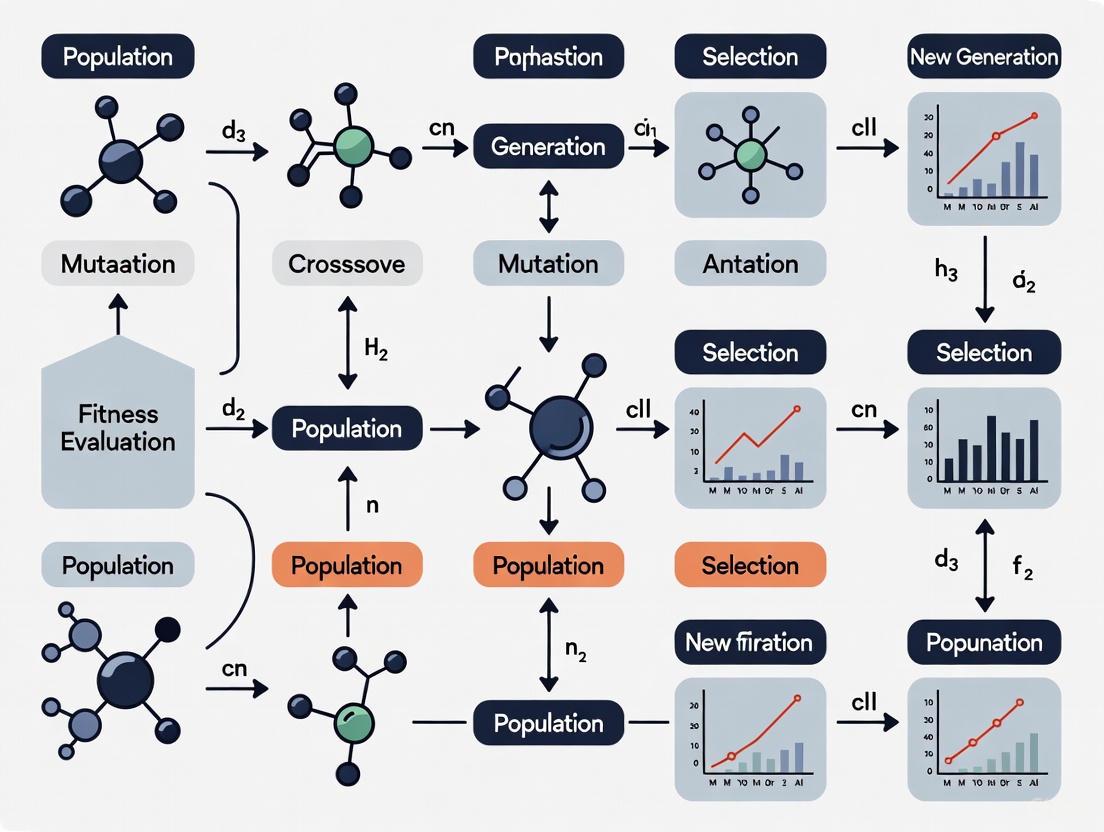
The following diagram illustrates the comprehensive workflow of an evolutionary algorithm, highlighting the integration and interaction between selection, crossover, and mutation operators within the complete optimization cycle:
Experimental Protocol for Drug Design Optimization
This protocol details the application of evolutionary algorithms for optimizing quantitative structure-activity relationship (QSAR) models in pharmaceutical research, specifically for predicting biological activity of compound libraries.
Research Reagent Solutions
Table 4: Essential Research Reagents and Computational Tools
| Item | Function/Description | Application Context |
|---|---|---|
| Chemical Compound Library | Diverse collection of molecular structures with associated biological activity data [4]. | Provides training and validation data for QSAR model development. |
| Molecular Descriptors | Quantitative representations of molecular properties (e.g., logP, molar refractivity, topological indices) [4]. | Serves as feature set for evolutionary algorithm optimization. |
| Evolutionary Algorithm Framework | Software implementation of EA operators (e.g., thefittest, DEAP) [5]. | Provides optimization engine for feature selection and model parameter tuning. |
| Fitness Function | Objective function measuring model performance (e.g., predictive accuracy, complexity) [1] [4]. | Guides evolutionary search toward optimal solutions. |
| Validation Dataset | Hold-out set of compounds not used during model training [4]. | Enables unbiased assessment of optimized model performance. |
Step-by-Step Methodology
Problem Formulation and Representation
- Objective: Develop a QSAR model with maximum predictive accuracy for target biological activity
- Representation: Encode solution candidates as real-valued vectors representing feature subsets and model parameters [4] [5]
- Fitness Function: Define a composite fitness metric balancing model accuracy (R², classification rate) with complexity (number of features) [4]
Algorithm Initialization
- Set population size to 100-500 individuals based on problem complexity [5]
- Initialize population with random feature subsets and parameter values within predefined bounds [1] [2]
- Configure evolutionary operators: tournament selection (size=3), uniform crossover (rate=0.8), Gaussian mutation (rate=0.1, std=0.05) [3] [5]
Evolutionary Optimization Cycle
- Fitness Evaluation: For each individual, train a predictive model (e.g., partial least squares regression, random forest) using the selected feature subset and evaluate on validation data [4]
- Selection: Apply tournament selection to identify parents for recombination [3]
- Variation: Generate offspring through crossover and mutation operations [3]
- Replacement: Implement elitist replacement strategy, preserving top 5% of individuals unchanged between generations [3]
- Termination Check: Continue iterations until fitness plateaus (no improvement for 50 generations) or maximum generations (500-1000) reached [5]
Validation and Analysis
- Apply the best-evolved feature subset and model parameters to independent test set
- Analyze selected molecular descriptors for biochemical interpretability [4]
- Compare evolved model performance against baseline methods (e.g., full feature set, stepwise selection)
Advanced Applications in Pharmaceutical Research
Evolutionary algorithms have demonstrated significant utility across multiple domains in drug discovery and development, leveraging their core mechanisms to address complex optimization challenges.
Multi-Objective Compound Optimization
In lead optimization, researchers often face competing objectives such as maximizing potency while minimizing toxicity and synthetic complexity [6] [4]. Multi-criterion evolutionary optimization approaches enable the discovery of Pareto-optimal solutions representing different trade-offs between these objectives. The selection operator balances exploration across the Pareto front with convergence toward non-dominated solutions, while crossover and mutation operators facilitate the discovery of novel chemical structures satisfying multiple constraints [6].
Autonomous Protein Engineering
Recent advances integrate evolutionary algorithms with automated laboratory systems for programmable protein evolution [7]. In these platforms, selection operators implement growth-coupled selection pressure where protein functionality directly influences cellular fitness, crossover enables recombination of beneficial protein domains, and mutation introduces sequence diversity through error-prone replication [7]. These systems can operate autonomously for extended periods (e.g., one month), executing continuous evolutionary optimization of target proteins such as enzymes, biosensors, and therapeutic proteins [7].
Hybrid Quantum-Evolutionary Approaches
Emerging research explores the integration of quantum computing principles with evolutionary algorithms for enhanced optimization in pharmaceutical applications [8]. Quantum-inspired evolutionary algorithms leverage superposition and entanglement concepts to maintain more diverse populations, potentially improving exploration of complex molecular search spaces [8]. These hybrid approaches may offer computational advantages for specific problem classes in drug design, such as molecular docking simulations and protein folding predictions [8].
Performance Optimization Guidelines
Successful application of evolutionary algorithms for parameter optimization requires careful tuning of operator parameters and implementation strategies.
Operator Parameter Tuning
- Selection Pressure: Balance exploitation and exploration by adjusting tournament size or using adaptive selection methods that respond to population diversity metrics [3]
- Crossover Rate: Typically set between 0.7-0.9 to encourage sufficient mixing of genetic material without excessive disruption of building blocks [3]
- Mutation Rate: Employ lower rates (0.01-0.1) to maintain diversity without devolving into random search; consider adaptive schemes that increase mutation when diversity decreases [3]
- Elitism: Preserve 1-5% of top performers to ensure monotonic improvement while preventing premature convergence [3]
Problem-Specific Operator Selection
- Real-valued parameter optimization: Prefer blend crossover (BLX) or simulated binary crossover (SBX) with Gaussian or polynomial mutation [3] [5]
- Combinatorial problems: Employ order-based representations with order crossover (OX) or partially mapped crossover (PMX) and swap or inversion mutation [3]
- Feature selection: Use binary representations with uniform or multi-point crossover and bit-flip mutation [4]
Performance Enhancement Techniques
- Fitness Scaling: Implement linear or exponential scaling to maintain appropriate selection pressure throughout the evolutionary process [1]
- Constraint Handling: Apply penalty functions, repair mechanisms, or specialized operators to ensure solution feasibility in constrained optimization problems [4]
- Parallelization: Leverage population-based parallelism to evaluate multiple solutions simultaneously, significantly reducing computation time for fitness evaluation [5]
The core mechanisms of mutation, crossover, and selection operators provide a powerful foundation for addressing complex parameter optimization challenges in pharmaceutical research. By understanding the theoretical principles, practical implementation details, and domain-specific applications of these operators, researchers can effectively harness evolutionary algorithms to accelerate drug discovery and development efforts.
In the realm of parameter optimization research, evolutionary algorithms (EAs) are a class of population-based metaheuristics inspired by biological evolution and collective swarm intelligence [9]. The efficacy of these algorithms is profoundly dependent on the precise formulation of the optimization problem, which is encapsulated by its search space. Defining this space—through decision variables, constraints, and objective functions—is a critical first step that dictates the algorithm's ability to navigate the solution landscape efficiently. This is especially true in complex, real-world domains like drug development, where problems often involve high-dimensional, constrained, and multi-faceted objectives [10] [11]. This document provides detailed application notes and protocols for researchers and scientists to define these core components effectively within the context of evolutionary algorithms for parameter optimization.
Core Components of a Search Space
The search space in an optimization problem is defined by three fundamental components. The interplay between these components guides the evolutionary search process.
Decision Variables
Decision variables represent the adjustable parameters of the system to be optimized. The choice of variable type directly influences the algorithm's design and operator selection. Supported variable types in evolutionary computation frameworks are diverse [12] [13].
Table 1: Types of Decision Variables and Their Applications
| Variable Type | Description | Example Applications |
|---|---|---|
| Real/Continuous | Real-valued parameters within bounds [12]. | Optimizing neural network weights, chemical compound concentrations [14]. |
| Integer | Discrete, integer-valued parameters [12]. | Determining the number of nodes in a network, generalized knapsack problems. |
| Binary | Variables restricted to 0 or 1 [12]. | Feature selection, standard knapsack problems. |
| Permutation | An ordered sequence of items [12]. | Traveling Salesman Problem (TSP), scheduling tasks. |
| Selection | A fixed-length subset of items [12]. | Selecting a set of molecular descriptors or key features from a dataset. |
Constraints
Constraints define the feasible region of the search space by imposing conditions that solutions must satisfy. They represent real-world limitations. In EAs, constraints are often handled using penalty functions, where infeasible solutions have their fitness degraded by an amount proportional to the constraint violation [13]. For a solution vector x, constraints can be:
- Inequality constraints: ( g_j(x) \leq 0 ), for ( j = 1, 2, ..., J ) [10]
- Equality constraints: ( h_p(x) = 0 ), for ( p = 1, 2, ..., P ) [10]
- Bound constraints: ( xi^l \leq xi \leq x_i^u ), for ( i = 1, 2, ..., n ) [10]
Objective Function
The objective function (or fitness function) quantitatively evaluates the quality of any candidate solution. In a single-objective optimization problem, the goal is to find the solution that minimizes or maximizes this single function [10]. In a multi-objective optimization problem (MultiOOP), two or three conflicting objectives are optimized simultaneously [10]. A many-objective optimization problem (ManyOOP) involves more than three objectives, which is common in drug design where properties like potency, novelty, toxicity, and synthetic cost must be balanced [10] [11].
Workflow for Search Space Definition
The following diagram illustrates the logical workflow and decision process for defining the core components of a search space.
Application in Drug Discovery: Experimental Protocols
Drug discovery presents a canonical example of complex many-objective optimization. The following protocol details the application of an EA for a de novo drug design task.
Protocol: Setting up a Many-Objective Molecular Optimization
Objective: To identify novel molecular structures that simultaneously optimize multiple pharmacological properties.
Materials and Reagents:
- Molecular Datasets: Source from public repositories like DrugBank or Swiss-Prot [14].
- Property Prediction Tools: Software for calculating ADMET properties, molecular docking scores, quantitative estimate of drug-likeness (QED), and synthetic accessibility score (SAS) [11].
- Computational Framework: A flexible evolutionary computation toolkit such as DEAP in Python [13] or YPEA in MATLAB [12].
Procedure:
- Variable Definition:
- Represent a molecule using a real-valued latent vector from a generative model (e.g., a Transformer autoencoder like ReLSO or FragNet) [11]. Alternatively, use a string representation (SMILES/SELFIES) or a graph-based representation.
- For a latent vector representation, the decision variables are the continuous values of the vector (e.g., 128 dimensions). Bounds are typically defined by the latent space distribution [11].
Objective Function Formulation:
- Define four or more objective functions to be optimized. The following table summarizes common objectives in drug design [10] [11].
- Table 2: Example Objectives for Many-Objective Drug Design
Objective Goal Typical Measure Potency/Efficacy Maximize Negative of binding affinity (docking score) from molecular docking [11]. Toxicity Minimize Predicted toxicity probability from an ADMET model [11]. Drug-Likeness Maximize Quantitative Estimate of Drug-likeness (QED) score [11]. Synthetic Accessibility Maximize Negative of Synthetic Accessibility Score (SAS) [11]. Pharmacokinetics Optimize Predictions for Absorption, Distribution, Metabolism, Excretion (ADMET) [11].
Constraint Definition:
- Chemical Validity: Enforce via the molecular representation (e.g., using SELFIES) or by incorporating a validity check as a hard constraint [11].
- Structural Constraints: Impose limits on molecular weight (e.g., ≤ 500 g/mol) or the number of rotatable bonds.
- Potency Threshold: Define a minimum required binding affinity (e.g., docking score < -7.0 kcal/mol) as an inequality constraint.
Algorithm Execution:
- Select a many-objective evolutionary algorithm (e.g., MOEA/D, NSGA-III) [10] [11].
- Initialize a population of random latent vectors or molecules.
- In each generation (iteration): a. Decode latent vectors to molecules [11]. b. Evaluate each molecule by calculating all objective functions from Table 2. c. Apply penalty functions to molecules that violate defined constraints [13]. d. Select parent solutions based on their fitness and non-domination rank. e. Create offspring via crossover and mutation operators in the latent space [11].
- Repeat for a predetermined number of generations or until performance converges.
Output Analysis:
- The algorithm returns a Pareto front, a set of non-dominated solutions representing optimal trade-offs between the conflicting objectives [10].
- Analyze the chemical structures and property profiles of the molecules on the Pareto front for further investigation.
The Scientist's Toolkit
Table 3: Essential Research Reagents and Computational Tools
| Item | Function/Description | Example/Reference |
|---|---|---|
| DEAP Framework | A Python library for rapid prototyping of Evolutionary Algorithms, supporting various variable types and genetic operators [13]. | DEAP Documentation |
| YPEA Toolbox | A MATLAB toolbox for solving optimization problems using EAs and metaheuristics, with built-in support for real, integer, binary, and permutation variables [12]. | YPEA on Yarpiz |
| ADMET Prediction Models | AI models used to predict absorption, distribution, metabolism, excretion, and toxicity properties of a molecule in silico [11]. | Integrated in frameworks like [11] |
| Molecular Docking Software | Computational tools to predict the binding orientation and affinity of a small molecule (ligand) to a protein target [11]. | Used for objective evaluation in [11] |
| Generative Latent Models | Transformer-based autoencoders (e.g., ReLSO, FragNet) that encode molecules into a continuous latent space for optimization [11]. | ReLSO model [11] |
The Strength of Population-Based Search in Rugged Landscapes
Evolutionary Algorithms (EAs) represent a class of powerful optimization techniques inspired by natural selection, playing an increasingly vital role in complex parameter optimization challenges across scientific domains, including computational biology and drug development. The performance and efficiency of EAs are critically dependent on appropriate population sizing, a parameter traditionally determined through empirical means rather than theoretical grounding [15]. Rugged fitness landscapes, characterized by numerous local optima and deceptive pathways, present particularly challenging environments for optimization algorithms. In such landscapes, the interplay between exploration (searching new regions) and exploitation (refining existing solutions) becomes paramount. Population-based search strategies offer distinct advantages in these contexts through their inherent parallelism and diversity maintenance mechanisms. This application note examines the theoretical foundations of population sizing in rugged landscapes, provides detailed experimental protocols for researchers, and presents a structured framework for evaluating population-based search performance in challenging optimization scenarios, with specific relevance to computational drug discovery.
Theoretical Framework: Population Sizing and Landscape Ruggedness
The theoretical justification for population-based approaches in rugged landscapes stems from two primary considerations: fitness landscape analysis and Probably Approximately Correct (PAC) learning theory. Research indicates that population sizing should be informed by fitness landscapes' ruggedness to ensure effective search performance [15]. Landscape ruggedness, quantitatively described by metrics such as fitness distance correlation and autocorrelation measures, directly influences the difficulty of optimization problems. Rugged landscapes with high epistasis (gene interactions) and numerous local optima require larger population sizes to maintain sufficient genetic diversity to avoid premature convergence.
The PAC learning framework provides theoretical bounds on population size required to achieve satisfactory solutions with high probability [15]. This approach formalizes the relationship between solution quality, computational resources, and problem difficulty, offering researchers principled estimates for population parameters rather than relying solely on empirical tuning. For rugged landscapes, the population must be sufficiently large to sample multiple promising regions simultaneously while withstanding deceptive fitness signals that might lead search algorithms toward local optima rather than global solutions.
Table 1: Key Metrics for Assessing Landscape Ruggedness
| Metric | Description | Interpretation in Rugged Landscapes | Calculation Method |
|---|---|---|---|
| Fitness Distance Correlation | Measures correlation between fitness and distance to global optimum | Values near 0 indicate difficult, rugged landscapes; negative values suggest deceptive landscapes | Pearson correlation between fitness and distance to nearest global optimum |
| Autocorrelation Length | Measures how fitness changes with increasing distance in search space | Shorter length indicates more rugged landscape with frequent fitness changes | Random walk analysis with fitness evaluation at each step |
| Epistasis Index | Quantifies degree of gene interaction effects | Higher values indicate more complex gene interactions contributing to ruggedness | Analysis of variance in fitness contributions |
| Number of Local Optima | Count of locally optimal solutions | Higher counts directly indicate increased ruggedness | Adaptive search with basin identification |
Population-Based Search in Uncertain Environments
Recent advances in population-based search methodologies have addressed the critical challenge of optimization under uncertainty, particularly relevant to real-world scientific applications where measurement noise and parameter uncertainty are inherent. Traditional robust multi-objective optimization methods typically prioritize convergence while treating robustness as a secondary consideration, which can yield solutions that are not genuinely robust under noise-affected scenarios [16]. The innovative Uncertainty-related Pareto Front (UPF) framework represents a paradigm shift by balancing robustness and convergence as equal priorities during the optimization process [16].
This approach is particularly valuable for drug development applications where experimental conditions, binding affinities, and pharmacokinetic parameters exhibit natural variability. Unlike traditional methods that evaluate robustness of individual solutions post-optimization, the UPF framework directly optimizes a non-dominated front that inherently embeds robustness guarantees for the entire population [16]. For rugged landscape optimization, this approach enables maintenance of diverse solution populations that collectively navigate multiple promising regions while accounting for uncertainty in fitness evaluations—a common challenge in high-throughput screening and molecular dynamics simulations.
Experimental Protocols for Rugged Landscape Optimization
Protocol 1: Population Sizing for Rugged Landscape Exploration
Purpose: To determine the minimum population size required to reliably locate global optima in rugged fitness landscapes.
Materials:
- Computational environment with evolutionary algorithm framework
- Fitness landscape generator with adjustable ruggedness parameters
- Statistical analysis software
Procedure:
- Landscape Characterization: Quantify baseline ruggedness using fitness distance correlation and autocorrelation analysis [15]. Perform 100 random walks of 10,000 steps each, recording fitness at each step.
- Initial Population Setup: Initialize populations of sizes [50, 100, 200, 500, 1000] with identical random number seeds for comparative analysis.
- Evolutionary Run: Execute 500 generations of evolutionary search using tournament selection (size=3), uniform crossover (probability=0.8), and point mutation (probability=0.01).
- Performance Monitoring: Record best fitness, average fitness, and population diversity at generations 10, 50, 100, 250, and 500.
- Success Criterion Definition: Define successful optimization as locating a solution within 1% of known global optimum fitness.
- Statistical Validation: Repeat entire procedure 30 times with different random seeds to establish significance.
Data Analysis: Calculate success rates for each population size, plotting relationship between population size and optimization success. Fit logarithmic model to determine point of diminishing returns for population increases.
Protocol 2: UPF-Based Robust Optimization in Noisy Environments
Purpose: To implement Uncertainty-related Pareto Front optimization for maintaining solution diversity and robustness in rugged landscapes with noisy fitness evaluations.
Materials:
- RMOEA-UPF algorithm implementation [16]
- Noise injection module for simulating parameter uncertainty
- Multi-objective performance assessment metrics
Procedure:
- Uncertainty Modeling: Define noise distribution for fitness evaluations based on application context (Gaussian noise with μ=0, σ=0.05 recommended for initial trials).
- Archive Initialization: Establish elite archive with capacity for 100 non-dominated solutions using uncertainty-aware dominance criteria [16].
- Parent Selection: Generate parents directly from elite archive using crowding distance selection to maintain diversity.
- Offspring Generation: Apply simulated binary crossover and polynomial mutation to create 100 offspring solutions.
- Fitness Evaluation with Perturbation: Evaluate each solution under 10 different noise perturbations to estimate robustness [16].
- Archive Update: Incorporate new solutions into archive using non-dominated sorting with dual criteria of convergence and robustness.
- Termination Check: Continue for 500 generations or until Pareto front stabilization (less than 1% improvement for 50 generations).
Data Analysis: Compute hypervolume and inverted generational distance metrics to quantify performance. Compare solution diversity and robustness against traditional MOEA approaches.
Visualization Framework
Figure 1: Population-based search workflow with uncertainty handling. The diagram illustrates the integration of robustness assessment within the evolutionary cycle, highlighting the UPF update process for maintaining solutions that perform well under uncertainty.
Figure 2: Population sizing strategy matrix for different landscape types. The diagram illustrates optimal population size selection based on landscape ruggedness, demonstrating that larger populations are essential for success in highly rugged environments while smaller populations suffice for smooth landscapes.
The Scientist's Toolkit: Research Reagent Solutions
Table 2: Essential Computational Tools for Rugged Landscape Optimization
| Tool/Resource | Function | Application Context | Implementation Notes |
|---|---|---|---|
| Landscape Ruggedness Analyzer | Quantifies fitness landscape characteristics using autocorrelation and fitness distance correlation | Preliminary problem analysis to determine appropriate population size | Requires significant sampling (≥10,000 evaluations) for accurate assessment |
| RMOEA-UPF Algorithm | Maintains diverse population of robust solutions under uncertainty | Optimization problems with noisy evaluations or parameter uncertainty | Archive size should be 50-100% of main population for effective diversity maintenance |
| Noise Injection Module | Introduces controlled perturbations to simulate real-world uncertainty | Testing algorithm robustness before deployment in experimental settings | Perturbation magnitude should reflect domain-specific uncertainty levels |
| Population Diversity Tracker | Monitors genotypic and phenotypic diversity throughout evolution | Preventing premature convergence in multimodal landscapes | Combine multiple metrics (Hamming distance, fitness variance, niche count) |
| Multi-objective Performance Assessor | Computes hypervolume, spread, and spacing metrics | Comparing algorithm performance across different rugged landscapes | Requires reference point selection appropriate to problem domain |
Population-based search strategies offer distinct advantages for navigating rugged optimization landscapes common in scientific and industrial applications. The integration of landscape-aware population sizing with robust optimization frameworks like UPF enables researchers to tackle increasingly complex parameter optimization challenges in domains ranging from drug discovery to materials science. The protocols and frameworks presented herein provide a structured approach for implementing these methods in research settings, with specific consideration for the uncertainty inherent in experimental sciences. Future directions include adaptive population sizing techniques and domain-specific implementations for pharmaceutical applications such as protein folding optimization and compound screening.
Why EAs Excel at Avoiding Local Optima in Complex Systems
Evolutionary Algorithms (EAs) are a class of population-based, stochastic search methodologies inspired by the principles of natural evolution and genetics. Their fundamental strength in navigating complex, multi-modal search spaces and avoiding premature convergence on sub-optimal solutions stems from their core operational principles. Unlike gradient-based or local search methods that can become trapped in local optima—sub-optimal peaks in the fitness landscape—EAs maintain a diverse population of candidate solutions and employ biologically-inspired operators to explore and exploit the search space simultaneously [17]. This capability is paramount for solving real-world optimization problems in domains such as drug development, where the relationship between model parameters and objective functions is often non-convex, discontinuous, or poorly understood.
The inherent parallelism of EAs, evaluating multiple points in the search space at once, provides a statistical advantage against local optima. As summarized in Table 1, this, combined with their lack of dependency on gradient information and their explicit maintenance of diversity, forms the foundational reasons for their robustness. The following sections detail the architectural and operational mechanisms underpinning this capability, supported by application notes and detailed protocols for researcher implementation.
Table 1: Core Mechanisms in EAs for Avoiding Local Optima
| Mechanism | Principle | Effect on Local Optima |
|---|---|---|
| Population-Based Search | Evaluates many solutions simultaneously, exploring multiple regions of the search space. | Reduces the risk of the entire search process being captured by a single local optimum. |
| Stochastic Operators | Uses probabilistic operations (crossover, mutation) for exploration. | Allows random exploration that can escape the basin of attraction of a local optimum. |
| Diversity Preservation | Mechanisms like fitness sharing or crowding to maintain solution variety. | Prevents population convergence on a single peak, allowing other peaks to be explored. |
| Lack of Gradient Dependency | Relies on fitness evaluations, not gradient information, to guide the search. | Can traverse flat regions and jump across discontinuities where gradient-based methods fail. |
Architectural Framework and Operational Principles
The Self-Optimization EA Architecture
The ability to avoid local optima is embedded within the architecture of a self-optimizing EA. A generalized structure involves a main EA that, at a decision point ("time now"), initiates an optimization manager [18]. This manager interacts with an optimization algorithm (AO) to generate and test parameter sets.
- Manager Function: The manager requests a "set" of parameters from the optimization algorithm (AO) [18].
- Virtual Strategy (EA Virt): The manager passes this set to a virtual, fully functional copy of the trading strategy. This virtual EA runs on historical data from a defined "past" point up to the "time now" point, simulating performance without real-world execution [18].
- Fitness Evaluation (ff result): The virtual run produces a result based on a user-defined fitness function (e.g., profit factor, mathematical expectation). This result is returned to the manager [18].
- Iterative Optimization: The manager passes the fitness result back to the optimization algorithm. This cycle repeats—generating new parameter sets, testing them virtually, and evaluating results—until a stopping condition is met (e.g., a number of iterations or a fitness threshold). The best-found parameter set is then passed back to the main EA for live trading until the next re-optimization point [18].
This structure separates the exploration and evaluation phases, allowing for aggressive, risk-free exploration of the parameter space. The following DOT script visualizes this workflow and its data flows.
Key Evolutionary Operators for Global Exploration
The effectiveness of the architecture above depends on the algorithms (AO) it employs. Evolutionary Algorithms use specific operators to drive exploration and avoid local optima.
Table 2: Key Evolutionary Operators and Their Functions
| Operator | Function | Role in Avoiding Local Optima |
|---|---|---|
| Selection | Chooses fitter individuals from the population to be parents for the next generation. | Guides the search towards promising regions, exploiting current knowledge. |
| Crossover (Recombination) | Combines genetic information from two or more parents to create one or more offspring. | Explores new regions by recombining building blocks (schemata) from different solutions. |
| Mutation | Randomly alters one or more genes in an offspring's chromosome with a low probability. | Introduces new genetic material, enabling the search to reach entirely new points in the space and escape local optima. |
| Elitism | Directly copies a small proportion of the fittest individuals to the next generation. | Guarantees that the best solution found is not lost, ensuring monotonic improvement. |
Experimental Protocols for EA Evaluation
Protocol: Benchmarking EA Performance on Test Functions
Objective: To quantitatively evaluate and compare the performance of different EA configurations in avoiding local optima and finding the global optimum on known multi-modal test functions.
Materials:
- Software: Optimization software platform (e.g., MATLAB, Python with DEAP or PyGMO libraries).
- Hardware: Standard research computer.
- Test Functions: A suite of standard global optimization benchmark functions with known local and global optima (e.g., Rastrigin function, Ackley function, Schwefel function).
Procedure:
- EA Initialization:
- Select an EA variant (e.g., Genetic Algorithm, Differential Evolution).
- Define the population size (e.g., 50-100 individuals), crossover probability (e.g., 0.8-0.9), mutation probability (e.g., 1/chromosome_length), and selection strategy (e.g., tournament selection).
- Set the termination criterion (e.g., maximum number of generations, convergence threshold).
- Experimental Run:
- For each test function and each EA configuration, execute a minimum of 30 independent runs to account for stochasticity.
- In each run, initialize the population with random values within the defined search space.
- Data Collection:
- Record for each run: (a) the best fitness value found, (b) the number of function evaluations to reach the global optimum (or a close vicinity), and (c) the final population diversity.
- Track the best-so-far fitness curve over generations for a qualitative assessment of convergence behavior.
Analysis:
- Calculate the success rate (number of runs where the global optimum was found within a specified tolerance).
- Compare the mean and standard deviation of the best fitness and the number of function evaluations across different EA configurations using statistical tests (e.g., Mann-Whitney U test).
- Visually compare convergence plots to identify configurations that exhibit premature convergence versus those that maintain exploration.
Protocol: Implementing a Virtual Strategy for Parameter Optimization
Objective: To adapt the self-optimization architecture from Figure 1 for optimizing parameters of a computational model, such as a pharmacokinetic/pharmacodynamic (PK/PD) model.
Materials:
- Target Model: The model to be optimized (e.g., a system of differential equations representing a PK/PD system).
- Dataset: Historical or synthetic dataset for the virtual evaluation of the model.
- Computational Environment: Python/R/MATLAB environment with the model implemented and an EA library.
Procedure:
- Setup:
- Implement the main EA manager script that will control the optimization loop.
- Encapsulate the target model as the "EA Virt" component, which can be called with a parameter set and return a fitness score (e.g., Root Mean Square Error between model output and dataset).
- Select and configure the optimization algorithm (AO), such as a Differential Evolution algorithm.
- Optimization Cycle:
- The manager initiates optimization at a defined point, passing the optimization parameters (ranges for each model parameter) to the AO.
- The AO provides a population of parameter sets.
- For each set, the manager calls the virtual model ("EA Virt"), runs the simulation on the dataset, and calculates the fitness.
- The fitness results are fed back to the AO.
- The cycle continues until the stopping condition is met.
- Validation:
- The best parameter set from the optimization is validated on a hold-out dataset not used during the optimization process.
Troubleshooting:
- Poor Convergence: Increase population size or adjust operator probabilities to enhance exploration.
- High Computational Cost: Reduce the population size or the complexity of the virtual model, if possible. Consider using a fitness approximation (surrogate model).
- Constraint Violation: Ensure the EA or the virtual model includes constraint-handling techniques (e.g., penalty functions) to manage parameter boundaries and model constraints.
The Scientist's Toolkit: Essential Research Reagents & Materials
Table 3: Key Research Reagent Solutions for EA Implementation
| Item | Function / Description | Example / Specification |
|---|---|---|
| Optimization Algorithm (AO) | The core engine that performs the evolutionary search for optimal parameters [18]. | Differential Evolution (DE), Genetic Algorithm (GA), Evolution Strategies (ES) [17]. |
| Virtual Strategy (EA Virt) | A virtual copy of the system or model being optimized; it tests parameter sets risk-free on historical or synthetic data [18]. | A computational model (e.g., a PK/PD simulation, a trading strategy back-testing engine). |
| Fitness Function (ff) | A user-defined metric that quantifies the performance of a parameter set, guiding the optimization process [18]. | Can be a single objective (e.g., minimization of error) or a complex, multi-objective criterion. |
| Historical/Synthetic Dataset | The data upon which the virtual strategy is evaluated. It must be representative of the system's behavior to ensure optimized parameters are valid [18]. | Clinical trial data, protein folding simulation outputs, historical financial data. |
| Visualization & Analysis Suite | Software tools for tracking algorithm performance, population diversity, and convergence behavior. | Python with Matplotlib/Seaborn, R with ggplot2, proprietary software. |
Advanced Hybridization and Error Correction
More advanced EA implementations incorporate hybrid and error-correction mechanisms to further bolster robustness. Hybrid approaches combine the global exploration of EAs with the local refinement of other methods (e.g., combining an EA with a gradient-based local search) [17]. This creates a powerful synergy where the EA finds the promising region, and the local search efficiently locates the precise local optimum within that region.
Furthermore, recognizing the potential for infeasible solutions to be generated by stochastic operators, integrated error-correction mechanisms can be deployed. These mechanisms use precisely tailored rules or prompts (especially in emerging LLM-EA hybrids) to "repair" generated solutions that violate problem constraints, ensuring all evaluated solutions are valid and saving computational resources [19]. The following diagram illustrates the population dynamics in a hybrid EA system.
Advanced EA Strategies and Their Transformative Applications in Drug Discovery
Differential Evolution (DE) is a population-based stochastic optimization algorithm widely recognized for its simplicity, robustness, and effectiveness in solving complex global optimization problems in continuous space [20] [21]. Since its introduction by Storn and Price in 1996, DE has become a cornerstone in the field of evolutionary algorithms, particularly for real-valued parameter optimization [21]. Its significance is highlighted by the continuous emergence of improved variants, many of which are benchmarked in prestigious annual competitions like the Congress on Evolutionary Computation (CEC) [21]. Within research on evolutionary algorithms for parameter optimization, DE stands out for its performance on continuous problems, which are defined over a domain where solution quantities are assumed to be fields, often governed by differential equations or integral operations [22]. These characteristics make DE particularly valuable for researchers and scientists tackling challenging optimization problems in fields like drug development, where modeling complex, continuous systems is paramount [23].
Core Mechanisms of Differential Evolution
The DE algorithm operates on a population of candidate solutions, iteratively improving them through cycles of mutation, crossover, and selection. The following sections detail these core mechanisms.
Population Initialization and Dynamics
DE initializes a population of (Np) individuals, where each individual is represented as a vector (x{i,g}) in a D-dimensional continuous space. The index (i) denotes the individual's position in the population, and (g) represents the generation number. The initial population is typically generated uniformly at random within the specified lower and upper bounds for each variable [21]. The population size (N_p) is a critical parameter; a larger size promotes a more diverse exploration of the search space but at an increased computational cost [20]. The dynamics of this population throughout the generations drive the algorithm's convergence toward an optimal solution.
Mutation Strategies
Mutation is the primary mechanism for generating diversity in DE. It produces a mutant vector (v_{i,g+1}) for each target vector in the population by combining existing vectors. Several mutation strategies exist, each with distinct characteristics influencing the algorithm's explorative and exploitative behavior [20].
Common mutation strategies include:
- DE/rand/1: ( \vec{v}i = \vec{x}{r1} + F \times (\vec{x}{r2} - \vec{x}{r3}) ) - An explorative strategy that relies on randomly selected vectors.
- DE/best/1: ( \vec{v}i = \vec{x}{best} + F \times (\vec{x}{r1} - \vec{x}{r2}) ) - An exploitative strategy that leverages the best solution found so far to direct the search.
- DE/current-to-best/1: ( \vec{v}i = \vec{x}i + F \times (\vec{x}{best} - \vec{x}i) + F \times (\vec{x}{r1} - \vec{x}{r2}) ) - A balanced strategy that incorporates information from both the current individual and the best individual.
In all equations, (r1), (r2), and (r3) are randomly selected, mutually distinct indices different from (i), and (F) is the scaling factor controlling the magnitude of the differential variation [20] [21].
Table 1: Characteristics of Common DE Mutation Strategies
| Mutation Strategy | Characteristics |
|---|---|
| DE/rand/1 | Explorative, simple, maintains diversity |
| DE/best/1 | Exploitative, fast convergence, can stagnate |
| DE/current-to-best/1 | Balanced exploration and exploitation |
Crossover and Selection
Following mutation, a crossover operation generates a trial vector (u{i,g+1}) by mixing components from the target vector (x{i,g}) and the mutant vector (v{i,g+1}). The most common method is binomial crossover, defined as: [ u{ji,g+1} = \begin{cases} v{ji,g+1} & \text{if } rand(j) \leq Cr \text{ or } j = rn(i) \ x{ji,g} & \text{otherwise} \end{cases} ] Here, (Cr) is the crossover rate, (rand(j)) is a uniform random number from [0,1], and (rn(i)) is a randomly chosen index ensuring the trial vector gets at least one component from the mutant vector [21].
Finally, a greedy selection mechanism determines whether the target vector or the trial vector survives to the next generation. The selection is based on the fitness function, typically for minimization: [ x{i,g+1} = \begin{cases} u{i,g+1} & \text{if } f(u{i,g+1}) \leq f(x{i,g}) \ x_{i,g} & \text{otherwise} \end{cases} ] This selection pressure ensures the population's average fitness improves over generations [20] [21].
Modern Variants and Advanced Topics
Recent research has focused on enhancing DE's effectiveness and efficiency through adaptive mechanisms, hybridization, and specialized procedures for complex problem classes.
Adaptive and Self-Adaptive DE
A significant advancement in DE is the development of adaptive and self-adaptive variants that dynamically adjust control parameters like the scaling factor (F) and crossover rate (Cr) during the optimization process. This self-tuning capability improves robustness and eliminates the need for tedious manual parameter tuning for each new problem. These methods work by using feedback from the optimization process or embedding the parameters within the individual's representation so they evolve alongside the solutions [20].
Hybrid Differential Evolution
Hybridizing DE with other algorithms is a promising approach to overcome its limitations. Common hybrids include:
- DE with Local Search: Combining DE with gradient-based methods or the Nelder-Mead simplex improves local exploitation, refining solutions and accelerating convergence [20].
- DE with other Population-based Algorithms: Integrating DE with algorithms like Particle Swarm Optimization (PSO) or Genetic Algorithms (GA) can enhance global exploration capabilities and population diversity [20].
Multi-Objective Optimization
DE has been successfully extended to multi-objective optimization (MOO) problems, where multiple conflicting objectives must be optimized simultaneously. Popular DE variants for MOO use Pareto-based approaches to select and maintain a set of non-dominated solutions or decomposition methods that break the MOO problem into multiple single-objective subproblems [20].
Local Minima Escape Procedure
A key challenge for DE is premature convergence to local minima. A recent innovation, the Local Minima Escape Procedure (LMEP), directly addresses this issue [24]. LMEP detects when a population is trapped and executes a "parameter shake-up" to disrupt the stagnant state, allowing the algorithm to explore new regions of the search space. When integrated with classical DE strategies, LMEP has been shown to improve convergence by 25% to 100% on challenging benchmark functions and real-world problems like optimizing quantum simulations of photosynthetic complexes [24].
Experimental Protocols and Performance Analysis
Robust experimental design and statistical analysis are essential for validating the performance of DE algorithms, especially when comparing modern variants.
Benchmarking and Statistical Comparison
Performance evaluation of DE variants typically relies on standardized benchmark suites, such as those defined for the CEC special sessions on single-objective real-parameter numerical optimization. These suites contain various function types, including unimodal, multimodal, hybrid, and composition functions, tested at different dimensions (e.g., 10D, 30D, 50D, and 100D) [21].
Since DE is stochastic, algorithms are run multiple times on each benchmark. Statistical tests are then used to draw reliable conclusions from the resulting data. Non-parametric tests are preferred because they do not assume a normal distribution of the results [21].
Table 2: Statistical Tests for Comparing DE Algorithm Performance
| Statistical Test | Purpose | Key Characteristic |
|---|---|---|
| Wilcoxon Signed-Rank Test | Pairwise comparison of two algorithms | Considers the magnitude of differences in performance ranks; used for paired samples (same problems). |
| Friedman Test | Multiple comparison of several algorithms | Ranks algorithms for each problem; detects significant differences in median performance across multiple algorithms. |
| Mann-Whitney U-score Test | Pairwise comparison of two algorithms | Ranks all results from both algorithms; designed for independent samples. |
Protocol: Conducting a Performance Comparison Study
- Problem Selection: Select a benchmark suite (e.g., CEC 2024) and define the problem dimensions for testing [21].
- Algorithm Configuration: Implement the DE variants to be compared, ensuring consistent coding environment and hardware.
- Data Collection: Execute each algorithm over multiple independent runs (e.g., 30-51 runs are common) for each benchmark function. Record the final objective function value or the error from the known optimum for each run.
- Statistical Testing:
- Perform the Friedman test to determine if there are statistically significant differences among all algorithms. If the result is significant, conduct a post-hoc Nemenyi test to identify which specific pairs differ [21].
- For focused comparisons, use the Wilcoxon signed-rank test on the average performance from multiple runs for each benchmark to compare two algorithms [21].
- Alternatively, apply the Mann-Whitney U-score test on the collected results to compare two algorithms across different trials [21].
- Reporting: Report the p-values and test statistics. A p-value below the significance level (e.g., α=0.05) allows rejection of the null hypothesis, indicating a statistically significant performance difference.
Protocol: Implementing the Local Minima Escape Procedure
The following protocol details the integration of LMEP into a standard DE routine, based on the method described by Chesalin et al. (2025) [24].
Objective: To enhance the convergence rate of a standard DE algorithm by enabling it to detect and escape from local minima. Materials: A functioning DE codebase (e.g., in Python, MATLAB, C++). Procedure:
- Define LMEP Parameters: Set the trigger condition for LMEP (e.g., no improvement in the best fitness over a consecutive number of generations, (G_{stag})) and the magnitude of the "shake-up" (e.g., a perturbation factor).
- Incorporate Detection: Within the main DE loop, after the selection step in each generation, monitor the best solution in the population for improvement.
- Trigger and Execute LMEP: If the stagnation criterion (G_{stag}) is met: a. Detection: Flag the current best solution as a potential local minimum. b. Shake-up: Apply a perturbation to the entire current population or a subset of individuals. This could involve: - Re-initializing a percentage of the population randomly within the bounds. - Applying a strong mutation to all individuals except the current best. - Randomly shifting all individuals by a random vector. c. Resume DE: Continue the standard DE operations (mutation, crossover, selection) with the perturbed population.
- Termination: Continue the process until a global termination criterion is met (e.g., maximum number of generations or function evaluations, or a desired fitness threshold).
Validation: Test the performance of DE with and without LMEP on benchmark functions with many local minima, such as Rastrigin and Griewank. Compare the convergence curves and the success rate in locating the global optimum over multiple runs [24].
The Scientist's Toolkit
This section provides key resources for researchers implementing and applying Differential Evolution.
Research Reagent Solutions
Table 3: Essential Components for a DE Implementation
| Component / "Reagent" | Function / Purpose |
|---|---|
| Population Vector ((x_{i,g})) | The fundamental unit representing a candidate solution in the D-dimensional search space. |
| Scaling Factor ((F)) | Controls the magnitude of the differential variation during mutation, impacting the algorithm's step size. |
| Crossover Rate ((Cr)) | Determines the probability of incorporating a component from the mutant vector into the trial vector, balancing old and new genetic information. |
| Mutation Strategy (e.g., DE/rand/1) | The "recipe" for generating mutant vectors, defining the algorithm's explorative/exploitative character. |
| Fitness Function ((f(x))) | The objective function that evaluates the quality of a solution, guiding the selection process. |
| Benchmark Suite (e.g., CEC2024) | A standardized set of test problems for validating algorithm performance and conducting fair comparisons. |
Visualization of Algorithm Workflows
The following diagrams illustrate the logical workflow of a standard DE algorithm and the enhanced version with the Local Minima Escape Procedure.
DE Algorithm Basic Workflow
DE Enhanced with Local Minima Escape
Application in Pharmaceutical Process Development
Optimization is critical in pharmaceutical process development, impacting areas from drug substance manufacturing to final product formulation. DE is applied to optimize Critical Quality Attributes (CQAs), process performance (yield, material demand), economic objectives (capital, operational expenditures), and environmental metrics (energy demand, waste) [23]. A specific application involves using machine learning-based optimization frameworks, which can be coupled with DE, to optimize multi-step ion exchange chromatography for complex ternary protein separations, ensuring compliance with operational and quality constraints [23]. The robustness of DE in handling complex, constrained, continuous problems makes it a valuable tool for improving the efficiency and sustainability of pharmaceutical manufacturing.
Optimization of chemical systems and processes has been profoundly enhanced by the development of sophisticated algorithms. While numerous methods exist to systematically investigate how variables correlate with outcomes, many require substantial experimentation to accurately model these relationships. As chemical systems grow in complexity, there is a pressing need for algorithms that can propose efficient experiments to optimize objectives while avoiding convergence on local minima [25]. Evolutionary optimization algorithms, inspired by biological evolution, represent a powerful class of such methods. They use a starting set of potential solutions (seeds) that are evaluated using an objective function to iteratively evolve a population of solution vectors toward optimal solutions [25] [26].
The Paddy field algorithm (PFA), implemented as the Paddy software package, is a recently developed evolutionary optimization algorithm that demonstrates particular promise for chemical applications. As a biologically inspired method, Paddy propagates parameters without direct inference of the underlying objective function, making it particularly valuable when the functional relationship between variables is unknown [25] [27]. Benchmarked against established optimization approaches including Bayesian methods and other evolutionary algorithms, Paddy maintains strong performance across diverse optimization challenges while offering markedly lower runtime [25].
This case study examines Paddy's implementation, performance, and practical applications in chemical optimization tasks, with particular emphasis on its value for researchers in chemical sciences and drug development.
Algorithmic Fundamentals and Mechanism of Action
Core Principles and Biological Inspiration
The Paddy field algorithm is inspired by the reproductive behavior of plants in agricultural settings, specifically how plant propagation correlates with soil quality and pollination efficiency. This biological metaphor translates to optimization as follows: parameters are treated as seeds, their fitness scores represent plant quality, and the density of successful solutions drives a pollination mechanism that guides further exploration [25].
Unlike traditional evolutionary algorithms that rely heavily on crossover operations, Paddy employs a density-based reinforcement mechanism where solution vectors (plants) produce offspring based on both their fitness scores and their spatial distribution within the parameter space. This approach allows Paddy to effectively balance exploration (searching new areas) and exploitation (refining promising solutions) [25].
The Five-Phase Process
Paddy implements optimization through five distinct phases:
Sowing: The algorithm initializes with a random set of user-defined parameters as starting seeds. The exhaustiveness of this initial step significantly influences downstream propagation, with larger seed sets providing better starting points at the cost of computational resources [25].
Selection: The fitness function evaluates the seed parameters, converting seeds to plants. A user-defined threshold parameter then selects the top-performing plants based on sorted fitness values. Notably, Paddy can incorporate evaluations from previous iterations, enabling cumulative learning [25].
Seeding: Selected plants produce seeds proportionally to their fitness scores, with the number of seeds determined as a fraction of a user-defined maximum. This fitness-proportional reproduction ensures promising regions of parameter space receive more attention [25].
Pollination: A density-based calculation influences offspring production, with higher concentrations of successful plants resulting in more intensive sampling of surrounding regions. This unique mechanism mimics how plants in dense clusters benefit from increased pollination [25].
Propagation: Parameter values for the next generation are created by applying Gaussian mutation to selected plants, introducing controlled randomness to explore adjacent parameter space [25].
The table below summarizes Paddy's comparative performance against other optimization methods:
Table 1: Performance Benchmarking of Paddy Against Other Optimization Algorithms
| Algorithm | Optimization Approach | Key Strengths | Chemical Applications Demonstrated | Runtime Efficiency |
|---|---|---|---|---|
| Paddy | Evolutionary with density-based pollination | Robust versatility, avoids local minima, excellent runtime | Molecule generation, hyperparameter tuning, experimental planning | Excellent |
| Bayesian Optimization (Gaussian Process) | Probabilistic model with acquisition function | Sample efficiency with minimal evaluations | Neural network optimization, generative sampling | Computational cost increases with complexity |
| Tree-structured Parzen Estimator | Sequential model-based optimization | Handles complex search spaces | Hyperparameter optimization [25] | Moderate to high |
| Genetic Algorithm | Evolutionary with crossover and mutation | Well-established, diverse solution generation | Various engineering and chemical applications [26] | Varies with implementation |
| Differential Evolution | Evolutionary with vector differences | Effective for continuous optimization, prevents local minima | Function optimization in continuous space [26] | Generally good |
Workflow Visualization
The following diagram illustrates the five-phase iterative workflow of the Paddy algorithm:
Paddy Algorithm Five-Phase Workflow
Experimental Applications in Chemical Optimization
Molecular Optimization for Drug Discovery
Paddy demonstrates particular strength in targeted molecule generation, a crucial task in drug discovery. Researchers have employed Paddy to optimize input vectors for a junction-tree variational autoencoder (JT-VAE), a generative model for molecular structures [25] [28]. In this application, Paddy efficiently navigates the complex latent space of the decoder network to generate molecules with optimized properties.
The algorithm's ability to avoid local optima proves valuable when searching for molecular structures with specific pharmaceutical characteristics. Unlike some Bayesian methods that may prematurely converge on suboptimal regions of chemical space, Paddy's density-based pollination mechanism maintains diverse exploration, increasing the probability of discovering novel scaffolds with desired properties [25].
Hyperparameter Optimization for Chemical AI Models
Artificial intelligence and machine learning (AI/ML) models have become indispensable in chemical sciences for tasks ranging from retrosynthesis planning to reaction condition prediction [25]. The performance of these models heavily depends on proper hyperparameter tuning.
Paddy has been successfully benchmarked for hyperparameter optimization of artificial neural networks tasked with classifying solvents for reaction components [25] [27]. In these experiments, Paddy efficiently navigated the hyperparameter space to identify configurations that maximized classification accuracy. The algorithm's robust performance across different problem types—from mathematical functions to chemical classification—highlights its versatility as an optimization tool [25].
Autonomous Experimental Planning and Closed-Loop Optimization
A promising application of Paddy lies in autonomous experimentation, where the algorithm can propose optimal experimental conditions with minimal human intervention. This capability is particularly valuable for high-throughput experimentation in pharmaceutical and materials science [25] [28].
Paddy has demonstrated effectiveness in sampling discrete experimental space for optimal experimental planning [25]. When integrated with robotic laboratory systems, Paddy can function as the decision-making engine in closed-loop optimization systems, similar to implementations using Bayesian optimization [29]. The algorithm's lower runtime compared to Bayesian methods makes it particularly suitable for time-sensitive applications where rapid iteration between proposal and experimentation is valuable [25].
Detailed Experimental Protocol
Implementation for Targeted Molecule Generation
This protocol describes the application of Paddy for targeted molecule generation using a pre-trained junction-tree variational autoencoder (JT-VAE), based on methodologies reported in benchmark studies [25].
Research Reagent Solutions and Computational Tools
Table 2: Essential Research Reagents and Computational Tools
| Item Name | Specification/Type | Function in Experiment |
|---|---|---|
| Paddy Software Package | Python library (v1.0+) | Core optimization algorithm implementation |
| JT-VAE Model | Pre-trained generative model | Molecular structure decoding from latent vectors |
| Chemical Property Predictor | QSAR model or computational function | Evaluates desired molecular properties (fitness function) |
| Molecular Descriptors | Tanimoto similarity, logP, etc. | Quantifies chemical similarity and properties |
| Python Environment | 3.7+ with NumPy/SciPy | Experimental execution and data analysis |
Step-by-Step Procedure
Initialization and Parameter Definition
- Install the Paddy package via PyPI (
pip install paddy-optimizer) or from GitHub repository. - Define the parameter space for latent vectors, specifying bounds for each dimension based on the JT-VAE's latent space characteristics.
- Set Paddy parameters: population size (default: 50-100), maximum number of seeds (s_max), selection threshold (H), and Gaussian mutation radius.
- Install the Paddy package via PyPI (
Fitness Function Formulation
- Develop a fitness function that incorporates desired molecular properties (e.g., drug-likeness, target affinity, synthetic accessibility).
- The function should: decode latent vectors to molecular structures using JT-VAE, calculate chemical properties, and return a composite fitness score.
- Example function structure:
Algorithm Execution
- Initialize Paddy with random latent vectors within defined bounds.
- Run the optimization for predetermined iterations or until convergence criteria are met.
- Monitor progress through fitness scores of best candidates each generation.
Result Analysis and Validation
- Extract top-performing latent vectors and decode to molecular structures.
- Validate chemical properties using independent assessment methods.
- Analyze chemical diversity of generated molecules to evaluate exploration effectiveness.
Protocol for Hyperparameter Optimization of Neural Networks
This protocol applies Paddy to tune hyperparameters of neural networks for chemical classification tasks, such as solvent classification based on molecular features [25].
Step-by-Step Procedure
Search Space Definition
- Identify critical neural network hyperparameters: learning rate, hidden layer dimensions, dropout rate, batch size, etc.
- Define valid ranges for each parameter (continuous or discrete).
Fitness Function Implementation
- Implement function that: instantiates neural network with proposed hyperparameters, trains on chemical dataset, evaluates on validation set, returns performance metric (accuracy, F1-score, etc.).
- Incorporate computational efficiency constraints if needed.
Paddy Configuration
- Adjust selection threshold to maintain population diversity and prevent premature convergence.
- Set appropriate Gaussian mutation ranges for each parameter type.
Parallelization Strategy
- Leverage Paddy's capability to propose parallel evaluations when computational resources allow.
- Execute multiple neural network training sessions concurrently to accelerate optimization.
Technical Advantages and Implementation Considerations
Comparative Strengths for Chemical Applications
Paddy's performance across chemical optimization benchmarks reveals several distinct advantages:
Resistance to Local Minima: The density-based pollination mechanism prevents premature convergence, a critical feature when optimizing complex chemical systems with multiple suboptimal regions [25].
Runtime Efficiency: Studies report "markedly lower runtime" compared to Bayesian optimization approaches, making Paddy suitable for computationally expensive fitness functions [25] [27].
Versatility Across Problem Types: Paddy maintains robust performance across diverse optimization challenges, from mathematical functions to chemical latent space navigation and experimental planning [25].
Minimal Functional Assumptions: Unlike Bayesian methods that build probabilistic models of the objective function, Paddy operates without direct inference of underlying relationships, advantageous when these relationships are complex or unknown [25].
Practical Implementation Guidelines
Successful implementation of Paddy requires careful consideration of several factors:
Parameter Tuning: While Paddy has fewer hyperparameters than some alternatives, appropriate setting of population size, selection threshold, and mutation radius significantly impacts performance.
Constraint Handling: For chemical applications with practical constraints, implement boundary checks in the fitness function or parameter encoding.
Categorical Parameters: Future developments could enhance Paddy's handling of categorical variables (e.g., catalyst types, solvent classes), potentially drawing inspiration from approaches used in Bayesian optimization [29].
The Paddy algorithm represents a valuable addition to the computational chemist's toolkit, particularly for optimization challenges where traditional methods struggle with complex landscapes or excessive computational demands. Its biological inspiration translates to practical advantages in chemical optimization tasks, from molecular design to experimental planning.
As chemical systems grow in complexity and high-throughput experimentation becomes increasingly automated, algorithms like Paddy that efficiently navigate parameter spaces without premature convergence will play a crucial role in accelerating discovery. The continued development and application of evolutionary optimization methods, including Paddy, promises to enhance our ability to solve challenging optimization problems across chemical sciences and drug development.
Paddy's open-source availability, documented performance benchmarks, and modular implementation make it well-suited for adoption by research teams seeking robust optimization solutions for chemical applications [25] [28].
The advent of ultra-large, make-on-demand compound libraries, such as the Enamine REAL space, which contains billions of readily synthesizable molecules, presents a transformative opportunity for in-silico drug discovery [30] [31]. However, the computational cost of exhaustively screening these vast libraries using flexible protein-ligand docking protocols has been a significant bottleneck. The REvoLd (RosettaEvolutionaryLigand) algorithm directly addresses this challenge by implementing an evolutionary algorithm to efficiently navigate combinatorial make-on-demand chemical spaces without the need to enumerate all possible molecules [30] [31]. By exploiting the inherent combinatorial structure of these libraries—defined by lists of substrates and chemical reactions—REvoLd achieves extraordinary efficiency, benchmarking on five drug targets showed improvements in hit rates by factors between 869 and 1,622 compared to random selection [30] [32] [31]. This capability frames REvoLd as a critical methodological advancement within the broader thesis of evolutionary algorithms for parameter optimization, demonstrating their power to solve complex, high-dimensional search problems in structural biology and drug discovery.
Algorithmic Framework and Workflow
Core Evolutionary Mechanics
REvoLd operationalizes Darwinian principles of evolution within the context of computational molecular design. The algorithm begins with a population of randomly generated molecules and applies selective pressure based on a fitness function, which is typically the protein-ligand interface energy calculated through RosettaLigand's flexible docking protocol [33] [34]. Individuals with higher fitness (lower binding energy) are preferentially selected to "reproduce" for the next generation. Reproduction occurs through genetic operators tailored for combinatorial chemistry spaces, including:
- Mutation: Alters a molecule by switching a single fragment to a low-similarity alternative or by changing the reaction scheme, thereby exploring nearby regions of chemical space.
- Crossover: Recombines fragments from two or more high-scoring "parent" molecules to create novel "child" compounds, facilitating the exchange of promising structural motifs [33] [31]. This process iterates over multiple generations, progressively steering the population toward molecules with superior predicted binding affinity, while the algorithm's design ensures all proposed molecules remain synthetically accessible within the defined make-on-demand library [31].
Detailed Workflow Visualization
The following diagram illustrates the complete REvoLd optimization cycle, from initialization to the final output of high-scoring ligands.
Research Reagent Solutions and Essential Materials
Successful implementation of REvoLd requires a specific set of computational reagents and resources. The table below details the essential components and their functions within the screening protocol.
| Resource Name | Type/Source | Function in REvoLd Protocol |
|---|---|---|
| Enamine REAL Space | Make-on-Demand Library (Enamine Ltd.) | Defines the vast combinatorial chemical space (billions of compounds) from which REvoLd samples and constructs molecules [31] [35]. |
| Rosetta Software Suite | Molecular Modeling Platform | Provides the core computational infrastructure, including the REvoLd application and the RosettaLigand docking protocol [30] [35]. |
| Target Protein Structure | User Provided (e.g., PDB File) | The prepared 3D structure of the protein target used for docking simulations and fitness calculation [35]. |
| Reactions & Reagents Files | Library Definition Files | Two whitespace-separated files that formally define the combinatorial library by specifying the available chemical reactions and building blocks [35]. |
| RosettaScript (XML) | Docking Protocol | An XML file defining the specific parameters for the flexible protein-ligand docking and scoring process [35]. |
Performance Benchmarking and Quantitative Analysis
Enrichment Performance Across Drug Targets
Extensive benchmarking under realistic conditions against five distinct drug targets has quantified REvoLd's exceptional performance. The following table summarizes the key enrichment metrics, demonstrating its robustness and consistency.
| Target Protein | Total Unique Molecules Docked | Hit Rate Enrichment Factor (vs. Random) |
|---|---|---|
| Target 1 | 49,000 - 76,000 | 1,622x |
| Target 2 | 49,000 - 76,000 | 1,422x |
| Target 3 | 49,000 - 76,000 | 1,155x |
| Target 4 | 49,000 - 76,000 | 975x |
| Target 5 | 49,000 - 76,000 | 869x |
Note: The range of docked molecules per target is due to the stochastic nature of the evolutionary optimization process. Data aggregated from 20 independent runs per target [31].
Optimized Evolutionary Protocol Parameters
Through systematic hyperparameter optimization using a pre-docked benchmark subset of one million molecules, a highly effective standard protocol was established. The table below lists the critical parameters and their optimized values.
| Parameter | Function | Optimized Value |
|---|---|---|
| Initial Population Size | Number of random molecules in the first generation | 200 individuals |
| Population Size | Number of individuals selected to advance each generation | 50 individuals |
| Maximum Generations | Number of evolutionary cycles per run | 30 generations |
| Main Selector | Method for applying selective pressure (e.g., TournamentSelector) | Tournament Selection |
| nscoringruns | Number of docking runs per ligand to find best pose | 150 |
| Fitness Function | Score term used to rank ligands (default) | lid_root2 |
This specific configuration was found to optimally balance exploration of the chemical space and exploitation of promising leads. While the algorithm can discover good solutions after about 15 generations, 30 generations ensures a more thorough exploration without premature convergence [31].
Step-by-Step Application Protocol
System Setup and Compilation
- Acquire Combinatorial Library: Obtain the definition files (reactions and reagents) for a make-on-demand library, such as the Enamine REAL space, typically under a Non-Disclosure Agreement (NDA) from vendors [35].
- Obtain Rosetta Code: Clone the latest version of the Rosetta software suite from the official GitHub repository:
git clone https://github.com/RosettaCommons/rosetta.git[35]. - Compile REvoLd: Navigate to the Rosetta source directory and compile the REvoLd application with MPI support using the SCons build system. This step is crucial for parallelization and may require troubleshooting compiler paths in the
site.settingsfile [35].
Input File Preparation
- Prepare Protein Target: Obtain a 3D structure file (e.g., PDB format) of the target protein. Prepare this structure by adding hydrogen atoms, assigning correct protonation states, and ensuring it is ready for docking.
- Define Binding Site: Determine the centroid coordinates (xyz) of the binding site for initial ligand placement. This can be derived from a known ligand or through binding site prediction tools.
- Configure Docking Script: Prepare a RosettaScript (XML file) that defines the flexible docking protocol. The publicly available RosettaLigand script can be used as a starting point, with potential adjustments to parameters like
box_sizeandScoringGridwidth to suit the specific target [35].
Execution and Results Analysis
Run REvoLd: Execute the algorithm using the
mpiruncommand to leverage parallel processing. A typical command structure is shown below. It is critical to run multiple independent runs (10-20 are suggested) in separate directories to explore diverse regions of the chemical space [31] [35].Analyze Output: After completion, the run directory will contain two primary result files:
ligands.tsv: The main result file, listing all docked ligands sorted by their fitness score (default: lid_root2). This file connects each ligand to its corresponding pose.- PDB Files: Thousands of PDB files containing the atomic coordinates of the best-scoring protein-ligand complex for each considered molecule [35].
REvoLd represents a significant leap forward in virtual screening methodology. By strategically combining the flexible docking capabilities of RosettaLigand with an evolutionary algorithm specifically engineered for combinatorial libraries, it achieves unprecedented enrichment of hit compounds from billions of possibilities using only thousands of docking calculations [30] [31]. Its performance, generating enrichment factors up to 1,622-fold, robustly validates the application of evolutionary algorithms for parameter optimization in complex biological search spaces. As ultra-large libraries become standard in drug discovery, REvoLd provides a computationally tractable and powerful protocol to harness their full potential, dramatically accelerating the identification of novel lead compounds for experimental validation.
The discovery of novel small molecule drugs requires the simultaneous optimization of numerous, often competing, pharmacological properties, a significant challenge known as multi-parameter optimization (MPO). The core problem in computational de novo drug design is efficiently navigating the vast chemical space—estimated to contain between 10³⁰ and 10⁶⁰ synthesizable organic compounds—to identify candidates that balance diverse objectives such as binding affinity, pharmacokinetics, and synthetic feasibility [36]. Conventional methods often struggle with the trade-off between exploring diverse chemical structures (exploration) and refining promising candidates (exploitation).
The STELLA (Systematic Tool for Evolutionary Lead optimization Leveraging Artificial intelligence) framework addresses this challenge by integrating a metaheuristics-based generative molecular design approach with deep learning-based property prediction [36]. This Application Note details the operational protocols, experimental validation, and implementation guidelines for employing STELLA in molecular design, contextualizing it within the broader family of evolutionary algorithms (EAs) used for complex parameter optimization in engineering and scientific domains [26].
The STELLA Framework: Core Architecture and Workflow
STELLA's architecture combines an evolutionary algorithm (EA) for fragment-based chemical exploration with a clustering-based conformational space annealing (CSA) method for efficient multi-parameter optimization [36]. Its workflow consists of four interconnected phases, visualized below.
Diagram 1: The iterative STELLA workflow for molecular design and optimization. The process begins with an initial seed and cycles through generation, scoring, and clustering-based selection until termination conditions are met.
Workflow Phase Specifications
Phase 1: Initialization. The process initiates with a user-defined seed molecule. An initial pool of variants is generated using the FRAGRANCE (Fragment-based Algorithm for Generating Rationally Accessible Novel Chemical Entities) mutation operator, which performs fragment-level modifications. A pre-existing custom compound library can optionally be incorporated into this initial pool to bootstrap the diversity [36].
Phase 2: Molecule Generation. New candidate structures are created from the selected population using three primary genetic operators [36]:
- FRAGRANCE Mutation: Introduces structural diversity through fragment replacement.
- Maximum Common Substructure (MCS)-based Crossover: Recombines promising traits from parent molecules.
- Trimming: Removes peripheral molecular segments to optimize size or other properties.
Phase 3: Scoring. Each generated molecule is evaluated using a user-configurable objective function. This function computes a weighted composite score based on target pharmacological properties, such as docking score (e.g., GOLD PLP Fitness) and quantitative estimate of drug-likeness (QED). The framework can leverage integrated graph transformer-based deep learning models for highly accurate property prediction [36].
Phase 4: Clustering-based Selection. This phase implements the core CSA logic. The entire population of molecules is clustered based on structural similarity. The best-scoring molecule from each cluster is selected for the next generation, ensuring the preservation of structural diversity. The distance cutoff for clustering is progressively reduced with each iterative cycle, gradually shifting the selection pressure from broad exploration to focused exploitation of high-fitness regions [36].
Experimental Validation and Benchmarking
A case study was conducted to benchmark STELLA's performance against REINVENT 4, a state-of-the-art deep learning-based molecular design tool, in a hypothetical virtual screening scenario for novel PDK1 inhibitors [36].
Experimental Protocol
- Objective: To generate novel molecules with optimized docking scores and drug-likeness.
- Software & Tools: The study utilized the OpenEye toolkit (v2023.1.1) for ligand preparation and CCDC's GOLD (v2024.2.0) for molecular docking [36].
- Metrics: A "hit" candidate was defined as a molecule achieving a GOLD PLP Fitness score ≥ 70 and a QED value ≥ 0.7. Both metrics were weighted equally in the objective function [36].
- Experimental Conditions: For a fair comparison, REINVENT 4 was run for 50 epochs of reinforcement learning with a batch size of 128. STELLA was configured to generate 128 molecules per iteration for 50 iterations, making the total number of molecules evaluated computationally equivalent [36].
Table 1: Performance comparison between STELLA and REINVENT 4 over 50 training iterations/epochs.
| Metric | REINVENT 4 | STELLA | Relative Improvement |
|---|---|---|---|
| Total Hit Compounds | 116 | 368 | +217% |
| Average Hit Rate | 1.81% per epoch | 5.75% per iteration | +218% |
| Mean Docking Score | 73.37 | 76.80 | +4.7% |
| Mean QED | 0.75 | 0.77 | +2.7% |
| Unique Scaffolds | Benchmark | 161% more | +161% |
Results and Interpretation
The quantitative results demonstrate STELLA's superior performance in this MPO task. STELLA generated over three times the number of hit compounds while also achieving higher average scores in both primary objectives [36]. Furthermore, the 161% increase in unique scaffolds among its hits signifies a critical advantage: STELLA can explore a much broader and more diverse region of the chemical space without compromising the quality of the solutions, effectively overcoming the exploration-exploitation dilemma [36]. This aligns with the strengths of evolutionary algorithms, which are known for their robustness and ability to avoid local optima in complex landscapes [26].
The Scientist's Toolkit: Essential Research Reagents
Successful implementation of the STELLA framework relies on several computational tools and resources. The following table details the key components.
Table 2: Essential research reagents and software solutions for implementing STELLA protocols.
| Item Name | Function / Purpose | Specifications / Alternatives |
|---|---|---|
| STELLA Framework | Core metaheuristic engine for fragment-based molecular generation and multi-parameter optimization. | Includes built-in FRAGRANCE mutator, CSA selector, and property predictors [36]. |
| Docking Software | Evaluates protein-ligand binding affinity (docking score). | CCDC GOLD (v2024.2.0); Alternative: AutoDock Vina, Glide [36]. |
| Ligand Prep Tool | Prepares 3D molecular structures for docking calculations. | OpenEye Toolkit (v2023.1.1); Alternative: Schrodinger LigPrep [36]. |
| Property Calculator | Computes key drug-likeness and ADMET descriptors. | Built-in QED; Alternatives: RDKit for topological descriptors, specialized ADMET models [36]. |
| EA Optimization Library | Provides foundational algorithms for custom EA development. | Frameworks like DEAP (Python) or custom implementations in C++/Python [26]. |
Implementation Protocol: Configuring a STELLA Run
This section provides a step-by-step protocol for setting up and executing a standard molecular optimization campaign using the STELLA framework.
Pre-Run Configuration
- Define Objective Function: Formulate the objective score as a weighted sum of target properties. Example:
Objective Score = w1 * Docking_Score + w2 * QED + w3 * SA_Score, where weightsw1,w2,w3are assigned based on relative importance. - Prepare Seed Structure: Select a chemically relevant starting molecule or a small pool of known actives in SMILES or SDF format.
- Configure Parameters: Set key run parameters in the configuration file:
population_size: Number of molecules per generation (e.g., 128).generations: Maximum number of iterations (e.g., 50).cluster_cutoff_start: Initial similarity threshold for clustering.cluster_cutoff_decay: Rate at which the cutoff decreases per cycle.
Execution and Monitoring
- Initialization: Launch STELLA with the configuration file and seed input. The system will generate the initial population.
- Iterative Cycle: The framework automatically cycles through Molecule Generation, Scoring, and Clustering-based Selection.
- Monitor Output: Check the log files for the evolution of the population's average objective score, best score, and structural diversity metrics to ensure healthy progress.
Post-Run Analysis
- Hit Identification: Extract all molecules from the final population that meet the predefined hit criteria (e.g., docking score ≥ 70, QED ≥ 0.7).
- Diversity Assessment: Cluster the final hits and analyze the number of unique scaffolds and functional groups represented.
- Pareto Analysis: Identify non-dominated solutions on the trade-off surface between key objectives (e.g., docking score vs. QED) to understand the achievable property balances.
Context within Evolutionary Algorithm Research
STELLA is a specialized instantiation of a broader class of Evolutionary Algorithms (EAs). Its design incorporates principles from several EA variants, as illustrated below.
Diagram 2: STELLA's relationship to the main families of evolutionary algorithms. It draws inspiration from the population-based approach of Genetic Algorithms and the selection strategies of Evolution Strategies, applying them to a fragment-based molecular representation.
STELLA's use of a population-based stochastic search, genetic operators (mutation/crossover), and fitness-based selection is rooted in Genetic Algorithms (GAs) [26]. However, its progressive focus from exploration to exploitation via a reducing distance cutoff mirrors the parameter adaptation mechanisms in advanced Evolution Strategies (ES) like the CMA-ES [26]. The framework demonstrates how modern EA concepts are being successfully translated to solve high-dimensional optimization problems in biochemistry, a trend also seen in other cutting-edge platforms like ShinkaEvolve, which uses LLMs to evolve algorithms with high sample efficiency [37].
The STELLA framework represents a significant advance in de novo molecular design by effectively applying evolutionary computation principles to the complex multi-parameter optimization problem in drug discovery. Its hybrid architecture, which combines fragment-based evolutionary algorithms with clustering-based selection and deep learning, enables a more balanced and efficient exploration of the chemical space. Experimental validations confirm that STELLA can outperform deep learning-based benchmarks like REINVENT 4, generating a higher volume and greater diversity of hit compounds with superior objective scores. For researchers, STELLA provides a powerful, flexible, and practical tool for accelerating the discovery of novel therapeutic candidates.
Hyper-heuristics represent a groundbreaking methodology in the field of evolutionary computation, operating at a higher level of abstraction than traditional metaheuristics. Rather than directly searching for solutions to a specific problem, a hyper-heuristic explores a space of algorithms to automatically design or select the most effective heuristic for a given problem domain [38] [39]. This approach marks a significant paradigm shift from simply using evolutionary algorithms (EAs) as problem-solving tools to employing them as algorithm-generating systems, thereby raising the level of generality at which evolutionary computation operates [38].
The fundamental premise behind hyper-heuristics is that the design and development of algorithms can be time-consuming and difficult due to problem complexity, numerous design degrees of freedom, and challenges in algorithm analysis stemming from heuristic biases and stochasticity [38]. While human expertise and intuition have traditionally guided algorithm design, hyper-heuristics leverage powerful automated configuration methods to make this process more systematic, objective, and effective [38]. The core objective is to produce solutions (algorithms) that are applicable to multiple instances of a problem domain rather than being tailored to a single problem instance [38] [39].
Theoretical Foundations and Methodological Frameworks
Key Concepts and Terminology
Hyper-heuristics can be broadly categorized along several dimensions. Based on their source of feedback, we distinguish between online methods that learn while solving problems and offline methods that design algorithms before deployment [38] [39]. More recently, life-long hyper-heuristics have emerged that continuously learn by solving new problems [38]. Based on the nature of the search space, we find heuristic selection methods that choose from existing low-level heuristics and heuristic generation methods that create new heuristics from fundamental components [39].
The relationship between hyper-heuristics and traditional evolutionary algorithms represents a key conceptual hierarchy. While evolutionary algorithms are metaheuristics that provide search in a space of problem solutions, hyper-heuristics are meta-metaheuristics that perform search in a space of metaheuristics [40]. This hierarchical relationship enables hyper-heuristics to address the algorithm configuration problem systematically: finding the optimal combination of algorithmic components, parameters, and structures for a given problem class [38] [40].
Representation and Search Space Formulation
A critical aspect of hyper-heuristic approaches involves defining appropriate representation schemes for algorithms. Three predominant paradigms have emerged in the literature:
Grammar-based Representations: These approaches use formal grammars to define the space of possible algorithms, allowing hyper-heuristics to recombine components following grammatical rules [38] [41]. This method enables the generation of syntactically valid algorithms while maintaining flexibility in algorithm structure.
Modular Frameworks: Systems like SATenstein [38] and modular DE [42] provide flexible algorithmic frameworks where hyper-heuristics select and configure components from predefined libraries. This approach constrains the search space to proven algorithmic components while allowing novel combinations.
Generative Representations: With the advent of large language models (LLMs), new generative hyper-heuristic approaches can produce complete algorithm code without fixed templates [42]. The LLaMEA framework, for instance, uses LLMs to generate and iteratively refine black-box optimizers through an evolutionary process [42].
Table 1: Hyper-Heuristic Classification Framework
| Classification Dimension | Categories | Key Characteristics | Representative Examples |
|---|---|---|---|
| Learning Timeline | Offline | Designs algorithms before deployment; amortizes computational cost over many problem instances | Grammar-based generation of stochastic local search heuristics [38] |
| Online | Adapts heuristics while solving problems | Adaptive operator selection in DEA²H² [43] | |
| Life-long | Continuously learns across problem domains | Not specified in results | |
| Search Space | Heuristic Selection | Chooses from existing low-level heuristics | Success-history-based operator selection [43] |
| Heuristic Generation | Creates new heuristics from components | Genetic Programming hyper-heuristics [38] | |
| Methodological Approach | Genetic Programming | Evolves algorithm structures using GP representations | Evolving black-box search algorithms [38] |
| LLM-driven Generation | Uses large language models to generate and refine algorithms | LLaMEA framework [42] | |
| Automated Configuration | Tunes parameters and components of flexible frameworks | SATenstein, modular CMA-ES [38] [42] |
Experimental Protocols and Benchmarking
Standardized Evaluation Frameworks
Rigorous evaluation of hyper-heuristics requires standardized benchmarking practices. The BLADE benchmark suite [42] has been proposed specifically for evaluating LLM-driven automated algorithm design methods, emphasizing comprehensive logging of all runs for transparency. For continuous optimization, the BBOB benchmark suite [42] provides a collection of noiseless test functions that enable meaningful comparison of algorithm performance across diverse problem landscapes.
Performance assessment should extend beyond final solution quality to capture anytime performance characteristics. The Area Over the Convergence Curve (AOCC) metric [42] has been promoted as a more informative performance measure than final results alone, as it quantifies how quickly and consistently an algorithm finds good solutions over the entire evaluation budget. This is particularly important for real-world applications where computational time is often constrained.
Behavior Space Analysis Protocol
Understanding why certain automatically designed algorithms outperform others requires going beyond performance metrics to analyze search behavior and algorithm structure:
Behavioral Metrics Calculation: Compute quantitative measures from optimization traces, including exploration-exploitation ratios, convergence speed, stagnation periods, and search space coverage [42].
Search Trajectory Network Construction: Create graph-based models where nodes represent locations of representative solutions in the search space, and edges connect successive locations in the search trajectory [42].
Code Evolution Analysis: Track structural changes in generated algorithms across generations using Code Evolution Graphs that integrate Abstract Syntax Tree metrics and code complexity measures [42].
Comparative Visualization: Use parallel coordinate plots and network projections to visualize algorithm "footprints" in behavior space and identify characteristic patterns of successful algorithm designs [42].
Diagram 1: Behavior Space Analysis Workflow
Application in Pharmaceutical Research and Drug Development
Optimization Challenges in Pharmaceutical Sciences
The pharmaceutical industry faces numerous complex optimization problems that make it an ideal application domain for hyper-heuristics. Traditional drug discovery processes suffer from high failure rates (approximately 90% of drugs entering clinical trials fail to reach FDA approval), extended timelines (averaging 12 years from discovery to market), and astronomical costs (approximately $2.6 billion per approved drug) [41]. These challenges stem partly from the limitations of human-designed algorithms in navigating complex, high-dimensional optimization spaces inherent to pharmaceutical problems.
Hyper-heuristics offer particular promise for addressing key bottlenecks in drug discovery, including molecular docking optimization, high-throughput screening configuration, clinical trial design, and pharmacological parameter estimation [44] [41] [45]. For instance, in high-throughput screening (HTS), automation, miniaturization, and new software algorithms are improving throughput and accuracy [44]. Hyper-heuristics can optimize these HTS workflows by automatically designing specialized algorithms for specific assay types or compound libraries.
Specific Application Protocols
Molecular Docking Optimization Protocol
Molecular docking represents a critical step in structure-based drug design where the goal is to predict the optimal binding orientation and affinity of small molecule ligands to target protein receptors. The following protocol outlines how hyper-heuristics can enhance this process:
Problem Formulation:
- Define the search space encompassing ligand conformational degrees of freedom (translation, rotation, torsion angles)
- Specify the scoring function combining energy terms, empirical data, and knowledge-based potentials
- Identify algorithmic components: local search methods, evolutionary operators, and hybrid strategies
Hyper-heuristic Configuration:
- Implement a grammar-based representation of algorithm space incorporating various search operators and hybrid strategies
- Configure the high-level selection mechanism using reinforcement learning with reward functions based on docking accuracy and computational efficiency
- Define evaluation metrics: RMSD to experimental structures, scoring function correlation, and computational time
Training and Validation:
- Utilize diverse benchmark datasets including the PDBbind database with known protein-ligand complexes
- Employ cross-validation across different protein families to ensure generalized performance
- Compare automatically designed algorithms against standard docking programs (AutoDock, GOLD, Glide)
This approach has demonstrated potential in pharmaceutical applications where AI-driven methods have shown significantly higher success rates (80-90%) in Phase I trials compared to traditional methods (~40%) [45].
Clinical Trial Optimization Protocol
Clinical trial design involves complex optimization problems including patient stratification, dose scheduling, and endpoint optimization. The following protocol applies hyper-heuristics to these challenges:
Multi-objective Formulation:
- Define competing objectives: maximization of treatment efficacy, minimization of adverse events, cost reduction, and timeline compression
- Incorporate constraints: ethical considerations, regulatory requirements, and practical limitations
- Establish algorithmic components for handling multi-objective, constrained optimization
Adaptive Hyper-heuristic Framework:
- Implement an online hyper-heuristic capable of adapting trial parameters in response to interim results
- Integrate real-world evidence and electronic health record data for continuous learning
- Design mechanisms for handling heterogeneous data types and missing information
Validation Framework:
- Utilize historical clinical trial data for retrospective validation
- Implement simulation-based evaluation using virtual patient populations
- Compare against standard designs using metrics including statistical power, patient recruitment efficiency, and trial duration
Table 2: Pharmaceutical Optimization Applications of Hyper-Heuristics
| Application Domain | Key Optimization Challenges | Hyper-heuristic Approach | Expected Benefits |
|---|---|---|---|
| Molecular Docking | High-dimensional search space, inaccurate scoring functions, computational intensity | Grammar-based generation of hybrid algorithms combining global and local search | Improved binding pose prediction, reduced computational cost, better virtual screening performance |
| High-Throughput Screening | Large compound libraries, assay-specific optimization needs, data quality issues | Offline hyper-heuristics for assay-specific protocol optimization | Increased throughput, improved hit rates, reduced reagent consumption |
| Clinical Trial Design | Patient heterogeneity, ethical constraints, multiple competing objectives | Multi-objective hyper-heuristics with adaptive capabilities | Faster recruitment, improved statistical power, enhanced patient safety |
| Pharmacokinetic/Pharmacodynamic Modeling | Nonlinear dynamics, parameter identifiability issues, inter-individual variability | Symbolic regression via genetic programming for model structure discovery | Improved predictive accuracy, better dosage individualization, reduced trial-and-error |
| Drug Synergy Prediction | Combinatorial explosion of drug pairs, complex interaction mechanisms | Representation learning combined with evolutionary feature selection | Identification of novel combination therapies, reduced experimental validation cost |
Successful implementation of hyper-heuristics in pharmaceutical research requires both computational infrastructure and domain-specific resources. The following toolkit outlines essential components for establishing a hyper-heuristic research pipeline:
Table 3: Essential Research Reagents and Computational Resources
| Resource Category | Specific Tools/Platforms | Function/Purpose | Pharmaceutical Application Examples |
|---|---|---|---|
| Benchmarking Suites | BBOB, BLADE, CEC competition benchmarks | Standardized performance evaluation across diverse problem types | Algorithm validation against known benchmarks before pharmaceutical application |
| Optimization Frameworks | IOHexperimenter, DEA²H², LLaMEA | Infrastructure for running experiments and tracking algorithm performance | Large-scale drug screening optimization, clinical trial simulation |
| Domain-Specific Datasets | PDBbind, ChEMBL, FDA drug labels, electronic health records | Problem-specific data for training and validation | Target identification, compound efficacy prediction, patient stratification |
| Behavior Analysis Tools | Search Trajectory Network algorithms, Code Evolution Graphs | Understanding algorithm behavior and explaining performance differences | Interpretability of automatically designed algorithms for regulatory compliance |
| Computational Infrastructure | High-performance computing clusters, cloud computing platforms | Handling computational intensity of hyper-heuristic search and evaluation | Molecular dynamics simulation, population pharmacokinetic modeling |
Implementation Framework and Technical Protocols
LLM-Driven Algorithm Discovery Protocol
The emergence of large language models has created new opportunities for algorithm discovery. The LLaMEA framework exemplifies this approach [42]:
Diagram 2: LLM-Driven Algorithm Discovery Workflow
Initialization:
- Create initial population of algorithm designs, either randomly or seeded with known effective algorithms
- Define representation format (e.g., Python code, pseudocode, functional blocks)
- Specify evaluation budget and performance metrics
Evolutionary Loop:
- Evaluate each algorithm on target problem instances using the IOHexperimenter framework [42]
- Compute AOCC scores to rank algorithms by anytime performance
- Select top-performing algorithms for variation using elitist (1+1) or population-based strategies
- Apply LLM-powered mutation through carefully engineered prompts requesting specific modifications
Variation Operators:
- Implement multiple prompt strategies: simplification prompts, random perturbation prompts, and performance-guided refinement
- Apply code validation and sanitization to ensure generated algorithms are executable
- Maintain diversity through explicit mechanisms or through the stochastic nature of LLM generation
Experimental results indicate that the variant employing both code simplification and random perturbation prompts in a 1+1 elitist evolution strategy achieves the best performance, with higher-performing algorithms exhibiting more intensive exploitation behavior and faster convergence with less stagnation [42].
Differential Evolution Hyper-heuristic Protocol
The DEA²H² algorithm provides a concrete example of a success-history-based hyper-heuristic for continuous optimization [43]:
Low-Level Heuristic Library:
- Implement ten DE-derived search operators covering different mutation strategies (DE/rand/1, DE/best/1, DE/current-to-best/1) and crossover variants
- Ensure complementary search characteristics across the operator portfolio
High-Level Selection Mechanism:
- Initialize operator selection probabilities uniformly
- Track success history for each operator using a memory mechanism
- If a parent individual successfully evolves an offspring using a specific operator, preserve that operator for subsequent iterations
- If evolution is unsuccessful, replace the search operator through random reinitialization
Performance Assessment:
- Conduct comprehensive numerical experiments on standardized benchmark functions (CEC2020, CEC2022)
- Evaluate on real-world engineering problems to assess practical utility
- Perform statistical analysis (e.g., Wilcoxon signed-rank tests) to validate significance of results
- Conduct ablation studies to isolate the contribution of the success-history-based component
This approach has demonstrated superiority and robustness across diverse optimization tasks, highlighting its potential as an effective tool for continuous optimization problems in pharmaceutical applications [43].
Future Directions and Research Challenges
Despite significant advances, hyper-heuristic research faces several important challenges. The foundations of hyper-heuristics remain poorly understood, with limited knowledge about how the choice of meta-heuristic for exploring algorithm space impacts the performance of automatically designed algorithms [38]. Initial comparative studies have examined algorithms generated by hyper-heuristics powered by five major types of genetic programming, but more comprehensive theoretical analysis is needed [38].
The explainability of automatically designed algorithms represents another critical challenge, particularly in pharmaceutical applications where regulatory compliance requires understanding of decision mechanisms [42]. Behavior-space analysis combined with static code analysis offers promising approaches to address this challenge by linking how algorithms search to what they consist of and how they perform [42].
From a practical perspective, computational intensity remains a barrier to widespread adoption, though asynchronous parallel evolution approaches show promise for exploiting the large variation in fitness evaluation times typical of hyper-heuristics [38]. Additionally, the trade-off between generality and effectiveness of different hyper-heuristics or of algorithms produced by a hyper-heuristic requires further investigation to guide method selection for specific application domains [39].
For pharmaceutical applications specifically, future research should focus on developing domain-specific primitives for hyper-heuristic search spaces that incorporate knowledge of molecular modeling, pharmacokinetics, and clinical trial design. Integration with federated learning approaches could address data privacy concerns while leveraging diverse datasets from multiple pharmaceutical organizations. Finally, establishing regulatory-friendly validation frameworks for automatically designed algorithms will be essential for clinical adoption.
Optimizing Evolutionary Algorithm Performance: Protocols, Parameters, and Pitfalls
The performance of Evolutionary Algorithms (EAs) is profoundly influenced by the configuration of their hyperparameters. Key among these are population size, number of generations, and selection pressure, which collectively control the exploration-exploitation trade-off and convergence behavior [46]. Proper tuning of these parameters is crucial for navigating high-dimensional search spaces effectively, a common challenge in fields like drug development where optimization problems are complex and computationally expensive [47]. This document provides detailed application notes and experimental protocols for researchers, focusing on the empirical optimization of these core hyperparameters within a broader thesis on evolutionary algorithms for parameter optimization.
Core Hyperparameters in Evolutionary Algorithms
Theoretical Foundations and Interdependencies
The hyperparameters of population size, generations, and selection pressure are deeply interconnected. Population size determines the genetic diversity available for selection to act upon. An insufficient size leads to premature convergence, while an excessively large one slows computation without meaningful gains [46]. The number of generations defines the algorithm's horizon for improvement. Selection pressure, often controlled by parameters like tournament size or fitness scaling, dictates the rate at which high-fitness solutions dominate the population [46]. Balancing these parameters is critical; for instance, high selection pressure requires a larger population or more generations to maintain diversity and avoid local optima.
Quantitative Guidelines and Parameter Interplay
The table below summarizes general guidelines and quantitative relationships for these key hyperparameters, synthesized from empirical studies and theoretical analyses [48] [46].
Table 1: Hyperparameter Characteristics and Tuning Guidelines
| Hyperparameter | Primary Effect | Low Value Impact | High Value Impact | Common Tuning Range | Interaction Considerations |
|---|---|---|---|---|---|
| Population Size | Determines genetic diversity and exploration capability | Premature convergence, susceptibility to local optima | Greatly increased computational cost per generation | 50 - 1000 individuals [48] | Must be balanced with the number of generations; larger populations may require fewer generations. |
| Number of Generations | Controls the duration of the evolutionary search | Incomplete convergence, sub-optimal solution | Diminishing returns, unnecessary computational expense | 10 - 500 generations [48] | The optimal number is highly dependent on population size and selection pressure. |
| Selection Pressure | Influences the rate of convergence | Slow convergence, inefficient search | Loss of diversity, premature convergence | Tournament size (2-7) [46] or analogous parameters | High pressure often necessitates a larger population size to compensate for diversity loss. |
Experimental Protocols for Hyperparameter Tuning
This section provides a detailed methodology for empirically determining the optimal settings for population size, generations, and selection pressure.
Protocol 1: Sequential Grid Search for Population Size and Generations
Objective: To identify a performant combination of population size and generation number for a fixed, moderate selection pressure.
Materials:
- Computing Environment: Python with
sklearn-genetic-opt[48] or DEAP. - Test Problem: A representative benchmark function or a simplified version of the target problem (e.g., a low-dimensional drug property prediction model).
- Evaluation Metric: A predefined fitness function (e.g., cross-validation score on training data).
Procedure:
- Define the Hyperparameter Grid: Specify a logarithmic or linear scale of values for population size (e.g., 50, 100, 200, 500) and generations (e.g., 50, 100, 200).
- Fix Selection Pressure: Set selection pressure to a standard, moderate value (e.g., tournament size of 3).
- Iterate and Evaluate: For each combination of population size and generations, run the evolutionary algorithm on the test problem.
- Record Performance Metrics: For each run, log the final best fitness, the generation at which convergence occurred, and the total computational time.
- Analyze Results: Plot the performance metrics against the hyperparameters. The goal is to identify the region where increasing either parameter yields negligible improvement, indicating a cost-effective configuration.
Protocol 2: Calibrating Selection Pressure
Objective: To analyze the effect of selection pressure on population diversity and convergence speed.
Materials:
- Same as Protocol 1.
- Diversity Metric: A measure such as average Hamming distance between individuals or entropy of the population.
Procedure:
- Fix Base Parameters: Set population size and generations to values identified as reasonable from Protocol 1.
- Vary Selection Mechanism: Execute multiple runs while systematically varying the parameter controlling selection pressure (e.g., tournament sizes from 2 to 7).
- Monitor Diversity and Fitness: Throughout each run, track the population diversity metric and the best fitness in each generation.
- Analyze Trade-offs: Identify the selection pressure value that achieves a good balance between convergence rate (steep fitness increase) and maintenance of diversity (slower decay of the diversity metric). A sharp, rapid drop in diversity often signals excessive selection pressure leading to premature convergence.
Protocol 3: Leveraging Advanced Optimization Algorithms
Objective: To automate the simultaneous tuning of multiple hyperparameters using a meta-optimization approach.
Materials:
- A higher-level optimization algorithm, such as a Genetic Algorithm [48], Bayesian Optimization [49], or a Large Language Model (LLM) based tuner [50].
Procedure:
- Define the Meta-Search Space: The parameters for the base EA (population size, generations, tournament size) become the decision variables for the meta-algorithm. Define feasible ranges for each.
- Define the Meta-Fitness Function: This function takes a hyperparameter set, runs the base EA with these settings on the target problem, and returns the resulting fitness (e.g., the final best fitness value of the base EA run).
- Execute Meta-Optimization: Run the meta-algorithm (e.g.,
GASearchCV[48]) to find the hyperparameter set that maximizes the meta-fitness function. - Validation: The best hyperparameters found by the meta-algorithm should be validated on a held-out test set or a different instance of the problem to ensure generalizability.
Workflow Visualization
The following diagram illustrates the logical workflow for the experimental protocols described above, highlighting the iterative process of hyperparameter tuning and evaluation.
The Scientist's Toolkit: Research Reagent Solutions
The table below details key software and algorithmic components essential for implementing the described hyperparameter tuning protocols.
Table 2: Essential Research Tools for Evolutionary Hyperparameter Tuning
| Tool / Component | Type | Primary Function | Application in Protocols |
|---|---|---|---|
sklearn-genetic-opt [48] |
Python Library | Provides GASearchCV for performing evolutionary hyperparameter optimization on scikit-learn models. |
Core component for Protocol 3; can be used for implementing base EA in all protocols. |
| DEAP (Distributed Evolutionary Algorithms in Python) | Python Framework | A flexible toolkit for building and experimenting with custom evolutionary algorithms. | Foundation for building the base EA and implementing custom selection, crossover, and mutation operators. |
| Bayesian Optimization [49] | Optimization Algorithm | A surrogate-model-based approach for optimizing expensive black-box functions. | An alternative meta-optimization algorithm for Protocol 3, effective with limited computational budget. |
| Large Language Models (LLMs) [50] | AI Model | Analyzes optimization logs in real-time to provide hyperparameter recommendations. | An emerging tool for automated reasoning about hyperparameter adjustments, usable in Protocol 3. |
| Stratified K-Fold Cross-Validation [48] | Evaluation Method | Provides a robust estimate of model performance by partitioning data into training and validation sets. | Critical for the meta-fitness function in Protocol 3 to avoid overfitting during hyperparameter tuning. |
Balancing Exploration and Exploitation to Prevent Premature Convergence
In the domain of evolutionary algorithms (EAs) for parameter optimization, the balance between exploration and exploitation represents a fundamental challenge determining algorithmic efficacy. Exploration involves searching broadly for new solutions in uncharted regions of the search space, while exploitation refines existing solutions through local search [51]. Premature convergence occurs when exploitation dominates, causing the population to become trapped in suboptimal solutions before locating the global optimum region [52] [51]. This application note provides structured methodologies and analytical frameworks for maintaining this critical balance, with specific relevance to parameter optimization in complex research domains including drug development.
The population dynamics of EAs naturally exhibit tension between these competing objectives. As selection pressure drives the population toward fitter individuals, genetic diversity typically decreases, accelerating convergence but potentially sacrificing solution quality [51]. Maintaining optimal diversity requires careful monitoring and intervention throughout the evolutionary process, particularly for high-dimensional parameter spaces common in scientific applications.
Quantitative Framework for Balance Assessment
Metrics and Monitoring
Table 1: Diversity and Convergence Metrics for Population Monitoring
| Metric Category | Specific Metric | Measurement Approach | Interpretation Guidelines |
|---|---|---|---|
| Genetic Diversity | Hamming Distance | Average bit differences between individuals in population | Decreasing values indicate rising convergence risk |
| Phenotypic Diversity | Solution Spread | Variance in objective function values | Low spread suggests limited exploration |
| Fitness Distribution | Best/Average Fitness Ratio | Ratio between best and average fitness in population | Values >1 indicate selection pressure; >2 suggests high pressure |
| Convergence Tracking | Fitness Improvement Rate | Percentage improvement in best fitness per generation | Slowing improvements (<0.1% per generation) suggest convergence |
Monitoring these metrics enables researchers to identify premature convergence triggers, particularly the combination of low diversity measures with slowing fitness improvements [51]. Implementation requires establishing baseline measurements during initial generations and tracking relative changes throughout the evolutionary process.
Diversity Preservation Techniques
Table 2: Diversity Preservation Methods and Implementation Parameters
| Technique | Mechanism | Key Parameters | Optimal Application Context |
|---|---|---|---|
| Fitness Sharing | Penalizes similarity through reduced fitness | Sharing radius (σ): 0.1-0.3 × search space diameter | Multimodal problems with known optima distribution |
| Crowding | Replaces similar parents with offspring | Replacement factor: 0.5-0.8 | Maintains diversity without explicit niching |
| Island Models | Maintains separate subpopulations | Migration rate: 0.05-0.1; Interval: 10-50 generations | Parallel architectures; complex constraint landscapes |
| Novelty Search | Rewards behavioral uniqueness | Archive size: 1-2× population; k-nearest neighbors: 10-15 | Deceptive fitness landscapes; premature convergence issues |
These techniques directly address diversity loss by structurally maintaining variety within the evolutionary population [51]. Implementation success depends on parameter tuning specific to problem characteristics, particularly search space dimensionality and constraint complexity.
Experimental Protocols for Balance Optimization
Adaptive Parameter Control Protocol
This protocol dynamically adjusts evolutionary parameters based on real-time diversity measurements to maintain exploration-exploitation balance.
Materials and Equipment:
- Evolutionary computation framework (e.g., DEAP, JMetal)
- Population diversity tracking module
- Parameter adjustment controller
Procedure:
- Initialization Phase
- Set initial population size to 50-100 individuals for complex parameter spaces
- Configure mutation rate to 0.01-0.05 and crossover rate to 0.7-0.9
- Initialize diversity metrics tracking (Table 1)
Monitoring Phase
- Calculate diversity metrics every generation
- Track fitness improvement rates across 10-generation windows
- Flag concerning thresholds: diversity loss >60% or improvement rate <0.1%
Intervention Phase
- If premature convergence detected:
- Increase mutation rate by 25-50%
- Introduce 5-10% random immigrants to population
- Temporarily reduce selection pressure by expanding selection pool
- If excessive diversity hindering convergence:
- Decrease mutation rate by 15-25%
- Increase selection pressure through stricter elitism
- Implement local search around best solutions
- If premature convergence detected:
Validation Phase
- Execute multiple independent runs with varied random seeds
- Compare solution quality against fixed-parameter approaches
- Statistical testing for significant improvement (p<0.05)
This protocol enables maintenance of evolutionary progress without manual parameter retuning, particularly valuable for extended optimization runs in research settings [51].
Multi-Objective Constrained Optimization Protocol
Transforming single-objective constrained problems into multi-objective formulations represents an advanced strategy for maintaining diversity while handling constraints [53] [54].
Materials and Equipment:
- Constrained optimization problem definition
- Multi-objective evolutionary algorithm framework
- Pareto ranking and selection modules
Procedure:
- Problem Reformulation
- Convert constrained problem: Original objective + Constraint violations as separate objectives
- For minimization problem: Define objective 1 as f(x), objective 2 as G(x) = Σ constraint violations
Algorithm Selection
- Implement Pareto-based selection (NSGA-II, SPEA2) or decomposition-based approaches (MOEA/D)
- Configure population size 100-200 for adequate Pareto front representation
- Set archive size to preserve non-dominated solutions
Optimization Execution
- Evolve population for prescribed generations or until Pareto front stabilizes
- Apply niching techniques to maintain diversity along Pareto front
- Implement constraint-handling techniques (feasibility rules, stochastic ranking) [53]
Solution Extraction
- Identify feasible solutions from final Pareto front
- Select optimal solution based on primary objective from feasible set
- Analyze trade-offs between objective performance and constraint satisfaction
This approach naturally maintains diversity by preserving solutions across the Pareto front, effectively preventing premature convergence in constrained optimization problems common in engineering and drug development applications [53] [54].
Visualization Frameworks
Adaptive Balancing Workflow
Spectral Balancing Mechanism
The Graph Neural Evolution (GNE) framework introduces spectral analysis for explicit exploration-exploitation control through frequency component manipulation [55].
Research Reagent Solutions
Table 3: Essential Research Components for Evolutionary Balance Studies
| Component Category | Specific Tool/Solution | Function in Research | Implementation Example |
|---|---|---|---|
| Algorithm Frameworks | DEAP, JMetal, PlatypUS | Provides foundation evolutionary operators | Custom algorithm development with diversity tracking |
| Diversity Metrics | Hamming distance, phenotypic spread | Quantifies population variety | Early warning system for convergence risk |
| Constraint Handling | Feasibility rules, penalty methods, multi-objective transformation | Manages constrained optimization problems | Converting drug binding constraints to penalty functions |
| Adaptive Controllers | Parameter adjustment modules | Dynamically balances exploration/exploitation | Real-time mutation rate control based on diversity |
| Visualization Tools | Fitness landscapes, diversity plots | Reveals population dynamics | Identifying convergence patterns in parameter optimization |
These research components provide the necessary infrastructure for implementing and testing exploration-exploitation balance strategies in evolutionary parameter optimization [53] [56] [51].
Maintaining the critical balance between exploration and exploitation requires structured approaches combining quantitative monitoring, adaptive interventions, and appropriate algorithmic strategies. The methodologies presented herein provide researchers with practical tools for preventing premature convergence in evolutionary optimization tasks. Particularly for parameter optimization in complex scientific domains, these approaches enable more robust and reliable discovery of optimal solutions while mitigating the risk of convergence to suboptimal regions. Implementation of these protocols requires careful consideration of problem-specific characteristics but offers significant improvements in evolutionary search performance and solution quality.
The optimization of complex parameters is a cornerstone challenge in fields ranging from engineering design to computational biology. Evolutionary Algorithms (EAs) have proven to be a powerful class of metaheuristics for addressing such problems by mimicking principles of natural selection, including selection, crossover, and mutation [57]. While standard EAs provide a robust framework, their performance can be limited by premature convergence and an inadequate balance between exploring new regions of the solution space and exploiting known promising areas [58]. This protocol outlines advanced methodologies for enhancing EA performance through structured crossover operations and a novel, multi-stage mutation strategy. The integration of these mechanisms addresses critical limitations of classical approaches by fostering greater genetic diversity and enabling a more dynamic, adaptive search process. By framing these techniques within a rigorous experimental protocol, we provide researchers and drug development professionals with a reproducible toolkit for optimizing complex parameters in high-dimensional, non-linear problems.
The theoretical foundation of this work rests upon the recognized need for hybridization in optimization algorithms. As noted in recent literature, "The performance of any optimization algorithm is inherently limited by the No Free Lunch (NFL) theorem" [58], which necessitates tailored approaches for specific problem domains. Furthermore, the "Crayfish Optimization Algorithm (COA) is recognized for its effective exploration capabilities... however, COA's performance is somewhat constrained by its inadequate exploitation mechanisms" [58]. Similarly, tuning mutation parameters presents a significant challenge, as "small mutation size is preferable in the final period of optimization... however, the risk that the algorithm will terminate at the local suboptimum is increased" [57]. The protocols described herein directly address these limitations through carefully designed genetic operators.
Theoretical Background and Definitions
Core Algorithmic Components
Evolutionary Algorithms operate on a population of candidate solutions, applying biologically-inspired operators to iteratively improve solution quality over successive generations. The efficacy of this process fundamentally depends on the design and interaction of its core components:
Crossover (Recombination): This operator combines genetic information from two or more parent solutions to produce offspring. It facilitates the exchange of beneficial traits between solutions, enabling the algorithm to explore new combinations of existing genetic material. Effective crossover strategies must balance exploration potential with the preservation of building blocks.
Mutation: Mutation introduces random changes to individual solutions, providing a mechanism for introducing novel genetic material into the population. It serves as a crucial force for maintaining diversity and escaping local optima. The scale and frequency of mutations significantly impact search behavior, with larger perturbations favoring exploration and finer adjustments aiding exploitation.
Multi-Stage Mutation: This advanced mutation strategy dynamically adjusts mutation characteristics throughout the optimization process. Rather than applying a uniform mutation operator, multi-stage approaches implement distinct mutation regimes aligned with different search phases—for example, employing larger, exploratory mutations during initial stages and smaller, refinining mutations during later stages.
Differential Evolution (DE) Strategies: DE incorporates a specialized form of mutation where the difference vector between two population members is used to perturb another individual [58]. This self-organizing property allows DE to automatically adapt mutation scales to the population distribution, making it particularly effective for continuous parameter optimization.
The Exploration-Exploitation Dilemma
The central challenge in EA design lies in balancing two competing objectives: exploration (searching new regions of the solution space) and exploitation (refining existing promising solutions) [57]. Excessive exploration leads to inefficient random search, while overemphasis on exploitation causes premature convergence to suboptimal solutions. The crossover and multi-stage mutation protocols described in this document are specifically designed to manage this balance through structured, adaptive mechanisms that respond to search progress and population diversity metrics.
Table 1: Core Components of Evolutionary Algorithms for Parameter Optimization
| Component | Primary Function | Impact on Search Process | Key Parameters |
|---|---|---|---|
| Crossover | Combines genetic material from parents | Facilitates inheritance of beneficial traits from multiple solutions | Crossover rate, selection strategy, recombination method |
| Mutation | Introduces random perturbations | Maintains population diversity and enables escape from local optima | Mutation rate, mutation size/step size |
| Selection | Determines which solutions propagate to next generation | Drives population improvement through survival of the fittest | Selection pressure, elitism mechanisms |
| Fitness Evaluation | Quantifies solution quality | Guides search direction toward promising regions | Objective function design, constraint handling |
Experimental Setup and Reagent Solutions
Computational Research Toolkit
Implementing the protocols for crossovers and multi-stage mutations requires specific computational "reagents" and framework components. These elements form the essential toolkit for constructing and executing evolutionary optimization experiments:
Table 2: Essential Research Reagent Solutions for Evolutionary Algorithm Implementation
| Reagent Solution | Function | Implementation Examples |
|---|---|---|
| Population Management Framework | Maintains and evolves candidate solutions | Custom object-oriented structures; libraries like DEAP, Platypus |
| Fitness Evaluation Module | Quantifies solution quality against objectives | Objective function implementations; constraint handling mechanisms |
| Genetic Operator Library | Applies crossover and mutation operations | Differential Evolution strategies [58]; Fuzzy Logic-controlled mutation [57] |
| Parameter Tuning Interface | Adjusts algorithmic parameters dynamically | Fuzzy Logic Part (FLP) [57]; historical data analysis components |
| Benchmark Problem Set | Provides standardized testing environments | CEC 2014/2017/2020 benchmark functions [58]; real-world engineering design problems |
| Convergence Monitoring System | Tracks algorithm performance and progress | Diversity metrics; improvement history; stagnation detection |
Benchmarking and Validation Requirements
Robust experimental validation requires standardized benchmark problems with known characteristics and optimal solutions. The CEC (Congress on Evolutionary Computation) benchmark suites from 2014, 2017, and 2020 provide well-established test functions for evaluating algorithm performance [58]. These benchmarks include unimodal, multimodal, hybrid, and composition functions that challenge different algorithmic capabilities. Additionally, real-world engineering design problems offer practical validation scenarios, though they may lack known global optima. Performance metrics should include solution quality, convergence speed, consistency across multiple runs, and statistical significance testing (e.g., Wilcoxon Rank Sum Test) [58].
Protocol 1: Structured Crossover Implementation
Principles and Objectives
Crossover operations serve as the primary mechanism for recombining beneficial traits from parent solutions. This protocol outlines the implementation of structured crossover strategies that go beyond simple one-point crossover by incorporating problem-specific knowledge and adaptive mechanisms. The primary objectives are to: (1) preserve and combine promising building blocks from parent solutions, (2) introduce controlled diversity through structured recombination, and (3) accelerate convergence toward high-quality regions of the search space. The integration of Differential Evolution's crossover strategies has demonstrated particular effectiveness in enhancing global optimization performance [58].
Step-by-Step Procedure
Parent Selection Mechanism:
- Implement tournament selection with size 3-5 to identify parent solutions with above-average fitness while maintaining selection pressure.
- Alternatively, employ fitness-proportional selection for problems with smooth fitness landscapes.
- Record selection metrics to monitor selection pressure and diversity maintenance.
Differential Evolution Crossover Integration:
- For each target vector in the population, select three distinct random individuals (a, b, c).
- Create a donor vector using the DE/rand/1 strategy:
donor = a + F * (b - c), where F is the differential weight parameter (typically 0.5-0.9) [58]. - Perform binomial crossover between the target vector and donor vector by swapping elements with probability Cr (crossover rate, typically 0.7-0.9).
Solution Assembly and Validation:
- Combine genetic material according to the selected crossover strategy.
- Verify that resulting offspring satisfy all problem constraints through repair mechanisms or penalty functions.
- Evaluate offspring fitness using the predefined objective function.
Elitism and Population Update:
- Retain a small percentage (typically 5-10%) of best-performing parent solutions unchanged in the next generation.
- Complete the next generation with the highest-quality offspring from the crossover procedure.
- Maintain detailed records of parent-offspring fitness relationships for performance analysis.
Protocol 2: Multi-Stage Mutation with Fuzzy Logic Control
Principles and Objectives
Traditional EAs often employ static mutation parameters that fail to adapt to changing search requirements throughout the optimization process. This protocol implements a multi-stage mutation strategy where mutation characteristics dynamically respond to search progress and population diversity metrics. The primary innovation lies in incorporating a Fuzzy Logic Part (FLP) that uses historical evolutionary data to tune mutation size, effectively balancing exploration and exploitation phases [57]. Objectives include: (1) preventing premature convergence through adaptive mutation strategies, (2) automatically transitioning between exploration and exploitation based on search progress, and (3) reducing sensitivity to initial parameter settings.
Step-by-Step Procedure
Historical Data Collection:
- Track and store key algorithm metrics over previous generations, including:
- Diversity metrics (e.g., population variance, average distance to centroid)
- Improvement rates (fitness change over recent generations)
- Generation count relative to maximum allowed generations
- Maintain a sliding window of historical data (typically 10-50 generations).
- Track and store key algorithm metrics over previous generations, including:
Fuzzy Logic Controller Configuration:
- Define input linguistic variables for the FLP:
- "DiversityLevel" with terms: Low, Medium, High
- "ImprovementRate" with terms: Decreasing, Stable, Increasing
- "SearchStage" with terms: Early, Middle, Late
- Define output linguistic variable "MutationSize" with terms: Small, Medium, Large
- Implement membership functions for each variable based on problem characteristics.
- Create fuzzy rule base connecting inputs to outputs, for example:
- IF DiversityLevel IS Low AND ImprovementRate IS Decreasing THEN MutationSize IS Large
- IF SearchStage IS Late AND ImprovementRate IS Stable THEN MutationSize IS Small
- Define input linguistic variables for the FLP:
Mutation Size Determination:
- At each generation, feed current historical data to the FLP.
- Execute fuzzy inference to determine appropriate mutation size.
- Defuzzify output to obtain numerical mutation parameter value.
Multi-Stage Mutation Application:
- For exploration phase (large mutation size): Apply global search operators such as random resetting or large Gaussian perturbations.
- For exploitation phase (small mutation size): Implement local search operators like small Gaussian mutations or boundary-aware perturbations.
- For transitional phases: Employ blended operators that combine exploration and exploitation characteristics.
Performance Monitoring and Adaptation:
- Continuously monitor algorithm performance relative to mutation strategy.
- Adjust fuzzy rules and membership functions if stagnation is detected.
- Maintain correlation data between mutation parameters and performance metrics.
Integrated Workflow and Hybrid Implementation
Complete Algorithm Integration
The full integration of structured crossovers and multi-stage mutations creates a synergistic hybrid optimization approach. This protocol combines the strengths of both mechanisms, similar to the HCOADE algorithm which "integrates COA's dynamic search patterns with DE's powerful mutation and crossover techniques" [58]. The hybrid approach enables more effective navigation of complex solution spaces while maintaining diversity and convergence properties.
Step-by-Step Procedure
Population Initialization:
- Generate initial population using Latin Hypercube Sampling or quasi-random sequences to ensure uniform coverage of the search space.
- Evaluate initial fitness for all population members.
- Initialize historical data tracking structures.
Generational Processing Loop:
- For each generation until termination criteria are met:
- Perform structured crossover (Protocol 1) on selected parent pairs.
- Determine mutation parameters using FLP (Protocol 2).
- Apply multi-stage mutation to offspring population.
- Evaluate fitness of new candidate solutions.
- Update historical data repository with current generation metrics.
- Implement elitist replacement to form the next generation.
- For each generation until termination criteria are met:
Termination and Output:
- Terminate upon reaching maximum generations, fitness threshold, or convergence stagnation.
- Output best-found solution with complete performance metrics.
- Export historical data for post-hoc analysis and algorithm refinement.
Performance Metrics and Validation Protocol
Quantitative Assessment Framework
Rigorous validation of the implemented protocols requires comprehensive performance metrics across multiple dimensions. The framework should capture both solution quality and algorithmic efficiency using standardized measures:
Table 3: Performance Metrics for Protocol Validation
| Metric Category | Specific Measures | Target Values | Measurement Protocol |
|---|---|---|---|
| Solution Quality | Best fitness, Average fitness, Statistical significance (p-value) | Superior to reference algorithms (p < 0.05) | Wilcoxon Rank Sum Test across 30 independent runs [58] |
| Convergence Speed | Generations to threshold, Function evaluations to convergence | 8-27% improvement over reference solutions [59] | Average ranking across CEC 2014/2017 benchmarks [58] |
| Robustness | Success rate across multiple runs, Standard deviation of results | Low variance (<5% coefficient of variation) | Multiple runs with different random seeds |
| Diversity Maintenance | Population entropy, Average distance to centroid | Avoid complete convergence before termination | Tracking throughout evolutionary process |
Comparative Benchmarking Procedure
Algorithm Selection:
Experimental Configuration:
- Implement all algorithms with optimal parameter settings from literature.
- Use identical computational resources and fitness evaluation budgets.
- Apply to standardized benchmark sets (CEC 2014, 2017, 2020) [58].
Data Collection and Analysis:
- Execute minimum of 30 independent runs per algorithm per problem.
- Record convergence history, final solution quality, and computational overhead.
- Perform statistical significance testing on results.
- Generate performance profiles for comprehensive comparison.
Anticipated Results and Interpretation
Expected Performance Outcomes
Implementation of these protocols should yield measurable improvements in optimization performance across multiple dimensions. Based on similar hybrid approaches, the anticipated outcomes include:
Enhanced Solution Quality: The hybrid HCOADE algorithm demonstrated "superiority" in comparative analyses, suggesting similar improvements can be expected from proper implementation of these protocols [58].
Improved Convergence Characteristics: The integration of fuzzy logic for mutation control should result in more appropriate balance between exploration and exploitation, reducing premature convergence while maintaining convergence speed [57].
Robustness Across Problem Types: The multi-stage approach should adapt to different problem characteristics, performing consistently across unimodal, multimodal, and composition problems.
Troubleshooting and Protocol Optimization
During implementation, several common issues may arise with corresponding solutions:
Diversity Collapse: If population diversity decreases too rapidly, increase the weight of diversity metrics in the fuzzy logic controller and verify crossover rate is sufficiently high.
Stagnation in Late Stages: If convergence stalls during exploitation phases, introduce occasional "kick" mutations through additional rules in the FLP to escape local optima.
Parameter Sensitivity: If results show high sensitivity to specific parameters, implement secondary adaptation mechanisms for those parameters or expand the fuzzy rule base.
Computational Overhead: If the FLP introduces significant slowdown, reduce the historical data window size or implement periodic rather than generational updates.
Successful implementation should be verified through comparison with established benchmarks and demonstration of statistically significant improvements over baseline approaches. The protocols provide a foundation for further refinement and specialization to domain-specific optimization challenges.
Strategies for Enhancing Diversity and Scaffold Exploration in Chemical Space
The pursuit of novel chemical entities in drug discovery is fundamentally limited by the vastness of the theoretically possible chemical space, estimated to exceed 10^60 compounds for small organic molecules alone [60]. While the number of compounds in public repositories and commercial libraries is rapidly increasing, this growth does not automatically translate to enhanced chemical diversity. Recent studies have quantitatively demonstrated that simply expanding library size provides diminishing returns for diversity without strategic exploration methods [60]. Evolutionary algorithms (EAs) have emerged as powerful computational strategies for navigating this immense search space, enabling researchers to systematically explore diverse regions while optimizing for multiple parameters including synthetic accessibility, drug-likeness, and target affinity. These bio-inspired algorithms mimic natural selection processes to generate novel chemical scaffolds and optimize compound properties, addressing critical bottlenecks in early drug discovery campaigns against challenging targets.
Algorithmic Frameworks for Chemical Space Exploration
Diversity Assessment Foundations
Quantitative assessment of chemical diversity presents significant computational challenges due to the combinatorial explosion when comparing molecular pairs. Traditional similarity indices scale quadratically (O(N²)) with library size, becoming prohibitively expensive for libraries containing millions of compounds. The iSIM (intrinsic Similarity) framework addresses this limitation through mathematical innovations that enable linear scaling (O(N)) by simultaneously comparing all molecular fingerprints in a collection [60]. This approach calculates the average pairwise Tanimoto similarity (iT) across an entire library without explicit pairwise comparisons, providing researchers with a practical tool for diversity quantification in large datasets. Complementary to this global diversity metric, the concept of "complementary similarity" enables identification of medoid-like (central) and outlier (peripheral) molecules within a chemical space, allowing for targeted exploration strategies [60].
For more granular analysis of chemical space topology, the BitBIRCH clustering algorithm adapts the Balanced Iterative Reducing and Clustering using Hierarchies (BIRCH) approach for binary fingerprint data, enabling efficient grouping of compounds into structurally related clusters. This hierarchical method facilitates the identification of underrepresented regions in existing libraries and guides the strategic expansion into novel chemical territory [60].
Evolutionary Algorithm Implementations
Table 1: Comparative Analysis of Evolutionary Algorithm Platforms for Chemical Space Exploration
| Platform | Core Algorithm | Chemical Representation | Diversity Mechanism | Primary Application |
|---|---|---|---|---|
| SECSE [61] | Fragment-based genetic algorithm with deep learning integration | Rule-based fragment assembly | Extensive fragment library (121+ million fragments) | Target-focused de novo design |
| REvoLd [33] | Evolutionary algorithm with multiple selection strategies | Reaction-based fragment combination | Ultra-large library screening (Enamine REAL space) | Lead optimization & scaffold hopping |
| AIDD [62] | Multi-parameter optimization with PBPK/ADMET integration | SMILES-based evolutionary operations | Property-based selection pressure | Multi-parameter drug optimization |
| LigBuilder [61] | Genetic algorithm with structure-based growing | 3D fragment assembly | Pocket-aware molecular growth | Structure-based de novo design |
SECSE (Systemic Evolutionary Chemical Space Explorer) implements a fragment-based drug design approach conceptually inspired by a "Lego-building" process within target binding pockets [61]. The platform employs over 3,000 comprehensively curated rules for molecular transformations, strategically categorized for optimal output. Its evolutionary workflow begins with fragment docking, where small molecular fragments (<13 heavy atoms) are positioned in the target binding site. Elite fragments with high docking scores or ligand efficiency are selected for iterative evolution through rule-based transformations. The platform incorporates a deep learning module to accelerate elite selection in each generation, balancing exploration of novel chemical space with exploitation of promising regions [61].
REvoLd implements a comprehensive evolutionary strategy specifically designed for ultra-large chemical libraries, demonstrating exceptional performance in benchmark studies with over 1,600-fold enrichment compared to random sampling [33]. The algorithm initiates with a population of random molecules from libraries such as Enamine REAL space, which are evaluated through docking against target proteins. Selection pressure is applied through multiple selector types (ElitistSelector, TournamentSelector, and RouletteSelector) with varying degrees of determinism. Reproduction occurs through three primary operations: point mutations, reaction-based mutations, and crossover events that combine promising structural elements from different parents [33].
AIDD (AI-driven Drug Design) distinguishes itself through tight integration of physiologically-based pharmacokinetic simulations (powered by GastroPlus) and ADMET predictions (powered by ADMET Predictor) within its evolutionary optimization workflow [62]. This multi-parameter optimization approach ensures generated molecules satisfy not only target affinity requirements but also drug-like property constraints. The platform employs an advanced evolutionary algorithm that differs from current generative models, using property-based selection pressures to drive the population toward regions of chemical space with optimal bioactivity and pharmacokinetic profiles [62].
Experimental Protocols
SECSE Implementation Protocol
Workflow Overview:
- Fragment Library Preparation: Utilize the provided SQLite database containing 121,860,917 pre-enumerated fragments or generate proprietary fragments using the supplied algorithm analogous to GDB13 [61].
- Input Preparation:
- For protein targets: Prepare 3D structures from PDB, homology models, or AlphaFold2/RoseTTAFold predictions using ADFR suite v1.2.
- For ligands: Convert SMILES to 3D structures using ETKDG v2 implementation in RDKit; generate tautomers and enumerate spiro centers as needed.
- Initial Docking Phase:
- Convert all fragments under 13 heavy atoms to PDBQT format using Open Babel v3.1.1.
- Dock fragments exhaustively into prepared binding pocket using AutoDock Vina.
- Select elite fragments based on docking scores and ligand efficiency thresholds (recommended: top 5%).
- Evolutionary Cycling:
- Apply transformation rules to elite fragments to generate child molecules.
- Cluster child molecules using Taylor-Butina or Jarvis-Patrick algorithms.
- Sample representative molecules from each cluster (recommended: 100-200 representatives).
- Dock sampled representatives and select new elites based on docking scores and structural conservation.
- Deep Learning Acceleration:
- Implement graph-based machine learning model after 3-5 evolutionary cycles.
- Use predicted bioactivity scores to pre-screen candidates before docking.
- Hit Selection:
- Visually inspect top-ranking molecules for binding mode rationality.
- Select final compounds for synthesis based on novelty, synthetic accessibility, and docking scores.
Diversity Quantification Protocol
Implementation of iSIM Framework:
- Molecular Representation:
- Generate extended-connectivity fingerprints (ECFP4) for all compounds in library using RDKit.
- Standardize fingerprint length to 2048 bits for consistent comparisons.
- iT Calculation:
- Arrange all fingerprints in an N×M matrix, where N is library size and M is fingerprint length.
- Calculate column sums vector K = [k₁, k₂, ..., kₘ], where kᵢ represents the number of "on" bits in column i.
- Compute intrinsic Tanimoto similarity (iT) using the formula: iT = Σ[kᵢ(kᵢ-1)/2] / Σ[kᵢ(kᵢ-1)/2 + kᵢ(N-kᵢ)]
- Complementary Similarity Analysis:
- Remove each molecule from the set and recalculate iT for the remaining compounds.
- Identify medoids (lowest 5% complementary similarity) and outliers (highest 5% complementary similarity).
- Temporal Diversity Tracking:
- Calculate iT for sequential library versions (e.g., ChEMBL releases 1-33).
- Compute Jaccard similarity between medoid and outlier sets across timepoints: J(Lₚ, L𝚚) = |Lₚ ∩ L𝚚| / |Lₚ ∪ L𝚚|
REvoLd Screening Protocol
Ultra-Large Library Exploration:
- Library Configuration:
- Configure REvoLd to access Enamine REAL space or Otava CHEMriya space.
- Define reaction rules and fragment sets appropriate for target class.
- Evolutionary Parameters:
- Set population size to 100-500 molecules depending on computational resources.
- Configure selection pressure (recommended: TournamentSelector with size 3).
- Define stopping criteria (generation limit or fitness plateau detection).
- Docking Setup:
- Implement Rosetta docking protocol for protein-ligand complex optimization.
- Define binding site using geometric constraints or known active site residues.
- Iterative Evolution:
- Generate initial random population from accessible chemical space.
- Dock all population members and calculate fitness using binding energy.
- Apply selection pressure to identify top performers.
- Generate new population through mutation and crossover operations.
- Repeat for 50-100 generations or until convergence.
- Hit Identification:
- Select top-ranking molecules from final generation.
- Analyze structural diversity using BitBIRCH clustering.
- Prioritize compounds for synthesis based on fitness, novelty, and synthetic accessibility.
Workflow Visualization
Figure 1: Evolutionary Chemical Space Exploration Workflow. The diagram illustrates the iterative process of fragment-based evolution, evaluation, and selection for generating diverse, optimized compounds.
Figure 2: Chemical Diversity Assessment Methodology. The workflow demonstrates the iSIM framework for efficient diversity quantification and clustering in large compound libraries.
Research Reagent Solutions
Table 2: Essential Research Tools for Evolutionary Chemical Space Exploration
| Tool/Resource | Type | Function | Access |
|---|---|---|---|
| ChEMBL [60] | Chemical Database | Manually curated bioactivity data for diversity analysis and validation | Publicly available |
| Enamine REAL [33] | Make-on-Demand Library | Ultra-large chemical space (billions) for evolutionary screening | Commercial |
| RDKit [61] | Cheminformatics | Chemical representation, fingerprint generation, and manipulation | Open source |
| AutoDock Vina [61] | Docking Software | Structure-based fitness evaluation for evolutionary algorithms | Open source |
| Rosetta [33] | Modeling Suite | Protein-ligand docking and scoring implementation for REvoLd | Academic license |
| ADMET Predictor [62] | Prediction Software | Multi-parameter optimization including pharmacokinetic properties | Commercial |
| GastroPlus [62] | PBPK Simulation | Physiologically-based pharmacokinetic modeling in AIDD platform | Commercial |
| BitBIRCH [60] | Clustering Algorithm | Efficient O(N) clustering of large chemical libraries | Implementation dependent |
| SECSE Fragment DB [61] | Fragment Library | 121+ million fragments for evolutionary starting points | Custom generation |
Evolutionary algorithms represent a paradigm shift in chemical space exploration, moving beyond the limitations of predefined compound libraries toward targeted generation of novel, diverse chemical entities. The integration of sophisticated diversity metrics like iSIM with fragment-based evolutionary strategies enables researchers to systematically navigate the vastness of possible chemical space while maintaining synthetic accessibility. Platforms such as SECSE, REvoLd, and AIDD demonstrate the power of combining evolutionary principles with structure-based design and multi-parameter optimization to address the critical challenge of scaffold exploration in drug discovery. As these methodologies continue to mature, they promise to significantly accelerate the identification of novel chemical starting points against increasingly challenging biological targets, ultimately expanding the druggable universe.
Benchmarking and Validating Evolutionary Algorithms: Statistical Rigor and Real-World Impact
In the field of evolutionary algorithms (EAs) for parameter optimization, robust statistical validation is paramount for verifying that a new algorithm provides genuine improvement over existing methods. Nonparametric statistical tests are particularly valuable in this domain, as they do not rely on assumptions—such as normality, independence, and homoscedasticity (homogeneity of variances)—that are often violated by the performance distributions of stochastic optimization algorithms [63]. This application note details the practical use of the Wilcoxon rank-sum test (also known as the Mann-Whitney U test), the Wilcoxon signed-rank test, and the Friedman test within this research context. We provide structured protocols, workflows, and reagent solutions to equip researchers with the tools for rigorous algorithmic comparison.
Foundational Concepts of Nonparametric Tests
Statistical tests used for comparing computational intelligence algorithms are broadly categorized as parametric or nonparametric. Parametric tests are often unsuitable for analyzing stochastic algorithms because their underlying assumptions are frequently not met [63]. Nonparametric tests, which use rank-based data instead of raw performance values, offer a flexible and powerful alternative without these stringent assumptions.
The core applications in evolutionary computation include:
- Pairwise Comparisons: Determining the significance of performance differences between two algorithms across multiple problems or datasets. The Wilcoxon tests are designed for this purpose [63] [64] [65].
- Multiple Comparisons: Evaluating the performance differences among three or more algorithms simultaneously. The Friedman test serves as an omnibus test for this scenario [63].
The subsequent sections provide detailed methodologies and decision frameworks for implementing these tests.
The Wilcoxon and Mann-Whitney Tests for Pairwise Comparison
The Wilcoxon rank-sum test (also known as the Mann-Whitney U test) is a nonparametric test for comparing two independent groups. It is ideal for comparing the final performance metrics (e.g., best-found fitness, convergence accuracy) of two different evolutionary algorithms across numerous benchmark function runs [65].
Key Hypotheses and Assumptions
- Null Hypothesis (H₀): The distributions of performance values for the two algorithms are identical.
- Alternative Hypothesis (H₁): The distributions differ by a location shift (one algorithm tends to yield higher or lower values than the other) [65].
- Test Assumptions:
- The observations (performance scores) are independent both within and between groups.
- The data are at least ordinal (i.e., performance values can be ranked) [65].
Protocol: Executing the Wilcoxon Rank-Sum / Mann-WhitneyUTest
Objective: To determine if there is a statistically significant difference in performance between two independent evolutionary algorithms (e.g., Differential Evolution (DE) [66] and a Particle Swarm Optimization (PSO) [67]) across multiple problem instances.
Materials: Performance data (e.g., mean best fitness over 30 runs) for Algorithm A and Algorithm B on n benchmark functions (e.g., n ≥ 10 from the CEC2018 benchmark suite [66]).
Procedure:
- Data Collection: For each of the n benchmark problems, run each algorithm for a sufficient number of independent trials (e.g., 30 runs). Record the performance measure of interest (e.g., the best objective function value found) for each run.
- Calculate Summary Statistic: For each benchmark problem, calculate a summary statistic (e.g., the mean or median) of the performance measure across the runs. This results in two paired sets of n data points, one for each algorithm.
- Rank the Data:
- Combine the performance values from both algorithms into a single set of N = 2n values.
- Assign ranks from 1 to N to these values, from smallest to largest. If values are tied, assign them the average of the ranks they would have occupied.
- Calculate Test Statistic (U):
- Let R₁ be the sum of the ranks for Algorithm A.
- The U statistic for Algorithm A is calculated as: U₁ = n₁n₂ + [n₁(n₁ + 1)/2] – R₁, where n₁ and n₂ are the sample sizes (both equal to n in this balanced design) [65].
- The test statistic U is the smaller of U₁ and U₂.
- Determine Significance:
- For small sample sizes (n < 20), compare the calculated U statistic to critical values from a Mann-Whitney U distribution table.
- For larger samples, the distribution of U approximates a normal distribution. A z-score can be computed, and the p-value can be derived from the standard normal distribution. This is typically handled automatically by statistical software.
- Interpretation:
- If the p-value is less than the chosen significance level (α, typically 0.05), reject the null hypothesis. This indicates a statistically significant difference in the performance distributions of the two algorithms.
- The direction of the difference (which algorithm is better) can be determined by comparing the average ranks or the median performances.
Note: The Wilcoxon signed-rank test is used under a similar scenario but for paired or matched samples. This is appropriate when the two algorithms are compared on the exact same set of benchmark functions, and the analysis focuses on the differences in their performance for each function. It tests whether the median of these differences is zero [64]. Its execution in software like R is similar to the rank-sum test, with the paired=TRUE argument specified.
Workflow: Statistical Comparison of Two Algorithms
The diagram below outlines the logical decision process for selecting and applying the appropriate pairwise statistical test.
The Friedman Test for Multiple Comparisons
When comparing the performance of three or more algorithms (e.g., GA, DE, PSO, and CMA-ES [67] [66]) across multiple problems or datasets, the Friedman test is the appropriate nonparametric omnibus test. It is the non-parametric equivalent of the repeated-measures ANOVA.
Key Hypotheses
- Null Hypothesis (H₀): All algorithms perform equally well; their average ranks are not significantly different.
- Alternative Hypothesis (H₁): At least one algorithm performs differently from the others [63].
Protocol: Executing the Friedman Test
Objective: To detect if any algorithm in a set of k ≥ 3 algorithms exhibits a statistically significant difference in performance across n benchmark problems.
Materials: Performance data (e.g., mean best fitness) for k algorithms on n benchmark functions.
Procedure:
- Data Collection & Ranking: For each benchmark problem i (i = 1 to n), rank the performance of the k algorithms from 1 (best) to k (worst). Handle ties by assigning average ranks.
- Calculate Average Ranks: Compute the average rank R_j for each algorithm j across all n problems.
- Compute Friedman Statistic: The Friedman test statistic χ²F is calculated as follows [63]: χ²F = [12n / (k(k+1))] * [ Σ R_j² ] - 3n(k+1)
- Determine Significance:
- The test statistic follows a χ² distribution with k-1 degrees of freedom under the null hypothesis for sufficiently large n and k.
- Compare the computed χ²_F to the critical value from the χ² distribution, or more commonly, obtain a p-value from statistical software.
- Interpretation:
- If the p-value < α (e.g., 0.05), reject the null hypothesis. This indicates that not all algorithms perform the same.
- A significant Friedman test must be followed by a post-hoc analysis to identify which specific pairs of algorithms differ.
Protocol: Post-Hoc Analysis (Nemenyi Test)
Objective: To perform pairwise comparisons between all algorithms after a significant Friedman test and identify which pairs are significantly different.
Procedure:
- Calculate Critical Difference (CD): The performance of two algorithms is considered significantly different if their average ranks differ by at least the Critical Difference. CD = qα * √[ (*k*(*k*+1)) / (6*n*) ] where *q*α is the critical value for the Nemenyi test based on the studentized range statistic.
- Compare Rank Differences: Compute the difference in average ranks for every pair of algorithms. Any difference that exceeds the CD is statistically significant.
Workflow: Multiple Algorithm Comparison
The diagram below illustrates the end-to-end process for comparing three or more algorithms using the Friedman test and post-hoc procedures.
Structured Data Presentation
| Test Name | Scope of Comparison | Key Assumptions | Typical Application in EA Research | Follow-up Test |
|---|---|---|---|---|
| Wilcoxon Rank-Sum /Mann-Whitney U | Two independent groups | Independent observations, data at least ordinal [65] | Comparing final performance of two different EAs (e.g., DE vs. PSO) across multiple benchmarks [67] | Not applicable |
| Wilcoxon Signed-Rank | Two paired/matched groups | Paired observations, differences are ordinal and symmetric [64] | Comparing two EA configurations on the exact same set of benchmark runs | Not applicable |
| Friedman Test | Three or more groups | Independent observations across problems, data at least ordinal [63] | Omnibus test to detect any differences among k EAs (e.g., GA, DE, PSO, CMA-ES) | Post-hoc tests (e.g., Nemenyi) |
Table 2: Illustrative Friedman Test Results (k=4 Algorithms, n=25 Benchmark Functions)
| Algorithm | Average Rank | Comparison with GA(Rank Difference) | Comparison with DE(Rank Difference) | Comparison with PSO(Rank Difference) |
|---|---|---|---|---|
| Genetic Algorithm (GA) | 3.10 | --- | ||
| Differential Evolution (DE) | 1.95 | 1.15* | --- | |
| Particle Swarm (PSO) | 2.45 | 0.65 | -0.50 | --- |
| CMA-ES | 1.50 | 1.60* | -0.45 | -0.95* |
| Critical Difference (CD) | 0.92 |
Note: An asterisk () denotes a statistically significant difference, where the rank difference exceeds the Critical Difference (CD).*
The Scientist's Toolkit: Essential Research Reagents
Table 3: Key Research Reagents and Materials for Experimental Validation
| Item Name | Function/Description | Example Use Case |
|---|---|---|
| CEC Benchmark Suites | Standardized sets of numerical optimization functions (unimodal, multimodal, composite) for fair algorithm comparison [63] [66]. | Used as the test problems (n problems) for evaluating and comparing the performance of different evolutionary algorithms. |
| Statistical Software (R) | Programming environment with comprehensive packages for nonparametric statistics (e.g., wilcox.test, friedman.test) [64]. |
Used to execute all statistical tests, calculate p-values, and perform post-hoc analyses. |
| Parameter Tuning Framework | A system for optimizing EA hyperparameters (e.g., based on Bayesian Optimization or self-adaptive mechanisms) [67] [66]. | Ensures that each algorithm compared is performing at its best, leading to a fairer and more valid comparison. |
| Performance Metric | A quantitative measure of algorithm success, such as "Mean Best Fitness" or "Average Convergence Time". | The dependent variable that is recorded for each run and subsequently ranked for input into the statistical tests. |
| Successful Parameter Archive | A mechanism that stores the values of parameters (e.g., mutation size, crossover rate) that led to successful offspring, used for adaptive parameter control [66]. | Improves the robustness and performance of the EAs being tested, a key consideration in modern algorithm design. |
In the field of parameter optimization, evolutionary algorithms (EAs) have established themselves as a powerful and robust family of search and optimization techniques inspired by natural evolution [68] [69]. The broader thesis of research in this domain is to develop and refine these algorithms to efficiently solve complex, real-world optimization problems that are often characterized by high dimensionality, multiple conflicting objectives, and computationally expensive function evaluations [70] [54]. Within this context, rigorously evaluating algorithm performance is paramount. Performance metrics such as Hit Rates, Enrichment Factors, and measures of Computational Efficiency serve as critical indicators, enabling researchers and practitioners to quantitatively assess, compare, and select the most appropriate evolutionary optimization strategy for their specific application.
This document provides detailed application notes and protocols for understanding and applying these key metrics, with a particular emphasis on challenges and solutions in computationally expensive domains like drug development. It is structured to offer researchers and scientists a practical guide, complete with structured data presentations, experimental protocols, and essential toolkits.
Core Performance Metrics in Evolutionary Optimization
Hit Rate
The Hit Rate is a fundamental metric used to evaluate the reliability of an evolutionary algorithm. It is formally defined as the proportion of independent algorithm runs in which the algorithm successfully finds a solution that meets a pre-defined success criterion within a specified computational budget (e.g., a maximum number of function evaluations or a target fitness value) [69].
Protocol for Calculating Hit Rate:
- Define Success Criterion: Precisely specify the condition for a successful run. This is typically achieving a solution fitness value, f, that is equal to or better than a target value, f_target, (i.e., f ≤ f_target for minimization problems) or discovering a solution within a specified distance, ϵ, from the known global optimum.
- Execute Independent Runs: Perform N independent runs of the evolutionary algorithm on the same optimization problem. Each run must be initialized with a different random seed.
- Tally Successful Runs: Count the number of runs, N_success, that satisfy the success criterion.
- Calculate Hit Rate: Compute the Hit Rate (HR) using the formula: HR = (N_success / N) × 100%
A high Hit Rate indicates that an algorithm is robust and consistently effective, reducing the risk of complete failure in a practical deployment. In drug discovery, this could translate to the consistency with which a virtual screening workflow identifies known active compounds.
Enrichment Factor
The Enrichment Factor (EF) is a crucial metric in scenarios involving search or screening within a vast combinatorial space, such as virtual screening in drug development. It measures an algorithm's ability to "enrich" the top fraction of selected candidates with high-quality solutions compared to a random selection baseline.
Protocol for Calculating Enrichment Factor:
- Define the Total Set: Identify the total population size, N_total (e.g., the entire compound library).
- Identify True Positives: Know the number of true high-quality solutions, N_actives (e.g., known active compounds).
- Run Algorithm and Select Top Fraction: Execute the evolutionary algorithm and select the top k solutions from its final output (e.g., the top 1% of the library ranked by the algorithm's fitness function).
- Count Selected True Positives: Count the number of true high-quality solutions, n_selected, within the top k selections.
- Calculate Enrichment Factor: Compute the EF for the top x% (where x% = k / N_total) using the formula: EF_x% = (n_selected / k) / (N_actives / N_total)
An EF of 1 indicates performance equivalent to random selection. An EF greater than 1 signifies enrichment, with higher values indicating a more powerful and efficient search capability. This directly translates to reduced experimental costs by prioritizing the most promising candidates for further analysis.
Computational Efficiency
Computational Efficiency assesses the resources consumed by an algorithm to find a solution of a desired quality. For expensive optimization problems (EOPs), this is often the primary constraint [70].
Key measures include:
- Function Evaluations (FEs): The total number of times the objective function is called. This is the most common metric, especially when the objective function is a computationally expensive simulation (e.g., molecular dynamics).
- Wall-clock Time: The total real time taken for an optimization run. This is highly dependent on the hardware and implementation.
- Time-to-Solution: The time or number of FEs required to achieve a pre-defined solution quality or Hit Rate.
The core challenge in EOPs is that traditional EAs may require a prohibitively large number of FEs. This has led to the rise of Surrogate-Assisted Evolutionary Algorithms (SAEAs), which replace the expensive true function evaluation with an inexpensive, data-driven surrogate model (e.g., Radial Basis Functions, Gaussian Processes) for most iterations, dramatically improving computational efficiency [70]. The efficiency gains are typically reported as the reduction in the number of true function evaluations required to hit a target, compared to a standard EA.
Application Notes for Expensive Optimization Problems
In practical engineering and drug development, many problems involve objective functions that are computationally prohibitive to evaluate frequently. Table 1 summarizes the characteristics and corresponding algorithmic countermeasures for such expensive optimization problems.
Table 1: Challenges and SAEA Strategies for Expensive Optimization
| Challenge | Impact on Optimization | Surrogate-Assisted Countermeasure |
|---|---|---|
| High Computational Cost per Evaluation [70] | Limits total number of evaluations, hindering convergence. | Use of fast surrogate models (e.g., RBF, GP) to approximate the fitness landscape [70]. |
| High-Dimensional Parameter Space [70] | "Curse of dimensionality"; requires exponentially more samples. | Dimensionality reduction techniques or specialized high-dimensional SAEAs [70]. |
| Multiple Conflicting Objectives [54] | Increases complexity; requires finding a Pareto front. | Multi-Objective SAEAs (MO-SAEA) using multiple surrogates [70] [54]. |
| Need for Robust Parameter Tuning [71] | EA performance is sensitive to its own parameter settings. | Automated algorithm design and parameter tuning frameworks [69] [71]. |
A key protocol in this domain is model management, which dictates how the expensive true function and the inexpensive surrogate interact.
Protocol for Surrogate Model Management in SAEAs:
- Initial Design: Generate an initial population and evaluate it using the true expensive function.
- Surrogate Construction: Use the initial data to train a surrogate model (e.g., an RBF network or an ensemble of models) to approximate the objective function [70].
- Evolutionary Search on Surrogate: Run the EA (e.g., a genetic algorithm or particle swarm optimization) using the surrogate model for fitness evaluation. This allows for a large number of cheap generations.
- Infill Criterion: Periodically, select one or a few promising candidate solutions from the current population based on a model management strategy (e.g., selecting individuals with the best predicted fitness or those in uncertain regions of the model).
- True Evaluation and Model Update: Evaluate the selected candidates with the true expensive function. Add these new data points to the training set and update the surrogate model.
- Termination Check: Repeat steps 3-5 until a computational budget (e.g., maximum true function evaluations) is exhausted or a solution quality target is met.
Experimental Protocols and Workflows
Protocol: Benchmarking EA Performance
This protocol outlines the steps for a rigorous comparative evaluation of different evolutionary algorithms.
- Algorithm Selection: Choose the algorithms to be benchmarked (e.g., CMA-ES, DE, a standard GA, and a SAEA variant) [69] [68].
- Benchmark Problem Suite: Select a set of standard test functions (e.g., from the CEC benchmark suite) and/or real-world problem instances [68].
- Parameter Tuning: For each algorithm, perform a preliminary tuning phase (e.g., using F-Race or other tuning methods) to find robust parameter settings, ensuring a fair comparison [71].
- Experimental Setup:
- Set a strict budget of true function evaluations for all algorithms on expensive problems.
- Define a single target solution quality for all algorithms.
- Execution: For each algorithm and problem, perform a sufficient number of independent runs (e.g., 25 or 30) with different random seeds.
- Data Collection: For each run, record:
- The best fitness found at the end of the run.
- The fitness trajectory over the number of FEs.
- The wall-clock time.
- Metric Calculation & Statistical Testing: Calculate the Hit Rate and Computational Efficiency for each algorithm. Perform statistical significance tests (e.g., Wilcoxon signed-rank test) to validate observed performance differences.
Workflow: EA-driven Virtual Screening
The diagram below illustrates a typical EA-powered workflow for virtual screening in drug development, highlighting where key performance metrics are applied.
The Scientist's Toolkit
Successful implementation of evolutionary algorithms for parameter optimization requires a suite of essential computational "reagents." The following table details these key components.
Table 2: Essential Research Reagent Solutions for EA-based Optimization
| Research Reagent | Function & Explanation |
|---|---|
| Algorithm Frameworks (e.g., pymoo, DEAP) | Provides pre-implemented, modular building blocks for various EAs (e.g., G3PCX, CMA-ES, NSGA-II), enabling rapid prototyping and benchmarking [72]. |
| Surrogate Models (e.g., RBF, GP, Ensemble) | Data-driven models that approximate the expensive true function. They are the core of SAEAs, drastically reducing computational costs by replacing most true evaluations with cheap predictions [70]. |
| Benchmark Suites (e.g., CEC, BBOB) | Standardized sets of test functions used to rigorously evaluate and compare the performance of different algorithms in a controlled and reproducible manner [68]. |
| Parameter Tuning Tools (e.g., irace, SPOT) | Automated methods to configure an EA's own parameters (e.g., population size, mutation rate), which is a non-trivial optimization problem itself, crucial for achieving robust performance [71]. |
| High-Per Computing (HPC) Infrastructure | Essential for handling EOPs. Allows for parallel evaluation of candidate solutions (population-based parallelism) and running multiple independent algorithm runs for statistical significance [70]. |
The disciplined application of performance metrics—Hit Rate, Enrichment Factor, and Computational Efficiency—is fundamental to advancing research and application in evolutionary parameter optimization. As the field moves forward, key trends such as the increased use of surrogate models [70], the development of algorithms for many-objective problems [54], and the automation of algorithm design [69] will continue to shape how these metrics are defined and applied. For researchers and professionals in drug development and other computationally intensive fields, a deep understanding of these metrics and protocols ensures that evolutionary algorithms are deployed not just as black boxes, but as powerful, efficient, and reliable tools for scientific discovery.
The optimization of complex parameters represents a cornerstone of modern scientific research, particularly in fields like drug development where outcomes hinge on identifying optimal configurations within high-dimensional, constrained spaces. Within a broader thesis on evolutionary algorithms (EAs) for parameter optimization, this analysis provides a structured comparison between EAs and Bayesian Optimization, two dominant paradigms in the AI-driven optimization landscape. We detail their operational mechanisms, performance characteristics, and practical applications, with a specific focus on protocols relevant to researchers and scientists in drug discovery.
Core Methodological Comparison
The following table summarizes the fundamental attributes, advantages, and limitations of Evolutionary Algorithms and Bayesian Optimization.
Table 1: Fundamental Comparison of Evolutionary Algorithms and Bayesian Optimization
| Feature | Evolutionary Algorithms (EAs) | Bayesian Optimization (BO) |
|---|---|---|
| Core Principle | Population-based search inspired by biological evolution (selection, crossover, mutation) [53] | Probabilistic modeling using a surrogate (e.g., Gaussian Process) and an acquisition function to guide search [73] [74] |
| Exploration vs. Exploitation | Excellent explorers of the search space; can find diverse, promising regions [53] | Expertly balances exploration and exploitation; efficiently hones in on the optimum [73] [74] |
| Problem Scope | Effective for discontinuous, non-differentiable, noisy, and highly constrained optimization problems (COPs) [53] | Ideal for expensive-to-evaluate, black-box functions where the objective is unknown or noisy [74] |
| Scalability | Generally better suited for high-dimensional problems and complex constraints [53] | Performance can degrade in high-dimensional spaces (>20 parameters) due to surrogate model complexity [73] [74] |
| Sample Efficiency | Can require a large number of function evaluations (1,000s to 100,000s) [53] | Highly sample-efficient; finds optimum with far fewer evaluations (often <100) [73] [74] |
| Inherent Parallelism | Naturally parallel, as a population of candidates can be evaluated simultaneously [53] | Inherently sequential; the next point is chosen based on all previous evaluations [73] |
| Key Strengths | Global search capability, handles complex constraints, no gradient information needed [53] | Sample efficiency, provides uncertainty quantification, theoretical convergence guarantees [74] |
| Primary Limitations | Computationally expensive per generation, slower convergence, many hyperparameters to tune [53] | Computational overhead of model fitting, struggles with high dimensionality and non-stationary functions [74] |
Quantitative Performance Benchmark
Data from hyperparameter tuning tasks with 12 parameters demonstrate the performance gap in sample efficiency.
Table 2: Performance Benchmark on a 12-Parameter Tuning Task [73]
| Method | Evaluations Needed | Time (Hours) | Final Performance |
|---|---|---|---|
| Grid Search | 324 | 97.2 | 0.872 |
| Random Search | 150 | 45.0 | 0.879 |
| Bayesian (Basic) | 75 | 22.5 | 0.891 |
| Bayesian (Advanced) | 52 | 15.6 | 0.897 |
Note: Final performance is a normalized score where higher is better.
Experimental Protocols and Implementation
Protocol for Constrained Optimization with Evolutionary Algorithms
This protocol is adapted from methods used to solve Constrained Optimization Problems (COPs) [53].
Objective: Minimize an objective function ( f(x) ) subject to inequality constraints ( gj(x) \leq 0 ) and equality constraints ( hj(x) = 0 ).
Workflow:
```dot
The integration of evolutionary computation into pharmaceutical development represents a paradigm shift in how researchers approach the optimization of complex biological systems. Inspired by natural selection, these algorithms iteratively evolve solutions to problems with vast parameter spaces, making them uniquely suited for the challenges of drug discovery and personalized medicine [75]. This application note details how a novel artificial intelligence (AI) platform, grounded in evolutionary computation and information theory, was deployed to derive predictive biomarkers from a clinical trial in rheumatoid arthritis (RA). The content is framed within a broader thesis on evolutionary algorithms for parameter optimization, demonstrating their superior capability in navigating high-dimensional biological data to yield clinically actionable, transparent models for precision medicine [76] [77].
Background and Rationale
The Challenge of Clinical Trial Attrition and Personalization
Drug development is characterized by a high attrition rate. A recent dynamic analysis of clinical trial success rates (ClinSR) found great variation across diseases and drug modalities, underscoring the inherent risks in pharmaceutical development [78]. A fundamental limitation of traditional trial analysis is its focus on population-level average responses, which fails to provide guidance on which individual patients are likely to benefit from a therapy [77]. This creates an urgent need for analytical methods that can stratify patients based on their predicted treatment response.
Evolutionary Algorithms as a Solution for Biological Complexity
Conventional machine learning (ML) often functions as a "black box," lacking transparency and a broad palette of mathematical functions to characterize the non-linear interactions pervasive in biological systems [79] [77] [80]. Evolutionary algorithms address these limitations by exploring a wide landscape of potential solutions—in this case, mathematical models—without prior assumptions about the underlying relationships between variables [76] [75]. The fittest models, those that most accurately predict the outcome of interest, are selected and iteratively refined over generations. This process is particularly effective for optimizing parameters in deep learning models and for directly identifying complex, interpretable biomarker signatures from large-scale genomic data [75].
Application Note: Predicting Anti-TNF Response in Rheumatoid Arthritis
Objective
To derive and validate a transparent, algorithmic biomarker from baseline patient data that accurately predicts individual response to anti-Tumor Necrosis Factor (anti-TNF) therapy in patients with rheumatoid arthritis.
Experimental Protocol and Workflow
Data Source and Patient Cohort
The discovery analysis utilized data from a published, randomized, double-blind, placebo-controlled trial of infliximab in RA patients (ClinicalTrials.gov ID: NCT01313520) [76] [77]. Key cohort characteristics are summarized in Table 1.
Table 1: Patient Cohort for Discovery Analysis
| Characteristic | Description |
|---|---|
| Patient Population | Active RA, inadequate response to methotrexate, naive to anti-TNF therapy |
| Trial Design | Randomized, double-blind, placebo-controlled |
| Treatment Groups | Infliximab (n=30) or Placebo (n=29) added to stable methotrexate |
| Primary Endpoint | Synovial disease activity by MRI |
| Key Secondary Endpoint | Disease Activity Score 28 (DAS28) |
| DAS28 Response Definition | Decrease in DAS28 score of ≥1.2 at 14 weeks [77] |
Baseline Variables and Data Preprocessing
Baseline peripheral blood gene expression data generated using Affymetrix U133 Plus 2.0 microarrays was available for 59 patients. The dataset comprised 52,379 baseline variables. Data files were transposed into a CSV format where rows represented individual subject records and columns represented gene expression values and clinical variables (e.g., treatment assignment) [77]. No pre-processing or filtering of the gene expression variables was performed, allowing the evolutionary algorithm to identify potentially significant low-expression or non-linear variables typically discarded by conventional feature selection methods [77].
Evolutionary Algorithm Workflow
The following diagram illustrates the core workflow of the evolutionary computation platform used in this study.
Diagram Title: Evolutionary Algorithm Validation Workflow
Key Process Steps:
- Data Segregation: The patient data was automatically and rigorously divided into three distinct subsets: a Training set (n=18) for generating candidate algorithms, a Selection set (n=21) for evaluating and selecting the fittest algorithm, and a Test set (n=20) for final validation. This strict separation prevents information leakage and overfitting [77].
- Evolutionary Search: The software platform, based on evolutionary computation and information theory, used the Training set to generate a population of candidate algorithms. These algorithms combined variables (e.g., gene expression levels, treatment assignment) with mathematical functions (e.g., logarithms, exponents, arithmetic operations) [76] [77].
- Fitness Evaluation and Selection: Candidate algorithms were evaluated on the Selection set based on their predictive accuracy. The algorithm with the highest "fitness" (i.e., best performance) was selected.
- Validation: The final selected algorithm was locked and its performance was assessed on the held-out Test set to confirm its predictive power and generalizability.
Key Outcomes and Quantitative Results
The evolutionary algorithm derived a discovery algorithm using four gene expression variables (SPTY2D1, C1orf105, KCTD4, UL84), the treatment assignment variable (infliximab/placebo), and 12 sequential mathematical operations [77]. This model achieved 100% accuracy, sensitivity, and specificity in predicting DAS28 response for all 59 patients in the discovery cohort [76] [77]. The results of the discovery analysis are summarized in Table 2.
Table 2: Performance Metrics of the Discovery Algorithm
| Metric | Result | Description |
|---|---|---|
| Accuracy | 100% | Correctly predicted all 59 patients as responders/non-responders |
| Sensitivity | 100% | Identified all true responders |
| Specificity | 100% | Identified all true non-responders |
| Algorithm Variables | 4 gene expressions + treatment | SPTY2D1, C1orf105, KCTD4, UL84 |
| Mathematical Operations | 12 | Sequential operations including logs, exponents, etc. |
Subsequently, the eight gene expression variables identified across discovery algorithms were validated on six independent, published RA cohorts treated with anti-TNF therapies. In every validation analysis, the algorithmic predictors derived using only these eight variables surpassed the predictive performance benchmarks previously reported by the original studies, which had employed various other analytical approaches, including machine learning [77].
The Scientist's Toolkit: Research Reagent Solutions
Table 3: Essential Materials and Computational Tools
| Item | Function/Description | Example/Note |
|---|---|---|
| Evolutionary Computation Software | Core analytic platform for deriving transparent algorithms from complex data without prior assumptions. | Proprietary software based on evolutionary computation, information theory, and mathematical functions [76] [77]. |
| High-Performance Computing (HPC) Cloud | Provides computational power for running evolutionary searches on large genomic datasets. | Oracle Cloud Infrastructure (OCI) GPU instances were used in a similar context to accelerate AI model processing [81]. |
| Gene Expression Microarray | Profiling tool for generating baseline transcriptomic data from patient peripheral blood. | Affymetrix U133 Plus 2.0 microarray [77]. |
| Public Genomic Data Repositories | Source of independent validation datasets for benchmarking and confirming biomarker utility. | Gene Expression Omnibus (GEO) archive (Accessions: GSE58795, GSE5392, etc.) [77]. |
| Clinical Trial Registry | Source of structured clinical trial data, including protocols and outcomes, for analysis. | ClinicalTrials.gov (e.g., NCT01313520) [78] [77]. |
Signaling Pathway and Algorithmic Logic
The algorithmic biomarker does not target a single linear pathway but rather captures a multi-gene signature reflective of the underlying biological state predictive of treatment response. The following diagram maps the logical relationship between the key components of the derived algorithm and the final clinical prediction.
Diagram Title: Predictive Algorithm Decision Logic
This case study demonstrates that AI platforms using evolutionary design can successfully address the critical challenge of patient stratification in clinical trials. The derived algorithmic biomarker achieved perfect prediction of anti-TNF response in the discovery cohort and was validated across multiple independent datasets, outperforming existing benchmarks [76] [77]. This highlights a key advantage of evolutionary algorithms in parameter optimization research: their ability to generate transparent, interpretable models from highly complex data, moving beyond the "black box" nature of many other AI approaches [79] [80].
The implications for drug development are substantial. By accurately predicting which patients will respond to a therapy, these tools can enable more efficient and smaller clinical trials, reduce late-stage attrition, and accelerate the adoption of precision medicine [77] [81]. The successful application described herein provides a robust protocol for leveraging evolutionary computation to unlock clinically meaningful insights from therapeutic clinical trials, ultimately aiming to improve patient outcomes and reshape the pharmaceutical development landscape.
Conclusion
Evolutionary algorithms have solidified their role as a versatile and powerful tool for parameter optimization in biomedical research, particularly in drug discovery. They offer a robust solution for navigating high-dimensional, complex search spaces where traditional methods struggle, consistently demonstrating an innate ability to bypass local optima and identify globally competitive solutions. The integration of EAs with other AI methodologies, such as deep learning and active learning, is creating powerful hybrid pipelines that compress discovery timelines and improve success rates. Looking ahead, future advancements in hyper-heuristics for automated algorithm design, life-long learning systems, and the continued maturation of multi-objective optimization will further unlock the potential of EAs. For researchers, this translates into a proven, scalable strategy to de-risk projects, extract latent value from legacy data, and ultimately accelerate the delivery of novel therapeutics to the clinic.
References
- 1. What Are Evolutionary ? - Dataconomy Algorithms [https://dataconomy.com/2025/03/26/what-are-evolutionary-algorithms/]
- 2. in Computational Math Evolutionary Algorithms [https://www.numberanalytics.com/blog/evolutionary-algorithms-computational-math-guide]
- 3. , Selection , and Crossover | Mutation ... Operators Evolutionary [https://fiveable.me/evolutionary-robotics/unit-2/selection-crossover-mutation-operators/study-guide/tmli67ZTcpBxT7sz]
- 4. Evolutionary Algorithms in Drug Design | Natural Computing [https://link.springer.com/article/10.1007/s11047-004-5237-8]
- 5. GitHub - sherstpasha/thefittest: Implementation of data mining methods... [https://github.com/sherstpasha/thefittest]
- 6. Multi-Criterion Evolutionary : 13th... | SpringerLink Optimization [https://link.springer.com/book/10.1007/978-981-96-3506-1]
- 7. Automated Lab Accelerates Programmable Protein Evolution [https://bioengineer.org/automated-lab-accelerates-programmable-protein-evolution/]
- 8. Frontiers | Quantum algorithms and complexity in healthcare applications: a systematic review with machine learning-optimized analysis [https://www.frontiersin.org/journals/computer-science/articles/10.3389/fcomp.2025.1584114/full]
- 9. Overview of Nature-Inspired Metaheuristic Algorithms [https://www.baeldung.com/cs/nature-inspired-algorithms]
- 10. Multi-and many-objective optimization: present and future in de novo drug design - PMC [https://pmc.ncbi.nlm.nih.gov/articles/PMC10773868/]
- 11. Integrating transformers and many-objective optimization for drug design | BMC Bioinformatics | Full Text [https://bmcbioinformatics.biomedcentral.com/articles/10.1186/s12859-024-05822-6]
- 12. YPEA: Yarpiz Evolutionary - Yarpiz Algorithms [https://yarpiz.com/477/ypea-yarpiz-evolutionary-algorithms]
- 13. Optimization using Genetic Algorithm / Evolutionary ... | Medium [https://aviral-agarwal.medium.com/implementation-of-genetic-algorithm-evolutionary-algorithm-in-python-using-deap-framework-c2d4bd247f70]
- 14. Automated drug design for druggable target identification using integrated stacked autoencoder and hierarchically self-adaptive optimization - PMC [https://pmc.ncbi.nlm.nih.gov/articles/PMC12402097/]
- 15. Sizing Population on Based Feature | SpringerLink Landscape [https://link.springer.com/chapter/10.1007/3-540-45110-2_56]
- 16. - Population Method Using Uncertainty-related Pareto... Based Search [https://arxiv.org/html/2510.16386v1]
- 17. Optimizing Complex Systems [https://www.numberanalytics.com/blog/optimizing-complex-systems-global-optimization]
- 18. Using optimization algorithms to configure EA on the fly parameters [https://www.mql5.com/en/articles/14183]
- 19. Can Large Language Models Be Trusted as Evolutionary Optimizers for Network-Structured Combinatorial Problems? [https://arxiv.org/html/2501.15081]
- 20. in Depth Differential Evolution [https://www.numberanalytics.com/blog/differential-evolution-in-depth]
- 21. Comparative Study of Modern Differential ... | Preprints.org Evolution [https://www.preprints.org/manuscript/202503.1551/v2]
- 22. Continuous Problems [https://www.iue.tuwien.ac.at/phd/spevak/node8.html]
- 23. Applications of optimization in the pharmaceutical process development - ScienceDirect [https://www.sciencedirect.com/science/article/pii/B9780128134795000124]
- 24. A local minima escape procedure to improve the convergence... | CoLab [https://colab.ws/articles/10.1016%2Fj.asoc.2025.112753]
- 25. Paddy: an evolutionary optimization algorithm for chemical systems and spaces - PMC [https://pmc.ncbi.nlm.nih.gov/articles/PMC12053974/]
- 26. and their applications to engineering problems Evolutionary algorithms [https://link.springer.com/article/10.1007/s00521-020-04832-8]
- 27. [2403.15101] Paddy: Evolutionary Optimization Algorithm for Chemical Systems and Spaces [https://arxiv.org/abs/2403.15101]
- 28. : Paddy for Chemical Systems... Evolutionary Optimization Algorithm [https://www.linkedin.com/posts/choprag_paddy-evolutionary-optimization-algorithm-activity-7177871176411611136-lduI]
- 29. Data-science driven autonomous process optimization | Communications Chemistry [https://www.nature.com/articles/s42004-021-00550-x]
- 30. - Ultra with an evolutionary large in... library screening algorithm [https://pubmed.ncbi.nlm.nih.gov/41203805/]
- 31. Ultra-large library screening with an evolutionary algorithm in Rosetta (REvoLd) | Communications Chemistry [https://www.nature.com/articles/s42004-025-01758-x]
- 32. [2404.17329] REvoLd : Ultra - Large with an... Library Screening [https://arxiv.org/abs/2404.17329]
- 33. : Accelerating Drug Discovery Through REvoLd ... - CBIRT Evolutionary [https://cbirt.net/revold-accelerating-drug-discovery-through-evolutionary-algorithm-driven-ultra-large-library-screening-in-rosetta/]
- 34. REvoLd: Ultra-Large Library Screening with an Evolutionary Algorithm in Rosetta [https://arxiv.org/html/2404.17329v1]
- 35. RosettaEvolutionaryLigand (REvoLd) [https://docs.rosettacommons.org/docs/latest/revold]
- 36. provides a drug STELLA enabling extensive... design framework [https://www.nature.com/articles/s41598-025-12685-1?error=cookies_not_supported&code=65ada865-eb03-470a-9d73-b067190cb23d]
- 37. ShinkaEvolve: Evolving New Algorithms with LLMs, Orders of... [https://sakana.ai/shinka-evolve/]
- 38. ECADA [https://bonsai.auburn.edu/ecada/GECCO2025/index.html]
- 39. GECCO 2025 | 15th Workshop on Evolutionary Computation for the... [https://gecco-2025.sigevo.org/Workshop?itemId=2340]
- 40. - Hyper for structure and heuristics tuning in parameters ... evolutionary [https://elib.sfu-kras.ru/handle/2311/110721]
- 41. AI in Drug Discovery 2025: Accelerating Pharma Innovation [https://kanerika.com/blogs/ai-in-drug-discovery/]
- 42. Behaviour Space Analysis of LLM-driven Meta- heuristic Discovery [https://arxiv.org/html/2507.03605v1]
- 43. DEA $$^2$$ H $$^2$$ : differential evolution architecture based... [https://link.springer.com/article/10.1007/s10586-024-04587-0]
- 44. Accelerating Discovery and Development with Advances in High-Throughput Screening | Pharmaceutical Technology [https://www.pharmtech.com/view/accelerating-discovery-and-development-with-advances-in-high-throughput-screening]
- 45. AI In Action: Redefining Drug Discovery and Development - PMC [https://pmc.ncbi.nlm.nih.gov/articles/PMC11800368/]
- 46. Advancements in Evolutionary for Algorithms Optimization [https://scisimple.com/en/articles/2025-10-17-advancements-in-evolutionary-algorithms-for-optimization--a3l6q46]
- 47. K- hyperparameter in high-dimensional genomics using joint... tuning [https://link.springer.com/article/10.1007/s41870-024-02279-x]
- 48. rodrigo-arenas/Sklearn-genetic-opt: ML hyperparameters and... tuning [https://github.com/rodrigo-arenas/Sklearn-genetic-opt]
- 49. Innovative Approaches to Hyperparameter in... | MoldStud Tuning [https://moldstud.com/articles/p-innovative-approaches-to-hyperparameter-tuning-in-machine-learning]
- 50. [2408.02451] An investigation on the use of Large Language Models... [https://arxiv.org/abs/2408.02451]
- 51. Population Dynamics and Convergence | Evolutionary ... | Fiveable [https://fiveable.me/evolutionary-robotics/unit-2/population-dynamics-convergence/study-guide/KKt3prsCsbUTng5V]
- 52. and Balancing in genetic exploration ... exploitation algorithm [https://link.springer.com/article/10.1007/s12065-025-01028-8]
- 53. An evolutionary algorithm based on learning strategies and a predictive model for constrained optimization problems - ScienceDirect [https://www.sciencedirect.com/science/article/abs/pii/S2210650225003657]
- 54. ech T Press Science Doi:10.32604/cmc.2025.068087 REVIEW [https://www.techscience.com/cmc/online/detail/24383/pdf]
- 55. Learn from Global Correlations: Enhancing Evolutionary ... Algorithm [https://arxiv.org/html/2412.17629v4]
- 56. An improved hyperparameter optimization framework for AutoML systems using evolutionary algorithms - PMC [https://pmc.ncbi.nlm.nih.gov/articles/PMC10036546/]
- 57. Fuzzy logic applied to tunning mutation size in evolutionary algorithms [https://www.nature.com/articles/s41598-025-86349-5?error=cookies_not_supported&code=913195d9-f3ab-4e2a-8a8d-b7880d85729b]
- 58. Enhanced crayfish optimization with differential... algorithm [https://link.springer.com/article/10.1007/s10462-024-11069-7]
- 59. (PDF) POWEA: A System for Automated Network Protocol ... Parameter [https://www.academia.edu/631082/POWEA_A_System_for_Automated_Network_Protocol_Parameter_Optimisation_Using_Evolutionary_Algorithms]
- 60. Growth vs. Diversity: A Time-Evolution Analysis of the Chemical Space - PMC [https://pmc.ncbi.nlm.nih.gov/articles/PMC11870478/]
- 61. Systemic evolutionary space chemical for drug discovery... exploration [https://pmc.ncbi.nlm.nih.gov/articles/PMC8973791/]
- 62. The AI-driven Drug Design (AIDD) platform: an interactive... [https://link.springer.com/article/10.1007/s10822-024-00552-6]
- 63. A practical tutorial on the use of nonparametric statistical tests as a methodology for comparing evolutionary and swarm intelligence algorithms - ScienceDirect [https://www.sciencedirect.com/science/article/abs/pii/S2210650211000034]
- 64. R: Wilcoxon Rank Sum and Signed Rank Tests [https://stat.ethz.ch/R-manual/R-devel/library/stats/html/wilcox.test.html]
- 65. Mann–Whitney U test - Wikipedia [https://en.wikipedia.org/wiki/Mann%E2%80%93Whitney_U_test]
- 66. A novel adaptive parameter strategy differential evolution ... algorithm [https://link.springer.com/article/10.1007/s40747-023-01186-1]
- 67. An improved hyperparameter optimization framework for AutoML systems using evolutionary algorithms | Scientific Reports [https://www.nature.com/articles/s41598-023-32027-3]
- 68. PPT - Evolutionary for Algorithms ... Parameter Optimization [https://www.slideserve.com/madison/a-snapshot-on-the-use-of-evolutionary-algorithms-for-parameter-optimization-milestones-and-current-trends]
- 69. Evolutionary Algorithms for Parameter Optimization-Thirty Years Later - PubMed [https://pubmed.ncbi.nlm.nih.gov/37339005/]
- 70. A survey of surrogate-assisted evolutionary algorithms for expensive optimization | Journal of Membrane Computing [https://link.springer.com/article/10.1007/s41965-024-00165-w]
- 71. and Methods to... | SpringerLink Evolutionary Algorithm Parameters [https://link.springer.com/chapter/10.1007/978-3-642-21434-9_2]
- 72. G3PCX: A Computationally for... Efficient Evolutionary Algorithm [https://pymoo.org/algorithms/soo/g3pcx.html]
- 73. Agent Hyperparameter Tuning: AI 's Best Practices for 2025 ... Bayesian [https://markaicode.com/ai-agent-hyperparameter-tuning-bayesian-optimization-scale/]
- 74. in Machine Learning - GeeksforGeeks Bayesian Optimization [https://www.geeksforgeeks.org/artificial-intelligence/bayesian-optimization-in-machine-learning/]
- 75. Enhancing Clinical Practice: AI -Driven Personalized Medicine and... [https://ijisae.org/index.php/IJISAE/article/view/6656]
- 76. Quantitative AI based on evolutionary computation and information theory combined with mathematical functions yields algorithmic RNA biomarkers from a randomized rheumatoid arthritis clinical trial, accurately predicting individual patient responses to anti-TNF treatment, to enable precision medicine. [https://www.medrxiv.org/content/10.1101/2024.01.29.24301910v2]
- 77. Abstract [https://www.medrxiv.org/content/medrxiv/early/2025/01/27/2024.01.29.24301910.source.xml]
- 78. Dynamic clinical trial success rates for drugs in the 21st century | Nature Communications [https://www.nature.com/articles/s41467-025-64552-2]
- 79. The integration of artificial intelligence into clinical medicine: Trends... [https://pubmed.ncbi.nlm.nih.gov/40140300/]
- 80. Artificial intelligence in drug development: reshaping the therapeutic landscape - PubMed [https://pubmed.ncbi.nlm.nih.gov/40008227/]
- 81. Machine Learning and AI in Clinical Trials: Use Cases [2025] [https://www.coherentsolutions.com/insights/role-of-ml-and-ai-in-clinical-trials-design-use-cases-benefits]