Deep Homology vs. Developmental System Drift: Evolutionary Forces in Biomedicine and Drug Development
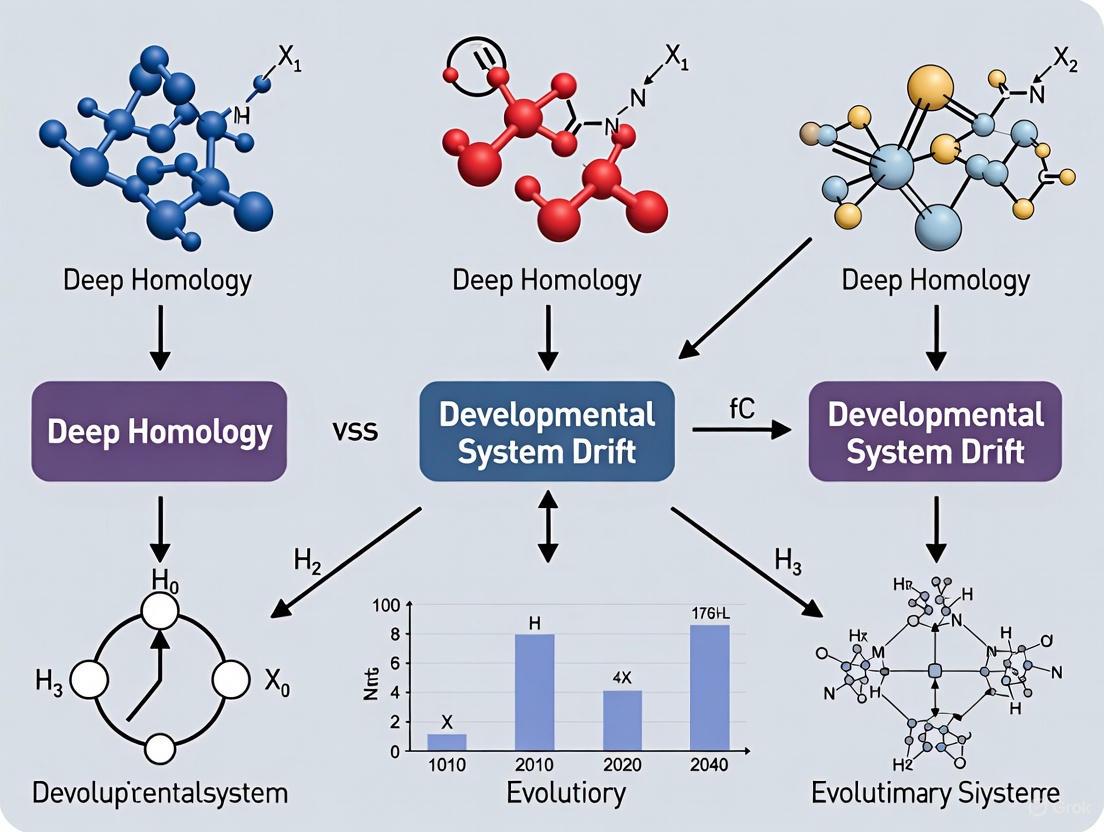
This article explores the pivotal roles of deep homology and developmental system drift (DSD) in evolutionary developmental biology and their critical implications for biomedical research.
Deep Homology vs. Developmental System Drift: Evolutionary Forces in Biomedicine and Drug Development
Abstract
This article explores the pivotal roles of deep homology and developmental system drift (DSD) in evolutionary developmental biology and their critical implications for biomedical research. Deep homology describes the conservation of ancient genetic toolkits governing development across vastly different species, while DSD explains how conserved traits can be produced by divergent genetic mechanisms over evolutionary time. For researchers and drug development professionals, understanding this interplay is essential for effective model organism selection, drug target validation, and interpreting cross-species experiments. We synthesize foundational concepts, methodological approaches, troubleshooting strategies, and validation frameworks to provide a comprehensive guide for navigating these evolutionary principles in preclinical research and therapeutic development.
Evolutionary Principles: Uncovering Deep Homology and Developmental System Drift
The concept of deep homology describes the remarkable evolutionary phenomenon where distantly related organisms share ancient genetic regulatory machinery for building morphologically similar structures. This guide objectively compares the core tenets of deep homology against the contrasting framework of developmental system drift (DSD), evaluating supporting experimental data from modern genomics, transcriptomics, and computational biology. We demonstrate that while deep homology emphasizes the conservation of a core genetic toolkit—such as Hox genes, Pax-6, and Wnt signaling pathways across bilaterians—DSD reveals how these conserved processes can be executed by divergent molecular pathways. For researchers and drug development professionals, understanding this interplay is crucial for identifying stable therapeutic targets and interpreting disease models across species.
The discovery that diverse organisms utilize a shared set of genes to control development revolutionized evolutionary and developmental biology, giving rise to the concept of a conserved genetic toolkit [1]. This toolkit, comprising transcription factors and signaling proteins like Hox, Pax, and Wnt families, underpins deep homology—the sharing of ancient evolutionary genetic programs across phylogenetically distant species for building analogous anatomical structures [1]. For instance, the Hox gene complex determines body axis patterning in both fruit flies and mammals, while Pax-6 controls eye development in organisms ranging from insects to vertebrates [1].
However, a more nuanced understanding has emerged with the concept of developmental system drift (DSD), which occurs when species maintain highly conserved morphological traits despite underlying genetic or molecular pathways diverging over evolutionary time [1] [2]. This framework challenges a simplistic view of conservation and highlights the plasticity of regulatory networks. Research on coral gastrulation has demonstrated that even morphologically conserved processes can be governed by significantly divergent gene regulatory networks (GRNs) in different species [2].
This guide compares these two research frameworks by presenting quantitative data on genetic conservation and divergence, detailing experimental methodologies for their study, and discussing the implications for biomedical research and therapeutic development.
Comparative Analysis: Core Tenets and Supporting Evidence
The following table summarizes the core principles and key evidence for the deep homology and developmental system drift paradigms.
Table 1: Comparative Analysis of Deep Homology and Developmental System Drift
| Aspect | Deep Homology | Developmental System Drift (DSD) |
|---|---|---|
| Core Principle | Conservation of ancient genetic toolkits and regulatory circuits for building homologous structures in distantly related organisms [1]. | Conservation of morphological traits despite divergence in the underlying genetic programs or molecular pathways [1] [2]. |
| Representative Evidence | - Hox genes determine body plan patterning across bilaterians [1].- Pax-6/Eyeless controls eye initiation in insects, mollusks, and vertebrates [1]. | - Different genes regulate homologous segmented features in related insect species [1].- Divergent GRNs control conserved gastrulation in Acropora coral species [2]. |
| Typical Methodology | - Candidate gene cloning via sequence homology [1].- Cross-species transgenic rescue experiments (e.g., mouse Pax-6 in Drosophila) [1]. | - Comparative transcriptomics and genomics [2].- Analysis of gene expression dynamics in non-model organisms [2]. |
| Implication for Evolution | Suggests a limited repertoire of ancient, reusable regulatory modules for building complex structures [1]. | Reveals developmental systems' plasticity and multiple genetic solutions for achieving the same phenotypic outcome [1]. |
Quantitative Evidence from Genomic and Transcriptomic Studies
Modern high-throughput technologies provide quantitative data to evaluate the extent of genetic conservation and divergence.
Table 2: Quantitative Evidence from Key Genomic and Transcriptomic Studies
| Study System | Finding Related to Deep Homology | Finding Related to Developmental System Drift | Reference |
|---|---|---|---|
| Mouse-Chicken Heart Development | Conservation of 3D chromatin structure (Genomic Regulatory Blocks) and key TF expression despite ~310 million years of divergence [3]. | Only ~10% of heart enhancers show sequence conservation; most functional conservation is positional ("indirectly conserved") [3]. | [3] |
| Acropora digitifera vs. Acropora tenuis (Coral Gastrulation) | Identification of a conserved regulatory "kernel" of 370 differentially expressed genes for gastrulation, including genes for axis specification and endoderm formation [2]. | Widespread divergence in gene regulatory networks (GRNs) and significant temporal/modular expression shifts in orthologous genes between species [2]. | [2] |
Experimental Protocols for Investigating Deep Homology and DSD
Protocol 1: Identifying Positionally Conserved, Sequence-Divergent Cis-Regulatory Elements
This protocol, based on the study of mouse and chicken embryonic hearts, uses synteny and functional genomics to find conserved regulatory elements that standard sequence alignment misses [3].
- Sample Collection & Functional Genomic Profiling: Collect tissues from equivalent developmental stages (e.g., E10.5 mouse heart, HH22 chicken heart). Perform ATAC-seq or ChIPmentation for histone modifications (e.g., H3K27ac) to map active cis-regulatory elements (CREs).
- CRE Prediction & Filtering: Use a tool like CRUP to predict high-confidence promoters and enhancers from histone modification data. Integrate these predictions with chromatin accessibility and RNA-seq data to filter for active, tissue-specific CREs.
- Ortholog Mapping with Interspecies Point Projection (IPP):
- Input: The genomic coordinates of a CRE from the source species (e.g., mouse).
- Anchor Points: Identify blocks of alignable sequences (anchor points) flanking the CRE using pairwise alignments between the source and target (e.g., chicken) genomes.
- Bridged Alignments: To improve accuracy, use multiple bridging species (e.g., other mammals, reptiles) to create additional anchor points.
- Projection: Interpolate the position of the CRE in the target genome based on its relative position between anchor points in the source genome.
- Classification: Projections near direct alignments are "Directly Conserved." Those further away but supported by bridged alignments are classified as "Indirectly Conserved," indicating functional orthology despite sequence divergence [3].
- Functional Validation: Test the in vivo enhancer activity of projected "Indirectly Conserved" elements from one species (e.g., chicken) in a model organism (e.g., mouse) using reporter assays like LacZ or GFP [3].
Protocol 2: Profiling Gene Regulatory Network Divergence During Conserved Morphogenesis
This protocol outlines a comparative transcriptomic approach to quantify DSD, as used in the study of Acropora coral gastrulation [2].
- Sample Collection: For the species being compared (e.g., A. digitifera and A. tenuis), collect biological replicates at key, morphologically conserved developmental stages (e.g., blastula, gastrula, post-gastrula).
- RNA Sequencing & Transcriptome Assembly: Extract total RNA and prepare RNA-seq libraries. After sequencing and quality control, align reads to the respective reference genomes and assemble transcripts.
- Identification of Orthologs and Paralog Groups: Use orthology prediction tools to identify one-to-one orthologs between the two species, as well as species-specific in-paralogs.
- Differential Expression and Co-expression Network Analysis: Perform differential expression analysis across stages for each species. Construct stage-specific co-expression networks or modules for each species and identify conserved versus divergent network components.
- Analysis of Paralog Usage and Alternative Splicing: Quantify differences in the expression of species-specific paralogs and analyze alternative splicing patterns across development to identify mechanisms of GRN rewiring [2].
Visualization of Conceptual and Experimental Frameworks
Diagram 1: DSD and deep homology relationship. This diagram illustrates how an ancestral gene regulatory network can evolve via two parallel mechanisms: Deep Homology, which preserves a core regulatory kernel, and Developmental System Drift, which allows for widespread network divergence, both resulting in conserved morphology.
Table 3: Key Research Reagents and Computational Resources for Evo-Devo Research
| Tool / Resource | Function / Application | Example Use Case |
|---|---|---|
| Multiple Sequence Alignments (MSAs) | Provides evolutionary information and co-evolutionary signals for predicting protein structures and interactions [4]. | Used by DeepSCFold and AlphaFold-Multimer to predict protein complex structures [4]. |
| Synteny-Based Algorithms (e.g., IPP) | Identifies orthologous genomic regions between distantly related species independent of sequence similarity [3]. | Revealed a 5x increase in conserved heart enhancers between mouse and chicken compared to alignment-based methods [3]. |
| Cross-Species Reporter Assays (e.g., LacZ/GFP) | Tests the functional conservation of putative enhancer elements in a heterologous model system [3]. | Validated the in vivo enhancer activity of sequence-divergent chicken elements in mouse embryos [3]. |
| Comparative Transcriptomics | Quantifies gene expression dynamics and identifies differentially expressed genes and co-expression modules [2]. | Uncovered divergent GRNs underlying conserved gastrulation in Acropora corals [2]. |
| High-Throughput Chromatin Profiling (ATAC-seq, ChIP-seq) | Maps open chromatin and histone modifications to identify active cis-regulatory elements [3]. | Generated high-confidence sets of promoters and enhancers in mouse and chicken embryonic hearts [3]. |
The paradigms of deep homology and developmental system drift are not mutually exclusive but represent complementary forces in evolution. Deep homology provides a powerful framework for understanding the astonishing conservation of core genetic machinery across the tree of life, offering predictable models for gene function and informing cross-species therapeutic target validation. Conversely, DSD explains the remarkable robustness and plasticity of developmental systems, revealing how conserved forms can emerge from divergent molecular paths.
For drug development professionals, this duality is critical. It underscores the value of model organisms for studying fundamental biology while simultaneously cautioning against oversimplifying the translation of molecular mechanisms from model systems to humans. Lineage-specific genetic rewiring, as seen in DSD, could underlie species-specific drug responses or side effects. Future research, leveraging the rich toolkit of comparative genomics, single-cell technologies, and genome editing in diverse organisms, will continue to refine our understanding of this interplay, ultimately enhancing the precision and efficacy of biomedical discovery.
Developmental system drift (DSD) represents a fundamental evolutionary phenomenon wherein the genetic architectures and developmental mechanisms underlying homologous traits diverge over time while the phenotypic outcomes remain conserved [5]. This concept challenges the historically prevalent assumption in evolutionary developmental biology that conserved phenotypes necessarily imply conserved genetic underpinnings. The term was originally coined by True and Haag (2001) to describe "the process by which conserved traits diverge in their developmental genetic underpinnings over evolutionary time" [5]. This conceptual framework has gained substantial empirical support across diverse biological systems, revealing that even traits with striking morphological conservation can exhibit remarkable divergence in their developmental genetic machinery.
DSD must be clearly distinguished from several related evolutionary concepts. It is distinct from genetic drift, which refers to random fluctuations in allele frequencies within populations without specific reference to phenotype conservation [5]. DSD is also separate from genetic robustness, which describes the stability of phenotypes in the face of genetic perturbations, though robustness can contribute to DSD by allowing genetic changes to accumulate without phenotypic consequences [5]. The investigation of DSD intersects with the concept of deep homology, which describes the sharing of ancestral genetic regulatory apparatus between evolutionary distant lineages, yet DSD highlights how these shared mechanisms can diverge while maintaining phenotypic outcomes [6].
Table 1: Key Definitions in Developmental System Drift Research
| Term | Definition | Distinction from DSD |
|---|---|---|
| Developmental System Drift | Divergence in genetic basis of conserved traits over evolutionary time | Primary phenomenon of interest |
| Genetic Drift | Random fluctuation in allele frequencies in populations | Population genetics process without specific phenotype relationship |
| Genetic Robustness | Stability of phenotype to genetic perturbations | System property that may enable DSD |
| Deep Homology | Shared genetic regulatory apparatus from common ancestry | Focuses on conservation rather than divergence |
| Compensatory Evolution | Selection for changes that restore function after perturbation | One potential mechanism driving DSD |
Empirical Evidence: Documented Cases of Developmental System Drift
Gastrulation in Acropora Corals
A compelling example of DSD comes from comparative studies of coral species within the genus Acropora. Research comparing Acropora digitifera and Acropora tenuis, which diverged approximately 50 million years ago, revealed that despite remarkable conservation of gastrulation morphology, these species employ substantially divergent transcriptional programs and gene regulatory networks (GRNs) [2] [7]. While both species execute the conserved developmental process of gastrulation, their gene expression profiles during this critical morphogenetic event show significant differences in temporal dynamics and modular organization. Interestingly, researchers identified a conserved regulatory "kernel" of 370 differentially expressed genes that were upregulated at the gastrula stage in both species, suggesting that evolutionary conservation operates at the level of core functional modules rather than entire networks [2]. This case illustrates how extensive rewiring of peripheral network components can occur while maintaining phenotypic output through conservation of key regulatory elements.
Nematode Vulva Development
The experimental system of Caenorhabditis nematodes has provided particularly robust evidence for the pervasiveness of DSD. A comprehensive comparative analysis of over 1,300 genes with RNA interference (RNAi) phenotypes in C. elegans and C. briggsae revealed that approximately 7% of orthologous genes produced qualitatively different phenotypes when perturbed, despite the near-identical anatomy and cell lineages of these closely related species [8]. This systematic approach demonstrated that DSD affects a substantial fraction of the genome even over relatively short evolutionary timescales. Follow-up experiments utilizing reporter constructs and gene chimeras indicated that changes in gene expression patterns and genetic context, rather than protein coding sequences, primarily drive these functional divergences [8]. This suggests that regulatory evolution plays a predominant role in DSD, with network context exerting strong influence on gene function.
Axis Patterning in Annelids
Recent research on dorsoventral (DV) axis patterning in spiralians has revealed striking examples of DSD linked to evolutionary transitions in developmental mode. Studies across four annelid species demonstrated that the ancestral signaling hierarchy for DV patterning, with Bone Morphogenetic Protein (BMP) pathway acting downstream of ERK1/2, has been disrupted in lineages that transitioned to autonomous, maternally controlled development [9]. For instance, Capitella teleta utilizes Activin/Nodal signaling for dorsoventral polarization, while Platynereis dumerilii relies on BMP signaling but only in specific embryonic regions [9]. This divergence in upstream regulatory mechanisms was accompanied by extensive rewiring of downstream target genes, illustrating how changes in developmental mode can drive diversification of genetic circuitry while preserving ultimate morphological outcomes.
Table 2: Documented Cases of Developmental System Drift Across Taxa
| Organism/Taxon | Biological Process | Key Finding | Reference |
|---|---|---|---|
| Acropora corals | Gastrulation | Divergent transcriptional programs despite morphological conservation | [2] [7] |
| Caenorhabditis nematodes | Vulva development, sex determination | 7% of orthologs show divergent RNAi phenotypes | [8] |
| Annelid worms | Dorsoventral axis patterning | Signaling hierarchy divergence linked to developmental mode transitions | [9] |
| Vertebrates | Segmentation clock | Divergent genetic mechanisms for somitogenesis | [5] |
| Insects | Gap gene networks | Regulatory network rewiring with conserved output | [5] |
Mechanisms and Drivers: How Developmental System Drift Occurs
DSD operates through several distinct but non-exclusive evolutionary mechanisms. The first involves the robustness of developmental systems to mutations in their genetic components [5]. Robust gene regulatory networks inherited from a common ancestor can accumulate genetic changes in descendant lineages without altering phenotypic outcomes, leading to divergence in genetic underpinnings over time. This neutral accumulation of changes represents one pathway through which DSD can occur.
A second mechanism involves compensatory evolution driven by natural selection [5]. When pleiotropic genes experience directional selection affecting one function, compensatory changes may occur to maintain other functions under stabilizing selection. This process can lead to substantial rewiring of genetic networks while preserving phenotypic outputs. For example, if a transcription factor acquires a novel regulatory target through selection, changes in expression patterns or co-factors may evolve to maintain its original functions, resulting in network reorganization without phenotypic change.
Research in nematodes has provided insight into the relative contributions of different molecular mechanisms to DSD. Studies comparing C. elegans and C. briggsae revealed that changes in gene expression patterns and shifts in genetic context account for most observed functional divergence, with relatively few cases attributable to changes in protein coding sequence [8]. This highlights the importance of regulatory evolution in driving DSD and suggests that gene regulatory networks undergo constant reconfiguration even when phenotypes remain stable.
Diagram 1: Conceptual Framework of Developmental System Drift. This diagram illustrates how conserved phenotypes can be maintained despite divergence in underlying genetic components and network architecture over evolutionary time.
Methodological Approaches: Experimental Protocols for Detecting DSD
Comparative Functional Genomics Protocol
The detection and characterization of DSD requires integrative approaches combining comparative genomics with functional validation. A robust protocol for identifying DSD involves several key steps:
Ortholog Identification and Phylogenetic Analysis: Identify orthologous genes across species of interest using reciprocal best BLAST hits and phylogenetic reconstruction to confirm orthology relationships [2] [8].
Expression Profiling: Conduct comparative transcriptomic analyses across multiple developmental stages using RNA sequencing. For the Acropora study, researchers collected embryos at blastula (PC), gastrula (G), and sphere (S) stages, with triplicate sampling for each stage [2]. Library preparation follows standard RNA-seq protocols with quality control measures including RIN values >8.0.
Differential Expression Analysis: Process raw sequencing reads through quality filtering (typically using FastQC), alignment to reference genomes (using HISAT2 or STAR), and read quantification (featureCounts). Differential expression is analyzed using DESeq2 or edgeR with false discovery rate correction [2].
Gene Regulatory Network Reconstruction: Infer regulatory relationships using algorithms that leverage expression correlations, transcription factor binding motifs, and chromatin accessibility data when available. Modularity analysis helps identify conserved kernels versus divergent peripheral elements [2].
Functional Validation: Implement cross-species perturbation experiments using RNAi (in amenable systems) or CRISPR-Cas9 gene editing. Critical controls include rescue experiments with heterologous transgenes to distinguish coding sequence versus regulatory evolution [8].
Cross-Species Transgene Rescue Protocol
This approach specifically tests whether functional divergence stems from changes in protein sequence versus genetic context:
Mutant Generation: Create null mutations in target genes using CRISPR-Cas9 or existing mutant strains [8].
Transgene Construction: Generate transformation vectors containing: (a) Conspecific coding sequence with conspecific regulatory regions, (b) Heterospecific coding sequence with heterospecific regulatory regions, (c) Chimeric constructs swapping coding and regulatory sequences between species [8].
Rescue Assessment: Introduce transgenes into mutant background and quantify rescue efficiency based on established phenotypic metrics. Complete rescue by heterologous transgenes indicates contextual rather than protein-based divergence [8].
Expression Pattern Comparison: Use in situ hybridization or reporter constructs (GFP fusions) to compare spatial and temporal expression patterns between orthologs [8].
Diagram 2: Experimental Workflow for Detecting Developmental System Drift. This flowchart outlines the key methodological steps for identifying and validating cases of DSD, from initial orthology determination through functional validation.
Research Reagent Solutions: Essential Tools for DSD Investigation
Table 3: Essential Research Reagents for Developmental System Drift Studies
| Reagent Category | Specific Examples | Function in DSD Research | Application Examples |
|---|---|---|---|
| Genome Editing Tools | CRISPR-Cas9 systems, TALENs | Targeted gene knockout for functional analysis | Creating null mutants for rescue assays [8] |
| Transcriptomics Kits | RNA-seq library prep kits, single-cell RNA-seq platforms | Comprehensive gene expression profiling | Comparative transcriptomics across species [2] |
| In Situ Hybridization Reagents | RNA probes, hybridization buffers, detection kits | Spatial localization of gene expression | Comparing expression patterns of orthologs [8] |
| Transgenesis Systems | Fluorescent protein vectors, Gateway cloning systems | Reporter constructs and rescue experiments | Cross-species transgene rescue [8] |
| Bioinformatics Tools | Orthology prediction software, differential expression packages, GRN inference algorithms | Data analysis and interpretation | Ortholog identification, network reconstruction [2] [8] |
Implications and Applications: From Basic Science to Biomedical Research
The recognition of DSD's prevalence has profound implications for comparative biology and biomedical research. In evolutionary developmental biology, DSD challenges the assumption that homologous structures necessarily share conserved genetic mechanisms, necessitating more nuanced approaches to homology assessment [5]. This has practical consequences for the extrapolation of findings from model organisms to less-studied taxa, as genetic pathways identified in established model systems may not be conserved in distant relatives [5] [10].
In the biomedical realm, understanding DSD is critical for appropriate use of animal models in drug development and disease modeling. As noted by Lynch (2009), "the assumption that gene functions and genetic systems are conserved between models and humans is taken for granted, often in spite of evidence that gene functions and networks diverge during evolution" [10]. Examples include functional divergence in transcription factors like HoxA-11, which has acquired novel functions in placental mammals, and differences in subcellular localization of phospholipase C zeta 1 (PLCZ1) between mice and other mammals [10]. These differences can significantly impact the translational relevance of model organism studies, particularly for rapidly evolving systems related to reproduction, immunity, and neural function [10].
Future research directions in DSD include systematic quantification of its prevalence across the tree of life, investigation of the relationship between evolutionary rates and DSD, and analysis of how developmental system properties influence susceptibility to drift. The integration of DSD awareness into comparative developmental biology promises to yield more accurate null models for evolutionary change and deeper insights into the principles governing the evolution of developmental systems [5].
Historical Context and Key Discoveries in Evolutionary Developmental Biology
Evolutionary developmental biology (evo-devo) represents a synthesis of two traditionally separate biological disciplines, comparing developmental processes across different organisms to infer how these processes have evolved over time [11]. The field investigates how changes in embryonic development during single generations relate to the evolutionary changes that occur between generations, focusing on the mechanisms that link genes (genotype) with structures (phenotype) [12]. This integrative approach has revealed that genes do not directly make structures; rather, developmental processes create structures using genetic roadmaps alongside other signals including physical forces, environmental temperature, and interspecies interactions [12]. The resurgence of evo-devo over recent decades has provided powerful new frameworks for understanding the origins of morphological diversity and the evolutionary relationships between species.
Historical Foundations and Theoretical Framework
Early Historical Context
The conceptual roots of evo-devo extend back to classical antiquity when philosophers first contemplated how animals acquire form during embryonic development [11]. Aristotle, for instance, argued against Empedocles' spontaneous emergence of order, proposing instead that embryonic development follows a predefined goal with inherent potential to become specific body parts [11]. The 19th century marked a pivotal period with the emergence of evolutionary embryology following the publications of Charles Darwin's "On the Origin of Species" (1859) and Ernst Haeckel's theory that ontogeny recapitulates phylogeny (1866) [12]. Darwin himself recognized the importance of embryology for understanding evolution, noting that shared embryonic structures implied common ancestry [11]. He cited examples like the shrimp-like larva of the barnacle, whose sessile adults looked nothing like other arthropods, as evidence for evolutionary relationships [11].
The late 19th century saw intense interest in evolutionary embryology, with leading zoologists of the era recognizing its potential for understanding evolutionary patterns. As William Bateson later recalled, "Morphology was studied because it was the material believed to be the most favorable for the elucidation of the problems of evolution, and we all thought that in embryology the quintessence of morphological truth was most palpably presented" [12]. However, frustration with reconstructing evolutionary trees from embryonic sequences, coupled with the rise of experimental embryology and the rediscovery of Mendelian genetics in 1900, eventually cast evolutionary embryology into relative obscurity for much of the 20th century [12].
The Modern Synthesis and Its Limitations
The Modern Synthesis of the early 20th century, forged between 1918 and 1930 primarily through the work of Ronald Fisher, integrated Darwin's theory of evolution with Mendel's laws of genetics into a coherent framework for evolutionary biology [11]. This synthesis largely excluded embryology from evolutionary explanation, instead focusing on population genetics and the mathematical modeling of allele frequency changes [13]. The resulting perspective viewed organisms as straightforward reflections of their component genes, with biochemical pathways and new species evolving through mutations in these genes [11]. This gene-centered approach provided a simple, nearly comprehensive picture but failed to adequately explain embryology and the emergence of complex morphological traits [11].
Throughout the mid-20th century, several influential concepts were introduced that would later prove important for evo-devo. In the 1930s, Hans Spemann and Hilde Mangold discovered embryonic induction through transplantation experiments in amphibian embryos, dramatically demonstrating the importance of cell-cell interactions in development [14]. Conrad Waddington proposed concepts of canalization (buffering of developmental pathways against perturbations) and genetic assimilation (where environmentally elicited phenotypes are eventually taken over by the genotype) [14]. mathematician Alan Turing (1952) suggested reaction-diffusion mechanisms could generate spatial patterns during morphogenesis [11] [14], while Lewis Wolpert (1969) later developed the concept of positional information, suggesting cells acquire positional identity through morphogen gradients [14].
The Rebirth of Evo-Devo
The modern emergence of evo-devo as a distinct discipline began in the 1970s, fueled by molecular genetic advances that finally allowed embryology to reconnect with evolutionary biology [11]. The term "evolutionary developmental biology" first appeared in print in 1983 in a book by Peter Calow [12]. Stephen J. Gould's 1977 book "Ontogeny and Phylogeny" and François Jacob's paper "Evolution and Tinkering" (1977) were particularly influential in revitalizing the relationship between development and evolution [11]. A pivotal discovery came in 1978 when Edward B. Lewis discovered homeotic genes that regulate development in Drosophila [11]. Shortly thereafter, homeobox sequences were found in diverse organisms including vertebrates, birds, mammals, fungi, and plants, revealing remarkable conservation of developmental control genes across eukaryotes [11]. The 1995 Nobel Prize awarded to Christiane Nüsslein-Volhard, Eric Wieschaus, and Edward B. Lewis recognized these foundational contributions to understanding genetic control of embryonic development [11].
Table 1: Key Historical Milestones in Evolutionary Developmental Biology
| Year | Discovery/Event | Key Researcher(s) | Significance |
|---|---|---|---|
| 1828 | Laws of embryonic development | Karl Ernst von Baer | Established that early embryos of different species resemble each other |
| 1859 | Theory of evolution by natural selection | Charles Darwin | Provided evolutionary framework for understanding biological diversity |
| 1866 | Biogenetic law ("ontogeny recapitulates phylogeny") | Ernst Haeckel | Proposed relationship between development and evolutionary history |
| 1977 | Publication of "Ontogeny and Phylogeny" | Stephen J. Gould | Revitalized academic interest in development-evolution relationship |
| 1978 | Discovery of homeotic genes | Edward B. Lewis | Revealed genes that control body plan organization |
| 1984 | Conservation of homeobox genes across metazoa | McGinnis, Gehring et al. | Demonstrated deep evolutionary conservation of developmental genes |
Conceptual Frameworks: Deep Homology versus Developmental System Drift
Deep Homology: Conserved Genetic Toolkits
A central concept emerging from evo-devo research is deep homology – the finding that dissimilar organs such as the eyes of insects, vertebrates and cephalopod molluscs, long thought to have evolved separately, are controlled by similar genes such as pax-6 from the evo-devo gene toolkit [11]. These toolkit genes are ancient and highly conserved across phyla, generating patterns in time and space that shape the embryo and ultimately form the body plan [11]. A key insight is that species often differ less in their structural genes than in how gene expression is regulated, with the same toolkit genes being reused multiple times in different parts of the embryo and at different developmental stages [11]. This pleiotropic reuse explains why these genes are highly conserved, as any changes would have multiple adverse consequences that natural selection would oppose [11].
Research in diverse organisms has provided compelling evidence for deep homology. For example, the distal-less gene was found to be involved in developing appendages or limbs in fruit flies, fish fins, chicken wings, marine annelid worm parapodia, tunicate ampullae and siphons, and sea urchin tube feet [11]. This gene must date back to the last common ancestor of bilateral animals before the Ediacaran Period (beginning approximately 635 million years ago), demonstrating the deep evolutionary conservation of developmental genetic toolkits [11].
Developmental System Drift: Divergent Pathways to Similar Outcomes
In contrast to deep homology, developmental system drift (DSD) describes situations where homologous morphological traits are generated by processes involving non-homologous genes, or where the relationship between evolution at genotypic and phenotypic levels becomes dissociated [15]. This phenomenon highlights how the same phenotypic outcome can be achieved through different genetic pathways over evolutionary time, revealing surprising flexibility in genotype-phenotype mapping [15].
A compelling example of developmental system drift comes from recent studies of coral species. Research on gastrulation in Acropora species (A. digitifera and A. tenuis), which diverged approximately 50 million years ago, revealed that although gastrulation is morphologically conserved, it involves divergent transcriptional programs [2]. Each species uses divergent gene regulatory networks (GRNs) despite morphological similarity, with orthologous genes showing significant temporal and modular expression divergence [2]. This GRN diversification rather than conservation occurred even as both species maintained a subset of 370 differentially expressed genes up-regulated at the gastrula stage, suggesting a conserved regulatory "kernel" for the process alongside species-specific differences in paralog usage and alternative splicing patterns [2].
Table 2: Key Comparisons Between Deep Homology and Developmental System Drift
| Characteristic | Deep Homology | Developmental System Drift |
|---|---|---|
| Genetic Basis | Conserved genetic toolkits across distantly related taxa | Divergent genetic pathways and regulatory networks |
| Phenotypic Outcome | Similar or homologous structures | Conserved morphological outcomes despite genetic divergence |
| Evolutionary Mechanism | Constrained evolution due to pleiotropic reuse of genes | Developmental buffering allowing for genetic rewiring |
| Typical Evidence | Similar regulatory genes controlling development in different lineages | Conserved morphology with divergent underlying genetics |
| Examples | Pax-6 in eye development; Distal-less in appendage formation | Gastrulation in Acropora corals; Segmentation in insects and vertebrates |
Key Experimental Models and Methodological Approaches
Experimental Models in Evo-Devo Research
Evo-devo employs diverse model organisms to understand how changes in development drive evolutionary innovation. Traditional developmental biology research has focused on established models like mice, chickens, zebrafish, and frogs, while evo-devo researchers often compare these to less conventional organisms such as the little skate (Leucoraja erinacea) [16]. For example, research on skates has been used to study how fins evolved into limbs, while studies of skate jaw development have revealed a small structure (the pseudobranch) that resembles a gill and shares cell types and gene expression features with gills, suggesting jaws evolved from gill-forming structures [16]. Complementary zebrafish studies using mutant gill-less fish have shown that genes essential for gill development are also required for proper pseudobranch development, further supporting the evolutionary connection between gills and jaws [16].
Research on coral species of the genus Acropora has also emerged as a valuable model system, particularly for understanding the evolution of developmental mechanisms at the base of animal evolution [2]. As members of the class Anthozoa within the phylum Cnidaria, corals occupy a basal position as the sister group to bilaterians, making them ideal for studying ancestral developmental mechanisms [2]. Comparative transcriptomic studies of Acropora digitifera and Acropora tenuis have provided insights into how species-specific gene duplication events and differential splicing shape developmental gene regulatory networks during gastrulation [2].
Methodological Advances and Reagent Solutions
Modern evo-devo research employs diverse methodological approaches, with recent advances in single-cell technologies and genomics proving particularly transformative [16]. The field has experienced successive waves of innovation, beginning with histological and microscopic techniques in the late 19th century, followed by molecular biological approaches for studying genes and gene expression, and more recently genome editing and sequencing technologies alongside advanced microscopy [16].
Table 3: Key Research Reagents and Methodological Approaches in Evo-Devo
| Research Reagent/Technique | Application in Evo-Devo | Experimental Function |
|---|---|---|
| Comparative transcriptomics | Analysis of gene expression divergence | Identifies conserved and divergent transcriptional programs across species |
| Single-cell RNA sequencing | Cell type identification and comparison | Reveals evolutionary relationships between cell types across species |
| Genome editing (CRISPR-Cas9) | Functional testing of candidate genes | Validates gene function in non-traditional model organisms |
| In situ hybridization | Spatial localization of gene expression | Maps expression patterns of developmental genes in embryonic tissues |
| Phylogenetic comparative methods | Reconstruction of evolutionary history | Traces evolution of developmental traits across phylogenetic trees |
Signaling Pathways and Conceptual Frameworks
The conceptual relationship between evolution and development can be visualized through several key frameworks, including the historical transformation of scientific thought and the comparative analysis of developmental processes across species.
Diagram 1: Historical and Conceptual Framework of Evo-Devo. This diagram illustrates the historical development of evolutionary developmental biology and the relationship between its key conceptual frameworks.
Experimental Evidence and Comparative Analysis
Analysis of Developmental System Drift in Coral Gastrulation
Recent research on Acropora corals provides compelling experimental evidence for developmental system drift. The experimental workflow for such studies typically involves several key stages: (1) sample collection at precise developmental stages (blastula, gastrula, sphere stages); (2) RNA extraction and sequencing; (3) reference genome alignment and transcript assembly; (4) comparative analysis of gene expression profiles; and (5) identification of conserved and divergent genetic elements [2].
In the Acropora study, researchers collected samples at three developmental stages (blastula/prawn chip stage, gastrula, and sphere stage) from both A. digitifera and A. tenuis, with triplicate libraries for each stage [2]. After quality filtering, they obtained approximately 30.5 and 22.9 million reads for A. digitifera and A. tenuis respectively, which were aligned against reference genomes resulting in 68.1-89.6% and 67.51-73.74% mapping rates [2]. This approach identified 38,110 merged transcripts for A. digitifera and 28,284 for A. tenuis, revealing significant differences in transcript number potentially explained by greater sequencing depth in A. digitifera [2].
The key finding was that although gastrulation is morphologically conserved between these species, they employ divergent transcriptional programs, with orthologous genes showing significant temporal and modular expression divergence [2]. Despite this overall divergence, researchers identified a conserved regulatory "kernel" of 370 differentially expressed genes upregulated at the gastrula stage in both species, with roles in axis specification, endoderm formation, and neurogenesis [2]. Additionally, species-specific differences in paralog usage and alternative splicing patterns indicated independent peripheral rewiring of this conserved module, with A. digitifera exhibiting greater paralog divergence consistent with neofunctionalization, while A. tenuis showed more redundant expression suggesting greater regulatory robustness [2].
Process Homology and Evolutionary Dynamics
The concept of process homology has emerged as an important framework in evo-devo, referring to situations where ontogenetic processes can be homologous without homology of the underlying genes or gene networks [15]. Such processes constitute a dissociable level and distinctive unit of comparison requiring specific criteria of homology, including sameness of parts, morphological outcome, topological position, dynamical properties, dynamical complexity, and evidence for transitional forms [15].
Animal segmentation processes provide illustrative examples of evolutionary dissociation between levels of organization. For instance, vertebrate somitogenesis (body segment formation) involves posterior tissue growth and a regulatory network with three dynamical modules: a cell-autonomous oscillator (segmentation clock), cell-cell signaling for synchronization, and a graded long-range modulation of clock period (wavefront) [15]. These dynamical modules and their interactions are conserved across vertebrates from fish to mammals, resulting in periodic waves of gene expression that form somites (blocks of mesodermal tissue) [15]. However, the underlying molecular mechanisms differ in many details, with segmentation clocks based on negative auto-regulation by Hes/Her transcription factor family members but exhibiting built-in redundancy and variation [15].
Diagram 2: Experimental Workflow in Comparative Evo-Devo Studies. This diagram outlines the key methodological steps in comparative evolutionary developmental biology research, from sample collection through analytical outcomes.
Implications and Future Directions
The integration of developmental and evolutionary biology has profound implications for understanding morphological diversity and evolutionary processes. Evo-devo has revealed that new morphological features and ultimately new species arise through variations in the genetic toolkit, either when genes are expressed in new patterns, or when toolkit genes acquire additional functions [11]. There is also growing recognition that epigenetic changes may be consolidated at the genetic level, potentially playing important roles in the history of multicellular life [11].
Contemporary evo-devo continues to expand into new research areas including ecology, physiology, and behavior, with some speculating that it may eventually be absorbed into a unified evolutionary biology or serve as a major component of a broader biological synthesis [12]. The field is increasingly characterized by the application of genomic approaches, imaging technologies, and quantitative morphometrics to a broader range of organisms, enabling better appreciation of morphological diversity origins [14]. These approaches are being applied to fundamental questions about major evolutionary transitions, structural diversification and modification, intraspecific variation, and developmental plasticity [14].
Recent trends toward intertwining development and evolution contrast sharply with the separation of these domains during most of the 20th century [13]. This integration faces conceptual and methodological challenges but offers promising frameworks for understanding how the extraordinary range of living organisms arose [14]. As evo-devo continues to develop, it provides increasingly powerful approaches for addressing long-standing questions about the origins of morphological diversity and the evolutionary processes that generate biological complexity.
The interplay between genetic robustness and compensatory evolution represents a central paradigm for understanding how complex biological systems maintain stability while evolving new functions. These theoretical frameworks provide essential insights into the fundamental question of how organisms preserve phenotypic stability in the face of constant genetic and environmental perturbations. Within evolutionary developmental biology, this tension manifests prominently in the debate between deep homology—the conservation of genetic toolkits across vast evolutionary distances—and developmental system drift (DSD)—the divergence of genetic mechanisms underlying conserved phenotypes [5].
Genetic robustness describes the capacity of biological systems to produce consistent phenotypic outputs despite variations in their genetic blueprint or environmental conditions [17]. This robustness emerges from multiple biological mechanisms, including gene regulatory network architecture, feedback loops, and biochemical buffering systems. When robustness fails or is overwhelmed, compensatory evolution provides an adaptive pathway whereby mutations elsewhere in the genome mitigate the fitness consequences of initial deleterious mutations [18]. The investigation of these processes has profound implications for diverse fields, from understanding evolutionary trajectories to identifying novel therapeutic strategies in disease treatment.
This article examines key experimental evidence illuminating the mechanisms connecting genetic robustness to compensatory evolution, framed within the conceptual contrast between deep homology and developmental system drift. We integrate quantitative findings from recent studies and provide detailed methodological protocols to equip researchers with practical tools for investigating these evolutionary phenomena.
Core Theoretical Frameworks: Deep Homology vs. Developmental System Drift
Deep Homology: Conserved Genetic Toolkits
The concept of deep homology posits that homologous developmental mechanisms, particularly conserved gene regulatory networks (GRNs), underlie the formation of homologous structures across divergent lineages [6]. This framework emphasizes evolutionary conservation at the genetic level, suggesting that phenotypic conservation often reflects underlying genetic conservation. Deep homology has been instrumental in identifying core "kernels" of regulatory logic that persist throughout evolution, such as the Hox genes that pattern the anterior-posterior axis across bilaterians.
Developmental System Drift: Divergent Paths to Similar Outcomes
In contrast, developmental system drift describes the phenomenon whereby the genetic underpinnings of homologous traits diverge over evolutionary time while the phenotypic outcome remains conserved [5]. True and Haag first formally defined DSD in 2001, noting that conserved traits can diverge in their developmental genetic implementation. DSD occurs through two primary mechanisms: (1) neutral accumulation of mutations in genetically robust systems, and (2) compensatory evolution in response to selective pressures [5]. This framework challenges straightforward extrapolation from model organisms to distant taxa and highlights the dynamic nature of genotype-phenotype relationships.
Table 1: Key Characteristics of Deep Homology and Developmental System Drift
| Characteristic | Deep Homology | Developmental System Drift |
|---|---|---|
| Genetic Basis | Conserved genetic toolkits and regulatory circuits | Divergent genetic mechanisms |
| Phenotypic Outcome | Conserved homologous structures | Conserved homologous structures |
| Evolutionary Process | Stabilizing selection on developmental mechanisms | Neutral drift or compensatory evolution |
| GRN Architecture | Conserved kernel networks | Rewired regulatory connections |
| Experimental Implication | Mechanisms transferable across species | Limited extrapolation between distant lineages |
Experimental Evidence: Model Systems and Key Findings
Compensatory Evolution in Yeast Under Replication Stress
A 2025 study investigating compensatory evolution in Saccharomyces cerevisiae experiencing constitutive DNA replication stress provides compelling evidence for predictable evolutionary trajectories across environments [19]. Researchers evolved 96 parallel populations of budding yeast with ctf4Δ mutations (inducing replication stress) across four glucose concentrations (0.25%, 0.5%, 2%, and 8%). Despite significant impacts of glucose availability on physiology and adaptation rates, whole-genome sequencing revealed remarkable genetic robustness and parallelism across conditions.
Table 2: Key Quantitative Findings from Yeast Compensatory Evolution Study [19]
| Experimental Variable | Observation/Measurement | Interpretation/Significance |
|---|---|---|
| Glucose Impact | Affected growth rate and adaptation speed | Environmental context modulates physiological expression of mutation |
| Genetic Convergence | Recurrent mutations across glucose conditions | High predictability of evolutionary repair despite environmental differences |
| Fitness Restoration | Near wild-type fitness achieved through compensatory mutations | Compensatory evolution effectively mitigates initial fitness defects |
| Novel Adaptive Module | RNA polymerase II mediator complex mutations | Identification of previously unrecognized mechanism for replication stress adaptation |
| Pleiotropic Costs | Associated fitness costs of compensatory mutations | Evolutionary trade-offs even with successful compensation |
The experimental data demonstrated that glucose starvation (0.25%-0.5%) restored some cell cycle traits to wild-type levels and improved competitive fitness of ctf4Δ mutants, unlike the severe growth impairments observed under standard (2%) or high (8%) glucose conditions [19]. Nevertheless, compensatory mutations that arose recurrently across these different environments collectively recapitulated the fitness of evolved lines and proved advantageous across all tested macronutrient conditions. This finding challenges the presumption that environmental constraints inevitably lead to distinct evolutionary outcomes and instead highlights the robustness of compensatory evolution to constitutive replication stress.
Developmental System Drift in Coral Gastrulation
A complementary 2025 study on gastrulation in Acropora digitifera and Acropora tenuis provides compelling evidence for developmental system drift operating in early embryonic development [2]. Despite morphological conservation of gastrulation between these coral species that diverged approximately 50 million years ago, comparative transcriptomics revealed significant divergence in their underlying gene regulatory networks.
The research identified only 370 differentially expressed genes that were consistently up-regulated at the gastrula stage in both species, representing a conserved regulatory "kernel" for this fundamental developmental process [2]. Beyond this core module, the species exhibited substantial differences in paralog usage and alternative splicing patterns, indicating independent peripheral rewiring of the conserved module. Specifically, A. digitifera showed greater paralog divergence consistent with neofunctionalization, while A. tenuis displayed more redundant expression patterns suggesting regulatory robustness [2]. These findings illustrate how developmental system drift can maintain phenotypic conservation through different genetic strategies.
Gene Network Robustness as a Multivariate Character
Theoretical work using individual-based simulations of gene regulatory network evolution demonstrates that robustness to different perturbation types (genetic, environmental) represents a multivariate character with both correlated and independent components [20]. This research reveals that while five different measurements of gene expression robustness were substantially correlated, robustness was mutationally variable in multiple dimensions, and distinct robustness components could evolve differentially under direct selection pressure.
This modeling approach provides a conceptual framework for understanding how robustness mechanisms can facilitate compensatory evolution. The simulations demonstrated that the sensitivity of gene expression to mutations and environmental factors, while relying on the same gene networks, can have distinct evolutionary histories, enabling specialized adaptation to different perturbation sources while maintaining overall phenotypic stability [20].
Experimental Protocols for Investigating Robustness and Compensation
Laboratory Evolution Protocol for Compensatory Mutation Detection
The following detailed protocol for experimental evolution studies is adapted from methodologies successfully employed in yeast compensatory evolution research [19] [18]:
Strain Construction: Generate isogenic strains with defined gene deletions or mutations inducing measurable fitness defects. For replication stress studies, delete non-essential replication fork components like CTF4.
Evolution Setup: Initiate multiple (≥12) parallel populations for each experimental condition. Maintain populations through serial passaging for 400+ generations, ensuring effective population sizes sufficient for beneficial mutation emergence.
Environmental Manipulation: Apply distinct environmental conditions to test GxE interactions. For nutrient studies, utilize defined media with varying carbon source concentrations (e.g., 0.25%, 0.5%, 2%, 8% glucose).
Fitness Monitoring: Regularly assess competitive fitness relative to ancestral strains using flow cytometry or selective plating. Measure growth parameters (doubling time, carrying capacity) through growth curve analysis.
Whole-Genome Sequencing: Isolate genomic DNA from evolved populations and ancestral controls. Prepare sequencing libraries using Illumina-compatible protocols. Sequence to sufficient coverage (≥50x) for variant detection.
Variant Identification: Process sequencing data through standard pipelines (alignment, duplicate marking, base quality recalibration). Call variants using GATK or similar tools. Filter for high-confidence mutations.
Validation: Recapitulate identified mutations in ancestral backgrounds through CRISPR/Cas9 editing or cross-and-isolate strategies. Confirm fitness effects through competitive assays.
Gene Regulatory Network Robustness Assessment
This protocol for quantifying robustness in gene regulatory networks adapts approaches from empirical and theoretical studies [20] [17]:
Perturbation Generation: Create systematic perturbations using:
- Genetic perturbations: siRNA knockdown with varying doses [17], CRISPRi, or degron systems for titratable depletion
- Environmental perturbations: controlled variation in temperature, nutrient conditions, or chemical treatments
Expression Profiling: Measure transcriptome-wide gene expression responses using RNA-seq across multiple replicates for each perturbation condition.
Robustness Quantification: Calculate robustness metrics for each gene:
- Genetic robustness: Variance in expression across genetic backgrounds or perturbation levels
- Environmental robustness: Variance in expression across environmental conditions
- Stochastic robustness: Variance between isogenic individuals in controlled conditions
Network Analysis: Construct co-expression networks from perturbation response data. Identify network properties (modularity, connectivity) correlated with robustness measures.
Correlation Analysis: Assess congruence between different robustness types by comparing robustness profiles across perturbation classes.
The Scientist's Toolkit: Essential Research Reagents
Table 3: Key Research Reagents for Investigating Robustness and Compensatory Evolution
| Reagent/Category | Specific Examples | Experimental Function | Application Context |
|---|---|---|---|
| Model Organisms | Saccharomyces cerevisiae, Caenorhabditis elegans | Laboratory evolution studies | Compensatory mutation detection [19] [18] |
| Gene Perturbation Tools | CRISPR-Cas9, siRNA, degron systems | Targeted genetic perturbations | Robustness mechanism identification [17] |
| Genomic Technologies | Whole-genome sequencing, RNA-seq | Mutation identification, expression profiling | Compensatory mutation mapping [19] [18] |
| Environmental Control | Chemostats, defined media | Precise environmental manipulation | GxE interaction studies [19] |
| Gene Regulatory Network Models | Boolean networks, ordinary differential equations | Theoretical robustness analysis | Network property prediction [20] |
Integrated Analysis: Implications for Evolutionary Biology and Biomedicine
The experimental evidence reveals that compensatory evolution operates with surprising predictability for core cellular processes like DNA replication, even across diverse environmental contexts [19]. This convergence suggests constraints on evolutionary paths that may make certain outcomes more predictable than previously assumed. Simultaneously, the prevalence of developmental system drift in traits like gastrulation mechanisms highlights how different genetic solutions can achieve phenotypically similar outcomes [2] [5].
This apparent paradox finds resolution in the hierarchical organization of biological systems. Conserved phenotypic outcomes may emerge through a combination of deeply homologous core mechanisms ("kernels") and diverged peripheral circuitry. The relative balance between these components determines whether deep homology or developmental system drift predominates in any specific evolutionary context.
These theoretical frameworks have significant implications for biomedical research, particularly in understanding cancer evolution and drug resistance. The capacity of cancer cells to compensate for oncogene-induced replication stress through predictable mutational patterns mirrors the compensatory evolution observed in yeast models [19]. Similarly, the revelation that compensatory mutations often fail to restore wild-type gene expression patterns [18] suggests limitations to evolutionary reversion that could be exploited therapeutically.
The integration of genetic robustness and compensatory evolution frameworks provides a more complete understanding of evolutionary dynamics than either perspective alone. Experimental evidence confirms that biological systems employ both robust architectures that buffer against perturbations and compensatory mechanisms that restore function when robustness is exceeded. The tension between deep homology and developmental system drift reflects different outcomes of these fundamental evolutionary processes operating across varying timescales and organizational hierarchies.
Future research in this field will benefit from expanded taxonomic sampling, moving beyond traditional model organisms to assess the full scope of developmental system drift across the tree of life. Similarly, integrating single-cell resolution analyses with evolutionary approaches will reveal how robustness and compensation operate within heterogeneous cell populations. These advances will further illuminate the principles governing evolutionary innovation and constraint, with significant implications for understanding disease mechanisms and developing novel therapeutic strategies.
The debate between deep homology and developmental system drift (DSD) represents a central tension in evolutionary developmental biology (evo-devo) [5]. Deep homology describes the situation where conserved genetic mechanisms underlie the development of homologous structures across divergent lineages, suggesting the existence of an ancestral developmental genetic program [6]. In contrast, developmental system drift occurs when the genetic basis for homologous traits diverges over evolutionary time despite conservation of the phenotype itself [5].
This guide objectively compares two canonical model systems—Pax6 in eye development and nematode vulva formation—that have been fundamental to this debate. We examine the supporting experimental data, methodologies, and research tools that have shaped our understanding of these systems, providing a structured comparison for researchers investigating conserved developmental mechanisms.
Pax6 in Eye Development: A Case for Deep Homology
Molecular Biology and Functional Conservation
The PAX6 gene encodes a transcription factor containing two DNA-binding domains (a paired domain and a homeodomain) connected by a linker region, followed by a proline-serine-threonine-rich transactivation domain [21]. This molecular structure is highly conserved across metazoans, with homologous genes identified in mice, zebrafish, quail, Drosophila, and annelids [21] [22].
Key functional evidence supporting deep homology comes from gain-of-function experiments where PAX6 overexpression induced ectopic eye formation in both Drosophila and Xenopus [21]. Loss-of-function studies across species consistently demonstrate PAX6's essential role in ocular development. In humans, heterozygous mutations cause aniridia (iris hypoplasia), while in annelids (Capitella teleta), morpholino knockdown disrupts eye formation and nervous system development [21] [22].
Pax6 Isoforms and Regulatory Complexity
The PAX6 locus generates multiple protein isoforms through alternative splicing and promoter usage, primarily the canonical PAX6 and PAX6(5a) isoforms, which have distinct DNA-binding properties and expression patterns during development [21]. The ratio of these isoforms appears critical for normal eye development, with canonical PAX6 dominating during embryonic stages and PAX6(5a) becoming more prominent in later development and adulthood [21].
Table 1: PAX6 Isoforms and Their Functional Characteristics
| Isoform | Amino Acids | Structural Features | Expression Pattern | Functional Specialization |
|---|---|---|---|---|
| Canonical PAX6 | 422 | Standard paired domain | Embryonic lens, cornea, retina | Cell fate determination, differentiation |
| PAX6(5a) | 436 | 14aa insertion in paired domain | Adult eye tissues, posterior retina | Cell proliferation, foveal development |
| Pax6ΔPD | Variant | Lacks paired domain | Peripheral neural retina, ciliary body | Distinct role in mammalian eye development |
Experimental Approaches and Key Findings
Research on PAX6 has employed diverse methodological approaches across model organisms:
Functional Studies: Knock-in mouse models demonstrate that Pax6(5a) can partially substitute for Pax6 in brain development but not in lens induction or retinal differentiation, indicating context-dependent functional specificity [23]. In annelids, morpholino knockdown experiments show that the paired domain alone is sufficient for partial Pax6 function [22].
Expression Analysis: Comparative studies reveal conserved Pax6 expression in the developing eye and nervous system of vertebrates, Drosophila, and annelids [22]. In C. elegans, the Pax6 ortholog vab-3 is expressed in sensory organ precursors and regulates integrin expression during gonad development [24] [25].
Nematode Vulva Formation: A System for Studying Developmental Drift
Evolutionary Variation in Vulval Development
While Pax6 represents a case of deep homology, nematode vulva formation exemplifies developmental system drift, where the homologous developmental process (vulva formation) shows significant divergence in cellular and molecular mechanisms across nematode species despite morphological conservation [5].
The vulva develops from specific precursor cells during larval stages, with variations in cell lineage patterns, inductive signaling, and underlying genetic pathways across nematode species. This system demonstrates how conserved phenotypes can be maintained despite changes in genetic mechanisms.
Molecular Pathways and Regulatory Networks
The search results indicate limited specific information on nematode vulva formation, but references to "nematode vulva development" as an example of DSD suggest this system shows evolutionary divergence in the genetic basis of a conserved trait [5]. This contrasts with the strong conservation observed for Pax6 in eye development.
Comparative Analysis: Deep Homology vs. Developmental System Drift
Structured Comparison of Both Systems
Table 2: Comparative Analysis of Pax6 and Vulva Development Model Systems
| Characteristic | Pax6 in Eye Development | Nematode Vulva Formation |
|---|---|---|
| Degree of Conservation | High conservation of gene sequence, expression, and function across bilaterians | Conserved morphology with divergent genetic mechanisms across nematodes |
| Molecular Mechanisms | Conserved transcription factor with similar DNA-binding properties and targets | Divergent signaling pathways and cell interactions across species |
| Evidence for Deep Homology | Strong: Ectopic eye induction, similar loss-of-function phenotypes, conserved expression | Weak: Different genetic pathways produce similar morphological outcomes |
| Evidence for DSD | Limited: Mainly isoform usage and regulatory elements show some divergence | Strong: Different molecular pathways underlie homologous structures |
| Experimental Advantages | Cross-species functional tests possible, multiple model organisms available | Comparative development within nematodes, precise cell lineage analysis |
| Theoretical Significance | Supports existence of ancestral genetic program for eye development | Illustrates how developmental system drift produces phenotypic stability |
Theoretical Implications for Evolutionary Developmental Biology
The contrast between these systems informs fundamental questions in evo-devo. Pax6 exemplifies deep homology, where conservation of genetic machinery suggests the eye may have a single evolutionary origin [21] [22]. Conversely, nematode vulva formation demonstrates developmental system drift, where conserved phenotypes can be maintained despite genetic divergence [5].
DSD may occur through two primary mechanisms: (1) the inherent robustness of developmental gene regulatory networks to mutations in some components, allowing genetic changes to accumulate in descendant lineages, or (2) compensatory evolution by natural selection, where adaptive change in one process disrupts another, necessitating compensatory changes to restore function [5].
Research Reagent Solutions and Experimental Tools
Essential Research Materials for Developmental Studies
Table 3: Key Research Reagents for Investigating Deep Homology and DSD
| Reagent/Category | Specific Examples | Research Application | Function in Experimental Design |
|---|---|---|---|
| Gene Perturbation Tools | Morpholinos (Capitella), CRISPR/Cas9, RNAi | Loss-of-function studies | Determine gene necessity in development |
| Expression Reporters | GFP transcriptional fusions, lacZ reporters | Spatial-temporal expression mapping | Visualize gene expression patterns in vivo |
| Antibodies | Anti-PAX6 antibodies, cell type-specific markers | Protein localization and characterization | Detect protein expression and cell identity |
| Transgenic Systems | Knock-in mice (Pax6), C. elegans transgenes | Functional analysis in model organisms | Test gene function and regulation in context |
| Comparative Genomics | Multiple species genomes, regulatory element maps | Evolutionary sequence analysis | Identify conserved and divergent elements |
Signaling Pathways and Molecular Interactions
The following diagrams illustrate key signaling pathways and regulatory relationships for both model systems, created using DOT language with compliance to the specified formatting requirements.
Pax6 Regulatory Network in Eye Development
Developmental System Drift in Nematodes
These canonical examples illustrate how deep homology and developmental system drift represent complementary rather than mutually exclusive evolutionary phenomena. Pax6 in eye development demonstrates remarkable conservation of genetic machinery across diverse lineages, supporting the concept of deep homology. Conversely, nematode vulva formation shows how developmental system drift can maintain phenotypic stability despite genetic divergence.
For researchers investigating conserved developmental mechanisms, both phenomena highlight the importance of:
- Comparative approaches across multiple species
- Functional tests of gene function in different contexts
- Detailed mechanistic studies of regulatory networks
- Integration of evolutionary and developmental perspectives
Understanding the balance between deep homology and developmental system drift has practical implications for biomedical research, particularly in drug development where model organism studies are extrapolated to humans. The contrasting patterns observed in these canonical systems provide fundamental insights into the evolutionary processes that both conserve and modify developmental programs across phylogenetic distances.
Research Approaches: Detecting and Analyzing Evolutionary Patterns
Comparative Genomics and Phylogenetic Analysis for Homology Assessment
In evolutionary developmental biology (evo-devo), two compelling conceptual frameworks offer contrasting explanations for how similar traits arise across diverse species: deep homology and developmental system drift. The deep homology paradigm suggests that conserved genetic toolkits, often originating from common ancestors, are redeployed to build analogous structures in distantly related organisms [6]. In contrast, developmental system drift describes how conserved morphological traits can be maintained despite underlying genetic and regulatory divergence [2]. Resolving which mechanism operates in specific evolutionary contexts requires precise methodological approaches for assessing homology at the molecular level.
Comparative genomics and phylogenetic analysis provide the essential empirical foundation for distinguishing between these evolutionary models. These methodologies enable researchers to trace the evolutionary history of genes and regulatory elements across species, identifying conserved molecular pathways that may underlie deep homology versus diverged mechanisms that maintain similar forms through developmental system drift. The accuracy of such assessments hinges on sophisticated computational tools that can handle the ever-increasing volume of genomic data while maintaining phylogenetic accuracy [26] [27]. This guide examines and compares current methodologies central to this endeavor, providing researchers with objective performance data and experimental protocols to inform their experimental designs in evolutionary genetics and drug discovery research.
Tool Comparison: Performance Benchmarks and Applications
Quantitative Performance Metrics
Table 1: Comparative Performance of Orthology Inference Tools
| Tool | Core Methodology | Scalability | Reported Precision | Reported Recall | Primary Application Context |
|---|---|---|---|---|---|
| FastOMA | k-mer-based mapping to reference HOGs, taxonomy-guided subsampling | Linear scaling (2,086 genomes in <24h) | 0.955 (SwissTree) | 0.69 (SwissTree) | Large-scale phylogenomic studies [26] [27] |
| OrthoFinder | All-against-all comparisons, gene tree inference | Quadratic scaling | Moderate (varies) | High (0.8-0.9 range) | Medium-scale comparative genomics [27] |
| PhyloTune | DNA language model, attention-guided region selection | Efficient subtree updates | Moderate (RF distance: 0.021-0.054) | N/A | Taxonomic classification, tree updating [28] |
| CompàreGenome | BLASTN-based homology, similarity classes | Handles small microbial genomes effectively | High for strain differentiation | N/A | Strain-level comparisons, genomic diversity [29] |
Experimental Workflow for Homology Assessment
Table 2: Experimental Protocols for Key Analyses
| Analysis Type | Input Requirements | Key Processing Steps | Output Deliverables |
|---|---|---|---|
| Orthology Inference (FastOMA) | Proteome sets, species tree [27] | 1. OMAmer mapping to reference HOGs2. RootHOG construction3. Taxonomy-guided tree traversal4. HOG delineation at each taxonomic level | Hierarchical Orthologous Groups (HOGs), Ortholog pairs, Gene trees |
| Developmental System Drift Analysis | RNA-seq across developmental stages, reference genomes [2] | 1. Transcriptome assembly and quantification2. Ortholog identification3. Differential expression analysis4. Paralog/isoform usage assessment | Conserved/divergent GRN components, Expression divergence metrics |
| Phylogenetic Tree Updating (PhyloTune) | New sequences, existing phylogenetic tree [28] | 1. Taxonomic unit identification using DNA BERT2. High-attention region extraction3. Subtree alignment with MAFFT4. Tree inference with RAxML | Updated phylogenetic tree, Attention-mapped genomic regions |
Methodological Implementation: From Theory to Practice
FastOMA Algorithm for Large-Scale Orthology Inference
The FastOMA algorithm represents a significant advancement in orthology inference methodology, specifically designed to address the scalability challenges posed by modern genomic datasets. Its implementation follows a structured two-step process that efficiently handles thousands of eukaryotic genomes. In the initial step, FastOMA employs OMAmer, a k-mer-based tool, to map input protein sequences to reference Hierarchical Orthologous Groups (HOGs) from the OMA database [26] [27]. This alignment-free approach dramatically reduces computational requirements by avoiding all-against-all sequence comparisons between unrelated proteins. Sequences that cannot be mapped to existing HOGs are processed using Linclust from the MMseqs package to identify novel gene families, ensuring comprehensive coverage [27].
The second phase of the FastOMA algorithm involves resolving the nested structure of HOGs through a bottom-up traversal of the species tree. At each taxonomic level, the algorithm identifies groups of genes that descended from a single ancestral gene, effectively distinguishing orthologs from paralogs through phylogenetic analysis [27]. This approach maintains the high accuracy and resolution of the established OMA method while achieving linear scalability through taxonomy-guided subsampling. The methodology is particularly valuable for detecting deep homologies across widely diverged taxa, as it can process thousands of genomes while maintaining high precision (0.955 on SwissTree benchmarks) [27].
Assessing Developmental System Drift in Coral Gastrulation
A recent investigation of developmental system drift in Acropora corals provides an exemplary protocol for quantifying divergence in gene regulatory networks (GRNs) underlying conserved morphological processes. The experimental design compared gene expression profiles during gastrulation of Acropora digitifera and Acropora tenuis, species that diverged approximately 50 million years ago [2]. Researchers generated RNA-seq libraries from triplicate samples of three key developmental stages: blastula (PC), gastrula (G), and sphere (S) stages. Following quality filtering and alignment to reference genomes, they assembled transcriptomes and identified orthologous genes using comparative genomic approaches [2].
The analysis revealed significant temporal and modular expression divergence between orthologous genes, indicating substantial GRN diversification despite morphological conservation of gastrulation [2]. Researchers identified a conserved regulatory "kernel" of 370 differentially expressed genes upregulated at the gastrula stage in both species, with roles in axis specification, endoderm formation, and neurogenesis. This core module was accompanied by species-specific differences in paralog usage and alternative splicing patterns, indicating independent peripheral rewiring of the developmental program [2]. This methodological approach provides a template for distinguishing conserved regulatory kernels from diverged network components, essential for discriminating deep homology from developmental system drift.
Figure 1: FastOMA Orthology Inference Workflow. The diagram illustrates the two-stage process of orthology inference using FastOMA, from input data to biological interpretation.
Research Reagent Solutions: Essential Materials for Genomic Analysis
Table 3: Key Research Reagents and Computational Tools
| Resource Category | Specific Tool/Resource | Function in Analysis | Application Context |
|---|---|---|---|
| Orthology Databases | OMA Browser (3000 genomes) [26] | Reference hierarchical orthologous groups | Evolutionary inference, annotation transfer |
| Sequence Alignment | DIAMOND [26], BLAST+ [29] | Fast protein/DNA sequence comparison | Homology detection, functional annotation |
| Phylogenetic Inference | RAxML [28], FastTree [28] | Phylogenetic tree construction | Evolutionary relationship reconstruction |
| Genomic Comparison | CompàreGenome [29] | Genomic diversity estimation | Strain differentiation, conserved gene identification |
| Taxonomic Classification | PhyloTune (DNA BERT) [28] | Taxonomic unit identification | Phylogenetic tree updating, novelty detection |
| Programming Environments | Biopython [29], SeqinR [29] | Genomic data manipulation | Pipeline development, custom analyses |
Integration of Genomic and Phylogenetic Approaches
The synergy between comparative genomic and phylogenetic methods creates a powerful framework for addressing fundamental questions in evolutionary biology. PhyloTune exemplifies this integration by leveraging pretrained DNA language models to identify taxonomic affiliations and extract phylogenetically informative regions from genomic sequences [28]. This approach uses transformer-based attention mechanisms to identify nucleotide positions that contribute most significantly to taxonomic classification, which often correspond to evolutionarily conserved regions informative for phylogenetic reconstruction [28]. The method substantially reduces computational requirements by focusing analysis on informative subsequences and enabling targeted subtree updates rather than complete tree reconstruction.
For researchers investigating deep homology versus developmental system drift, combined approaches offer distinct advantages. The conserved regulatory kernels identified in the Acropora study [2] represent potential candidates for deep homology—ancestral genetic modules reused in similar developmental processes across distantly related species. Conversely, the diverged transcriptional programs and species-specific paralog usage illustrate developmental system drift in action. Distinguishing between these scenarios requires both fine-scale orthology assessment (provided by tools like FastOMA) and phylogenetic context (provided by methods like PhyloTune). This integrated methodology enables researchers to determine whether similar traits in different species share a common genetic basis (deep homology) or have evolved different genetic solutions to achieve similar outcomes (developmental system drift).
Figure 2: Analytical Framework for Distinguishing Evolutionary Patterns. The diagram shows how orthogonal methodologies combine to discriminate between deep homology and developmental system drift.
The expanding toolkit for comparative genomics and phylogenetic analysis offers researchers powerful methods to distinguish between deep homology and developmental system drift—two fundamental but contrasting evolutionary patterns. FastOMA provides unprecedented scalability for orthology inference across thousands of genomes, making it ideal for large-scale phylogenomic studies seeking to identify deeply conserved genes [26] [27]. PhyloTune offers efficient phylogenetic tree updating through attention-guided sequence analysis, valuable for placing newly sequenced organisms in established taxonomic frameworks [28]. CompàreGenome delivers sensitive strain-level differentiation, appropriate for studies of closely related organisms or population-level analyses [29].
Method selection should be guided by specific research questions and scale requirements. For investigating deep homology across widely divergent taxa, high-precision orthology inference coupled with phylogenetic context is essential. When studying developmental system drift, detailed expression analyses alongside orthology assessment can reveal how conserved morphological outcomes emerge from diverged genetic programs. As genomic datasets continue to expand, the integration of these approaches will be increasingly crucial for unraveling the complex interplay between genetic conservation and innovation in evolutionary processes. The methodological comparisons and experimental protocols presented here provide a foundation for researchers to design rigorous, scalable studies in evolutionary genomics and developmental biology.
Gene Regulatory Network (GRN) Mapping and Comparative Analysis
Gene Regulatory Networks (GRNs) represent the complex circuits of interactions among genes, proteins, and other molecules that control developmental processes, cellular responses, and organismal functions. Deciphering these networks is fundamental to understanding the molecular basis of life, with profound implications for disease research and therapeutic development [30]. In evolutionary developmental biology (evo-devo), a central thesis revolves around two contrasting yet complementary concepts: deep homology, which posits the conservation of ancient genetic regulatory kernels across vast evolutionary distances, and developmental system drift, which describes how conserved morphological traits can be underpinned by diverged molecular programs [2] [31]. This guide objectively compares the performance of modern computational methods for GRN reconstruction, framing the discussion within this core evolutionary tension and providing the experimental data and protocols needed for their application.
Comparative Performance of GRN Inference Methods
The performance of GRN inference algorithms varies significantly based on the data type, underlying assumptions, and biological context. The table below summarizes key metrics and characteristics of prominent methods.
Table 1: Performance Comparison of GRN Inference Methods
| Method | Core Algorithm | Optimal Data Type | Reported Performance Advantage | Key Experimental Validation |
|---|---|---|---|---|
| CMIA with KSG-MI [32] | Conditional Mutual Information Augmentation with k-Nearest Neighbor MI | Bulk transcriptomics (Microarray, RNA-seq) | 20-35% improvement in precision-recall over gold standards on synthetic benchmarks [32] | In-silico benchmarking with 15 synthetic networks from DREAM challenges [32] |
| Hybrid ML/DL [33] | Combined Convolutional Neural Networks & Machine Learning | Bulk transcriptomics from multiple species | >95% accuracy on holdout test datasets; superior identification of known TFs [33] | Cross-species validation in Arabidopsis, poplar, and maize; transfer learning [33] |
| DAZZLE [34] | Stabilized Autoencoder with Dropout Augmentation | Single-cell RNA-seq (scRNA-seq) | Improved robustness & stability over DeepSEM; handles zero-inflation in scRNA-seq [34] | Benchmarking on BEELINE datasets; application to longitudinal mouse microglia data (~15,000 genes) [34] |
| GENIE3/GRNBoost2 [34] | Tree-based (Random Forest) | Bulk or single-cell transcriptomics | Found to work well on single-cell data without modification [34] | Widely used in pipelines like SCENIC for co-expression module identification [34] |
| PIDC [34] | Partial Information Decomposition | Single-cell RNA-seq | Models cellular heterogeneity using mutual information among gene sets [34] | Not specified in search results |
Experimental Protocols for Key GRN Methodologies
Protocol: kNN-Based Mutual Information Estimation with CMIA
This protocol is designed for inferring GRNs from bulk transcriptomic data and is implemented in the CMIA algorithm [32].
- Input Data Preparation: Collect a gene expression matrix (e.g., from RNA-seq or microarrays) with dimensions N (conditions/perturbations) × G (genes). Normalize the data appropriately.
- Mutual Information (MI) Estimation: For each pair or triplet of genes, calculate the MI using the Kraskov–Stögbauer–Grassberger (KSG) k-nearest neighbor estimator.
- Network Inference with CMIA: Apply the Context Likelihood of Relatedness (CLR)-inspired CMIA algorithm. This step uses the estimated MI values to remove spurious indirect interactions and reconstruct the direct regulatory network.
- Benchmarking: Validate the inferred network against a gold-standard synthetic network (e.g., from DREAM challenges) using precision-recall curves [32].
Protocol: GRN Inference from Single-Cell Data with DAZZLE
This protocol addresses the specific challenge of "dropout" (false zero counts) in single-cell RNA-seq data [34].
- Input Data Preprocessing: Transform the raw UMI count matrix x using the transformation log(x + 1) to reduce variance and avoid undefined values.
- Dropout Augmentation (DA): Augment the input training data by artificially introducing additional zeros to simulate dropout events. This regularizes the model and increases its robustness to zero-inflation.
- Model Training with DAZZLE: Train the DAZZLE model, which uses a variational autoencoder (VAE) architecture where the adjacency matrix A is a parameter. The model is trained to reconstruct its input while learning the direct dependencies between genes.
- Sparsity Control: Apply a new optimization method to control the sparsity of the inferred adjacency matrix, preventing overfitting.
- Network Extraction and Validation: Extract the finalized GRN from the trained model and evaluate its performance using benchmark datasets like those from the BEELINE framework [34].
Visualizing Concepts and Workflows
Deep Homology in a Conserved Enhancer
This diagram illustrates the concept of deep homology through the conserved SFZE regulatory syntax in the brachyury gene, which drives notochord development across chordates and is found in even more ancient ancestors [35].
Developmental System Drift in Gene Networks
This diagram contrasts the concepts of conserved morphology and divergent GRNs, as observed in the gastrulation of two Acropora coral species, supporting the model of developmental system drift [2] [31].
Single-Cell GRN Inference with Dropout Augmentation
This workflow outlines the DAZZLE pipeline for inferring GRNs from single-cell RNA-sequencing data, specifically designed to handle data sparsity (dropout) [34].
The Scientist's Toolkit: Essential Research Reagents & Materials
Table 2: Key Research Reagents and Computational Tools for GRN Analysis
| Item/Resource | Function in GRN Research | Example Application Context |
|---|---|---|
| CMIA Algorithm [32] | A computational method for inferring direct regulatory interactions from gene expression data. | Reconstructing high-precision networks from bulk transcriptomic data (e.g., microarray, RNA-seq). |
| DAZZLE Software [34] | A robust tool for GRN inference from single-cell RNA-seq data, specifically handling dropout noise. | Inferring context-specific networks from sparse single-cell datasets. |
| Compass Framework [36] | A database (CompassDB) and R package (CompassR) for comparative analysis of gene regulation across tissues/cell types. | Identifying tissue-specific vs. universally active cis-regulatory elements (CREs). |
| ArcCreERT2 Mouse Line [37] | An activity-dependent genetic system for permanently tagging and visualizing neurons active during a specific experience. | Mapping and comparing neural ensembles (engrams) underlying different memories or behaviors. |
| SMARTTR R Package [37] | A tool for registering cell count data to a brain atlas and performing network-based statistical analysis. | Brain-wide analysis of functional connectivity from imaging-based activity maps. |
| Transfer Learning [33] | A machine learning strategy to apply knowledge from a data-rich species to a data-poor target species. | Predicting GRNs in non-model plant or animal species with limited experimental data. |
Experimental Perturbation Studies Across Multiple Species
Understanding how different species respond to experimental perturbations provides crucial insights into evolutionary developmental biology. This guide compares computational methods for analyzing perturbation effects across species, focusing on the context of deep homology versus developmental system drift (DSD). DSD occurs when conserved traits diverge in their genetic underpinnings over evolutionary time despite maintaining similar phenotypic outputs [5]. For researchers and drug development professionals, recognizing these differences is essential for extrapolating findings from model organisms and understanding the stability of gene regulatory networks across species.
Method Comparison: Single-Cell Perturbation Analysis Tools
The table below summarizes key computational methods for analyzing experimental perturbations in single-cell RNA sequencing data, particularly relevant for cross-species comparisons.
Table 1: Comparison of Single-Cell Perturbation Analysis Methods
| Method | Key Approach | Data Input | Output Metrics | Strengths | Limitations |
|---|---|---|---|---|---|
| MELD [38] | Graph signal processing using sample-associated relative likelihood | scRNA-seq from multiple conditions | Relative likelihood scores, Vertex Frequency Clusters | 57% more accurate than next-best method; identifies granular perturbation responses | Limited to discrete experimental conditions |
| CINEMA-OT [39] | Causal inference + optimal transport for counterfactual pairs | scRNA-seq with perturbation data | Individual Treatment Effects (ITE), Synergy metrics | Separates confounding from treatment effects; handles multiple combined treatments | Requires substantial computational resources; complex implementation |
| Cluster-Based Methods [38] | Discrete clustering before differential analysis | scRNA-seq datasets | Fold changes, p-values within clusters | Simple implementation; easily interpretable | Misses subtle perturbation responses; oversimplifies data geometry |
Experimental Protocols for Perturbation Studies
MELD Algorithm Workflow
The MELD algorithm processes single-cell data through these methodological steps [38]:
Graph Construction: Build an affinity graph G = {V, E} by applying an anisotropic kernel function to the dataset X = {x₁, x₂, ..., xₙ} where each xᵢ represents a cell's transcriptomic profile.
Indicator Signal Creation: Instantiate one-hot indicator matrix Y, with one column for each unique experimental condition in label set y.
Normalization: Column-wise L1 normalization of Y to yield Yₙₒᵣₘ, accounting for different cell counts per sample.
Density Estimation: Apply manifold heat filter over (G, Yₙₒᵣₘ) to calculate sample-associated density estimates using the graph filter: f̂(x,t) = e⁻ᵗᴸx = Ψh(Λ)Ψ⁻¹x where t is kernel bandwidth, L is graph Laplacian, Ψ and Λ are eigenvectors and eigenvalues of L.
Relative Likelihood Calculation: Row-wise L1 normalization to yield sample-associated relative likelihoods, representing the probability of observing each cell in each condition.
CINEMA-OT Causal Inference Protocol
CINEMA-OT employs this multi-stage analytical pipeline for causal perturbation analysis [39]:
Confounder Identification: Apply Independent Component Analysis (ICA) to separate confounding variation from treatment-associated variation using a Chatterjee's coefficient-based distribution-free test.
Reweighting (CINEMA-OT-W): For datasets with differential abundance, align treated cells by k-nearest neighbors in untreated condition, cluster based on confounder space, and subsample to equalize ratios.
Optimal Transport Matching: Implement entropic regularization with Sinkhorn-Knopp algorithm to compute causally matched counterfactual cell pairs while setting treatment-associated factors to zero.
Individual Treatment Effect Calculation: Compute ITE matrices as cell-by-gene matrices representing perturbation responses.
Downstream Analysis: Perform response clustering, synergy analysis for combined treatments, and biological process enrichment.
Visualization of Method Workflows
MELD Algorithm Workflow
CINEMA-OT Causal Inference
DSD Versus Deep Homology
The Scientist's Toolkit: Research Reagent Solutions
Table 2: Essential Research Reagents for Perturbation Studies
| Reagent/Resource | Function | Application in Perturbation Studies |
|---|---|---|
| scRNA-seq platforms | High-throughput transcriptome profiling | Capturing cellular states across conditions and species [38] |
| MELD Python package | Sample-associated relative likelihood estimation | Quantifying perturbation effects across continuous manifold [38] |
| CINEMA-OT algorithm | Causal inference matching | Identifying true treatment effects separated from confounders [39] |
| Optimal transport algorithms | Distributional matching between conditions | Generating counterfactual cell pairs for causal analysis [39] |
| Gene set enrichment tools | Biological process annotation | Interpreting differentially expressed genes in evolutionary context [38] |
| Independent Component Analysis | Source signal separation | Isolating confounding factors from treatment-associated variation [39] |
Discussion: Implications for Deep Homology vs. Developmental System Drift
The methods compared in this guide enable researchers to distinguish between deep homology (conserved genetic mechanisms) and developmental system drift in perturbation responses. DSD represents cases where "conserved traits diverge in their developmental genetic underpinnings over evolutionary time" [5], which can occur through two primary mechanisms:
Network Robustness: Developmental gene regulatory networks can tolerate mutations in some components while maintaining phenotypic output, allowing genetic changes to accumulate in descendant lineages [5].
Compensatory Evolution: When pleiotropic correlations exist between developmental processes, adaptive changes in one process may disrupt another, necessitating compensatory changes that alter genetic architecture while preserving function [5].
Tools like MELD and CINEMA-OT provide the resolution necessary to detect these evolutionary patterns by quantifying subtle, continuous changes in perturbation responses across species. For drug development professionals, this distinction is critical when extrapolating results from model organisms to humans, as DSD can lead to unexpected therapeutic outcomes when genetic mechanisms have diverged despite phenotypic conservation.
Dynamical Systems Modeling for Process Homology Evaluation
In evolutionary developmental biology (evo-devo), a central challenge is determining whether similar developmental processes in different lineages are truly homologous—derived from a common ancestral process—or the result of convergent evolution. This question sits at the heart of the debate between deep homology (the sharing of ancient genetic regulatory apparatus) and developmental system drift (the divergence of genetic mechanisms underlying conserved traits) [6]. Dynamical systems modeling provides a powerful analytical framework to resolve this debate by moving beyond simple genetic similarity to evaluate the underlying logic and behavior of developmental processes themselves.
Process homology can exist even without homology of the underlying genes or gene networks, as these genetic elements can diverge over evolutionary time while the core dynamics of the process remain conserved [15]. For example, vertebrate somitogenesis and insect segmentation processes can be homologous despite significant differences in their specific genetic components [15]. This perspective requires a shift in how we conceptualize and evaluate homology, focusing on the dynamic properties of developmental systems rather than merely their constituent parts. Dynamical systems modeling enables researchers to characterize these properties mathematically, creating a rigorous foundation for comparing processes across evolutionary lineages and testing hypotheses about their historical relationships.
Theoretical Foundation: Process Homology in the Era of Developmental System Drift
Defining Process Homology
The concept of process homology represents a significant expansion of traditional homology concepts, which have primarily focused on morphological structures or genetic sequences. Process homology specifically concerns the conservation of dynamical properties across evolutionary lineages, even when the molecular components have diverged. According to recent research, ontogenetic processes constitute a dissociable level and distinctive unit of comparison requiring their own specific criteria of homology [15].
The core challenge in establishing process homology lies in the widespread phenomenon of developmental system drift, wherein conserved morphological traits are generated by divergent genetic mechanisms [2]. This phenomenon is vividly illustrated in coral gastrulation, where despite morphological conservation between Acropora digitifera and Acropora tenuis, comparative transcriptomics reveals significant divergence in their underlying gene regulatory networks [2]. This evidence supports the concept that developmental processes can maintain similar outputs through different molecular means, complicating simple homology assessments based solely on genetic similarity.
Criteria for Establishing Process Homology
Research has proposed six specific criteria for establishing homology of developmental processes [15]:
- Sameness of parts: Conservation of core components or modules within the process.
- Morphological outcome: Similarity in the resulting morphological structures.
- Topological position: Conservation of the process within the broader developmental context.
- Dynamical properties: Similarity in the quantitative behavior and regulatory logic.
- Dynamical complexity: Conservation of the level of system integration and interaction.
- Evidence for transitional forms: Historical evidence linking the processes through evolutionary intermediates.
These criteria emphasize that process homology is fundamentally about conserved system dynamics rather than merely conserved components. Dynamical systems modeling provides the mathematical framework necessary to quantify these dynamic properties, enabling rigorous comparative analysis.
Software Toolkit for Dynamical Modeling in Evo-Devo
Selecting appropriate software is critical for constructing and analyzing dynamical models of developmental processes. The table below compares key simulation tools suitable for process homology research:
| Software Tool | Best For | Key Features for Evo-Devo Modeling | Licensing & Cost |
|---|---|---|---|
| MATLAB/Simulink | Control systems, multi-domain dynamical systems [40] [41] | - Graphical environment for model-based design [40]- Tight MATLAB integration for data analysis [40]- Extensive toolboxes [40] | Commercial, starts at $840/year [42] |
| COMSOL Multiphysics | Complex, multi-physics simulations [40] | - Coupling of different physical phenomena [40]- Extensive pre-built physics modules [40] | Commercial, starts at ~$6,000/year [40] |
| AnyLogic | Multi-method simulation [40] [43] | - Combines system dynamics, agent-based, discrete event [40]- Cloud-based experimentation [42] | Commercial, free PLE for education [43] |
| Vensim | Continuous simulation with stocks and flows [43] | - Flexible array syntax- Calibration optimization, Markov chain Monte Carlo [43] | Commercial, free PLE for education [43] |
| OpenFOAM | Computational fluid dynamics (CFD) [40] | - Open-source, highly customizable [40]- Extensive CFD solvers [40] | Free, open-source [40] |
| Berkeley Madonna | Building mathematical models for research [43] | - Solves ODEs, difference equations [43]- Suitable for large-scale, boundary value problems [43] | Commercial [43] |
| NetLogo | Agent-based modeling [43] | - Accessible environment for agent-based simulation [43] | Free, GPLv2 [43] |
Selection Guidelines for Research Applications
The choice of modeling software depends heavily on the specific research question and type of developmental process being studied. For tissue-level patterning processes involving reaction-diffusion mechanisms or mechanical interactions, COMSOL Multiphysics or OpenFOAM provide appropriate physics-based simulation capabilities [40]. For gene regulatory network dynamics, MATLAB/Simulink or Berkeley Madonna offer robust differential equation solvers and parameter optimization tools [40] [43]. For cell-based behaviors where individual cell decisions drive population-level patterns, AnyLogic or NetLogo provide flexible agent-based modeling frameworks [40] [43].
Experimental Framework: Quantifying Process Homology
Core Methodological Pipeline
The evaluation of process homology through dynamical modeling follows a systematic workflow that integrates experimental data with computational analysis. The diagram below illustrates this pipeline:
Key Experimental Protocols
Protocol 1: Gene Regulatory Network Conservation Analysis
This protocol evaluates whether conserved morphological outcomes arise from deeply homologous regulatory networks or through developmental system drift, using transcriptomic data from comparable developmental stages across species [2].
- Sample Collection: Collect biological samples at equivalent developmental stages from multiple species (e.g., blastula, gastrula, and post-gastrula stages) [2].
- RNA Sequencing: Perform RNA-seq with triplicate sampling for statistical power. Sequence to a minimum depth of 20 million reads per sample and map to respective reference genomes [2].
- Differential Expression: Identify differentially expressed genes between developmental stages within each species using appropriate statistical thresholds (e.g., FDR < 0.05).
- Orthology Mapping: Map orthologous genes between species using reciprocal best BLAST hits or orthology databases.
- Network Construction: Reconstruct gene regulatory networks for each species using time-series expression data with algorithms like GENIE3 or dynamic Bayesian networks.
- Conservation Scoring: Calculate conservation metrics for network topology, including:
- Edge conservation rate: Percentage of regulatory interactions shared between species
- Network modularity preservation: Conservation of co-expression modules
- Hub gene conservation: Preservation of highly connected genes
This approach successfully identified that despite morphological conservation during gastrulation in Acropora corals, only a small conserved "kernel" of 370 genes maintained coordinated expression, while significant GRN divergence indicated developmental system drift [2].
Protocol 2: Dynamical Property Comparison
This protocol quantifies the conservation of dynamic behaviors in developmental processes, focusing on properties like oscillatory dynamics, stability, and response to perturbation.
- System Identification: Define key system variables (e.g., morphogen concentrations, cell states) from experimental data.
- Model Structure: Formulate mathematical models (typically ordinary or partial differential equations) capturing the core regulatory logic.
- Parameter Estimation: Fit model parameters to quantitative time-series data using optimization algorithms (e.g., particle swarm optimization, Markov Chain Monte Carlo).
- Bifurcation Analysis: Identify critical parameter values where system behavior qualitatively changes (bifurcations).
- Robustness Testing: Evaluate system performance under parameter variations and stochastic noise.
- Cross-Species Comparison: Compare estimated parameters and dynamic properties across species, focusing on:
- Time-scale similarity (e.g., oscillation periods)
- Phase relationships between components
- Response characteristics to perturbations
This method has been applied to vertebrate segmentation clocks, revealing conserved oscillatory dynamics despite differences in specific genetic components [15].
Essential Research Reagents and Computational Tools
Successful implementation of dynamical modeling for process homology requires both wet-lab and computational resources. The table below details key solutions:
| Category | Item | Function & Application |
|---|---|---|
| Experimental Data Generation | RNA-seq reagents | Profiling transcriptome dynamics across developmental stages [2] |
| Live imaging reagents (e.g., fluorescent reporters) | Quantifying spatiotemporal dynamics of gene expression | |
| CRISPR/Cas9 mutagenesis kits | Functional testing of network components through perturbation | |
| Computational Infrastructure | High-performance computing cluster | Handling large-scale simulations and parameter searches |
| Data visualization workstations | Interactive exploration of complex simulation results | |
| Version control systems (e.g., Git) | Managing collaborative model development | |
| Software & Algorithms | Differential equation solvers | Simulating continuous deterministic systems |
| Stochastic simulation algorithms | Modeling systems with low copy numbers or high noise | |
| Parameter optimization tools | Estimating model parameters from experimental data | |
| Model reduction algorithms | Simplifying complex models while preserving essential dynamics |
Case Study: Segmentation Clock Evolution
The vertebrate segmentation clock provides a compelling case study for process homology evaluation through dynamical modeling. This biological oscillator controls the rhythmic formation of body segments (somites) during embryogenesis [15].
Computational models of the segmentation clock typically incorporate three dynamical modules: (1) a cell-autonomous genetic oscillator based on Hes/Her transcription factors, (2) intercellular coupling that synchronizes neighboring cells, and (3) a slowly varying regulatory gradient (wavefront) that terminates oscillations [15]. These models reveal that the core dynamic behavior—traveling waves of gene expression emerging from coupled oscillators—is conserved across vertebrates, representing a clear case of process homology.
However, comparative analysis reveals significant differences in network architecture and specific molecular components between species, illustrating developmental system drift [15]. For example, while the core negative feedback loop is conserved, additional regulatory layers and differing sets of paralogous genes contribute to the oscillator in different lineages. This case demonstrates how dynamical modeling can disentangle conserved processes from divergent mechanisms, providing a more nuanced understanding of evolutionary relationships.
Future Directions and Implementation Recommendations
As dynamical modeling approaches become increasingly integrated into evolutionary developmental biology, several promising directions emerge. Multi-scale models that connect molecular regulatory networks to tissue-level morphogenesis will provide deeper insights into how process homology is maintained across organizational levels. Additionally, machine learning approaches for automated parameter estimation and model selection will enable more comprehensive comparison of developmental processes across diverse species.
For research groups implementing these approaches, we recommend:
- Start with well-characterized model systems where comparative data exists
- Develop simple models first, then incrementally increase complexity
- Establish collaborations between experimental and theoretical researchers
- Utilize available open-source tools to minimize initial costs
- Implement version control and documentation practices from the outset
The integration of dynamical systems modeling with comparative developmental biology represents a powerful approach for resolving longstanding questions about process homology, deep homology, and developmental system drift. By focusing on the conserved logic and dynamics of developmental processes rather than merely their molecular components, this framework provides a more principled basis for understanding the evolutionary relationships between complex biological systems.
Interspecies Hybridization and Developmental Genetics Approaches
Interspecies hybridization, the process where genetically distinct species interbreed, serves as a powerful experimental paradigm for investigating fundamental questions in evolutionary developmental biology. This approach provides critical insights into the genetic and developmental mechanisms underlying evolutionary novelty, adaptation, and speciation. Current research in this field is largely framed by two contrasting conceptual frameworks: deep homology, which emphasizes the conservation of genetic toolkits across vast evolutionary distances, and developmental system drift (DSD), which describes how conserved traits diverge in their genetic underpinnings while maintaining phenotypic output [5]. The tension between these frameworks shapes investigative approaches, as researchers seek to determine whether hybrid traits emerge from deeply conserved genetic networks or through novel genetic combinations and compensatory evolution.
Studies of interspecific hybrids have revealed that this phenomenon is not merely evolutionary "noise" but can generate adaptive potential through various mechanisms. Hybridization creates novel genomes that are immediately exposed to natural selection, potentially accelerating evolutionary processes [44]. This is particularly valuable for understanding how organisms adapt to extreme environmental stresses and how new lineages emerge. For developmental genetics, hybridization experiments function as natural genetic screens, revealing how divergent developmental systems interact when combined in a single organism. These approaches are shedding light on the evolution of developmental pathways, the architecture of reproductive isolation, and the genetic basis of adaptive traits [45] [46].
Experimental Models in Interspecies Hybridization
Yeast Model Systems
Saccharomyces yeasts have emerged as premier model systems for studying interspecies hybridization due to their facile genetics, rapid generation times, and amenability to genomic approaches. Species within the Saccharomyces sensu stricto complex, including S. cerevisiae, S. paradoxus, S. mikatae, S. kudriavzevii, and S. bayanus, show nucleotide sequence divergences ranging from 15% to 35% yet maintain the ability to form viable hybrids despite low meiotic fertility [45]. This combination of significant genetic divergence with weak prezygotic barriers makes them ideal for hybridization studies.
Natural yeast hybrids were first suspected in polyploid brewing strains such as Saccharomyces pastorianus (formerly S. carlsbergensis), which was later shown through DNA-DNA reassociation studies to be a partial allodiploid arising from natural hybridization between S. cerevisiae and S. bayanus [45]. Subsequent genomic analyses have revealed numerous independently formed hybrids between various Saccharomyces species in industrial fermentation environments, demonstrating the ecological relevance of these hybridization events.
Experimental evolution approaches using yeast hybrids have produced insights into their adaptive potential. For instance, when exposed to UV-mimetic conditions for approximately 100 generations, both hybrid and parental yeast populations showed evidence of adaptation, though contrary to expectations, hybrids achieved a lower rate of adaptation than parental species [47]. This suggests potential limits to hybrid advantage under certain stress conditions, possibly resulting from interactions between DNA damage and the inherent genetic instability of hybrids.
Plant Model Systems
The genus Senecio (Asteraceae) provides an excellent plant model for studying the role of hybridization in adaptation and speciation. A classic example is found on Mount Etna, Sicily, where two species, S. aethnensis (high-elevation) and S. chrysanthemifolius (low-elevation), form a stable hybrid zone at intermediate elevations [46]. These species exhibit dramatic differences in leaf morphology, physiology, and gene expression patterns despite relatively recent divergence (<200,000 years ago) and ongoing gene flow.
Studies of these species have identified candidate genes potentially involved in adaptation to different elevations, including genes related to high light intensity, UV stress, sulphur metabolism, dehydration, and cold stress [46]. The maintenance of species differences despite hybridization suggests the operation of multiple isolating mechanisms, including genetic incompatibilities and strong divergent selection against hybrids.
Other plant systems like Helianthus (sunflowers) have demonstrated that hybrid zones can be "semi-permeable," with barriers to gene flow in some genomic regions but free introgression in others [46]. The Mentha genus also showcases successful application of interspecific hybridization in crop improvement, where specific characteristics such as disease resistance are transferred from wild species to cultivated varieties [48].
Pathogenic Fungal Systems
Interspecific hybridization plays a significant role in the evolution of pathogenic fungi, with important implications for public health. Clinically important opportunistic pathogens such as Candida albicans derived from a single hybrid ancestor, with descendant species like C. stellatoidea and C. africana diverging through large-scale loss of heterozygosity (LOH) [49]. Hybrids within the Cryptococcus genus contribute significantly to cryptococcosis cases in Europe and show evidence of transgressive segregation in traits related to antifungal drug resistance [49].
These pathogenic hybrids present compelling systems for studying how hybridization affects traits like virulence, drug resistance, and host adaptation. The observation that approximately 30% of cryptococcosis cases in Europe are caused by hybrids highlights the medical relevance of understanding hybridization in pathogenic fungi [49].
Quantitative Comparison of Hybridization Outcomes
Table 1: Fitness and Adaptation Metrics in Experimental Hybridization Studies
| Organism System | Hybrid Type | Fitness Measure | Key Findings | Reference |
|---|---|---|---|---|
| Saccharomyces yeast | Interspecific (S. cerevisiae × S. paradoxus) | Adaptation rate to UV-mimetic conditions | Hybrids showed lower adaptive potential than parents despite genomic instability | [47] |
| Tridacna clams | Interspecific (T. maxima × T. crocea) | Growth rate & survival | Hybrids showed 24.47% survival at one year, with significantly faster growth than parental species | [50] |
| Senecio plants | Natural hybrid zone (S. aethnensis × S. chrysanthemifolius) | Phenotypic intermediacy & gene flow | Hybrids show intermediate phenotypes with evidence of divergent selection maintaining species differences | [46] |
| Saccharomyces yeast | Artificial (S. cerevisiae × S. kudriavzevii) | Antifungal drug resistance | Broad phenotypic diversity in progeny; identified 41 QTL regions with novel resistance associations | [49] |
| Crop plants | Various interspecific crosses | Agricultural trait improvement | Successful transfer of disease resistance, environmental adaptability, and quality traits | [48] [51] |
Table 2: Genomic and Developmental Consequences of Hybridization
| Consequence Type | Manifestation | Evolutionary Significance | Example Systems |
|---|---|---|---|
| Transcriptome shock | Altered gene expression patterns | May create novel phenotypic variation for selection | Senecio hybrid zone [46] |
| Genomic instability | Chromosome loss, aneuploidy, LOH | Accelerated genome evolution; potential for rapid adaptation | Yeast hybrids [45] [49] |
| Transgressive segregation | Phenotypes outside parental range | Source of evolutionary novelty; potential adaptation to new niches | Sunflower hybrids [46] |
| Uniparental chromosome elimination | Complete loss of one parent's chromosomes | Postzygotic barrier; can produce haploid individuals | Cereal hybrids [48] |
| Regulatory network rewiring | Changes in GRN architecture | Altered developmental trajectories; developmental system drift | Various plant hybrids [5] |
Methodological Approaches and Experimental Protocols
Hybrid Creation and Validation
The creation of interspecific hybrids follows distinct protocols across different model systems. In yeast systems, experimental crosses typically involve mixing haploid strains of different species in liquid medium, followed by plating on double selection media to isolate diploid hybrids [47]. For example, in studies of S. cerevisiae × S. kudriavzevii hybrids, researchers grew haploid strains overnight, diluted them to standard optical density, mixed them in tubes, and inoculated multiple replicates of mating cultures [49]. After incubation, mating cultures were spotted on double selection solid medium, with individual colonies picked as founder populations for evolution experiments.
In plant systems, interspecific hybridization may require more specialized approaches to overcome reproductive barriers. Embryo rescue techniques have been successfully applied to produce original interspecific hybrids in roses and other plants [48]. In clonal crops like Mentha, in vitro plant breeding and propagation advancements have provided powerful tools for genetic enhancement through interspecific hybridization, overcoming limitations of sexual hybridization [48].
Validation of successful hybridization employs various molecular techniques. Capillary electrophoresis has been used to confirm hybrids in Tridacna clams [50], while in yeast systems, hybridization with subtelomeric sequences, AFLP analyses, and comparative genome hybridization (CGH) arrays have been employed [45]. More recently, whole-genome sequencing has become the gold standard for identifying hybrid genomes and introgressed regions.
Phenotypic Screening and Selection
Phenotypic screening of hybrids employs both laboratory assays and field observations. In antifungal resistance studies with yeast hybrids, researchers screen progeny in the presence of various antifungal drugs including azoles, echinocandins, and pyrimidine analogues [49]. Typical protocols involve growing hybrid strains in 96-well microtiter plates, incubating them to saturation, and then stamping them onto solid media plates containing antifungal agents at different concentrations [49]. Fitness is then quantified through growth measurements over time.
In plant systems, phenotypic screening often focuses on agriculturally relevant traits such as growth rate, survival, disease resistance, and environmental stress tolerance. In Tridacna clam hybrids, researchers measured shell length, survival rates, and mantle color patterns, finding that hybrid offspring displayed substantial heterosis with faster growth rates and enhanced coloration compared to parental species [50].
Genetic and Genomic Analyses
Modern hybridization studies increasingly rely on genomic approaches to unravel the genetic consequences of hybridization. Quantitative Trait Locus (QTL) mapping has been successfully applied in yeast hybrid systems to identify genomic regions associated with traits like antifungal resistance [49]. This approach involves comparing alleles between pools of high-fitness and low-fitness offspring to identify hybrid-specific genetic regions involved in resistance.
Gene expression analyses through RNA sequencing have revealed how hybridization affects transcriptional networks. Studies in Senecio hybrids have identified genes showing transgressive expression patterns (outside the parental range), as well as evidence for compensatory evolution in regulatory networks [46]. These expression differences often correlate with physiological and morphological traits relevant to adaptation.
Genomic stability in hybrids is assessed through various approaches, including karyotyping, fluorescence in situ hybridization (FISH), and analysis of loss of heterozygosity (LOH). In yeast hybrids, researchers have documented rapid genomic changes including chromosome loss, aneuploidy, translocations, and LOH events that contribute to hybrid genome evolution [45].
Visualization of Research Approaches
Conceptual Framework for Interspecies Hybridization Research
Genomic and Developmental Consequences of Hybridization
The Scientist's Toolkit: Essential Research Reagents and Materials
Table 3: Key Research Reagents and Experimental Materials
| Reagent/Material | Primary Function | Application Examples | Technical Notes |
|---|---|---|---|
| Double selection media (YPD + antibiotics) | Selection of successful hybrids | Yeast interspecific crosses [47] | Typically contains nourseothricin (100 μg/ml) and hygromycin B (250 μg/ml) |
| 4-Nitroquinoline 1-oxide (4-NQO) | UV-mimetic DNA damaging agent | Experimental evolution under DNA damage stress [47] | Mimics UV radiation effects; challenges DNA repair mechanisms |
| Antifungal agents (azoles, echinocandins) | Selection pressure for resistance studies | Screening hybrid yeast populations [49] | Includes fluconazole, micafungin, flucytosine; reveals transgressive segregation |
| Molecular markers (AFLP, microsatellites, SNPs) | Genotyping and tracking introgression | Hybrid zone analysis; QTL mapping [45] [49] | Essential for identifying hybrid-specific genetic regions |
| RNA sequencing reagents | Transcriptome profiling | Analysis of transcriptome shock in hybrids [46] | Reveals gene expression changes following genome combination |
| Embryo rescue media | Overcoming postzygotic barriers | Plant interspecific hybridization [48] | Enables recovery of hybrid embryos that would otherwise abort |
The study of interspecies hybridization through developmental genetics approaches continues to provide fundamental insights into evolutionary processes. The integration of genomic tools with ecological and developmental perspectives has transformed hybridization from a taxonomic curiosity into a powerful framework for understanding how genetic and developmental systems evolve. The tension between deep homology and developmental system drift frameworks has proven particularly productive, driving research that reveals both the remarkable conservation and the surprising flexibility of developmental systems.
Future research in this field will likely focus on several promising directions. First, the integration of time-series analyses of hybrid genomes will clarify the dynamics of genomic stabilization following hybridization events. Second, single-cell approaches will reveal how hybridization affects developmental trajectories at unprecedented resolution. Third, the application of these approaches to non-model organisms will expand our understanding of the taxonomic distribution and variability of hybridization outcomes. Finally, the growing recognition of hybridization's role in generating adaptive variation, particularly in response to rapid environmental change, underscores the practical importance of these fundamental studies for conservation, agriculture, and medicine.
Research Challenges: Navigating DSD in Model Organism Translation
Identifying and Mitigating DSD in Preclinical Model Selection
A fundamental assumption in preclinical research is that biological mechanisms discovered in model organisms are conserved and translatable to humans. This concept of deep homology—where similar developmental processes are controlled by similar genetic machinery across diverse species—has long underpinned the use of animal models in drug development [6]. However, a significant challenge emerges from the phenomenon of developmental system drift (DSD), where conserved traits diverge in their genetic underpinnings over evolutionary time despite conservation of the phenotype [5]. This evolutionary process complicates extrapolation from model organisms to humans and presents substantial barriers to translational success.
DSD occurs through two primary mechanisms: through the robustness of developmental gene regulatory networks to mutations in some of their components, and through compensatory evolution by natural selection when pleiotropically correlated processes are disrupted by adaptive changes [5]. When DSD has occurred, the genetic mechanism for a trait is not shared between homologous traits in different species, and assuming otherwise leads to experimental error and failed translations [5]. Understanding and detecting DSD is therefore critically important for selecting appropriate preclinical models and for establishing reliable patterns of conservation and variability for conserved developmental traits and their underlying mechanisms.
Understanding Developmental System Drift: Concepts and Evidence
Defining Developmental System Drift
Developmental system drift was originally defined by True and Haag as "the process by which conserved traits diverge in their developmental genetic underpinnings over evolutionary time" [5]. This definition highlights the crucial distinction between phenotypic conservation and genetic conservation. DSD is distinct from both genetic drift (random fluctuation in allele frequencies) and genetic robustness (stability of a phenotype to genetic perturbations), though these concepts may contribute to DSD processes [5].
A key requirement for identifying DSD is establishing trait homology—demonstrating that the traits being compared across species truly share an evolutionary origin. Homologies are identified through criteria including sameness of position in the body plan and complex similarities in phenotype and genetic mechanisms that are unlikely to be independently evolved [5]. Homologous structures remain recognized as such despite changes in size, shape, heterochrony, or function.
Table 1: Key Concepts in Developmental System Drift
| Term | Definition | Relevance to Preclinical Models |
|---|---|---|
| Developmental System Drift (DSD) | Divergence in the genetic basis of conserved traits over evolutionary time [5]. | Explains why mechanisms may differ between model organisms and humans despite similar phenotypes. |
| Deep Homology | Shared genetic regulatory apparatus underlying similar developmental processes across distantly related species [6]. | Supports use of model organisms to understand human development and disease. |
| Qualitative DSD | Developmental system drift involving change in the identity of genes [5]. | Different genes or pathways control similar traits in different species. |
| Quantitative DSD | Developmental system drift involving changes in gene expression levels or regulatory dynamics without change in gene identity [5]. | Same genetic components are used differently in timing, location, or degree of expression. |
| Gene Regulatory Network (GRN) | A set of genes in which at least some genes regulate the expression of other genes by transcription factor proteins binding to cis-regulatory elements [5]. | The system-level architecture that may be conserved or diverge through DSD. |
Empirical Evidence for DSD
Evidence for DSD has been found across diverse organisms and biological processes. Recent research on reef-building corals (Acropora digitifera and Acropora tenuis) provides a compelling example. Despite morphological conservation during gastrulation over approximately 50 million years of divergence, these species exhibit significant differences in their transcriptional programs, with orthologous genes showing substantial temporal and modular expression divergence [2]. This suggests extensive rewiring of gene regulatory networks underlying a conserved developmental process.
Other documented cases include the vertebrate segmentation clock, nematode vulva development, and insect gap gene networks [5]. These empirical findings demonstrate that DSD is not merely a theoretical concern but a practical challenge affecting multiple biological systems relevant to biomedical research.
Detection Methodologies: Experimental Approaches for Identifying DSD
Comparative Transcriptomics and Gene Expression Profiling
Comparative analysis of gene expression patterns across species provides powerful evidence for DSD. The Acropora study employed RNA sequencing at three developmental stages (blastula, gastrula, and sphere) in both species, followed by alignment to reference genomes and identification of differentially expressed genes [2]. This approach revealed that despite morphological similarity, each species uses divergent gene regulatory networks, supporting DSD.
Table 2: Experimental Approaches for Detecting DSD
| Methodology | Key Outputs | DSD Evidence | Considerations for Preclinical Models |
|---|---|---|---|
| Comparative Transcriptomics | Gene expression profiles across developmental stages or tissues [2]. | Divergent expression patterns of orthologous genes despite conserved phenotypes. | Requires appropriate tissue sampling and normalization; confirms functional conservation. |
| Paralog Usage Analysis | Assessment of which gene duplicates are employed in developmental processes [2]. | Species-specific differences in paralog usage indicating independent rewiring. | Important for gene families with multiple members; affects pharmacological specificity. |
| Alternative Splicing Analysis | Identification of isoform diversity and usage across species [2]. | Species-specific splicing patterns contributing to functional divergence. | Impacts drug target selection and protein function prediction. |
| Perturbation Studies | Phenotypic outcomes following genetic or environmental disruption [5]. | Different compensatory mechanisms or network responses across species. | Tests robustness and reveals cryptic genetic differences. |
| GRN Mapping | Architecture of gene regulatory interactions controlling development [5]. | Conserved "kernels" with divergent peripheral components. | Identifies core conserved elements versus species-specific adaptations. |
Orthology and Paralog Analysis
Detection of DSD also involves analyzing the usage patterns of orthologous and paralogous genes. In the Acropora study, researchers observed that A. digitifera exhibits greater paralog divergence consistent with neofunctionalization, while A. tenuis shows more redundant expression, suggesting different evolutionary trajectories and regulatory robustness in these closely related species [2]. Such differences in gene usage despite similar phenotypic outcomes represent strong evidence for DSD.
The Scientist's Toolkit: Essential Research Reagents
Table 3: Key Research Reagents for DSD Investigation
| Reagent/Category | Function in DSD Research | Application Examples |
|---|---|---|
| Species-Specific Genomes | Reference sequences for mapping functional genomic data [2]. | Read alignment in RNA-seq studies; identification of genetic elements. |
| RNA-seq Libraries | Transcriptome profiling across developmental stages [2]. | Comparative gene expression analysis; detection of expression divergence. |
| Conditional Mutants | Tissue-specific or inducible gene manipulation [52]. | Testing gene function without developmental compensation. |
| Specific Agonists/Antagonists | Pharmacological modulation of target function [52]. | Testing functional conservation of pathways; target validation. |
| Cross-Reactive Antibodies | Detection of protein expression and localization across species [52]. | Assessing conservation of protein expression patterns. |
| In Situ Hybridization Probes | Spatial localization of gene expression in developing tissues [5]. | Comparing expression patterns in homologous structures across species. |
DSD Detection Workflow
The following diagram illustrates a systematic approach for identifying developmental system drift in preclinical models:
Implications for Preclinical Model Selection and Drug Development
Improving Preclinical Model Selection
The presence of DSD necessitates more sophisticated approaches to model selection in drug development. Rather than assuming mechanistic conservation based on phenotypic similarity, researchers should empirically verify conservation of underlying mechanisms for specific processes relevant to their therapeutic area. The detection of DSD between Acropora species despite morphological conservation highlights that even closely related species with similar phenotypes may have diverged mechanistically [2].
Preclinical research relies heavily on animal models to determine pharmacokinetics, distinguish tissue-specific from systemic effects, and identify optimal timing for therapeutic intervention [52]. When DSD affects these processes, predictions based on animal models may fail in human trials. Therefore, understanding the extent and nature of DSD for particular biological systems enables more informed model selection—choosing models with conserved mechanisms rather than merely conserved phenotypes.
Mitigation Strategies in Drug Development
Several strategies can help mitigate the risks posed by DSD in drug development:
Multi-Species Validation: Critical findings should be verified across multiple model species with different evolutionary relationships to humans to identify conserved mechanisms.
Focus on Conserved Kernels: The concept of conserved regulatory "kernels" in gene regulatory networks suggests that certain core components remain stable over evolution while peripheral elements diverge [2]. Targeting these conserved kernels may improve translational success.
Humanized Models: When DSD is suspected, developing humanized models or using human cell-based systems can provide more relevant experimental platforms.
Comparative Transcriptomics: Incorporating comparative gene expression analysis during target validation can identify potential DSD before committing to a particular model system.
Developmental system drift presents both a challenge and an opportunity for preclinical research. The challenge lies in recognizing that conserved phenotypes do not guarantee conserved mechanisms, potentially undermining the predictive value of animal models. The opportunity exists in developing more sophisticated, evidence-based approaches to model selection that account for evolutionary divergence in genetic mechanisms.
As the field advances, increased taxonomic sampling in developmental studies will improve our understanding of DSD patterns and frequencies [5]. This knowledge will enable better null hypotheses for expected genetic divergence based on phylogenetic distance and contribute to principles of gene regulatory evolution. For drug development professionals, incorporating DSD awareness into preclinical planning represents a crucial step toward improving translational success rates and reducing costly late-stage failures.
Ultimately, navigating the complexities of DSD requires moving beyond assumptions of deep homology to empirically-grounded assessments of mechanistic conservation. By doing so, researchers can select models with greater predictive power and develop therapies with higher likelihoods of success in human applications.
Strategies for Differentiating True Conservation from System Drift
A central challenge in modern evolutionary developmental biology (evo-devo) lies in accurately distinguishing true conservation from developmental system drift (DSD). True conservation occurs when homologous traits across species share both phenotypic similarity and conserved genetic underpinnings. In contrast, DSD describes the phenomenon where phenotypes remain conserved while their underlying genetic mechanisms diverge over evolutionary time [5]. This distinction is not merely academic; it has profound implications for biomedical research, where extrapolating findings from model organisms to humans requires understanding whether shared phenotypes reflect shared mechanisms or evolutionary convergence [5]. This guide provides a structured framework, complete with experimental and computational protocols, to differentiate between these two evolutionary patterns objectively.
Conceptual Framework and Definitions
Deep Homology: This occurs when homologous developmental mechanisms, such as conserved gene regulatory networks (GRNs), are deployed across distantly related species to build morphologically similar or homologous traits. The classic example is the Pax6 gene and its role in eye development across bilaterians, where the same genetic machinery is reused despite vast evolutionary distance [15] [5].
Developmental System Drift (DSD): DSD is defined as the divergence in the genetic basis of homologous traits over evolutionary time despite conservation of the phenotype itself [5]. It is distinct from genetic drift and genetic robustness, though these forces can contribute to its occurrence. DSD can be qualitative, involving changes in the identity of key genes, or quantitative, involving changes in gene expression levels or regulatory dynamics without a change in gene identity [5].
The core difficulty arises from the dissociability of evolutionary levels; homologous morphological traits can be generated by processes involving non-homologous genes, while homologous genes are often co-opted for non-homologous traits [15].
Comparative Analysis: Key Differentiating Criteria
A multi-faceted approach is required to robustly distinguish true conservation from DSD. The following table outlines the primary expectations for each scenario across several criteria, synthesizing concepts from homology of process and DSD research [15] [5].
Table 1: Criteria for Differentiating True Conservation from Developmental System Drift
| Criterion | True Conservation | Developmental System Drift (DSD) |
|---|---|---|
| Genetic Basis | Conservation of key genes and their interactions within the Gene Regulatory Network (GRN). | Divergence in gene identity (qualitative DSD) or expression dynamics (quantitative DSD) within the GRN. |
| Phenotypic Outcome | Conservation of the homologous morphological trait or process. | Conservation of the homologous morphological trait or process. |
| GRN Topology | Conserved network architecture and regulatory logic. | Rewiring of regulatory interactions, though the overall functional output is preserved. |
| Dynamical Properties | Conserved spatiotemporal dynamics of the ontogenetic process (e.g., oscillation periods, gradient shapes). | Altered dynamics that nonetheless converge on a similar phenotypic outcome via compensatory changes. |
| Phylogenetic Distribution | Mechanism and phenotype are shared in a pattern consistent with common ancestry. | Phenotype is shared, but the underlying mechanism is clade-specific or lineage-specific. |
| Response to Perturbation | Similar phenotypic consequences upon perturbation of orthologous genes. | Divergent phenotypic consequences upon perturbation of orthologous genes, indicating different network contexts. |
Experimental Protocols for Differentiation
To apply the criteria in Table 1, specific experimental approaches are required. The workflows below detail protocols for two key analyses: comparative gene expression and functional perturbation.
Diagram 1: Workflow for comparative gene expression analysis.
Protocol 1: Comparative Gene Expression and Localization Analysis This protocol tests for conservation of transcriptional dynamics, a key indicator of true conservation.
- Sample Collection: Collect tissue samples or whole embryos at carefully staged, homologous developmental time points from at least three species spanning a relevant phylogenetic distance.
- RNA Sequencing: Extract total RNA and prepare sequencing libraries. Sequence to a sufficient depth (e.g., 30-50 million paired-end reads per sample) to robustly detect transcripts.
- Bioinformatic Analysis: Map reads to the respective reference genomes. Perform differential expression analysis to identify genes significantly associated with the trait. Compare expression levels of orthologous genes across species. Clustering and principal component analysis (PCA) can reveal conserved vs. divergent expression profiles.
- Spatial Validation: Use in situ hybridization (RNAscope or traditional methods) on embryo sections to confirm the spatial expression patterns of key candidate genes identified in the sequencing data. This step is critical for verifying that expression domains are truly homologous.
Interpretation: Conserved expression levels and spatial patterns for core GRN genes support true conservation. Significant divergence in expression dynamics or spatial domains, despite a conserved phenotype, indicates quantitative DSD.
Diagram 2: Workflow for cross-species functional perturbation.
Protocol 2: Cross-Species Functional Perturbation This protocol tests the functional conservation of genes by assessing phenotypic outcomes after perturbation.
- Gene Selection: Based on expression data and literature, select core transcription factors or signaling molecules from the GRN underlying the trait.
- Perturbation: Using CRISPR/Cas9, generate knockout mutations in the selected genes. Alternatively, use RNAi or morpholinos for transient knockdown. It is critical to target the orthologous gene in each model species.
- Phenotypic Assessment: Document the resulting phenotypes using quantitative morphology (e.g., geometric morphometrics), histology, and molecular markers (e.g., immunostaining for downstream factors). Assess both the final morphology and any alterations in the developmental process.
- Comparative Analysis: Compare the severity, penetrance, and qualitative nature of the phenotypic defects across the studied species.
Interpretation: Similar phenotypic consequences upon perturbation of orthologs support true conservation. Divergent phenotypic outcomes—for example, a severe defect in one species and a mild or absent defect in another—suggest the gene's role and network context has diverged, indicating DSD [5].
Successfully differentiating conservation from drift relies on a suite of specialized reagents and tools. The following table catalogs essential solutions for the required experiments.
Table 2: Research Reagent Solutions for Evolutionary Developmental Studies
| Reagent / Resource | Primary Function | Application in Differentiation |
|---|---|---|
| CRISPR/Cas9 Gene Editing Systems | Targeted knockout or knock-in of genes in non-model organisms. | Functional perturbation assays to test the role of orthologous genes across species (Protocol 2). |
| Cross-Species RNA-Seq Libraries | Transcriptome profiling across multiple species and time points. | Comparative gene expression analysis to identify conserved vs. divergent gene expression (Protocol 1). |
| Phylogenetically Informed Antibodies | Detecting conserved protein epitopes across distant taxa via immunostaining. | Validating protein expression and localization in tissues where transcript data is insufficient. |
| In Situ Hybridization Probes | Spatial mapping of gene expression in embryonic tissues. | Determining if expression domains of key GRN components are conserved (Protocol 1). |
| Live Imaging & Biosensors | Quantitative, real-time tracking of dynamic processes like somitogenesis. | Comparing the dynamical properties (e.g., oscillation speed, wave propagation) of developmental processes [15]. |
| Computational Models of GRNs | In silico simulation of network dynamics and their evolution. | Testing how changes to GRN parameters (quantitative DSD) or structure (qualitative DSD) affect phenotypic output. |
Data Presentation and Visualization Standards
Clear data presentation is paramount for objective comparison. Adhere to the following standards:
- For Continuous Data (e.g., expression levels): Use box plots or dot plots to show the distribution, central tendency, and outliers of quantitative measurements for different species or conditions. Avoid bar graphs for continuous data, as they obscure the data distribution and can be misleading [53].
- For Relationships Between Variables: Use scatter plots with correlation statistics to display the relationship between two continuous variables (e.g., expression of gene A vs. gene B in different species) [53].
- For Tables: Ensure they are clearly labeled, with defined units of measure and a descriptive title above the table. Organize data so that like elements are read down the columns [54].
Distinguishing between true conservation and developmental system drift is a complex but essential endeavor in evolutionary developmental biology. By employing a multi-pronged strategy that integrates comparative phylogenetics, detailed molecular dissection of GRNs, and rigorous functional tests across multiple species, researchers can move beyond superficial phenotypic similarities to uncover the true evolutionary dynamics of developmental systems. The frameworks, protocols, and tools outlined in this guide provide a concrete pathway for researchers to generate robust, comparable data, ultimately refining our understanding of homology and improving the extrapolation of biological findings across species.
Overcoming Limitations in Extrapolating from Model Organisms
The use of model organisms represents a fundamental paradigm in biological and medical research, enabling groundbreaking discoveries through controlled experimentation on a limited set of species. However, this approach faces significant challenges in extrapolating findings across the breadth of biodiversity and, crucially, to human applications. Research reveals that mathematical models of complex biological systems are often "sloppy," characterized by many poorly constrained parameters that are difficult to infer from experimental data [55]. This sloppiness, quantified by the exponential eigenvalue distribution of the Fisher Information Matrix, creates fundamental limitations in parameter identifiability and predictive accuracy [55]. Simultaneously, the field of evolutionary developmental biology (evo-devo) grapples with the tension between two competing frameworks: deep homology, which emphasizes conserved genetic toolkits across species, and developmental system drift (DSD), which highlights how conserved morphological outcomes can arise through divergent molecular pathways [2].
This review synthesizes current approaches for overcoming extrapolation limitations, comparing traditional and emerging methodologies through quantitative benchmarks and experimental data. We examine how researchers are addressing the dual challenges of biological complexity and model uncertainty through innovative experimental designs, computational approaches, and the strategic expansion of model organism diversity. By framing these solutions within the deep homology versus DSD framework, we provide researchers with practical guidance for selecting appropriate strategies based on their specific research contexts and extrapolation goals.
Theoretical Frameworks: Deep Homology vs. Developmental System Drift
The conceptual tension between deep homology and developmental system drift provides critical theoretical context for understanding limitations in model organism extrapolation. Deep homology refers to the conservation of genetic regulatory circuits across vast evolutionary distances, where similar developmental processes are controlled by orthologous genes in different species. This framework supports extrapolation by suggesting that mechanisms discovered in model organisms may apply broadly across taxa. In contrast, developmental system drift describes how conserved morphological traits can be maintained despite divergence in the underlying genetic pathways and molecular mechanisms [2].
Recent research on coral gastrulation provides compelling evidence for developmental system drift. A comparative transcriptomic study of two Acropora species (A. digitifera and A. tenuis) that diverged approximately 50 million years ago revealed that despite morphological conservation of gastrulation, each species employs divergent gene regulatory networks (GRNs) [2]. The study identified significant temporal and modular expression divergence in orthologous genes, indicating substantial GRN diversification rather than conservation. However, researchers also discovered a conserved regulatory "kernel" of 370 differentially expressed genes upregulated during gastrulation in both species, suggesting that conserved morphological outcomes may emerge through a combination of stable core elements and flexible peripheral circuitry [2].
Table 1: Key Characteristics of Deep Homology and Developmental System Drift
| Characteristic | Deep Homology | Developmental System Drift |
|---|---|---|
| Genetic Basis | Conservation of orthologous genes and regulatory circuits | Divergence in genetic pathways despite conserved morphology |
| Extrapolation Potential | High across distant taxa | Limited without understanding system-level compensations |
| Experimental Support | Classic model organisms (e.g., Hox genes) | Recent comparative 'omics studies (e.g., Acropora corals) |
| Research Approach | Focus on conserved elements | Focus on divergent elements and compensatory mechanisms |
| Representation in Model Systems | Well-represented in traditional models | Emerging from studies of non-traditional organisms |
The recognition of developmental system drift has profound implications for extrapolation from model organisms. It suggests that even when morphological outcomes appear conserved, the underlying mechanisms may have diverged significantly, creating potential pitfalls for extrapolation. This theoretical framework underscores the need for comparative approaches that can distinguish between conserved kernels and diverged regulatory elements in biological systems.
Limitations of Traditional Model Organisms
Biological and Methodological Constraints
Traditional model organisms such as mice (Mus musculus), fruit flies (Drosophila melanogaster), and the roundworm (Caenorhabditis elegans) have enabled tremendous advances in biology and medicine. However, these systems face several inherent limitations for extrapolation to human applications. Well-established model organisms often fail to represent the complexity of more complex systems like the human body and its specific interactions with its long-life adapted microbiota [56]. Animals and plants must be considered as holobionts—complex systems comprising not only their own cells but also those of their associated microorganisms—a dimension frequently overlooked in traditional models [56].
The selection of simplified model systems risks overlooking species-specific particularities that prevent systematic extrapolation to other species. A dramatic example of this limitation occurred with the immunomodulator TGN1412, which unexpectedly triggered a severe immune response in all six volunteers during phase I clinical studies, resulting in life-threatening multi-organ failure [56]. This catastrophic outcome occurred despite preclinical trials in various animal species concluding that the molecule was safe and effective for treating autoimmune diseases [56]. Such cases demonstrate that extrapolating results from model organisms may represent a methodological shortcut that overlooks significant interspecies differences.
Table 2: Documented Limitations of Traditional Model Organisms
| Limitation Category | Specific Examples | Impact on Extrapolation |
|---|---|---|
| Physiological Differences | Mouse vs. human immune responses (TGN1412 case) | Direct safety concerns in clinical translation |
| Microbiome Complexity | Laboratory mice with standardized microbiota | Poor representation of human microbiome interactions |
| Lifespan and Aging | Short-lived rodents (2 years) vs. long-lived humans | Limited insights into human aging processes |
| Genetic Diversity | Inbred laboratory strains | Reduced representation of population-level genetic variation |
| Environmental Interactions | Controlled laboratory conditions vs. real-world human exposures | Limited ecological validity |
Representation Gaps in Clinical Translation
Beyond biological limitations, representation gaps in clinical research create additional barriers to effective extrapolation. Analysis of clinical trial enrollment patterns reveals that Black patients are consistently underrepresented in clinical trials relative to their share in the U.S. population and are similarly underrepresented in prescriptions for newly approved medications [57]. This underrepresentation has measurable consequences for the perceived applicability of research findings. Through survey experiments with physicians and patients, researchers found that representative data significantly influences clinical decision-making and patient perceptions [57].
Physicians who care for Black patients report greater willingness to prescribe drugs tested in representative samples, with a one standard deviation increase in the share of Black trial participants increasing prescribing intention by 0.11 standard deviation units—an effect equivalent to roughly half the standardized effect of the drug's efficacy [57]. Similarly, Black patients shown representative trials were 20 percentage points more likely to believe that a drug would work as well for them as described in the trial [57]. These findings demonstrate that underrepresentation in clinical research creates a extrapolation confidence gap that affects both healthcare providers and patients, potentially exacerbating health disparities.
Emerging Solutions and Comparative Analysis
Expanding the Pantheon of Model Organisms
A promising strategy for overcoming extrapolation limitations involves diversifying the range of organisms used in biological research. Researchers are increasingly looking beyond traditional models to species that exhibit unique biological properties or may be more representative for specific research questions. The naked mole rat (Heterocephalus glaber) has emerged as a valuable model for cancer resistance due to its exceptional resistance to tumorigenesis, while bears provide insights into muscle maintenance during prolonged inactivity, a phenomenon that would cause significant atrophy in humans [56]. These "alternative models" enable researchers to study how wildlife succeeds where humans fail—understanding natural resistance mechanisms rather than focusing exclusively on disease states.
The development of advanced molecular tools has dramatically accelerated the adoption of new model organisms. Proteomics approaches now enable analysis from single cells to complex microbial communities, allowing researchers to qualify biological systems from minimal biological material [56]. The Initiative for Model Organism Proteomes (iMOP) actively promotes research on non-human species that have been neglected, leveraging the fact that proteomics does not necessarily require previously sequenced genomes [56]. This positions virtually any species as a potential model organism, significantly expanding opportunities for comparative biology.
Table 3: Emerging Model Organisms and Their Research Applications
| Organism | Key Biological Feature | Research Application | Advantages Over Traditional Models |
|---|---|---|---|
| Naked mole rat (Heterocephalus glaber) | Cancer resistance | Tumor suppression mechanisms | Novel cancer resistance pathways not found in mice |
| Bears (Ursidae) | Muscle maintenance during hibernation | Prevention of disuse atrophy | Insights into maintaining muscle mass during inactivity |
| Killifish (Nothobranchius furzeri) | Rapid aging | Aging research | Rapid generation time combined with vertebrate biology |
| Acropora corals (Cnidarians) | Developmental system drift | Evo-devo, conservation biology | Basal metazoan position informs animal evolution |
| Bats (Chiroptera) | Long lifespan for body size | Aging, disease resistance | Exceptionally long lifespan for mammals of their size |
Computational and Mathematical Approaches
Advanced computational methods are addressing extrapolation challenges by explicitly accounting for model limitations and uncertainties. The concept of sloppy models—characterized by many poorly constrained parameters—has led to new approaches in model selection and experimental design [55]. Research shows that optimal experimental design in sloppy models must balance parameter identifiability against systematic error, as experiments that optimally constrain parameters may simultaneously increase model discrepancy [55]. This has prompted a shift from focusing exclusively on parameter estimation in single models to considering hierarchies of models of varying detail.
Generative artificial intelligence (AI) approaches are showing particular promise in drug discovery, where they can explore chemical spaces beyond those represented in traditional model organism research. A recently developed workflow combining a variational autoencoder with two nested active learning cycles successfully generated novel, diverse, drug-like molecules with high predicted affinity for challenging targets like CDK2 and KRAS [58]. For CDK2, this approach yielded 9 synthesized molecules, 8 of which showed in vitro activity including one with nanomolar potency—demonstrating how computational methods can bypass some limitations of traditional model-based discovery pipelines [58].
Benchmark analyses provide crucial guidance for selecting appropriate computational methods for different data types. For environmental metabarcoding datasets—which share characteristics with many model organism datasets—Random Forest models consistently excel in both regression and classification tasks, with Recursive Feature Elimination further enhancing their performance [59]. Importantly, research indicates that feature selection—identifying informative subsets of relevant variables—may impair rather than improve performance for tree ensemble models like Random Forests, highlighting the importance of matching analytical approaches to specific data characteristics [59].
Community-Driven Benchmarking and Standardization
The emergence of community-driven benchmarking resources represents another promising approach to addressing extrapolation challenges. In biological AI research, the lack of trustworthy, reproducible benchmarks has forced researchers to spend valuable time building custom evaluation pipelines instead of focusing on discovery [60]. In response, initiatives like the Chan Zuckerberg Initiative's benchmarking suite provide standardized toolkits that enable robust assessment of model biological relevance and technical performance [60].
These community resources function as living ecosystems where researchers can propose new tasks, contribute evaluation data, and share models. The initial release includes six tasks widely used for single-cell analysis, each paired with multiple metrics for comprehensive performance assessment [60]. Unlike past benchmarking efforts that often relied on single metrics and cherry-picked results, these standardized approaches facilitate direct comparison across studies and improve reproducibility—critical factors for valid extrapolation across model systems.
Experimental Protocols and Methodologies
Comparative Transcriptomics for Developmental System Drift
The study of developmental system drift requires sophisticated comparative approaches that can identify both conserved and divergent elements of gene regulatory networks. Research on Acropora corals provides a exemplary methodology for such analyses [2]:
Sample Collection and Preparation:
- Collect embryos of A. digitifera and A. tenuis at three key developmental stages: blastula (prawn chip stage), gastrula, and sphere stage
- Preserve biological triplicates for each stage and species to ensure statistical robustness
- Immediately freeze samples in liquid nitrogen for RNA preservation
RNA Sequencing and Processing:
- Extract total RNA using standard kits with DNase treatment
- Prepare sequencing libraries with poly-A selection for mRNA enrichment
- Sequence on Illumina platform to obtain approximately 30.5 million reads for A. digitifera and 22.9 million reads for A. tenuis
- Perform quality control with FastQC and trim adapters using Trimmomatic
Bioinformatic Analysis:
- Align filtered reads to reference genomes (GCA014634065.1 for *A. digitifera*, GCA014633955.1 for A. tenuis)
- Assemble transcripts and quantify expression levels
- Identify differentially expressed genes between stages and species
- Conduct gene ontology enrichment analysis for functional interpretation
- Perform orthology analysis to distinguish species-specific paralogs
This protocol revealed that although 68.1-89.6% of reads mapped to the respective reference genomes, the two species exhibited divergent GRNs despite morphological conservation of gastrulation [2].
Generative AI with Active Learning for Drug Discovery
The innovative generative AI workflow that successfully addressed limited chemical space exploration provides a template for bypassing traditional model organism limitations [58]:
Diagram 1: Generative AI with Active Learning Workflow. This diagram illustrates the nested active learning (AL) cycle approach combining variational autoencoder (VAE) with chemical and affinity oracles for molecule generation.
Data Representation and Initial Training:
- Represent training molecules as SMILES strings, tokenized and converted to one-hot encoding vectors
- Initially train Variational Autoencoder (VAE) on general molecular dataset to learn viable chemical space
- Fine-tune VAE on target-specific training set to increase target engagement
Nested Active Learning Cycles:
- Inner AL Cycle: Generated molecules evaluated by chemoinformatic oracles for drug-likeness, synthetic accessibility, and similarity thresholds
- Molecules meeting criteria added to temporal-specific set for VAE fine-tuning
- Outer AL Cycle: Accumulated molecules evaluated by molecular modeling oracles (docking simulations)
- Molecules meeting docking thresholds transferred to permanent-specific set for VAE fine-tuning
Candidate Selection and Validation:
- Apply stringent filtration to permanent-specific set molecules
- Conduct binding pose refinement using Monte Carlo simulations with Protein Energy Landscape Exploration (PELE)
- Perform Absolute Binding Free Energy (ABFE) simulations for top candidates
- Experimental validation through synthesis and bioactivity testing
This methodology generated novel scaffolds distinct from known chemical spaces for both CDK2 and KRAS targets, with experimental validation confirming 8 of 9 synthesized molecules showing in vitro activity for CDK2 [58].
The Scientist's Toolkit: Essential Research Solutions
Table 4: Key Research Reagent Solutions for Extrapolation Challenges
| Tool/Category | Specific Examples | Function/Application | Key Features |
|---|---|---|---|
| Community Benchmarking Suites | CZI Virtual Cell Benchmarking Suite | Standardized model evaluation | Multiple metrics per task, community-contributed tasks, living ecosystem |
| Generative AI Platforms | VAE with Active Learning (VAE-AL) | De novo molecule generation | Nested active learning, physics-based oracles, novelty optimization |
| Proteomics Technologies | Initiative for Model Organism Proteomes (iMOP) | Protein analysis without prior genomes | De novo protein sequencing, single-cell to metaproteome capability |
| Comparative Genomics Pipelines | Orthology detection, RNA-seq analysis | Identifying conserved/divergent elements | Multi-species alignment, differential expression, functional enrichment |
| Machine Learning Frameworks | Random Forest with Recursive Feature Elimination | Analyzing complex compositional data | Handles high-dimensional sparse data, robust to noise |
The limitations in extrapolating from model organisms represent both a fundamental challenge and an opportunity for innovation in biological research. Our analysis reveals that no single approach provides a complete solution; rather, researchers must select strategies based on their specific extrapolation goals and research contexts.
For studies focused on deeply conserved biological processes, traditional model organisms remain valuable when complemented by computational approaches that explicitly account for model sloppiness and parameter uncertainty. The integration of generative AI with active learning frameworks demonstrates particular promise for exploring spaces beyond those represented in traditional training data.
For research addressing species-specific adaptations or clinical translation, expanding the range of model organisms and ensuring representative sampling in human subjects are essential strategies. The emergence of standardized benchmarking platforms and advanced proteomic technologies now makes non-traditional organisms increasingly accessible for rigorous study.
Regardless of the specific approach, researchers should prioritize methodological transparency, community-driven standards, and hierarchical modeling frameworks that acknowledge rather than ignore the inherent limitations of biological extrapolation. By adopting these strategies, the scientific community can gradually transform model organism research from an exercise in approximation to a more predictive science capable of navigating the complexities of biological systems across species.
Addressing Genetic Redundancy and Network Rewiring in Therapeutic Targeting
The pursuit of effective therapeutic targets is fundamentally complicated by two inherent biological properties: genetic redundancy and network rewiring. These phenomena find their roots in the broader evolutionary biology debate concerning deep homology—the conservation of genetic toolkits across vast evolutionary distances—versus developmental system drift (DSD)—the divergence of genetic mechanisms underlying conserved traits. Genetic redundancy, defined as the phenomenon where two or more genes can perform the same function, provides biological systems with robustness to genetic perturbations [61]. This robustness stems from mechanisms including gene duplication events, where duplicated genes initially provide identical functions, buffering the system against deleterious mutations [62]. Network rewiring, in contrast, describes the evolutionary process whereby the genetic interactions and regulatory relationships between genes change over time, leading to divergent regulatory architectures even for conserved phenotypes [5].
The tension between deep homology and DSD presents a critical challenge for therapeutic development. Deep homology suggests that mechanistic insights and therapeutic targets discovered in model organisms will translate reliably to humans due to conserved genetic programs. DSD, however, demonstrates that conserved phenotypes often rely on divergent genetic mechanisms across species, complicating extrapolation [5]. This evolutionary dynamic directly impacts drug discovery, as redundant genes can compensate for inhibited targets, conferring treatment resistance, while rewired networks can alter disease mechanisms across patient populations. Understanding these principles is therefore essential for developing robust therapeutic strategies that overcome biological robustness and evolutionary adaptability.
Genetic Redundancy: Mechanisms and Therapeutic Challenges
Forms and Evolutionary Origins of Redundancy
Genetic redundancy manifests at multiple biological levels, creating a hierarchical buffering system against perturbations. Research has identified several specific types of redundancy that are widely applicable across life [62]:
- Molecular Redundancy: Occurs when multiple genes encode identical or functionally equivalent proteins, allowing compensation if one gene is damaged or lost.
- Pathway Redundancy: Arises when different effector molecules can manipulate multiple proteins within a host pathway, providing resilience against the loss of any single effector.
- Cellular Process Redundancy: Functions through effector molecules that compensate for each other by targeting redundant or complementary host pathways that collectively control a single cellular process.
- System Redundancy: Elevates backup mechanisms to system-level processes, exemplified by multiple cell death pathways (apoptosis, necrosis, pyroptosis, autophagy) that collectively ensure damaged cells are destroyed.
The evolutionary origins of redundancy are predominantly traced to gene duplication events. Immediately after duplication, two gene duplicates possess identical functions, creating instantaneous redundancy [61]. Contrary to early assumptions that such redundancy would be evolutionarily transient, recent phylogenetic analyses reveal that genetic redundancy can be remarkably stable. Studies in Saccharomyces cerevisiae and Caenorhabditis elegans show that 95% and 90% of known redundant duplicates, respectively, have maintained overlapping functions for over 100 million years [61]. This conservation challenges the notion that redundant genes inevitably diverge or accumulate deleterious mutations.
Plant genomes provide particularly compelling models for studying redundancy. Flowering plants have undergone multiple whole-genome duplications during their evolution, resulting in most known genes having at least one copy [62]. This extensive redundancy creates robust networks where distributed protection and adaptive ability are conferred by gene networks rather than individual genes.
Table 1: Evolutionary Conservation of Genetic Redundancy in Model Organisms
| Organism | Percentage of Redundant Pairs Conserved >100 Million Years | Key Evolutionary Mechanism |
|---|---|---|
| Saccharomyces cerevisiae (Yeast) | 95% | Whole-genome duplication events |
| Caenorhabditis elegans (Nematode) | 90% | Gene duplication predating species divergence |
| Flowering plants | High (precise percentage not specified) | Repeated whole-genome duplications |
Therapeutic Challenges Posed by Genetic Redundancy
Genetic redundancy presents significant obstacles in drug development, particularly in oncology and infectious disease. Redundant networks allow cancer cells to survive targeted therapies through backup genes that compensate for inhibited targets [61]. This compensation enables treatment resistance and disease recurrence. Several specific molecular mechanisms underlie this resilience:
- Back-up compensation: Direct functional overlap between proteins, where inhibition of one triggers increased activity of its redundant counterpart.
- Distributed robustness: Protection emerges from network properties rather than individual gene pairs, making redundancy difficult to predict from linear pathways [62].
- Conditional essentiality: Many redundant genes appear dispensable under standard laboratory conditions but become essential when the system is challenged, such as during drug treatment or environmental stress [62].
The prion protein family exemplifies how redundancy complicates target validation. Initial knockout experiments of the PrPc prion protein in mice showed no apparent phenotypic impact, suggesting functional redundancy. Subsequent research revealed that related proteins Doppel and Shadoo provide backup functions, and adverse consequences from PrPc deletion only manifest under specific challenges like influenza A infection [62]. This demonstrates the context-dependent nature of genetic redundancy and its implications for interpreting target validation experiments.
Network Rewiring: Mechanisms and Analytical Approaches
Developmental System Drift and Network Plasticity
Developmental system drift (DSD) describes the evolutionary process whereby the genetic basis for homologous traits diverges over time despite conservation of the phenotype [5]. First formally defined by True and Haag in 2001, DSD represents a fundamental challenge to the assumption that conserved phenotypes imply conserved genetic architectures. DSD has been detected across diverse organisms and biological processes, including the vertebrate segmentation clock, nematode vulva development, and insect gap gene networks [5].
Two primary mechanisms drive DSD [5]:
- Robustness of Gene Regulatory Networks: Developmentally robust gene regulatory networks (GRNs) inherited from a common ancestor can tolerate the accumulation of genetic changes in descendant lineages without phenotypic consequences.
- Compensatory Evolution: When pleiotropically correlated developmental processes exist, adaptive change in one process can disrupt another, necessitating compensatory changes to restore the disrupted process.
Network rewiring represents the dynamic reorganization of molecular interactions within cells. Unlike DSD, which operates over evolutionary timescales, rewiring can occur rapidly in disease states. In cardiometabolic diseases like type 2 diabetes mellitus (T2DM) and hypertension (HTN), network rewiring analysis has revealed condition-specific changes in gene connectivity, with genes such as ST18 and SLBP gaining prominence in T2DM, while SLC16A7 and SPX show decreased connectivity in HTN [63] [64]. This rewiring creates disease-specific regulatory architectures that require tailored therapeutic approaches.
Analytical Methods for Detecting Network Rewiring
Advanced computational approaches are essential for identifying and characterizing network rewiring in disease states. Integrative systems biology methods combine multiple data types to reveal rewired networks:
- Differential Gene Expression Analysis: Identifies genes with significantly altered expression between disease and control states.
- Co-expression Network Construction: Uses weighted gene co-expression network analysis (WGCNA) to identify modules of co-expressed genes.
- Protein-Protein Interaction Mapping: Maps identified genes onto physical interaction networks.
- Transcription Factor Activity Inference: Algorithms like DoRothEA and VIPER infer transcription factor activity from gene expression data.
- Network Rewiring Analysis: Quantifies connectivity gains and losses between conditions to identify significant rewiring events [63] [64].
Table 2: Analytical Approaches for Studying Network Rewiring
| Method | Primary Function | Application in Disease Research |
|---|---|---|
| Weighted Gene Co-expression Network Analysis (WGCNA) | Identifies modules of highly correlated genes | Revealed distinct regulatory modules ME3 (T2DM) and ME7 (HTN) |
| Protein-Protein Interaction (PPI) Networks | Maps physical interactions between proteins | Identified hub genes (GNB1, JAK1 in T2DM; MAPK1 in HTN) |
| Transcription Factor Activity Inference | Infers regulator activity from target expression | Identified shared regulators HNF4A and STAT2 in T2DM/HTN |
| Differential Connectivity Analysis | Quantifies changes in gene-gene associations between states | Detected condition-specific rewiring of ST18, SLBP, SLC16A7, SPX |
Application of these methods to T2DM and HTN revealed shared transcriptional regulators (HNF4A and STAT2) implicated in inflammation, oxidative stress, and vascular remodeling, highlighting transcriptional convergence between these frequently comorbid conditions [63]. This systems-level understanding provides opportunities for targeting shared regulatory architecture rather than individual pathway components.
Experimental Approaches and Research Solutions
Experimental Models for Dissecting Redundancy and Rewiring
Several innovative experimental approaches enable researchers to dissect the complexities of redundancy and rewiring:
Gene Editing and Synthetic Lethal Screens: CRISPR-based gene editing allows systematic investigation of genetic interactions. Synthetic lethal approaches identify pairs of genes where simultaneous perturbation is lethal while individual targeting is not. This strategy is particularly promising for cancer therapy, as it potentially selectively targets cancer cells harboring specific mutations while sparing normal cells [61].
Generalized Engineered Activation Regulators (GEARs): This innovative technology enables rewiring of endogenous signaling pathways to genomic targets for therapeutic cell reprogramming. GEARs consist of the MS2 bacteriophage coat protein fused to regulatory or transactivation domains, rerouting activation of native pathways (NFAT, NFκB, MAPK, or SMAD) to dCas9-directed gene expression from genomic loci [65]. This approach demonstrates the potential of deliberately engineering network rewiring for therapeutic benefit.
Multi-omics Integration: Combining genomic, transcriptomic, proteomic, and epigenomic data provides a comprehensive view of cellular networks and their alterations in disease. Machine learning approaches applied to these datasets can predict drug-target interactions and identify novel therapeutic targets [66].
The Scientist's Toolkit: Essential Research Reagents
Table 3: Key Research Reagents for Studying Redundancy and Rewiring
| Reagent/Tool | Function/Application | Utility in Experimental Design |
|---|---|---|
| CRISPR-Cas9 Gene Editing Systems | Targeted gene knockout and genome engineering | Creating single and double knockouts to identify redundant gene pairs and synthetic lethal interactions |
| Therapeutic Target Database (TTD) | Comprehensive repository of drug targets and agents | Provides data on poor binders, non-binders, prodrugs, and co-targets for multi-target strategies |
| DARTS (Drug Affinity Responsive Target Stability) | Label-free target identification by monitoring protein stability changes | Identifies direct drug-target interactions in complex lysates without genetic modification |
| GEARs (Generalized Engineered Activation Regulators) | Rewires endogenous signaling to genomic targets | Therapeutic cell reprogramming for immunotherapy and metabolic diseases |
| Multi-omics Datasets | Integrated genomic, transcriptomic, proteomic profiles | Enables network-based prediction of drug targets and identification of rewired interactions |
Visualization of Concepts and Workflows
Developmental System Drift Mechanisms
Therapeutic Rewiring of Endogenous Signaling
Network Rewiring Analysis Workflow
Comparative Analysis of Therapeutic Strategies
Table 4: Strategy Comparison for Overcoming Redundancy and Rewiring
| Therapeutic Strategy | Mechanism of Action | Advantages | Limitations | Representative Targets/Agents |
|---|---|---|---|---|
| Synthetic Lethality | Targets complementary gene pairs; lethal only when both are inhibited | Potentially selectively targets cancer cells with specific mutations | Context-dependent effects; challenging to identify optimal pairs | PARP inhibitors in BRCA-deficient cancers |
| Multi-Target Therapies | Simultaneously inhibits multiple nodes in redundant networks | Overcomes compensatory mechanisms; reduces resistance | Increased risk of off-target effects; complex pharmacology | Co-targets of therapeutic targets (e.g., 1127 co-targets of 672 targets) |
| Network Pharmacology | Targets hub genes or master regulators in rewired networks | Addresses system-level properties rather than single components | Requires sophisticated computational modeling; validation challenges | Hub genes GNB1, JAK1 (T2DM); MAPK1 (HTN) |
| Therapeutic Rewiring (GEARs) | Reprograms endogenous signaling to therapeutic gene expression | Leverages natural signaling sensitivity; highly specific | Delivery challenges; potential immune recognition | GEARNFAT, GEARSMAD2, GEARp65 |
Addressing the challenges posed by genetic redundancy and network rewiring requires a fundamental shift from reductionist, single-target approaches to network-based therapeutic strategies. The evolutionary perspective provided by the deep homology versus developmental system drift framework reveals that biological systems have evolved multiple layers of robustness that must be systematically overcome for effective therapeutic intervention.
Promising paths forward include synthetic lethal approaches that exploit cancer-specific vulnerabilities, multi-target therapies that simultaneously inhibit redundant pathways, and network-based strategies that target master regulators rather than individual components. Emerging technologies like GEARs demonstrate the potential of deliberately engineering network connections for therapeutic benefit, representing a paradigm shift in therapeutic development.
Future progress will depend on continued development of sophisticated computational models that can predict redundancy and rewiring patterns, combined with experimental approaches that systematically probe genetic interactions. By embracing the complexity of biological systems rather than ignoring it, researchers can develop therapeutic strategies that are robust to biological robustness itself, ultimately leading to more effective and durable treatments for complex diseases.
Optimizing Experimental Design for Evolutionary Conservation Studies
A central challenge in modern evolutionary developmental biology (evo-devo) lies in distinguishing between deep homology—where distantly related species share conserved developmental mechanisms derived from a common ancestor—and developmental system drift (DSD), wherein conserved morphological traits are produced by divergent underlying molecular processes [15]. This distinction is not merely academic; it fundamentally shapes how we design experiments, interpret genomic data, and understand the very nature of evolutionary constraint and innovation.
The concept of homology of process provides a critical framework for this investigation. It posits that ontogenetic processes themselves can be homologous, even when the specific genes or gene regulatory networks (GRNs) involved have diverged over evolutionary time [15]. This perspective is essential for optimizing experimental designs in evolutionary conservation studies, as it shifts the focus from a purely genetic level to the dynamics of the developmental process itself.
Core Theoretical Framework for Comparative Analysis
Defining the Conceptual Spectrum
The dichotomy between deep homology and developmental system drift represents a spectrum of evolutionary outcomes for developmental processes:
Deep Homology: This is evidenced by the retention of a core "regulatory kernel"—a conserved set of genetic interactions within a GRN—across vast evolutionary distances, leading to similar developmental outcomes [15] [2]. A classic example is the use of homologous genes and network architectures in eye development between vertebrates and insects, despite their eyes being morphologically distinct and not homologous as structures.
Developmental System Drift: This occurs when natural selection maintains a conserved morphological output, but the underlying developmental genetic machinery undergoes substantial rewiring. This can involve changes in the specific genes used, their regulatory connections, or the deployment of paralogs and alternative splicing variants [15] [2]. A compelling case is found in corals; gastrulation in Acropora digitifera and Acropora tenuis is morphologically conserved but is controlled by significantly divergent transcriptional programs [2].
Criteria for Establishing Process Homology
To rigorously classify a system, researchers can apply six complementary criteria for establishing process homology [15]:
- Sameness of Parts: Are the core components (e.g., cell types, tissues) similar?
- Morphological Outcome: Does the process produce the same anatomical structure?
- Topological Position: Does it occur in the same relative position within the embryo or body plan?
- Dynamical Properties: Do mathematical models reveal shared spatiotemporal dynamics (e.g., oscillatory patterns, wave propagation)?
- Dynamical Complexity: Does the process exhibit a similar level of regulatory complexity and modularity?
- Evidence for Transitional Forms: Are there intermediate forms in the fossil record or extant species that illustrate the evolutionary pathway?
Table 1: Criteria for Differentiating Deep Homology from Developmental System Drift.
| Criterion | Deep Homology | Developmental System Drift |
|---|---|---|
| Genetic Components | Conserved "kernel" genes and network architecture | Divergent genes, co-option, paralog switching |
| GRN Structure | High conservation of core interactions | Conservation of peripheral networks only |
| Dynamical Properties | Conserved spatiotemporal dynamics (e.g., oscillation) | Altered dynamics achieving similar output |
| Expression Patterns | Conserved spatiotemporal expression of key regulators | Divergent expression of homologous genes |
| Phenotypic Output | Conserved or recognizably homologous structure | Highly conserved morphological structure |
Computational Tools for Structural & Interaction Prediction
A key step in modern comparative studies is the computational prediction of protein structures and complexes, which can provide hypotheses about functional conservation or divergence.
Performance Comparison of State-of-the-Art Tools
Recent benchmarks, particularly from the CASP15 competition, provide quantitative data on the performance of leading protein complex (multimer) prediction tools. The following table summarizes their relative performance on standard datasets.
Table 2: Quantitative Performance Comparison of Protein Complex Prediction Tools. Data is based on benchmarks from the CASP15 competition and the SAbDab database [4].
| Prediction Tool | Key Methodology | Global TM-score (CASP15) | Interface Success Rate (Antibody-Antigen) | Key Strengths |
|---|---|---|---|---|
| DeepSCFold | Predicts structural complementarity & interaction probability from sequence to build paired MSAs [4]. | Highest (11.6% improvement over AlphaFold-Multimer) [4] | 76.4% (24.7% improvement over AlphaFold-Multimer) [4] | Superior for complexes lacking clear co-evolution (e.g., antibody-antigen). |
| AlphaFold3 | End-to-end diffusion model for predicting structures and interactions of proteins, DNA, RNA, and ligands [4] [67]. | Lower than DeepSCFold [4] | 64.0% [4] | Holistic view of molecular complexes; user-friendly server [67]. |
| AlphaFold-Multimer | Extension of AlphaFold2 for multimers using paired MSAs for co-evolutionary signals [4]. | Lower than DeepSCFold [4] | 51.7% [4] | Pioneering method for multimers; good baseline. |
| DMFold-Multimer | Extensive sampling with MSA variations and increased recycling [4]. | High (CASP15 top performer) [4] | Data not explicitly stated in sources. | Effective strategy for enhancing AlphaFold-Multimer predictions. |
Experimental Protocol for Protein Complex Prediction
For researchers aiming to model protein complexes, the following workflow, inspired by DeepSCFold and other advanced methods, is recommended [4]:
- Input Preparation: Gather the amino acid sequences for all subunits of the protein complex of interest.
- Monomeric MSA Construction: Use sequence search tools (e.g., HHblits, Jackhmmer, MMseqs2) against genomic and metagenomic databases (e.g., UniRef30, BFD, MGnify) to generate deep multiple sequence alignments for each individual subunit [4].
- Paired MSA Construction: This is the critical, methodology-dependent step.
- For DeepSCFold: Use the pipeline's deep learning models to predict protein-protein structural similarity (pSS-score) and interaction probability (pIA-score). Use these scores to systematically concatenate monomeric homologs from different subunits into biologically relevant paired MSAs [4].
- For AlphaFold-Multimer: The tool internally generates paired MSAs by concatenating monomeric MSAs based on species of origin or other heuristic pairing [4].
- For MULTICOM3: Generate diverse paired MSAs by leveraging potential protein-protein interactions extracted from multiple biological databases and literature sources [4].
- Structure Prediction: Feed the input sequences and the constructed (paired) MSAs into the chosen prediction tool (e.g., DeepSCFold, AlphaFold-Multimer). Perform multiple runs with different random seeds to enable extensive conformational sampling.
- Model Selection & Refinement: Use the model's built-in confidence metrics (e.g., pLDDT, ipTM) or a standalone model quality assessment method (e.g., DeepUMQA-X used by DeepSCFold) to select the top-ranking model[sitation:3]. The selected model can be used as a template for a final round of iterative refinement.
Wet-Lab Experimental Validation & Workflow
Computional predictions require validation through carefully designed wet-lab experiments. The following workflow integrates molecular biology, microscopy, and functional assays.
Key Experimental Protocols
Protocol 1: Comparative Transcriptomics to Uncover DSD [2]
- Sample Collection: Obtain biological replicates of key developmental stages (e.g., blastula, gastrula, organogenesis) from the species under comparison.
- RNA Extraction & Sequencing: Perform total RNA extraction, library preparation, and high-throughput RNA sequencing (RNA-seq).
- Differential Expression & Orthology Mapping: Map reads to respective reference genomes. Identify differentially expressed genes (DEGs) between stages. Map orthologous genes between species.
- Network Analysis: Construct stage-specific co-expression networks. Compare network topology and identify conserved gene modules ("kernels") versus divergent ("peripheral") modules to quantify DSD.
Protocol 2: Functional Perturbation with Cross-Species Rescue
- Knockout Generation: Use CRISPR-Cas9 to create a null mutation of a key developmental gene in Species A.
- Phenotypic Characterization: Document the resulting mutant phenotype with high-resolution microscopy and morphometric analysis.
- Rescue Attempt: Introduce the wild-type coding sequence from Species A (positive control) and its ortholog from Species B into the mutant background of Species A.
- Interpretation: If the ortholog from Species B fully rescues the wild-type phenotype, it provides strong evidence for deep homology at the functional level. Incomplete or failed rescue suggests functional divergence, consistent with DSD.
The Scientist's Toolkit: Essential Research Reagents & Materials
Table 3: Key Research Reagent Solutions for Evolutionary Conservation Studies.
| Reagent / Material | Function & Application | Example Use-Case |
|---|---|---|
| AlphaFold Server / DeepSCFold | Predicts 3D structures of proteins and their complexes from sequence alone. Generates testable structural hypotheses for interaction interfaces [4] [67]. | Modeling a conserved signaling complex to see if the binding interface is preserved despite low sequence identity. |
| CRISPR-Cas9 Gene Editing System | Enables targeted gene knockouts, knock-ins, and precise mutations in model and non-model organisms to test gene function [2]. | Knocking out a candidate "kernel" gene to see if it disrupts a conserved process in different species. |
| RNA-seq Library Prep Kits | Facilitate transcriptome profiling to quantify gene expression dynamics across development and between species [2]. | Identifying divergent gene expression programs underlying a conserved morphological process (gastrulation). |
| In Situ Hybridization Probes | Allow spatial visualization of mRNA expression patterns in whole-mount embryos or tissues, crucial for comparing expression domains [15]. | Testing if a homologous gene is expressed in the same topological position during development in different lineages. |
| Co-Immunoprecipitation (Co-IP) Antibodies | Used to pull down a protein and its interaction partners from a cell lysate, validating predicted protein-protein interactions. | Experimentally verifying a protein complex interaction predicted by DeepSCFold or AlphaFold3. |
| Live-Cell Imaging Dyes & Reporters | Enable real-time, dynamic visualization of cell behaviors and process dynamics (e.g., using fluorescent reporters for clock genes) [15]. | Quantifying the oscillation dynamics of a segmentation clock in vertebrate versus invertebrate embryos. |
Biomedical Applications: Validating Targets Across Evolutionary Distance
Comparative Analysis of Developmental Processes Across Species
The comparative analysis of developmental processes across species is a cornerstone of evolutionary developmental biology (evo-devo), fundamentally structured around the tension between two conceptual frameworks: deep homology and developmental system drift. Deep homology refers to the conservation of genetic toolkits and gene regulatory networks (GRNs) across vast evolutionary distances, explaining how distantly related species can develop similar morphological structures [68]. In contrast, developmental system drift describes the phenomenon where the same trait is conserved across species, but the underlying developmental genetic pathways diverge over evolutionary time [69] [2]. This scientific guide objectively compares these evolutionary strategies by synthesizing current experimental data, providing researchers with a framework for analyzing developmental processes in biomedical and evolutionary contexts.
Quantitative Comparison of Developmental Timing and Scaling
A primary focus in comparative developmental biology is the analysis of allochrony—proportionally scaled changes in the pace of development across species. Recent in vitro studies utilizing directed differentiation of pluripotent stem cells have quantified these temporal scaling factors for key developmental processes.
Table 1: Species-Specific Tempo in Developmental Processes
| Developmental Process | Species | Time Scale | Temporal Scaling Factor (vs. Human) | Key References |
|---|---|---|---|---|
| Somitogenesis Oscillation | Human | 5-6 hours | 1.0 (reference) | [70] |
| Mouse | 2-3 hours | ~0.4-0.5 | [70] | |
| Zebrafish | ~30 minutes | ~0.08-0.1 | [70] | |
| Motor Neuron Differentiation | Human | ~2 weeks | 1.0 (reference) | [70] |
| Mouse | 3-4 days | ~0.2-0.3 | [70] | |
| Zebrafish | <1 day | ~0.07 | [70] |
Table 2: Carnegie Stage Comparison Across Species (Selected Stages)
| Species | Stage 9 | Stage 15 | Stage 23 (End of Embryonic Period) | Key References |
|---|---|---|---|---|
| Human | 20 days | 36 days | 58 days | [71] |
| Mouse | 9 days | 12 days | 16 days | [71] |
| Rat | 10.5 days | 13.5 days | 17.5 days | [71] |
| Chicken | 1 day | 3.25 days | 10 days | [71] |
The data reveal a consistent temporal scaling factor of approximately 2-3 between mouse and human development during the phylotypic stage—the period when embryos of different species most closely resemble each other [70] [71]. This allochrony represents a form of heterochrony where developmental processes are proportionally scaled across species rather than showing disproportionate changes in specific stages.
Experimental Evidence: Conserved GRNs and Divergent Mechanisms
Case Study: Segmentation Clock and Motor Neuron Differentiation
Cutting-edge experimental approaches have elucidated the mechanistic basis for developmental tempo differences. The segmentation clock, a oscillatory GRN controlling somitogenesis, shows species-specific periods that are retained in vitro, indicating cell-autonomous control of timing [70].
Experimental Protocol: Interspecies Tempo Analysis
- Stem Cell Differentiation: Mouse and human pluripotent stem cells were differentiated into presomitic mesoderm (for segmentation clock studies) or motor neurons using established directed differentiation protocols [70]
- Real-time Imaging: Live-cell imaging of fluorescent reporter constructs (e.g., HES7 oscillation reporters) enabled quantitative measurement of oscillation periods
- Protein Turnover Measurement: Metabolic labeling with pulse-chase strategies quantified endogenous protein decay rates
- Mathematical Modeling: Dynamical systems models parameterized with experimental measurements tested hypotheses about tempo control
The experimental findings revealed that swapping the human HES7 genomic locus for the mouse equivalent did not alter the oscillation period in mouse embryos, indicating that cis-regulatory elements alone don't control tempo [70]. Instead, the kinetic properties of the HES7 negative feedback loop—particularly protein and mRNA degradation rates—were sufficient to explain interspecies period differences. For motor neuron differentiation, increased protein stability of key transcriptional regulators in human cells correlated with slower temporal progression [70].
Diagram 1: Molecular mechanisms controlling species-specific tempo in the segmentation clock. Kinetic properties of protein degradation and feedback delays determine oscillation periods.
Case Study: Developmental System Drift in Acropora Gastrulation
A recent comparative transcriptomics study of two coral species (Acropora digitifera and Acropora tenuis) that diverged approximately 50 million years ago provides compelling evidence for developmental system drift [69] [2]. Despite morphological conservation of gastrulation, each species employs divergent GRNs with significant temporal and modular expression differences in orthologous genes.
Experimental Protocol: Comparative Transcriptomics
- Sample Collection: Triplicate samples of blastula (PC), gastrula (G), and postgastrula (S) stages from both species
- RNA Sequencing: High-throughput sequencing generated 22.9-30.5 million reads per species after quality filtering
- Differential Expression Analysis: Alignment to reference genomes and identification of statistically significant expression differences
- Network Analysis: Identification of conserved regulatory "kernels" and species-specific network rewiring
The research identified only 370 differentially expressed genes that were up-regulated at the gastrula stage in both species, representing a conserved regulatory kernel for axis specification, endoderm formation, and neurogenesis [69]. However, extensive species-specific differences in paralog usage and alternative splicing patterns indicated independent peripheral rewiring of this conserved module—a classic signature of developmental system drift.
Diagram 2: Developmental system drift model in Acropora corals. Conserved morphology emerges from divergent gene regulatory networks with a small conserved kernel.
The Scientist's Toolkit: Essential Research Reagents and Methodologies
Table 3: Research Reagent Solutions for Comparative Developmental Studies
| Reagent/Method | Function | Example Applications | Key References |
|---|---|---|---|
| Pluripotent Stem Cells | In vitro modeling of developmental processes | Directed differentiation to study species-specific tempo | [70] |
| Fluorescent Reporter Constructs | Real-time visualization of gene expression | Live imaging of segmentation clock oscillations | [70] |
| Metabolic Labeling | Measurement of protein turnover rates | Pulse-chase analysis of protein stability differences | [70] |
| RNA-seq | Transcriptome profiling across development | Comparative analysis of GRN conservation/divergence | [69] [2] |
| Mathematical Modeling | Dynamical systems analysis of GRNs | Testing hypotheses about tempo control mechanisms | [70] |
| Phylogenetic Comparative Methods | Evolutionary analysis of quantitative traits | Mapping allometric coefficients onto phylogenetic trees | [72] [73] |
Implications for Biomedical Research and Drug Development
The comparative analysis of developmental processes has profound implications for biomedical research, particularly in translational applications and disease modeling. Understanding species-specific developmental timing is crucial for:
Stem Cell-Based Disease Modeling: Temporal scaling factors must be accounted for when comparing disease progression and therapeutic responses between human stem cell models and animal validation systems [70]
Evolutionary Medicine: Developmental system drift explains how conserved physiological processes can have divergent genetic underpinnings across species, affecting drug target conservation and translational potential [69] [2]
Toxicology and Teratology: Species differences in developmental timing impact susceptibility to teratogens during critical periods of organogenesis, requiring careful stage-matching in safety assessments [71]
The evidence from comparative developmental biology suggests that while deep homology provides fundamental organizational principles, developmental system drift and temporal scaling represent crucial evolutionary flexibility that must be considered when extrapolating findings across species in biomedical research.
Validation Frameworks for Conserved Drug Targets in Divergent Lineages
The pursuit of novel drug targets is a cornerstone of pharmaceutical innovation, yet the high failure rate of candidate therapies underscores a critical need for robust validation frameworks. Within evolutionary biology, two compelling concepts—deep homology and developmental system drift—offer a foundational lens through which to evaluate target credibility. Deep homology posits that distantly related organisms share ancestral genetic toolkits for building analogous anatomical structures, implying that core regulatory mechanisms can remain conserved over vast evolutionary distances [6]. Conversely, developmental system drift describes a phenomenon where similar developmental outcomes are achieved through divergent molecular pathways. For drug discovery, this dichotomy is paramount: a target rooted in deep homology may offer a broader therapeutic window and greater translational potential across species, while one subject to drift may exhibit limited conservation and higher preclinical attrition.
This guide objectively compares contemporary computational and experimental frameworks designed to validate conserved drug targets. It provides researchers with a structured comparison of these methodologies, complete with performance metrics, experimental protocols, and essential toolkits, to inform strategic decisions in early-stage therapeutic development.
Deep Homology and System Drift: The Evolutionary Foundation
The central thesis of deep homology suggests that despite widespread sequence divergence, the architectural "blueprint" for complex traits—including the regulatory positions and core gene regulatory networks—can be profoundly conserved. Recent research on embryonic hearts in mouse and chicken revealed that while most cis-regulatory elements (CREs) lack sequence conservation, their genomic position and function are often maintained. This "indirect conservation" underscores that functional relevance cannot be judged by sequence alignment alone [3].
This principle directly impacts target validation. A drug target with evidence of deep homology (e.g., conserved regulatory logic and expression patterns across divergent lineages) presents a stronger candidacy for translational success. Research can be reframed to move beyond simple sequence similarity and toward identifying conserved character identity mechanisms that underlie trait development [6]. Validation frameworks must, therefore, differentiate between targets underpinned by such deep, conserved mechanisms and those resulting from convergent or drifted pathways, which may be more prone to failure in cross-species models.
Comparative Analysis of Modern Validation Frameworks
The following section compares two classes of modern validation frameworks: one designed to identify conserved regulatory elements across species, and another built to translate drug response data from preclinical models to patients.
Framework 1: Identifying Indirectly Conserved Regulatory Elements
This framework addresses the challenge of functional conservation in the absence of obvious sequence similarity, which is a key signature of deep homology.
- Experimental Protocol for Identifying Indirectly Conserved CREs
The following workflow, derived from studies in embryonic heart development, details the steps for identifying positionally conserved cis-regulatory elements [3].
- Tissue Collection and Preparation: Collect target tissues (e.g., embryonic hearts) from model organisms (e.g., mouse, chicken) at precisely equivalent developmental stages.
- Functional Genomic Profiling:
- Perform ATAC-seq on isolated nuclei to map genome-wide chromatin accessibility.
- Perform ChIPmentation for specific histone marks (e.g., H3K27ac for active enhancers) to pinpoint putative regulatory elements.
- Perform RNA-seq to profile gene expression and confirm tissue-specific activity.
- (Optional) Perform Hi-C to map the 3D chromatin architecture and identify genomic regulatory blocks.
- CRE Identification: Integrate the chromatin and expression data using a tool like CRUP to generate a high-confidence set of enhancers and promoters.
- Ortholog Mapping with IPP: Use the Interspecies Point Projection (IPP) algorithm, a synteny-based method, to project CREs from one species to another. This method uses multiple bridging species to interpolate the position of non-alignable elements based on flanking blocks of alignable sequences.
- Classification: Classify CREs as Directly Conserved (DC) if they are within 300 bp of a sequence alignment, Indirectly Conserved (IC) if projected via bridged alignments, or Non-Conserved (NC).
- Functional Validation: Test the in vivo enhancer activity of IC elements using reporter assays (e.g., in mouse embryos) to confirm functional conservation.
Framework 2: Translating Preclinical Drug Response Predictions
This framework is critical for validating whether a conserved target exhibits a conserved pharmacological response, bridging the gap between model systems and humans.
- Experimental Protocol for TRANSPIRE-DRP
This protocol outlines the use of the TRANSPIRE-DRP deep learning framework for predicting patient drug response based on data from Patient-Derived Xenograft (PDX) models [74].
- Data Collection:
- Source Domain: Collect genomic feature data (e.g., RNA-seq) and binary drug response labels (sensitive/resistant) from PDX models.
- Target Domain: Collect unlabeled genomic feature data from patient tumor samples.
- Model Pre-training (Unsupervised):
- Train a specialized autoencoder on large-scale, unlabeled genomic data from both PDX and patient domains.
- The encoder learns to decompose input data into domain-shared and domain-private representations, creating robust, domain-invariant genomic features.
- Model Adaptation (Supervised):
- Fine-tune the pre-trained model using a domain adversarial adaptation framework.
- The framework aligns the PDX and patient feature representations while preserving the drug response signals learned from the labeled PDX data.
- Prediction and Interpretation:
- Use the adapted model to predict drug response for the patient samples.
- Perform interpretability analyses (e.g., pathway enrichment) to validate that the model's predictions are based on biologically coherent mechanisms.
- Data Collection:
Framework Performance Comparison
The table below summarizes the key performance metrics and characteristics of the two featured frameworks.
Table 1: Comparative Performance of Target Validation Frameworks
| Framework Feature | IPP for Indirect Conservation [3] | TRANSPIRE-DRP for PDX-Patient Translation [74] |
|---|---|---|
| Primary Objective | Identify functionally conserved, non-coding regulatory elements across species. | Translate drug response predictions from PDX models to human patients. |
| Core Methodology | Synteny-based genomic mapping (IPP) with functional genomics. | Deep learning with domain-adversarial adaptation. |
| Key Experimental Inputs | ATAC-seq, ChIPmentation, Hi-C, RNA-seq from equivalent developmental stages. | Genomic profiles (e.g., RNA-seq) and drug response data from PDXs; genomic profiles from patients. |
| Key Output | A set of orthologous CREs classified by conservation type (DC, IC). | A model that predicts individual patient drug response. |
| Reported Performance Gain | Identified >5x more conserved enhancers than alignment-based methods (increasing from 7.4% to 42% in mouse-chicken comparison). | Consistently outperformed cell line-based state-of-the-art models and PDX-based baselines. |
| Therapeutic Context | Target discovery and validation; understanding regulatory basis of deep homology. | Clinical translation and personalized oncology; biomarker discovery. |
The Scientist's Toolkit: Essential Research Reagents and Materials
Successful implementation of the described frameworks requires a suite of specialized reagents and computational tools.
Table 2: Key Research Reagent Solutions for Validation Experiments
| Item / Solution | Function / Application | Framework |
|---|---|---|
| ChIPmentation Kits | A streamlined protocol combining chromatin immunoprecipitation (ChIP) with library construction via a Tn5 transposase for mapping histone modifications. | Indirect Conservation [3] |
| CETSA (Cellular Thermal Shift Assay) | Validates direct drug-target engagement in intact cells and native tissue environments, providing physiologically relevant confirmation of binding. | Drug Discovery [75] |
| Patient-Derived Xenograft (PDX) Models | In vivo models generated by implanting patient tumor fragments into mice, preserving tumor heterogeneity and biology for superior preclinical drug testing. | PDX-Patient Translation [74] |
| Interspecies Point Projection (IPP) Algorithm | A synteny-based computational algorithm that identifies orthologous genomic regions independent of sequence conservation, crucial for finding "indirectly conserved" elements. | Indirect Conservation [3] |
| AutoDock / SwissADME | Computational tools for molecular docking and predicting absorption, distribution, metabolism, and excretion (ADME) properties during in silico screening. | Drug Discovery [75] |
| Domain Adversarial Neural Network | A deep learning architecture that learns to create feature representations indistinguishable between a source (e.g., PDX) and target (e.g., patient) domain. | PDX-Patient Translation [74] |
The evolving landscape of target validation is increasingly defined by integrative strategies that marry evolutionary insight with advanced computational power. Frameworks like IPP for identifying indirect conservation and TRANSPIRE-DRP for translational prediction represent a paradigm shift. They move beyond simplistic, sequence-centric views to a more nuanced understanding of functional and pharmacological conservation.
Future progress will be driven by several key trends. In AI-driven drug discovery, platforms are rapidly advancing, with multiple AI-designed small-molecule candidates now in clinical trials [76]. The field is also moving toward a greater emphasis on target engagement in physiologically relevant systems, using technologies like CETSA to close the gap between biochemical potency and cellular efficacy [75]. Finally, the rise of integrated, cross-disciplinary pipelines that combine in silico foresight with robust experimental validation is becoming the standard for reducing late-stage attrition [75]. For researchers, leveraging frameworks that explicitly test for the hallmarks of deep homology, while rigorously controlling for developmental system drift, will be critical for identifying the most promising and therapeutically viable conserved drug targets.
The process of endoderm specification represents a foundational event in animal embryogenesis. While the germ layer itself is conserved across bilaterians, the developmental strategies employed to create it vary dramatically. This guide objectively compares the mechanisms of endoderm specification in two canonical model systems: the nematode Caenorhabditis elegans and vertebrate models like zebrafish and Xenopus. By examining the gene regulatory networks (GRNs), signaling pathways, and experimental methodologies, we highlight a core paradox in evolutionary developmental biology: the interplay between deep homology of conserved regulatory genes and the pervasive occurrence of developmental system drift (DSD) in the wiring of the networks they form. This comparison provides a framework for understanding how conserved cell types can arise through divergent developmental mechanisms, with implications for evolutionary biology and the use of model systems in biomedical research.
The formation of the endoderm, the innermost germ layer that gives rise to the gastrointestinal and respiratory tracts, is a critical step in building the animal body plan. Research over recent decades has revealed two overarching principles governing its evolution.
Deep Homology: This concept describes how the genetic toolkits for building complex traits are often shared across distantly related organisms, having been co-opted independently into the development of non-homologous structures [77]. A classic example is the Pax6 gene, which is involved in eye development in both vertebrates and cephalopods, despite their eyes not being homologous [77]. In the context of endoderm, a deeply homologous core exists around specific transcription factors.
Developmental System Drift (DSD): DSD occurs when the developmental processes leading to the same morphological structure diverge between species, even while the underlying GRNs remain largely conserved [78] [79]. This results in a situation where "the same" organ or tissue is specified by non-orthologous signaling events or network architectures in different organisms.
This guide provides a side-by-side comparison of endoderm specification in nematodes and vertebrates, dissecting where deep homology is evident and where DSD has taken hold.
Comparative Analysis of Endoderm Specification
The following section provides a detailed, data-driven comparison of the specification events in nematodes and vertebrates. The table below summarizes the key quantitative and qualitative differences.
Table 1: Comparative Overview of Endoderm Specification Mechanisms
| Feature | Nematodes (C. elegans) | Vertebrates (Zebrafish/Xenopus/Mouse) |
|---|---|---|
| Specification Mode | Mosaic, cell-autonomous (in derived species) [79] | Regulative, inductive [80] [81] |
| Key Initiating Signal | Wnt/MAPK/Src from P2 blastomere [78] [79] | Nodal signaling from extra-embryonic/neighboring tissues [80] [81] |
| Core GRN Transcription Factors | SKN-1/Nrf → MED-1/2 → END-1/3 → ELT-2/7 (GATA factors) [78] [79] | Nodal → FoxA, GATA, Sox, Mix-type factors [80] [81] |
| Primary Inducing Signaling Pathway | Wnt/β-Catenin, MAPK [78] [79] | Nodal/TGF-β, FGF, Wnt/β-Catenin [80] [81] |
| Key Integrator/Effector | POP-1/Tcf (repressor in MS, activator in E) [78] [79] | Smad2/Smad4 complex [80] |
| Representative Experimental Models | C. elegans, Pristionchus pacificus, Acrobeloides nanus [78] [79] | Zebrafish, Xenopus, Mouse, Chick [80] [81] |
The Nematode Endoderm GRN: A Precise Mosaic System
In the highly derived nematode C. elegans, endoderm specification follows an invariant, mosaic lineage. The entire intestine is clonally derived from a single blastomere, the E cell [78] [79]. The GRN is a direct, transcription factor cascade initiated by maternal contribution.
- Core GRN Architecture: The network is initiated by maternally provided SKN-1/Nrf, which activates the zygotic expression of the GATA-like factors MED-1 and MED-2. These, in turn, activate the canonical GATA factors END-1 and END-3, which finally specify the endoderm lineage by activating the differentiation GATA factors ELT-2 and ELT-7 [78] [79]. ELT-2 alone is responsible for activating thousands of gut-expressed genes required for terminal differentiation [78].
- Signaling Inputs: A critical inductive signal from the neighboring P2 blastomere is required. This signal is triply redundant, involving Wnt, MAPK, and Src signaling pathways. This signal polarizes the mother cell (EMS) and modifies the activity of the transcriptional effector POP-1/Tcf. In the posterior daughter cell (E), POP-1 becomes an activator of end-1/3, while in the anterior daughter (MS), it acts as a repressor, promoting mesoderm instead [78] [79]. This creates a binary fate switch.
The following diagram illustrates the core C. elegans endoderm specification network:
The Vertebrate Endoderm GRN: A Regulative and Inductive Process
Vertebrate endoderm formation is regulative and relies heavily on intercellular induction. The definitive endoderm arises from a common mesendodermal progenitor population during gastrulation [80] [81].
- Core GRN Architecture: The key initiating signal is provided by members of the Nodal family of TGF-β signaling molecules. Nodal signaling activates a core set of transcription factors, including FoxA (HNF3β), GATA4-6, Sox17, and Mix-type family proteins (e.g., Mixl1) [80] [81]. This combination of factors acts redundantly and in concert to specify endodermal fate and repress alternative mesodermal programs.
- Signaling Inputs and Patterning: Following specification by Nodal, the endoderm is patterned along the anterior-posterior axis into broad domains (foregut, midgut, hindgut) by a cascade of signaling interactions with the surrounding mesoderm. Key pathways involved include FGF, BMP, Wnt, and retinoic acid (RA), which refine the endoderm into organ-specific territories such as the liver, pancreas, and intestines [80].
The following diagram illustrates the core vertebrate endoderm specification network:
Experimental Protocols for Key Studies
Understanding the foundational data in this field requires knowledge of the key experimental methodologies used. The table below outlines the core protocols used to dissect endoderm GRNs in both model systems.
Table 2: Key Experimental Protocols in Endoderm Research
| Method | Application in Nematodes | Application in Vertebrates | Key Outcome Measures |
|---|---|---|---|
| RNA Interference (RNAi) | Systematic knockdown of gene function by feeding bacteria or injection [78] [79] | Injection of morpholino antisense oligonucleotides into early embryos [80] [81] | Alterations in cell lineage (e.g., E fate), marker gene expression (e.g., end-1, elt-2), and gut morphology |
| Lineage Tracing & Fate Mapping | Injection of fluorescent dyes into individual blastomeres (e.g., EMS) [78] [79] | Injection of lineage tracers (e.g., fluorescent dextrans) or use of transgenic GFP reporters [80] [81] | Maps of progenitor cell potential and fate, identification of mesendodermal precursors |
| Mutant Analysis | Isolation and characterization of mutants with gut specification defects (e.g., skn-1, pop-1) [78] | Use of targeted gene knockouts (e.g., Foxa2 in mouse) or natural mutants (e.g., casanova in zebrafish) [80] [81] | Defines genetic requirement and hierarchy within the GRN |
| Transcriptomics | Single-cell RNA-seq of embryonic stages to resolve GRN dynamics [78] | Single-cell RNA-seq of gastrulating embryos to identify endodermal subpopulations [80] | Genome-wide identification of gene expression patterns and network states; discovery of novel regulators |
| Embryo Micromanipulation | Ablation of specific signaling cells (e.g., P2 blastomere) [79] | Explant assays (animal cap) to test inductive capacity of signals [80] [81] | Tests the necessity and sufficiency of inductive interactions |
Protocol Detail: Blastomere Ablation in C. elegans
This protocol tests the requirement for inductive signaling in endoderm specification [79].
- Preparation: Mount early C. elegans embryos (at the 2-cell stage) on an agar pad for microscopy.
- Ablation: Using a laser microbeam, precisely ablate the P2 blastomere before it can signal to the EMS cell.
- Culture & Observation: Allow the operated embryo to develop in a controlled environment.
- Analysis: Use Differential Interference Contrast (DIC) microscopy to observe cell divisions and assess the fate of the E cell lineage. Confirm molecularly by fixing embryos and performing in situ hybridization for endoderm-specific markers like elt-2.
- Expected Outcome: In the absence of the P2 signal, the EMS cell often fails to be polarized, leading to a loss of E (endoderm) fate and the production of two MS-like (mesoderm) cells.
Protocol Detail: Animal Cap Assay in Xenopus
This protocol tests the sufficiency of factors to induce endoderm in a naive tissue [80] [81].
- Explant Isolation: Dissect the "animal cap" region (presumptive ectoderm) from a Xenopus blastula-stage embryo.
- Treatment: Incubate the explant in a solution containing a candidate inducing factor (e.g., purified Nodal protein, mRNA encoding an activated receptor).
- Culture: Allow the explant to develop until control embryos reach the desired stage.
- Analysis: Use RT-PCR or in situ hybridization to screen for the expression of endodermal marker genes (e.g., Sox17, FoxA2).
- Expected Outcome: Successful induction will result in the expression of endoderm markers in the animal cap tissue, which would not normally express them, demonstrating the factor's sufficiency to initiate the GRN.
The Scientist's Toolkit: Essential Research Reagents
The following table catalogs key reagents and tools that are indispensable for experimental research in this field.
Table 3: Essential Research Reagents for Endoderm Studies
| Reagent/Tool | Function | Example Application |
|---|---|---|
| Morphants/Knockouts | To assess gene function through loss-of-function. | C. elegans skn-1(zu67) mutant; Zebrafish casanova (sox32) mutant [80] [78]. |
| Transgenic Reporter Lines | To visualize specific cell lineages or monitor gene expression in live embryos. | C. elegans wIs78 [elt-2::GFP]; Zebrafish Tg(sox17:GFP) [80] [78]. |
| Morpholino Antisense Oligos | To transiently knock down gene expression by blocking translation or splicing. | Knockdown of Nodal-related genes in Xenopus and zebrafish [80] [81]. |
| Specific Chemical Inhibitors/Activators | To temporally control the activity of specific signaling pathways. | Azakenpaullone (GSK3β inhibitor to activate Wnt/β-catenin); SB431542 (ALK4/5/7 inhibitor to block Nodal signaling) [80] [82]. |
| Antibodies for Immunostaining | To detect protein localization and abundance. | Anti-β-catenin to visualize nuclear accumulation; Anti-phospho-Smad2 to monitor Nodal signaling activity [80] [82]. |
Synthesis: Deep Homology and Drift in Evolution
The comparative data reveals a clear picture of conservation and divergence. A deeply homologous core exists at the level of key transcription factors, particularly the GATA family, which is central to endoderm specification from nematodes to humans [78] [79]. This suggests an ancient evolutionary origin for the core identity of this germ layer.
However, pervasive Developmental System Drift is evident in the upstream inputs and regulatory wiring. The initiating signals are entirely different: Wnt/MAPK/Src from P2 in C. elegans versus Nodal from extra-embryonic tissues in vertebrates [78] [80]. Furthermore, the logic of the network differs, with the nematode POP-1/Tcf playing a binary, context-dependent switch role, while its vertebrate homolog Tcf is more integrated with Wnt signaling in posterior patterning [78] [80]. Even within nematodes, DSD is evident; the basal species Acrobeloides nanus specifies endoderm cell-autonomously without the P2 signal, unlike the derived C. elegans [79].
This combination of a conserved core executor (deep homology) and divergent regulatory inputs (DSD) demonstrates the plasticity of developmental systems. Evolution can tinker with the "how" of a process while preserving the "what," allowing for the conservation of complex cell types and organs even as the instructions to build them drift over evolutionary time.
Assessing Functional Equivalence Despite Genetic Divergence
A foundational challenge in modern evolutionary and developmental biology lies in resolving the apparent paradox of conserved biological function in the face of significant underlying genetic divergence. This phenomenon forces a critical re-evaluation of the "ortholog conjecture"—the long-held notion that orthologs (genes separated by a speciation event) are more likely to retain identical functions than paralogs (genes separated by a duplication event) [83]. The central question becomes: how can we rigorously assess and confirm that two entities—be they genes, proteins, or developmental processes—perform the same biological function when their genetic sequences or immediate regulatory architectures have demonstrably drifted apart?
This guide objectively compares the primary analytical frameworks and experimental methodologies used to address this question, framing the comparison within the active scientific debate between concepts of deep homology, where similar traits are derived from a common ancestral developmental genetic mechanism, and developmental system drift (DSD), where conserved traits are maintained despite divergence in their underlying genetic underpinnings [5] [6]. For researchers in drug development, accurately distinguishing between these scenarios is not merely academic; it is critical for validating animal models, assessing target conservation, and avoiding costly misinterpretations when extrapolating findings from model organisms to humans.
Conceptual Frameworks: Deep Homology vs. Developmental System Drift
The interpretation of functional equivalence amidst genetic change is guided by two major conceptual frameworks. The table below summarizes their core principles and implications for research.
Table 1: Comparing Conceptual Frameworks for Functional Equivalence
| Aspect | Deep Homology | Developmental System Drift (DSD) |
|---|---|---|
| Core Principle | Conserved function derives from homologous genetic mechanisms and regulatory networks, even for non-homologous morphological structures [6]. | Conserved phenotypic traits are maintained despite genetic and developmental pathway divergence over evolutionary time [5]. |
| Genetic Basis | Identity or strong conservation of key regulatory genes and network topology. | Change in identity of genes ("qualitative DSD") or their expression dynamics ("quantitative DSD") [5]. |
| Primary Evidence | Shared, derived regulatory genes and "character identity mechanisms" [6]. | Documented divergence in genetic mechanisms for homologous traits across lineages. |
| Implication for Research | Supports generalizing mechanisms from models to distant taxa; functional annotation transfer is more reliable. | Warrants caution in extrapolation; requires direct testing of functional equivalence in each lineage of interest [5]. |
A key insight from recent work is that the relationship between evolution at the genotypic and phenotypic levels is "highly dissociable, degenerate, multi-level and complex" [15]. This means that homologous morphological traits can be generated by processes involving non-homologous genes—a phenomenon known as developmental system drift—while, conversely, homologous genes are often co-opted to generate non-homologous traits—a signature of deep homology [5]. This dissociation necessitates specific criteria for establishing "homology of process," which includes not only traditional indicators like sameness of parts and morphological outcome but also criteria derived from dynamical systems modelling, such as sameness of dynamical properties and complexity [15].
Methodological Comparison for Assessing Functional Equivalence
Researchers have developed a diverse toolkit to empirically test for functional equivalence. These methods range from computational sequence analyses to direct experimental perturbations.
Table 2: Comparison of Methodologies for Assessing Functional Equivalence
| Methodology | Key Principle | Application Context | Key Experimental/Data Output |
|---|---|---|---|
| Sequence & Structural Evolution Analysis | The "least diverged ortholog (LDO) conjecture" proposes that after duplication, the slower-evolving copy often retains ancestral function [84]. | Determining functional fates of duplicated genes (paralogs) across gene families. | Branch length asymmetry analysis in phylogenetic trees; 3D protein structure comparison [84]. |
| Statistical Equivalence Testing (QuEStVar) | Uses statistical hypothesis testing (TOST) to formally demonstrate similarity, not just absence of difference [85]. | Identifying a quantitatively stable core proteome across diverse conditions (e.g., cancer cell lines) [85]. | Equivalence boundaries and p-values from a two-one-sided t-test (TOST) on quantitative proteomics data. |
| Hierarchical Orthologous Groups (HOGs) | Provides an evolutionary framework that unifies gene, domain, and family-level relationships across taxonomic levels within a phylogenetic context [83]. | Integrated analyses of genome evolution, function, and ancestral organization beyond pairwise gene relationships. | Phylogenetic trees with explicitly represented duplication and loss events. |
| Dynamical Systems Modeling | Homology of a developmental process is assessed by comparing model parameters and dynamic properties (e.g., oscillatory behavior) rather than just genetic components [15]. | Comparing complex, nonlinear developmental processes like insect segmentation or vertebrate somitogenesis [15]. | Quantitative models of system dynamics (e.g., oscillator period, wavefront gradient); parameter sensitivity analysis. |
Experimental Protocols
To ensure reproducibility, below are detailed protocols for two key methodologies from the comparison table.
Protocol 1: Statistical Equivalence Testing with QuEStVar for Proteomics Data This protocol is adapted from the QuEStVar framework for analyzing quantitative proteomics data to identify statistically stable proteins [85].
- Sample Pair Creation: Define sample pairs for testing using a structured metadata document. For example, compare proteomes across different cancer cell lines or tissue types.
- Data Filtering:
- Missing Value Filter: Exclude proteins if any replicate within a sample is missing. This ensures equal sample size for all proteins.
- Coefficient of Variation (CV) Filter: Apply a user-defined CV threshold (e.g., 50-75%) to remove proteins with high intrasample variance, deeming them unreliably quantified.
- Statistical Testing:
- Perform a standard two-sample t-test for difference for each protein across the sample pair. Calculate the log2 fold-change (LFC).
- Perform a Two-One-Sided t-test (TOST) for equivalence. This test checks if the LFC lies within a pre-defined equivalence boundary (e.g., ± log2(1.5)).
- Multiple Test Correction: Correct the raw p-values from both tests using a method like Benjamini-Hochberg (FDR) or Bonferroni.
- Categorization: Classify each protein based on the corrected p-values (
p_eqandp_diff), LFC, and the chosen boundaries (B_eqandB_df):- Equivalent:
p_eq< significance threshold (α) and LFC withinB_eq. - Different:
p_diff< α and LFC outsideB_df. - Ambiguous: Neither of the above conditions is met.
- Equivalent:
Protocol 2: Assessing Functional Divergence After Gene Duplication via the LDO Conjecture This protocol uses asymmetric evolution analysis to predict which paralog retains the ancestral function [84].
- Gene Family Selection: Identify gene families that have undergone duplication events in the species of interest using databases like PANTHER.
- Phylogenetic Tree Reconstruction: Reconstruct a detailed phylogenetic tree for the gene family. Estimate branch lengths from the duplication node to each descendant paralog.
- Branch Length Comparison: Identify pairs of paralogs that show significant asymmetry in their branch lengths from the common duplication node.
- Functional Correlation:
- Designate the paralog with the significantly shorter branch length as the Least Diverged Ortholog (LDO) and the other as the Most Diverged Ortholog (MDO).
- Test functional retention using expression profiling (e.g., the LDO is predicted to have an expression profile more similar to the single-copy ortholog in an outgroup species) or structural analysis (e.g., the LDO's protein structure is more conserved).
- Validation: Experimentally validate predictions, for example, by knocking out the LDO and expecting to see loss of the ancestral function, while knocking out the MDO might reveal a novel or specialized phenotype.
Visualization of Research Workflows
The following diagrams illustrate the logical flow and key decision points in two primary research workflows discussed in this guide.
Statistical Equivalence Testing Workflow
Statistical Equivalence Testing Workflow
Functional Fate After Gene Duplication
Functional Fate Analysis Workflow
Successful assessment of functional equivalence relies on a suite of computational tools, databases, and experimental reagents. The table below details key resources.
Table 3: Key Research Reagent Solutions for Functional Equivalence Studies
| Tool/Resource Name | Type | Primary Function | Relevance to Functional Equivalence |
|---|---|---|---|
| PANTHER Database [84] | Database & Tool | Classifies proteins and their genes into families and subfamilies. | Provides curated gene families, evolutionary histories, and functional classifications. Essential for LDO/MDO analysis. |
| OrthoXML-tools [83] | Software Tool | Parses, manipulates, and converts hierarchical orthology data. | Enables interoperability and analysis of complex orthology data from different sources. |
| Profylo [83] | Software (Python) | Compares phylogenetic profiles using unified metrics and clustering. | Facilitates systematic detection of co-evolving genes, a signal of functional association. |
| OrthoGrafter [83] | Software Tool | Grafts new query sequences onto pre-computed, curated gene trees. | Allows researchers to rapidly place genes of interest into an established orthology framework without full inference. |
| QuEStVar [85] | Software (Python) | A combined statistical framework for differential and equivalence testing. | Provides a rigorous, hypothesis-based method to identify quantitatively stable analytes (proteins, genes). |
| Two-One-Sided t-test (TOST) [85] | Statistical Method | Tests if the mean difference between two groups is within a specified equivalence margin. | The core statistical engine in equivalence testing frameworks like QuEStVar. |
| Adaboost Classifier [86] | Machine Learning Algorithm | Identifies predictive attributes from positive and negative training sets. | Used in function prediction pipelines to integrate sequence and 3D structure attributes for GO term prediction. |
Integrating Evolutionary Principles into Drug Development Pipelines
The integration of evolutionary principles into drug development pipelines represents a transformative approach for addressing complex challenges in therapeutic discovery. This paradigm shift moves beyond traditional "one-gene, one-target, one-mechanism" hypotheses toward a systems-level understanding of biological complexity and evolutionary constraint [87]. At the heart of this integration lie two fundamental evolutionary concepts: deep homology and developmental system drift.
Deep homology refers to the conservation of core genetic regulatory circuits and developmental processes across diverse evolutionary lineages, despite their application to different morphological structures [15]. This concept enables researchers to identify functionally conserved networks that can be targeted for therapeutic intervention. Conversely, developmental system drift describes how homologous traits can be generated by different underlying genetic mechanisms across species through evolutionary time [15]. This phenomenon explains why targeting conserved processes may require species-specific approaches despite functional similarities.
The growing recognition that biological systems exhibit evolutionary dissociability—where different levels of organization (genetic, network, process) can evolve semi-independently—demands new approaches to drug discovery [15]. By understanding these evolutionary dynamics, drug developers can better predict efficacy, identify potential toxicity issues, and design more robust therapeutic strategies that account for evolutionary constraints and variations across species and populations.
Evolutionary Concepts: Theoretical Framework for Drug Discovery
Deep Homology: Identifying Conserved Regulatory Networks
Deep homology reveals how ancient genetic toolkits are repurposed across evolutionary lineages, providing opportunities for targeting fundamental biological processes. The conservation of core processes across species enables researchers to utilize model organisms for drug screening with greater predictive power for human efficacy [15]. For example, segmentation clocks in vertebrate somitogenesis and insect segmentation represent deeply homologous processes that could inform developmental disorder therapeutics [15].
The practical application of deep homology involves identifying regulatory networks that control clinically relevant processes despite their manifestation in different morphological structures. This approach allows drug developers to focus on evolutionarily constrained nodes within biological networks, which often represent more druggable targets with better safety profiles due to their fundamental roles in physiology.
Developmental System Drift: Accounting for Mechanistic Divergence
Developmental system drift presents both challenges and opportunities for drug development. While the conservation of morphological outcomes might suggest straightforward translation between model organisms and humans, differences in underlying genetic mechanisms can lead to unexpected failures in therapeutic efficacy or safety [15]. This phenomenon is particularly relevant for precision medicine approaches, where individual genetic variations may cause differential treatment responses.
Understanding developmental system drift enables more sophisticated preclinical models that account for species-specific differences in drug metabolism, target engagement, and pathway regulation. This knowledge helps researchers select appropriate animal models for specific therapeutic areas and interpret translational results with greater accuracy, potentially reducing late-stage clinical failures.
Table: Evolutionary Concepts and Their Implications for Drug Development
| Evolutionary Concept | Definition | Drug Development Implications | Practical Applications |
|---|---|---|---|
| Deep Homology | Conservation of genetic regulatory circuits across evolutionary lineages | Identifies highly constrained, fundamental targets with potentially better safety profiles | Target prioritization, model organism selection, mechanism of action studies |
| Developmental System Drift | Divergence of genetic mechanisms generating homologous traits | Explains species-specific differences in drug response and toxicity | Improved translational models, biomarker identification, toxicology prediction |
| Evolutionary Dissociability | Independent evolution at different biological organization levels | Enables network-level targeting beyond single gene approaches | Polypharmacology, combination therapies, systems pharmacology |
Comparative Analysis: Evolutionary Versus Traditional Approaches
Target Identification and Validation
Traditional target identification often focuses on differentially expressed genes in disease states or genome-wide association studies without sufficient consideration of evolutionary constraints. This approach can lead to targets that appear promising in initial screens but fail in clinical development due to redundancy, adaptability, or essential functions in normal physiology [88].
Evolution-informed target selection incorporates phylogenetic analysis, evolutionary rate calculations, and network conservation metrics to identify targets with optimal profiles for therapeutic intervention. Quantitative Systems Pharmacology (QSP) represents a methodological framework that aligns with this evolutionary thinking by modeling biological networks rather than isolated targets [87]. QSP integrates "multiscale experimental and computational methods to identify mechanisms of disease progression and to test predicted therapeutic strategies likely to achieve clinical validation for appropriate subpopulations of patients" [87].
Table: Performance Comparison of Target Identification Approaches
| Evaluation Metric | Traditional Approach | Evolution-Informed Approach | Experimental Evidence |
|---|---|---|---|
| Clinical Success Rate | 5-10% from target identification to approval | Potential for 2-3x improvement (theoretical) | Analysis of drug development portfolios showing higher success for evolutionarily constrained targets |
| Target Druggability Prediction | Based on structural features and binding sites | Incorporates evolutionary conservation and genetic constraint data | Retrospective studies showing improved prediction accuracy when evolutionary metrics are included |
| Toxicity Prediction | Limited to off-target binding predictions | Includes evolutionary essentiality and pathway conservation | Preclinical toxicology studies demonstrating reduced late-stage attrition |
| Species Translation | Often problematic due to unaccounted differences | Explicit modeling of conservation and drift patterns | Improved concordance between animal models and human responses |
Lead Optimization and Scaffold Design
Evolutionary principles provide powerful guidance for lead optimization, particularly through the concept of scaffold hopping—identifying structurally distinct compounds with similar biological activity by preserving evolutionarily conserved interaction patterns [89]. Traditional medicinal chemistry often relies on incremental structural modifications, which may lead to intellectual property limitations and insufficient exploration of chemical space.
AI-driven molecular representation methods have revolutionized scaffold hopping by enabling "exploration of broader chemical spaces" beyond traditional structural similarities [89]. These approaches use "graph-based representations, and novel learning strategies" to "capture nuances in molecular structure that may have been overlooked by traditional methods" [89]. By incorporating evolutionary constraints on protein binding sites, these methods can identify novel scaffolds that maintain interaction with conserved regions while optimizing other drug properties.
Scaffold Optimization Informed by Evolutionary Principles
Experimental Protocols and Methodologies
Evolutionary Conservation Analysis for Target Prioritization
Objective: Identify and prioritize drug targets based on evolutionary conservation patterns to maximize therapeutic efficacy while minimizing toxicity.
Materials and Reagents:
- Multi-species genomic sequences from databases such as Ensembl Compara or UCSC Genome Browser
- Protein structure data from PDB or AlphaFold DB
- Pathway analysis tools (KEGG, Reactome)
- Conservation scoring algorithms (SIFT, PolyPhen-2, GERP++)
Procedure:
- Compile Orthologous Sequences: Identify orthologs of the potential drug target across multiple species, with emphasis on species representing key evolutionary divergences.
- Calculate Evolutionary Rates: Use maximum likelihood methods (e.g., PAML) to estimate rates of synonymous (dS) and nonsynonymous (dN) substitutions.
- Map Conservation to Structural Features: Project conservation scores onto protein structures to identify constrained functional domains.
- Analyze Network Context: Evaluate the target's position and conservation within broader biological networks using tools like Cytoscape with evolutionary plugins.
- Assess Genetic Constraint: Integrate data from human population genomics (gnomAD) to identify regions intolerant to variation.
Validation: Experimentally test target essentiality using CRISPR screens in multiple cell lines and model organisms to confirm predictions derived from evolutionary analysis.
Quantitative Systems Pharmacology (QSP) with Evolutionary Parameters
Objective: Develop multiscale models of disease progression and drug action that incorporate evolutionary constraints on biological networks.
Materials and Reagents:
- Multi-omics data (genomics, transcriptomics, proteomics) from relevant tissues
- Clinical data from diverse patient populations
- Mathematical modeling software (MATLAB, R, Python with systems biology libraries)
- High-performance computing resources for complex simulations
Procedure:
- Network Reconstruction: Build comprehensive networks of the disease-relevant biological processes using literature mining and omics data.
- Parameterize with Evolutionary Data: Incorporate evolutionary conservation metrics as priors for parameter estimation in network models.
- Model Disease Perturbations: Simulate disease states as perturbations to evolutionarily constrained networks.
- Predict Therapeutic Interventions: Test potential drug candidates for their ability to restore network homeostasis with minimal off-target effects.
- Validate Experimentally: Use cellular models (including iPSC-derived cells) and targeted assays to validate model predictions.
Implementation Considerations: The QSP platform should facilitate "the integrated and iterative feedback from quantitative experiments with computational tools" [87], with particular attention to how evolutionary constraints shape network dynamics and therapeutic responses.
Signaling Pathways and Workflow Visualization
Deep Homology in Segmentation Clock Pathways
The segmentation clock represents a deeply homologous process across vertebrates, with implications for developmental disorders and tissue regeneration therapies. Despite conservation of the oscillatory dynamics, the specific genetic components exhibit developmental system drift, requiring careful consideration for therapeutic targeting.
Evolutionary Dynamics in Segmentation Clock Pathways
Integrated Drug Discovery Workflow Incorporating Evolutionary Principles
A comprehensive drug discovery pipeline that systematically integrates evolutionary principles can significantly improve success rates by targeting biologically constrained processes and accounting for species-specific differences.
Evolution-Informed Drug Discovery Workflow
The Scientist's Toolkit: Research Reagent Solutions
Table: Essential Research Reagents for Evolutionary-Informed Drug Discovery
| Reagent/Category | Function | Evolutionary Application | Example Products/Sources |
|---|---|---|---|
| Multi-Species Genomic Arrays | Comparative analysis of gene conservation | Identification of deeply homologous regions | Illumina Multi-Species Genotyping Arrays, NGS panels |
| Phylogenetic Analysis Software | Reconstruction of evolutionary relationships | Mapping developmental system drift | PAML, BEAST2, IQ-TREE, MEGA |
| Cross-Reactive Antibodies | Detection of conserved epitopes across species | Validation of target conservation in model organisms | Abcam Phospho-Specific Antibodies, Cell Signaling Technology antibodies |
| iPSC Differentiation Kits | Generation of human cell types for testing | Assessing functional conservation of targets | STEMCELL Technologies kits, Thermo Fisher Human iPSC kits |
| Pathway Analysis Platforms | Systems-level modeling of biological processes | Identifying conserved network modules | Ingenuity Pathway Analysis, Metascape, Cytoscape |
| CETSA Kits | Target engagement studies in cellular contexts | Evaluating conservation of drug binding across species | Pelago Bioscience CETSA, Thermo Fisher CETSA kits |
| Molecular Representation Tools | AI-driven chemical space exploration | Scaffold hopping based on conserved interactions | RDKit, DeepChem, OEChem toolkit |
The integration of evolutionary principles into drug development pipelines represents a fundamental shift from reactive to proactive therapeutic design. By understanding and applying concepts of deep homology and developmental system drift, researchers can better predict which targets will yield successful therapeutics, which chemical scaffolds will maintain efficacy while reducing toxicity, and how to optimally translate findings from model systems to human applications.
The future of evolution-informed drug development lies in further developing quantitative frameworks that explicitly incorporate evolutionary parameters into predictive models of drug efficacy and safety. As QSP approaches mature and incorporate more sophisticated evolutionary dynamics, they will enable truly personalized medicine strategies that account for individual genetic variations within the context of our shared evolutionary history. This integration will be essential for addressing the complex challenges of drug-resistant cancers, antimicrobial resistance, and chronic diseases that have proven intractable to traditional drug discovery approaches.
Conclusion
The interplay between deep homology and developmental system drift represents a fundamental paradigm in evolutionary developmental biology with profound implications for biomedical research and therapeutic development. While deep homology reveals conserved genetic circuits that enable effective model organism research and target identification, developmental system drift necessitates careful validation when translating findings across species. Future research should focus on developing more sophisticated computational models to predict DSD, expanding comparative studies to non-traditional model organisms, and creating standardized frameworks for assessing functional conservation in drug target validation. For clinical translation, this synthesis suggests that therapeutic strategies targeting deeply homologous pathways may offer broader efficacy, but require careful assessment of potential species-specific adaptations. The integration of these evolutionary principles promises to enhance the precision and success of biomedical research by providing a more nuanced understanding of conservation and divergence in biological systems.
References
- 1. Evo-Devo: Discovery of Diverse Mechanisms Regulating ... [https://www.sciencedirect.com/science/article/abs/pii/S0070215315001805]
- 2. Developmental system drift and modular gene regulatory ... [https://pmc.ncbi.nlm.nih.gov/articles/PMC12360431/]
- 3. Conservation of regulatory elements with highly diverged ... [https://www.nature.com/articles/s41588-025-02202-5]
- 4. High-accuracy protein complex structure modeling based ... [https://www.nature.com/articles/s41467-025-65090-7]
- 5. Understanding developmental system drift - PMC [https://pmc.ncbi.nlm.nih.gov/articles/PMC11529278/]
- 6. Reframing research on evolutionary novelty and co-option [https://www.sciencedirect.com/science/article/pii/S1084952122001033]
- 7. Developmental system drift and modular gene regulatory ... [https://www.life-science-alliance.org/content/8/11/e202503293/tab-article-info]
- 8. Worms Reveal the Pervasiveness of Developmental System Drift [https://journals.plos.org/plosgenetics/article?id=10.1371/journal.pgen.1004150]
- 9. Developmental system drift in dorsoventral patterning is ... [https://research-portal.st-andrews.ac.uk/en/publications/developmental-system-drift-in-dorsoventral-patterning-is-linked-t]
- 10. Use with caution: Developmental systems divergence and ... [https://pmc.ncbi.nlm.nih.gov/articles/PMC2701150/]
- 11. Evolutionary developmental biology [https://en.wikipedia.org/wiki/Evolutionary_developmental_biology]
- 12. Evolutionary Developmental Biology (Evo-Devo): Past ... [https://evolution-outreach.biomedcentral.com/articles/10.1007/s12052-012-0418-x]
- 13. Evolution and Development [https://plato.stanford.edu/entries/evolution-development/]
- 14. Perspectives on the history of evo-devo and the contemporary ... [https://pmc.ncbi.nlm.nih.gov/articles/PMC5182407/]
- 15. Homology of process: developmental dynamics in ... [https://pmc.ncbi.nlm.nih.gov/articles/PMC8086918/]
- 16. The Evolution of Evo-Devo [https://www.mbl.edu/news/evolution-evo-devo]
- 17. Robustness: mechanisms and consequences - PubMed Central [https://pmc.ncbi.nlm.nih.gov/articles/PMC2770586/]
- 18. The Genomic Landscape of Compensatory Evolution [https://journals.plos.org/plosbiology/article?id=10.1371/journal.pbio.1001935]
- 19. Compensatory evolution to DNA replication stress is robust ... [https://pmc.ncbi.nlm.nih.gov/articles/PMC12494895/]
- 20. Gene network robustness as a multivariate character [https://peercommunityjournal.org/articles/10.24072/pcjournal.125/]
- 21. The Spectrum of PAX6 Mutations and Genotype-Phenotype ... [https://pmc.ncbi.nlm.nih.gov/articles/PMC6947179/]
- 22. Functional role of pax6 during eye and nervous system ... [https://www.sciencedirect.com/science/article/pii/S0012160618300551]
- 23. An Allelic Series at the Paired Box Gene 6 (Pax6) Locus ... [https://www.sciencedirect.com/science/article/pii/S0021925819334209]
- 24. Positive and negative regulatory inputs restrict pax-6/vab-3 ... [https://www.sciencedirect.com/science/article/pii/S0925477308000099]
- 25. Control of C. elegans hermaphrodite gonad size and ... [https://pmc.ncbi.nlm.nih.gov/articles/PMC1899471/]
- 26. FastOMA: a fast and accurate orthology inference tool [https://comparative-genomics.ch/2025/01/03/fastoma-a-fast-and-accurate-orthology-inference-tool/]
- 27. Orthology inference at scale with FastOMA [https://www.nature.com/articles/s41592-024-02552-8]
- 28. PhyloTune: An efficient method to accelerate phylogenetic ... [https://www.nature.com/articles/s41467-025-61684-3]
- 29. CompàreGenome: a command-line tool for genomic ... [https://pmc.ncbi.nlm.nih.gov/articles/PMC11731138/]
- 30. A review of methods for gene regulatory networks reconstruction and... [https://link.springer.com/article/10.1007/s10462-025-11257-z]
- 31. Developmental system drift and modular gene regulatory ... [https://www.life-science-alliance.org/content/8/11/e202503293.abstract]
- 32. Gene regulation network inference using k-nearest neighbor-based... [https://bmcbioinformatics.biomedcentral.com/articles/10.1186/s12859-022-05047-5]
- 33. Gene regulatory network prediction using machine learning ... [https://pmc.ncbi.nlm.nih.gov/articles/PMC12441907/]
- 34. Improved gene regulatory network inference from single cell ... [https://journals.plos.org/ploscompbiol/article?id=10.1371/journal.pcbi.1013603]
- 35. Deep homology of a brachyury cis-regulatory syntax and ... [https://pmc.ncbi.nlm.nih.gov/articles/PMC12292651/]
- 36. Comparative analysis of gene regulation in single cells ... [https://www.sciencedirect.com/science/article/pii/S2667237525000712]
- 37. A SMARTTR workflow for multi-ensemble atlas mapping and... [https://elifesciences.org/articles/101327]
- 38. Quantifying the effect of experimental perturbations at single ... [https://pmc.ncbi.nlm.nih.gov/articles/PMC8122059/]
- 39. Causal identification of single-cell experimental ... [https://www.nature.com/articles/s41592-023-02040-5]
- 40. Top 10 Simulation Software Tools in 2025: Features, Pros ... [https://www.devopsschool.com/blog/top-10-simulation-software-tools-in-2025-features-pros-cons-comparison/]
- 41. 5 Power system simulation tools for 2025 [https://www.opal-rt.com/blog/5-power-system-simulation-tools-for-2025/]
- 42. Top 10 Modeling and Simulation Tools in 2025 [https://www.cotocus.com/blog/top-10-modeling-and-simulation-tools-in-2025-features-pros-cons-comparison/]
- 43. Comparison of system dynamics software [https://en.wikipedia.org/wiki/Comparison_of_system_dynamics_software]
- 44. Introduction. Extent, processes and evolutionary impact of ... [https://pmc.ncbi.nlm.nih.gov/articles/PMC2453525/]
- 45. Evolutionary Role of Interspecies Hybridization and Genetic ... [https://pmc.ncbi.nlm.nih.gov/articles/PMC3510521/]
- 46. The Role of Interspecific Hybridisation in Adaptation and ... [https://www.frontiersin.org/journals/plant-science/articles/10.3389/fpls.2022.907363/full]
- 47. Interspecific hybrids show a reduced adaptive potential under ... [https://pmc.ncbi.nlm.nih.gov/articles/PMC7980265/]
- 48. Interspecific Hybridization - an overview [https://www.sciencedirect.com/topics/immunology-and-microbiology/interspecific-hybridization]
- 49. Impact of inter-species hybridisation on antifungal drug ... [https://pmc.ncbi.nlm.nih.gov/articles/PMC11610120/]
- 50. Development and characteristics of artificial interspecific ... [https://www.sciencedirect.com/science/article/pii/S2352513425000808]
- 51. Editorial: Interspecific hybridization in plant biology [https://www.frontiersin.org/journals/plant-science/articles/10.3389/fpls.2022.1026492/full]
- 52. Identifying and validating novel targets with in vivo disease ... [https://www.sciencedirect.com/science/article/abs/pii/S1359644607001481]
- 53. Scientific Data Presentation: a Picture Is Worth a Thousand ... [https://www.aje.com/arc/scientific-data-presentation-picture-worth-thousand-words]
- 54. Figures and Charts - UNC Writing Center [https://writingcenter.unc.edu/tips-and-tools/figures-and-charts/]
- 55. The Limitations of Model-Based Experimental Design and ... [https://pmc.ncbi.nlm.nih.gov/articles/PMC5140062/]
- 56. Diversifying the concept of model organisms in the age of [https://www.nature.com/articles/s42003-023-05458-x]
- 57. REPRESENTATION AND EXTRAPOLATION: EVIDENCE ... [https://pmc.ncbi.nlm.nih.gov/articles/PMC11164133/]
- 58. Optimizing drug design by merging generative AI with a ... [https://www.nature.com/articles/s42004-025-01635-7]
- 59. A benchmark analysis of feature selection and machine ... [https://www.sciencedirect.com/science/article/pii/S2001037025001382]
- 60. Accelerating AI in Biology With Community-Driven ... [https://chanzuckerberg.com/blog/ai-biology-community-benchmarks/]
- 61. Genetic Redundancy - an overview [https://www.sciencedirect.com/topics/biochemistry-genetics-and-molecular-biology/genetic-redundancy]
- 62. Understanding redundancy and resilience [https://pmc.ncbi.nlm.nih.gov/articles/PMC8892264/]
- 63. Shared transcriptional regulators and network rewiring ... [https://pubmed.ncbi.nlm.nih.gov/40909129/]
- 64. Shared transcriptional regulators and network rewiring ... [https://www.frontiersin.org/journals/molecular-biosciences/articles/10.3389/fmolb.2025.1621413/full]
- 65. Rewiring of endogenous signaling pathways to genomic ... [https://www.nature.com/articles/s41467-020-14397-8]
- 66. The Art of Finding the Right Drug Target: Emerging Methods ... [https://pmc.ncbi.nlm.nih.gov/articles/PMC11334170/]
- 67. AlphaFold: Five Years of Impact [https://deepmind.google/blog/alphafold-five-years-of-impact/]
- 68. Developmental Biology - Stanford Encyclopedia of Philosophy [https://plato.stanford.edu/archives/fall2025/entries/biology-developmental/]
- 69. Developmental system drift and modular gene regulatory ... [https://www.life-science-alliance.org/content/8/11/e202503293]
- 70. Cross-species comparisons and in vitro models to study ... [https://pmc.ncbi.nlm.nih.gov/articles/PMC8086913/]
- 71. Carnegie Stage Comparison [https://embryology.med.unsw.edu.au/embryology/index.php/Carnegie_Stage_Comparison]
- 72. Quantitative developmental data in a phylogenetic framework [https://pubmed.ncbi.nlm.nih.gov/25130201/]
- 73. Comparative quantitative genetics: evolution of the G matrix [https://www.sciencedirect.com/science/article/abs/pii/S0169534702025053]
- 74. TRANSPIRE-DRP: a deep learning framework for translating ... [https://pmc.ncbi.nlm.nih.gov/articles/PMC12642064/]
- 75. Top 5 Drug Discovery Trends 2025 Driving Breakthroughs [https://www.pelagobio.com/cetsa-drug-discovery-resources/blog/drug-discovery-trends-2025/]
- 76. Leading AI-Driven Drug Discovery Platforms [https://www.sciencedirect.com/science/article/abs/pii/S0031699725075118]
- 77. Using Genetic Networks and Homology to Understand the ... [https://pmc.ncbi.nlm.nih.gov/articles/PMC3269019/]
- 78. Evolution and Developmental System Drift in the ... [https://www.frontiersin.org/journals/cell-and-developmental-biology/articles/10.3389/fcell.2020.00170/full]
- 79. Evolution and Developmental System Drift in the Endoderm ... [https://pmc.ncbi.nlm.nih.gov/articles/PMC7093329/]
- 80. Vertebrate Endoderm Development and Organ Formation [https://pmc.ncbi.nlm.nih.gov/articles/PMC2861293/]
- 81. Early endoderm development in vertebrates: lineage ... [https://www.sciencedirect.com/science/article/abs/pii/S0959437X03000856]
- 82. Segregation of endoderm and mesoderm germ layer ... [https://www.nature.com/articles/s41467-025-63287-4]
- 83. Perspectives on Orthology During the Quest for Orthologs [https://link.springer.com/article/10.1007/s00239-025-10290-4]
- 84. Unveiling the functional fate of duplicated genes through ... [https://pubmed.ncbi.nlm.nih.gov/40813247/]
- 85. Statistical Testing for Protein Equivalence Identifies Core ... [https://pmc.ncbi.nlm.nih.gov/articles/PMC11166143/]
- 86. A new approach to assess and predict the functional roles ... [https://pmc.ncbi.nlm.nih.gov/articles/PMC3089730/]
- 87. A Perspective on Implementing a Quantitative Systems ... [https://pmc.ncbi.nlm.nih.gov/articles/PMC4917453/]
- 88. Quantitative Methods in System-Based Drug Discovery [https://www.intechopen.com/chapters/53186]
- 89. Recent advances in molecular representation methods and ... [https://www.nature.com/articles/s44386-025-00017-2]