Beyond the Model System: Integrating Comparative and Mechanistic Approaches in Modern Biology and Drug Discovery
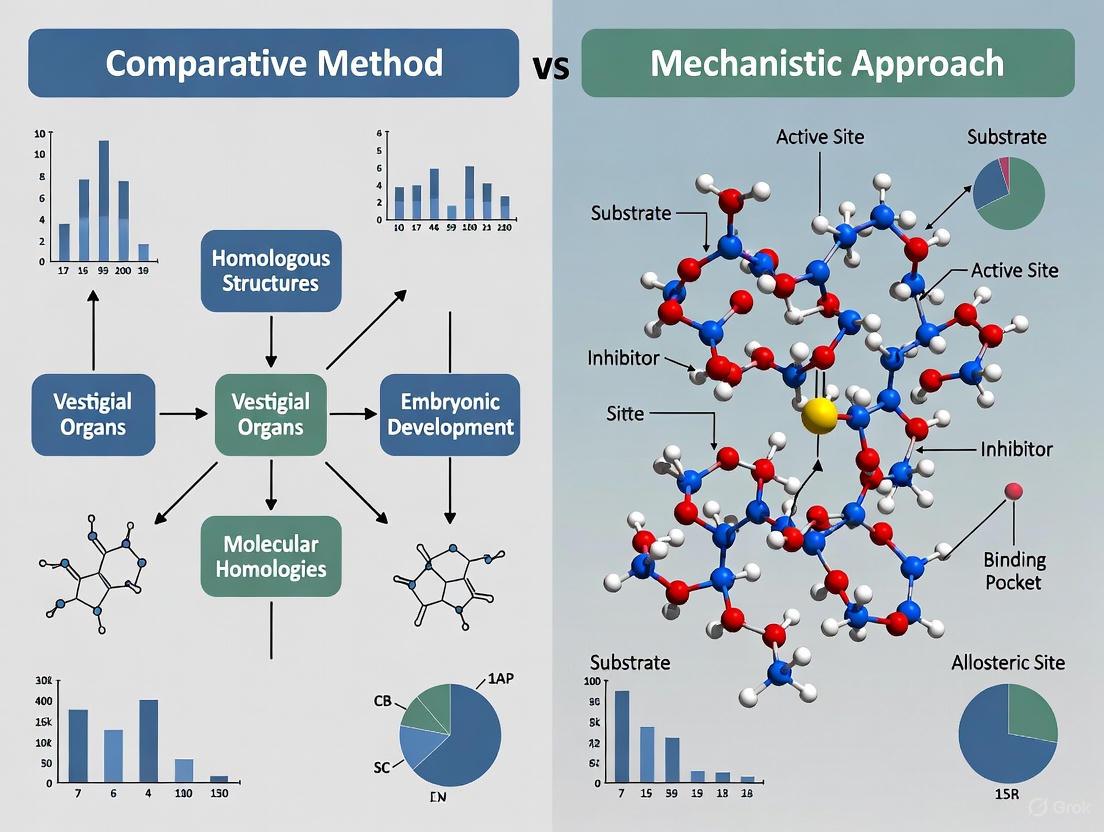
This article explores the foundational dichotomy and emerging synthesis between the comparative and mechanistic approaches in biology.
Beyond the Model System: Integrating Comparative and Mechanistic Approaches in Modern Biology and Drug Discovery
Abstract
This article explores the foundational dichotomy and emerging synthesis between the comparative and mechanistic approaches in biology. Tailored for researchers, scientists, and drug development professionals, it delves into the historical and philosophical underpinnings of both methods, showcasing their distinct applications from basic research to therapeutic development. We provide a practical framework for selecting and optimizing each approach, address common pitfalls like the 'essentialist trap' of over-relying on model organisms, and outline rigorous validation strategies. By synthesizing key insights, the article advocates for an integrated methodology that leverages the strengths of both perspectives to drive robust scientific discovery and enhance the translational pipeline in biomedicine.
Philosophical Roots and Core Principles: Defining the Two Biological Worldviews
The mechanistic paradigm in biology is a way of thinking that views living organisms as complex machines whose functions can be understood by studying their component parts and the physical and chemical interactions between them [1]. This perspective, rooted in Cartesian dualism and Newtonian physics, has profoundly shaped modern biological research, suggesting that biological systems operate through predictable, cause-and-effect relationships [2]. The application of this paradigm to the study of development, known as "Entwicklungsmechanik" or developmental mechanics, emerged in the late 19th century and represented a pivotal shift from purely descriptive embryology to experimental analysis of developmental processes [3]. This transformative approach sought to explain the mysteries of development not through vital forces or abstract principles, but through identifiable, testable mechanisms.
The subsequent rise of model organisms represents the logical extension of this mechanistic worldview. These non-human species, extensively studied with the expectation that discoveries will provide insight into the workings of other organisms, became the practical instruments through which the mechanistic paradigm could be implemented in laboratory settings [4] [5]. The foundational premise is that despite tremendous morphological and physiological diversity, all living organisms share common metabolic, developmental, and genetic pathways conserved through evolution [4]. This article will compare the performance of different model organisms within the context of the mechanistic approach, contrasting it with the comparative method in biology, and provide supporting experimental data that illustrates their respective utilities and limitations in biomedical research.
The Foundation: Entwicklungsmechanik and its Legacy
The concept of Entwicklungsmechanik (developmental mechanics) established a new research program that focused on the "mechanics" of development, emphasizing physicochemical contributions—mechanical, molecular, and otherwise—to understanding how organisms develop [3]. This approach stood in stark contrast to the predominantly descriptive and comparative morphological traditions that preceded it. Where comparative biology sought to understand patterns of diversity through historical relationships and homologies, Entwicklungsmechanik asked proximate questions about causal mechanisms: What physical forces shape the embryo? What chemical signals coordinate cellular differentiation?
This mechanistic approach gained considerable momentum throughout the 20th century with the growth of disciplines such as physiology and genetics, and particularly with the rise of molecular biology from the 1950s onward [3]. The analysis of mutants and the identification of affected genes, along with the mapping of epistatic relationships, provided developmental biology with powerful tools for deciphering the minute details involved in the generation of body structures, from cellular processes to three-dimensional patterning [3]. The enthusiasm for this approach eventually led to what some scholars have termed an "essentialist trap" in developmental biology—the assumption that mechanisms discovered in a handful of laboratory models universally represent developmental processes across diverse species [3].
Model Organisms as Mechanistic Platforms
The Concept and Selection Criteria
Model organisms are defined as non-human species that are extensively studied to understand particular biological phenomena, with the expectation that discoveries made in them will provide insight into the workings of other organisms [4]. They are widely used to research human disease when human experimentation would be unfeasible or unethical [4] [5]. The selection of model organisms is not random; they are typically chosen based on practical considerations that facilitate mechanistic investigation under controlled laboratory conditions.
Key criteria for model organism selection include:
- Short generation time to observe multiple life cycles and genetic inheritance
- Tractability to genetic manipulation through inbred strains, stem cell lines, and transformation methods
- Compact genome with low proportion of junk DNA to facilitate sequencing
- Specialized living requirements that are easily replicated in laboratory settings
- Economic considerations related to cost-effective maintenance [4] [5]
As one analysis notes, "The use of (a few) models has led to a narrow view of the processes that occur at a higher level (supra-cellular) in animals, since these processes tend to be quite diverse and thus cannot be well-represented by the idiosyncrasies of any specific animal model" [3]. This limitation represents a significant challenge when applying the mechanistic paradigm to broader biological questions.
Historical Trajectory of Key Model Organisms
The use of animals in research dates back to ancient Greece, with Aristotle and Erasistratus among the first to perform experiments on living animals [4]. The 18th and 19th centuries saw landmark experiments, including Antoine Lavoisier's use of guinea pigs in calorimeters to prove respiration was a form of combustion, and Louis Pasteur's demonstration of the germ theory of disease using anthrax in sheep [4].
The fruit fly Drosophila melanogaster emerged as one of the first, and for some time the most widely used, model organisms in the early 20th century [4]. Thomas Hunt Morgan's work between 1910 and 1927 identified chromosomes as the vector of inheritance for genes, discoveries that "helped transform biology into an experimental science" [4]. During this same period, William Ernest Castle's laboratory, in collaboration with Abbie Lathrop, began systematic generation of inbred mouse strains, establishing Mus musculus as another foundational model organism [4].
The late 20th century saw the introduction of new model organisms, including the zebrafish Danio rerio around 1970, which was developed through three recognizable stages: choice and stabilization of the organism; accumulation of mutant strains and genomic data; and the use of the organism to construct models of mechanisms [6]. Similar trajectories occurred with other organisms like C. elegans, while established models like Drosophila were redesigned for new experimental approaches [6].
Table 1: Historical Development of Key Model Organisms
| Organism | Introduction Period | Key Historical Figures | Major Contributions |
|---|---|---|---|
| Drosophila melanogaster (Fruit fly) | 1910-1927 | Thomas Hunt Morgan | Chromosomal theory of inheritance, gene mapping |
| Mus musculus (Mouse) | Early 1900s | William Ernest Castle, Abbie Lathrop | Mammalian genetics, inbred strains, immunology |
| Danio rerio (Zebrafish) | circa 1970 | George Streisinger | Vertebrate development, genetic screens |
| Arabidopsis thaliana (Mouse-ear cress) | 1943 | Friedrich Laibach | Plant genetics, molecular biology |
Comparative Analysis of Model Organisms in Mechanistic Research
Representative Model Organisms and Their Applications
Different model organisms offer distinct advantages for investigating specific biological questions within the mechanistic paradigm. The following table summarizes key characteristics and applications of major model organisms:
Table 2: Comparative Analysis of Major Model Organisms in Mechanistic Research
| Organism | Life Cycle | Genetic Tools | Key Advantages | Primary Research Applications |
|---|---|---|---|---|
| Arabidopsis thaliana (Mouse-ear cress) | 4-6 weeks | Agrobacterium-mediated transformation, T-DNA insertion mutants | Small genome, small size, high seed production | Plant genetics, molecular biology, development, physiology |
| Drosophila melanogaster (Fruit fly) | 8-10 days | P-element transgenesis, GAL4/UAS system, RNAi | Complex nervous system, well-characterized development, low cost | Human development, neurobiology, genetics, behavior |
| Danio rerio (Zebrafish) | 3 months | CRISPR-Cas9, morpholinos, transgenesis | Transparent embryos, vertebrate biology, high fecundity | Vertebrate development, organogenesis, toxicology, gene function |
| Mus musculus (Laboratory mouse) | 10-12 weeks | CRISPR-Cas9, embryonic stem cells, transgenesis | Mammalian physiology, similar to human disease | Human disease models, immunology, cancer, therapeutics |
Quantitative Experimental Data from Model Organism Research
The utility of model organisms in the mechanistic paradigm is demonstrated by their extensive contributions to understanding disease mechanisms and developing therapeutic interventions. The following table summarizes key experimental findings and their biomedical implications:
Table 3: Key Experimental Findings and Biomedical Applications from Model Organism Research
| Organism | Experimental Approach | Key Finding | Human Disease Relevance |
|---|---|---|---|
| Zebrafish | Targeted mutagenesis using CRISPR-Cas9 [7] | Zebrafish mutants exhibited stroke symptoms, confirming gene role | Stroke and vascular inflammation in children |
| Fruit flies | Genetic mapping and phenotypic characterization [4] [5] | Genes are physical features of chromosomes | Fundamental genetic principles |
| Mouse | Knockout Mouse Phenotyping Program (KOMP2) [7] | Systematic characterization of null mutations in every mouse gene | Understanding gene function in mammalian systems |
| Maize | Cytogenetic studies [5] | Discovery of transposons ("jumping genes") | Genome evolution, mutation mechanisms |
The Mechanistic versus Comparative Approach in Biology
The comparative method in biology represents a fundamentally different approach to understanding biological systems. Rather than seeking proximate, mechanistic explanations through experimental manipulation, it focuses on historical products and evolutionary patterns [3]. Organisms and clades are defined by their uniqueness, and their comparison provides insight into patterns of diversification [3]. As one researcher notes, "Process analysis gives us information on proximal causes while patterns inform us of ultimate (evolutionary) causes/mechanisms" [3].
The tension between these approaches reflects a deeper philosophical divide in biological research. The mechanistic approach, with its emphasis on controlled experimentation and predictable outcomes, aligns with a positivist epistemology that favors quantitative methods and empirical evidence obtained through sensory experience [2]. In contrast, the comparative approach embraces the historical contingency and uniqueness of biological systems, recognizing that "processes such as development can be interrogated through external intervention (manipulation of the system); but not so patterns: patterns are mental (re)constructions" [3].
This distinction has profound implications for how biological research is conducted and interpreted. As one analysis observes, "It is a sociological truth that we tend to think that the analysis of the mechanistic particularities of any biological process somehow represents a superior form of analysis; but this only reflects a particular (cultural) bias in our view of what it means to understand nature" [3].
Experimental Protocols in Mechanistic Research
Large-Scale Mutagenesis Screens in Zebrafish
The "Big Screen" in zebrafish research exemplifies the application of the mechanistic paradigm to identify genes essential for development [6]. This coordinated, large-scale mutagenesis approach involved:
Mutagenesis: Male zebrafish were treated with ethylnitrosourea (ENU), a chemical mutagen that introduces random point mutations throughout the genome.
Breeding Scheme: Treated males were crossed with wild-type females to establish F1 families. These F1 fish, each carrying different heterozygous mutations, were then intercrossed to produce homozygous mutant offspring in the F2 generation.
Phenotypic Screening: F2 embryos were systematically examined for developmental abnormalities at specific stages using morphological criteria. This identified mutants with defects in various processes including organogenesis, patterning, and physiology.
Genetic Mapping: Mutants of interest were outcrossed to polymorphic strains to map the chromosomal location of the causative mutation.
Gene Identification: Positional cloning techniques were used to identify the specific genes responsible for the observed phenotypes [6].
This approach led to the identification of numerous genes critical for vertebrate development, including the one-eyed pinhead (oep) gene, which was found to be essential for nodal signaling and establishment of the embryonic axis [6].
CRISPR-Cas9 Genome Engineering in Model Organisms
The CRISPR-Cas9 system has revolutionized mechanistic research in model organisms by enabling precise genome manipulations:
Guide RNA Design: Sequence-specific guide RNAs (gRNAs) are designed to target the gene of interest.
Delivery System: gRNAs and Cas9 nuclease are introduced into the organism via microinjection (in embryos), viral vectors, or other transformation methods.
Genetic Modification: The Cas9 nuclease creates double-strand breaks at the target site, which are repaired through non-homologous end joining (introducing insertions/deletions) or homology-directed repair (for precise edits).
Phenotypic Characterization: Mutant organisms are systematically analyzed for morphological, physiological, or behavioral changes compared to wild-type controls.
Validation: The specific genetic lesion is confirmed through sequencing, and its correlation with the phenotype is verified through rescue experiments or independent alleles [7].
This approach has been successfully applied in zebrafish, mice, fruit flies, and other model organisms to model human diseases and investigate gene function [7].
Research Reagent Solutions for Mechanistic Studies
Table 4: Essential Research Reagents and Their Applications in Mechanistic Studies
| Reagent/Resource | Composition/Type | Function in Research | Example Applications |
|---|---|---|---|
| CRISPR-Cas9 System | Cas9 nuclease + guide RNA | Targeted genome editing | Creating specific disease models in various organisms [7] |
| Ethylnitrosourea (ENU) | Chemical mutagen | Induces random point mutations | Large-scale mutagenesis screens [6] |
| Morpholinos | Modified oligonucleotides | Transient gene knockdown | Assessing gene function during development |
| Antibodies | Immunoglobulin molecules | Protein detection and localization | Spatial and temporal expression pattern analysis |
| Mutant Strain Collections | Curated genetic stocks | Repository of genetic variants | Phenotypic analysis of specific mutations [6] |
Visualization of Mechanistic Research Workflows
The Progression from Model Organism to Therapeutic Insight
Diagram 1: From Model Organisms to Therapeutic Insight
Comparative vs. Mechanistic Approaches in Biology
Diagram 2: Two Approaches to Biological Research
The mechanistic paradigm, from its origins in Entwicklungsmechanik to its contemporary implementation through model organisms, has proven enormously powerful in elucidating the proximate causes of biological phenomena [8] [3]. The strategic use of model organisms has enabled researchers to dissect complex biological processes into manageable, experimentally tractable components, leading to fundamental discoveries about gene function, developmental mechanisms, and disease pathogenesis [4] [5] [7].
However, the limitations of this approach are increasingly apparent. The focus on a handful of laboratory models has created a narrow view of biological diversity, and the assumption that mechanisms discovered in these systems universally apply across taxa represents what some term an "essentialist trap" [3]. The comparative method offers an essential complementary approach by placing biological mechanisms in an evolutionary context, testing their generality across diverse species, and appreciating the uniqueness of different organisms [3] [9].
Future progress in biological research will likely require a more integrated approach that combines the methodological rigor of the mechanistic paradigm with the evolutionary perspective of the comparative method. Such integration would leverage the strengths of both approaches: the ability to establish causal mechanisms through experimental manipulation and the capacity to understand their evolutionary significance through comparative analysis. As technological advances such as artificial intelligence make a wider range of organisms accessible to detailed mechanistic study [5], this synthesis may become increasingly feasible, potentially leading to a more comprehensive understanding of biological systems that transcends the limitations of both approaches alone.
Evolutionary biology has long been guided by two distinct yet complementary methodological paradigms: the comparative tradition, which discerns evolutionary history through patterns of diversity, and the mechanistic approach, which seeks proximal causes through experimental intervention. This guide objectively compares these research frameworks, detailing their philosophical underpinnings, technical requirements, and applications in modern biological research, including drug development. We provide structured comparisons of their capabilities, experimental protocols, and outputs, supported by quantitative data and visualizations of research workflows.
A significant methodological schism characterized 20th-century biology, with evolutionary and molecular disciplines developing largely separate cultures and modes of inference [10]. The comparative tradition emphasizes the analysis of variation across individuals, populations, and taxa as the fundamental phenomenon requiring explanation. It draws historical inferences from patterns detected in sequences, allele frequencies, and phenotypes, offering a realistic view of biological systems in their natural and historical contexts [10] [3]. In contrast, the mechanistic approach employs controlled experiments to isolate factors and establish causal links, setting aside natural complexity to achieve high-standard, evidence-based inferences [10] [3].
Today, a "functional synthesis" bridges this divide, combining statistical analyses of gene sequences with manipulative molecular experiments to reveal how historical mutations altered biochemical processes and produced novel phenotypes [10] [11]. This synthesis leverages the strengths of both approaches while compensating for their respective limitations.
Framework Comparison: Comparative vs. Mechanistic Approaches
The table below summarizes the core characteristics of each research approach and their modern synthesis.
Table 1: Fundamental Comparison of Biological Research Approaches
| Aspect | Comparative Approach | Mechanistic Approach | Functional Synthesis |
|---|---|---|---|
| Primary Focus | Patterns of diversification; historical relationships [3] | Physicochemical "mechanics" of processes; proximal causes [3] | Mechanism and history of phenotypic evolution [10] |
| Core Strength | Historical realism; focus on natural variation [10] | Strong causal inference via controlled experiments [10] | Decisive insights into adaptation's mechanistic basis [10] |
| Inference Basis | Statistical associations from surveys and sequences [10] | Isolation of variables with all else held constant [10] | Corroboration of statistical patterns with experimental tests [10] |
| View of Organisms | Historical products defined by uniqueness [3] | Model systems representing general processes [3] | Historical entities amenable to reductionist analysis [10] |
| Typical Data | Phylogenies, fossil records, morphological homologies [3] | Molecular pathways, mutant phenotypes, reaction rates [10] | Resurrected protein functions, fitness effects of historical mutations [10] |
| Key Limitation | Associations do not reliably indicate causality [10] | Limited generalizability due to reduced complexity [10] | Technically challenging; requires cross-disciplinary expertise [10] |
The Functional Synthesis: A Hybrid Workflow
The integrated functional synthesis approach follows a defined pathway, leveraging the strengths of both comparative and mechanistic methods.
Diagram 1: Functional synthesis workflow combining comparative and mechanistic methods.
Experimental Protocols in the Functional Synthesis
Ancestral Sequence Reconstruction and Resurrection
This protocol tests evolutionary hypotheses by experimentally characterizing the functions of ancestral proteins [10] [11].
Detailed Methodology:
- Sequence Alignment and Curation: Collect and align homologous gene sequences from diverse extant species. Verify alignment accuracy and identify conserved regions.
- Phylogenetic Tree Inference: Reconstruct the evolutionary relationships among sequences using maximum likelihood or Bayesian methods.
- Ancestral State Reconstruction: Infer the most probable protein sequences at ancestral nodes of the phylogenetic tree using probabilistic models of sequence evolution.
- Gene Synthesis: Physically synthesize the DNA sequences encoding the inferred ancestral proteins, with codon optimization for the intended expression system (e.g., E. coli).
- Protein Expression and Purification: Clone synthesized genes into expression vectors, express in host cells, and purify proteins using affinity chromatography (e.g., His-tag purification).
- Functional Characterization: Perform biochemical assays to determine kinetic parameters (e.g., Km, kcat), ligand binding affinity, stability, or other relevant functions. Compare activities between ancestral and modern proteins.
Historical Mutagenesis and Functional Tests
This protocol identifies the specific mutations responsible for functional shifts and characterizes their effects [10].
Detailed Methodology:
- Identify Historical Mutations: Using comparative sequence analysis, identify amino acid replacements that occurred on specific lineages during a period of putative adaptive evolution.
- Site-Directed Mutagenesis: Introduce individual or combined historical mutations into the background of a resurrected ancestral protein or a modern protein.
- In Vitro Functional Assays: Measure the functional consequences of each mutation. For example, in the study of insecticide resistance:
- Structural Analysis (Optional): Model protein structures based on related crystallographic data to visualize how mutations alter active site geometry and catalytic mechanisms [10].
- In Vivo Verification (Ideal): In suitable model organisms, use transgenesis to introduce ancestral and modern alleles and measure their effects on whole-organism phenotypes and fitness in controlled environments [10].
Essential Research Reagent Solutions
The following tools and reagents are fundamental for conducting research in the functional synthesis.
Table 2: Key Reagents for Evolutionary-Mechanistic Research
| Research Reagent / Material | Critical Function | Application Context |
|---|---|---|
| Gene Synthesis Services | Physically creates DNA sequences inferred for ancestral genes, enabling their resurrection [10]. | Ancestral sequence reconstruction |
| Site-Directed Mutagenesis Kits | Introduces specific historical amino acid changes into plasmid DNA for functional testing [10]. | Historical mutagenesis |
| Heterologous Expression Systems | Produces large quantities of ancestral/modern proteins for purification (e.g., E. coli, yeast) [10]. | Protein biochemistry |
| Affinity Chromatography Resins | Purifies recombinant proteins from cell lysates based on specific tags (e.g., Ni-NTA for His-tagged proteins). | Protein biochemistry |
| Spectrophotometric Assay Kits | Measures enzyme kinetic parameters (e.g., Vmax, Km) by tracking substrate depletion or product formation. | Functional characterization |
| Model Organism Strains | Provides a genetically tractable system (e.g., fruit flies, mice) for testing phenotypic effects of alleles in vivo [10]. | Transgenic phenotyping |
Case Study: Evolution of Insecticide Resistance
A seminal study on diazinon resistance in the sheep blowfly Lucilia cuprina exemplifies the functional synthesis [10].
Table 3: Quantitative Data from Insecticide Resistance Study
| Measurement | Susceptible E3 Allele | Resistant E3 Allele | Gly135Asp Mutant |
|---|---|---|---|
| Organophosphate Hydrolysis Rate | Very low/undetectable [10] | High [10] | Confered novel capacity for high-rate hydrolysis [10] |
| Key Active Site Residue | Glycine (Gly135) [10] | Aspartate (Asp135) [10] | Single-site determinant of novel function |
| Functional Effect of Reverse Mutation (Asp135Gly) | Not applicable | Not applicable | Produced susceptible phenotype [10] |
Experimental Workflow:
- Comparative Analysis: Researchers compared E3 esterase sequences from resistant and susceptible fly populations, identifying five amino acid differences [10].
- Chimeric Protein Construction: Created and expressed chimeric enzymes to localize the functional source of resistance [10].
- Site-Specific Mutagenesis: Pinpointed the Gly135Asp switch as conferring the novel capacity to hydrolyze organophosphates. The reverse mutation (Asp135Gly) reverted the enzyme to a susceptible phenotype [10].
- Structural Modeling: Modeled the active site on a related esterase structure, revealing the mechanistic basis: the aspartate's side-chain carboxylate activates a water molecule, enabling hydrolysis of the enzyme-inhibitor complex [10].
This case demonstrates how the functional synthesis can move from statistical association to a decisive, mechanistic understanding of adaptation.
Implications for Drug Development
The comparative and mechanistic approaches also underpin critical methodologies in pharmaceutical research, particularly in regulatory science.
Table 4: Application of Comparative and Mechanistic Thinking in Drug Development
| Aspect | 505(b)(1) Pathway (Novel Drug) | 505(b)(2) Pathway (Modified Drug) |
|---|---|---|
| Philosophical Analogy | Largely mechanistic: requires full, de novo characterization of the agent's action [12]. | Largely comparative: relies on bridging and comparison to an already approved reference drug [12]. |
| Clinical Pharmacology Requirement | Full assessment of MOA, ADME, PK/PD, and safety in specialized populations [12]. | Leverages data from Listed Drugs; focuses on establishing bioequivalence or justifying differences [12]. |
| Model-Informed Drug Development (MIDD) | Used to predict human dose response, refine dosing regimens, and support waivers for specific clinical studies (e.g., TQT) [12]. | Used to establish a scientific bridge to the reference drug, especially for complex changes (e.g., formulation) [12]. |
The power of the comparative approach in drug development is exemplified by the bioequivalence concept for generic drugs, where demonstrating comparable pharmacokinetic (PK) exposure to a reference drug serves as a surrogate for re-establishing clinical efficacy and safety, thereby avoiding redundant clinical trials [13]. Furthermore, clinical pharmacology employs PK and pharmacodynamic (PD) data as comparative tools throughout development for dose-finding, assessing the impact of intrinsic and extrinsic factors, and supporting biomarker development [13].
In biological research, the distinction between proximate and ultimate causation represents a fundamental epistemological divide that shapes how scientists investigate and interpret biological phenomena. This dichotomy, famously articulated by Ernst Mayr, separates questions of immediate function (how) from questions of evolutionary origin and adaptive significance (why) [14]. Proximate causes explain biological function in terms of immediate physiological or environmental factors, while ultimate explanations address traits in terms of evolutionary forces that have acted upon them throughout history [15]. This framework creates two complementary but distinct approaches to biological investigation: the mechanistic approach, which focuses on decoding immediate operational processes, and the comparative method, which seeks to reconstruct historical evolutionary pathways [3]. Understanding this epistemological divide is essential for researchers navigating the complexities of modern biological research, particularly in fields like drug development where both immediate mechanism and evolutionary context inform therapeutic strategies.
Conceptual Framework: Definitions and Philosophical Foundations
Proximate Causation: The Mechanistic Approach
Proximate causation refers to the immediate, mechanical factors that underlie biological function. This approach investigates the biochemical, physiological, and developmental processes that operate within an organism's lifetime. Proximate explanations focus on how structures and behaviors function through molecular interactions, cellular processes, and organ system functions [15]. In scientific practice, this represents the mechanistic approach, which employs reductionist methods to isolate and characterize biological components. For example, when studying a disease mechanism, a proximate approach would investigate the specific molecular pathways disrupted in the condition, the cellular responses to this disruption, and the physiological consequences that manifest as symptoms [3]. The mechanistic approach dominates fields like molecular biology, biochemistry, and physiology, where controlled experimentation allows researchers to establish causal links between factors and their effects by holding other variables constant [10].
Ultimate Explanations: The Evolutionary Approach
Ultimate causation explains why traits exist by reference to their evolutionary history and adaptive significance. This approach investigates the selective pressures, phylogenetic constraints, and historical contingencies that have shaped traits over generational time [14]. Ultimate explanations address why certain characteristics have evolved and persisted in populations, typically through comparative analysis across species or populations [15]. This epistemological stance aligns with the comparative method in biology, which uses patterns of variation across taxa to infer evolutionary processes [3]. For instance, when investigating antibiotic resistance, an ultimate perspective would examine the evolutionary pressures that favored resistant strains, the genetic variation that made resistance possible, and the historical emergence and spread of resistance mechanisms in bacterial populations [10]. The comparative method is central to evolutionary biology, ecology, and systematics, where statistical analyses of variation reveal patterns that illuminate evolutionary processes.
Table 1: Fundamental Contrasts Between Proximate and Ultimate Approaches
| Aspect | Proximate/Mechanistic Approach | Ultimate/Comparative Approach |
|---|---|---|
| Primary Question | How does it work? | Why did it evolve? |
| Timescale | Immediate (organism's lifetime) | Historical (evolutionary time) |
| Analytical Focus | Internal processes & mechanisms | Evolutionary patterns & selective history |
| Primary Methods | Controlled experimentation, molecular analysis | Comparative analysis, phylogenetic reconstruction |
| Standards of Evidence | Causal demonstration via isolation of variables | Statistical inference from patterns of variation |
| Explanatory Scope | Universal mechanisms across taxa | Historical trajectories specific to lineages |
Methodological Applications: Experimental Paradigms and Workflows
The Mechanistic Research Program: Establishing Proximate Causality
The mechanistic approach to establishing proximate causation follows a defined workflow that emphasizes controlled experimentation and molecular manipulation. This research program typically begins with phenotype characterization, where a biological phenomenon of interest is carefully described and quantified. Researchers then proceed to hypothesis generation about potential molecular mechanisms, often based on prior knowledge of similar systems or preliminary data. The core of the mechanistic approach involves experimental manipulation, where specific components of the system are selectively altered through genetic, pharmacological, or environmental interventions [10]. This is followed by functional assessment to determine the effects of these manipulations on the phenotype of interest.
A powerful illustration of this approach comes from studies of insecticide resistance in the sheep blowfly Lucilia cuprina [10]. Researchers investigating resistance to diazinon employed a systematic mechanistic workflow:
- Statistical association of resistance with specific alleles at the E3 esterase locus
- Sequence comparison between resistant and susceptible populations, identifying five amino acid differences
- Chimeric protein construction to test functional contributions of different protein regions
- Site-directed mutagenesis to isolate the specific mutation responsible (Gly135Asp)
- Structural modeling to understand the mechanistic basis for the functional change
- Functional assays confirming that the Asp135 replacement enabled organophosphate hydrolysis
This workflow established that a single amino acid change conferred resistance by altering the enzyme's active site, allowing it to hydrolyze the insecticide rather than being inhibited by it [10]. The mechanistic approach thus moved from correlation to causation by systematically testing and verifying the molecular basis of the phenotype.
The Comparative Research Program: Inferring Ultimate Causality
The comparative method for establishing ultimate explanations follows a different epistemological pathway focused on pattern detection and historical inference. This approach typically begins with character documentation across multiple taxa or populations, identifying variations in the trait of interest. Researchers then employ phylogenetic reconstruction to establish evolutionary relationships among the studied entities. The core analytical phase involves mapping character evolution onto the phylogenetic framework to infer historical patterns of trait origin, modification, and loss. Finally, researchers test evolutionary hypotheses by examining correlations between trait variations and ecological factors or by detecting statistical signatures of selection in genetic data [3].
A modern extension of the comparative approach integrates molecular biology with evolutionary analysis in what has been termed the "functional synthesis" [10]. This integrated workflow includes:
- Phylogenetic analysis to identify lineages where functional changes occurred
- Ancestral sequence reconstruction to infer historical genetic states
- Gene resurrection to express and characterize ancestral proteins
- Site-directed mutagenesis of historical mutations into ancestral backgrounds
- Functional characterization of effects on molecular phenotype
- Fitness assessment through competition experiments or other measures
This approach allows researchers to move beyond statistical inference to experimental verification of evolutionary hypotheses, effectively bridging the proximate-ultimate divide [10].
Experimental Data and Comparative Analysis
Quantitative Comparison of Research Approaches
The epistemological differences between proximate and ultimate approaches manifest in distinctive methodological preferences, analytical techniques, and interpretive frameworks. These differences can be quantified across multiple dimensions of scientific practice, reflecting deeper philosophical commitments about what constitutes biological explanation.
Table 2: Methodological Comparison of Research Approaches in Biology
| Dimension | Mechanistic Approach | Comparative Method | Functional Synthesis |
|---|---|---|---|
| Primary Data | Experimental measurements from controlled manipulations | Patterns of variation across taxa/populations | Combined sequence patterns & experimental measurements |
| Model Systems | Few, highly tractable "model organisms" | Diverse representatives of clades of interest | Phylogenetically informed selection of study systems |
| Causal Inference | Direct demonstration through intervention | Statistical inference from correlated variation | Experimental testing of evolutionary hypotheses |
| Analytical Scope | Isolated components & pathways | Broad taxonomic & historical patterns | Historical mutations & their functional consequences |
| Strength of Inference | High internal validity through variable control | Identification of natural patterns & correlations | Combined historical & experimental verification |
| Generalizability | Potentially limited by system-specific factors | Broad evolutionary patterns but correlational | Mechanistic generalizability with historical context |
Case Study: Molecular Evolution of Hormone Signaling
Research on the evolution of hormone-receptor interactions provides compelling quantitative data illustrating both the distinct contributions and complementary nature of proximate and ultimate approaches. Studies of glucocorticoid receptor (GR) evolution have employed both mechanistic and comparative methods to reconstruct the historical path by which this important signaling system acquired its modern specificity.
In one landmark study, researchers combined phylogenetic analysis of vertebrate GR sequences with experimental characterization of resurrected ancestral proteins [10]. This integrated approach revealed that a historical change in receptor specificity involved multiple permissive mutations that initially had no effect on function but later enabled the specificity switch through additional mutations. The quantitative data from functional assays demonstrated how historical mutations progressively shifted receptor specificity:
- Ancstral GR: Broad sensitivity to multiple steroid hormones
- Intermediate forms: Gradual reduction in sensitivity to certain ligands
- Modern GR: High specificity for cortisol over other steroids
This case study exemplifies how the integration of proximate and ultimate approaches can yield insights inaccessible to either approach alone. The comparative method identified the historical sequence of changes, while mechanistic analyses revealed the functional consequences of each step in the evolutionary pathway.
Table 3: Experimental Data from GR Evolution Study
| Receptor Form | Cortisol Activation (EC50) | Aldosterone Activation (EC50) | Specificity Ratio | Key Mutations |
|---|---|---|---|---|
| Ancestral GR | 0.5 nM | 1.2 nM | 2.4:1 | Baseline |
| Intermediate 1 | 0.6 nM | 5.8 nM | 9.7:1 | S106P, L111Q |
| Intermediate 2 | 0.7 nM | 28.4 nM | 40.6:1 | L29M, F98I |
| Modern GR | 1.0 nM | >1000 nM | >1000:1 | C127D, S212A |
Essential Research Tools and Reagent Solutions
The practical implementation of both proximate and ultimate research programs requires specialized methodological tools and reagents. These resources enable the distinctive forms of experimentation and analysis characteristic of each approach.
Table 4: Essential Research Tools for Proximate and Ultimate Approaches
| Research Tool | Function/Application | Approach |
|---|---|---|
| Site-directed Mutagenesis Kits | Introduce specific historical or mechanistic mutations into genes | Both approaches |
| Protein Expression Systems | Produce ancestral or modified proteins for functional characterization | Both approaches |
| Phylogenetic Analysis Software | Reconstruct evolutionary relationships and ancestral sequences | Ultimate approach |
| High-throughput Sequencers | Generate genetic data from multiple taxa/populations for comparative analysis | Ultimate approach |
| Crystallography Platforms | Determine three-dimensional protein structures to understand mechanistic basis of function | Proximate approach |
| Functional Assay Reagents | Measure biochemical activities, binding affinities, and catalytic properties | Proximate approach |
| Model Organism Resources | Genetically tractable systems for experimental manipulation | Proximate approach |
| Comparative Collections | Biodiversity specimens representing taxonomic and evolutionary diversity | Ultimate approach |
For the integrated "functional synthesis" approach, researchers particularly rely on tools that bridge evolutionary and experimental methods. Gene synthesis services enable the physical resurrection of ancestral sequences inferred from phylogenetic analyses. Directed evolution platforms allow experimental testing of evolutionary hypotheses by generating alternative historical trajectories. High-throughput screening technologies facilitate the functional characterization of numerous historical variants, generating quantitative data that link historical mutations to functional consequences [10].
Discussion: Complementary Epistemologies in Biological Research
The distinction between proximate and ultimate causation represents more than a simple methodological divide; it reflects fundamentally different epistemologies for constructing biological knowledge. The mechanistic approach prioritizes causal demonstration through experimental control, offering strong evidence for how biological systems operate in the present. The comparative method emphasizes historical inference through pattern analysis, providing explanatory power for why biological systems have their current forms. Rather than representing competing paradigms, these approaches offer complementary strengths that address different aspects of biological explanation.
Contemporary biological research increasingly recognizes the limitations of pursuing either approach in isolation. The mechanistic focus on a few model organisms, while powerful for establishing general principles, risks what some have termed an "essentialist trap" – assuming that mechanisms discovered in one system apply universally across diverse taxa [3]. Conversely, the comparative method's reliance on statistical correlation leaves evolutionary hypotheses vulnerable to alternative explanations. The emerging functional synthesis represents a promising integration of these epistemologies, combining the historical inference of comparative biology with the causal demonstration of mechanistic approaches [10].
This epistemological integration has particular significance for applied fields like drug development. Understanding the proximate mechanisms of disease pathways enables targeted therapeutic interventions, while appreciation of ultimate evolutionary perspectives helps anticipate resistance mechanisms and understand species-specific differences in drug responses. The most robust biological explanations increasingly incorporate both perspectives – elucidating both how biological systems operate and why they have evolved to function as they do.
Table of Contents
- Introduction: The Two Faces of Biological Inquiry
- Defining the Approaches: Comparative Method vs. Mechanistic Approach
- The Essentialist Trap: How Model Systems Constrain Vision
- Case Study: Drug Development and the Rise of Integrative Strategies
- Visualizing the Scientific Workflow: From Trap to Synthesis
- Essential Research Reagent Solutions
- Conclusion: Embracing a Pluralistic Scientific Vision
In biological research, two powerful streams of inquiry coexist: the comparative method, which seeks to understand diversity and evolutionary history by analyzing patterns across species, and the mechanistic approach, which aims to elucidate the underlying physico-chemical processes that govern a specific biological system [3]. The mechanistic approach, fueled by molecular biology and genetics, has achieved monumental success, but this success has come with a significant, often unacknowledged, cost. An over-enthusiastic embrace of this methodology, particularly its reliance on a handful of standardized model organisms, has led the field into what some theorists identify as an "essentialist trap" [3]. This trap is a narrowed view of biological diversity, where the intricate, plastic, and varied developmental processes seen across the tree of life are unconsciously streamlined into the idiosyncrasies of a few lab-adapted models. This article will explore the contours of this trap, contrast the philosophical underpinnings of comparative and mechanistic biology, and demonstrate through contemporary examples from drug development how a synthesis of both approaches is essential for a truly robust and innovative scientific vision.
Defining the Approaches: Comparative Method vs. Mechanistic Approach
The comparative and mechanistic approaches are founded on distinct philosophical foundations and are geared toward answering different types of biological questions. The table below provides a structured comparison of these two paradigms.
Table 1: Core Differences Between the Comparative and Mechanistic Approaches
| Feature | Comparative Method | Mechanistic Approach |
|---|---|---|
| Primary Goal | Understand patterns of diversification, evolutionary history, and ultimate causes [3] | Decipher the proximate, physico-chemical causes and step-by-step processes underlying a biological phenomenon [3] |
| Unit of Analysis | Species, clades, and groups across phylogeny [3] | Entities and their activities within a specific system (e.g., a cell, organism) [3] |
| Core Concept | Homology (shared ancestry) [3] | Mechanism (organized entities and interactions) [16] |
| View of Nature | Dynamic, historical product of evolution [3] | System to be decomposed and analyzed [3] |
| Typical Output | Phylogenetic trees, identification of synapomorphies, predictive models of trait evolution [3] [17] | Pathway maps, molecular interaction networks, quantitative models of system behavior [16] |
| Inherent Strength | Captures the breadth and plasticity of biological diversity [3] | Provides deep, causal detail and enables targeted intervention [18] |
| Inherent Limitation | Often correlational; cannot alone establish proximate causality [17] | Risk of over-generalizing from a few model systems, leading to the "essentialist trap" [3] |
The Essentialist Trap: How Model Systems Constrain Vision
The "essentialist trap" arises from the pragmatic necessities of the mechanistic approach. To manage overwhelming complexity, researchers focus on model organisms like fruit flies, zebrafish, and lab mice. These models are selected for practical advantages such as short generation times, ease of manipulation, and robustness in a laboratory setting [3]. The trap is sprung when researchers unconsciously begin to treat these models not as convenient tools, but as perfect representatives of broader biological categories—the "essence" of a clade or process [3].
This has several consequences:
- A Narrowed View of Diversity: The development and physiology of a handful of models are taken as the general rule, while the fascinating and informative variations seen in other organisms are treated as exceptions or noise [3]. This obscures the true extent of nature's plasticity.
- Streamlined Systems: The use of inbred laboratory lines creates a streamlined, simplified version of a species, which reinforces typological thinking and departs from the polymorphic reality of wild populations [3].
- The Illusion of Understanding: There is a dangerous assumption that by thoroughly understanding a mechanism in one model system, we fundamentally "understand" that process in all of evolution, which is "further from the truth" as shown by studies revealing high developmental plasticity [3].
This trap is not merely a philosophical concern; it has tangible effects on scientific progress. In conservation biology, for instance, an over-reliance on general principles derived from a few well-studied species can lead to poor predictions and failed interventions for other species with different traits, such as habitat specialization or reproductive strategies [17]. The solution is not to abandon the mechanistic approach, but to consciously free it from the essentialist trap by re-integrating the comparative perspective.
Case Study: Drug Development and the Rise of Integrative Strategies
The field of drug development provides a powerful, real-world case study of the essentialist trap and the ongoing shift toward a more integrative, pluralistic approach. The traditional pipeline has been dominated by a mechanistic, model-centric philosophy, but its high failure rates and costs are a direct manifestation of the trap's limitations.
The Trap in Action: Limitations of Traditional Models
The preclinical stage of drug development has long relied on standardized in vitro models (e.g., specific cell lines) and in vivo animal models to predict human efficacy and toxicity. These models are the mechanistic equivalents of standard biological model organisms. However, they often fail to capture the complex heterogeneity of human diseases and populations. This oversimplification contributes to the staggering statistic that over 90% of drugs that enter clinical trials fail, often due to a lack of efficacy or unforeseen safety issues that were not apparent in the streamlined model systems [19]. This is the essentialist trap on an industrial scale: assuming that a response in a mouse model is the essential predictor of a response in humans.
Breaking the Trap: Comparative and Integrative MIDD
The field is now aggressively adopting Model-Informed Drug Development (MIDD), which uses a suite of quantitative approaches to break free from this narrow view. MIDD does not reject mechanistic models but enhances them with comparative and computational methods that account for complexity and diversity [20].
Table 2: Model-Informed Drug Development (MIDD) Tools to Overcome Mechanistic Limitations
| MIDD Tool | Description | How It Mitigates the Essentialist Trap |
|---|---|---|
| Quantitative Systems Pharmacology (QSP) | Integrative modeling combining systems biology and pharmacology to simulate drug effects across multiple biological scales [20]. | Moves beyond a single model organism by integrating diverse human data (genomic, proteomic) to create a "virtual human" for testing. |
| Physiologically Based Pharmacokinetic (PBPK) | Mechanistic modeling that simulates the absorption, distribution, metabolism, and excretion of a drug based on human physiology [20]. | Allows for extrapolation between species (e.g., from rat to human) and across different human populations, acknowledging biological variation. |
| AI/ML for Target Discovery | Machine learning analyzes massive, diverse datasets (genomic, clinical) to identify novel drug targets and biomarkers [19] [21]. | Uses a comparative analysis of large populations to find patterns invisible in single-model studies, highlighting diversity rather than ignoring it. |
| Real-World Evidence (RWE) | Incorporates data from actual patient care (e.g., electronic health records) into regulatory and development decisions [22]. | Brings the "comparative method" to the clinic, using real-world human diversity to validate or challenge findings from controlled, mechanistic trials. |
The following experimental workflow diagram illustrates how these tools are integrated into a modern, trap-avoiding drug development pipeline.
Diagram 1: Integrative drug development workflow.
Experimental Protocol: Validating a Drug Target with an Integrative Approach
This protocol outlines a key experiment that combines both comparative and mechanistic methods to avoid the essentialist trap in early-stage drug discovery.
- Objective: To identify and preliminarily validate a novel therapeutic target for a complex disease (e.g., Polycystic Ovary Syndrome - PCOS) using an integrative methodology that transcends reliance on a single model [23].
- Hypothesis: Gene X, identified through a comparative analysis of human genomic data, plays a conserved but context-dependent role in a metabolic pathway relevant to PCOS pathology.
Methodology:
- Comparative Identification (The "Comparative Method"):
- Data Collection: Curate large-scale human genomic and transcriptomic datasets from consortia like UK Biobank, including data from PCOS patients and healthy controls of diverse ancestries [19].
- AI/ML Analysis: Employ machine learning algorithms (e.g., deep neural networks) to perform a genome-wide association study (GWAS) and differential expression analysis. The goal is to identify Gene X, which shows a strong statistical association with PCOS phenotypes across a broad population, not just a homogenous cohort [21].
- Mechanistic Validation (The "Mechanistic Approach"):
- In Vitro Model: Transfer the findings into a controlled lab setting. Use CRISPR/Cas9 gene editing to create a knockout of the ortholog of Gene X in a human cell line relevant to PCOS (e.g., ovarian granulosa cell line). The use of a human-derived cell line is a conscious choice to reduce cross-species extrapolation error at this stage.
- Phenotypic Assays: Measure downstream effects of Gene X knockout using high-content imaging and molecular profiling (RNA-seq, proteomics) to map the altered pathway mechanisms [23].
- Integrative Synthesis (Bridging the Approaches):
- QSP Modeling: Build a preliminary QSP model that incorporates the kinetic parameters of the pathway affected by Gene X, derived from the in vitro data.
- In Silico Prediction: Use this model to simulate the effect of modulating Gene X activity in a simulated virtual population, predicting which patient subpopulations (e.g., defined by specific genetic backgrounds) would most likely respond to a therapy targeting Gene X [20]. This step directly tests if the mechanistic finding from the cell line holds across a more diverse, "comparative" virtual cohort.
Visualizing the Scientific Workflow: From Trap to Synthesis
The conceptual journey from a constrained, model-centric vision to a pluralistic, integrative one is summarized in the following diagram.
Diagram 2: Shifting from essentialist trap to integrative pluralism.
Essential Research Reagent Solutions
The following table details key reagents and tools that are foundational for the experiments cited in this article, particularly for the integrative validation of novel drug targets.
Table 3: Key Research Reagent Solutions for Integrative Studies
| Reagent / Tool | Function in Research | Specific Application Example |
|---|---|---|
| CRISPR/Cas9 Gene Editing System | Precise knockout or modification of specific genes in model systems to determine gene function. | Creating isogenic cell lines with a target gene (e.g., Gene X from protocol) knocked out to study its mechanistic role in a pathway [23]. |
| Trusted Research Environment (TRE) | A secure data platform that allows analysis of sensitive genomic and clinical data without the data leaving a protected environment. | Enabling the comparative analysis of large-scale human data (e.g., from UK Biobank) for target identification while preserving patient privacy [19]. |
| Federated Learning AI Platform | A machine learning technique where an algorithm is trained across multiple decentralized data holders without sharing the data itself. | Allowing a drug target prediction model to learn from diverse, proprietary datasets across multiple hospitals or research institutes, mitigating bias [19]. |
| Physiologically Based Pharmacokinetic (PBPK) Software | Software that implements PBPK modeling to simulate the absorption, distribution, metabolism, and excretion of a compound. | Predicting human pharmacokinetics and drug-drug interactions early in development, reducing reliance on animal model extrapolation alone [20]. |
| Validated Antibodies for Pathway Analysis | Antibodies used in Western Blot or Immunohistochemistry to detect and quantify specific proteins in a biological sample. | Measuring the expression levels of proteins in a hypothesized pathway (e.g., in PCOS models) after a genetic or therapeutic intervention [23]. |
The history of biology shows that scientific progress is often hampered not by a lack of tools, but by a lack of vision. The essentialist trap—the uncanny, unconscious narrowing of scientific inquiry through over-reliance on a few model systems—is a profound but surmountable challenge. As philosopher William Bechtel's approach suggests, the path forward is not to discard the powerful, detail-generating mechanistic approach, but to embed it within a framework of integrative pluralism [24]. This requires a conscious effort to continually place mechanistic findings within the broader, comparative context of biological diversity, whether that diversity is found across species or within human populations.
The transformation already underway in drug development, through Model-Informed Drug Development (MIDD) and AI-driven analyses of diverse datasets, serves as a powerful template for all of biology [20] [21]. By deliberately using multiple kinds of models and bringing them into productive contact, we can free ourselves from the essentialist trap. The future of biological discovery, and the rapid translation of that discovery into therapies, depends on a vision that values both the deep, causal story and the broad, comparative narrative that together reveal the true richness of the living world.
The history of biological discovery has been shaped by two fundamentally different yet complementary approaches: the comparative method and the mechanistic approach. The comparative method, rooted in historical analysis and pattern observation, seeks to understand biological diversity through examination of similarities and differences across species, lineages, and evolutionary time [3]. In contrast, the mechanistic approach focuses on dissecting proximate causes through experimental intervention to uncover the physicochemical underpinnings of biological processes [3] [25]. This article examines how these distinct methodologies have collectively advanced biological knowledge, driven drug discovery, and shaped modern research paradigms.
The tension and synergy between these approaches reflect a deeper philosophical divide in scientific pursuit. While the mechanistic approach offers deep, causal explanations of how specific biological systems operate, the comparative method provides broader evolutionary context for why these systems vary across organisms [3]. As biology increasingly embraces both perspectives through fields like Evolutionary Developmental Biology (Evo-Devo), understanding their respective contributions and limitations becomes essential for navigating contemporary research challenges.
The Comparative Method: Understanding Through Patterns
Historical Foundations and Key Principles
The comparative method dates to Aristotle and gained substantial momentum through 19th-century comparative anatomy [3]. This approach fundamentally views organisms as historical products, with their unique characteristics reflecting evolutionary diversification patterns [3]. By analyzing regularities and variations across species, researchers can reconstruct evolutionary histories and identify homologous structures—shared characters derived from common ancestors [3].
Table 1: Historical Applications of the Comparative Method in Biology
| Era | Key Researchers | Primary Contribution | Impact on Biological Discovery |
|---|---|---|---|
| 19th Century | Geoffroy, Cuvier | Comparative anatomy | Established structural homologies across species [3] |
| Early 20th Century | Medawar, Comfort, Sacher | Lifespan and mortality patterns | Developed foundational concepts in biogerontology [9] |
| Late 20th Century | Willi Hennig | Phylogenetic systematics | Introduced cladistic methodology based on synapomorphies [3] |
| Contemporary Genomic Era | Comparative genomics consortia | Cross-species sequence analysis | Identified conserved genes and regulatory elements [26] |
The introduction of phylogenetic systematics by Willi Hennig revolutionized comparative biology by providing rigorous methods for classifying organisms based on evolutionary relationships rather than superficial similarities [3]. His crucial distinction between plesiomorphic (ancestral) and synapomorphic (derived) characters enabled biologists to identify sister groups and reconstruct evolutionary history with greater accuracy [3].
Modern Applications: Comparative Genomics
Contemporary comparative biology finds powerful expression in comparative genomics, which leverages evolutionary conservation to identify functional genetic elements. This approach operates on the principle that important biological sequences are conserved between species due to functional constraints [26]. The strategic selection of species for comparison—balancing evolutionary distance, biological relevance, and sequence conservation—has proven crucial for deciphering genomic function [26].
Table 2: Comparative Genomics Applications and Discoveries
| Comparative Framework | Evolutionary Distance | Key Discoveries | Biological Insights Gained |
|---|---|---|---|
| Human-Mouse | ~80 million years | APOA5 gene identification [26] | Discovery of pivotal regulator of plasma triglyceride levels [26] |
| Human-Rodent | ~80-100 million years | Interleukin gene cluster regulation [26] | Identification of conserved coordinate regulatory element controlling three interleukin genes [26] |
| Human-Fish | ~400 million years | Conserved non-coding elements | Identification of long-range gene regulatory sequences [26] |
| Multiple vertebrate comparisons | Varying distances | "Phylogenetic footprinting" | Detailed characterization of transcription factor binding sites [26] |
A landmark application of comparative genomics emerged from human-mouse sequence comparisons, which revealed the previously unknown apolipoprotein A5 gene (APOA5) based on its high degree of sequence conservation within a well-studied cluster of apolipoproteins [26]. Subsequent functional studies demonstrated that this gene serves as a pivotal determinant of plasma triglyceride levels, with significant implications for understanding cardiovascular disease [26]. Similarly, comparative analysis of interleukin gene clusters uncovered a highly conserved 401-basepair non-coding sequence that coordinates the expression of three interleukin genes across 120 kilobases of genomic sequence—a regulatory relationship that had eluded traditional experimental approaches [26].
Experimental Protocols in Comparative Biology
Protocol 1: Cross-Species Sequence Analysis for Gene Discovery
- Sequence Alignment: Select genomic regions of interest from multiple species with varying evolutionary distances (e.g., human, mouse, zebrafish, pufferfish) [26].
- Conservation Detection: Use computational tools (e.g., BLASTZ, MultiPipMaker) to identify evolutionarily conserved sequences with significantly reduced mutation rates [26].
- Functional Annotation: Classify conserved sequences as coding exons, regulatory elements, or structural components based on sequence features and genomic context.
- Expression Validation: Isolate transcripts from relevant tissues (e.g., liver for APOA5) using reverse transcription polymerase chain reaction (RT-PCR) to confirm conserved sequences represent expressed genes [26].
- Functional Characterization: Employ transgenic and knockout animal models to determine the physiological role of newly identified genes [26].
Protocol 2: Phylogenetic Comparative Analysis in Aging Research
- Trait Data Collection: Assemble lifespan, metabolic rate, and body size data across multiple taxa (e.g., mammals, birds, reptiles) [9].
- Phylogenetic Tree Construction: Build or select a phylogenetic tree representing evolutionary relationships among studied species.
- Statistical Control for Phylogeny: Use comparative methods (e.g., independent contrasts, phylogenetic generalized least squares) to account for shared evolutionary history [9].
- Correlation Analysis: Test hypotheses about evolutionary trade-offs (e.g., between reproduction and longevity) while controlling for phylogenetic non-independence [9].
- Exception Identification: Identify exceptionally long- or short-lived species for further mechanistic study (e.g., naked mole-rats for aging research) [9].
Figure 1: Comparative genomics workflow for identifying functional elements through evolutionary conservation.
The Mechanistic Approach: Dissecting Causality
Historical Development and Philosophical Foundations
The mechanistic approach in biology traces its origins to the concept of "Entwicklungsmechanik" or developmental mechanics, which emerged in the late 19th and early 20th centuries [3]. This perspective gained substantial momentum with the rise of physiology, genetics, and molecular biology, which provided tools and conceptual frameworks for dissecting biological processes into constituent parts and interactions [3]. The approach focuses on proximate causes—how biological systems operate through molecular interactions, biochemical pathways, and physical forces.
Philosophically, mechanistic inquiry is guided by normative constraints to increase the intelligibility of phenomena and completely uncover their causal structure [25]. This often involves developing multiple complementary models that capture different aspects of how various entities and activities contribute to a mechanism's operation [25]. In contemporary biology, the mechanistic approach is characterized by deep investigation into specific model systems, with the assumption that fundamental biological processes are conserved across diverse organisms [3].
Model Systems and Their Limitations
The mechanistic approach relies heavily on a limited set of model organisms selected for practical experimental considerations: short generation times, ease of laboratory manipulation, and availability of genetic tools [3]. These include baker's yeast (Saccharomyces cerevisiae), nematodes (Caenorhabditis elegans), fruit flies (Drosophila melanogaster), and inbred laboratory mice (Mus musculus) [9]. While this strategy has been enormously productive, it has introduced what some term an "essentialist trap"—the assumption that a handful of model systems can adequately represent biological diversity [3].
Table 3: Traditional Model Organisms in Mechanistic Biology
| Model Organism | Key Experimental Advantages | Semantic Contributions | Limitations |
|---|---|---|---|
| Saccharomyces cerevisiae (Baker's yeast) | Rapid reproduction, easy genetic manipulation | Cell cycle regulation, aging mechanisms [9] | Limited relevance to multicellular organization |
| Caenorhabditis elegans (Nematode) | Transparent body, invariant cell lineage | Programmed cell death, neural development | Simplified physiology compared to vertebrates |
| Drosophila melanogaster (Fruit fly) | Complex development, genetic toolbox | Embryonic patterning, signal transduction | Evolutionary distance from mammalian systems |
| Mus musculus (Laboratory mouse) | Mammalian physiology, genetic models | Immunological function, drug metabolism | Inbred lines lack genetic diversity of wild populations [9] |
The use of inbred laboratory models has produced a streamlined version of animal species that incorporates essentialist/typological undertones, potentially misrepresenting the true diversity of biological systems [3]. This limitation has become increasingly apparent as researchers discover substantial plasticity in developmental processes across different organisms [3].
Experimental Protocols in Mechanistic Research
Protocol 3: Gene Regulatory Element Characterization
- Candidate Identification: Identify putative regulatory sequences through comparative genomics or chromatin features [26].
- Reporter Construct Design: Clone candidate sequences upstream of a minimal promoter driving a reporter gene (e.g., GFP, luciferase).
- Transgenic Validation: Introduce reporter constructs into model organisms (e.g., mouse zygotes) or cell cultures.
- Expression Pattern Analysis: Document spatial and temporal reporter expression to determine regulatory function.
- Binding Site Mapping: Use "phylogenetic footprinting" to identify transcription factor binding sites through cross-species sequence comparison [26].
- Functional Disruption: Employ CRISPR-Cas9 to delete endogenous regulatory elements and assess phenotypic consequences [26].
Protocol 4: Visual Processing Circuit Mapping
- Anatomical Tracing: Inject neuronal tracers (e.g., horseradish peroxidase, fluorescent dextrans) into specific brain regions.
- Electrophysiological Recording: Measure neuronal responses to visual stimuli using single-unit or multi-electrode arrays.
- Computational Modeling: Develop canonical microcircuit models representing connectivity patterns and signal transformations [25].
- Model Testing: Generate predictions from competing circuit models and test through targeted experimental manipulations [25].
- Model Refinement: Iteratively revise models based on empirical evidence, pursuing both complementary and competing explanations [25].
Figure 2: Iterative cycle of mechanistic inquiry involving hypothesis generation, experimental intervention, and model refinement.
Case Study Integration: Aging Research
Complementary Insights from Both Approaches
Aging research exemplifies how comparative and mechanistic approaches provide complementary insights. The comparative method has revealed extraordinary diversity in aging patterns across species—from short-lived rodents to centuries-old naked mole-rats and bowhead whales [9]. These observations have tested mechanistic theories, including the oxidative damage hypothesis, by examining whether exceptional longevity correlates with enhanced antioxidant capacity or reduced oxidative damage across species [9].
The mechanistic approach has dissected conserved longevity pathways through genetic manipulations in model organisms, identifying insulin/IGF-1 signaling, mTOR pathways, and mitochondrial function as critical regulators of lifespan [9]. However, the limitations of standard laboratory models—inbred strains maintained in pathogen-free environments—have prompted calls for incorporating wild-derived, outbred animal models that may better represent natural aging processes [9].
Data Exploration and Quantitative Analysis
Modern biological research increasingly depends on sophisticated data exploration workflows that serve both comparative and mechanistic approaches [27]. Effective data exploration requires flexible, visualization-rich approaches that reveal trends, identify outliers, and refine hypotheses [27]. Quantitative cell biology exemplifies this integration, employing both:
- Continuous data: Measured values within a range (e.g., fluorescence intensity, cell size) [27]
- Categorical data: Distinct groups or categories (e.g., control vs. treated, wild type vs. mutant) [27]
Best practices include assessing biological variability through SuperPlots that display individual data points by biological repeat while capturing overall trends, and maintaining meticulous metadata tracking to understand variability and ensure reproducibility [27].
The Scientist's Toolkit: Essential Research Reagents
Table 4: Essential Research Reagents for Comparative and Mechanistic Biology
| Reagent Category | Specific Examples | Primary Function | Application Context |
|---|---|---|---|
| Genomic Tools | BLASTZ, MultiPipMaker, phylogenetic footprinting algorithms | Identify evolutionarily conserved sequences [26] | Comparative genomics, regulatory element discovery |
| Model Organisms | Inbred laboratory mice (Mus musculus), wild-derived species (Peromyscus) [9] | Experimental manipulation, natural genetic variation studies | Mechanistic testing, evolutionary adaptations |
| Visualization Reagents | Horseradish peroxidase, fluorescent dextrans, GFP reporters | Neuronal tracing, gene expression monitoring | Circuit mapping, promoter analysis |
| Data Analysis Platforms | R, Python with imaging libraries (e.g., scikit-image) [27] | Quantitative analysis, statistical modeling | Data exploration, hypothesis testing |
| Genetic Manipulation Tools | CRISPR-Cas9, transgenic constructs, knockout models | Gene function assessment | Causal testing, validation of conserved elements |
The historical development of biology reveals that comparative and mechanistic approaches are not competing alternatives but complementary strategies that collectively drive scientific progress. The comparative method provides the essential evolutionary context for interpreting biological diversity, while the mechanistic approach offers causal explanations for how specific biological systems operate [3]. Rather than representing a dichotomy, these approaches form a continuum of biological inquiry [25].
Future progress will depend on effectively integrating both perspectives—employing comparative methods to identify evolutionarily significant phenomena and mechanistic approaches to dissect their underlying causal structures. This integration is particularly crucial for addressing complex biomedical challenges, where evolutionary insights can guide mechanistic investigation toward biologically significant targets, and mechanistic understanding can translate comparative observations into therapeutic strategies [9]. As biology continues to evolve, the productive tension between these approaches will remain essential for generating deep, comprehensive understanding of living systems.
From Theory to Bench: A Practical Guide to Implementing Each Approach
In modern biological research and drug development, two fundamental philosophies guide experimentation: the comparative approach and the mechanistic approach. The comparative method relies on observing and correlating differences between biological states, often through high-throughput screening and omics-scale comparisons. In contrast, the mechanistic approach seeks to establish causal relationships by systematically perturbing biological systems and quantitatively measuring outcomes. This guide objectively evaluates key methodologies for executing the mechanistic approach, focusing on three foundational pillars: genetic manipulation technologies, molecular assays for validation, and computational frameworks for pathway analysis. Each method carries distinct advantages and limitations that determine its appropriate application across different research contexts, from basic biological discovery to therapeutic development.
The mechanistic approach demands tools that enable precise intervention, accurate measurement, and meaningful interpretation of biological processes. Recent advances in CRISPR technology, artificial intelligence, and modeling frameworks have significantly enhanced our ability to dissect causal mechanisms in complex biological systems. By comparing the performance characteristics, experimental requirements, and output data of these methodologies, researchers can make informed decisions about which tools best address their specific scientific questions within a mechanistic research paradigm.
Comparative Analysis of Genetic Manipulation Techniques
Genetic manipulation represents the cornerstone of the mechanistic approach, enabling researchers to establish causal relationships between genes and phenotypes. Current methodologies offer diverse mechanisms of action, temporal dynamics, and specificity profiles. The table below provides a quantitative comparison of four prominent genetic perturbation techniques based on recent experimental data.
Table 1: Performance comparison of genetic manipulation techniques
| Method | Mechanism of Action | Temporal Onset | Off-target Transcripts | Key Applications |
|---|---|---|---|---|
| CRISPR-Cas9 Knock-out | Permanent DNA cleavage and gene disruption | Delayed (protein degradation-dependent) | 70% overlap with control [28] | Functional genomics, disease modeling |
| RNA Interference (RNAi) | mRNA degradation and translational inhibition | Intermediate (24-72 hours) | 10% overlap with control [28] | High-throughput screening, target validation |
| Antibody-mediated Loss-of-function | Intracellular antibody-target interaction | Rapid (<24 hours) | 30% overlap with control [28] | Acute functional inhibition, signaling studies |
| CRISPR Activation/Inhibition | Epigenetic modulation of gene expression | Intermediate to delayed (24-96 hours) | Varies by guide RNA design [29] | Gene regulatory studies, synthetic circuits |
Each method operates through distinct biological mechanisms that directly influence their performance characteristics. CRISPR-Cas9 creates permanent genetic changes through DNA double-strand breaks followed by non-homologous end joining, resulting in frameshift mutations and complete gene disruption [30]. RNAi achieves temporary suppression through mRNA degradation via the RNA-induced silencing complex, allowing reversible manipulation of gene expression [28]. Antibody-mediated approaches introduce engineered antibodies that bind and inhibit specific protein functions without altering expression levels, providing acute intervention with minimal impact on transcriptional networks [28]. CRISPR activation and inhibition systems utilize catalytically dead Cas9 fused to transcriptional regulators to control endogenous gene expression without permanent DNA modification [29].
The temporal dynamics of phenotypic onset represent a critical consideration for experimental design. Antibody-mediated approaches demonstrate the most rapid action, with functional effects observed within hours of intracellular delivery, making them ideal for studying acute processes like signaling transduction. RNAi typically requires 24-72 hours for maximal target suppression as existing proteins undergo natural turnover. CRISPR-Cas9 knock-out exhibits the most delayed timeline, requiring both genomic editing and subsequent protein depletion, often taking several days to achieve complete phenotypic manifestation [28].
Transcriptomic analyses reveal significant differences in off-target effects across these methodologies. RNAi demonstrates the highest degree of off-target transcriptional changes, with only 10% overlap between transcripts deregulated by targeting versus control siRNAs. CRISPR-Cas9 shows substantially improved specificity, with 70% overlap between sgRNA and control conditions. Antibody-mediated approaches exhibit intermediate specificity, with 30% overlap between target-specific and control conditions [28]. These findings highlight the importance of including appropriate controls and validation experiments when interpreting mechanistic studies.
Molecular Assays for Measuring Genetic Manipulation Efficiency
Accurately quantifying the efficiency of genetic manipulations is essential for drawing meaningful conclusions from mechanistic experiments. The table below compares five widely used methods for assessing gene editing efficiency, highlighting their quantitative capabilities, detection limits, and practical considerations.
Table 2: Comparison of gene editing efficiency assessment methods
| Method | Quantitative Capability | Detection Limit | Key Advantage | Primary Application |
|---|---|---|---|---|
| T7 Endonuclease I (T7EI) | Semi-quantitative | Moderate | Low cost, rapid implementation | Initial screening of editing efficiency |
| Tracking of Indels by Decomposition (TIDE) | Quantitative | High (~1-5%) | Detailed indel spectrum analysis | Characterization of editing profiles |
| Inference of CRISPR Edits (ICE) | Quantitative | High (~1-5%) | Compatible with standard sequencing | Quantitative comparison of editing conditions |
| Droplet Digital PCR (ddPCR) | Highly quantitative | Very high (~0.1%) | Absolute quantification without standard curve | Precise measurement of specific edits |
| Fluorescent Reporter Cells | Quantitative | Moderate | Live-cell tracking, enrichment capability | Functional assessment in cellular context |
The T7 Endonuclease I (T7EI) assay represents one of the most established methods for detecting CRISPR-induced mutations. This approach exploits the ability of T7 endonuclease I to recognize and cleave mismatched DNA heteroduplexes formed by hybridization of wild-type and mutant DNA strands. The cleavage products are separated by gel electrophoresis, and the editing efficiency is estimated through densitometric analysis of band intensities. While simple and cost-effective, this method provides only semi-quantitative results and lacks sensitivity for detecting low-frequency editing events [30].
Sequencing-based approaches like TIDE (Tracking of Indels by Decomposition) and ICE (Inference of CRISPR Edits) offer significantly improved quantification and characterization of editing outcomes. Both methods analyze Sanger sequencing chromatograms from edited samples using decomposition algorithms to determine the spectrum and frequency of different insertion and deletion mutations. TIDE provides detailed information about the specific types of indels generated, while ICE offers robust quantification of editing efficiency, with both methods capable of detecting indels at frequencies as low as 1-5% [30]. These approaches balance reasonable cost with comprehensive editing characterization.
Droplet digital PCR (ddPCR) represents the gold standard for precise, absolute quantification of editing efficiencies. This method utilizes fluorescent probes to distinguish between wild-type and edited alleles within thousands of nanoliter-sized droplets, enabling highly accurate measurement of editing frequencies without requiring standard curves. ddPCR achieves exceptional sensitivity (as low as 0.1%) and is particularly valuable for applications requiring exact quantification, such as assessing gene therapy products or quantifying low-frequency editing events [30].
Fluorescent reporter systems provide unique capabilities for monitoring editing efficiency in live cells over time. These engineered constructs express fluorescent proteins only upon successful gene editing, enabling both quantification via flow cytometry and potential enrichment of edited cells through fluorescence-activated cell sorting. While highly useful for method development and optimization, reporter systems assess editing in artificial contexts that may not fully recapitulate editing efficiency at endogenous genomic loci due to chromatin environment effects [30].
Table 3: Experimental workflow requirements for editing efficiency assessment methods
| Method | Hands-on Time | Total Time | Specialized Equipment | Cost per Sample |
|---|---|---|---|---|
| T7 Endonuclease I (T7EI) | 3-4 hours | 6-8 hours | Standard molecular biology equipment | Low |
| TIDE/ICE | 2-3 hours | 24-48 hours (including sequencing) | Sanger sequencing capability | Medium |
| Droplet Digital PCR (ddPCR) | 2-3 hours | 4-6 hours | Droplet digital PCR system | High |
| Fluorescent Reporter Cells | 1-2 hours | 48-72 hours (including editing) | Flow cytometer | Variable |
Experimental Protocol: Comparative Analysis of Editing Efficiency Methods
To directly compare the performance of T7EI, TIDE, ICE, and ddPCR methods for quantifying gene editing efficiency, researchers can implement the following experimental protocol based on recently published methodologies [30]:
Sample Preparation:
- Generate editing samples using CRISPR-Cas9 systems targeting a gene of interest alongside non-treated controls.
- Extract genomic DNA 72 hours post-transfection using standardized extraction methods.
- Amplify the target region by PCR using high-fidelity DNA polymerase with the following thermocycling conditions: initial denaturation at 98°C for 30 seconds, followed by 30 cycles of denaturation at 98°C for 10 seconds, annealing at 60°C for 30 seconds, and extension at 72°C for 30 seconds, with a final extension at 72°C for 2 minutes.
- Verify PCR product size and purity by electrophoresis on a 1% agarose gel.
T7 Endonuclease I Assay:
- Purify PCR products using commercial gel and PCR clean-up kits.
- Form heteroduplexes by denaturing and reannealing the PCR products: denature at 95°C for 5 minutes, then cool to 85°C at -2°C/second, then cool to 25°C at -0.1°C/second.
- Digest with T7 Endonuclease I by incubating 8 μL purified PCR product with 1 μL NEBuffer 2 and 1 μL T7 Endonuclease I (M0302, New England Biolabs) at 37°C for 30 minutes.
- Separate digestion products on a 1% agarose gel containing ethidium bromide or GelRed stain.
- Image gels using a standard documentation system and quantify band intensities using image analysis software.
- Calculate editing efficiency using the formula: % editing = [1 - (1 - (b + c)/(a + b + c))^{1/2}] × 100, where a is the integrated intensity of the undigested PCR product, and b and c are the integrated intensities of the cleavage products.
TIDE Analysis:
- Submit purified PCR products for Sanger sequencing using one of the amplification primers.
- Obtain sequencing chromatograms in *.ab1 format.
- Upload the edited sample sequence file alongside a control (unedited) sample sequence file to the TIDE web tool (http://shinyapps.datacurators.nl/tide/).
- Specify the target site location (typically 3 bases upstream of the PAM sequence) and analysis window size.
- Download results including overall editing efficiency, spectra of specific indels, and statistical confidence metrics.
ICE Analysis:
- Prepare samples as for TIDE analysis with Sanger sequencing.
- Upload control and edited sample sequences to the ICE webtool (Synthego).
- Specify the target sequence and guide RNA information.
- Obtain quantitative editing efficiency measurements and visualization of editing profiles.
ddPCR Analysis:
- Design and validate fluorescent probes specific for wild-type and edited alleles.
- Prepare ddPCR reactions containing digested PCR products, probes, and ddPCR supermix.
- Generate droplets using a droplet generator.
- Perform PCR amplification with the following conditions: 95°C for 10 minutes, followed by 40 cycles of 94°C for 30 seconds and 60°C for 60 seconds, with a final 98°C for 10 minutes.
- Read droplets using a droplet reader and analyze using companion software to determine editing efficiency based on positive droplets for each probe.
Pathway Analysis and Computational Frameworks
Systema: A Framework for Evaluating Genetic Perturbation Responses
As mechanistic biology advances beyond single-gene manipulations toward network-level understanding, computational frameworks for interpreting perturbation responses have become increasingly important. The Systema framework addresses critical limitations in current perturbation response prediction methods by differentiating biologically meaningful signals from systematic artifacts [31].
Traditional evaluation metrics for perturbation response prediction are susceptible to systematic variation—consistent transcriptional differences between perturbed and control cells arising from selection biases or biological confounders. For example, in the widely used Adamson and Norman datasets, where perturbations target genes involved in specific biological processes (endoplasmic reticulum homeostasis and cell cycle regulation, respectively), standard metrics often overestimate predictive performance because methods capture these systematic differences rather than perturbation-specific effects [31].
Systema introduces a more rigorous evaluation approach that:
- Quantifies the degree of systematic variation in perturbation datasets
- Emphasizes perturbation-specific effects rather than average treatment effects
- Provides interpretable assessment of a method's ability to reconstruct the true perturbation landscape
When applied to benchmark state-of-the-art methods including compositional perturbation autoencoder (CPA), GEARS, and scGPT against simple baselines that capture only average perturbation effects, Systema revealed that current methods struggle to generalize beyond systematic variation. Simple baselines like "perturbed mean" (average expression across all perturbed cells) and "matching mean" (average of matching perturbation centroids) performed comparably to or even outperformed sophisticated algorithms on standard metrics across ten different perturbation datasets [31].
Table 4: Performance comparison of perturbation prediction methods across datasets
| Method | Adamson Dataset (PearsonΔ) | Norman Dataset (PearsonΔ) | Replogle Dataset (PearsonΔ) | Generalization Capability |
|---|---|---|---|---|
| Perturbed Mean Baseline | 0.72 | 0.68 | 0.65 | Limited to average effects |
| Matching Mean Baseline | 0.71 | 0.75 | 0.63 | Limited to combinatorial recall |
| CPA | 0.69 | 0.66 | 0.62 | Moderate |
| GEARS | 0.70 | 0.68 | 0.63 | Moderate |
| scGPT | 0.68 | 0.64 | 0.61 | Moderate |
These findings highlight the importance of rigorous evaluation frameworks that discriminate between true biological insight and methodological artifacts when applying computational approaches to mechanistic biology.
Molecular Process Diagrams for Visualizing Mechanistic Models
Rule-based modeling has emerged as a powerful approach for representing complex biological mechanisms while managing combinatorial complexity. The Molecular Process Diagram (MPD) framework bridges the gap between detailed rule-based specifications and intuitive pathway visualizations [32].
Traditional reaction network diagrams face fundamental limitations in representing mechanistic models with combinatorial complexity. For example, the EGF receptor alone contains nine independently phosphorylated tyrosines, leading to 512 distinct receptor states—far too many to represent explicitly in a comprehensible diagram [32]. Rule-based modeling overcomes this by specifying patterns of molecular features required for interactions, with a single rule potentially representing numerous individual reactions.
MPDs integrate three fundamental elements to maintain visual clarity while preserving molecular details:
- Interacting molecular complexes with specific modification states
- Molecular sites directly modified by a rule
- Molecular sites that modulate interactions without being directly modified
Implemented within the Virtual Cell modeling environment, MPDs maintain compatibility with Systems Biology Graphical Notation (SBGN) standards while enhancing representation of site-specific details critical for accurate mechanistic modeling [32]. This approach enables researchers to visualize complex signaling pathways like EGFR signaling with appropriate detail about phosphorylation-dependent interactions while maintaining intuitive pathway representation.
Molecular Process Diagram for EGFR Signaling
Essential Research Reagent Solutions
Implementing robust mechanistic studies requires carefully selected research reagents and tools. The table below details essential solutions for genetic manipulation, molecular assays, and computational analysis.
Table 5: Essential research reagent solutions for mechanistic studies
| Reagent/Tool | Primary Function | Key Features | Example Applications |
|---|---|---|---|
| CRISPR-GPT | AI-assisted experimental design | Natural language interface, beginner/expert modes, ethical safeguards | CRISPR experiment planning, troubleshooting, guide RNA design [29] |
| T7 Endonuclease I | Detection of DNA mismatches | Recognition of heteroduplex DNA, simple gel-based readout | Initial assessment of CRISPR editing efficiency [30] |
| ddPCR Systems | Absolute nucleic acid quantification | High sensitivity, absolute quantification without standards, rare allele detection | Precise measurement of editing efficiency, viral titer determination [30] |
| CETSA (Cellular Thermal Shift Assay) | Target engagement validation | Measurement of thermal stability shifts in intact cells, physiologically relevant context | Confirmation of drug-target interactions, mechanism of action studies [33] |
| Systema Framework | Perturbation response evaluation | Quantification of systematic variation, emphasis on perturbation-specific effects | Rigorous assessment of computational perturbation models [31] |
| Virtual Cell MPDs | Rule-based model visualization | Integration of site-specific details, SBGN compatibility, pathway clarity | Visualization of complex signaling mechanisms, model communication [32] |
| Antibody Transfection Reagents | Intracellular antibody delivery | Preservation of antibody function, efficient cellular uptake, minimal toxicity | Acute protein inhibition, functional validation studies [28] |
The comparative analysis presented in this guide demonstrates that successfully executing the mechanistic approach requires careful matching of methodologies to specific research questions and contexts. Genetic manipulation techniques each offer distinct advantages: CRISPR-Cas9 for permanent genetic disruption, RNAi for reversible knockdown, and antibody-mediated approaches for acute functional inhibition. Molecular assays for quantifying editing outcomes span a spectrum from rapid screening methods (T7EI) to highly precise quantification approaches (ddPCR), with appropriate selection dependent on required sensitivity and throughput. Computational frameworks like Systema provide essential rigor for interpreting perturbation responses, while visualization tools like Molecular Process Diagrams enhance communication of complex mechanistic models.
For researchers and drug development professionals, strategic implementation involves considering multiple factors: the temporal dynamics required for phenotypic assessment, the necessary precision for editing efficiency measurement, the scalability needs for screening applications, and the computational rigor for pathway-level interpretation. As these technologies continue to evolve—with AI-assisted tools like CRISPR-GPT lowering barriers to experimental design and advanced frameworks like Systema providing more rigorous evaluation standards—the mechanistic approach will continue to yield deeper insights into biological systems and accelerate therapeutic development.
A Product Comparison Guide: Phylogenetic Comparative Methods vs. Mechanistic Biological Models
This guide provides an objective comparison of two primary "products" in biological research: Phylogenetic Comparative Methods (PCMs) and Mechanistic Biological Models. For researchers and drug development professionals, selecting the right analytical framework is crucial. This document compares their performance, data requirements, and applicability, framing them within the broader thesis of the comparative method versus the mechanistic approach in biology.
Core Product Specifications & Performance Metrics
The table below summarizes the fundamental characteristics and quantitative performance metrics of Phylogenetic Comparative Methods and Mechanistic Models.
Table 1: Core Product Specifications and Performance Comparison
| Feature | Phylogenetic Comparative Methods (PCMs) | Mechanistic Biological Models |
|---|---|---|
| Core Function | Infer evolutionary history and processes by analyzing traits across species [34]. | Describe interconnected biological processes using mathematical formalism (e.g., ODEs, PDEs, agent-based models) [18]. |
| Primary Data Inputs | Species trait data; estimate of species relatedness (phylogeny); fossil data [34]. | Initial conditions; model parameters; environmental inputs [18]. |
| Analytical Outputs | History of trait evolution; factors influencing speciation/extinction; ancestral state reconstructions [34] [35]. | Predictions of system states over time and under varying conditions [18]. |
| Computational Demand | Generally lower; analysis is computationally expensive but less so than complex simulations [36]. | Can be very high; simulations can take hours or days [18]. |
| Key Performance Metric | Parsimony (minimizing evolutionary changes); statistical support for nodes (e.g., bootstrap values). | Prediction accuracy vs. experimental data (e.g., MAE, MSE, R²) [18]. |
| Reported Speed vs. Mechanistic | Not applicable (baseline). | ML Surrogates can be 3-4 orders of magnitude faster than original mechanistic models [18]. |
| Reported Accuracy | High consistency with established evolutionary relationships [35] [37]. | ML Surrogates can achieve R² of 0.987–0.998 and MAE as low as 2.5 x 10⁻² [18]. |
Experimental Protocols & Workflows
Protocol for Phylogenetic Character Mapping
Character mapping is a fundamental "experiment" in PCMs used to trace the evolution of traits [35].
Detailed Methodology:
- Phylogeny Construction: First, a phylogenetic tree representing the estimated evolutionary relationships of the species in the study must be established. This tree is the scaffold for all subsequent mapping [37].
- Trait Data Collection: Character states (e.g., "hair absent" vs. "hair present") are recorded for each terminal taxon (extant species) in the tree [35].
- Character Polarity Determination: An outgroup—a species or group known to be closely related to, but not part of, the study group—is used to determine the ancestral (plesiomorphic) and derived (apomorphic) states for each character [35].
- Mapping Character States: The character states of the extant species are mapped onto the tips of the tree. The states of ancestral nodes are then inferred by applying the principle of parsimony, which minimizes the number of character state changes required to explain the distribution of traits across the tree [37].
- Interpretation: The resulting map is interpreted to identify:
Protocol for Developing an ML Surrogate for a Mechanistic Model
This protocol describes how to create a Machine Learning (ML) surrogate to approximate a computationally expensive mechanistic model [18].
Detailed Methodology:
- Define Scope: Determine which outputs of the mechanistic model need to be predicted and which input parameters will be varied.
- Generate Training Data: Run numerous simulations of the original mechanistic model, systematically varying the chosen inputs to create a dataset of input-output pairs.
- Data Splitting: Split the generated data into three sets: a training set (typically 80-90%), a testing set, and a validation set. Cross-validation may also be employed [18].
- Model Selection & Training: Select an appropriate ML algorithm (e.g., LSTM, Gaussian Process, Feedforward Neural Network). Train the surrogate model using the training dataset to learn the mapping between the inputs and outputs of the mechanistic model.
- Validation & Deployment: Validate the trained surrogate's accuracy against the held-out testing and validation data. Once satisfactory accuracy is achieved (e.g., high R², low MAE), the surrogate can replace the original model for simulations, offering a massive speed-up [18].
The following workflow diagram illustrates the key steps in this protocol:
This section details key "research reagent solutions," including software tools and data resources, essential for conducting research in these fields.
Table 2: Essential Research Reagents & Resources
| Tool/Resource Name | Function / Application | Relevance |
|---|---|---|
| EvoPipes.net Server | Provides bioinformatic pipelines for ecological and evolutionary genomics, including ortholog identification (RBH Orthologs) and gene family analysis (DupPipe) [38]. | PCMs: Streamlines genomic data analysis for evolutionary studies. |
| Lolipop | A bioinformatic tool to infer genotype linkage and visualize allele frequency dynamics in evolving populations [36]. | PCMs/Mechanistic: Useful for analyzing data from experimental evolution. |
| TreeBASE | A repository of phylogenetic trees and the data used to generate them [39]. | PCMs: Source for pre-existing phylogenetic hypotheses to underpin comparative studies. |
| Long Short-Term Memory (LSTM) Network | A type of deep neural network used as a surrogate for approximating the behavior of complex dynamic systems modeled by SDEs/ODEs [18]. | Mechanistic: Core ML algorithm for building accurate surrogates for time-series biological data. |
| Generalized Polynomial Chaos (gPC) | A surrogate modeling technique used for uncertainty quantification and to approximate model outputs with reduced computational cost [18]. | Mechanistic: An alternative to neural networks for creating fast, approximate models. |
| Outgroup Taxon | A species or group used in phylogenetic analyses to root the tree and determine ancestral vs. derived character states [35]. | PCMs: A critical methodological "reagent" for polarizing characters in comparative studies. |
Logical & Conceptual Pathway Diagrams
Decision Pathway for Model Selection
The following diagram outlines the logical decision process for choosing between a Phylogenetic Comparative Method and a Mechanistic Modeling approach based on the research question.
Phylogenetic Character State Interpretation
This diagram illustrates the logical relationships between different character states based on their distribution on a phylogenetic tree, a core concept in PCMs [35].
The functional synthesis represents a transformative approach in evolutionary biology, bridging the historical-narrative focus of traditional comparative methods with the reductionist, causal-inference culture of molecular biology. This paradigm integrates statistical analyses of gene sequences with manipulative molecular experiments to decisively uncover the mechanisms through which historical mutations produced novel phenotypes. This guide compares the functional synthesis against standalone phylogenetic and mechanistic approaches, detailing its experimental protocols, visualization frameworks, and reagent solutions to equip researchers with practical tools for investigating molecular evolution and adaptation.
For much of the twentieth century, evolutionary biology and molecular biology operated as distinct scientific cultures. Evolutionary biology emphasized historical inference from patterns of variation across individuals, populations, and taxa, yet its conclusions often remained correlative. In contrast, molecular biology emphasized causal mechanisms through controlled, manipulative experiments, though sometimes at the cost of biological context and generalizability [10]. This divide is particularly evident in the contrast between the comparative method, which reconstructs evolutionary history from patterns of diversification, and the mechanistic approach, which dissects proximate causes through intervention in model systems [3].
The functional synthesis directly addresses this schism by combining the techniques of evolutionary analysis (phylogenetics, population genetics) with those of molecular biology (gene synthesis, directed mutagenesis, functional assays). This fusion creates a powerful framework for moving from statistical signatures of selection to decisive, mechanistic understandings of adaptation [10].
Core Methodologies and Workflows
The functional synthesis relies on a sequence of interconnected methodologies, each building upon the previous to establish a chain of evidence from historical sequence variation to present-day function.
Phylogenetic and Comparative Analysis
The initial phase identifies key historical mutations and formulates testable hypotheses about their functional impact.
- Sequence Alignment and Phylogeny Reconstruction: Molecular sequences from multiple species are aligned, and a phylogenetic tree is inferred to establish evolutionary relationships and identify lineages where functional shifts may have occurred [10] [40].
- Ancestral Sequence Reconstruction: Maximum likelihood algorithms are used to infer the most probable amino acid sequences of ancestral proteins at key nodes in the phylogeny [40]. These sequences serve as hypotheses about historical genotypes.
- Detection of Selection Signatures: Statistical tests (e.g., for positive selection) are applied to identify sites that may have been under selective pressure during functional evolution. However, these signatures can also arise from non-adaptive processes, necessitating experimental validation [10].
Molecular Resurrection and Directed Mutagenesis
This phase involves the physical creation of ancestral and variant proteins for experimental characterization.
- Gene Synthesis: The coding sequences for inferred ancestral proteins are synthesized de novo [10] [40]. This allows for the "resurrection" of ancient genes that have not existed for millions of years.
- Site-Directed Mutagenesis: Specific historical amino acid replacements are introduced into ancestral or modern protein backgrounds. This enables researchers to isolate the phenotypic effect of individual mutations that occurred in the past [10].
- Protein Expression and Purification: Resurrected and mutagenized genes are expressed in host systems (e.g., bacteria, yeast, cultured cells), and the resulting proteins are purified for functional and structural analysis [10].
Functional and Fitness Assays
The final phase tests the mechanistic and adaptive hypotheses generated from the comparative analyses.
- In Vitro Biochemical Assays: The catalytic activity, ligand binding, or other intrinsic functions of the resurrected proteins are quantified and compared [10]. For example, chimeric enzymes can be constructed and tested to pinpoint mutations conferring novel functions [10].
- Structural Analyses: Crystallography or modeling of engineered proteins reveals the structural mechanisms by which historical amino acid replacements produced functional shifts [10].
- In Vivo Phenotypic and Fitness Assays: Transgenic techniques are used to introduce ancestral or mutagenized genes into living organisms. The effect on whole-organism phenotypes can be assessed, and competition experiments between genetically engineered organisms in defined environments allow direct measurement of the fitness effects of specific mutations [10] [40].
The following diagram summarizes the integrated workflow of the functional synthesis.
Figure 1: The Integrated Workflow of the Functional Synthesis. The process bridges historical inference with experimental validation.
Comparative Analysis of Research Approaches
The table below provides a structured comparison of the functional synthesis against the standalone comparative and mechanistic approaches.
Table 1: Objective Comparison of Research Approaches in Evolutionary Biology
| Feature | Standalone Comparative Approach | Standalone Mechanistic Approach | Functional Synthesis |
|---|---|---|---|
| Primary Focus | Patterns of diversification; historical relationships [3] | Proximal causes; molecular & cellular mechanisms [3] | Mechanisms of historical evolutionary change [10] |
| Core Methodology | Statistical analysis of variation across species/populations [10] | Controlled intervention in model systems (e.g., mutants) [3] | Phylogenetics combined with molecular resurrection and mutagenesis [10] |
| Strength of Inference | Correlative; identifies associations, but alternative explanations are often viable [10] | Establishes causality under controlled conditions [10] | Decisive; provides strong, independent corroboration of historical hypotheses [10] |
| Handling of Phenotype | Often ignored or treated as a statistical unit; limited explanatory power for adaptation [10] | Central to the analysis, but context may be limited to a few model systems [3] | Explicitly connects genotype to phenotype and fitness [10] |
| Insight into Mechanism | Limited; can infer process but not mechanism [10] | High detail for proximal mechanism in specific systems [3] | Reveals the mechanistic basis for adaptation in a historical context [10] |
| Generalizability | Focused on real biological systems in natural contexts [10] | Can be unclear due to reliance on few, highly specialized model systems [3] | High; mechanisms can be tested across evolutionary scales [10] |
Detailed Experimental Protocols
This section outlines key experimental protocols central to the functional synthesis, providing a template for researchers.
Protocol: Ancestral Protein Resurrection and Testing
This protocol is adapted from studies on the evolution of the V-ATPase proton pump [40].
Objective: To resurrect an ancestral protein and test its ability to replace the function of its modern descendants in vivo.
Materials:
- List of homologous protein sequences from diverse species.
- Computational tools for phylogenetic analysis (e.g., PhyML, RAxML) and ancestral sequence reconstruction (e.g., PAML, HyPhy).
- Facilities for de novo gene synthesis.
- A model organism system (e.g., Saccharomyces cerevisiae) with a knockout strain for the modern gene of interest.
Method:
- Sequence Alignment and Phylogeny: Curate a multiple sequence alignment and infer a maximum likelihood phylogeny.
- Ancestral Reconstruction: Use a maximum likelihood algorithm to infer the ancestral amino acid sequence at the node of interest.
- Gene Synthesis and Cloning: Synthesize the DNA sequence encoding the ancestral protein, optimized for expression in the host model organism, and clone it into an appropriate expression vector.
- Functional Complementation: Transform the constructed plasmid into the knockout model organism. For example, introduce the ancestral gene into yeast strains deficient for one or more modern subunits (
vma3Δ,vma11Δ,vma16Δ). - Phenotypic Assessment: Assay for rescue of the wild-type phenotype. In the V-ATPase study, this involved testing for growth on media containing elevated CaCl₂, a condition under which V-ATPase-deficient yeast cannot grow [40].
- Specificity Controls: Perform essential control experiments, such as mutating conserved catalytic residues (e.g., essential glutamic acids in V-ATPase) in the ancestral protein to confirm that functional rescue is specifically linked to the protein's activity [40].
Protocol: Dissecting Adaptive Mutations via Directed Mutagenesis
This protocol is exemplified by the study of insecticide resistance in the sheep blowfly [10].
Objective: To identify which historical amino acid replacements were responsible for a novel function and characterize their biochemical mechanism.
Materials:
- cDNA for the modern protein (susceptible and resistant alleles).
- Site-directed mutagenesis kit.
- System for heterologous protein expression (e.g., cultured cells).
- Assay for relevant biochemical activity (e.g., hydrolysis of insecticide).
Method:
- Identify Candidate Mutations: Compare protein sequences from resistant and susceptible populations to identify non-synonymous differences.
- Construct Chimeric Proteins: Create chimeric proteins between resistant and sensitive alleles and express them to narrow down the region responsible for the new function.
- Introduce Point Mutations: Use site-directed mutagenesis to introduce individual candidate mutations from the resistant allele into the susceptible background (and the reverse).
- Functional Characterization: Express and purify the mutant proteins. Measure their enzymatic activity against both native and novel substrates (e.g., organophosphate insecticides).
- Structural Mechanism Analysis: Model the protein's active site based on a related crystallographic structure. Analyze how the identified mutation alters the active site chemistry to enable the new function (e.g., by activating a water molecule for hydrolysis) [10].
Case Study: Evolution of the V-ATPase Proton Pump Ring
The evolution of the three-component V0 ring in fungi is a seminal example of the functional synthesis in action, revealing how molecular complexity increases through simple, high-probability processes [40].
Experimental Data and Findings
The following table summarizes key experimental results from the V-ATPase study, demonstrating the power of the functional synthesis to answer long-standing questions.
Table 2: Key Experimental Findings from the V-ATPase Evolution Study
| Experimental Manipulation | Experimental System | Key Result | Interpretation |
|---|---|---|---|
| Expression of Anc.3-11 | vma3Δ or vma11Δ yeast |
Rescued growth on CaCl₂ [40] | The single ancestral protein could perform the functions of both modern descendants. |
| Expression of Anc.3-11 | vma3Δvma11Δ yeast |
Partially rescued growth [40] | Confirmed functional redundancy and ancestral capacity. |
| Co-expression of Anc.3-11 & Anc.16 | vma3Δvma11Δvma16Δ yeast |
Rescued growth and vacuole acidification [40] | The ancient two-paralogue ring is functionally sufficient. |
| Expression of Anc.3 | vma3Δ yeast |
Rescued growth [40] | Anc.3 retained Vma3-like function. |
| Expression of Anc.3 | vma11Δ yeast |
Did not rescue growth [40] | Anc.3 lost the ancestral capacity for Vma11-like function. |
| Expression of Anc.11 | vma11Δ yeast |
Rescued growth [40] | Anc.11 retained Vma11-like function. |
| Expression of Anc.11 | vma3Δ yeast |
Did not rescue growth [40] | Anc.11 lost the ancestral capacity for Vma3-like function. |
| Gene fusion to constrain interfaces | Engineered yeast strains | Anc.3-11 functioned in all positions; Anc.3 and Anc.11 showed complementary interface losses [40] | Complexity increased via complementary degeneration of interaction interfaces, making both subunits essential. |
Visualizing a Key Workflow: From Gene Duplication to Complexity
The following diagram illustrates the specific evolutionary mechanism for the V-ATPase ring, from gene duplication to the establishment of a three-protein complex.
Figure 2: Evolution of Molecular Complexity in the V-ATPase Ring. A gene duplication followed by complementary loss of protein-protein interaction interfaces led to the essential three-protein complex.
The Scientist's Toolkit: Essential Research Reagents and Materials
Successful implementation of the functional synthesis requires a suite of specialized reagents and computational tools.
Table 3: Essential Research Reagent Solutions for the Functional Synthesis
| Reagent / Material | Function / Application | Specific Examples / Notes |
|---|---|---|
| Gene Synthesis Services | Physical resurrection of inferred ancestral genes for experimental testing. | Essential for obtaining DNA coding for proteins that do not exist in any living organism. |
| Site-Directed Mutagenesis Kits | Introducing specific historical mutations into ancestral or modern gene backgrounds to isolate their phenotypic effects. | Commercial kits (e.g., from Agilent, NEB) enable precise genetic engineering. |
| Heterologous Expression Systems | Producing and purifying ancestral and mutant proteins for in vitro assays. | Bacterial (e.g., E. coli), yeast (e.g., S. cerevisiae), or cell culture systems. |
| Model Organism Genetic Systems | Conducting in vivo functional complementation assays to assess phenotypic and fitness effects. | Yeast knockout collections are particularly valuable for studying essential molecular machines [40]. |
| Phylogenetic Software | Inferring evolutionary relationships and reconstructing ancestral sequences. | PAML, HyPhy, RAxML, PhyML. |
| Crystallography & Modeling | Determining the structural mechanisms by which historical mutations alter function. | Reveals how amino acid replacements shift active site chemistry or protein interactions [10]. |
The functional synthesis is not merely a technical advance but a fundamental shift in evolutionary inquiry. By moving beyond correlation to establish causation, it provides decisive insights into the molecular mechanisms of adaptation. This approach has resolved long-standing questions, demonstrating that complexity can evolve through simple, complementary mutations rather than the evolution of novel functions [40]. For researchers in evolutionary biology, genetics, and drug development—where understanding functional variation is paramount—the functional synthesis offers a robust and powerful framework for connecting the deep past to present-day molecular function.
The practice of target identification and validation in drug discovery sits at a critical crossroads between two fundamental approaches in biological research: the comparative method and the mechanistic approach. The comparative method, centered on understanding organisms as historical products, uses patterns of similarity and difference across species or clades to infer evolutionary relationships and functional significance [3]. In contrast, the mechanistic approach seeks to decompose biological systems into their constituent parts and operations, aiming to explain phenomena through underlying physical and molecular interactions [3] [41]. This philosophical divide manifests practically throughout drug discovery, influencing methodology, model system selection, and the interpretation of biological data.
The "essentialist trap" identified in developmental biology reflects a risk in mechanistic approaches—the assumption that a handful of model systems can fully represent biological diversity [3]. Meanwhile, comparative approaches face challenges in establishing causal relationships from correlative patterns. Modern drug discovery, particularly in the era of artificial intelligence (AI), increasingly seeks to integrate these perspectives, leveraging the predictive power of comparative analyses with the explanatory depth of mechanistic investigations [42] [43]. This integration is especially critical in target identification and validation, where understanding both evolutionary conservation (comparative) and molecular causality (mechanistic) determines therapeutic success.
Comparative Versus Mechanistic Approaches: A Framework Analysis
Core Principles and Applications
Table 1: Fundamental Characteristics of Comparative and Mechanistic Approaches
| Feature | Comparative Approach | Mechanistic Approach |
|---|---|---|
| Primary Focus | Patterns of diversification across species/clades [3] | Physicochemical operations of system components [3] [44] |
| Temporal Dimension | Evolutionary history (ultimate causes) [3] | Immediate causality (proximal causes) [3] |
| Methodology | Observation, correlation, phylogenetic analysis [3] | Intervention, manipulation, decomposition [44] |
| Model Systems | Diverse organisms reflecting natural variation [3] | Limited laboratory models (e.g., C. elegans, Drosophila, mouse) [3] |
| Strength in Target ID | Identifying evolutionarily conserved targets with fundamental biological significance | Elucidating precise molecular pathways and intervention points |
| Data Output | Homology assessments, phylogenetic patterns, conservation metrics [3] | Molecular interaction maps, kinetic parameters, pathway architectures [45] [44] |
| AI Implementation | Pattern recognition across multi-omics datasets from diverse species [43] | Rule-based modeling, dynamic simulations of molecular networks [45] [44] |
Practical Implementation in Modern Drug Discovery
In contemporary drug discovery, both approaches have been transformed by computational technologies. The comparative approach now leverages AI-powered pattern recognition across massive multi-omics datasets—genomics, transcriptomics, proteomics, and metabolomics—to identify novel disease targets through evolutionary conservation and variation analysis [43]. For example, GATC Health's Multiomics Advanced Technology platform applies this comparative logic to understand complex multifactorial diseases like opioid use disorder by analyzing patterns across biological data layers [43].
The mechanistic approach has evolved into rule-based modeling and dynamical systems analysis, which explicitly represents molecular interactions while managing combinatorial complexity [45]. Tools like Virtual Cell (VCell) and BioNetGen enable researchers to create detailed computational models of signaling pathways that incorporate site-specific molecular details, such as phosphorylation-dependent binding events in receptor tyrosine kinase signaling [45]. These models generate testable hypotheses about therapeutic intervention points and potential network behaviors arising from target modulation.
Experimental Platforms and Methodologies
Comparative Workflows for Target Identification
Table 2: Experimental Methodologies for Comparative Target Identification
| Methodology | Experimental Protocol | Data Output | Applications in Target ID |
|---|---|---|---|
| Multi-omics Integration | 1. Collect genomic, transcriptomic, proteomic data from multiple species/conditions2. Apply AI algorithms for cross-dataset pattern recognition3. Identify evolutionarily conserved pathways and divergent elements [43] | Conservation scores, phylogenetic profiles, co-evolution patterns | Prioritizing targets with fundamental biological significance across species |
| Knowledge-Graph Mining | 1. Structure heterogeneous biological data into connected networks2. Apply graph traversal algorithms to find novel connections3. Validate relationships through experimental triangulation [42] [46] | Network centrality measures, connection hypotheses, prioritized target lists | Repurposing existing drugs, identifying novel disease mechanisms |
| Population Genomics | 1. Sequence diverse human populations2. Identify genetic variants associated with disease protection/resistance3. Map variants to protein structures and functions [47] | Genetic association signals, variant effect predictions, natural experiment evidence | Discovering targets with human validation and understanding variant effects |
Comparative Target Identification Workflow
Mechanistic Workflows for Target Validation
Table 3: Experimental Methodologies for Mechanistic Target Validation
| Methodology | Experimental Protocol | Data Output | Applications in Target Validation |
|---|---|---|---|
| Rule-Based Modeling | 1. Define molecular components with interaction sites2. Specify rules governing molecular interactions3. Generate and simulate reaction networks [45] | Dynamic trajectory predictions, system perturbations, mechanistic hypotheses | Understanding complex signaling behaviors and combinatorial phosphorylation |
| CETSA (Cellular Thermal Shift Assay) | 1. Treat cells with compound2. Heat cells to denature proteins3. Measure stabilized target protein4. Confirm engagement in physiological context [33] | Thermal stabilization curves, target engagement metrics, cellular permeability data | Confirming compound binding in live cells, understanding on-target effects |
| Biological Foundation Models | 1. Train transformer architectures on protein sequences/structures2. Fine-tune with proprietary interaction data3. Predict binding affinities and functional effects [47] | Binding affinity predictions, druggability assessments, function annotations | Genome-wide target druggability assessment (e.g., AbbVie's approach) [47] |
Mechanistic Target Validation Workflow
Performance Comparison: Quantitative Analysis of Approaches
Computational Platform Performance
Table 4: Performance Metrics of Leading AI-Driven Drug Discovery Platforms
| Platform/Company | Primary Approach | Key Technologies | Reported Efficiency Gains | Clinical Stage Candidates |
|---|---|---|---|---|
| Exscientia | Mechanistic (Generative Chemistry) | Centaur Chemist, Design-Make-Test-Analyze cycles [46] | 70% faster design cycles; 10x fewer compounds synthesized [46] | 8 clinical compounds (2023); CDK7 inhibitor (Phase I/II) [46] |
| Insilico Medicine | Hybrid (Generative AI) | Generative adversarial networks, reinforcement learning [42] [46] | Target to Phase I in 18 months (idiopathic pulmonary fibrosis) [42] [46] | AI-designed IPF drug (Phase I); multiple additional candidates [42] |
| BenevolentAI | Comparative (Knowledge Graphs) | Knowledge graph mining, pattern recognition across literature [42] [46] | Identified baricitinib for COVID-19 repurposing [42] | Multiple candidates in clinical trials [46] |
| Recursion | Mechanistic (Phenotypic Screening) | High-content imaging, automated phenotyping [46] | Maps >10% of human genome with phenotypic signatures [46] | Multiple clinical-stage assets, particularly in oncology [46] |
| GATC Health | Comparative (Multi-omics) | Multiomics Advanced Technology, systems biology modeling [43] | Identifies novel mechanisms for complex diseases (e.g., OUD) [43] | Partnerships advancing candidates (cardiovascular, OUD) [43] |
Success Metrics and Limitations
The quantitative performance of both approaches reveals complementary strengths. Mechanistic platforms demonstrate remarkable efficiency in chemical optimization, with Exscientia reporting clinical candidate identification after synthesizing only 136 compounds compared to thousands in traditional programs [46]. However, this efficiency hasn't yet translated to proven clinical success, with no AI-designed drugs achieving regulatory approval as of 2025 [46].
Comparative approaches excel in identifying novel biological relationships, with BenevolentAI's identification of baricitinib for COVID-19 representing a notable success in drug repurposing [42]. The scalability of comparative methods is evidenced by platforms that can process millions of scientific papers and multi-omics datasets to identify non-obvious therapeutic connections [43] [47].
The integration of both approaches shows particular promise. For example, the merger of Exscientia (mechanistic/generative chemistry) with Recursion (comparative/phenotypic screening) aims to create an "AI drug discovery superpower" by combining their respective strengths [46].
The Scientist's Toolkit: Essential Research Reagents and Solutions
Core Research Materials and Platforms
Table 5: Essential Research Reagents and Solutions for Target ID/Validation
| Research Tool | Function | Application Context |
|---|---|---|
| CETSA | Quantifies target engagement in physiologically relevant cellular contexts [33] | Mechanistic validation of compound binding in live cells |
| Virtual Cell (VCell) | Rule-based modeling platform for simulating molecular interactions [45] | Mechanistic modeling of signaling pathways with molecular detail |
| AlphaFold/ESM-2 | Protein structure prediction from sequence data [42] [47] | Comparative analysis of structural conservation and binding sites |
| Knowledge Graphs | Structured networks connecting biological entities and relationships [42] [46] | Comparative pattern mining across published literature and databases |
| Multi-omics Datasets | Integrated genomic, transcriptomic, proteomic, metabolomic profiles [43] | Comparative analysis across species, conditions, and disease states |
| BioFoundation Models | Large-scale AI models pre-trained on biological sequences and structures [47] | Both comparative (evolutionary patterns) and mechanistic (binding predictions) |
Integrated Workflows: Synthesizing Comparative and Mechanistic Approaches
The most advanced drug discovery platforms now explicitly integrate comparative and mechanistic approaches throughout the target identification and validation pipeline. "Lab in the loop" systems, such as Genentech's AI-first research platform, create iterative cycles where AI models trained on comparative data generate predictions that guide mechanistic experiments [47]. The resulting data then refines the models in a continuous feedback cycle that compresses discovery timelines from weeks to minutes for certain tasks [47].
Similarly, federated learning approaches used by consortia like the AI Structural Biology consortium enable collaborative model training across distributed proprietary datasets, preserving intellectual property while leveraging comparative insights from multiple organizations [47]. This addresses one of the key limitations in both approaches: limited data accessibility [42].
The emerging paradigm treats comparative and mechanistic approaches not as opposites but as complementary perspectives on biological complexity. As noted in philosophical analyses of biology, both are necessary for a complete understanding—comparative methods reveal what is possible in evolution, while mechanistic methods explain how these possibilities are physically realized [3] [41].
The application of both comparative and mechanistic approaches to target identification and validation represents a powerful framework for addressing the persistent challenges in drug discovery. The comparative method provides the evolutionary context and pattern recognition capabilities to identify biologically significant targets, while the mechanistic approach delivers the causal understanding necessary for therapeutic intervention.
The integration of these approaches through AI platforms is beginning to deliver tangible advances, compressing timelines from years to months and reducing the number of compounds needed for optimization [46]. However, the true measure of success—improved clinical outcomes and regulatory approvals—remains ahead. The continued refinement of both perspectives, and their thoughtful integration, offers the most promising path to addressing the productivity challenges captured by Eroom's Law and delivering novel therapies for diseases of unmet need.
As the field advances, the philosophical tension between these approaches continues to stimulate methodological innovation, pushing researchers to develop more sophisticated computational models that respect both the historical nature of biological systems and their mechanistic operation. This productive synthesis represents the future of rigorous, effective drug discovery.
Leveraging AI and Interpretable Machine Learning for Both Methodologies
Biological research has long been characterized by two complementary methodological paradigms: the comparative method and the mechanistic approach. The comparative method, fundamentally data-driven, seeks to identify patterns and relationships within large datasets to draw inferences about biological function and evolution. In contrast, the mechanistic approach constructs hypothesis-driven models based on underlying physical principles and established biological mechanisms to simulate and understand system behavior [48]. While mechanistic models are inherently interpretable due to their foundation in established biology, they often struggle with scalability and parameter estimation when faced with complex, high-dimensional systems [48]. The emergence of artificial intelligence (AI) and machine learning (ML), particularly sophisticated deep learning, has profoundly transformed the comparative method, enabling the detection of complex patterns in massive genomic, proteomic, and other omics datasets that defy traditional statistical analysis [49] [50]. However, this power comes with a significant cost: the "black-box" problem, where the reasoning behind model predictions is opaque [51] [52]. This opacity limits trust, acceptance, and the ability to derive new biological insights. Interpretable Machine Learning (IML) has therefore emerged as a critical bridge, not only making AI-driven comparative methods transparent but also providing a synergistic link to mechanistic understanding [48] [51]. This guide objectively compares how IML-enhanced AI is being leveraged for both comparative and mechanistic methodologies, evaluating their performance, applications, and the experimental frameworks used to validate them.
Core Concepts and Definitions
The AI and IML Landscape in Biology
Artificial Intelligence (AI) is a data-driven system that uses advanced tools and networks to mimic intelligent behavior and perform complex tasks, such as analyzing large amounts of genetic and protein data [49] [53]. Machine Learning (ML), a subset of AI, focuses on building computational systems that learn from data to make predictions rather than following static program instructions, explicitly managing trade-offs between prediction accuracy and model generalization [50].
Interpretable Machine Learning (IML) aims to elucidate why a prediction model has arrived at a particular score or classification. This is achieved either by deriving an explanation after the model is trained (post-hoc explanations) or by building interpretable mechanisms directly into the model architecture (by-design methods) [51]. The core goal is to provide transparency, enabling researchers to verify that a model's output reflects actual biological mechanisms rather than artifacts or biased patterns in the data [51] [54].
Comparative vs. Mechanistic Approaches
The comparative method in biology is inherently pattern-based. It involves analyzing data across different entities (e.g., species, individuals, cells) to identify correlations, classify types, or predict traits. AI supercharges this approach by finding complex, non-linear patterns in high-dimensional data like multi-omics datasets [50] [53]. For example, AI can predict gene function or identify disease-causing mutations by comparing genomic sequences across many patients [49].
The mechanistic approach describes the behavior of biological systems based on underlying principles and mechanisms. Mechanistic models are simulatable and interpretable by design, as they are built from prior knowledge of biological pathways and interactions [48]. A classic example is a kinetic model of a metabolic pathway, where differential equations represent the flux of metabolites based on enzyme concentrations and kinetic parameters.
Table 1: Core Concepts of AI, IML, and Research Paradigms.
| Concept | Core Principle | Primary Strength | Inherent Challenge |
|---|---|---|---|
| Artificial Intelligence (AI) | Mimics intelligent behavior to perform complex, data-driven tasks [52] [53]. | High predictive accuracy with complex, high-dimensional data [50] [55]. | Opacity; the "black-box" problem limits trust and insight [51] [52]. |
| Interpretable ML (IML) | Provides explanations for AI model predictions, either after training or by design [51]. | Bridges the gap between predictive power and biological understanding [48] [51]. | Explanations can be method-dependent and require careful evaluation [51]. |
| Comparative Method | Identifies patterns and relationships across different entities in large datasets [50]. | Discovers novel associations and predictions without pre-specified hypotheses [49] [50]. | Risk of detecting spurious correlations that lack causal, mechanistic basis [48]. |
| Mechanistic Approach | Constructs models based on underlying physical/biological principles and mechanisms [48]. | Inherently interpretable and provides causal, simulatable understanding [48]. | Struggles with scalability and parameter estimation in complex systems [48]. |
Key IML Methods and Their Experimental Evaluation
A Taxonomy of IML Techniques
IML methods are broadly categorized into two groups, each with distinct applications for comparative and mechanistic research.
Post-hoc Explanation Methods are applied after a model is trained and are often model-agnostic. They work by analyzing the relationship between inputs and outputs.
- Feature Importance Methods: Assign an importance value to each input feature based on its contribution to a prediction. Key techniques include:
- SHAP (SHapley Additive exPlanations): A game theory-based approach to fairly distribute the "payout" (prediction) among the "players" (input features) [51] [52].
- LIME (Local Interpretable Model-agnostic Explanations): Approximates a complex model locally with an interpretable one (e.g., linear model) to explain individual predictions [51] [52].
- Gradient-based Methods (e.g., Integrated Gradients, DeepLIFT): Calculate importance by analyzing the gradients of the model's output with respect to its input [51].
- Perturbation-based Methods: Systematically perturb the input data and observe changes in the model's output to infer feature importance. In silico mutagenesis, where sequence bases are altered to gauge their effect on a prediction, is a classic biological application [51].
Interpretable By-Design Models are inherently transparent due to their architecture.
- Biologically-Informed Neural Networks: Encode domain knowledge directly into the model's architecture. Examples include DCell, which represents hierarchical cell subsystems, and P-NET, which leverages biological pathway organization [51]. These models' hidden nodes correspond to biological entities, making their internal reasoning more transparent.
- Attention Mechanisms: Used in transformer models, these learn a set of weights indicating which parts of an input sequence the model "pays attention to" when making a prediction. While popular for explaining model focus, their validity as a true explanation is debated [51].
Experimental Protocols for Evaluating IML Outputs
Rigorous evaluation is critical to ensure IML explanations are reliable. Two key algorithmic metrics are used, often in tandem [51]:
Faithfulness (Fidelity): This metric evaluates the degree to which an explanation reflects the true reasoning process of the underlying ML model. The standard protocol involves:
- Input: A trained predictive model and a set of explanations for its predictions.
- Procedure: Perturb or remove features deemed important by the IML method and measure the subsequent change in the model's predictive performance. A faithful explanation should identify features whose perturbation causes a significant drop in performance.
- Measurement: The correlation between feature importance scores and the impact of their perturbation on model accuracy.
Stability (Consistency): This metric assesses whether an IML method provides consistent explanations for similar inputs. The experimental protocol involves:
- Input: A set of similar data instances (e.g., genomic sequences with minor variations).
- Procedure: Apply the IML method to each instance and compare the resulting explanations.
- Measurement: The degree of similarity between explanations for similar inputs. High stability is crucial for biologically meaningful interpretations, as unstable explanations can lead to unreliable insights [51].
Performance Comparison: IML-Enhanced AI vs. Mechanistic Models
The integration of AI/IML with mechanistic modeling is creating powerful hybrid approaches. The table below summarizes a performance comparison based on published applications.
Table 2: Performance Comparison of IML-AI and Mechanistic Modeling Approaches.
| Application Area | Pure Mechanistic Model | Pure AI (Black-Box) Model | IML-Enhanced AI or Hybrid Model | Key Supporting Findings |
|---|---|---|---|---|
| Target Identification | Relies on pre-defined pathways; may miss novel, complex associations [48]. | Discovers novel targets from multi-omics data but lacks rationale, hindering validation [55]. | Identifies novel targets and provides explanations (e.g., key genes, pathways), accelerating validation [48] [55]. | AI can analyze vast datasets to uncover hidden therapeutic targets, with IML highlighting the key biological networks involved [55]. |
| Protein Structure Prediction | Physics-based simulations (e.g., molecular dynamics) are interpretable but computationally expensive and often less accurate for large proteins [49]. | High accuracy, as demonstrated by AlphaFold; but initial versions gave no insight into reasoning or confidence [49]. | High accuracy with assessments of reliability and, in some cases, insights into folding mechanisms [49]. | AlphaFold's high accuracy in CASP competitions demonstrated its superiority over traditional methods [49]. |
| Patient Stratification | Limited by a priori knowledge of disease subtypes; struggles with high heterogeneity [53]. | Clusters patients using clinical/omics data but subgroups may not be biologically meaningful or actionable [53]. | Creates interpretable subtypes by linking clusters to specific biomarkers or pathways, enabling precise therapy [51] [53]. | IML tools like P-NET have been used to stratify cancer patients based on pathway activity, with outcomes correlated to clinical survival data [51]. |
| Drug Response Prediction | Pharmacokinetic/ pharmacodynamic (PK/PD) models are simulatable but often fail to capture full biological complexity [48] [55]. | Predicts response from cell line/patient data but does not explain why a drug works, limiting clinical adoption [55]. | Accurate predictions with explanations (e.g., specific genetic markers), informing combination therapies and trial design [48] [55]. | Hybrid AI-mechanistic models have been shown to improve the estimation of hard-to-capture parameters in PK/PD studies [48]. |
Visualization of Key Workflows and Architectures
IML for Comparative Analysis Workflow
The following diagram illustrates a standard workflow for applying and evaluating IML in a comparative biological study, such as classifying disease states from genomic data.
Figure 1: Standard workflow for applying IML in comparative biological studies.
Pathway-Guided Interpretable AI Architecture
Pathway-guided models represent a prime example of a by-design IML method that directly integrates mechanistic knowledge into an AI architecture.
Figure 2: Architecture of a pathway-guided interpretable neural network.
Table 3: Key Research Reagent Solutions for IML and AI-Driven Biology.
| Tool / Resource | Type | Primary Function | Relevance to Methodology |
|---|---|---|---|
| SHAP/LIME [51] [52] | Software Library | Provides post-hoc explanations for any ML model. | Comparative Method: Explains feature importance in data-driven predictions, linking patterns to biological entities. |
| AlphaFold [49] | AI Model & Database | Accurately predicts protein 3D structures from amino acid sequences. | Both: Provides structural data for mechanistic modeling and serves as a benchmark for comparative AI performance. |
| Pathway Databases (KEGG, GO) [56] | Knowledge Base | Curated repositories of biological pathways and functional annotations. | Mechanistic Approach: Provides the foundational knowledge for building pathway-guided interpretable AI models [51] [56]. |
| DCell / P-NET [51] | Software Library (By-Design IML) | Implements biologically-informed neural networks for phenotype prediction. | Hybrid: Embeds mechanistic knowledge (subsystems/pathways) into AI architecture, making comparisons biologically transparent. |
| SWIF(r) Reliability Score (SRS) [54] | Evaluation Metric | Measures the trustworthiness of a classifier's prediction for a specific data instance. | Comparative Method: Identifies when a model is making a prediction on out-of-distribution data, preventing over-interpretation. |
| UK Biobank / TCGA | Data Resource | Large-scale, multimodal datasets linking genomics to phenotypes and clinical data. | Both: Provides the essential high-quality data for training comparative AI models and validating mechanistic hypotheses. |
Navigating Pitfalls and Enhancing Rigor in Biological Research
Model systems, whether biological organisms or artificial intelligence networks, provide invaluable but constrained platforms for scientific discovery. This review examines a critical challenge permeating both computational and biological research: the degradation of model integrity through inbreeding artifacts and a fundamental lack of translational fidelity. In genetics, inbreeding reduces genetic diversity and amplifies deleterious traits, while in generative AI, a parallel phenomenon termed "generative inbreeding" occurs when models train on AI-generated content, causing progressive quality deterioration and "model collapse" [57] [58]. Simultaneously, the translational crisis in preclinical research sees interventions successful in animal models consistently failing in human trials, highlighting a critical fidelity gap [59]. By examining these limitations through the contrasting lenses of the comparative method—which embraces natural diversity for historical inference—and the mechanistic approach—which seeks universal principles through controlled experimentation—this article provides a framework for developing more robust and predictive models across scientific disciplines [3] [10].
Scientific progress relies on models—simplified representations of complex systems. Two predominant approaches guide their use: the mechanistic approach and the comparative method. The mechanistic approach focuses on isolating and manipulating system components to uncover universal physicochemical principles, often relying on a few highly optimized model systems like inbred laboratory animals or standardized AI benchmarks [3]. This paradigm's strength lies in its capacity for controlled, reproducible experiments that establish causality. However, it carries an inherent risk of falling into an "essentialist trap"—the assumption that mechanisms discovered in a few models are universally representative of entire clades or system types, thereby overlooking the profound influence of historical contingency and natural variation [3].
In contrast, the comparative method explicitly embraces diversity to reconstruct historical patterns and infer evolutionary processes [3]. It treats each organism or system as a unique historical product, and its power lies in identifying regularities across diverse entities. Where the mechanistic approach asks "How does this specific system work?", the comparative method asks "How did the observed diversity across systems arise?" [3]. This review explores how over-reliance on the mechanistic paradigm, while productive, has led to two interconnected problems: the emergence of inbreeding artifacts (the corruption of a model system's internal "gene pool") and a pervasive failure of translational fidelity (the inability of findings to generalize beyond the model environment) [57] [59].
Generative Inbreeding: The Corruption of AI's Cultural Gene Pool
The concept of inbreeding, well-understood in population genetics, has a powerful analogue in artificial intelligence. Generative inbreeding refers to the progressive degradation of generative AI models when they are trained on datasets containing significant amounts of AI-generated content, rather than solely on human-created source material [57] [58].
Mechanism and Consequences
The first generation of Large Language Models (LLMs) was trained on a relatively clean "gene pool" of human artifacts—massive quantities of text, images, and audio representing the breadth of human cultural production [57]. As the internet becomes flooded with AI-generated content, there is a significant risk that new AI systems will be trained on datasets containing increasingly distorted, AI-created artifacts. This creates a recursive feedback loop: newer AI systems, trained on copies of human culture, fill the world with slightly distorted artifacts, which then become the training data for the next generation, leading to copies of copies ad infinitum [57]. This process is akin to making a photocopy of a photocopy, where each generation loses fidelity and introduces new distortions [58].
The consequences are twofold. First, it leads to the potential degradation of AI systems themselves, a phenomenon recently identified as "model collapse" due to "data poisoning" [57]. Studies suggest that as AI-generated data increases in a training set, generative models become "doomed" to have their quality progressively decrease [57]. Second, and more profoundly, it risks the distortion of human culture. Inbred AI systems may introduce increasing "deformities" into our collective cultural gene pool—artifacts that do not faithfully represent human creative sensibilities [57]. As AI-generated content becomes more prevalent and, due to a recent US federal court ruling, cannot be copyrighted (potentially making it more widely shared than copyrighted human content), human creators could see their influence on cultural direction diminish [57].
Experimental Insights and Quantifying Model Collapse
The phenomenon of model collapse can be observed through controlled experiments where an initial model (Parent) is trained on human-generated data (the original "gene pool"). Its outputs are then used to train a subsequent model (Child), and this process is repeated for successive generations.
Table 1: Quantitative Evidence of Generative Inbreeding and Model Collapse
| Study Focus | Experimental Approach | Key Finding | Implication |
|---|---|---|---|
| Model Collapse [57] | Iterative re-training of generative models on their own outputs. | Progressive decrease in output quality and diversity over generations. | AI systems can enter a degenerative cycle, breaking over time. |
| Data Poisoning [57] | Increasing the proportion of AI-generated data in training sets. | Generative models become "doomed" to have quality progressively decrease. | Contamination of training data has a measurable negative impact. |
| Translation Fidelity [60] | Comparing Neural Machine Translation (NMT) output to source text. | Larger NMT models often rewrite arguments and add unsupported rhetorical flourishes. | High fluency can mask fundamental inaccuracies and hallucinations. |
The following diagram illustrates the conceptual workflow for studying this degenerative cycle and its cultural impact:
Conceptual Workflow of Generative Inbreeding and Cultural Pollution
The Translational Fidelity Crisis in Biological Research
The biomedical field is grappling with a parallel crisis: the frequent failure of interventions developed in animal models to translate into effective human treatments. This underscores a critical lack of translational fidelity.
The Stroke Research Paradigm
A systematic analysis of opinion papers in translational stroke research provides a stark case study [59]. Despite decades of research using animals to develop pharmaceutical treatments for stroke, few therapeutic options exist. The vast majority of interventions successful in preclinical animal studies have proven to have no efficacy in humans or are actively harmful [59]. The quest for a neuroprotective agent is particularly infamous: of more than 1,000 candidate neuroprotective drugs tested in animals, not a single one was found to benefit humans with stroke [59]. This translational failure persists even as stroke remains the second leading cause of death and disability worldwide [59].
Root Causes and Researcher Responses
Analysis reveals that researchers in the field widely agree that translational stroke research is in crisis [59]. However, views on the causes are diverse. While some attribute the failure to fundamental animal-human species differences, most proposed solutions involve fine-tuning animal models rather than fundamentally challenging their use [59]. Suggested modifications include using animals with comorbidities, of mixed gender, and advanced age to better model the complex patient profile of human stroke [59]. This reflects a Kuhnian observation that scientists confronted with anomalies tend to modify the existing paradigm rather than renounce it, and a paradigm is only declared invalid when an alternate candidate is available [59].
Table 2: Translational Failures in Preclinical Stroke Research
| Intervention Category | Performance in Animal Models | Performance in Human Clinical Trials | Reference |
|---|---|---|---|
| Neuroprotective Agents | Over 1,000 candidates successful. | Not a single one found to benefit humans. | [59] |
| NXY-059 | Successful in preclinical studies. | No efficacy in humans. | [59] |
| Tirilazad | Successful in preclinical studies. | Increased risk of death in humans. | [59] |
| Calcium Channel Blockers | Successful in preclinical studies. | No efficacy in humans. | [59] |
Experimental Approaches: Bridging Comparative and Mechanistic Methods
Addressing these limitations requires innovative experimental frameworks that combine the realism of the comparative method with the causal power of mechanistic science.
The Functional Synthesis in Evolutionary Biology
A powerful emerging approach, the "functional synthesis," bridges evolutionary biology and molecular biology [10]. It combines statistical analyses of gene sequences (the comparative method) with manipulative molecular experiments (the mechanistic approach) to reveal how historical mutations altered biochemical processes and produced novel phenotypes [10]. The typical workflow involves:
- Phylogenetic Analysis: Identifying historical mutations associated with adaptive phenotypes and the lineages in which they arose.
- Ancestral Gene Resurrection: Synthesizing and expressing inferred ancestral protein sequences.
- Functional Characterization: Using directed mutagenesis to introduce historical mutations and assay their effects on function and fitness.
This approach was used decisively to demonstrate that a single Gly135Asp mutation in the E3 esterase gene was responsible for insecticide resistance in the sheep blowfly, by both conferring the novel function when introduced into a susceptible allele and removing it when reversed in a resistant allele [10]. This functional synthesis provides stronger, causally definitive inferences than either comparative or mechanistic approaches alone [10].
Studying Co-Translational Quality Control
In molecular biology, sophisticated pulse-labeling and isolation techniques are used to study co-translational protein degradation, a quality control mechanism where misfolded nascent proteins are marked for degradation while still on the ribosome [61]. The following workflow, adapted from Wang et al., is used to quantify this process in mammalian cells:
Workflow for Quantifying Co-Translational Ubiquitination
This protocol revealed that 12-15% of total nascent polypeptides in HEK293T cells are ubiquitinated co-translationally, predominantly with K48-linked chains targeting them for proteasomal degradation [61]. A similar study in yeast, using 35S-pulse labelling and sucrose fractionation, found a smaller but significant pool (~1.1%) of ribosome-bound nascent chains are ubiquitinated and rapidly degraded [61]. These methods exemplify the hybrid approaches needed to study complex, transient biological processes with high fidelity.
The Scientist's Toolkit: Essential Research Reagent Solutions
The following table details key reagents and their functions for the experimental methodologies discussed in this review.
Table 3: Key Research Reagents and Their Applications
| Reagent / Tool | Function / Definition | Experimental Context |
|---|---|---|
| FLAG-Tagged Ubiquitin | Allows immunoprecipitation and purification of ubiquitinated protein species using FLAG antibodies. | Studying co-translational ubiquitination [61]. |
| Biotin-Puromycin | Analog of puromycin that incorporates into and releases nascent polypeptide chains from ribosomes, labeling them with biotin. | Isolating and detecting nascent proteins during translation [61]. |
| Polyubiquitin Affinity Resin | Binds proteins modified with polyubiquitin chains, enabling their isolation from complex mixtures. | Enriching for ubiquitinated proteins from cellular fractions [61]. |
| Ancestral Sequence Reconstruction | Computational and synthetic biology method to infer and physically synthesize ancestral gene sequences. | Studying historical evolution of protein function in the "functional synthesis" [10]. |
| Defective Ribosomal Products (DRiPs) | Polypeptides that never attain native structure due to errors in translation or folding. | Quantifying efficiency of protein synthesis and quality control [61]. |
| AI Classifiers / Watermarking | Proposed technical solutions to distinguish AI-generated content from human content. | Mitigating generative inbreeding by filtering training data; currently of limited accuracy [57]. |
The pervasive challenges of inbreeding artifacts and poor translational fidelity reveal the inherent limitations of over-relying on narrow, optimized model systems. In AI, generative inbreeding threatens to corrupt both the performance of AI systems and the diversity of human culture itself [57] [58]. In biomedical science, the translational crisis in fields like stroke research demonstrates that fine-tuning a flawed model system is often insufficient when fundamental biological differences exist [59]. The solution is not to abandon model systems, but to use them more wisely, with a clear understanding of their constraints.
The most promising path forward is a deliberate integration of scientific paradigms. The comparative method, with its emphasis on historical patterns and diversity, provides the necessary context to assess the generalizability of findings from any single model [3]. The functional synthesis exemplifies this by combining comparative phylogenetic analysis with manipulative mechanistic experiments to yield causal, definitive insights into evolutionary adaptation [10]. For AI, this means prioritizing diverse, human-curated training data and developing robust technical safeguards against model collapse [57]. For drug development, it means a greater commitment to human-focused in vitro models and a critical re-evaluation of the animal model paradigm, especially when compelling alternatives exist [59]. By consciously bridging these approaches, researchers can develop more robust, predictive, and faithful models that truly accelerate progress across the scientific and technological landscape.
Comparative biology and mechanistic biology represent two fundamental, yet often divergent, approaches to understanding life. The comparative method views organisms as historical products, using patterns of cross-species trait variation to infer evolutionary processes and relationships [3]. In contrast, the mechanistic approach focuses on isolating and manipulating components of biological systems within controlled laboratory settings to establish causal links between factors and effects [10]. While the mechanistic approach offers high standards of evidence-based inference, its reliance on a handful of "model organisms" can impose a narrow, essentialist view of biological diversity [3]. Conversely, comparative studies embrace natural variation but often struggle with phylogenetic confounding—where evolutionary relationships, rather than functional adaptations, create spurious correlations [62]. This guide examines two central challenges—data scarcity and phylogenetic confounding—that complicate comparative analyses, and explores how integration with mechanistic studies is forging a stronger "functional synthesis" in evolutionary biology [10].
The Data Scarcity Challenge: Beyond the Model Organism
The Essentialist Trap of Model Systems
The mechanistic approach's practical necessity has been the selection of laboratory "model systems" suited to experimental manipulation: organisms with short intergenerational periods, robustness in laboratory environments, and available tools like sequenced genomes [3]. However, this has created a significant data gap for the vast majority of species not classified as model organisms.
- Streamlined Biological Representation: The use of inbred laboratory models produces a streamlined version of a species, incorporating clear essentialist/typological undertones and reproducing Aristotle's "Natural State Model" [3].
- Developmental Plasticity Ignored: Recent studies demonstrate that animal development is highly plastic, a fact often unappreciated when relying solely on model systems, leading to an "essentialist trap" in developmental biology [3].
- Limited Generalizability: Basic cellular processes are common across animals, justifying some use of models, but supra-cellular processes tend to be diverse and cannot be well-represented by the idiosyncrasies of any specific animal model [3].
Genomic Data Scarcity in Non-Model Organisms
The scarcity of molecular data has persistently constrained phylogenetic investigations across many taxa, particularly affecting studies of medicinal plants and less-charismatic animal species. For example, resolving the long-standing phylogenetic controversies between the medicinally important genus Agapetes and its relative Vaccinium was hampered until recent sequencing of their chloroplast genomes provided sufficient data for robust analysis [63]. This pattern repeats across many biological domains where molecular data remains limited.
Table 1: Experimental Solutions for Addressing Data Scarcity
| Solution Approach | Experimental Protocol | Key Advantage | Application Example |
|---|---|---|---|
| Chloroplast Genome Sequencing | 1. DNA extraction via CTAB method2. Illumina NovaSeq PE150 sequencing3. Assembly using NOVOPlasty v4.24. Annotation against reference databases | Provides hundreds of genetic markers from single assay | Resolved phylogenetic position of medicinal Agapetes species [63] |
| Ancestral Sequence Resurrection | 1. Phylogenetic inference of ancestral sequences2. Gene synthesis of ancestral variants3. Functional characterization in laboratory assays4. Site-directed mutagenesis to test historical mutations | Enables direct experimental test of evolutionary hypotheses | Determined mechanisms of insecticide resistance evolution in sheep blowfly [10] |
| Fast Assimilation-Temperature Response (FAsTeR) Method | 1. High-throughput gas exchange measurements2. Common garden experimental design3. Simultaneous quantification of environmental variables4. Integration with leaf functional trait data | Enables rapid measurement of thermal adaptation across many species | Assessed 243 AT response curves across 102 species from 96 families [64] |
Phylogenetic Confounding: The Tree Choice Problem
Consequences of Tree Misspecification
Phylogenetic comparative methods (PCMs) form the foundation of modern comparative biology, but all PCMs rest on a critical assumption: that the chosen phylogenetic tree accurately reflects the evolutionary history of the traits under study [62]. The fundamental challenge is that researchers must commit to a tree—either a species-level phylogeny or gene-specific trees—often without knowing whether this decision is optimal.
- Gene Tree-Species Tree Mismatch: Pervasive phylogenetic conflict arises from discrepancies between gene trees and species trees, which may not agree when trait evolution is governed by specific genes or restricted gene sets [62].
- Alarmingly High False Positive Rates: Simulation studies reveal that conventional phylogenetic regression yields excessively high false positive rates across mismatched tree scenarios, sometimes soaring to nearly 100% as datasets grow larger [62].
- Counterintuitive Data Scaling Effects: Adding more data exacerbates rather than mitigates tree misspecification issues, highlighting inherent risks for high-throughput analyses typical of modern comparative research [62].
Table 2: Impact of Tree Choice on Phylogenetic Regression Performance
| Trait Evolutionary History | Assumed Phylogenetic Tree | False Positive Rate (Conventional Regression) | False Positive Rate (Robust Regression) | Performance Characterization |
|---|---|---|---|---|
| Gene Tree (all traits) | Correct Gene Tree (GG) | <5% | <5% | Acceptable performance |
| Species Tree (all traits) | Correct Species Tree (SS) | <5% | <5% | Acceptable performance |
| Gene Tree (all traits) | Species Tree (GS) | 56-80% (large trees) | 7-18% (large trees) | Highly problematic, rescued by robust method |
| Species Tree (all traits) | Gene Tree (SG) | Moderate-high | Moderate | Problematic, partially rescued |
| Gene Tree (all traits) | Random Tree (RandTree) | Highest among scenarios | Substantially reduced | Worst scenario, most improved |
| Trait-Specific Gene Trees | Species Tree (GS) | Unacceptably high | Near or below 5% | Realistic scenario, effectively rescued |
Robust Regression as a Solution
Confronting the tree choice problem, researchers have found promise with robust estimators that can mitigate effects of tree misspecification under realistic evolutionary scenarios [62]. The application of a robust sandwich estimator to simulation data revealed consistently lower sensitivity to incorrect tree choice compared to conventional phylogenetic regression.
- Substantial False Positive Rate Reduction: Robust regression nearly always yielded lower false positive rates than conventional counterparts for the same tree choice scenario, with the greatest improvements observed for random tree assumptions [62].
- Effective Rescue of Tree Misspecification: In complex, realistic settings where each trait evolved along its own trait-specific gene tree, robust regression still markedly outperformed conventional regression across all misspecified scenarios [62].
- Empirical Validation: Experimental manipulations of tree topology in an empirical case study of gene expression and longevity traits in mammals revealed extreme sensitivity to tree choice, further validating simulation findings [62].
The Functional Synthesis: Integrating Comparative and Mechanistic Approaches
An emerging synthesis of evolutionary biology and experimental molecular biology is providing much stronger and deeper inferences about the dynamics and mechanisms of evolution than were possible in the past [10]. This functional synthesis combines statistical analyses of gene sequences with manipulative molecular experiments to reveal how ancient mutations altered biochemical processes and produced novel phenotypes.
Experimental Corroboration of Statistical Analyses
The functional synthesis extends traditional statistical approaches in three significant ways:
- Independent Corroboration: Statistical "signatures" of positive selection can be forged by chance, fluctuating population sizes, selection at linked sites, and other factors violating test assumptions. Experimental characterization of putatively important mutations provides strong independent validation [10].
- Genotype-Phenotype Connection: By revealing mechanisms by which specific mutations produce new phenotypes, the functional synthesis determines the causes and biological mechanisms of adaptation, moving beyond mere documentation of genetic differences [10].
- Resolution of Long-Standing Questions: The functional synthesis can resolve fundamental questions about evolutionary processes that have remained unresolved for decades, including the number of mutations required for new functions, the role of epistasis, and the existence of alternative evolutionary paths [10].
Exemplary Implementation: Insecticide Resistance Evolution
In an early exemplar of the functional synthesis, researchers studied the evolution of resistance to diazinon in the sheep blowfly Lucilia cuprina [10]. The experimental protocol involved:
- Statistical Association: Resistance was statistically associated with an allele at the E3 esterase locus [10].
- Sequence Comparison: E3 sequences from resistant and susceptible flies differed by five amino acids [10].
- Chimeric Protein Construction: Researchers constructed chimeric enzymes from resistant and sensitive alleles and expressed them in cultured cells [10].
- Functional Characterization: In vitro enzymatic activity testing identified a single Gly135Asp replacement as conferring novel organophosphate hydrolysis capacity [10].
- Structural Mechanism Elucidation: Active site modeling based on crystallographic structures revealed the mechanistic basis for this functional shift—the aspartate side-chain carboxylate activates a water molecule leading to hydrolysis of the inhibitor-enzyme complex [10].
Table 3: Research Reagent Solutions for Evolutionary Functional Analysis
| Reagent/Resource Type | Specific Examples | Function in Experimental Protocol | Field Application |
|---|---|---|---|
| Chloroplast Genome References | Vaccinium cp genomes | Reference sequences for phylogenetic placement via bowtie2 mapping | Resolving taxonomic controversies in medicinal plants [63] |
| Ancestral Sequence Reconstructions | Resurrected ancestral E3 esterase | Baseline for site-directed mutagenesis and functional comparison | Determining historical mutations responsible for novel functions [10] |
| Stable Cell Expression Systems | Cultured insect cells | Heterologous protein expression for functional characterization | Testing enzymatic activity of historical and mutant protein variants [10] |
| Common Garden Facilities | Controlled environment plant growth facilities | Standardized environmental conditions for phenotypic measurements | Separating genetic adaptation from plastic responses in comparative studies [64] |
| High-Throughput Phenotyping Platforms | FAsTeR gas exchange systems | Rapid measurement of assimilation-temperature response curves | Assessing thermal adaptation across many species simultaneously [64] |
The challenges of data scarcity and phylogenetic confounding represent significant hurdles in comparative biology, but emerging approaches offer promising paths forward. Data scarcity, particularly beyond standard model organisms, can be addressed through technological advances in sequencing and high-throughput phenotyping. Phylogenetic confounding requires careful tree selection and the application of robust statistical methods that mitigate the consequences of tree misspecification. Most importantly, the integration of comparative and mechanistic approaches through the "functional synthesis" provides a powerful framework for overcoming both challenges simultaneously, enabling stronger inferences about evolutionary processes while accounting for phylogenetic history. As this synthesis matures, it will continue to enhance our ability to extract meaningful biological insights from comparative data, ultimately enriching our understanding of evolutionary patterns and processes.
The explosion of biological data, particularly from omics technologies, has transformed the life sciences, generating datasets of previously unimaginable scale and complexity. The global datasphere reached 149 zettabytes in 2024, with biological data from genomics, proteomics, and other omics fields growing at a hyper-exponential rate [65]. This deluge presents both unprecedented opportunities and fundamental challenges for researchers. The foundational principle of "garbage in, garbage out" (GIGO) becomes critically important in this context, as the quality of input data directly determines the reliability of biological conclusions [66]. Studies indicate that up to 30% of published research contains errors traceable to data quality issues at the collection or processing stage, potentially affecting patient diagnoses in clinical genomics, wasting millions in drug discovery, and sending entire scientific fields in wrong directions for years [66].
The challenge of data quality intersects with a fundamental methodological divide in biological research: the comparative approach, which examines historical patterns across diverse organisms to understand evolutionary processes, versus the mechanistic approach, which focuses on detailed experimental dissection of molecular processes in model systems [3]. The mechanistic approach, while enormously powerful for understanding basic molecular mechanisms, has traditionally relied on a handful of model organisms, creating what some researchers term an "essentialist trap" - a narrow view of biological diversity that assumes a handful of well-studied animals can represent the full spectrum of developmental and evolutionary processes [3]. The comparative method, by contrast, views organisms as historical products whose uniqueness provides insight into patterns of diversification [3]. Both approaches face significant challenges in the era of high-dimensional biological data, where quality issues can compromise findings regardless of methodological orientation.
The Theoretical Framework: Comparative versus Mechanistic Approaches
Biological research has historically embraced two complementary but distinct approaches to scientific inquiry. The mechanistic approach focuses on the "mechanics" of biological processes, employing reductionist methods to isolate and characterize molecular components and their interactions [3]. This approach has flourished with model organisms selected for laboratory convenience, generating profound insights into universal cellular processes. However, this focus has also created a narrow view of biological diversity, as supra-cellular processes tend to be quite diverse and cannot be well-represented by the idiosyncrasies of any specific animal model [3].
The comparative method uses comparison between organisms and clades to provide insight into patterns of diversification [3]. This approach has a long tradition in biology, dating back to Aristotle and flourishing in 19th-century comparative anatomy, and has been reinvigorated through integration with molecular biology and phylogenetics in Evolutionary Developmental Biology (EvoDevo) [3]. The comparative approach recognizes that organisms are historical products whose genotypes and phenotypes change over evolutionary time under natural selection [3].
A new "functional synthesis" is now emerging that bridges these approaches, combining evolutionary biology's historical realism with molecular biology's reductionist precision [10]. This synthesis uses phylogenetic analyses to detect mutations associated with adaptive phenotypes, then employs molecular techniques to resurrect ancestral sequences, introduce historical mutations, and test their functional effects [10]. This hybrid approach provides stronger inferences than either method alone, moving beyond statistical associations to establish causal links between specific genetic changes and their phenotypic effects [10].
Table: Comparative Analysis of Biological Research Approaches
| Aspect | Mechanistic Approach | Comparative Approach | Functional Synthesis |
|---|---|---|---|
| Primary Focus | Molecular mechanisms underlying biological processes | Patterns of diversification across organisms | Causal links between historical mutations and functional shifts |
| Methodology | Controlled experiments on model systems | Statistical analyses across diverse taxa | Integration of phylogenetic analysis with molecular experiments |
| Strengths | Establishes causal mechanisms through isolation of variables | Captures evolutionary patterns and historical relationships | Provides decisive experimental tests of evolutionary hypotheses |
| Limitations | Narrow view of diversity; limited to tractable model systems | Statistical associations not reliable indicators of causality | Technically demanding; requires multiple specialized skill sets |
| Data Quality Concerns | Batch effects; technical artifacts; limited generalizability | Sample misidentification; phylogenetic non-independence | Integration of heterogeneous data types and quality |
Data Quality Challenges in High-Dimensional Biological Research
Biological data quality issues manifest differently across research approaches but share common themes that compromise research outcomes. Sample mislabeling represents one of the most persistent and problematic errors, with surveys of clinical sequencing labs finding that up to 5% of samples had labeling or tracking errors before corrective measures were implemented [66]. This issue can occur at multiple points—during collection, processing, sequencing, or data analysis—with consequences ranging from wasted resources to incorrect scientific conclusions and potential misdiagnoses in clinical settings [66].
Batch effects present a more subtle but equally problematic quality issue, occurring when non-biological factors introduce systematic differences between groups of samples processed at different times or under different conditions [66]. For example, samples sequenced on different days might show differences due to machine calibration rather than true biological variation. Technical artifacts in sequencing data can mimic biological signals, leading researchers to false conclusions, with common artifacts including PCR duplicates, adapter contamination, and systematic sequencing errors [66].
The multi-omics era introduces additional challenges through data integration complexities. Biological systems comprise diverse molecular structures forming complex, dynamical molecular machinery that can be represented as various types of interconnected molecular and functional networks [67]. Integrating these disparate data types—genomic, transcriptomic, proteomic, metabolomic—requires overcoming differences in data size, format, dimensionality, noise levels, and collection biases [67]. Without careful attention to these issues, integrated analyses can produce misleading results rather than the promised holistic, systems-level biological insights.
Table: Common Data Quality Pitfalls in Biological Research
| Pitfall Category | Specific Issues | Impact on Research | Detection Methods |
|---|---|---|---|
| Sample Handling | Mislabeling, cross-contamination, degradation | Incorrect sample associations; wasted resources; false conclusions | Genetic identity verification; degradation metrics |
| Technical Artifacts | PCR duplicates, adapter contamination, sequencing errors | False positive findings; distorted biological signals | Tools like FastQC, Picard, Trimmomatic |
| Batch Effects | Processing time, reagent lots, personnel differences | Confounding of technical and biological variation | Principal component analysis; control samples |
| Integration Challenges | Format inconsistencies, scale mismatches, platform-specific biases | Inaccurate data fusion; failure to capture true biological relationships | Concordance analysis; cross-validation |
Strategic Framework for Data Quality Assurance
Foundational Quality Control Practices
Ensuring high data quality in bioinformatics requires a multi-layered approach beginning with sample collection and continuing through data generation, processing, and analysis. The first defense against the GIGO problem is implementing standardized protocols for data collection across all workflow stages [66]. Standard operating procedures (SOPs) provide detailed, validated instructions for every aspect of data handling, from tissue sampling to DNA extraction to sequencing, reducing variability between labs and improving reproducibility [66]. The Global Alliance for Genomics and Health (GA4GH) has developed standards for genomic data handling now adopted by major sequencing centers worldwide [66].
Quality control metrics must be established at each data generation stage. In next-generation sequencing, this includes monitoring base call quality scores (Phred scores), read length distributions, and GC content analysis [66]. Tools like FastQC have become standard for generating these metrics, helping scientists identify issues in sequencing runs or sample preparation, with the European Bioinformatics Institute recommending minimum quality thresholds before data should be used in downstream analyses [66]. Automation plays a crucial role in maintaining data quality, with automated sample handling systems reducing human error in repetitive tasks, and laboratory information management systems (LIMS) ensuring proper sample tracking and metadata recording [66].
Advanced Computational Approaches
Machine learning frameworks offer powerful approaches for handling noisy, high-dimensional biological data. ML algorithms develop models from data to make predictions rather than following static program instructions, with the training process crucial for uncovering patterns not immediately evident [68]. A central challenge involves managing the trade-off between prediction precision and model generalization ability, specifically addressing overfitting (where models are too complex and fail to generalize) and underfitting (where models are too simple to capture underlying trends) [68].
Several ML algorithms have proven particularly valuable for biological data analysis. Ordinary least squares (OLS) regression provides a foundation for linear modeling, minimizing the sum of squared residuals between observed and predicted values [68]. Random forest algorithms offer robust performance for classification and regression tasks through ensemble learning, while gradient boosting machines sequentially build models to correct previous errors [68]. Support vector machines identify optimal boundaries between classes in high-dimensional spaces, making them valuable for classification tasks with complex datasets [68].
For biological systems exhibiting multi-scale dynamics, specialized frameworks like SINDy (Sparse Identification of Nonlinear Dynamics) integrated with Computational Singular Perturbation (CSP) and neural networks can identify governing equations from observational data [69]. This approach automatically partitions datasets into subsets characterized by similar dynamics, allowing valid reduced models to be identified in each region, successfully handling cases where global model identification fails [69].
Experimental Protocols for Data Quality Assessment
Multi-Omics Data Integration Protocol
Integrated analysis of multi-omics data requires systematic approaches to overcome heterogeneity across data types. The following protocol outlines a robust methodology for integrating diverse omics datasets while maintaining data quality:
Data Collection and Standardization: Collect datasets from genomics, transcriptomics, proteomics, and metabolomics sources. Convert all data to standardized formats, noting platform-specific biases and technical variations. Record detailed metadata including sample preparation methods, batch information, and processing parameters [67].
Quality Assessment and Filtering: Apply technology-specific quality control measures. For genomic data, assess sequencing depth, coverage uniformity, and base quality scores. For transcriptomic data, evaluate RNA integrity, library complexity, and mapping rates. For proteomic data, examine spectrum-to-peptide matches, protein inference confidence, and quantitative reproducibility. Filter out low-quality samples and features failing quality thresholds [66] [67].
Batch Effect Correction: Identify technical artifacts using principal component analysis and other dimensionality reduction techniques. Apply batch correction algorithms such as ComBat or remove unwanted variation (RUV) methods to mitigate non-biological variance while preserving biological signals. Validate correction efficiency using control samples and spike-in standards [66].
Data Transformation and Normalization: Normalize data within each omics layer to account for technical variations. Apply appropriate transformations (log, variance-stabilizing) to address heteroscedasticity. Use quantile normalization or other distribution-based methods to enhance comparability across samples [67].
Concatenation-Based Integration: Employ multi-omics factor analysis or similar dimensionality reduction techniques to identify latent factors representing shared biological signals across omics layers. Validate integrated representations using known biological relationships and functional annotations [67].
Network-Based Integration: Construct molecular interaction networks for each data type, then integrate using network fusion methods. Validate integrated networks for enrichment of known biological pathways and functional coherence [67].
Similarity-Based Integration: Calculate similarity matrices for each data type, then integrate using kernel fusion or matrix factorization approaches. Validate integrated similarities using cross-validation and biological ground truths [67].
Machine Learning Validation Protocol for High-Dimensional Data
When applying machine learning to high-dimensional biological data, rigorous validation protocols are essential to ensure reliable results:
Data Partitioning: Implement stratified splitting to maintain class distributions across training, validation, and test sets. For temporal data, use time-series aware splitting. For clustered data, ensure samples from the same cluster remain in the same partition [68].
Feature Selection Stability Assessment: Apply multiple feature selection methods (filter, wrapper, embedded) and assess stability across bootstrap samples. Retain features consistently selected across methods and resampling iterations to reduce dimensionality while maintaining biological relevance [68].
Model Training with Regularization: Utilize regularization techniques (L1/L2 regularization, dropout in neural networks) to prevent overfitting in high-dimensional settings. Implement hyperparameter optimization using Bayesian optimization or grid search with cross-validation [68].
Performance Validation: Employ nested cross-validation to provide unbiased performance estimates. Calculate multiple performance metrics (accuracy, precision, recall, AUC-ROC) appropriate for the biological question and class distribution [68].
Biological Validation: Validate model predictions using independent experimental data or literature evidence. Perform functional enrichment analysis on features contributing most to model predictions to assess biological coherence [68].
The Scientist's Toolkit: Essential Research Reagents and Computational Solutions
Table: Key Research Reagent Solutions for Quality Biological Data Generation
| Reagent Category | Specific Examples | Function | Quality Considerations |
|---|---|---|---|
| Nucleic Acid Extraction Kits | Qiagen DNeasy, Zymo Research kits | High-quality DNA/RNA isolation | Yield, purity (A260/A280), integrity (RIN/DIN) |
| Library Preparation Kits | Illumina Nextera, NEB Next | Sequencing library construction | Fragment size distribution, adapter contamination |
| Quality Control Assays | Agilent Bioanalyzer, Qubit fluorometer | Quantification and quality assessment | Sensitivity, dynamic range, reproducibility |
| Batch Effect Controls | External RNA Controls, UMIs | Technical variation monitoring | Stability, non-interference with biological signals |
| Multi-omics Integration Platforms | Illumina Connected Insights, Thermo Fisher Platform | Unified data analysis | Data standardization, interoperability |
Table: Computational Tools for Biological Data Quality Management
| Tool Category | Specific Tools | Application | Strengths |
|---|---|---|---|
| Quality Control | FastQC, MultiQC, Qualimap | Sequencing data quality assessment | Comprehensive metrics, visualization |
| Batch Correction | ComBat, limma, SVA | Technical artifact removal | Preservation of biological variance |
| Data Integration | MOFA+, iCluster, mixOmics | Multi-omics data fusion | Handling of heterogeneous data types |
| Machine Learning | Scikit-learn, TensorFlow, MLlib | Predictive modeling | Scalability, extensive algorithm libraries |
| Network Analysis | Cytoscape, Gephi, NetworkX | Biological network construction and analysis | Visualization, topological calculations |
Biological research stands at a critical juncture, where the unprecedented volume of available data offers tremendous potential for discovery while introducing formidable quality challenges. The strategic importance of data quality has elevated it from a technical concern to a fundamental determinant of research success, particularly as the field increasingly relies on complex computational analyses and machine learning approaches [65]. The competitive frontier in biological research is shifting from raw data generation to the ability to ensure data precision, reliability, and biological relevance [65].
The integration of comparative and mechanistic approaches through the emerging functional synthesis provides a powerful framework for addressing data quality challenges [10]. This synthesis combines the historical realism of evolutionary biology with the precise causal inference of molecular biology, creating a self-correcting methodology where statistical patterns identified through comparative analyses can be experimentally verified through molecular manipulations [10]. This approach not only strengthens scientific inference but also naturally embeds quality control through its requirement for experimental validation of computational predictions.
As biological datasets continue their hyper-exponential growth, the researchers and institutions that prioritize robust data quality frameworks will lead the next wave of discoveries. Success will require interdisciplinary teams combining molecular biologists, computer scientists, and statisticians, each bringing complementary perspectives to data quality assessment [66]. Investment must shift from focusing solely on data generation to building the computational infrastructure, data governance frameworks, and expert teams capable of managing unprecedented data scales while ensuring the precision required to distinguish biological signals from noise [65]. In this new landscape, the ability to generate high-quality, biologically meaningful data from complex systems represents the new competitive advantage in biological research.
In the spectrum of biological research, two predominant approaches guide inquiry: the comparative method, which seeks patterns from observed data across different groups or conditions, and the mechanistic approach, which aims to elucidate underlying causal processes through controlled experimentation [70]. While both are indispensable, each is susceptible to distinct forms of bias that can compromise the validity and reliability of findings. For researchers and drug development professionals, the implications are profound; biased data can lead to failed clinical trials, misguided therapeutic targets, and a misallocation of scientific resources.
Among the most pervasive and damaging biases are selective reporting and unrepresentative sampling. Selective reporting, or publication bias, occurs when the decision to publish research findings is influenced by the nature or direction of the results, leading to a skewed body of literature that overrepresents "positive" or statistically significant outcomes [71] [72]. A survey of ecology scientists revealed that 98% were aware of the importance of biases in science, yet they estimated the impact of biases on their own studies as 'high' almost three times less frequently than on other studies within their own field, illustrating a pervasive "bias blind spot" [71]. Simultaneously, unrepresentative sampling introduces error when the study sample does not accurately reflect the target population, threatening the external validity and generalizability of the research [73]. This is particularly critical in translational research, where findings from cell lines or animal models must reliably predict human responses.
This guide objectively compares the performance of different methodological frameworks in mitigating these biases. By presenting experimental data, detailed protocols, and practical tools, we provide a structured approach for enhancing methodological rigor across biological research and drug development.
Comparative versus Mechanistic Approaches: A Framework for Bias
The choice between comparative and mechanistic research designs fundamentally shapes a study's vulnerability to bias. The hierarchy of evidence, which ranks the internal validity of research designs, places descriptive comparative studies lower than carefully constructed experimental designs, which are better equipped to establish causality [74].
- Comparative Research Designs: Often observational in nature (e.g., cohort, case-control, cross-sectional studies), these designs are highly susceptible to selection bias and confounding [75]. For instance, a retrospective cohort study examining the link between a genetic marker and disease susceptibility might be biased if the cases and controls are drawn from populations with differing ancestral backgrounds, a form of selection bias. Their strength lies in identifying correlations and generating hypotheses in real-world contexts, but they struggle to prove causation.
- Mechanistic Research Designs: Typically experimental (e.g., Randomized Controlled Trials - RCTs, in vitro experiments), these designs employ strategies like randomization and blinding to minimize bias [74] [75]. Randomization ensures that known and unknown confounding factors are distributed evenly across study groups, while blinding prevents researchers and participants from influencing the outcomes based on their expectations (a form of confirmation bias) [71]. The primary strength of mechanistic designs is their high internal validity and ability to establish causal relationships, though they can sometimes suffer from reduced external validity if experimental conditions are overly artificial.
Table 1: Comparison of Research Approaches and Their Vulnerabilities to Bias
| Feature | Comparative Approach (Observational) | Mechanistic Approach (Experimental) |
|---|---|---|
| Primary Goal | Identify patterns & correlations; generate hypotheses [70] | Establish causality; elucidate underlying processes [70] |
| Typical Designs | Cohort, Case-Control, Cross-Sectional [74] | Randomized Controlled Trials (RCTs), laboratory experiments [74] |
| Inherent Bias Risks | High risk of selection bias, channeling bias, and confounding [75] | Risk of performance bias, attrition bias, and low external validity [74] |
| Key Bias Mitigation Strategies | Statistical control for confounders, careful matching in case-control studies [75] | Randomization, blinding, controlled laboratory conditions [71] [75] |
| Impact on Selective Reporting | Prone to publication bias as non-significant correlational findings are less published [72] | Rigorous pre-registration is required to combat selective analysis and reporting [72] |
| Impact on Representativeness | Can achieve high representativeness if probability sampling is used from a broad population [73] | May lack representativeness due to strict inclusion criteria or use of specific laboratory models [73] |
Quantitative Analysis of Bias Prevalence and Impact
Understanding the frequency and impact of bias is crucial for motivating mitigation efforts. A 2021 study published in Scientific Reports surveyed 308 ecology scientists about biases in research. The results provide quantitative insight into researcher attitudes and practices, which are likely generalizable to other life science fields, including biology [71].
- Awareness vs. Action: While 98% of respondents were aware of the importance of biases, a significant gap existed between awareness and implementation of corrective measures. Although 75% reported planning measures to avoid biases in their research, only 61% reported these measures in their publications [71]. This highlights a critical disconnect between knowledge and transparent reporting.
- Career Stage Differences: The study found that knowledge and attitudes toward bias are not uniform. Early-career scientists were more concerned about biases and knew more about measures to avoid them compared to senior scientists. For example, a larger fraction of early-career scientists were aware of critical biases like confirmation bias (65%) and observer bias (85%) than their senior counterparts (45% and 75%, respectively) [71]. This suggests a positive trend toward greater methodological rigor in new generations of researchers.
- The "Bias Blind Spot": A telling finding was that researchers consistently believed their own studies were less prone to bias than the work of their peers. Respondents estimated the impact of biases on their own studies as 'high' almost three times less frequently and as 'negligible' seven times more frequently compared to their estimates for other studies in their field [71]. This unconscious optimism underscores the need for external tools and checks, such as peer review and standardized reporting.
Table 2: Researcher Attitudes and Practices Regarding Bias (Based on a Survey of 308 Scientists) [71]
| Survey Metric | Overall Result | Early-Career Scientists | Senior Scientists |
|---|---|---|---|
| Aware of importance of biases | 98% | N/A | N/A |
| Believe impact of bias on their own studies is "High" | ~15% (estimated from graph) | Higher than seniors | Lower than early-career |
| Believe impact of bias on their own studies is "Negligible" | ~14% (estimated from graph) | Lower than seniors | Twice as frequently as early-career |
| Learned about biases from university courses | 36% | More frequent | Less frequent |
| Aware of Confirmation Bias | 58% overall | 65% | 45% |
| Aware of Blinding as a mitigation tactic | 70% overall | More frequent | Less frequent |
Experimental Protocols for Bias Assessment and Mitigation
Protocol 1: Assessing Risk of Selective Reporting (Outcome Switching)
Objective: To detect selective reporting in a completed study or pre-register outcomes to prevent it. Background: Selective reporting, or "outcome switching," occurs when published trial results differ from the originally planned analysis, for example, by omitting non-significant outcomes or changing the primary endpoint [72]. This biases meta-analyses and systematic reviews. Materials: Study protocol, statistical analysis plan (SAP), finalized dataset, statistical software (e.g., R, SPSS).
Pre-Registration (Preemptive Mitigation):
- Prior to participant enrollment, register the study protocol on a public platform like ClinicalTrials.gov or the Open Science Framework.
- Clearly define and list all primary, secondary, and exploratory outcome variables, including the specific metric, method of aggregation, and time point of measurement.
- Upload the detailed Statistical Analysis Plan (SAP), specifying the exact statistical tests, model specifications, and methods for handling missing data.
Audit for Outcome Switching (Post-Hoc Assessment):
- Obtain the final published manuscript.
- Systematically compare the "Methods" section of the publication against the pre-registered protocol and SAP.
- Create a comparison table with three columns: (1) Pre-registered Outcome, (2) Corresponding Analysis Plan, (3) Reported in Publication (Yes/No/Modified).
- For any discrepancies, note the nature of the switch (e.g., outcome omitted, primary outcome reported as secondary, new unregistered outcome introduced, change in analysis method).
- The risk of bias is considered high if one or more primary outcomes are switched, omitted, or introduced without justification.
Protocol 2: Validating Sample Representativeness
Objective: To evaluate whether a study sample is representative of the target population. Background: Representativeness ensures that study findings can be generalized. A representative sample accurately reflects the characteristics of the larger population [73]. This is often achieved through probability sampling methods, whereas non-probability sampling (e.g., convenience sampling) increases the risk of selection bias [73]. Materials: Dataset of the study sample, population-level data (e.g., from census, national surveys), statistical software.
Define Key Characteristics:
- Identify the key demographic and clinical variables that are most relevant to the research question and known to influence the outcome (e.g., age, sex, ethnicity, disease severity, socioeconomic status).
Acquire Population Data:
- Source reliable, contemporary data that describes the distribution of the key characteristics in the target population.
Compare Distributions:
- For each key characteristic, calculate the distribution (proportions for categorical variables; mean/standard deviation for continuous variables) within the study sample.
- Statistically compare the sample distribution to the population distribution using appropriate tests (e.g., Chi-square test for proportions; one-sample t-test for means).
- A p-value of >0.05 suggests no statistically significant difference between the sample and the population for that characteristic.
Calculate and Interpret Standardized Differences:
- For a more sensitive measure of imbalance, calculate the standardized difference for each characteristic.
- A standardized difference of less than 0.1 (10%) is generally considered to indicate a negligible difference between the sample and the population, supporting representativeness.
Diagram 1: Sample Representativeness Validation Workflow
A Scientist's Toolkit: Key Reagents and Solutions for Mitigating Bias
Implementing robust strategies requires both conceptual understanding and practical tools. The following table details essential "research reagents" for any scientist's methodological toolkit to combat bias.
Table 3: Research Reagent Solutions for Bias Mitigation
| Tool/Reagent | Function in Bias Mitigation | Application Context |
|---|---|---|
| Pre-Registration Platforms (e.g., ClinicalTrials.gov, OSF) | Prevents selective reporting and HARKing (Hypothesizing After the Results are Known) by creating a time-stamped, public record of the research plan [72]. | All experimental and observational studies. |
| Random Number Generators (e.g., in R, Excel) | Mitigates selection bias by ensuring every eligible participant has an equal chance of being assigned to any study group, distributing confounders evenly [75] [73]. | Randomized trials, random sampling from a population. |
| Blinding Protocols | Reduces observer bias (during measurement) and performance bias (by participants). Statisticians should also be blinded to group allocation during analysis [71] [75]. | All controlled experiments and outcome assessment. |
| Standardized Operating Procedures (SOPs) | Minimizes measurement bias and interviewer bias by ensuring data is collected, handled, and analyzed consistently across all participants and time points [75]. | All data collection, especially multi-center trials. |
| Sample Size Calculators (e.g., G*Power) | Reduces the risk of underpowered studies, which are more likely to produce false negative results and are less likely to be published, contributing to publication bias. | Planning any quantitative study. |
| Reporting Guidelines (e.g., CONSORT, STROBE) | Provide checklists to ensure complete and transparent reporting of all critical methodological details and results, fighting selective reporting [74]. | Manuscript preparation for specific study designs. |
Integrated Workflow for Robust Research Design
The following diagram synthesizes the core concepts discussed into a single, integrated workflow. It illustrates the parallel processes of combating selective reporting and ensuring representative sampling, highlighting how they converge to produce more reliable and generalizable research findings.
Diagram 2: Integrated Bias Mitigation Workflow
The integrity of biological research and the efficiency of drug development depend critically on a conscious and systematic effort to mitigate bias. As the data shows, simply being aware of bias is insufficient; researchers must actively implement and transparently report the use of mitigation strategies like pre-registration, blinding, and rigorous sampling [71]. The comparative method provides broad, real-world insights but must be interpreted with caution for causality, while the mechanistic approach offers causal clarity but requires careful design to ensure generalizability.
By adopting the experimental protocols, tools, and integrated workflow outlined in this guide, researchers and drug development professionals can significantly strengthen the evidentiary value of their work. This commitment to methodological rigor is the foundation upon which reliable scientific knowledge and effective, equitable medical interventions are built.
The pursuit of effective translational research—bridging fundamental biological discoveries to clinical applications—faces a fundamental methodological challenge. This divide exists between the comparative method and the mechanistic approach, two distinct paradigms for biological inquiry that offer complementary strengths for addressing translational bottlenecks [3].
The comparative method centers on understanding organisms as historical products, analyzing patterns of diversity across species or clades to infer evolutionary relationships and principles. This approach embraces natural variation as a source of insight, studying multiple systems to identify conserved mechanisms and lineage-specific adaptations [3]. In contrast, the mechanistic approach seeks fundamental understanding through detailed dissection of underlying processes in controlled model systems, focusing on physicochemical explanations at molecular, cellular, and physiological levels [3]. This "Entwicklungsmechanik" or developmental mechanics tradition has driven tremendous advances by intensively studying a limited set of model organisms optimized for laboratory manipulation [3].
Translational research must navigate the tension between these approaches: where mechanistic studies provide deep causal understanding often in idealized systems, comparative approaches offer broader evolutionary context and natural variation. This guide examines how contemporary frameworks integrate these methodologies to enhance predictive power and generalizability in translational science.
Comparative Analysis of Research Approaches
Table 1: Comparison of Fundamental Research Approaches in Biology
| Feature | Comparative Method | Mechanistic Approach |
|---|---|---|
| Primary focus | Patterns of diversification across species/clades [3] | Underlying physicochemical processes [3] |
| System selection | Multiple species to capture natural variation [3] | Limited model organisms optimized for laboratory study [3] |
| Key strength | Identifies evolutionary patterns and historical relationships [3] | Provides detailed causal understanding of mechanisms [3] |
| Translational value | Context of evolutionary conservation and variation [3] | Foundation for targeted interventions [3] |
| Risk of bias | Oversimplification of ancestral states [3] | "Essentialist trap" - overgeneralizing from limited models [3] |
| Time perspective | Evolutionary (long-term) [3] | Immediate causal relationships [3] |
Table 2: Translational Research Frameworks and Their Applications
| Framework | Primary Domain | Key Features | Evidence Level |
|---|---|---|---|
| Multiphase Optimization Strategy (MOST) [76] | Behavioral, biobehavioral, and biomedical interventions | Optimization phase before RCT; explicit constraints; factorial experiments [76] | Randomized optimization trials |
| Model-Informed Drug Development (MIDD) [20] | Drug development | Quantitative modeling; fit-for-purpose approach; integration across development stages [20] | Regulatory acceptance in drug approvals |
| Causal Machine Learning (CML) with Real-World Data (RWD) [77] | Drug development and clinical research | Combines ML with causal inference; addresses confounding in observational data [77] | Empirical validation against RCTs |
Experimental Approaches for Enhanced Generalizability
The Multiphase Optimization Strategy (MOST)
The MOST framework introduces a systematic optimization phase before proceeding to randomized controlled trials (RCTs), addressing critical limitations of the classical translational approach [76]. Where classical methods assemble multiple intervention components into a package for immediate RCT testing, MOST uses efficient experimental designs to evaluate individual components and their interactions before proceeding to definitive trials [76].
Experimental Protocol:
- Identify candidate components based on basic science findings and theoretical framework
- Establish key constraints (e.g., implementation cost, complexity limits) through stakeholder engagement
- Develop conceptual model specifying mechanisms through which each component affects outcomes
- Implement optimization trial using factorial or sequential designs to test components
- Evaluate component performance against constraints and outcome metrics
- Assemble optimized intervention comprising components that satisfy constraints while maximizing effect
- Proceed to RCT with intervention designed for scalability from inception [76]
The MOST framework directly addresses the mechanistic-comparative divide by using mechanistic understanding to identify candidate components while employing comparative evaluation across multiple configurations to optimize real-world effectiveness and efficiency.
Model-Informed Drug Development (MIDD)
MIDD represents a quantitative framework that integrates mechanistic and comparative approaches through mathematical modeling across the drug development continuum. This "fit-for-purpose" methodology applies different modeling techniques aligned with specific development stages and questions of interest [20].
Experimental Protocol:
- Define context of use and key questions for each development stage
- Select appropriate modeling tools based on specific needs:
- Early discovery: Quantitative structure-activity relationship (QSAR) models
- Preclinical: Physiologically based pharmacokinetic (PBPK) modeling
- Clinical: Population PK/exposure-response and quantitative systems pharmacology (QSP)
- Generate model-informed predictions to optimize decisions
- Iteratively refine models with emerging data
- Support regulatory decisions with integrated model-based evidence [20]
MIDD bridges mechanistic understanding of drug behavior with comparative analysis across populations and conditions, enhancing predictive power while reducing late-stage failures.
Table 3: MIDD Tools Across Drug Development Stages
| Development Stage | MIDD Tools | Primary Application | Key Questions |
|---|---|---|---|
| Discovery [20] | QSAR | Compound screening and optimization | Which compounds show desired target activity? |
| Preclinical [20] | PBPK | First-in-human dose prediction | What are safe starting doses for clinical trials? |
| Clinical [20] | Population PK/ER | Dose optimization and individualization | What dosing achieves target exposure? |
| Regulatory [20] | Model-based meta-analysis | Benefit-risk assessment | How does efficacy compare to existing treatments? |
Causal Machine Learning with Real-World Data
Causal machine learning (CML) integrates machine learning with causal inference to address confounding and selection biases in real-world data (RWD), creating a bridge between controlled experimental conditions and heterogeneous clinical populations [77].
Experimental Protocol:
- Assemble RWD sources (electronic health records, claims data, registries)
- Define target trial emulating idealized randomized study
- Implement CML methods:
- Advanced propensity score modeling (machine learning-based)
- Doubly robust estimation
- Targeted maximum likelihood estimation
- Validate against RCTs where available
- Identify treatment effect heterogeneity across subgroups
- Generate evidence for indication expansion or optimal targeting [77]
This approach leverages the comparative value of diverse real-world populations while incorporating mechanistic understanding of confounding and causal pathways.
Quantitative Evidence and Performance Metrics
Generalizability of Predictive Models
Recent evidence demonstrates that models trained on diverse data sources can maintain performance across heterogeneous populations. A multi-cohort study examining machine learning prediction of depression severity across 10 European sites with 3,021 participants found that a sparse model using only five key features (global functioning, extraversion, neuroticism, emotional abuse, somatization) achieved consistent prediction accuracy across independent samples (r = 0.60, SD = 0.089, p < 0.0001) [78]. Performance ranged from r = 0.48 in real-world general population samples to r = 0.73 in real-world inpatients, demonstrating robust generalizability across settings [78].
Optimization Trial Efficiency
The MOST framework demonstrates significant efficiency advantages over classical approaches. In a smoking cessation application, MOST enabled identification of intervention components that maintained effectiveness while meeting implementation constraints ($400 per patient cost limit) that would have necessitated ad-hoc component removal in the classical approach [76]. This systematic optimization before RCT evaluation reduces the typical 13-year translation timeline cited by NIH Director Francis Collins [76].
Causal ML Validation
CML approaches have demonstrated robust performance when validated against RCT results. The R.O.A.D. framework for clinical trial emulation applied to 779 colorectal liver metastases patients accurately matched the JCOG0603 trial's 5-year recurrence-free survival (35% vs. 34%) while identifying subgroups with 95% concordance in treatment response [77].
Research Reagent Solutions: Essential Methodological Tools
Table 4: Key Research Reagents and Methodological Tools for Translational Optimization
| Tool Category | Specific Methods/Assays | Primary Function | Translational Application |
|---|---|---|---|
| Computational Modeling [20] | PBPK, QSP, Population PK/ER | Quantitative prediction of drug behavior | Dose selection, trial design, regulatory submission |
| Machine Learning Algorithms [78] [77] | Elastic Net, Causal Forests, Doubly Robust Methods | Pattern recognition and causal inference | Patient stratification, treatment effect estimation |
| Experimental Designs [76] | Factorial experiments, Sequential Multiple Assignment Randomized Trials (SMART) | Efficient component testing | Intervention optimization |
| Data Harmonization [78] | Percent of Maximum Possible (POMP) scores, Common Data Models | Cross-study comparability | Meta-analysis, predictive model generalization |
| Mechanistic Pathway Analysis [79] | Signaling pathway activity methods | Modular understanding of cell functionality | Target identification, biomarker development |
The integration of comparative and mechanistic approaches through structured frameworks like MOST, MIDD, and CML with RWD represents a powerful evolution in translational science. These methodologies leverage the deep causal understanding derived from mechanistic studies while incorporating the population heterogeneity and real-world context central to the comparative tradition. By systematically addressing generalizability and predictive power throughout the research process—from initial discovery through implementation—these approaches demonstrate that the methodological divide in biology, when properly bridged, becomes a source of strength rather than limitation. The continuing refinement of these integrative frameworks promises to accelerate the translation of biological discoveries to clinical applications that improve human health.
Benchmarking Success: Metrics and Frameworks for Rigorous Validation
Biological research has long been guided by two complementary paradigms: the comparative method, which identifies relationships between observable variables through statistical analysis, and the mechanistic approach, which seeks to explain biological phenomena by detailing the underlying parts, operations, and their organization [80]. With the rise of complex artificial intelligence (AI) models in drug development and basic research, a new challenge has emerged: interpreting these black-box models in a way that is both faithful to their inner workings and stable across analyses. This guide objectively compares contemporary methods for validating these essential interpretation qualities—faithfulness and stability—framing them within the enduring tension between correlation-based comparison and mechanism-based explanation.
Core Concepts: Faithfulness and Stability in Model Interpretation
Interpretability is "the degree to which a human can understand the cause of a decision" [81]. For interpretations to be scientifically useful, especially in high-stakes biological research, they must possess two key properties:
- Faithfulness: This measures whether an explanation accurately reflects the true reasoning process of the model, not a post-hoc rationalization. Unfaithful explanations are particularly dangerous in fields like healthcare, where models might produce compelling yet misleading rationales that omit true drivers of a decision [82] [83].
- Stability: This refers to the consistency of explanations for similar inputs. Unstable interpretations, which change dramatically for minor, irrelevant input variations, undermine researcher trust and the reliability of the biological insights derived [83].
These metrics bridge a critical gap. As one source notes, "a single metric, such as classification accuracy, is an incomplete description of most real-world tasks" [81]. A model can achieve high accuracy while relying on spurious correlations or providing unfaithful explanations, which poses significant risks in clinical or drug development settings [84].
Comparative Analysis of Interpretation Methods and Their Validation Metrics
The table below summarizes quantitative performance data for various interpretable and self-explaining models, highlighting their performance on faithfulness and stability metrics.
Table 1: Quantitative Performance Comparison of Interpretation Methods
| Model / Framework | Core Methodology | Reported Faithfulness / Stability Performance | Predictive Performance Retention | Key Application Domain |
|---|---|---|---|---|
| SELIN [83] | Self-explaining with interpretable features & linear weights | High faithfulness; receives 89.8% human votes as a "good explanation" | 99.9% of base (non-explainable) model | Text & tabular data |
| SemanticLens [84] | Maps model components to a semantic foundation model space | Enables auditing for concept alignment; detects spurious correlations | - | Computer vision (e.g., ImageNet) |
| PGI-DLA [85] | Pathway-guided deep learning architectures | Intrinsic interpretability via biological knowledge integration | - | Biological multi-omics data |
| LSTM Surrogate [18] | Surrogate LSTM network for SDE/ODE models | R²: 0.987 - 0.99 | 30,000x acceleration vs. mechanistic model | Systems biology (pattern formation) |
| gPC Surrogate [18] | Generalized polynomial chaos surrogate | Mean Absolute Error (MAE): 0.14 | 180x speed-up | Biological pathway modeling |
Experimental Protocols for Validation
To objectively compare these methods, researchers employ standardized evaluation protocols:
- Human-Grounded Evaluation for Faithfulness (Human Precision): This involves presenting human experts with explanations from different models for the same prediction, without revealing the source model. Annotators then vote on which explanation they find most convincing and correct. In one study, this protocol revealed that the SELIN framework was considered a good explanation in 89.8% of cases and received the highest percentage of votes for the best explanation [83].
- Functionally-Grounded Evaluation for Faithfulness (Causal Concept Metric): This quantitative method involves:
- Identifying high-level concepts in the input (e.g., clinical symptoms, demographic attributes).
- Systematically perturbing these concepts (e.g., swapping or removing their values) to create counterfactual inputs.
- Measuring the causal effect of these perturbations on the model's prediction.
- Calculating the correlation between the magnitude of these causal effects and the importance scores assigned to the concepts by the explanation. A higher correlation indicates greater faithfulness [82].
- Stability Measurement: This is typically assessed by measuring the variance in explanations for a given input when the model is subjected to minor, non-semantic changes or initializations. A stable model will produce consistent explanations across these perturbations [83].
A Toolkit for Mechanistic Insight: Research Reagents and Solutions
Beyond conceptual frameworks, conducting rigorous validation requires a set of practical "research reagents." The following table details key resources for researchers designing experiments in this field.
Table 2: Research Reagent Solutions for Interpretation Validation
| Reagent / Resource | Function in Validation | Relevant Experimental Protocol |
|---|---|---|
| Pathway Databases (KEGG, GO, Reactome) [85] | Provide prior biological knowledge to guide model architecture (PGI-DLA) and define concepts for faithfulness audits. | Auditing concept alignment with expected reasoning. |
| Causal Concept Faithfulness Metric [82] | A quantitative proxy for measuring the alignment between explanations and a model's true decision process. | Functionally-grounded evaluation of faithfulness. |
| Sparse Autoencoders (SAEs) [86] | Tool for mechanistic interpretability; decompose model activations into human-interpretable features. | Identifying interpretable, monosemantic features in biological AI models (e.g., protein LMs). |
| BBQ & MedQA Datasets [82] | Benchmark datasets containing stereotype-sensitive scenarios and medical questions for stress-testing model faithfulness. | Application-grounded evaluation in safety-critical domains. |
| Foundation Model (e.g., CLIP) Semantic Space [84] | Serves as a structured, searchable reference space for mapping and auditing concepts learned by a subject model. | Searching for encoded concepts and auditing model knowledge. |
Workflow for a Comparative Validation Study
The following diagram illustrates a generalized experimental workflow for comparing the faithfulness and stability of different interpretation methods, integrating the core reagents and protocols.
The comparative evaluation of interpretation methods underscores that no single metric is sufficient. Robust validation requires a hybrid strategy, combining human-grounded studies to assess the plausibility of explanations for domain experts with functionally-grounded metrics to quantitatively probe their causal faithfulness. This multi-faceted approach mirrors the synthesis of the comparative and mechanistic research paradigms: one identifies which methods perform best under controlled tests, while the other seeks to understand the underlying reasons for their performance. For researchers in biology and drug development, adopting these rigorous validation practices is not merely a technical exercise but a fundamental step toward building trustworthy AI systems that can yield reliable, actionable mechanistic insights.
Biological research increasingly relies on two powerful, complementary paradigms: the comparative method and the mechanistic approach. The comparative method focuses on identifying correlations and patterns across biological entities (e.g., species, tissues, or treatment conditions), heavily utilizing statistical analysis of quantitative data to establish significant differences and associations [87]. In contrast, the mechanistic approach aims to develop interpretable representations of biological dynamics by explicitly incorporating biochemical, genetic, and physical principles to establish causal relationships [44]. This guide objectively compares the performance and applications of these methodologies, providing researchers with a framework for selecting appropriate strategies based on their research objectives, available data, and required evidence standards.
Core Principles and Methodological Comparison
Foundational Concepts
Comparative Analyses primarily utilize quantitative data analysis, which examines numerical data using mathematical, statistical, and computational techniques to uncover patterns, test hypotheses, and support decision-making [88]. This approach relies heavily on statistical measures of significance (e.g., p-values, confidence intervals) to determine whether observed differences between groups represent true biological effects rather than random variation.
Mechanistic Dynamic Modelling provides a structured and quantitative approach to deciphering complex cellular and physiological processes, representing quantities associated with biological entities (e.g., concentration of molecules or size of cell populations) as variables and their interactions as mathematical functions based on established biophysical and biochemical principles [44].
Comparative Framework
Table 1: Core Methodological Differences Between Comparative and Mechanistic Approaches
| Aspect | Comparative Analyses | Mechanistic Models |
|---|---|---|
| Primary Objective | Identify statistically significant differences and associations between groups | Understand causal relationships and system dynamics |
| Data Requirements | Multiple biological replicates per condition; group comparisons | Time-series or dose-response data for parameter estimation |
| Mathematical Foundation | Descriptive and inferential statistics | Ordinary differential equations, algebraic constraints |
| Key Outputs | p-values, confidence intervals, effect sizes | Parameter estimates, system simulations, predictions |
| Strength in Evidence | Establishing association with probability measures | Establishing causality through mathematical representation of mechanisms |
| Treatment of Uncertainty | Confidence intervals, statistical power | Uncertainty quantification, practical identifiability analysis |
Quantitative Data Analysis Methods in Comparative Biology
Comparative analyses employ two main categories of quantitative methods [88]:
Descriptive Statistics summarize and describe dataset characteristics using:
- Measures of Central Tendency: Mean (average), median (middle value), and mode (most frequent value)
- Measures of Dispersion: Range, variance, and standard deviation to show data spread
- Percentages and Frequencies: For identifying distribution patterns and proportions
Inferential Statistics use sample data to make generalizations about larger populations:
- Hypothesis Testing: Assesses whether assumptions about a population are valid based on sample data
- T-Tests and ANOVA: Determine significant differences between groups or datasets
- Regression Analysis: Examines relationships between dependent and independent variables
- Cross-Tabulation: Compares data across categories to uncover patterns
Experimental Applications and Protocols
Protocol 1: Comparative Gene Expression Analysis Using RNA Sequencing
Objective: Identify genes differentially expressed between healthy and diseased tissues.
Methodology:
- Sample Preparation: Isolate RNA from multiple biological replicates (typically n≥3) per condition
- Library Preparation & Sequencing: Convert RNA to cDNA, prepare sequencing libraries, sequence on appropriate platform (e.g., Illumina)
- Data Processing:
- Quality control (FastQC)
- Read alignment to reference genome (STAR, HISAT2)
- Quantify gene-level counts (featureCounts)
- Statistical Analysis:
- Normalize read counts (DESeq2, edgeR)
- Perform differential expression analysis using negative binomial models
- Apply multiple testing correction (Benjamini-Hochberg FDR control)
- Visualization:
- Create scatter plots of gene expression values
- Generate heatmaps of significantly differentially expressed genes
- Construct volcano plots (log2 fold-change vs. statistical significance)
Quantitative Components: Each point on a scatter plot represents a gene, with x-axis showing expression in one condition (e.g., healthy cells) and y-axis showing expression in another condition (e.g., cancerous cells) [89].
Protocol 2: Mechanistic Dynamic Modeling of Signaling Pathways
Objective: Develop a predictive model of a key signaling pathway (e.g., MAPK/ERK) to understand perturbation effects.
Methodology:
- Model Structure Identification:
- Define key molecular species and interactions based on literature
- Formulate reaction network using mass-action or Michaelis-Menten kinetics
- Represent system as ordinary differential equations (ODEs)
- Experimental Data Collection:
- Collect time-course measurements of pathway components (e.g., phosphorylated proteins)
- Measure responses to different ligand concentrations and/or inhibitors
- Parameter Estimation:
- Use optimization algorithms to fit model parameters to experimental data
- Address parameter identifiability issues (structural and practical)
- Model Validation:
- Compare predictions with experimental data not used for parameter estimation
- Perform uncertainty quantification to assess prediction reliability
- Experimental Testing:
- Design new experiments to test model predictions
- Iteratively refine model structure based on experimental results
Key Considerations: Practical identifiability analysis is essential, as it determines whether parameters can be reliably estimated from available, often noisy, experimental data [44].
Quantitative Comparison of Methodological Performance
Table 2: Performance Characteristics Across Research Objectives
| Research Objective | Optimal Method | Typical Data Requirements | Validation Approach | Key Limitations |
|---|---|---|---|---|
| Biomarker Discovery | Comparative Analysis | 20-50 samples per group; multi-omics data | Independent cohort validation; ROC analysis | Correlation does not imply causation; confounders may affect results |
| Drug Target Identification | Hybrid Approach | Gene expression data + pathway information | Experimental perturbation studies; knock-down experiments | Limited by completeness of pathway knowledge |
| Pathway Mechanism Elucidation | Mechanistic Modeling | Time-series data; perturbation responses | Prediction of novel system behaviors | Parameter identifiability challenges; computational complexity |
| Dose-Response Prediction | Mechanistic Modeling | Multiple dose levels; time-course measurements | Comparison with experimental dose-response curves | Requires substantial experimental data for parameterization |
| Population Variability Assessment | Comparative Analysis | Large cohort data (100s-1000s of samples) | Statistical power analysis; replication studies | Does not explain causes of variability |
Integrated Workflow for Biological Coherence Assessment
Diagram 1: Integrated workflow combining comparative and mechanistic approaches
The Scientist's Toolkit: Essential Research Reagent Solutions
Table 3: Key Research Reagents and Computational Tools for Comparative and Mechanistic Studies
| Tool/Reagent | Primary Application | Function in Research | Methodological Alignment |
|---|---|---|---|
| RNA Sequencing Kits (e.g., Illumina) | Transcriptome profiling | Generate quantitative gene expression data for group comparisons | Comparative Analyses |
| Phospho-Specific Antibodies | Signaling pathway analysis | Enable measurement of protein phosphorylation states for kinetic studies | Mechanistic Modeling |
| LC-MS/MS Instrumentation | Proteomics and metabolomics | Provide quantitative measurements of protein and metabolite abundances | Both Approaches |
| CRISPR-Cas9 Systems | Functional validation | Enable gene editing to test predictions from both comparative and mechanistic studies | Both Approaches |
| Mathematical Modeling Software (e.g., MATLAB, R) | Model development and simulation | Implement ODE models and perform parameter estimation | Mechanistic Modeling |
| Statistical Analysis Packages (e.g., R/Bioconductor, Python/scipy) | Statistical testing | Perform differential expression, ANOVA, and other statistical tests | Comparative Analyses |
| Pathway Databases (e.g., KEGG, Reactome) | Biological context | Provide prior knowledge for model building and result interpretation | Both Approaches |
| Identifiability Analysis Tools (e.g., SIAN, DAISY) | Model reliability assessment | Determine whether model parameters can be uniquely estimated from data | Mechanistic Modeling |
Signaling Pathway Analysis Methodology
Diagram 2: Integrated pathway analysis combining experimental measurements and modeling
The most powerful approach to contemporary biological research strategically integrates both comparative analyses and mechanistic modeling. Comparative methods provide essential statistical rigor for establishing significant differences between biological states, while mechanistic models offer causal understanding and predictive capability. By employing the workflow and tools outlined in this guide, researchers can leverage the complementary strengths of both approaches, establishing not only statistical significance but also biological coherence and mechanistic plausibility. This integrated methodology represents the future of robust, reproducible biological research with enhanced predictive capability for therapeutic development.
In biological research, a long-standing discourse has existed between two primary approaches: the comparative method and the mechanistic approach. The comparative method centers on understanding organisms as historical products, examining patterns of diversification across species and clades to infer evolutionary processes and relationships [3]. In contrast, the mechanistic approach focuses on dissecting the physicochemical underpinnings of biological processes using a reductionist framework, often relying on a limited set of model organisms optimized for laboratory manipulation [3]. While both offer distinct strengths, an emerging synthesis recognizes that neither approach alone is sufficient for addressing biology's most complex questions. This fusion creates what has been termed the "functional synthesis," which combines phylogenetic and statistical analyses from evolutionary biology with manipulative molecular experiments to establish decisive causal links between historical mutations and phenotypic adaptations [10].
Within this convergent paradigm, the validation of computational predictions and experimental findings through orthogonal methods has become a cornerstone of robust scientific discovery. The term "experimental validation" itself is being re-evaluated, with suggestions for more appropriate terminology such as "experimental calibration" or "experimental corroboration" that better reflect the process of accumulating complementary evidence rather than definitive proof [90]. This guide examines the critical role of wet-lab experiments and independent datasets in this corroborative process, providing researchers with practical frameworks for implementing these validation strategies across diverse biological domains.
Comparative Versus Mechanistic Approaches: A Philosophical and Practical Divide
Core Principles and Historical Context
The comparative method in biology has deep historical roots, dating back to Aristotle and forming the foundation for comparative anatomy in the 19th century [3]. This approach fundamentally recognizes that organisms and clades are defined by their uniqueness, with comparison providing insights into patterns of diversification. It relies heavily on the concept of homology—shared characters derived from ancestral forms—and informs our understanding of selection, adaptation, drift, and constraints through variations in morphological and molecular characters [3]. The comparative approach informs ultimate (evolutionary) causes and has been incorporated into modern frameworks like Evolutionary Developmental Biology (EvoDevo).
The mechanistic approach gained prominence with the concept of "Entwicklungsmechanik" or developmental mechanics, growing alongside disciplines such as physiology and genetics [3]. This reductionist framework focuses on proximal causes, seeking to characterize the mechanistic basis of biological processes by isolating variables in controlled experiments. Its strength lies in establishing causal links through experimental manipulation, though this often comes at the cost of biological context and diversity [10].
Table 1: Fundamental Differences Between Comparative and Mechanistic Approaches
| Aspect | Comparative Approach | Mechanistic Approach |
|---|---|---|
| Primary focus | Patterns of diversification across species/clades | Physicochemical underpinnings of biological processes |
| Temporal perspective | Historical (evolutionary time) | Contemporary (immediate processes) |
| Inference basis | Statistical associations across taxa | Controlled experimentation |
| Causality focus | Ultimate (evolutionary) causes | Proximal (immediate) causes |
| Model systems | Diverse species representing evolutionary relationships | Limited laboratory-adapted model organisms |
| Strengths | Historical realism, evolutionary context | Causal establishment, molecular detail |
| Limitations | Correlative inferences, multiple explanations possible | Limited biological context, generalization challenges |
The Essentialist Trap in Modern Biology
The mechanistic approach's reliance on a handful of model organisms has created what some term an "essentialist trap" in developmental biology [3]. This trap emerges when researchers implicitly assume that a few model species (e.g., fruit flies, zebrafish, mice) represent the broader biological diversity across clades. The use of inbred laboratory lines produces a streamlined version of animal species that incorporates typological undertones, reproducing what philosophers call the "Natural State Model" [3]. This perspective dangerously narrows our view of biological processes, particularly at supra-cellular levels where processes tend to be quite diverse and cannot be well-represented by the idiosyncrasies of any specific animal model.
The Functional Synthesis: A New Paradigm for Biological Research
Principles of the Functional Synthesis
The functional synthesis represents an emerging research paradigm that bridges the unnatural schism between evolutionary and molecular biology [10]. This approach integrates the techniques of evolutionary and phylogenetic analysis with those of molecular biology, biochemistry, and structural biology. It follows a systematic methodology:
- Phylogenetic/population genetic analyses detect mutations associated with putatively adaptive phenotypes and identify periods of functional change
- Gene synthesis and resurrection recreates ancestral sequences inferred through phylogenetic methods
- Directed mutagenesis introduces historical mutations into extant or ancestral sequences
- Functional assays characterize the effects of these mutations on molecular functions
- Structural studies determine mechanisms by which amino-acid replacements produce functional shifts
- Transgenic techniques and competition experiments assess effects on whole-organism phenotypes and fitness
This synthesis extends previous frameworks like evo-devo by incorporating explicit experimental tests of evolutionary hypotheses, moving beyond correlative inferences to establish causal relationships [10].
The Critical Role of Corroboration in the Functional Synthesis
Within the functional synthesis, corroboration through orthogonal methods provides essential strength to evolutionary inferences. Statistical "signatures" of positive selection derived from comparative analyses can be forged by chance, fluctuating population sizes, or selection at linked sites [10]. Experimental characterization of putatively important mutations provides independent corroboration that makes inferences far stronger than those made through statistical association alone [10].
This corroborative process explicitly connects genotype with phenotype, enabling deeper insights into the causes of evolutionary change. While the old comparative paradigm focused exclusively on genetic markers, ignoring phenotype could offer no explanation of how genetic differences alter function and fitness [10]. The functional synthesis addresses this limitation by revealing the mechanisms through which specific mutations produce new phenotypes.
Corroborative Frameworks Across Biological Domains
Orthogonal Methodologies in Omics Validation
The advent of high-throughput technologies has generated awe-inspiring amounts of biological data, necessitating sophisticated computational methods for analysis [90]. In this context, the question of whether computational inferences require "validation" through low-throughput gold standard methods frequently arises. However, the reprioritization of validation frameworks is occurring across multiple omics domains, with higher-throughput methods often providing superior evidence compared to traditional "gold standards":
Table 2: Validation Methods Across Omics Technologies
| Domain | High-Throughput Method | Traditional "Gold Standard" | Comparative Resolution | Appropriate Corroboration |
|---|---|---|---|---|
| Genomics | Whole-genome sequencing (WGS) | Sanger sequencing | VAF detection: ~5% (WGS) vs ~50% (Sanger) | High-depth targeted sequencing |
| Copy Number Analysis | WGS-based CNA calling | Karyotyping/FISH | Detects subclonal and sub-chromosome events | Low-depth WGS of single cells |
| Transcriptomics | RNA-seq | RT-qPCR | Comprehensive transcriptome vs limited targets | RNA-seq with higher coverage or replicates |
| Proteomics | Mass spectrometry (MS) | Western blot/ELISA | Multiple peptides vs antibody specificity | MS with replicate measurements |
In copy number aberration (CNA) analysis, for example, WGS-based methods can detect subclonal and sub-chromosome arm size events with resolution unmatched by traditional FISH, which typically examines only 20-100 cells with limited probes [90]. Similarly, in proteomics, mass spectrometry provides robust, accurate protein detection based on multiple peptides, often providing more reliable results than western blotting with its dependence on antibody specificity and efficiency [90].
Independent Dataset Analysis as Corroboration
The reuse of publicly available datasets represents a powerful form of corroboration that has been facilitated by the 'big data' revolution [91]. When defining "successful reuse" as the use of previously published data to enable novel scientific findings, several advantages emerge:
- Cost reduction and increased statistical robustness through expanded sample sizes
- Reproducibility and accountability of research findings
- Discovery of novel patterns through meta-analysis
- Avoidance of unnecessary repetitive experiments
Public data repositories like The Cancer Genome Atlas (TCGA) provide rich resources for such corroborative analyses. For example, studies using TCGA data have successfully stratified cancer patients into histological subgroups using different molecular levels (transcriptome, proteome, methylation), with accuracies exceeding 90% using just top discriminant features [92]. Such independent corroboration strengthens the validity of both initial findings and the classification methodologies employed.
Experimental Design for Corroborative Studies
Integrated Workflows for Computational and Experimental Corroboration
Effective corroboration requires carefully designed workflows that integrate computational and experimental components. The following diagram illustrates a robust framework for validation that incorporates both methodological approaches:
This framework emphasizes the iterative nature of corroboration, where discrepancies between computational predictions and experimental results feed back into refined analyses. The independent dataset analysis pathway provides an orthogonal line of evidence that strengthens the overall validation.
Collaborative Frameworks for Cross-Disciplinary Corroboration
Successful corroboration often requires collaboration between computational and experimental researchers. Such interdisciplinary projects can be challenging due to cultural differences in operations and values [93]. Key considerations for effective collaboration include:
- Choosing collaborators with aligned scientific interests and research values
- Establishing clear data and metadata structures following FAIR principles
- Defining publication policies early, including authorship expectations
- Jointly designing experiments rather than treating computational analysis as an afterthought
- Implementing project and time management with regular communication
Explicit discussion of expectations through tools like expectation forms can help detect and smooth potential misalignments between computational and experimental teams [93]. Starting collaborations early in the research process, rather than after experiments are completed, significantly enhances the quality and integration of corroborative efforts.
Research Reagent Solutions for Corroborative Studies
Table 3: Essential Research Reagents and Resources for Corroborative Studies
| Resource Category | Specific Examples | Function in Corroborative Research |
|---|---|---|
| Public Data Repositories | TCGA, GEO, MorphoBank, BRAIN Initiative | Provide independent datasets for validation and meta-analysis |
| Experimental Validation Reagents | CRISPR/Cas9 systems, transgenic constructs, specific antibodies | Enable targeted manipulation and testing of predictions |
| Analytical Tools | Phylogenetic software, statistical packages, simulation frameworks | Support computational predictions and comparative analyses |
| Reference Databases | PubChem, OSCAR, JASPAR, protein structure databases | Offer benchmark data for comparative validation |
| Simulation Methods | ZINB-WaVE, SPARSim, SymSim, Splat | Generate synthetic data with known ground truth for method validation |
The selection of appropriate reagents and resources depends heavily on the specific research domain and validation goals. For simulation-based validation, benchmark studies have shown that methods like ZINB-WaVE, SPARSim, and SymSim generally perform well across multiple data properties, though each has specific strengths and limitations [94]. Similarly, public data repositories vary in their domain focus, with TCGA specializing in cancer genomics, while GEO covers broader functional genomics data.
Implementation Considerations for Corroborative Reagents
When implementing these research resources, several practical considerations emerge:
- Data quality assessment is essential when reusing public datasets, as incomplete metadata or archiving can prevent meaningful reuse [91]
- Technical variability between experimental platforms must be accounted for in cross-dataset analyses
- Scalability and computational efficiency vary significantly between simulation methods, with trade-offs between modeling complexity and practical application [94]
- Experimental feasibility and ethical constraints may limit certain validation approaches, particularly in human subjects research
These considerations highlight the importance of selecting corroborative methods that align with both scientific goals and practical constraints.
The integration of comparative and mechanistic approaches through the functional synthesis represents a powerful evolution in biological research. This paradigm recognizes that robust scientific understanding emerges not from any single methodology, but from the convergence of evidence across orthogonal approaches. The terminology shift from "validation" to "corroboration" reflects this more nuanced understanding of scientific evidence, where multiple complementary lines of inquiry collectively build convincing cases for biological hypotheses.
As technological advances continue to increase the scale and complexity of biological data, the importance of effective corroboration strategies will only grow. By implementing the frameworks and methodologies outlined in this guide—including orthogonal experimental designs, independent dataset analysis, and thoughtful collaborative practices—researchers can significantly strengthen the evidentiary foundation of their findings. This multifaceted approach to biological validation ultimately moves the field toward more reproducible, reliable, and impactful science that fully leverages both our deep evolutionary history and our detailed molecular understanding of biological systems.
In modern biological research, two fundamental approaches guide the exploration of complex systems: the comparative method and mechanistic research. The comparative framework analyzes and compares large datasets to identify patterns, relationships, and performance metrics across different systems or models. In contrast, mechanistic biology focuses on elucidating the underlying processes, causal pathways, and operational principles that govern biological functions [95]. This dichotomy is increasingly relevant in the era of artificial intelligence, where researchers must evaluate both the performance metrics of AI models and their capacity to generate genuine biological insight. The recent dramatic improvements in large language models (LLMs) and specialized AI systems for biological applications have made this comparative evaluation particularly pressing [96] [97]. As biological AI models now match or exceed expert-level performance on certain benchmarks [96], the field requires robust frameworks that can systematically assess not only quantitative performance but also the biological plausibility and mechanistic relevance of model outputs.
Comparative Analysis of Frontier Biological AI Models
Performance Benchmarks Across Biological Domains
A systematic evaluation of 27 frontier Large Language Models conducted in 2025 reveals striking advancements in biological capabilities. The study assessed models from major AI developers released between November 2022 and April 2025 through ten independent runs across eight biology benchmarks spanning molecular biology, genetics, cloning, virology, and biosecurity [96]. The findings demonstrate that top model performance increased more than 4-fold on the challenging text-only subset of the Virology Capabilities Test over the study period, with OpenAI's o3 performing twice as well as expert virologists [96]. Several models now match or exceed expert-level performance on other challenging benchmarks, including the biology subsets of GPQA and WMDP and LAB-Bench CloningScenarios [96].
Table 1: Performance Comparison of Biological AI Models Across Specialized Domains
| Model Category | Key Benchmarks | Performance Level | Comparison to Human Experts |
|---|---|---|---|
| General LLMs | Virology Capabilities Test | 4-fold improvement (2022-2025) | OpenAI's o3 performs 2x better than virologists |
| General LLMs | Biology subsets of GPQA & WMDP | Matches or exceeds expert level | Comparable to domain specialists |
| General LLMs | LAB-Bench CloningScenarios | Matches or exceeds expert level | Comparable to domain specialists |
| Protein Language Models | Structure/Function Prediction | Rapidly improving | Lags behind frontier LLMs by ~100x compute |
| Specialized Biology AI | Specific protein properties | Sustainable scaling | Approximately 10x less compute than PLMs |
Computational Scaling Trends in Biological AI
The training compute of top AI models trained on biological data grew rapidly in 2019-2021, but has scaled at a more sustainable pace since then (2-4x per year) [97]. Training compute for these models increased by 1,000x-10,000x between 2018 and 2021, but has only increased 10x-100x since 2021 [97]. It is important to distinguish between two categories of biology AI models: general-purpose protein language models (PLMs) like Evo 2 that learn to predict biological sequences and can generate embeddings useful across many tasks, and specialized models like AlphaFold that are optimized for specific predictions such as protein structure or mutation effects [97]. PLMs are trained using about 10x more compute than specialized models, but still lag about 100x behind today's frontier language models, which now are trained with over 1e26 FLOP [97].
Table 2: Computational Scaling Trends in Biological AI Models
| Model Type | Compute Scaling (2019-2021) | Recent Compute Scaling (Post-2021) | Training Compute Relative to Frontier LLMs |
|---|---|---|---|
| Protein Language Models | 1,000x-10,000x increase | 3.7x per year | ~100x behind |
| Specialized Protein Models | 1,000x-10,000x increase | 2.2x per year | ~1,000x behind |
| Frontier LLMs | Not specified | >4x per year | Baseline (1e26 FLOP) |
Experimental Protocols for Model Evaluation
Benchmarking Methodology for Biological Capabilities
The standardized evaluation protocol for assessing biological AI models involves several critical methodological components. Researchers conduct ten independent runs per benchmark to ensure statistical reliability and account for potential variability in model outputs [96]. Benchmarks span eight distinct biological domains including molecular biology, genetics, cloning, virology, and biosecurity to assess breadth of capability [96]. The evaluation includes both zero-shot testing and chain-of-thought prompting to determine the impact of reasoning techniques on biological problem-solving [96]. Interestingly, contrary to expectations, chain-of-thought did not substantially improve performance over zero-shot evaluation, while extended reasoning features in models like o3-mini and Claude 3.7 Sonnet typically improved performance as predicted by inference scaling [96]. This comprehensive methodology enables direct comparison of model capabilities across biological subdisciplines and against human expert performance.
Single-Cell Foundation Model (scFM) Training Protocol
The development of single-cell foundation models represents a mechanistic approach to biological AI, focusing on understanding cellular components and their interactions. The pretraining process begins with data compilation from archives and databases that organize vast amounts of publicly available data sources, such as CZ CELLxGENE which provides unified access to annotated single-cell datasets with over 100 million unique cells standardized for analysis [98]. Tokenization involves converting raw input data into a sequence of discrete units called tokens, typically representing each gene (or feature) as a token, analogous to words in a sentence [98]. The model architecture primarily utilizes transformer networks with attention mechanisms that allow the model to learn and weight relationships between any pair of input tokens [98]. Most scFMs use either a BERT-like encoder architecture with bidirectional attention or a GPT-inspired decoder architecture with unidirectional masked self-attention [98]. Pretraining employs self-supervised learning tasks across unlabeled single-cell data, enabling the model to learn fundamental biological principles generalizable to new datasets or downstream tasks [98].
Diagram Title: Single-Cell Foundation Model Workflow
Table 3: Research Reagent Solutions for Biological AI Implementation
| Resource Category | Specific Tools/Platforms | Function in Research |
|---|---|---|
| Public Data Repositories | CZ CELLxGENE, Human Cell Atlas, NCBI GEO, EMBL-EBI Expression Atlas | Provide standardized, annotated single-cell datasets for model training and validation [98] |
| Computational Frameworks | scBERT, scGPT, Evo 2, AlphaFold | Offer specialized architectures for biological sequence analysis and structure prediction [97] [98] |
| Evaluation Benchmarks | Virology Capabilities Test, GPQA Biology, WMDP Biology, LAB-Bench CloningScenarios | Standardized tests for quantifying model performance across biological domains [96] |
| Analysis Platforms | ChartExpo, R Programming, Python (Pandas, NumPy, SciPy) | Enable quantitative data analysis and visualization of model performance metrics [88] |
| Accessibility Tools | axe DevTools, Color Contrast Analyzers | Ensure research tools and interfaces meet accessibility standards for diverse research teams [99] [100] |
Integrating Comparative and Mechanistic Approaches Through Visualization
The integration of comparative and mechanistic approaches requires sophisticated visualization techniques that can represent both performance metrics and biological plausibility. Quantitative data analysis methods are crucial for discovering trends, patterns, and relationships within evaluation datasets [88]. Techniques such as cross-tabulation analyze relationships between categorical variables like model types and performance categories, while MaxDiff analysis helps identify the most preferred model characteristics from sets of options based on researcher preferences [88]. Gap analysis compares actual model performance to potential capabilities, identifying areas for improvement and measuring strategy effectiveness [88].
For mechanistic insights, visualization approaches include scatter plots of gene expression data where each point represents a gene and axes show expression in different conditions, phylogenetic trees with evolutionary distance mapping genetic relationships, and protein structure and function mapping that displays 3D molecular models with quantitative data overlays [89]. These techniques enable researchers to move beyond pure performance metrics toward understanding how models represent biological reality.
Diagram Title: Biological AI Evaluation Framework
The rapidly evolving landscape of biological artificial intelligence demands sophisticated comparative frameworks that integrate both performance benchmarking and mechanistic validation. As biological AI models continue to scale at 2-4x per year [97] and begin to match or exceed human expert performance on certain benchmarks [96], the distinction between comparative and mechanistic approaches becomes increasingly important. The ideal evaluation framework must incorporate quantitative performance metrics across standardized biological benchmarks while also assessing the capacity of these models to generate genuine biological insights and accurately represent underlying mechanistic processes. Future developments in single-cell foundation models [98] and enhanced benchmarking methodologies will likely further blur the lines between these approaches, creating opportunities for more nuanced and biologically relevant model assessments that can accelerate drug development and fundamental biological discovery.
Understanding the evolution of insecticide resistance is critical for global public health and food security, with over 15,000 cases of arthropod pesticide resistance reported in more than 600 species [101]. Research in this field typically follows one of two methodological pathways: the comparative approach, which analyzes resistance patterns as they occur naturally in field populations, and the mechanistic approach, which utilizes controlled laboratory experiments to validate predictions and dissect underlying molecular processes. This case study examines how these complementary strategies form a validation blueprint for understanding resistance evolution, using contemporary research on insect pests and disease vectors.
The comparative method leverages observational data from field populations to document evolutionary changes as they unfold in real-world conditions. In contrast, the mechanistic approach employs experimental models to test specific hypotheses about genetic and biochemical pathways under controlled conditions. When integrated, these methodologies create a powerful framework for both understanding and predicting resistance evolution [101] [102].
Comparative Analysis: Documenting Resistance in Field Populations
The Chlorantraniliprole Resistance Case in China
The evolution of resistance to the diamide insecticide chlorantraniliprole in the striped rice stem borer (Chilo suppressalis) provides one of the best-documented examples of contemporary evolution in action [102]. This case offers quantitative data on resistance dynamics across temporal and spatial scales, demonstrating the power of comparative analysis for tracking evolutionary changes.
Chilo suppressalis is a major rice pest in Asia capable of causing >95% yield loss without effective control [102]. When diamide insecticides became available in China in 2008, they provided a much-needed new mode of action uncompromised by prior resistance issues. Chlorantraniliprole, an anthranilic diamide that acts as a ryanodine receptor modulator, rapidly became intensively used due to its effectiveness against lepidopteran pests and desirable mammalian safety profile [102].
Table 1: Documented Evolution of Chlorantraniliprole Resistance in Chilo suppressalis in China
| Year | Resistance Factor (RF) | Geographic Spread | Genetic Mechanisms Identified | Impact on Control |
|---|---|---|---|---|
| 2008 (Baseline) | 1.0 (reference LD₅₀ = 1.333 mg/larva) | Limited to initial detection sites | No major resistance mutations reported | Effective control achieved |
| 2012-2014 | 10-100 RF in multiple regions | Documented across major rice-growing provinces | Emergence of ryanodine receptor mutations (G4946E, I4790M/K) | Localized control failures reported |
| 2015-2018 | 100-1000+ RF in hotspot areas | Widespread across southern China | Multiple target-site mutations with varying geographic distributions | Significant control failures requiring alternative strategies |
| 2019-2022 | High-level resistance (>500 RF) common | Established in all major populations | Complex mutational profiles with potential epistatic interactions | Complete product failure in some regions, requiring insecticide class rotation |
The comprehensive resistance monitoring data show that field populations of C. suppressalis evolved from full susceptibility to high-level resistance within 5-7 years of intensive chlorantraniliprole use [102]. Molecular characterization revealed that this rapid evolution was primarily driven by the origin and spread of multiple mutations in the target site (ryanodine receptor), with some mutations also driving parallel evolution of resistance in other lepidopteran pests [102].
Metabolic Resistance in Culex Mosquito Vectors
Comparative studies of West Nile virus vectors in Illinois demonstrate how resistance profiling can identify distinct mechanistic patterns between species and insecticides. Research on Culex pipiens and Culex restuans from 2018-2020 revealed variable resistance patterns to permethrin (pyrethroid) and malathion (organophosphate) across different regions [103].
Table 2: Species-Specific Resistance Mechanisms in Illinois Culex Mosquitoes
| Species | Insecticide | Primary Resistance Mechanisms | Predictive Biochemical Markers | kdr Mutation Prevalence |
|---|---|---|---|---|
| Culex pipiens | Permethrin | kdr target-site mutations, metabolic detoxification | Oxidase levels most predictive | L1014F mutation in 50% of individuals, highest in southern Illinois |
| Culex pipiens | Malathion | Metabolic resistance via esterases | α- and β-esterase activity predictive | Not applicable (different mechanism) |
| Culex restuans | Permethrin | Metabolic detoxification | α-esterase and oxidase levels predictive | Not typically associated with kdr |
| Culex restuans | Malathion | Metabolic resistance and target-site insensitivity | β-esterase and insensitive acetylcholinesterase predictive | Not applicable (different mechanism) |
This comparative research revealed that permethrin resistance in C. pipiens was influenced by kdr allele frequency and oxidase levels, while malathion resistance was linked to α- and β-esterase activities [103]. For C. restuans, different metabolic markers predicted resistance to each insecticide, highlighting species-specific evolutionary pathways even within the same genus [103].
Mechanistic Dissection: Experimental Models for Resistance Validation
C. elegans as an Experimental Model System
While comparative studies reveal patterns in natural populations, mechanistic approaches require controlled experimental systems. The nematode Caenorhabditis elegans has emerged as a powerful model for studying insecticide resistance evolution, addressing limitations of working directly with pest species [101].
C. elegans offers several advantages for resistance research:
- Short lifecycle (3-4 days) enabling rapid experimental evolution studies [101]
- Large population sizes (tens of thousands of individuals) maintainable with ease, minimizing genetic drift [101]
- Discrete, non-overlapping generations created using population bleaching techniques [101]
- Extensive genetic tools including a large strain collection with annotated phenotypes [101]
- Genetic tractability for manipulation and transformation [101]
Most importantly, C. elegans has demonstrated sufficient pharmacological homology to pest insects to yield relevant insights. The model has been used to discover several insecticide modes of action, and in one instance, a resistance mechanism identified first in C. elegans was subsequently observed in field populations of pest insects [101].
Experimental Protocol: Integrating In Silico and In Vivo Approaches
A proof-of-concept study established a standardized protocol for validating resistance evolution predictions:
In Silico Population Genetics Modeling:
- Develop computational models simulating resistance allele dynamics under different selection regimes
- Parameterize models with known fitness costs, dominance parameters, and initial allele frequencies
- Predict resistance evolution under various insecticide deployment strategies (sequential, rotational, mixture)
In Vivo Experimental Evolution:
- Population Establishment: Initiate large, genetically diverse populations of C. elegans (minimum 10,000 individuals)
- Selection Regimes: Apply diagnostic concentrations of insecticides with distinct modes of action
- Generational Monitoring: Assay resistance phenotypes at each generation using standardized bioassays
- Genotype Verification: Sequence resistant populations to identify selected alleles
- Fitness Cost Assessment: Compare life-history traits of resistant and susceptible strains in insecticide-free environments
This integrated approach demonstrated that in silico predictions generally resembled multigenerational in vivo resistance selection outcomes, validating the use of combined computational and experimental approaches in resistance research [101].
The Researcher's Toolkit: Essential Reagents and Methods
Table 3: Essential Research Reagents and Methods for Resistance Studies
| Category | Specific Tools/Reagents | Application/Function | Experimental Context |
|---|---|---|---|
| Bioassay Systems | WHO tube test kits, CDC bottle bioassay | Phenotypic resistance screening | Standardized mortality assessment at diagnostic concentrations and times |
| Molecular Genotyping | Vgsc (kdr) primers, allele-specific PCR | Detection of target-site mutations | Identifying L1014F/S mutations in sodium channel gene [103] |
| Biochemical Assays | Enzyme substrates for oxidases, esterases, GSTs | Metabolic resistance profiling | Quantifying detoxification enzyme activities [103] |
| Model Organisms | C. elegans mutant strains (e.g., ryanodine receptor mutants) | Mechanistic validation | Studying resistance evolution in controlled laboratory settings [101] |
| Insecticide Bioassays | Diagnostic concentrations of pyrethroids, OPs, carbamates | Resistance monitoring | Establishing resistance ratios (RR) and LD₅₀ values [102] |
Signaling Pathways and Molecular Mechanisms
The molecular targets of major insecticide classes reveal how resistance evolves through specific biochemical pathways. The following diagram illustrates key target sites and resistance mechanisms:
This diagram illustrates the complexity of insecticide targets and resistance mechanisms, highlighting why integrated approaches are necessary for comprehensive understanding. Target-site mutations like the kdr (knockdown resistance) mutation in the voltage-gated sodium channel gene result from single nucleotide polymorphisms that confer resistance to pyrethroids by preventing insecticide binding [103]. Metabolic resistance occurs through overexpression or amplification of detoxification enzymes including cytochrome P450 monooxygenases, carboxylesterases, and glutathione S-transferases [104] [103].
Integrated Workflow: From Field Observation to Mechanistic Validation
The most powerful resistance research combines comparative and mechanistic approaches, as illustrated in the following experimental workflow:
This integrated workflow begins with comparative field studies documenting resistance patterns, proceeds through mechanistic dissection in model systems, and culminates in predictive modeling for resistance management. The synergy between approaches enables researchers to move from correlation to causation in understanding resistance evolution.
Discussion: Synergy Between Comparative and Mechanistic Approaches
The case studies presented demonstrate that neither comparative nor mechanistic approaches alone suffice to fully understand or predict resistance evolution. The comparative approach provides real-world validation and ecological context, while mechanistic studies enable rigorous hypothesis testing and causal inference.
For the chlorantraniliprole resistance case, comparative monitoring revealed the alarming speed at which field populations evolved resistance, while mechanistic studies identified specific ryanodine receptor mutations responsible [102]. For the Culex mosquito research, comparative analysis revealed species-specific resistance patterns, while biochemical and molecular tools identified the mechanistic basis for these differences [103].
The integration of these approaches is particularly powerful for evaluating Insecticide Resistance Management (IRM) strategies. Mathematical modeling suggests that using insecticides in full-dose mixtures typically extends strategy lifespan compared to sequences or rotations, regardless of whether resistance is modeled as a monogenic or polygenic trait [105] [106]. However, field validation of these predictions requires both comparative monitoring and mechanistic understanding of potential resistance pathways.
This validation blueprint—combining observational field studies with experimental model systems and computational predictions—provides a robust framework for addressing the ongoing challenge of insecticide resistance across agricultural and public health contexts. As new insecticides are developed, applying this integrated approach will be essential for prolonging their effectiveness through evidence-based resistance management.
Conclusion
The comparative and mechanistic approaches are not opposing forces but complementary pillars of modern biology. The mechanistic approach offers unparalleled depth into proximal causation, while the comparative method provides the essential evolutionary context for ultimate explanations. The most powerful insights emerge from their integration—the 'functional synthesis'—which uses historical patterns to generate hypotheses that are then tested with molecular precision. For biomedical and clinical research, this synergy is paramount. It moves the field beyond the constraints of a few model systems, embraces biological diversity, and enhances the translational potential of discoveries by ensuring they are both mechanistically sound and evolutionarily informed. Future progress will be fueled by advanced computational tools, including interpretable AI, that can navigate the complexity of biological data while preserving the rich contextual insights provided by a truly comparative worldview.
References
- 1. Facts for Kids Mechanistic paradigm [https://kids.kiddle.co/Mechanistic_paradigm]
- 2. Reimagining Research Paradigms : From Mechanistic to Conscious... [https://www.linkedin.com/pulse/reimagining-research-paradigms-from-mechanistic-conscious-murray-mpu9e]
- 3. The Comparative Method in Biology and the Essentialist Trap [https://www.frontiersin.org/journals/ecology-and-evolution/articles/10.3389/fevo.2018.00130/full]
- 4. Model organism [https://en.wikipedia.org/wiki/Model_organism]
- 5. What Are Model Organisms and Why Do We Use Them in ... [https://kids.frontiersin.org/articles/10.3389/frym.2025.1491979]
- 6. Stages in the development of a model organism ... [https://www.sciencedirect.com/science/article/abs/pii/S1369848611001403]
- 7. July 5 2016 The Power Of Model Organisms For Studying ... [https://www.genome.gov/july-5-2016-the-power-of-model-organisms-for-studying-rare-diseases]
- 8. The Spectrum of Mechanism-Oriented Models and Methods ... [https://pmc.ncbi.nlm.nih.gov/articles/PMC8277120/]
- 9. Comparative and alternative approaches and novel animal ... [https://pmc.ncbi.nlm.nih.gov/articles/PMC2527630/]
- 10. Mechanistic approaches to the study of evolution [https://pmc.ncbi.nlm.nih.gov/articles/PMC2488205/]
- 11. Evolutionary Biology With Molecular Precision - Todd Decker [https://tcdecker.com/2022/05/09/evolutionary-biology-with-molecular-precision/]
- 12. Optimized 505(b)(1) and 505(b)(2) Clinical Pharmacology ... [https://premier-research.com/perspectives/optimized-505b1-and-505b2-clinical-pharmacology-programs-to-accelerate-drug-development/]
- 13. Clinical pharmacology—how it shapes the drug ... [https://link.springer.com/article/10.1007/s00228-025-03811-z]
- 14. The debate over proximate and ultimate causation in biology [https://link.springer.com/article/10.1007/s11229-024-04890-8]
- 15. Proximate and ultimate causation [https://en.wikipedia.org/wiki/Proximate_and_ultimate_causation]
- 16. On mechanisms, pathways and their models [https://link.springer.com/article/10.1007/s10539-025-09997-x]
- 17. The comparative method in conservation biology [https://www.sciencedirect.com/science/article/abs/pii/S0169534704001405]
- 18. Bridging the gap between mechanistic biological models and ... [https://pmc.ncbi.nlm.nih.gov/articles/PMC10118077/]
- 19. AI-powered drug development: 2025 Revolution [https://lifebit.ai/blog/ai-powered-drug-development-2025-revolution/]
- 20. Advancing drug development with “Fit-for-Purpose” modeling ... [https://pmc.ncbi.nlm.nih.gov/articles/PMC12436579/]
- 21. The future of pharmaceuticals: Artificial intelligence in drug ... [https://www.sciencedirect.com/science/article/pii/S2095177925000656]
- 22. Regulatory strategy reimagined: Three trends accelerating ... [https://www.drugdiscoverytrends.com/regulatory-strategy-reimagined-three-trends-accelerating-drug-development/]
- 23. Comparative advantage and efficacy of natural products for ... [https://pubmed.ncbi.nlm.nih.gov/40783741/]
- 24. The Bechtel Approach to the Scope and Limits ... [https://link.springer.com/article/10.1007/s13752-025-00511-w]
- 25. Mechanistic inquiry and scientific pursuit: The case of ... [https://www.sciencedirect.com/science/article/abs/pii/S0039368122000589]
- 26. Comparative genomic analysis as a tool for biological ... [https://pmc.ncbi.nlm.nih.gov/articles/PMC1664741/]
- 27. Practical considerations for data exploration in quantitative ... [https://pmc.ncbi.nlm.nih.gov/articles/PMC12045597/]
- 28. Comparative analysis of antibody-mediated loss ... [https://www.sciencedirect.com/science/article/pii/S2472555225000760]
- 29. AI-powered CRISPR could lead to faster gene therapies ... [https://med.stanford.edu/news/all-news/2025/09/ai-crispr-gene-therapy.html]
- 30. Comparative Analysis of Methods for Assessing On-Target ... [https://www.mdpi.com/2409-9279/8/2/23]
- 31. Systema: a framework for evaluating genetic perturbation ... [https://www.nature.com/articles/s41587-025-02777-8]
- 32. Visualizing mechanistic models by integrating site-specific ... [https://www.frontiersin.org/journals/molecular-biosciences/articles/10.3389/fmolb.2025.1681081/abstract]
- 33. Top 5 Drug Discovery Trends 2025 Driving Breakthroughs [https://www.pelagobio.com/cetsa-drug-discovery-resources/blog/drug-discovery-trends-2025/]
- 34. Primer Phylogenetic comparative methods [https://www.sciencedirect.com/science/article/pii/S0960982217303482]
- 35. 2.3 Character Mapping [https://www.digitalatlasofancientlife.org/learn/systematics/phylogenetics/character-mapping/]
- 36. Tools - Cooper Lab [https://micropopbio.org/research/tools/]
- 37. Animal behaviour - Character Mapping [https://www.britannica.com/science/animal-behavior/Character-mapping]
- 38. EvoPipes.net: Bioinformatic Tools for Ecological and ... [https://pmc.ncbi.nlm.nih.gov/articles/PMC2978936/]
- 39. The Role of Phylogenetics in Comparative Genetics - PMC [https://pmc.ncbi.nlm.nih.gov/articles/PMC526274/]
- 40. Evolution of increased complexity in a molecular machine [https://pmc.ncbi.nlm.nih.gov/articles/PMC3979732/]
- 41. a conceptual model for comparative-mechanistic biology [https://philpapers.org/rec/DIFCIM]
- 42. Artificial intelligence revolution in drug discovery [https://www.sciencedirect.com/science/article/pii/S037851732500626X]
- 43. How AI and multiomics are accelerating drug discovery [https://www.ddw-online.com/how-ai-and-multiomics-are-accelerating-drug-discovery-38345-202510/]
- 44. Mechanistic dynamic modelling of biological systems [https://www.sciencedirect.com/science/article/abs/pii/S2452310025000137]
- 45. Visualizing mechanistic models by integrating site-specific ... [https://www.frontiersin.org/journals/molecular-biosciences/articles/10.3389/fmolb.2025.1681081/full]
- 46. Leading AI-Driven Drug Discovery Platforms [https://www.sciencedirect.com/science/article/abs/pii/S0031699725075118]
- 47. Highlights from the 2025 AWS Life Sciences Symposium's ... [https://aws.amazon.com/blogs/industries/highlights-from-the-2025-aws-life-sciences-symposiums-drug-discovery-track/]
- 48. Artificial-intelligence-driven Innovations in Mechanistic ... [https://www.sciencedirect.com/science/article/abs/pii/S0022283625002475]
- 49. AI and Machine Learning in Biology: From Genes to Proteins [https://pmc.ncbi.nlm.nih.gov/articles/PMC12562255/]
- 50. Machine learning in biological research: key algorithms ... [https://bmcbiol.biomedcentral.com/articles/10.1186/s12915-025-02424-3]
- 51. Applying interpretable machine learning in computational ... [https://pmc.ncbi.nlm.nih.gov/articles/PMC11348280/]
- 52. Explainable Artificial Intelligence: A Perspective on Drug ... [https://pmc.ncbi.nlm.nih.gov/articles/PMC12472777/]
- 53. Leveraging artificial intelligence and machine learning for ... [https://www.the-innovation.org/article/doi/10.59717/j.xinn-med.2025.100154]
- 54. Enabling interpretable machine learning for biological data ... [https://journals.plos.org/ploscompbiol/article?id=10.1371/journal.pcbi.1011175]
- 55. Integrating artificial intelligence in drug discovery and early ... [https://biomarkerres.biomedcentral.com/articles/10.1186/s40364-025-00758-2]
- 56. Pathway-Guided Architectures for Interpretable AI in ... [https://www.sciencedirect.com/science/article/pii/S2001037025004659]
- 57. Generative Inbreeding and the threat AI poses to Human ... [https://medium.com/predict/generative-inbreeding-and-the-new-threat-ai-poses-to-human-culture-f005c664ae4c]
- 58. The Menace of Generative AI Inbreeding [https://posts.lincoln.edu.my/the-menace-of-generative-ai-inbreeding/]
- 59. Are researchers moving away from animal models as a ... [https://pmc.ncbi.nlm.nih.gov/articles/PMC8749304/]
- 60. Neural Machine Translation, Fidelity, Entity Recognition ... [https://blog.gdeltproject.org/experiments-with-machine-translation-neural-machine-translation-fidelity-entity-recognition-and-grammatical-fluency/]
- 61. Ending a bad start: Triggers and mechanisms of co ... [https://www.frontiersin.org/journals/molecular-biosciences/articles/10.3389/fmolb.2022.1089825/full]
- 62. Robust regression rescues poor phylogenetic decisions [https://bmcecolevol.biomedcentral.com/articles/10.1186/s12862-025-02451-2]
- 63. Chloroplast phylogenomics provides new evidence for ... [https://www.frontiersin.org/journals/plant-science/articles/10.3389/fpls.2025.1586413/full]
- 64. Rapid Climate Acclimation (Not Traits or Phylogeny) Drives ... [https://pmc.ncbi.nlm.nih.gov/articles/PMC12404340/]
- 65. Why Biological Data Quality is the New Competitive Frontier [https://www.linkedin.com/pulse/hyper-precision-imperative-why-biological-data-quality-ramesh-ramji-td7vc]
- 66. Garbage In, Garbage Out: Dealing with Data Errors ... [https://blog.omni-inc.com/blog/garbage-in-garbage-out-dealing-with-data-errors-bioinformatics]
- 67. Methods for biological data integration: perspectives and ... [https://pmc.ncbi.nlm.nih.gov/articles/PMC4685837/]
- 68. Machine learning in biological research: key algorithms ... [https://pmc.ncbi.nlm.nih.gov/articles/PMC12574268/]
- 69. Data-driven identification of biological systems using multi ... [https://journals.plos.org/ploscompbiol/article?id=10.1371/journal.pcbi.1013193]
- 70. Types of Quantitative Research Methods and Designs [https://www.gcu.edu/blog/doctoral-journey/types-quantitative-research-methods-designs]
- 71. Biases in ecological research: attitudes of scientists and ... [https://www.nature.com/articles/s41598-020-80677-4]
- 72. Causes of reporting bias: a theoretical framework - PMC [https://pmc.ncbi.nlm.nih.gov/articles/PMC6713068/]
- 73. Representative Samples: What You Need to Know [https://www.qualtrics.com/articles/strategy-research/representative-samples/]
- 74. Quantitative Research Designs, Hierarchy of Evidence and ... [https://pmc.ncbi.nlm.nih.gov/articles/PMC12056466/]
- 75. Identifying and Avoiding Bias in Research - PMC [https://pmc.ncbi.nlm.nih.gov/articles/PMC2917255/]
- 76. Achieving the Goals of Translational Science in Public ... [https://pmc.ncbi.nlm.nih.gov/articles/PMC6383974/]
- 77. Real-World Data and Causal Machine Learning to ... [https://link.springer.com/article/10.1007/s43441-025-00849-0]
- 78. Generalizability of clinical prediction models in mental health [https://www.nature.com/articles/s41380-025-02950-0]
- 79. A comparison of mechanistic signaling pathway activity analysis... [https://pubmed.ncbi.nlm.nih.gov/29868818/]
- 80. Mechanistic Approach - an overview [https://www.sciencedirect.com/topics/computer-science/mechanistic-approach]
- 81. 2 Interpretability – Interpretable Machine Learning [https://christophm.github.io/interpretable-ml-book/interpretability.html]
- 82. What Drives Faithfulness in Large Language Models? [https://arxiv.org/html/2510.24236v2]
- 83. Toward faithful and human-aligned self-explanation of ... [https://www.nature.com/articles/s44387-025-00023-9]
- 84. Mechanistic understanding and validation of large AI ... [https://www.nature.com/articles/s42256-025-01084-w]
- 85. Pathway-guided architectures for interpretable AI in biological ... [https://pmc.ncbi.nlm.nih.gov/articles/PMC12636387/]
- 86. Circuits Updates - July 2025 [https://transformer-circuits.pub/2025/july-update/index.html]
- 87. 5.6 Data Visualization [https://web.stevenson.edu/mbranson/m4tp/version1/greenhouse-gas-math-topic-data-visualization.html]
- 88. Top 6 Visualizations for Quantitative Data Analysis Methods [https://chartexpo.com/blog/quantitative-data-analysis-methods]
- 89. 332. Examples of scientific data visualization with ... [https://medium.com/@ilakk2023/examples-of-scientific-data-visualization-with-quantitative-components-77ec53b7ce43]
- 90. Re-evaluating experimental validation in the Big Data Era [https://pmc.ncbi.nlm.nih.gov/articles/PMC7903713/]
- 91. The reuse of public datasets in the life sciences: potential ... [https://pmc.ncbi.nlm.nih.gov/articles/PMC7518187/]
- 92. Performance comparison between multi-level gene ... [https://www.sciencedirect.com/science/article/abs/pii/S0344033824003303]
- 93. Ten simple rules for collaborating with wet lab researchers ... [https://arxiv.org/html/2402.18348v1]
- 94. A benchmark study of simulation methods for single-cell ... [https://www.nature.com/articles/s41467-021-27130-w]
- 95. Open Biology strengthens its focus on mechanistic research [https://royalsociety.org/blog/2025/11/open-biology-focus-mechanism/]
- 96. LLMs Outperform Experts on Challenging Biology ... [https://www.media.mit.edu/publications/llms-outperform-experts-on-challenging-biology-benchmarks/]
- 97. Biology AI models are scaling 2-4x per year after rapid ... [https://epoch.ai/data-insights/biology-models-trends]
- 98. Single-cell foundation models: bringing artificial ... [https://www.nature.com/articles/s12276-025-01547-5]
- 99. Text has enhanced contrast | ACT Rule | WAI [https://www.w3.org/WAI/standards-guidelines/act/rules/09o5cg/]
- 100. Elements must meet minimum color contrast ratio thresholds [https://dequeuniversity.com/rules/axe/4.8/color-contrast]
- 101. A proof-of-concept experimental-theoretical model to ... [https://www.nature.com/articles/s41437-025-00781-x]
- 102. The Evolution of Pesticide Resistance: A Data‐Driven Case ... [https://pmc.ncbi.nlm.nih.gov/articles/PMC12229950/]
- 103. Mechanistic evidence of widespread insecticide resistance ... [https://www.nature.com/articles/s41598-025-05531-x]
- 104. Omics Approaches in Understanding Insecticide Resistance in ... [https://pmc.ncbi.nlm.nih.gov/articles/PMC11899280/]
- 105. Insecticide resistance management strategies for public health ... [https://pmc.ncbi.nlm.nih.gov/articles/PMC10130562/]
- 106. Insecticide resistance evolution with mixtures and sequences [https://pmc.ncbi.nlm.nih.gov/articles/PMC5815191/]