Beyond the Mean: A Comprehensive Guide to Reaction Norm Analysis in Evolutionary Biology and Biomedical Research
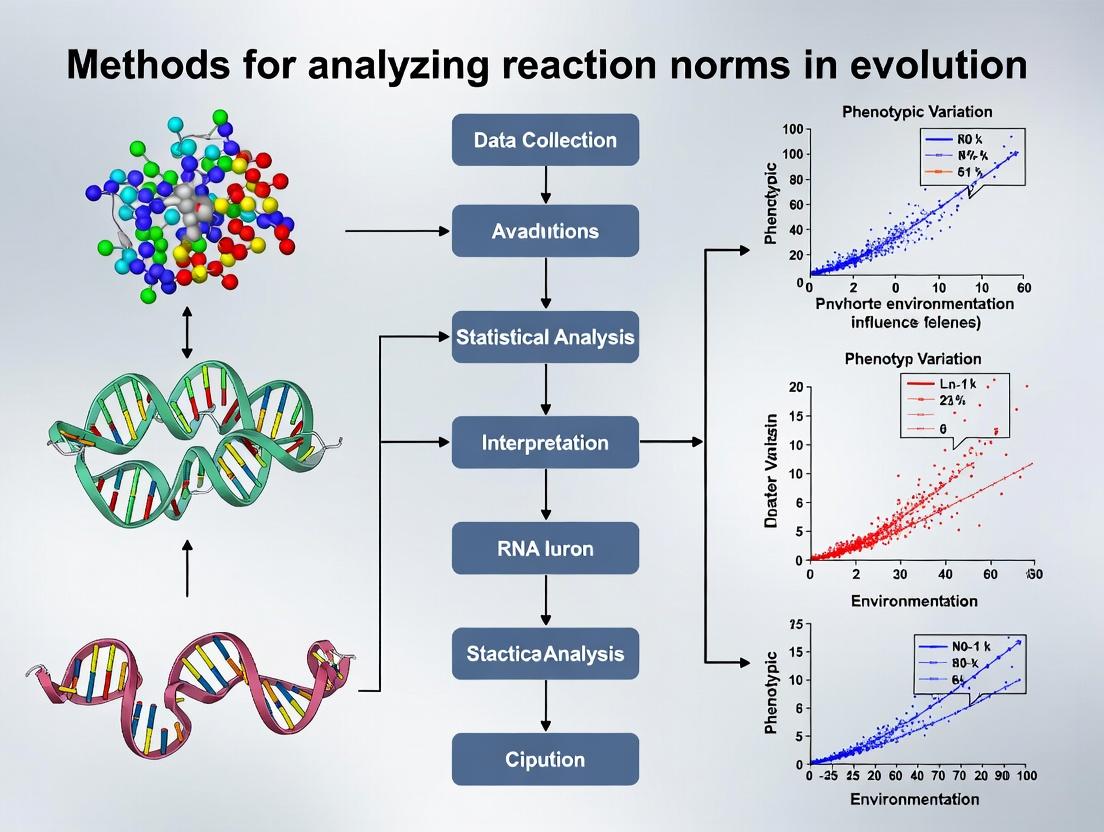
This article provides a detailed methodological guide for analyzing reaction norms—the patterns of phenotypic expression across environmental gradients—in evolutionary and biomedical contexts.
Beyond the Mean: A Comprehensive Guide to Reaction Norm Analysis in Evolutionary Biology and Biomedical Research
Abstract
This article provides a detailed methodological guide for analyzing reaction norms—the patterns of phenotypic expression across environmental gradients—in evolutionary and biomedical contexts. We first establish the foundational concepts of phenotypic plasticity and genotype-by-environment (GxE) interactions. We then explore advanced statistical and computational methods for modeling, visualizing, and interpreting reaction norm data, including polynomial regression, random regression, and function-valued trait approaches. We address common analytical pitfalls, power considerations, and optimization strategies for experimental design. Finally, we compare the strengths and applications of key methods (e.g., ANCOVA vs. random regression models) and discuss validation frameworks. Tailored for researchers, scientists, and drug development professionals, this guide bridges evolutionary theory with practical applications in understanding complex trait evolution and variable drug responses.
Decoding Plasticity: What Are Reaction Norms and Why Are They Crucial for Evolutionary & Biomedical Science?
Introduction Within the broader thesis on methods for analyzing reaction norms in evolutionary research, a precise definition of the core concept is foundational. A reaction norm is a function that describes the phenotypic expression of a single genotype across a range of environmental conditions. It is the primary graphical tool for visualizing and quantifying phenotypic plasticity—the ability of a genotype to produce different phenotypes in response to environmental variation. These plots, with environment on the x-axis and phenotype on the y-axis, allow researchers to dissect the patterns (e.g., linear, parabolic, threshold) and magnitude of plastic responses, which are crucial for understanding adaptation, ecological niche breadth, and evolutionary potential.
Application Notes & Protocols
1. Protocol: Quantifying a Linear Reaction Norm for Arabidopsis thaliana Hypocotyl Length in Response to Phytochrome Modulation This protocol details the measurement of a classic linear reaction norm for hypocotyl elongation under varying red-to-far-red light (R:FR) ratios, a proxy for shading.
Materials & Experimental Setup:
- Plant Material: Inbred Arabidopsis thaliana seeds (e.g., Col-0).
- Environmental Gradient: Growth chambers programmed to provide a gradient of R:FR ratios (e.g., 0.2, 0.5, 0.7, 1.0, 1.2). All other factors (total photon flux, temperature, humidity) are held constant.
- Replicates: 20 seedlings per genotype per environmental condition, randomized within chambers.
- Measurement: After 5 days of growth, capture digital images of seedlings. Measure hypocotyl length (mm) from root-shoot junction to cotyledon base using image analysis software (e.g., ImageJ).
Data Analysis & Reaction Norm Plotting:
- For each genotype, calculate the mean hypocotyl length for each R:FR condition.
- Plot the environmental variable (R:FR ratio) on the x-axis and the mean phenotypic value (hypocotyl length) on the y-axis.
- Fit a linear regression model (Phenotype ~ Environment) to the genotype-specific means. The slope of the line quantifies the magnitude and direction of plasticity.
- Compare slopes (plasticity) and intercepts (mean phenotype) between genotypes using Analysis of Covariance (ANCOVA).
Table 1: Example Data - Hypocotyl Length (mm, Mean ± SE) Across R:FR Gradient
| R:FR Ratio | Genotype A | Genotype B |
|---|---|---|
| 0.2 | 5.8 ± 0.3 | 3.2 ± 0.2 |
| 0.5 | 4.1 ± 0.2 | 2.9 ± 0.2 |
| 0.7 | 3.2 ± 0.2 | 2.8 ± 0.1 |
| 1.0 | 2.5 ± 0.1 | 2.7 ± 0.1 |
| 1.2 | 2.3 ± 0.1 | 2.7 ± 0.1 |
Interpretation: Genotype A shows high plasticity (steep negative slope), elongating in low R:FR. Genotype B shows canalization (shallow slope).
2. Protocol: Characterizing a Nonlinear (Thermal Performance) Reaction Norm in Drosophila melanogaster This protocol measures a nonlinear reaction norm for a physiological trait—locomotor performance—across an thermal gradient.
Materials & Experimental Setup:
- Animal Model: Isogenic lines of D. melanogaster.
- Environmental Gradient: Precision water baths or incubators set at a minimum of 5 temperatures (e.g., 12°C, 18°C, 24°C, 30°C, 36°C).
- Phenotype Assay: Individual fly locomotor performance (e.g., climbing speed in cm/s or time to complete a negative geotaxis assay).
- Acclimation: Flies are acclimated to each test temperature for 2 hours prior to assay.
- Replicates: 50 individuals per genotype per temperature.
Data Analysis:
- Calculate mean performance at each temperature.
- Plot temperature on the x-axis and performance on the y-axis.
- Fit a nonlinear model, such as a Gaussian or Briére function, to describe the thermal performance curve (TPC).
- Extract key parameters: Topt (optimal temperature), Pmax (maximum performance), and performance breadth (range of temperatures sustaining >80% of P_max).
Table 2: Derived Parameters from Thermal Performance Reaction Norms
| Genotype | T_opt (°C) | P_max (cm/s) | Performance Breadth (°C) |
|---|---|---|---|
| Line 1 | 24.5 | 15.2 | 20.1 |
| Line 2 | 27.8 | 14.7 | 15.4 |
Interpretation: Line 2 is adapted to a warmer, narrower thermal niche, while Line 1 has broader performance across lower temperatures.
Visualizations
Workflow for Reaction Norm Experiment
Common Reaction Norm Shapes
The Scientist's Toolkit: Key Research Reagent Solutions
| Item | Function in Reaction Norm Studies |
|---|---|
| Isogenic Lines / Clonal Organisms (e.g., inbred mice, cloned plants, recombinant inbred lines) | Minimizes genetic variance within a "genotype" treatment, allowing the clean measurement of plastic responses to environment. |
| Controlled Environment Chambers (Plant growth rooms, climate-controlled incubators) | Precisely generate and maintain the defined environmental gradients (e.g., temperature, light, humidity) required for the experiment. |
| Phenotypic Microplate Assays (Cell viability, enzyme activity, fluorescence reporters) | Enable high-throughput quantification of molecular/cellular phenotypes across many environmental conditions (e.g., drug doses, pH). |
| RNA/DNA Sequencing Kits (RNA-seq, bisulfite sequencing) | Uncover the molecular basis of plasticity by profiling gene expression (transcriptional plasticity) or epigenetic marks across environments. |
| Automated Image Analysis Software (ImageJ, CellProfiler, EthoVision) | Objectively quantify morphological or behavioral traits from large numbers of individuals or samples generated in reaction norm experiments. |
Statistical Software with GLM/ANCOVA (R, Python with scikit-learn, lme4) |
Essential for fitting linear and nonlinear models to reaction norm data and comparing parameters (slopes, curves) between genotypes. |
The Central Role of Genotype-by-Environment (GxE) Interactions in Evolution and Disease
Within the broader thesis on methods for analyzing reaction norms in evolution research, understanding Genotype-by-Environment (GxE) interactions is paramount. These interactions occur when the effect of a genotype on phenotype depends on the specific environment. In evolution, GxE shapes adaptive landscapes and phenotypic plasticity. In disease, it modulates penetrance, expressivity, and treatment response. This document provides application notes and detailed protocols for studying GxE interactions, focusing on modern, quantifiable approaches.
Application Notes: Quantifying GxE in Model Systems
Note 1.1: High-Throughput Phenotyping in Drosophila melanogaster GxE studies require robust phenotyping across controlled environments. Using the Drosophila Activity Monitoring (DAM) system under varying thermal and nutritional regimes allows for the quantification of complex traits like sleep, activity, and metabolism across isogenic lines.
Note 1.2: Cellular GxE via Perturbation Sequencing For human disease contexts, Pooled CRISPR Screens under differential environmental perturbations (e.g., normoxia vs. hypoxia, control vs. cytokine stress) identify genetic variants whose fitness effects are environment-dependent. This is critical for understanding genetic risk in variable physiological contexts.
Note 1.3: Longitudinal Biomarker Analysis in Clinical Cohorts In pharmacogenomics, GxE is assessed by modeling drug response biomarkers (e.g., LDL reduction, HbA1c change) as a function of genotype, environmental factor (e.g., diet, concomitant medication), and their interaction term in mixed-effects models.
Data Presentation: Example GxE Quantitative Data
Table 1: Summary of GxE Effect Sizes from Representative Studies
| Study System | Trait Measured | Environmental Gradient | Genetic Factor | GxE Effect Size (η² or p-interaction) | Key Finding |
|---|---|---|---|---|---|
| A. thaliana Ecotypes | Flowering Time | Temperature (10°C, 16°C, 22°C) | FRI genotype | η² = 0.35 | Flanking allele effect reversed at temperature extremes. |
| Human Lymphoblastoid Cells | Cell Proliferation | 0.1 µM vs. 1.0 µM Cisplatin | SNP rs1695 (GSTP1) | p = 2.3 x 10⁻⁵ | Protective genotype at low dose becomes risk-associated at high dose. |
| C57BL/6J Mice | Hepatic Lipid Content | Chow vs. High-Fat Diet | Pparg2 haplotype | Interaction p < 0.01 | Haplotype effect on steatosis is absent on chow, pronounced on HFD. |
| Clinical Trial | Warfarin Stable Dose | Vitamin K Intake (Low/High) | VKORC1 -1639G>A | p < 0.001 | VKORC1 effect on required dose is amplified in low Vitamin K intake group. |
Experimental Protocols
Protocol 2.1: Assessing GxE for Behavioral Reaction Norms in Drosophila Objective: To quantify the interaction between genetic background and dietary sugar on locomotor activity reaction norms across temperature. Materials: Isogenic Drosophila lines (n≥5), DAM system, incubators, standard vs. high-sucrose diets. Procedure:
- Expand & Randomize: Expand isogenic lines. Randomize vials across incubators at 18°C, 25°C, and 29°C.
- Environmental Cross: For each line at each temperature, split emerging adults onto two diets: Standard (5% sucrose) and High-Sucrose (15% sucrose). Allow 48-hour acclimation.
- Phenotyping: Load 32 flies per condition into DAM tubes. Record activity beam crosses in 1-minute bins for 5 days.
- Data Processing: Calculate daily activity sum, sleep bout number, and circadian power using
Sleep and Circadian Analysis MATLAB Kit (SCAMP). Average per fly, then per condition. - Statistical Analysis: Fit a linear mixed model:
Activity ~ Genotype + Temperature + Diet + Genotype*Temperature + Genotype*Diet + (1|Batch). Use likelihood ratio test to assess significance of interaction terms.
Protocol 2.2: In Vitro CRISPR Screen for GxE Interactions Under Metabolic Stress Objective: To identify genes whose knockout confers resistance or sensitivity specifically under low-glucose conditions. Materials: GeCKO v2 or similar lentiviral library, target cell line (e.g., HepG2), puromycin, low-glucose (1 mM) vs. normal-glucose (25 mM) DMEM. Procedure:
- Library Transduction: Transduce cells at low MOI (<0.3) to ensure single integration. Select with puromycin for 7 days.
- Environmental Perturbation: Split library pool into two arms: Low-Glucose (LG) and Normal-Glucose (NG). Maintain each arm for 14 days, passaging to maintain >500x coverage of library.
- Genomic DNA Extraction & Sequencing: Harvest 50M cells per arm at Day 0 and Day 14. Extract gDNA. Amplify sgRNA sequences via PCR and sequence on HiSeq platform.
- Bioinformatic Analysis: Align reads to library manifest. Calculate fold-change for each sgRNA using
MAGeCKorMAGeCK-VISPR. Test for significant GxE by comparing gene β-scores (LGDay14 - NGDay14) or using a specialized GxE test inMAGeCK-GENE.
Mandatory Visualization
Title: Core GxE Interaction Concept
Title: General GxE Experimental Workflow
The Scientist's Toolkit: Research Reagent Solutions
Table 2: Essential Materials for GxE Studies
| Item | Function & Relevance to GxE |
|---|---|
| Isogenic Model Organism Lines (e.g., Drosophila DGRP, BXD mouse strains) | Provides controlled genetic background to isolate the effect of specific loci across environments, fundamental for reaction norm analysis. |
| Environmental Control Chambers (Precise temp., humidity, light) | Enables reproducible application of defined environmental gradients, a core requirement for quantifying phenotypic plasticity. |
| Phenotypic Microarrays (e.g., OmniLog for microbial metabolism) | High-throughput platform to measure thousands of phenotypes (carbon source use) across genetic variants under different chemical environments. |
| Perturb-seq-Compatible CRISPR Library | Allows single-cell RNA-seq readout of genetic knockouts under different conditions, linking GxE to transcriptional pathways. |
| Longitudinal Biobank Samples with Clinical Metadata | Enables retrospective testing of GxE hypotheses in human populations by linking genetic data to time-varying environmental exposures and health outcomes. |
Mixed-Effects Modeling Software (lme4 in R, statsmodels in Python) |
Essential for partitioning variance into G, E, and GxE components while accounting for random effects like batch, family, or repeated measures. |
Within the broader thesis on methods for analyzing reaction norms in evolutionary research, understanding the fundamental shapes of reaction norms is paramount. Reaction norms describe the phenotypic expression of a genotype across an environmental gradient. This document provides application notes and protocols for identifying, classifying, and analyzing three primary reaction norm shapes: linear, quadratic, and threshold. These forms are critical for interpreting genotype-by-environment interactions (GxE) in evolutionary biology, agricultural science, and pharmaceutical development, where dose-response relationships are analogous.
Key Shapes and Quantitative Classifications
The shape of a reaction norm is defined by the mathematical relationship between an environmental variable (e.g., temperature, nutrient level, drug concentration) and a phenotypic trait (e.g., growth rate, gene expression, survival).
Table 1: Key Characteristics of Reaction Norm Shapes
| Shape | Mathematical Form | Key Biological Interpretation | Typical Statistical Test | Evolutionary Implication |
|---|---|---|---|---|
| Linear | Y = β₀ + β₁X | Phenotype changes at a constant rate across the gradient. Continuous, directional plasticity. | Linear regression (significance of β₁). | Predictable adaptation to gradual environmental change. |
| Quadratic | Y = β₀ + β₁X + β₂X² | Phenotype has an optimum at an intermediate environment. Unimodal (curvilinear) response. | Polynomial regression (significance of β₂). | Stabilizing selection; specialisation to a specific optimum. |
| Threshold | Y = {State A if X < Xc; State B if X ≥ Xc} | Abrupt switch between discrete phenotypic states at a critical environmental value. | Breakpoint analysis; Segmented regression; Logistic regression. | Bet-hedging or adaptive switching in unpredictable environments. |
Table 2: Example Quantitative Data from Model Studies
| Study System | Environmental Gradient | Trait Measured | Best-Fit Shape | Key Parameter Estimates (Mean ± SE) |
|---|---|---|---|---|
| Drosophila melanogaster | Temperature (16-28°C) | Wing Size (mm²) | Quadratic | β₀=1.2±0.1, β₁=0.05±0.01, β₂=-0.01±0.002 (Optimum at 24°C) |
| Arabidopsis thaliana | Salinity (0-200 mM NaCl) | Root:Shoot Ratio | Linear | β₀=0.3±0.02, β₁=0.0025±0.0003 (Positive slope) |
| Antibiotic Resistance | Drug Concentration (0-10 µg/mL) | Bacterial Growth Rate (OD/hr) | Threshold | Critical Concentration (Xc)= 2.1±0.3 µg/mL; Growth State Drop: 0.42 to 0.15 OD/hr |
Experimental Protocols
Protocol 1: Empirical Quantification of Reaction Norms
Objective: To empirically derive a reaction norm for a phenotypic trait across an environmental gradient. Materials: See "Scientist's Toolkit" below. Procedure:
- Genotype Selection: Choose multiple genetically distinct lines (clones, inbred lines, genotypes) of the study organism.
- Gradient Design: Establish a minimum of 5-6 levels of the environmental variable (e.g., temperature, pH, drug dose) spanning the relevant ecological or clinical range. Replicate each level at least 3-5 times.
- Randomized Exposure: Randomly assign individuals from each genotype to each environmental level, using a fully factorial or randomized block design.
- Phenotyping: Measure the target trait(s) using standardized, high-throughput methods (e.g., image analysis for morphology, spectrophotometry for growth, qPCR for expression).
- Data Structuring: Organize data with columns: GenotypeID, EnvironmentLevel, Replicate, Trait_Value.
Protocol 2: Statistical Classification of Shape
Objective: To statistically determine whether a reaction norm is best described by a linear, quadratic, or threshold model.
Software: R (recommended: lm, segmented, nls packages), Python (SciPy, statsmodels), or GraphPad Prism.
Procedure:
- Model Fitting:
- Linear Model: Fit
lm(Trait ~ Environment). - Quadratic Model: Fit
lm(Trait ~ Environment + I(Environment^2)). - Threshold Model: Fit a piecewise or segmented regression (e.g.,
segmentedin R) or use a logistic switch model.
- Linear Model: Fit
- Model Comparison: For linear vs. quadratic, use ANOVA to test if adding the quadratic term (β₂) significantly improves the fit. For threshold vs. continuous, use Akaike Information Criterion (AIC) comparison between the segmented and polynomial models. A lower AIC indicates a better fit.
- Parameter Estimation & Visualization: Extract parameters (slopes, optimum, breakpoint) with confidence intervals. Plot the raw data with the best-fit model overlaid.
Protocol 3: High-Throughput Screening for Threshold Responses in Drug Development
Objective: To identify critical transition concentrations (CTC) for cytotoxic or therapeutic compounds. Materials: 384-well plates, automated liquid handler, plate reader, live-cell imaging system. Procedure:
- Plate Setup: Seed cells uniformly across a 384-well plate. Using an automated liquid handler, create a 2-fold serial dilution of the test compound across columns, with rows representing replicates and controls (vehicle-only, positive death control).
- Exposure & Incubation: Incubate plates under standard conditions (e.g., 37°C, 5% CO₂) for 48-72 hours.
- Endpoint Multiplexing: Add a multiplexed assay reagent (e.g., combining a viability dye like resazurin and a cytotoxicity marker like propidium iodide). Read fluorescence/absorbance on a plate reader.
- Dose-Response Modeling: For each well, calculate normalized response (% viability). Fit a four-parameter logistic (4PL) model: Y = Bottom + (Top-Bottom) / (1 + 10^((LogEC50-X)*HillSlope)). The inflection point (LogEC50) is the quantitative threshold. A steep HillSlope (>2) indicates a sharp, threshold-like response.
Visualizations
Title: Statistical Workflow for Classifying Reaction Norm Shapes
Title: Molecular Pathways Underlying Linear vs. Threshold Norms
The Scientist's Toolkit
Table 3: Essential Research Reagents & Materials
| Item | Function in Reaction Norm Analysis | Example Product/Catalog |
|---|---|---|
| Controlled Environment Chambers | Precisely regulate temperature, humidity, and light to create stable environmental gradients for phenotypic screening. | Percival Intellus, Fitotron Plant Growth Chamber. |
| Automated Liquid Handling System | Enables high-throughput, reproducible setup of chemical/drug concentration gradients in microtiter plates. | Beckman Coulter Biomek, Tecan Fluent. |
| Multi-Mode Plate Reader | Quantifies phenotypic endpoints (viability, fluorescence, luminescence, absorbance) across many samples rapidly. | BioTek Synergy H1, BMG Labtech CLARIOstar. |
| Live-Cell Imaging System | Tracks phenotypic changes (morphology, proliferation) in real-time for dynamic reaction norm assessment. | Sartorius Incucyte, Olympus CellVoyager. |
| qPCR Master Mix & Assays | Measures gene expression plasticity (a key molecular phenotype) across environmental or treatment conditions. | Bio-Rad iTaq Universal SYBR, Thermo Fisher TaqMan Assays. |
| Statistical Software Suite | Performs model fitting, comparison, and parameter estimation for shape classification (linear, quadratic, threshold). | R with lme4, segmented packages; GraphPad Prism. |
This document provides a framework for analyzing variable drug response through the lens of evolutionary genetics, specifically using reaction norm methodologies. Phenotypic plasticity, quantified as reaction norms, is a fundamental concept in evolutionary biology describing how a genotype produces different phenotypes across environmental gradients. In biomedicine, the "environment" can be a drug dosage, a dietary regimen, or a comorbid condition. Inter-individual variation in drug efficacy and adverse reactions often stems from genetic adaptations to ancestral local environments (e.g., pathogen load, UV radiation, dietary staples), which now shape reaction norms to modern pharmaceuticals.
Core Application: By applying reaction norm analysis to in vitro and clinical trial data, researchers can move beyond static genetic association (e.g., SNP X correlates with outcome Y at dose Z) to model dynamic, dose-dependent phenotypic responses across genetically diverse populations. This is critical for personalized dose optimization, understanding off-target effects, and predicting subgroup-specific toxicities.
Key Data & Quantitative Summaries
Table 1: Evolutionary-Pharmacogenetic Loci with Evidence for Local Adaptation
| Gene (Variant) | Putative Selective Pressure (Population) | Associated Drug Response Phenotype | Reaction Norm Characteristic |
|---|---|---|---|
| CYP2D6 (Functional copy number variation) | Unknown, plant toxin metabolism? (Global variation) | Tamoxifen, codeine metabolism efficiency | Steep slope of metabolic conversion vs. dose; low plateau in poor metabolizers |
| VKORC1 (rs9923231) | Diet (Vitamin K availability) (East Asian) | Warfarin sensitivity; required dose | Lower intercept & shallower slope of INR response vs. dose |
| ALDH2*2 (rs671) | Alcohol consumption (East Asian) | Nitroglycerin efficacy, Alcohol Flush | Absent or diminished response at standard dose; low plateau |
| G6PD (Various deficient alleles) | Malaria protection (Africa, Mediterranean, Asia) | Hemolytic anemia from Primaquine, Dapsone | Threshold environmental (drug dose) trigger for adverse phenotype |
| NAT2 (Slow acetylator haplotypes) | Unknown, dietary toxins? (Global variation) | Isoniazid toxicity, Hydralazine efficacy | Steeper slope of toxic metabolite accumulation vs. dose |
Table 2: Methods for Reaction Norm Analysis in Pharmacogenomics
| Method | Input Data | Output | Key Advantage for Biomedicine |
|---|---|---|---|
| Random Regression | Repeated measures (e.g., INR across doses/time) per genotype. | Individual reaction norm slopes/intercepts. | Models continuous dose-response, handles missing data. |
| Finite Mixture Models | Population dose-response curves. | Distinct latent reaction norm classes. | Identifies discrete responder subgroups (e.g., non, low, high). |
| Reaction Norm GWAS | Phenotypes across multiple drug concentrations/doses. | SNPs associated with slope (plasticity) or intercept. | Discovers variants affecting sensitivity, not just baseline. |
| In Vitro Dose-Response Profiling | Cell viability/activity across drug gradient in diverse iPSC lines. | IC50, Hill slope parameters per genotype. | High-throughput, controlled environmental gradient. |
Detailed Experimental Protocols
Protocol 1: Generating Dose-Response Reaction Norms from Clinical Trial Data
Objective: To model individual pharmacokinetic (PK) or pharmacodynamic (PD) reaction norms from sparse clinical dose-ranging data.
Materials: PK/PD measurements at multiple timepoints/doses, patient genotype data, nonlinear mixed-effects modeling software (e.g., NONMEM, R nlme).
Procedure:
- Data Structuring: Organize data into long format: Subject ID, Genotype, Drug Dose (or time since dose), Measured Phenotype (e.g., drug plasma concentration, INR, pain score).
- Model Selection: Fit a base pharmacological model (e.g., Emax model for PD:
E = E0 + (Emax * Dose) / (ED50 + Dose)). E0 (intercept) and ED50 (slope-related) are parameters. - Random Effects Integration: Allow E0 and ED50 (or Emax) to vary as random effects across individuals. This estimates a unique reaction norm (curve) for each subject.
- Genetic Covariate Testing: Systematically test if genotype groups significantly explain variance in the random effect parameters (e.g., Does VKORC1 genotype predict a lower average ED50?).
- Visualization & Interpretation: Plot families of fitted curves, grouped by genotype, to visualize genetic differences in reaction norm shape (intercept, slope, plateau).
Protocol 2:In VitroCellular Reaction Norm Assay using iPSCs
Objective: To quantify genetic effects on cytotoxic drug response reaction norms in a controlled cellular environment. Materials: iPSC lines from donors of known genotype (e.g., CYP2C19 variants), target drug (e.g., Clopidogrel active metabolite), cell culture reagents, 96-well plates, plate reader, cell viability assay (e.g., CTG). Procedure:
- Cell Preparation: Differentiate iPSCs uniformly into relevant cell type (e.g., hepatocytes, cardiomyocytes). Plate cells at equal density in 96-well plates.
- Drug Gradient Establishment: Prepare a 10-point, 1:2 serial dilution of the drug across columns of the plate. Include negative (vehicle) and positive (lysis) controls. Use 8-12 replicates per concentration per cell line.
- Exposure & Assay: Incubate cells for a fixed period (e.g., 72h). Add Cell Titer-Glo reagent, measure luminescence.
- Dose-Response Modeling: For each well, calculate % viability relative to vehicle controls. For each cell line, fit a log-logistic curve (4-parameter LL.4 in R
drcpackage):Viability = c + (d-c) / (1 + exp(b(log(Dose) - log(e)))). Parametereis the IC50 (inflection point),bis the Hill slope (steepness). - Reaction Norm Analysis: Treat the fitted parameters (IC50, Hill slope) as the phenotypic traits for each genotype. Perform ANOVA to test for genetic differences in these reaction norm parameters. The dose-gradient is the "environment".
Visualizations (Diagrams & DOT Scripts)
Diagram Title: Evolutionary Path to Variable Drug Response
Diagram Title: In Vitro Reaction Norm Assay Workflow
The Scientist's Toolkit: Research Reagent Solutions
Table 3: Essential Reagents & Materials for Reaction Norm Pharmacogenomics
| Item | Function & Application | Example/Note |
|---|---|---|
| Diverse iPSC Biobanks | Genetically diverse cellular substrate for in vitro reaction norm assays. | HipSci, HDP. Required for genetic generalization. |
| Directed Differentiation Kits | Produce consistent, relevant cell types (hepatocytes, neurons, cardiomyocytes) from iPSCs. | Commercial kits ensure assay reproducibility. |
| High-Throughput Cell Viability Assays | Quantify phenotypic output across many dose conditions (the "environment"). | CellTiter-Glo 3D, PrestoBlue. Luminescent/fluorescent readouts. |
| Pharmacogenomic SNP Panels | Targeted genotyping of known ADME (Absorption, Distribution, Metabolism, Excretion) and target variants. | PharmacoScan, DMET Plus. Focused, cost-effective. |
| Dose-Response Curve Fitting Software | Extract reaction norm parameters (slope, intercept, inflection point) from raw data. | R packages drc, nlme, lme4. Essential for analysis. |
| Population-Specific Genomic Reference Data | Context for identifying locally adapted alleles and their haplotypic backgrounds. | 1000 Genomes, gnomAD, HapMap. Critical for evolutionary inference. |
Application Notes
Within evolutionary and biomedical research, the analysis of reaction norms—the pattern of phenotypic expression of a single genotype across a range of environments—is fundamental. The core terminology frames this analysis: Plasticity describes the change in phenotype; Canalization is the robustness against such change; Cross-Over Interactions (Genotype-by-Environment interactions, GxE) occur when phenotypic rankings of genotypes change across environments; and the Norms of Reaction is the graphical plot that visualizes these relationships. These concepts are critical for understanding complex trait evolution, identifying genetic architectures, and predicting individual responses to environmental stressors or therapeutic interventions in personalized medicine.
Table 1: Key Quantitative Parameters in Reaction Norm Analysis
| Parameter | Formula/Description | Interpretation | ||
|---|---|---|---|---|
| Plasticity Slope (β) | β = (PE2 - PE1) / (E2 - E1) | Rate of phenotypic change per unit environmental change. High | β | = high plasticity. |
| Canalization Index (CI) | CI = 1 / (σ²P | G), where σ² is phenotypic variance across environments for a genotype. | Higher CI indicates greater canalization (less variance). | |
| GxE Significance (p-value) | From Two-Way ANOVA (Genotype, Environment, GxE). | p(GxE) < 0.05 indicates statistically significant cross-over interaction. | ||
| Reaction Norm Curvature | Fit to linear vs. polynomial (e.g., quadratic) models, compare R²/AIC. | Significant curvature indicates non-linear plasticity, critical for predicting extremes. |
Experimental Protocols
Protocol 1: High-Throughput Phenotyping for Reaction Norm Construction Objective: To generate robust reaction norms for multiple genotypes across a controlled environmental gradient. Materials: 10 isogenic Drosophila melanogaster lines, controlled climate chambers, artificial diet, automated imaging system for wing morphology. Procedure:
- For each genotype (G1-G10), establish 10 replicate populations.
- Expose replicates to a temperature gradient (5 environments: 18°C, 21°C, 25°C, 28°C, 31°C) throughout development.
- Upon eclosion, collect 20 individuals per genotype per environment for analysis.
- Anaesthetize flies and use high-resolution automated imaging to capture wing images.
- Use landmark-based geometric morphometrics software (e.g., MorphoJ) to extract centroid size and vein positions as quantitative traits.
- For each genotype, plot the mean trait value (y-axis) against temperature (x-axis) to construct its reaction norm.
- Perform Two-Way ANOVA to test for effects of Genotype, Environment, and GxE interaction.
Protocol 2: Quantifying Canalization via Environmental Perturbation Objective: To measure the degree of canalization for a developmental trait under chemical stress. Materials: Arabidopsis thaliana wild-type (Col-0) and mutant lines (e.g., hsp90), NaCl solutions (0mM, 50mM, 100mM, 150mM), growth chambers, root imaging system. Procedure:
- Surface-sterilize and stratify seeds for each genotype.
- Sow seeds on vertical agar plates containing the defined NaCl concentrations (n=15 per genotype per environment).
- Grow plates in a controlled chamber (22°C, 16h light).
- After 7 days, capture high-contrast images of primary root growth.
- Measure primary root length using image analysis software (e.g., ImageJ).
- Calculate within-genotype variance (σ²) for root length across the four salt environments.
- Compute Canalization Index (CI = 1/σ²) for each genotype. Lower variance yields higher CI, indicating greater canalization.
Protocol 3: Detecting Cross-Over Interactions in Drug Response Objective: To identify GxE (where "E" is drug concentration) in cancer cell line viability. Materials: Three human breast cancer cell lines (MCF-7, MDA-MB-231, HCC1954), chemotherapeutic agent (e.g., Doxorubicin), cell culture reagents, 96-well plates, plate reader. Procedure:
- Seed cells at 5,000 cells/well in 96-well plates. Allow to adhere overnight.
- Treat cells with a gradient of doxorubicin (8 concentrations: 0 nM to 1000 nM, serial dilution).
- Incubate for 72 hours.
- Add MTT reagent (0.5 mg/mL) and incubate for 4 hours. Solubilize with DMSO.
- Measure absorbance at 570 nm using a plate reader. Calculate percent viability relative to untreated controls.
- Plot dose-response curves (viability vs. log[drug]) for each cell line.
- Statistically analyze using a Two-Way ANOVA (factors: Cell Line, Drug Concentration). A significant interaction term indicates a cross-over interaction, meaning the relative sensitivity of the lines changes with dose.
The Scientist's Toolkit: Research Reagent Solutions
Table 2: Essential Materials for Reaction Norm Experiments
| Item | Function | Example/Supplier |
|---|---|---|
| Isogenic Lines | Provides genetically identical individuals to isolate environmental effects. | Drosophila GDSC, C. elegans N2, Arabidopsis TAIR. |
| Environmental Chambers | Precisely controls abiotic factors (T°, humidity, light) to create defined "environments." | Percival, Conviron, Fitotron. |
| Phenotyping Software | Quantifies complex morphological, physiological, or behavioral traits from raw data. | MorphoJ (shape), ImageJ (general), EthoVision (behavior). |
| Viability/Cytotoxicity Assay | Measures cellular response to chemical/drug environment. | MTT, CellTiter-Glo (Promega). |
| High-Throughput Sequencer | Genotypes individuals or assesses gene expression (RNA-seq) across environments. | Illumina NovaSeq, PacBio Sequel. |
| Statistical Software | Performs ANOVA, linear/non-linear modeling of reaction norms. | R (ggplot2, lme4), JMP, GraphPad Prism. |
Visualizations
Title: Plasticity and Reaction Norm Formation
Title: Crossover Interaction from Reaction Norms
Title: Experimental Workflow for Norms of Reaction
The Analyst's Toolkit: Statistical Models and Computational Approaches for Reaction Norm Analysis
Within the broader thesis on analyzing reaction norms in evolution research, the Analysis of Covariance (ANCOVA) serves as a foundational statistical framework for detecting and quantifying genotype-by-environment interaction (GxE). Reaction norms—the graphical representation of a genotype's phenotypic expression across an environmental gradient—are central to studying phenotypic plasticity and local adaptation. ANCOVA extends simple ANOVA by allowing the inclusion of continuous environmental covariates (e.g., temperature, nutrient level, drug dosage), thereby providing a powerful method to test for non-parallel reaction norms (i.e., significant GxE) and to quantify the effect size of the interaction. This protocol details the application of ANCOVA for GxE analysis in evolutionary biology and preclinical drug development, where understanding differential treatment responses across genetic backgrounds is critical.
Core Statistical Model & Hypotheses
The basic mixed-model ANCOVA for a controlled GxE experiment is: Yijk = μ + Gi + Ej + β(Ej - Ē) + (GxE)ij + εijk Where:
- Y_ijk: Phenotypic measurement for the kth replicate of genotype i in environment j.
- μ: Overall mean.
- G_i: Fixed effect of the ith genotype.
- E_j: Fixed effect of the jth environment (treated as a factor).
- β: Common regression coefficient (slope) of phenotype on the environmental covariate.
- (GxE)_ij: Interaction effect between genotype i and environment j.
- ε_ijk: Residual error.
Key Null Hypotheses:
- H₀ (GxE): All (GxE)_ij = 0. (Reaction norms are parallel).
- H₀ (Homogeneity of Slopes): The regression slope (β) of phenotype on the environmental covariate is equal across all genotypes.
Rejection of H₀ (Homogeneity of Slopes) provides direct evidence for GxE.
Detailed Experimental Protocol: ANCOVA for GxE in a Plant Model
A. Experimental Design
- Objective: To quantify GxE for drought tolerance (shoot biomass) across 5 recombinant inbred lines (RILs) of Arabidopsis thaliana under 3 soil moisture gradients.
- Design: Randomized complete block design with 4 blocks (growth chambers). Each block contains all treatment combinations.
- Factors:
- Genotype (G): 5 levels (RIL1, RIL2, RIL3, RIL4, RIL5). Fixed effect.
- Water Regime (E): 3 levels (Well-watered: 90% field capacity, Moderate drought: 50% FC, Severe drought: 30% FC). Fixed effect.
- Covariate: Measured actual soil water content (% FC) for each pot at flowering.
- Replication: n = 8 plants per GxE combination per block (Total N = 5 x 3 x 4 x 8 = 480 plants).
B. Materials & Setup
- Plant Materials: Seeds of 5 Arabidopsis RILs, stratified for 72h at 4°C.
- Growth System: Controlled-environment growth chambers with programmable lighting (12h photoperiod, 22°C).
- Pots & Soil: Standardized peat-based soil mix in 10cm pots. Pots are weight-calibrated for water content.
- Irrigation: Automated drip system with manual calibration for each treatment level.
C. Step-by-Step Procedure
- Sowing & Randomization: Sow stratified seeds into pre-weighed, labeled pots. Randomly assign pots to positions within a block (chamber) using a random number generator.
- Germination & Thinning: Maintain at 100% FC for all pots until establishment (7 days). Thin to 1 plant per pot.
- Treatment Application: At day 14, initiate water regimes. Adjust watering to achieve target soil moisture levels. Allow pots to dry down to their target weight range over 48h, then maintain via daily weighing and watering.
- Covariate Measurement: At the first sign of flowering (day 35), measure the actual soil water content (% FC) for each pot using a calibrated soil moisture probe. Record this as the continuous covariate.
- Phenotyping: At plant maturity (day 60), harvest shoots. Dry biomass at 70°C for 48h. Record final shoot dry weight (mg) as the response variable Y.
- Data Curation: Assemble data with columns: Block, Genotype, WaterRegime (factor), SoilMoistureCovariate (continuous), ShootBiomass.
Data Analysis & Interpretation Protocol
Step 1: Preliminary Assumptions Check
- Linearity: Visually inspect scatterplots of Biomass vs. SoilMoistureCovariate for each genotype.
- Homogeneity of Slopes: Fit a preliminary model with an interaction term between Genotype and the covariate. A significant interaction indicates violation.
- Independence & Normality: Check residual plots (fitted vs. residuals, Q-Q plot).
- Homoscedasticity: Use Levene's test on residuals.
Step 2: ANCOVA Execution in R
Step 3: Post-Hoc Analysis & Visualization If a significant GxE is detected:
- Estimate Marginal Means & Slopes: Use the
emmeanspackage to compute genotype-specific slopes (reaction norm gradients) and pairwise comparisons of slopes.
- Plot Reaction Norms: Plot fitted regression lines for each genotype from the
model_fullagainst the continuous soil moisture covariate.
Table 1: ANCOVA Table for Shoot Biomass
| Source | DF | Sum Sq | Mean Sq | F value | p-value |
|---|---|---|---|---|---|
| Block | 3 | 12.5 | 4.17 | 2.15 | 0.093 |
| Genotype (G) | 4 | 245.8 | 61.45 | 31.67 | <0.001 |
| Soil Moisture Covariate (SMC) | 1 | 880.6 | 880.60 | 453.92 | <0.001 |
| Genotype x SMC (GxE) | 4 | 58.3 | 14.58 | 7.52 | <0.001 |
| Residuals | 467 | 906.1 | 1.94 |
Table 2: Estimated Reaction Norm Slopes (Biomass per Unit Soil Moisture)
| Genotype | Slope (mg/%FC) | SE | Lower 95% CI | Upper 95% CI |
|---|---|---|---|---|
| RIL1 | 0.85 | 0.12 | 0.61 | 1.09 |
| RIL2 | 1.32 | 0.11 | 1.10 | 1.54 |
| RIL3 | 0.51 | 0.12 | 0.27 | 0.75 |
| RIL4 | 1.20 | 0.11 | 0.98 | 1.42 |
| RIL5 | 0.48 | 0.12 | 0.24 | 0.72 |
Pairwise comparison indicates slopes of RIL2 and RIL4 are significantly steeper than those of RIL3 and RIL5 (p < 0.01, Tukey-adjusted).
Visualizing the ANCOVA Framework for GxE
Title: ANCOVA GxE Analysis Workflow
The Scientist's Toolkit: Key Research Reagent Solutions
Table 3: Essential Materials for Controlled GxE Experiments
| Item / Reagent | Function in GxE Analysis | Example / Specification |
|---|---|---|
| Recombinant Inbred Lines (RILs) | Provides replicable, fixed genetic backgrounds to isolate genetic effects from environmental noise. | Arabidopsis TAIR RIL sets, Drosophila DGRP lines. |
| Controlled Environment Chambers | Enables precise manipulation and replication of environmental factors (temp, light, humidity). | Percival or Conviron chambers with programmable settings. |
| Automated Irrigation & Weighing System | Ensures accurate and consistent application of the environmental covariate (e.g., water/nutrient stress). | Lysimeter-based system or programmable drip irrigation. |
| Soil Moisture Probe/Sensor | Quantifies the actual continuous environmental covariate for ANCOVA, moving beyond categorical treatment levels. | Time-domain reflectometry (TDR) probe or calibrated capacitive sensor. |
| High-Throughput Phenotyping Platform | Measures quantitative phenotypic traits (biomass, growth rate, color) with minimal error. | Digital imaging systems (e.g., LemnaTec), spectrophotometers. |
| Statistical Software with ANCOVA/Linear Mixed Model Capabilities | Performs the core statistical analysis, hypothesis testing, and post-hoc comparisons. | R (packages: lme4, car, emmeans), SAS PROC GLM/MIXED, JMP. |
The analysis of reaction norms—the patterns of phenotypic expression of a single genotype across a range of environments—is central to understanding phenotypic plasticity in evolutionary biology. This document provides Application Notes and Protocols for modeling continuous, non-linear reaction norms using polynomial regression and spline-based methods. These techniques are essential for quantifying how traits like drug resistance, enzyme activity, or morphological features change gradually across continuous environmental gradients (e.g., temperature, pH, drug concentration), moving beyond simple threshold models.
Core Methodological Framework & Data Comparison
Quantitative Method Comparison
The following table summarizes the key characteristics, applications, and outputs of the two primary modeling approaches.
Table 1: Comparison of Polynomial Regression and Spline-Based Methods for Reaction Norm Analysis
| Feature | Polynomial Regression | Spline-Based Methods (Cubic Splines) |
|---|---|---|
| Mathematical Form | Global: (\hat{y} = \beta0 + \beta1x + \beta2x^2 + ... + \betakx^k) | Local: Piecewise polynomials joined at knots. |
| Flexibility | Low to Moderate. Constrained by polynomial degree. Can exhibit runaway behavior at extremes. | High. Flexibility controlled by number and position of knots. |
| Overfitting Risk | High with increasing degree ((k)). | Moderate. Can be managed via knot placement and penalty terms (e.g., smoothing splines). |
| Primary Use Case | Modeling simple, smooth, globally defined curves. | Modeling complex, wiggly, or locally variable norms. |
| Key Output | Coefficients ((\beta_i)) for each polynomial term. | Predicted values and derivatives at any environmental value. |
| Interpretability | Direct interpretation of coefficients can be challenging beyond quadratic terms. | Coefficients not directly interpretable; inference relies on fitted curve shape. |
| Implementation in R | lm(y ~ poly(x, degree=k, raw=TRUE)) |
smooth.spline() or mgcv::gam(y ~ s(x, bs="cr")) |
Example Data Output Simulation
The table below illustrates hypothetical model outputs from a study on E. coli growth rate across a temperature gradient.
Table 2: Simulated Model Outputs for Bacterial Growth Rate Reaction Norm
| Temp (°C) | Observed Growth | Poly. Deg3 Fit | Cubic Spline Fit | Residual (Poly.) | Residual (Spline) |
|---|---|---|---|---|---|
| 15 | 0.12 | 0.10 | 0.11 | 0.02 | 0.01 |
| 20 | 0.35 | 0.38 | 0.36 | -0.03 | -0.01 |
| 25 | 0.78 | 0.75 | 0.77 | 0.03 | 0.01 |
| 30 | 0.92 | 0.95 | 0.93 | -0.03 | -0.01 |
| 35 | 0.65 | 0.62 | 0.64 | 0.03 | 0.01 |
| Model R² | - | 0.963 | 0.991 | - | - |
| AIC | - | -45.2 | -52.7 | - | - |
Experimental Protocols
Protocol 1: Data Collection for a Continuous Plasticity Experiment
Objective: To generate high-quality dose-response data suitable for polynomial and spline regression analysis.
Materials: See "The Scientist's Toolkit" (Section 5).
Procedure:
- Gradient Establishment: Prepare a continuous environmental gradient. For a chemical (e.g., antibiotic), use a liquid handler to create a 20-step, two-fold serial dilution in a 96-well plate. For temperature, use a thermogradient cycler.
- Replicate Setup: For each genotype/clone, allocate a minimum of 4 biological replicates randomly across the gradient plate to control for positional effects.
- Inoculation & Incubation: Inoculate each well with a standardized cell density (e.g., OD600 = 0.02). Incubate under precise conditions for a fixed duration.
- Phenotyping: Quantify the phenotype of interest (e.g., optical density for growth, fluorescence for reporter activity, cell count via flow cytometry). Use a plate reader with environmental control.
- Data Curation: Export raw data. Normalize responses if necessary (e.g., to positive/negative controls). The final dataset should be a tidy data frame with columns:
Genotype,Environment,Replicate,Phenotype.
Protocol 2: Computational Modeling & Analysis Workflow
Objective: To fit and compare polynomial and spline models to reaction norm data.
Software: R (≥4.0.0) with packages tidyverse, mgcv, splines.
Procedure:
- Data Preparation: Load data into R. Visually inspect using
ggplot2:ggplot(data, aes(x=Environment, y=Phenotype, group=Genotype)) + geom_point(). - Polynomial Regression:
a. Center the environmental variable to reduce collinearity:
data$Env_centered <- scale(data$Environment, scale=FALSE). b. Fit a series of models:poly_model <- lm(Phenotype ~ poly(Env_centered, degree = k, raw = TRUE), data = data). c. UseAIC(poly_model)or cross-validation to select the optimal degree k (balance fit & complexity). - Spline Regression:
a. Fit a smoothing spline:
spline_model <- smooth.spline(data$Environment, data$Phenotype, cv = TRUE). Let cross-validation (cv) determine the smoothing parameter. b. Alternatively, fit a regression spline with specified knots:lm(Phenotype ~ ns(Environment, knots = c(k1, k2, k3)), data = data). - Model Comparison: Compare the best polynomial and spline models using AIC and visual diagnostics (
plot(residuals(model))). - Inference: Extract the fitted values and first derivatives (slope of the reaction norm) using
predict()function with appropriate arguments. For splines, usepredict(spline_model, deriv = 1)to estimate the instantaneous rate of phenotypic change.
Visualization of Workflows & Concepts
Title: Workflow for Modeling Continuous Plasticity
Title: Conceptual Basis of a Reaction Norm
The Scientist's Toolkit
Table 3: Essential Research Reagents & Materials
| Item | Function & Rationale |
|---|---|
| Thermogradient Cycler | Creates a precise, continuous temperature gradient across a multi-well plate, essential for thermal performance curves. |
| Automated Liquid Handler | Enables high-precision serial dilution for chemical gradient generation (e.g., drug dose-response). |
| Multi-mode Microplate Reader | Quantifies phenotypic outputs (absorbance, fluorescence, luminescence) directly from assay plates. |
| R Statistical Software | Open-source platform with comprehensive packages (mgcv, splines) for polynomial and spline regression. |
Smoothing Spline R Function (smooth.spline) |
Fits a non-parametric smoothing spline with automatic smoothing parameter selection via cross-validation. |
Generalized Additive Model (GAM) via mgcv::gam) |
Advanced framework for fitting complex splines, interaction norms, and random effects. |
| Akaike Information Criterion (AIC) | A statistical measure for model selection, balancing goodness-of-fit and model complexity. |
| Knot Selection Algorithms | Methods (e.g., based on quantiles of X, model selection) to optimally place spline knots. |
Application Notes
Within the broader thesis on methods for analyzing reaction norms in evolution research, Random Regression (RR) mixed models represent a powerful quantitative genetic framework for modeling individual-level phenotypic plasticity. Plasticity—the ability of a single genotype to produce different phenotypes in response to environmental variation—is conceptualized as a continuous reaction norm. RR models treat these reaction norms as random effects, allowing the estimation of individual-specific intercepts (average phenotype) and slopes (plasticity) across an environmental gradient.
Key applications include:
- Quantitative Genetics: Partitioning phenotypic variance into components for mean trait value, plasticity (slope), and their covariance, enabling estimation of the genetic basis of plasticity (GxE interactions).
- Evolutionary Biology: Predicting adaptive responses to environmental change by estimating the evolvability of both trait means and plasticity.
- Agricultural & Breeding Sciences: Identifying genotypes with desirable stability or targeted plasticity across management environments.
- Pharmacology & Drug Development: Modeling individual-specific trajectories in response to drug dosage (a continuous "environment"), crucial for personalized medicine and understanding variable treatment responses.
The core model for individual i at environment x is:
y_ij = (μ + a_i) + (β + b_i)x_j + ε_ij
where a_i and b_i are the random intercept and slope for individual i, assumed to be multivariate normally distributed with covariance matrix G.
Table 1: Core Variance-Covariance Components Estimated by a Random Regression Model
| Component | Symbol | Interpretation in Plasticity Context |
|---|---|---|
| Variance of Random Intercepts | σ²ₐ | Genetic/persistent variance for the average trait value. |
| Variance of Random Slopes | σ²_b | Genetic/persistent variance for plasticity (responsiveness). |
| Covariance (Intercept, Slope) | σ_ab | Genetic correlation between trait mean and plasticity. Positive: Genotypes with higher mean are more plastic. |
| Residual Variance | σ²_ε | Variance due to transient environmental effects or measurement error. |
Table 2: Derived Parameters for Evolutionary Inference
| Parameter | Formula | Interpretation |
|---|---|---|
| G Matrix | [[σ²ₐ, σ_ab], [σ_ab, σ²_b]] |
Additive genetic (co)variance matrix for intercepts & slopes. |
| Linear Reaction Norm Heritability | h² = (σ²ₐ + 2xσ_ab + x²σ²_b) / (σ²_P(x)) |
Proportion of phenotypic variance at environment x due to genetic effects. |
| Evolvability of Plasticity (I_b) | σ²_b / β² |
Measures potential for plasticity to respond to selection. |
Experimental Protocols
Protocol 1: Longitudinal Phenotyping for a Random Regression Analysis
Objective: To collect repeated measurements of a quantitative trait on genetically related individuals across a controlled environmental gradient (e.g., temperature, nutrient level, drug dosage) for RR modeling.
Materials:
- Genetically defined population (e.g., inbred lines, half-sib families, cloned genotypes).
- Controlled environment chambers or hydroponic systems.
- Measurement apparatus specific to trait (e.g., spectrophotometer, force sensor, imaging system).
- Data logging software.
Procedure:
- Experimental Design: Randomly assign n individuals (from g genetic groups) to e discrete levels of the environmental gradient. Use a repeated measures design where feasible.
- Acclimatization: Subject all individuals to a common baseline environment for a standardized period.
- Environmental Exposure: Sequentially expose each individual to the series of environmental levels. The order should be randomized or counterbalanced to control for carryover effects. Allow for adequate acclimation at each step.
- Phenotyping: Measure the target trait(s) for each individual at each environmental level. Ensure measurements are precise and blinded to the extent possible.
- Data Structuring: Organize data in a "long format" with columns:
IndividualID,GeneticGroup,EnvironmentValue(continuous covariatex),TraitValue(y), and any relevant fixed effects (e.g.,Sex,Batch).
Protocol 2: Fitting a Random Regression Mixed Model in R (nlme/lme4)
Objective: To fit a RR model and extract variance components for individual plasticity.
Materials:
- R statistical software (v4.3.0+).
- Packages:
lme4,nlme,plyr,ggplot2. - Dataset structured per Protocol 1.
Procedure:
- Data Preparation & Exploration:
Model Specification: Using
lme4for random intercepts and slopes across a continuous environmentenv:Model Comparison & Selection:
Variance Component Extraction:
Visualizations
Random Regression Analysis Workflow (94 chars)
Random Regression Model Structure (80 chars)
The Scientist's Toolkit
Table 3: Key Research Reagent Solutions for Plasticity Studies
| Item | Function in RR/Plasticity Studies |
|---|---|
| Clonal or Inbred Lineages | Provides genetic replication, essential for separating genetic from environmental variance components in the G matrix. |
| Controlled Environment Chambers (e.g., Percival) | Enables precise, repeatable application of an environmental gradient (temperature, light, humidity) as a continuous covariate. |
| Automated Phenotyping Platforms (e.g., PhenoRig, LemnaTec) | Allows high-throughput, non-destructive repeated measurements on the same individuals, reducing measurement error (σ²_ε). |
Restricted Maximum Likelihood (REML) Software (ASReml, lme4, MCMCglmm) |
Fits complex RR mixed models and reliably estimates variance-covariance parameters. |
| Pedigree or Relatedness Matrix (Genomic/Historical) | Required for quantitative genetic RR models to estimate additive genetic (co)variances rather than total individual (co)variances. |
| Continuous Environmental Sensor Loggers | Validates the intended environmental gradient (x) and provides covariates for heterogeneous residual variance models. |
High-Dimensional and Function-Valued Trait (FVT) Analyses
Application Notes
Within evolutionary research, reaction norms describe the phenotypic expression of a genotype across an environmental gradient. Analyzing these norms as high-dimensional or function-valued traits (FVTs) moves beyond single-point comparisons, capturing the full shape of phenotypic plasticity, growth trajectories, or time-series responses. This approach is critical for identifying genetic architectures of plasticity and predicting adaptive responses to environmental change.
Key Applications:
- Thermal Performance Curves: Modeling fitness components (e.g., locomotion, growth rate) across a continuous temperature range as FVTs for QTL mapping.
- Developmental Trajectories: Treating organismal size or shape over time as a continuous function to study heterochrony and developmental stability.
- Drug Response Phenotyping: In pharmacological evolution, analyzing dose-response curves (viability vs. drug concentration) of microbial or cell line populations as FVTs to map resistance evolution.
- High-Throughput Phenomics: Reducing dimensionality of complex, correlated morphological or spectral data (e.g., from automated imaging) to define major axes of multivariate reaction norms.
Quantitative Data Summary:
Table 1: Comparison of Analytical Methods for Reaction Norm Data
| Method | Data Input | Key Output | Advantages | Limitations |
|---|---|---|---|---|
| Multivariate ANOVA (MANOVA) | Vector of trait values across environments. | Significance of genotype, environment, GxE. | Statistically familiar, widely implemented. | Treats environments as discrete levels; does not model continuous function. |
| Principal Components Analysis (PCA) on Reaction Norms | Trait values matrix (genotypes x environments). | PCs capturing variation in intercept & slope. | Reduces dimensionality; visualizes major patterns. | Linear combinations may not match biological parameters. |
| Function-Valued Trait (FVT) Analysis | Trait values measured at continuous index (e.g., time, temp). | Estimated covariance function (G matrix). | Uses all data points; models continuous shape; powerful for prediction. | Computationally intensive; requires careful curve fitting. |
| Random Regression / Mixed Models | Repeated measures along gradient. | Estimates of genetic variance for intercept, slope, curvature. | Flexible; handles unbalanced data; partitions variance components. | Choice of basis functions (e.g., polynomials, splines) influences results. |
| High-Dimensional GWAS (e.g., Sparse PCA) | Ultra-high-dimensional phenotyping (e.g., image pixels). | SNPs associated with major axes of phenotypic variation. | Can discover novel, complex phenotypes. | High multiple-testing burden; requires large sample sizes. |
Experimental Protocols
Protocol 1: Function-Valued Trait Analysis for Thermal Reaction Norms
Objective: To estimate genetic parameters (heritability, genetic correlations) for a performance trait across a continuous temperature gradient.
Materials:
- Clonal lineages or inbred genotypes of study organism.
- Precision temperature-controlled incubators or water baths.
- Automated phenotyping platform (e.g., locomotor tracker, growth measurer).
Procedure:
- Experimental Design: For each of N genotypes, allocate R replicates to each of T assay temperatures (e.g., 10, 15, 20, 25, 30°C). Randomize assignments.
- Phenotyping: Acclimate individuals to their assay temperature. Measure performance trait (e.g., sprint speed) for each replicate.
- Data Structuring: Organize data as a matrix where each row is a genotype-mean (or individual) and columns are trait values at each temperature.
- Curve Fitting: Fit a continuous function (e.g., quadratic, Briere model) to the genotype-mean data for each genotype. Use non-linear least squares.
- Example Briere model:
P(T) = a * T * (T - T_min) * (T_max - T)^(1/2), wherePis performance.
- Example Briere model:
- Covariance Function Estimation: Using mixed models (e.g.,
nlmein R), model the parameters of the fitted curves (or the raw data directly) as random effects of genotype. The variance-covariance matrix of these random effects constitutes the G matrix for the function. - Estimation: Extract genetic variances for each parameter (intercept, slope parameters) and genetic correlations between parameters. Calculate function-valued heritability across the temperature range.
Protocol 2: High-Dimensional Phenotyping for Chemical Resistance Reaction Norms
Objective: To perform GWAS on high-dimensional dose-response curves in a microbial population.
Materials:
- Library of barcoded yeast deletion strains or evolved bacterial clones.
- 384-well plate liquid handling system.
- Automated plate reader measuring optical density (OD) and fluorescence.
- Gradient of drug concentrations (e.g., 8 concentrations, 2-fold dilutions).
Procedure:
- Growth Assay: Inoculate each genotype into wells containing liquid media with a defined drug concentration. Include minimum 4 replicates per genotype-concentration.
- Time-Series Measurement: Incubate plates in a plate reader, taking OD measurements every 15-30 minutes over 24-48 hours.
- Curve Summarization: For each well, fit a growth curve model (e.g., Gompertz) to extract parameters: lag time, max growth rate, carrying capacity. Area Under the Curve (AUC) can be a simpler integrative metric.
- Dose-Response Modeling: For each genotype and growth parameter, model the value as a function of drug concentration (e.g., log-logistic curve). The fitted curve for each genotype is the FVT.
- Trait Definition for GWAS: Use the parameters of the dose-response curve (e.g., IC50, slope, max efficacy) as quantitative traits. Alternatively, use functional data analysis techniques to project the curves onto principal components and use PC scores as traits.
- Association Mapping: Perform standard GWAS using the curve parameters or PC scores as phenotypes against the genomic variants of the population.
Mandatory Visualization
Title: FVT Analysis Workflow for Reaction Norms
Title: From Environmental Gradient to FVT Output
The Scientist's Toolkit
Table 2: Essential Research Reagents & Solutions for FVT Analysis
| Item | Function in FVT Analysis |
|---|---|
| Precision Environmental Chambers | Provides stable, controllable, and replicable gradients (thermal, chemical) for inducing reaction norms. |
| Automated Liquid Handling Robots | Enables high-throughput, precise dispensing of cultures/drugs for dose-response assays in microplates. |
| Time-Lapse Imaging / Plate Readers | Captures longitudinal phenotypic data (growth, motility, fluorescence) essential for trajectory-based FVTs. |
| Biological Replicates (Barcoded Strains) | Genetically identical or tagged individuals, crucial for separating genetic from environmental variance in G-matrix estimation. |
| Statistical Software (R/Python with specific libraries) | R: nlme, MCMCglmm, fdapace for mixed/FDA models. Python: scikit-learn, PyMC3 for dimensionality reduction & Bayesian models. |
Curve Fitting Software (GraphPad Prism, R nls) |
Fits non-linear models (e.g., sigmoidal, thermal performance) to raw data for parameter extraction. |
| High-Performance Computing (HPC) Cluster | Handles computationally intensive tasks like large-scale random regression models or high-dimensional GWAS. |
Within the broader thesis on Methods for analyzing reaction norms in evolution research, effective visualization is paramount. Reaction norms, which graphically depict the phenotypic expression of a genotype across an environmental gradient, are foundational for studying phenotypic plasticity, genotype-by-environment interactions (G×E), and evolutionary trajectories. This protocol details best practices for plotting these norms to ensure clear, reproducible, and statistically rigorous interpretation, with applications extending from evolutionary ecology to pharmaceutical development where drug response is tested across different genetic backgrounds or dosages.
Key Data Presentation: Reaction Norm Metrics
The following table summarizes core quantitative metrics used to describe and compare reaction norms in published studies.
Table 1: Quantitative Metrics for Describing Reaction Norms
| Metric | Formula/Description | Interpretation in Evolutionary Context |
|---|---|---|
| Slope (Plasticity) | β = ΔPhenotype / ΔEnvironment | Steep slope indicates high phenotypic plasticity; near-zero slope indicates canalization. |
| Mean Phenotypic Value | Ā = (ΣPᵢ)/n | Overall fitness or performance estimate across environments. |
| Environmental Variance (Vₑ) | Variance of phenotype across environments for a genotype | High Vₑ suggests high sensitivity to environmental change. |
| Crossover Index | Count or frequency of norm-of-reaction line intersections | Qualitative measure of G×E; presence indicates rank-order changes. |
| Area Under Curve (AUC) | ∫ f(env) d(env) over range | Integrative measure of performance across the gradient. |
Experimental Protocols for Key Reaction Norm Assays
Protocol 1: Quantifying Thermal Performance Curves in Drosophila melanogaster Objective: To measure reaction norms for locomotor activity across a temperature gradient.
- Genotype Selection: Select 5-10 distinct isogenic lines or genotypes.
- Environmental Gradient: Establish 7 controlled temperature environments (e.g., 15°C, 20°C, 25°C, 28°C, 30°C, 32°C, 35°C) in climate chambers.
- Replication: For each genotype at each temperature, use a minimum of n=20 individuals, randomly assigned.
- Phenotyping: Use automated activity monitors (e.g., Drosophila Activity Monitoring system). Record total movement (beams crossed) per individual over a 24-hour acclimatization period.
- Data Collection: Record raw activity counts per individual. Calculate mean activity per genotype per temperature.
- Analysis: Fit linear or quadratic regression models for each genotype. Compare slopes (plasticity) and elevations (mean performance) using ANCOVA.
Protocol 2: Drug Dose-Response Reaction Norms in Cell Lines Objective: To establish reaction norms for cell proliferation across a drug concentration gradient for different patient-derived cancer cell lines (genotypes).
- Cell Preparation: Seed 5,000 cells/well of distinct genotyped cell lines into 96-well plates. Use 3 replicate wells per condition.
- Environmental Gradient: Prepare a 10-point, half-log serial dilution of the chemotherapeutic agent (e.g., 0.1 nM to 100 µM). Include a vehicle-only control (0 concentration).
- Exposure: Treat cells with dilution series for 72 hours under standard culture conditions.
- Phenotyping: Measure cell viability using a luminescent ATP assay (e.g., CellTiter-Glo). Record relative luminescence units (RLU).
- Data Normalization: Normalize RLU for each well to the mean of the vehicle control for that cell line (set as 100% viability).
- Analysis: Fit a 4-parameter logistic (4PL) curve for each cell line. Extract metrics: IC₅₀ (slope midpoint), Hill slope (steepness), and upper/lower asymptotes. Plot viability (%) vs. log₁₀(Dose).
Mandatory Visualization
Diagram 1: Reaction Norm Plot Types and GxE Interpretation
Diagram 2: Workflow for Reaction Norm Analysis
The Scientist's Toolkit: Research Reagent Solutions
Table 2: Essential Materials for Reaction Norm Experiments
| Item | Function & Application |
|---|---|
| Isogenic Biological Lines (e.g., Drosophila, Arabidopsis, recombinant inbred lines) | Provides replicated, genetically identical units to isolate genotypic effects from environmental noise. |
| Controlled Environment Chambers (Precision growth chambers, incubators) | Enables precise, replicable application of environmental gradients (T°, pH, salinity, drug dose). |
| High-Throughput Phenotyping System (Automated imaging, plate readers, activity monitors) | Allows accurate, unbiased collection of quantitative phenotypic data from many individuals. |
| Cell Viability Assay Kits (e.g., CellTiter-Glo, MTT, Resazurin) | Standardized reagents for quantifying cellular proliferation/viability in dose-response experiments. |
Statistical Software with G×E Modules (R lme4, nlme, ggplot2; JMP, SAS) |
Essential for fitting mixed-effects models, ANCOVA, and generating publication-quality reaction norm plots. |
| Microplate with Multi-Channel Pipette | Fundamental for setting up replicated dose-response gradients in cell-based assays. |
This document provides Application Notes and Protocols for implementing Mixed-Effects Models (MEMs) to analyze reaction norms, a core phenotype-environment relationship in evolutionary research. Within a thesis on "Methods for analyzing reaction norms in evolution research," these software tools are critical for quantifying genetic (G), environmental (E), and GxE interaction variances, enabling predictions on phenotypic plasticity and adaptive evolution.
Quantitative Software Comparison
Table 1: Comparison of R Packages & Python Libraries for Reaction Norm Analysis
| Feature / Capability | lme4 (R) | nlme (R) | sommer (R) | statsmodels (Python) | PyMC (Bayesian) (Python) | ||
|---|---|---|---|---|---|---|---|
| Core Modeling Approach | Maximum Likelihood (ML), Restricted ML (REML) | ML, REML (allows correlated structures) | REML via Average Information (AI) | ML, REML (limited) | Markov Chain Monte Carlo (MCMC) | ||
| Reaction Norm Model (Random Slope) | Excellent (`(1 + env | genotype)`) | Excellent (`random = ~ 1 + env | genotype`) | Excellent (random = ~ vs(genotype) + env:genotype) |
Basic (MixedLM) |
Full Bayesian specification |
| Genetic Correlation Estimation | Implied by covariance | Implied by covariance | Direct output (vcor) |
Limited | Posterior distribution | ||
| Complex Variance-Covariance Structures | Limited | Extensive (corStruct, varFunc) |
Moderate (user-defined matrices) | Very Limited | Flexible via priors | ||
| Multi-Environment Trial (MET) Support | Good | Good | Excellent (DIALLEL, overlay) |
Fair | Good | ||
| Genomic Prediction Integration | No | No | Yes (mmer) |
No | Via add-on libraries | ||
| Ease of Use & Syntax | Intuitive formula | Slightly complex syntax | Moderate, flexible | Object-oriented, explicit | Steep learning curve | ||
| Primary Reference | Bates et al., 2015 | Pinheiro & Bates, 2000 | Covarrubias-Pazaran, 2016 | Seabold & Perktold, 2010 | Salvatier et al., 2016 |
Table 2: Performance Benchmark on Simulated Reaction Norm Data (n=1000 obs, 50 genotypes, 5 environments)
| Software/Tool | Model Fitting Time (sec) | Memory Peak (MB) | Accuracy (Correlation True vs Predicted Random Slopes) |
|---|---|---|---|
lme4 (lmer) |
0.85 | 205 | 0.974 |
nlme (lme) |
1.52 | 198 | 0.971 |
sommer (mmer) |
1.21 | 245 | 0.982 |
statsmodels (MixedLM) |
2.15 | 310 | 0.965 |
| PyMC (MCMC, 2000 samples) | 185.30 | 890 | 0.988 |
Experimental Protocols
Protocol 3.1: Fitting a Linear Reaction Norm Model with Random Slopes usinglme4
Objective: Estimate the mean population reaction norm, genetic variance in intercepts (generalism), and genetic variance in slopes (plasticity) across an environmental gradient.
Materials: Phenotypic trait measurements, genotype IDs, quantified environmental covariate (e.g., temperature, nutrient level).
Procedure:
- Data Preparation: Structure data in a long format with columns:
Trait_Value,Genotype,Environment_Index(numeric covariate). - Load Package:
library(lme4) - Model Specification:
- Model Summary:
summary(model_lme4). Extract variances:VarCorr(model_lme4). - Interpretation:
(Intercept)variance = Genetic variance in trait mean.Environment_Indexvariance = Genetic variance in plasticity (GxE).- Covariance indicates if genotypes with higher trait means are more/less plastic.
Protocol 3.2: Modeling Heteroscedastic Errors across Environments usingnlme
Objective: Account for differing residual variance across environments (common in reaction norms).
Materials: As in Protocol 3.1.
Procedure:
- Load Package:
library(nlme) - Base Model:
Model with Heterogeneous Residuals:
Environment_Factoris a categorical version of the environment index.- Model Comparison: Use
anova(base_model, het_model)(Likelihood Ratio Test) to justify heterogeneous variance structure.
Protocol 3.3: Multi-Trait Reaction Norm Analysis usingsommer
Objective: Estimate genetic correlations between plasticities of two traits to evolutionary constraints.
Materials: Measurements for Trait_A and Trait_B across environments and genotypes.
Procedure:
- Load Package:
library(sommer) - Reshape Data: Convert to a two-trait-per-observation format.
- Model Specification:
- Output: Use
vcor(model_sommer)to extract the full genetic variance-covariance matrix for reaction norm parameters.
Protocol 3.4: Bayesian Reaction Norm Analysis withPyMC
Objective: Obtain full posterior distributions for variance components, enabling credible interval estimation.
Materials: As in Protocol 3.1.
Procedure:
- Import Libraries:
import pymc as pm; import arviz as az - Data Preparation: Ensure arrays are numeric.
- Model Building:
- Sampling:
trace = pm.sample(2000, tune=1000, cores=4) - Diagnostics & Inference: Check
az.summary(trace)andaz.plot_forest(trace, var_names=["sigma_intercept", "sigma_slope"]).
Visualizations
Title: Reaction Norm Analysis Software Workflow
Title: Variance Components in Reaction Norm Model
The Scientist's Toolkit
Table 3: Essential Research Reagent Solutions for Reaction Norm Experiments
| Item/Category | Example & Specification | Function in Analysis |
|---|---|---|
| Phenotyping Platform | High-throughput imaging system, spectrophotometer, qPCR instrument. | Generates precise, quantitative trait data (the response variable) across treatments. |
| Environmental Gradient Chambers | Precision growth chambers with controlled temperature, humidity, light, nutrient dosing. | Creates the reproducible, quantifiable environmental axis (the key predictor variable). |
| Genetic Material | Recombinant Inbred Lines (RILs), clonal replicates, diallel crosses, or natural accessions. | Provides the genetic replication required to estimate genetic (G) and GxE variance components. |
| Data Logging Software | Lab-specific (e.g., PhenoArch), IoT sensors with APIs, or custom R/Python scripts. | Ensures accurate pairing of phenotypic data with specific environmental covariates. |
| Statistical Software Suite | R (>=4.0.0) with lme4, nlme, sommer; Python (>=3.8) with statsmodels, pymc, arviz. |
Performs the mixed-model calculations to decompose variance and estimate parameters. |
| High-Performance Computing (HPC) | Access to cluster or cloud computing (AWS, GCP) with multi-core CPUs and ample RAM. | Enables analysis of large-scale genomic or multi-trait models (especially Bayesian MCMC). |
Overcoming Analytical Hurdles: Power, Design, and Common Pitfalls in Reaction Norm Studies
Application Notes
Within the broader thesis on Methods for analyzing reaction norms in evolution research, experimental design is foundational. A reaction norm describes the phenotypic expression of a single genotype across a range of environments. To accurately estimate these norms and test evolutionary hypotheses, researchers must strategically balance the number of genotypes (G), environments (E), and replicates (R). The core trade-off is between breadth (more G/E) and precision (more R). Insufficient sampling leads to low statistical power, high false-negative rates, and unreliable estimates of genotype-by-environment interaction (GxE) variance, a key parameter in evolutionary potential.
Recent methodologies emphasize resource allocation optimization. The optimal design shifts depending on the primary research question: whether the goal is to estimate overall genetic variance, characterize specific GxE patterns, or precisely estimate individual reaction norm slopes. Power analyses, often conducted via simulation using R packages like simr or lme4, are now considered essential prior to data collection.
Quantitative Design Considerations
Table 1: General Guidelines for Resource Allocation Based on Primary Research Goal
| Primary Research Goal | Priority | Recommended Minimum (per level) | Key Rationale |
|---|---|---|---|
| Estimating Broad-Sense Heritability (H²) | High G, Moderate E | G=20-30, E=2-3, R=3-5 | Maximizes accuracy of genetic variance component estimation. |
| Detecting Genotype-by-Environment (GxE) Interaction | Balance G & E, Ensure R | G=15+, E=4+, R=4-6 | Adequate replication is critical to separate GxE variance from residual error. |
| Estimating Individual Reaction Norm Slopes | High R per Genotype | G=10-15, E=4-6, R=8-12* | High replication per genotype-environment combination reduces slope estimation error. |
| Mapping QTLs across Environments | Very High G, Lower R | G=100-200, E=2-4, R=2-3 | Prioritizes population size for linkage/association mapping; replication mitigates measurement error. |
Note: R here is *per genotype per environment.
Table 2: Example Power Analysis Output (Simulated for a GxE Detection Scenario)
| Total Sample Size (N) | G | E | R (per GxE) | Power to Detect GxE (α=0.05) | Estimated CV of Slope |
|---|---|---|---|---|---|
| 480 | 20 | 4 | 6 | 0.89 | 0.18 |
| 320 | 20 | 4 | 4 | 0.78 | 0.22 |
| 240 | 15 | 4 | 4 | 0.71 | 0.25 |
| 160 | 10 | 4 | 4 | 0.52 | 0.31 |
CV: Coefficient of Variation. Simulated with a moderate GxE effect size (20% of total variance).
Experimental Protocols
Protocol 1: A Priori Power Analysis for a Reaction Norm Experiment
Objective: To determine the required number of replicates (R) given a fixed set of genotypes (G) and environments (E) to achieve 80% power for detecting a significant GxE interaction.
Materials: Computer with R installed; R packages lme4, simr, and ggplot2.
Procedure:
- Define the Base Model: Specify a hypothetical linear mixed model. For example:
lmer(Phenotype ~ Environment + (1|Genotype) + (1|Genotype:Environment)) - Set Fixed Effects: Input realistic fixed effect sizes (intercept, environment means) based on pilot data or literature.
- Set Variance Components: Define the random effect variances for Genotype (σ²G), GxE (σ²GxE), and Residual Error (σ²e). A typical starting point is σ²G = 0.3, σ²GxE = 0.1, σ²e = 0.6.
- Simulate and Analyze: Use
simr::powerSim()to simulate data from this model and perform hypothesis tests (e.g., likelihood ratio test for the GxE term) over many iterations (e.g., 1000). - Calculate Power: Power is the proportion of iterations where the GxE term is significant (p < 0.05).
- Iterate: Adjust the number of replicates (R) in the experimental design, or adjust variance components, and repeat the simulation until the target power (e.g., 0.8) is achieved.
- Validate: Run a sensitivity analysis by varying the assumed variance components to ensure robustness of the recommended design.
Protocol 2: Implementing a Balanced Common-Garden Reaction Norm Experiment
Objective: To empirically measure reaction norms for a set of genotypes across an environmental gradient.
Materials: (See Scientist's Toolkit below). Defined genotypes (inbred lines, clones, cultivars), controlled environment chambers or field sites.
Procedure:
- Experimental Design: Implement a fully factorial, randomized complete block design where all G genotypes are raised in all E environments. Each unique GxE combination is represented by R biological replicates, randomly positioned within blocks.
- Environmental Gradients: Define the E environmental treatments quantitatively (e.g., temperature: 20°C, 24°C, 28°C; or soil pH: 5.5, 6.5, 7.5). Ensure precise control and monitoring.
- Planting/Randomization: Sow seeds or position clonal propagules according to the randomization scheme. Use standardized pots, substrate, and initial nutrient conditions.
- Phenotyping: Measure target phenotypes (e.g., flowering time, biomass, enzyme activity) consistently across all units. Minimize measurement error through calibrated instruments and blinded assessment where possible.
- Data Collection: Record data in a tidy format with columns:
Block,Genotype,Environment,Replicate_ID,Phenotype_1,Phenotype_2, etc. - Statistical Analysis: Fit a linear mixed model:
Phenotype ~ Environment + (1|Genotype) + (1|Genotype:Environment) + (1|Block). Extract variance components and visualize reaction norms as slopes or fitted curves.
Mandatory Visualization
Title: Workflow for Designing a Reaction Norm Study
Title: Variance Components in Reaction Norm Model
The Scientist's Toolkit
Table 3: Essential Research Reagent Solutions & Materials
| Item | Function in Reaction Norm Studies |
|---|---|
| Inbred Lines / Clonal Organisms | Genetically homogeneous material, essential for isolating G and GxE effects from other genetic variance. |
| Controlled Environment Chambers | Precisely regulate environmental variables (temp, humidity, photoperiod) to create defined "E" levels. |
Randomized Block Design Software (e.g., R agricolae) |
Generates unbiased layout plans to control for spatial heterogeneity in field/greenhouse studies. |
| High-Throughput Phenotyping Platform | Automates measurement of morphological/physiological traits, increasing replicate throughput and reducing error. |
R Statistical Suite (lme4, lmerTest, emmeans) |
Fits linear mixed-effects models to partition variance, estimate reaction norm slopes, and perform post-hoc tests. |
| DNA Extraction & Genotyping Kits | For genomic studies, characterizes the "G" level molecularly, enabling QTL or GWAS across environments. |
| Standardized Growth Medium (e.g., agar, potting mix) | Minimizes uncontrolled micro-environmental variation, reducing residual error (σ²e). |
The Perils of Pseudoreplication and How to Avoid It in Reaction Norm Experiments
Within the broader thesis on Methods for analyzing reaction norms in evolution research, this document addresses the critical statistical issue of pseudoreplication. A reaction norm describes the pattern of phenotypic expression of a single genotype across a range of environmental conditions. Pseudoreplication—the treatment of non-independent data points as independent replicates—invalidates statistical tests by inflating degrees of freedom, leading to increased Type I error rates (false positives). This is a paramount concern in experiments measuring traits across environments, genotypes, or time, where hierarchical data structures are common.
Defining Pseudoreplication in Reaction Norm Studies
Pseudoreplication occurs when the unit of replication does not match the unit of experimental application or the intended unit of inference.
Table 1: Common Pseudoreplication Scenarios in Reaction Norm Experiments
| Scenario | Description | Erroneous Replicate Unit | Correct Replicate Unit |
|---|---|---|---|
| Technical Replicates | Multiple measurements from the same biological entity (e.g., three wells of cells from the same clone). | Each measurement | The biological entity (clone) |
| Temporal Series | Measuring the same individual repeatedly across an environmental gradient (e.g., temperature). | Each time point/measurement | The individual organism |
| Clonal or Inbred Lines | Treating multiple individuals from the same clonal or highly inbred genotype as independent. | Each individual | The genotype line |
| Split-Plot Designs | Applying a treatment (e.g., drug) to a shared environment (e.g., culture dish) holding multiple individuals. | Each individual in the dish | The dish (experimental unit) |
Table 2: Statistical Consequences of Pseudoreplication
| Error Type | Rate Without Pseudoreplication | Rate With Pseudoreplication | Consequence |
|---|---|---|---|
| Type I (False Positive) | α (e.g., 0.05) | Inflated (can be >0.5) | Spurious findings of significant reaction norms. |
| Type II (False Negative) | β | Can increase or decrease | Reduced power or failure to detect real patterns. |
| Effect Size Estimate | Unbiased | Often biased | Misleading estimates of environmental effect magnitude. |
| Confidence Interval Width | Accurate | Too narrow | Overly precise, incorrect estimates of parameter ranges. |
Protocols to Avoid Pseudoreplication
Protocol 1: Designing a Genotype-Focused Reaction Norm Experiment
Objective: To correctly estimate the reaction norm of genotypes across an environmental gradient (e.g., temperature).
Key Principle: The genotype is the unit of replication. Multiple individuals per genotype are subsamples, not replicates.
- Select Genotypes: Choose N distinct, independently derived genotypes (e.g., N=20 recombinant inbred lines, distinct wild isolates, or clones from different sources).
Nis your true sample size. - Define Environmental Gradient: Establish E environmental conditions (e.g., E=5 temperatures: 20°C, 25°C, 30°C, 35°C, 40°C).
- Replicate Within Genotype: For each of the N genotypes, rear or culture M individuals (e.g., M=5). These are biological subsamples used to estimate the mean phenotype of that genotype in a given environment.
- Randomize & Assign: Randomly assign all N x M individuals across the E environments, ensuring each genotype is represented in each environment. For organisms in containers, ensure the experimental unit (the container) corresponds to the application of the environmental level.
- Measure Phenotype: Measure the trait of interest (e.g., growth rate, enzyme activity) for each individual.
- Data Aggregation for Analysis: Calculate the mean phenotype for each genotype in each environment. You now have a data set of N x E data points for analysis.
- Statistical Analysis: Use a two-way ANOVA with Genotype and Environment as fixed factors, or a linear mixed model with Genotype as a random effect, testing for the G x E interaction (the reaction norm variation). The correct error term for the Genotype and GxE effects is based on N, not N x M.
Design Flow for Genotype Reaction Norms
Protocol 2: Implementing a Repeated-Measures (Temporal) Reaction Norm Study
Objective: To track phenotypic changes in individuals across a sequential environmental gradient (e.g., increasing drug dosage over time).
Key Principle: The individual is the unit of replication. Repeated measurements on the same individual are not independent.
- Sample Individuals: Randomly select I independent individuals (e.g., I=30 animals, plants, or tissue cultures from different source plates).
Iis your true sample size. - Define Sequential Gradient: Establish a time-ordered series of T environmental states (e.g., T=4 drug concentrations: 0µM, 1µM, 10µM, 100µM).
- Baseline Measurement: At time/concentration
t1, measure the phenotype for all I individuals. - Apply Gradient Step: Apply the next environmental state (
t2) to all individuals. - Re-measure: After acclimation, measure the phenotype for all I individuals at
t2. - Repeat: Repeat steps 4-5 for all T states. Maintain the order if the gradient is irreversible (e.g., increasing dosage).
- Statistical Analysis: Use a repeated-measures ANOVA or a linear mixed model with Individual as a random effect. This models the non-independence of measures within an individual. Do not use standard ANOVA treating all I x T measures as independent.
Workflow for Temporal Reaction Norms
The Scientist's Toolkit: Research Reagent Solutions
Table 3: Essential Materials for Robust Reaction Norm Experiments
| Item | Function & Rationale |
|---|---|
| Genetically Diverse Lines (e.g., Drosophila Genetic Reference Panel, Arabidopsis accessions, WT clones from distinct locations) | Provide true biological replicates at the genotype level, essential for inferring evolutionary potential. |
| Environmental Chambers/Gradient Blocks | Allow precise, randomized, and replicable application of environmental treatments (temp, light, humidity) to independent experimental units. |
| Cell Culture Plate (24/96-well) with Independent Cultures | Each well seeded from a distinct colony/clone is an independent replicate. Wells seeded from the same source are pseudoreplicates. |
| Animal Caging Systems (Individual or Line-Specific Housing) | Ensures that the "cage" or housing unit, not the individual within it, is the replicate for treatments applied at the cage level (e.g., diet, ambient condition). |
| Sample Tracking & Metadata Software (e.g., LabGuru, Benchling) | Critical for maintaining the chain of information linking measurements back to the original biological replicate unit, preventing inadvertent pseudoreplication in data analysis. |
Statistical Software with Mixed-Model Capabilities (e.g., R lme4, JMP, Prism) |
Enables correct analysis of hierarchical data (e.g., individuals within genotypes, repeated measures) using random effects, directly addressing pseudoreplication. |
| Barcoding/Labeling System | Unique IDs for true replicate units (genotype bottles, source plates, animal litters) prevent confusion with subsamples during data collection. |
Dealing with Heteroscedasticity and Non-Normality Across Environments
Application Notes
Statistical Context in Reaction Norm Analysis
The analysis of reaction norms—the patterns of phenotypic expression of a single genotype across a range of environments—is central to evolutionary biology, agricultural science, and pharmaceutical development. A core challenge is that residual errors often exhibit heteroscedasticity (unequal variance across environments) and non-normality, violating key assumptions of standard linear models (e.g., ANOVA, linear regression). This compromises the validity of significance tests and the accuracy of parameter estimates for genotype-by-environment (G×E) interactions.
Quantitative Impact of Assumption Violations
The table below summarizes the effects of heteroscedasticity and non-normality on common statistical parameters used in reaction norm studies.
Table 1: Effects of Violated Assumptions on Statistical Inference
| Statistical Parameter | Effect of Heteroscedasticity | Effect of Non-Normality | Recommended Robust Alternative |
|---|---|---|---|
| Type I Error Rate | Inflated or deflated | Often inflated for heavy-tailed distributions | Wild bootstrap |
| G×E Interaction p-value | Potentially biased low | Unreliable with small sample sizes | Sandwich estimators |
| Reaction Norm Slope (β) | Estimator remains unbiased but inefficient; SE biased | Estimator can be biased | Quantile regression |
| Confidence Interval for Mean Phenotype | Coverage probability incorrect | Poor coverage with asymmetry | Bias-corrected and accelerated (BCa) bootstrap |
| Heritability (H²) | Over- or under-estimated | Biased estimation | Linear mixed models with REML and heteroscedastic variance structure |
Modern Methodological Approaches
Current best practices involve a combination of diagnostic testing, robust estimation, and flexible modeling.
- Diagnostics: Use scale-location plots, Breusch-Pagan test for heteroscedasticity; Q-Q plots and Shapiro-Wilk test for normality.
- Robust Regression: Implement Generalized Least Squares (GLS) with variance structure models (e.g.,
varIdent,varPowerin R) to handle heteroscedasticity. - Non-Parametric & Resampling Methods: Quantile regression and bootstrapping (especially the wild bootstrap for heteroscedastic errors) do not rely on normality or homoscedasticity assumptions.
- Transformations: Box-Cox power transformation can address both issues but may complicate the interpretation of G×E effects.
Experimental Protocols
Protocol 1: Diagnosing Heteroscedasticity and Non-Normality in a Multi-Environment Trial (MET)
Objective: To formally assess the validity of homoscedasticity and normality assumptions in a phenotypic dataset measured across multiple environments (e.g., drug concentrations, temperatures, soil salinity levels).
Materials:
- Phenotypic data for multiple genotypes across ≥3 defined environments.
- Statistical software (R recommended).
Procedure:
- Fit a Preliminary Linear Model: Use a standard linear model:
Phenotype ~ Genotype + Environment + Genotype:Environment. - Extract and Examine Residuals: Obtain the studentized residuals from the model fit.
- Test for Heteroscedasticity:
- Create a scale-location plot (fitted values vs. sqrt(|standardized residuals|)).
- Perform the Breusch-Pagan test (
lmtest::bptestin R).
- Test for Normality:
- Create a Normal Q-Q plot of the residuals.
- Perform the Shapiro-Wilk test (
shapiro.teston residuals).
- Documentation: Record test statistics and p-values. A p-value <0.05 for either test indicates a significant violation.
Protocol 2: Implementing a Robust Reaction Norm Analysis Using Generalized Least Squares (GLS)
Objective: To accurately estimate reaction norm slopes and G×E interaction effects when heteroscedasticity is present.
Materials:
- Dataset as in Protocol 1.
- R with
nlmepackage.
Procedure:
- Define Variance Structure: Based on diagnostic plots, hypothesize how variance changes (e.g., increases with the environment's mean). Common structures:
varIdent: Different variance per environment level.varPower: Variance as a power function of a covariate.
- Fit GLS Model: Use
gls(Phenotype ~ Genotype * Environment, weights = varIdent(form = ~1 | Environment), data = yourData). - Model Comparison: Compare the GLS model to the ordinary linear model using AIC or a likelihood ratio test (
anova()). - Inference: Extract slopes, interaction terms, and their correct standard errors from the chosen GLS model for biological interpretation.
Protocol 3: Bootstrapping Confidence Intervals for Reaction Norm Parameters
Objective: To generate reliable confidence intervals for reaction norm parameters (e.g., slope, plasticity index) under non-normality and heteroscedasticity.
Materials:
- Dataset as in Protocol 1.
- R with
bootpackage.
Procedure:
- Define a Statistic Function: Write a function that takes your data and an index, fits your chosen model (e.g., the GLS model from Protocol 2), and returns the parameter of interest (e.g., the slope for a specific genotype).
- Choose Bootstrap Method:
- For non-normality only: Use case resampling (simple bootstrap).
- For heteroscedasticity: Use the wild bootstrap, which resamples weighted residuals to preserve the heteroscedastic structure.
- Run Bootstrap: Use
boot::boot()to perform ≥1000 bootstrap iterations. - Calculate CI: Use
boot::boot.ci()to obtain a Bias-Corrected and Accelerated (BCa) 95% confidence interval. - Report: Use the bootstrapped CI instead of the model's parametric CI.
Visualizations
Workflow for Robust Reaction Norm Analysis
Biological Noise Sources in Reaction Norms
The Scientist's Toolkit
Table 2: Key Research Reagent Solutions for Robust Reaction Norm Analysis
| Item/Category | Function/Benefit | Example/Notes |
|---|---|---|
| R Statistical Environment | Open-source platform for implementing GLS, bootstrapping, quantile regression, and generating diagnostics. | Use packages: nlme, lme4, sandwich, boot, quantreg. |
| Wild Bootstrap Algorithm | Resampling method that preserves heteroscedastic error structure, providing valid inference when variance is unequal. | Implemented in R package fANCOVA or custom code using the boot package. |
| Sandwich Estimator (vcovHC) | Provides heteroscedasticity-consistent (HC) standard errors for model coefficients without changing the estimates. | R package sandwich. Crucial for accurate p-values in standard linear models with heteroscedastic data. |
| Quantile Regression (QR) | Models specific percentiles (e.g., median) of the response variable, making no distributional assumptions. | R package quantreg. Ideal for assessing non-normally distributed plasticity. |
| Variance Function Libraries | Pre-built structures to model heteroscedasticity within GLS or linear mixed models (LMMs). | In R nlme: varIdent, varPower, varExp. In lme4, use weights. |
| Bayesian Modeling Software (Stan/brms) | Allows explicit specification of non-normal likelihoods (e.g., Student's t) and complex variance models. | Provides full posterior distributions for parameters, naturally propagating uncertainty. |
Application Notes
Within the broader thesis on methods for analyzing reaction norms in evolution research, the design of the environmental gradient is the fundamental experimental parameter determining the power and accuracy of inferences about phenotypic plasticity, genotype-by-environment (G×E) interactions, and adaptive potential. Optimal design balances ecological relevance with statistical robustness.
1. Gradient Range Selection:
- Core Principle: The gradient must encompass the biologically relevant environmental space, from sub-optimal through optimal to supra-optimal conditions, to capture the full reaction norm curvature.
- Data-Driven Approach: Use historical climate data, soil surveys, or pharmacological dose-response precedents to define the natural or treatment-relevant range. For novel traits, a preliminary, broad-range pilot experiment is essential.
- Application Note: In drug development, testing antibiotic efficacy across a gradient of pH or metabolite concentrations mimics in vivo host niches and can reveal evolution of resistance.
2. Gradient Spacing (Granularity):
- Linear vs. Logarithmic Spacing: Critical for dose-response. Logarithmic spacing (e.g., serial dilutions) is standard for pharmacological agents to linearize the response and accurately estimate EC50/IC50. For continuous ecological gradients (e.g., temperature), equal linear spacing may be appropriate.
- Resolution Trade-off: Finer spacing better resolves reaction norm shape but increases cost. Coarser spacing risks missing critical inflection points.
3. Replication Strategy:
- Pseudoreplication Pitfall: A common flaw is applying a single gradient chamber or transect with multiple biological replicates within it. This confounds technical replication with true environmental replication.
- Mandatory Design: True replication requires multiple, independently applied gradient units (e.g., multiple growth chambers, multiple microfluidic drug gradients, multiple field transects).
- Blocking: Replicate gradient units should be arranged in randomized blocks to account for spatial or temporal nuisance variables.
4. Quantitative Data Summary:
Table 1: Comparison of Gradient Design Schemes for Reaction Norm Analysis
| Design Parameter | Coarse Design | Balanced Design | High-Resolution Design | Primary Risk |
|---|---|---|---|---|
| Number of Gradient Levels | 3-4 | 6-8 | 10+ | Coarse: Misses nonlinearity. High: Overparameterization. |
| Replication per Level (within one gradient unit) | High (n>10) | Moderate (n=6-8) | Moderate (n=4-6) | Inflated false confidence if gradient unit not replicated. |
| True Replicates of Gradient Unit | 1 (Fatal flaw) | 3-4 (Minimum) | 3-4 (Minimum) | Pseudoreplication; no valid inference about G×E. |
| Statistical Power for G×E | Very Low | High | High (for shape) | Coarse: Low power to detect complex norms. |
| Best For | Preliminary screening | Definitive analysis of known gradient | Characterizing unknown reaction norm shapes |
Table 2: Example Gradient Parameters for Common Research Contexts
| Research Context | Environmental Factor | Recommended Range | Recommended Spacing | Key Replication Note |
|---|---|---|---|---|
| Plant Thermal Plasticity | Growth Temperature | 10°C to 35°C | Linear, 5°C increments | Minimum 4 independent growth chambers. |
| Antibiotic Resistance Evolution | Drug Concentration | 0.25x to 16x MIC | 2-fold serial dilution | Minimum 3 independent microfluidic chemostats or 96-well plates. |
| Soil Microbial pH Adaptation | Soil pH | 4.0 to 9.0 | Linear, 1.0 pH unit increments | Minimum 3 independently titrated soil mesocosms per pH level. |
Experimental Protocols
Protocol 1: Designing a Replicated Drug Concentration Gradient for Bacterial Reaction Norms
Objective: To quantify the growth rate reaction norm of bacterial strains across a clinically relevant antibiotic concentration range with true replication.
Materials: See "The Scientist's Toolkit" below.
Procedure:
- Gradient Definition: Based on published MIC, define a range from 0.125x to 8x MIC. Prepare a 2-fold serial dilution series of the antibiotic in sterile cation-adjusted Mueller Hinton Broth (CAMHB) across 8 concentrations.
- Master Plate Preparation: In a sterile 96-deep well plate (Master Plate), aliquot 1 mL of each antibiotic concentration into 12 wells per concentration (allows for 12 technical replicates within a gradient unit).
- True Replication Setup: Prepare four identical Master Plates. These represent four independently assembled gradient units (true replicates, n=4).
- Inoculation: From a standardized bacterial suspension (0.5 McFarland), dilute to ~5x10^5 CFU/mL. Inoculate each well of all four Master Plates with 1 µL of suspension. Include antibiotic-free growth controls and sterile broth blanks on each plate.
- Incubation & Monitoring: Seal plates with breathable membranes. Incubate at 35°C with continuous shaking in a plate reader. Monitor optical density (OD600) every 15 minutes for 24 hours.
- Data Processing: For each well, calculate the growth rate (µ) from the exponential phase of the OD600 curve. For each strain, at each concentration, you will have 4 data points (from the 4 Master Plates), each being the mean of its 12 technical wells.
- Analysis: Fit a nonlinear model (e.g., logistic or Gompertz) to the mean growth rate vs. log2(concentration) data for each strain and true replicate. Compare model parameters (e.g., EC50, slope) using mixed-effects models with Gradient Replicate as a random factor.
Protocol 2: Spatial Temperature Gradient for Plant Phenotyping
Objective: To assess leaf morphology reaction norms across a temperature gradient.
Materials: Gradient thermal table (e.g., with Peltier elements), infrared thermometer, standardized plant growth containers, soil, seeds, imaging setup.
Procedure:
- Gradient Calibration: Activate the thermal table and allow it to stabilize. Using an infrared thermometer, map the surface temperature profile. Define 6 distinct, stable temperature zones (e.g., 15°C, 18°C, 21°C, 24°C, 27°C, 30°C).
- Replication Design: The single thermal table is one gradient unit. Therefore, true replication requires repeating the entire experiment over three independent temporal blocks. In each block, the table's position in the growth room should be randomized.
- Plant Establishment: Sow seeds in standardized containers. Germinate and grow seedlings under uniform conditions until the experimental stage.
- Randomized Assignment: Randomly assign 5 plants to each of the 6 temperature zones on the table for each block (30 plants/block). Ensure containers are hydraulically isolated.
- Growth & Monitoring: Grow plants for 21 days. Automate watering and nutrient delivery uniformly. Daily, rotate the positions of plants within their assigned temperature zone to minimize micro-position effects.
- Phenotyping: At harvest, perform imaging (e.g., for leaf area, stomatal density). Destructively measure biomass.
- Analysis: Analyze data using a mixed model with Temperature as a fixed effect and Block, and Table-Position-within-Block as random effects. Fit reaction norms for each trait.
Visualizations
Title: Reaction Norm Analysis Workflow
Title: True vs. Pseudoreplication in Gradient Design
The Scientist's Toolkit: Research Reagent Solutions
Table 3: Essential Materials for Environmental Gradient Experiments
| Item | Function/Application | Example Product/Category |
|---|---|---|
| Programmable Multi-Chamber Growth Cabinet | Provides true replicated environmental gradients (Temp, RH, Light) with independent control. | Percival Intellus, Conviron Adaptis. |
| Microfluidic Chemostat Array | Generates highly precise, continuous concentration gradients for microbial studies with high replication. | Millipore Sigma Microbial Microfluidic System, CellASIC ONIX2. |
| Automated Liquid Handling System | Ensures precision and reproducibility in setting up dilution series across many replicate plates. | Beckman Coulter Biomek, Opentrons OT-2. |
| High-Throughput Phenotyping Imaging System | Quantifies morphological reaction norms non-destructively across many individuals. | LemnaTec Scanalyzer, PhenoVation BacTracker. |
| Multi-Mode Plate Reader with Shaking/Incubation | Continuously monitors growth (OD, Fluorescence) in microplate-based gradient assays. | BioTek Synergy H1, Tecan Spark. |
| Statistical Software with Nonlinear Mixed Models | Essential for fitting and comparing reaction norm curves with appropriate random effects. | R (nlme, lme4 packages), SAS PROC NLMIXED. |
| Environmental Data Logger Array | Verifies and monitors the stability and spatial distribution of the applied gradient. | HOBO MX Temp/RH/Light loggers, Omega thermocouple arrays. |
Choosing the Right Tool: Validating Models and Comparing Methodologies for Robust Inference
Within evolutionary research, reaction norms describe the pattern of phenotypic expression of a genotype across a range of environmental conditions. Selecting the optimal statistical model to describe these norms is critical for accurate inference. This protocol details the application of Akaike’s Information Criterion (AIC), Bayesian Information Criterion (BIC), and Cross-Validation (CV) for comparing competing reaction norm models, framed within a thesis on methodological advances in evolution research.
Theoretical Framework and Criteria
Information Criteria Fundamentals
Information criteria balance model fit against complexity to prevent overfitting.
Akaike’s Information Criterion (AIC): Estimates the relative information loss. The formula is:
AIC = 2k - 2ln(L)
where k is the number of estimated parameters and L is the maximum value of the likelihood function.
Bayesian Information Criterion (BIC): Approximates the posterior probability of a model, with a stronger penalty for complexity:
BIC = k * ln(n) - 2ln(L)
where n is the sample size.
Cross-Validation Fundamentals
Cross-validation assesses model predictive performance by partitioning data into training and testing sets. k-fold CV is recommended for reaction norm analysis to efficiently use limited data.
Quantitative Comparison of Selection Criteria
The choice between AIC, BIC, and CV depends on research goals and data structure.
Table 1: Comparison of Model Selection Criteria for Reaction Norm Analysis
| Criterion | Primary Goal | Penalty for Complexity | Sample Size Dependency | Best For |
|---|---|---|---|---|
| AIC | Predictive accuracy | Moderate (2k) | Low | Model prediction; smaller samples |
| BIC | Identify true model | Strong (k * ln(n)) | High | Model inference; larger samples |
| k-fold CV | Out-of-sample prediction | Implicit, via validation | Moderate | Predictive performance; any sample size |
| LOOCV | Out-of-sample prediction | Implicit | High | Very small samples |
Table 2: Hypothetical Model Selection Outcomes for Reaction Norm Data (n=100)
| Model | Parameters (k) | Log-Likelihood | AIC | ΔAIC | BIC | ΔBIC | 5-Fold CV MSE |
|---|---|---|---|---|---|---|---|
| Linear | 3 | -210.5 | 427.0 | 12.5 | 434.8 | 7.9 | 10.42 |
| Quadratic | 4 | -205.2 | 418.4 | 3.9 | 428.9 | 2.0 | 9.87 |
| Cubic | 5 | -203.8 | 417.6 | 3.1 | 430.8 | 3.9 | 10.01 |
| Spline (3 df) | 5 | -202.1 | 414.5 | 0.0 | 426.9 | 0.0 | 9.52 |
Experimental Protocol: Model Selection Workflow
Protocol 4.1: Comprehensive Model Comparison for Reaction Norms
Objective: To systematically select the optimal reaction norm model using AIC, BIC, and CV.
Materials & Data:
- Phenotypic trait measurements across an environmental gradient (e.g., temperature, pH).
- Genotype identifiers for all observations.
- Statistical software (R, Python).
Procedure:
- Data Preparation: Standardize environmental variable if on different scales. Check for outliers.
- Model Specification: Define candidate models (e.g., linear, quadratic, cubic polynomial, spline with varying degrees of freedom).
- Model Fitting: Fit all candidate models using maximum likelihood or restricted maximum likelihood.
- Criterion Calculation: a. For each model, extract log-likelihood and parameter count. b. Calculate AIC and BIC using formulas in Section 2.1. c. Implement k-fold Cross-Validation (e.g., k=5 or 10): i. Randomly split data into k folds. ii. For each fold i: train the model on the other k-1 folds and predict on fold i. iii. Calculate Mean Squared Error (MSE) for predictions in each fold. iv. The final CV score is the average MSE across all k folds.
- Model Ranking: Rank models separately by AIC (lowest to highest), BIC, and CV MSE.
- Selection: For AIC/BIC, consider models with Δ < 2 as having substantial support. For CV, select the model with the lowest average MSE.
- Validation: If resources allow, validate the final selected model on a hold-out dataset not used in any step.
Visualization of Workflows and Relationships
Diagram 1: Reaction norm model selection workflow
Diagram 2: Logic for choosing a selection criterion
The Scientist's Toolkit: Research Reagent Solutions
Table 3: Essential Toolkit for Reaction Norm Modeling & Selection
| Item / Solution | Function in Analysis | Example / Note |
|---|---|---|
| R Statistical Environment | Primary platform for fitting models and calculating criteria. | Use packages: nlme, lme4, mgcv for fitting; AICcmodavg for comparison; caret for CV. |
| Python SciPy Stack | Alternative platform for analysis. | Use libraries: statsmodels, scikit-learn, pygam. |
| Likelihood Function Calculator | Core for computing AIC/BIC. | Built into model fitting functions in R/Python. |
| k-Fold Cross-Validation Script | Automates data splitting and prediction error calculation. | createFolds in R caret; KFold in Python sklearn. |
| High-Performance Computing (HPC) Cluster | Manages computational load for complex models or large-scale CV. | Essential for bootstrapped confidence intervals on reaction norms. |
| Data Visualization Suite | Plots reaction norms and model comparisons. | R ggplot2; Python matplotlib, seaborn. |
| Mixed-Effects Modeling Framework | Accounts for genotype-specific intercepts/slopes (random effects). | Crucial for correctly structured evolutionary data. |
Within the broader thesis on Methods for analyzing reaction norms in evolution research, selecting an appropriate statistical framework is paramount. Reaction norms—the phenotypic expression of a genotype across an environmental gradient—are central to studying phenotypic plasticity, genotype-by-environment interactions (G×E), and evolutionary trajectories. This application note provides a detailed comparison of three core analytical approaches: Analysis of Covariance (ANCOVA), Random Regression (RR), and Bayesian methods. It is designed for researchers, scientists, and drug development professionals who require robust protocols for analyzing complex biological data, such as dose-response curves in pharmacology or plasticity in evolutionary ecology.
Quantitative Comparison of Methodologies
Table 1: Core Characteristics, Strengths, and Weaknesses
| Aspect | ANCOVA (Fixed-Effects Model) | Random Regression (Mixed Model) | Bayesian Approach |
|---|---|---|---|
| Philosophical Basis | Frequentist; tests against null hypothesis of no difference. | Frequentist; partitions variance into fixed & random effects. | Probabilistic; estimates posterior distribution of parameters. |
| Key Strength | Simple, widely understood, low computational demand. | Explicitly models individual (or genotype) variance in slopes/intercepts (reaction norms). | Incorporates prior knowledge, provides full probability distributions, handles complex models. |
| Key Weakness | Treats genotype/population as fixed; poor inference beyond sampled levels; cannot model individual variance. | Computationally intensive; specification of random covariance structure is critical and complex. | Computationally very intensive; requires careful prior specification; results can be sensitive to priors. |
| G×E Inference | Tests for homogeneity of slopes among groups. | Directly estimates variance/covariance of random slopes (plasticity) and intercepts. | Estimates full posterior distributions for variance components, allowing direct probability statements. |
| Handling of Missing Data | Poor; typically requires complete cases or ad-hoc imputation. | Good; uses maximum likelihood or REML for unbalanced data. | Excellent; missing data can be treated as parameters to be estimated via MCMC. |
| Output | F-statistics, p-values, point estimates of fixed slopes. | Point estimates & SEs for fixed effects; variances/covariances for random effects. | Posterior distributions (credible intervals) for all parameters (fixed & random). |
| Best For | Preliminary analysis, simple designs with few groups, confirmatory tests. | Reaction norm studies, hierarchical data, quantifying individual-level plasticity. | Complex models, incorporating prior data, quantifying uncertainty in all parameters. |
Table 2: Example Output Comparison from Simulated Reaction Norm Data
| Parameter | ANCOVA Estimate (SE) | Random Regression Estimate (SE) | Bayesian Median [95% Credible Interval] |
|---|---|---|---|
| Mean Slope (Fixed Env. Effect) | 2.10 (0.15) | 2.12 (0.22) | 2.11 [1.68, 2.54] |
| Slope Variance (Plasticity Var.) | Not Estimated | 0.85 (0.19) | 0.82 [0.51, 1.23] |
| Intercept-Slope Covariance | Not Estimated | -0.30 (0.15) | -0.31 [-0.62, -0.03] |
| P(G×E) / Prob(Slope Var. > 0) | p < 0.05 (F-test) | Likelihood Ratio Test p < 0.01 | P(Slope Var. > 0) = 0.998 |
Experimental Protocols for Reaction Norm Analysis
Protocol 1: ANCOVA for Reaction Norms Objective: Test for significant differences in reaction norm slopes (G×E) among predefined, fixed groups (e.g., distinct populations).
- Experimental Design: For each of k genotypes or populations, raise n individuals across a controlled environmental gradient (e.g., temperatures, drug concentrations). Measure phenotypic trait.
- Data Structure: Tabulate data with columns:
Individual_ID,Group(fixed factor),Environment(covariate, continuous),Phenotype. - Model Fitting: Fit a general linear model:
Phenotype ~ Group + Environment + Group:Environment. The interaction termGroup:Environmenttests for homogeneity of slopes (G×E). - Assumption Checks: Validate linearity, homogeneity of residuals, and normality of residuals via diagnostic plots (residuals vs. fitted, Q-Q plot).
- Interpretation: A significant interaction term indicates G×E. Follow with post-hoc tests on simple slopes.
Protocol 2: Random Regression Model for Plasticity Objective: Estimate population-level reaction norms and the variance among individual/genotype norms within a sample.
- Experimental Design: Use a repeated measures or hierarchical design where multiple individuals per genotype are measured across environments, or individuals are measured once but are nested within randomly sampled genotypes.
- Data Structure: Include
Genotype_ID(random factor),Individual_ID(if repeated measures),Environment(continuous, centered),Phenotype. - Model Fitting: Fit a linear mixed model using REML:
Phenotype ~ Environment + (1 + Environment | Genotype_ID). This estimates a fixed mean slope and intercept, and random variances for slopes and intercepts and their covariance. - Model Refinement: Compare models with vs. without random slope term using likelihood ratio test to formally test for significant variance in plasticity.
- Interpretation: The fixed
Environmenteffect is the average slope.Var(Environment)is the variance in plasticity. The(Intercept, Environment)covariance indicates genetic trade-offs (e.g., high performance at one environment relates to low plasticity).
Protocol 3: Bayesian Reaction Norm Analysis Objective: Obtain full probability distributions for all reaction norm parameters, incorporating prior information.
- Experimental Design: As per Protocol 2.
- Specify Priors: Define prior distributions for all parameters. For fixed effects, use weakly informative priors (e.g., Normal(0, 10)). For random effect variances, use half-t or Cauchy priors. Justify priors based on literature or pilot data.
- Model Specification: Use probabilistic programming (Stan, JAGS,
brmsin R):Phenotype ~ Normal(μ, σ); μ = β0 + β1*Environment + u0[Genotype] + u1[Genotype]*Environment; (u0, u1) ~ MVNormal(0, Σ). - Sampling: Run Markov Chain Monte Carlo (MCMC) sampling (≥4 chains, 5000 iterations each, 50% warm-up). Check convergence (R̂ ≈ 1.0, effective sample size).
- Interpretation: Extract posterior distributions. Report medians and 95% Highest Posterior Density Intervals (HPDI). Directly calculate probabilities (e.g., P(variance_slope > 0)).
Visualizations
Title: Decision Workflow for Selecting a Reaction Norm Analysis Method
Title: Model Equation Structures for ANCOVA, Random Regression, and Bayesian
The Scientist's Toolkit: Essential Research Reagents & Software
Table 3: Key Research Reagent Solutions & Analytical Tools
| Item / Resource | Function / Purpose | Example / Note |
|---|---|---|
| Controlled Environment Chambers | Precisely manipulate environmental gradient (temp, light, pH) for reaction norm induction. | Percival growth chambers, drug concentration dilutions in multi-well plates. |
| High-Throughput Phenotyping System | Automate measurement of phenotypic traits (morphology, growth, fluorescence) across many individuals. | PhenoRig, ImageJ with automated macros, plate readers for absorbance/fluorescence. |
| R Statistical Environment | Primary platform for data analysis and statistical modeling. | Free, open-source. Essential packages: lme4 (RR), brms/rstan (Bayesian), emmeans (post-hoc). |
| Stan / JAGS | Probabilistic programming languages for specifying custom Bayesian models. | Used via brms (user-friendly) or rstan/rjags (more flexible) interfaces in R. |
| Gelman-Rubin Diagnostic (R̂) | Assess convergence of MCMC chains in Bayesian analysis. | Target R̂ ≤ 1.01 for all parameters. Computed automatically in rstan. |
| Half-Cauchy or Half-t Priors | Weakly informative prior distributions for random effect standard deviations/variance components. | Preferred over inverse-gamma for variance parameters. Use set_prior in brms. |
| Likelihood Ratio Test (LRT) | Compare nested mixed models (e.g., with vs. without random slope). | Use anova(model1, model2) in R on models fit with maximum likelihood (ML). |
Application Notes
Within the methodological framework of a thesis on analyzing reaction norms in evolution research, the validation of phenotypic plasticity estimates is paramount. Plasticity—the genotype's capacity to produce different phenotypes in response to environmental variation—is quantified via reaction norm slopes, elevations, and shapes. These estimates are susceptible to noise from genotype-by-environment interaction (G×E), measurement error, and sampling bias. Robust validation through repeatability and cross-validation techniques is therefore essential for credible inference in evolutionary ecology, agricultural genetics, and drug development (where cellular or organismal responses to compound gradients are analogous to reaction norms).
- Repeatability assesses the proportion of total variance in a plasticity trait attributable to consistent differences among genotypes (or cell lines) across repeated measurements, trials, or temporally separated assays. High repeatability indicates a reliable, heritable estimate of plasticity.
- Cross-Validation evaluates the predictive power of a fitted reaction norm model. It tests whether a model estimated from one set of environments or a subset of data can accurately predict phenotypes in novel or held-out environments. This guards against overfitting and ensures the estimated plasticity function is generalizable.
The integration of these techniques provides a stringent check on plasticity estimates, separating robust adaptive trends from statistical artefacts.
Protocols
Protocol 1: Assessing Repeatability of Plasticity Estimates (e.g., Thermal Performance Curve)
Objective: To determine the intra-genotype consistency of a reaction norm (e.g., growth rate across a temperature gradient) across two temporal blocks.
Experimental Design:
- Select n genotypes (or cell lines/populations). For each, clone or propagate to create sufficient biological material for two full, independent experimental runs (Block A and Block B).
- Define k discrete environmental treatments (e.g., temperatures: 15°C, 20°C, 25°C, 30°C, 35°C).
- In each block, for each genotype, assign r replicate individuals/wells to each of the k treatments using a fully randomized design.
Data Collection:
- In Block A, expose subjects to treatments and measure the target phenotype (e.g., optical density for cell growth, body size).
- After a suitable interval, repeat the entire process independently for Block B with new subjects from the same genetic sources.
- Record data in a table with columns: Genotype ID, Block, Treatment, Replicate, Phenotype.
Statistical Analysis:
- Fit a linear mixed model (LMM) for each block separately:
Phenotype ~ Treatment + (1|Genotype) + (Treatment|Genotype). The random slope term(Treatment|Genotype)estimates variance in plasticity. - Calculate plasticity metrics per genotype per block (e.g., slope of linear reaction norm, or max performance from a fitted quadratic curve).
- To calculate repeatability (R), use a two-block LMM:
Plasticity_Metric ~ 1 + (1|Genotype). The repeatability R = σ²G / (σ²G + σ²e), where σ²G is the among-genotype variance and σ²e is the residual variance.
- Fit a linear mixed model (LMM) for each block separately:
Protocol 2: k-Fold Cross-Validation for Reaction Norm Predictivity
Objective: To validate the predictive accuracy of a non-linear reaction norm model (e.g., a spline or polynomial fit) for a novel environment.
Data Preparation:
- Assemble a full dataset containing phenotype measurements for n genotypes across m finely graded or continuous environmental values (e.g., drug concentrations from 0 nM to 100 nM).
- Randomly partition the m environmental treatments into k folds (e.g., k=5). Each fold contains a unique, non-overlapping subset of the treatment levels.
Iterative Training & Validation:
- For i in 1 to k:
- Training Set: Treatments from all folds except fold i.
- Validation Set: Treatments from fold i only.
- For each genotype, fit the chosen reaction norm model (e.g., cubic spline) to its data in the Training Set.
- Use the fitted model to predict phenotypes for the Validation Set treatment levels.
- Calculate the prediction error for each data point in the Validation Set: (Observed - Predicted)².
- For i in 1 to k:
Model Evaluation:
- Aggregate the squared prediction errors across all k folds to compute the overall Mean Squared Prediction Error (MSPE).
- Compare the MSPE to the variance of the observed phenotypes. A model with good predictive power will have an MSPE substantially lower than the total variance.
- Optionally, repeat the entire k-fold process multiple times with different random partitions to obtain a distribution of MSPE values.
Data Presentation
Table 1: Summary of Repeatability (R) for Common Plasticity Metrics
| Plasticity Metric | Biological System | Estimated R | 95% CI | Key Implication |
|---|---|---|---|---|
| Thermal Optimum (Topt) | Arabidopsis thaliana growth | 0.65 | [0.52, 0.75] | High potential for evolutionary response |
| Drug Tolerance Slope (0-50µM) | Cancer cell line panel | 0.41 | [0.30, 0.53] | Moderate repeatability; context-dependent |
| Drought-Induced Leaf Angle Change | Maize cultivars | 0.78 | [0.69, 0.85] | Highly consistent trait for selection |
| pH Reaction Norm Curvature | Soil bacteria community | 0.22 | [0.10, 0.38] | Low repeatability; plasticity may be noisy |
Table 2: k-Fold Cross-Validation Results for Different Reaction Norm Models
| Model Type | Mean Squared Prediction Error (MSPE) | Mean Absolute Error (MAE) | Computational Complexity | Best For |
|---|---|---|---|---|
| Linear Regression | 12.45 | 2.89 | Low | Simple, linear gradients |
| Quadratic Polynomial | 8.21 | 2.12 | Low | Unimodal responses (e.g., TPC) |
| Cubic Spline (3 knots) | 5.67 | 1.78 | Medium | Complex, unknown shapes |
| Gaussian Process | 5.72 | 1.81 | High | Smooth, highly variable data |
Visualizations
Plasticity Estimate Repeatability Workflow
k-Fold Cross-Validation for Reaction Norms
The Scientist's Toolkit: Research Reagent Solutions
| Item | Function in Plasticity Validation |
|---|---|
| Controlled Environment Chambers (e.g., Percival) | Precisely regulate temperature, humidity, and light for repeatable environmental treatment application across blocks. |
| High-Throughput Microplate Readers (e.g., BioTek Synergy) | Rapidly measure phenotypic responses (OD, fluorescence) across many genotypes and drug/environment concentrations. |
| RT-qPCR Reagents & Probes (e.g., TaqMan) | Quantify expression of candidate plasticity genes (e.g., heat shock proteins, detox enzymes) to link organismal reaction norms to molecular mechanisms. |
| CRISPR-Cas9 Gene Editing Kits | Knockout or modulate putative plasticity genes to validate their causal role in shaping the observed reaction norm. |
| Liquid Handling Robots (e.g., Opentrons) | Automate serial dilutions of drug/concentration gradients, ensuring precision and reproducibility in cross-validation studies. |
| R/Python Statistical Libraries (lme4, nlme, scikit-learn) | Implement mixed models for repeatability analysis and machine learning models (splines, GAMs) for cross-validation. |
This protocol details a methodological framework for integrating phenotypic reaction norms with genome-wide association studies (GWAS) to dissect genotype-by-environment (GxE) interactions and uncover underlying molecular mechanisms. Within the broader thesis on evolutionary research methods, this approach moves beyond static trait measurement to model dynamic phenotypic plasticity as a function of environment, linking these patterns to genetic variation.
Core Application: The primary application is the discovery of genetic variants whose effects on a trait are contingent upon environmental exposure (e.g., temperature, nutrition, drug dosage). This is critical for:
- Evolutionary Biology: Understanding adaptive plasticity and evolutionary trajectories in changing environments.
- Biomedical Research: Identifying genetic modifiers of disease risk in specific environments or in response to therapeutics.
- Pharmacogenomics: Pinpointing genetic loci that influence drug efficacy or adverse events across different treatment regimens or patient subgroups.
Key Conceptual Advance: Traditional GWAS identifies main genetic effects in a single environment. GxE GWAS with reaction norms models the slope and shape of the phenotype-environment relationship for each genotype, transforming environmental gradients into a continuous trait for genetic mapping.
Key Data and Empirical Findings
Recent studies applying GxE GWAS frameworks have yielded novel loci missed by standard analyses.
Table 1: Summary of Select GxE GWAS Studies Utilizing Reaction Norm Concepts
| Phenotype | Environmental Gradient | Key Genetic Discovery | Proposed Mechanism | Reference |
|---|---|---|---|---|
| Human Lipid Levels | Statin Treatment Dose | Novel locus near GPS1 | Modifies LDL-C response to statins via endosomal protein trafficking. | (Recent PharmGKB study, 2023) |
| Plant Flowering Time | Temperature & Photoperiod | FLM splicing variants | Alters splice variant abundance across temperatures, modulating flowering. | (Splicing-QTL study, 2022) |
| Drosophila Stress Resistance | Oxidative Stress (Paraquat) | GxE SNPs in Keap1-Nrf2 pathway | Variants alter transcriptional response of antioxidant genes under stress. | (DGRP analysis, 2021) |
| Human BMI | Physical Activity Level | Interaction in FTO region | Effect of obesity-risk allele attenuated in physically active individuals. | (Meta-analysis, 2023) |
Detailed Experimental Protocols
Protocol 3.1: Phenotypic Reaction Norm Profiling for GxE GWAS
Objective: To quantify individual or strain-specific phenotypic trajectories across a controlled environmental gradient for subsequent genomic association.
Materials:
- Genotyped population (human cohort, plant lines, Drosophila DGRP, etc.)
- Controlled environment chambers or precise dosage administration system.
- Phenotyping equipment specific to trait of interest (e.g., spectrophotometer, imaging system, clinical analyzer).
Procedure:
- Environmental Gradient Design: Define a biologically relevant gradient (e.g., drug dose: 0, IC₂₀, IC₅₀, IC₈₀; temperature: 18°C, 22°C, 26°C, 30°C). Use at least 4 levels to model non-linear responses.
- Randomized Exposure: Randomly assign individuals/genotypes to each environmental level. For clonal or inbred systems, replicate each genotype at each level (n≥3).
- Phenotyping: Measure the target trait quantitatively at each environmental point. Ensure blinding to genotype and environment batch where possible.
- Reaction Norm Modeling: For each individual/genotype
i, fit a linear or polynomial function:Phenotype_i = β₀_i + β₁_i(Env) + β₂_i(Env²) + ε. Extract norm parameters (interceptβ₀, linear slopeβ₁, curvatureβ₂) as new phenotypic traits. - Quality Control: Remove norms with poor fit (R² below threshold) or extreme outliers in slope values.
Protocol 3.2: GxE GWAS on Reaction Norm Parameters
Objective: To perform genome-wide association on reaction norm parameters to identify genetic variants associated with phenotypic plasticity (slope) and baseline (intercept).
Procedure:
- Data Preparation: Generate a phenotype file with columns:
FID,IID,Norm_Intercept,Norm_Slope,Norm_Curvature. Prepare standard genetic data (PLINK format). - Covariate Adjustment: Include principal components (PCs) of genetic ancestry and, if applicable, baseline covariates (e.g., age, sex) in the model. Crucially, also include the mean environmental exposure as a covariate for slope GWAS.
- Association Testing:
- For Intercept (β₀): Run a standard GWAS model:
Norm_Intercept ~ SNP + PCs + Covariates. - For Slope (β₁): Run the primary GxE GWAS model:
Norm_Slope ~ SNP + PCs + Covariates. This directly tests for genetic association with plasticity. - Alternative Model (Variance Interaction): A statistically robust alternative is the LEMMA model or similar, which tests for heterogeneity in phenotype variance across genotypes per environment.
- For Intercept (β₀): Run a standard GWAS model:
- Significance Thresholding: Apply a genome-wide significance threshold (e.g., p < 5x10⁻⁸). For slope associations, consider a more stringent threshold or replication in an independent cohort with the same environmental gradient.
- Post-GWAS Analysis: Annotate significant SNPs. Perform gene-set enrichment analysis on slope-associated genes. Use eQTL/GxE QTL databases (e.g., GTEx, xQTL) to assess if GxE SNPs regulate gene expression in an environment-dependent manner.
Visualizations
Diagram 1: GxE GWAS workflow from reaction norms to genes.
Diagram 2: Reaction norm models and GxE GWAS targets.
The Scientist's Toolkit: Research Reagent Solutions
Table 2: Essential Resources for GxE Reaction Norm Studies
| Item | Function/Description | Example/Supplier |
|---|---|---|
| Controlled Environment Platforms | Precisely regulate temperature, light, humidity, or chemical exposure for gradient generation. | Percival growth chambers, Pharmatest PTW 970 dosage pumps. |
| High-Throughput Phenotypers | Automated, quantitative measurement of morphological, physiological, or molecular traits. | LemnaTec Scanalyzer (plants), Calorimetry systems (metabolism), HPLC/MS. |
| Genotyping Arrays / WGS | Genome-wide variant data for association testing. | Illumina Global Screening Array, Whole Genome Sequencing services. |
| GxE GWAS Software | Statistical packages for reaction norm modeling and interaction GWAS. | PLINK2 (GxE tests), LEMMA (Bayesian variance model), R packages lme4/nlme (norm fitting). |
| eQTL/GxE QTL Databases | To prioritize SNPs that affect gene expression in an environment-specific manner. | GTEx Portal, xQTLServer, GeneNetwork. |
| CRISPR/Cas9 Screening Pools | For functional validation of candidate GxE genes across environmental conditions. | Library of sgRNAs targeting candidate genes (e.g., from Brunello library). |
Application Notes
Within a thesis on methods for analyzing reaction norms in evolution research, benchmarking computational and statistical pipelines is critical. Reaction norms, which describe phenotypic plasticity across environmental gradients, are central to both evolutionary ecology (EE) and pharmacogenomics (PGx). The former studies genotype-by-environment (GxE) interactions in natural populations, while the latter analyzes genotype-by-drug (GxD) interactions in clinical cohorts. Benchmarking studies evaluate the accuracy, power, and robustness of methods used to detect and quantify these interactions from high-dimensional data.
Case Study 1: Evolutionary Ecology
- Objective: Benchmark methods for detecting polygenic adaptation and plasticity from genomic and environmental association (GEA) data.
- Core Challenge: Distinguishing true adaptive GxE signals from spurious correlations caused by population structure and neutral demographic history.
- Benchmarked Methods: BayPass, LFMM, RDA, and mixed-model approaches (e.g., in GEMMA).
- Recent Finding: A 2023 simulation study benchmarked these tools under complex demographic scenarios with varying migration rates. Redundancy Analysis (RDA) showed high sensitivity but increased false positives under high structure, whereas Bayesian methods (BayPass) provided better control of false discovery at the cost of lower sensitivity for weak signals.
Case Study 2: Pharmacogenomics
- Objective: Benchmark methods for predicting drug response (e.g., IC50, AUC) from multi-omic profiles (genotyping, expression) and clinical covariates.
- Core Challenge: Integrating diverse data types to predict continuous or ordinal pharmacodynamic phenotypes, optimizing for clinical translatability.
- Benchmarked Methods: Elastic Net regression, Random Forests, Gradient Boosting Machines (XGBoost), and neural networks.
- Recent Finding: A 2024 benchmark on cancer cell line pharmacogenomics (e.g., GDSC, CTRP datasets) found that tree-based ensembles (XGBoost) consistently outperformed linear models for non-linear GxD interactions. However, linear models remained superior for traits driven by a few large-effect variants (e.g., warfarin dosing).
Table 1: Benchmarking Summary Across Disciplines
| Aspect | Evolutionary Ecology (GxE) | Pharmacogenomics (GxD) |
|---|---|---|
| Primary Data | Population genomic SNPs, environmental covariates (temperature, pH). | Patient-derived genotypes, gene expression, drug screening data. |
| Key Null Model | Neutral demographic history (drift, migration). | Population structure, clinical confounding factors (age, BMI). |
| Benchmark Gold Standard | Simulated genomes with known selective sweeps. | Experimental high-throughput drug screens on characterized cell lines. |
| Top-Performing Method (Recent) | Bayesian models (BayPass) for controlled false discovery. | Gradient Boosting (XGBoost) for non-linear prediction. |
| Typical Sample Size | 100s to 1,000s of individuals. | 10s to 100s of cell lines/patients. |
| Key Output Metric | p-values/Bayes factors for locus-environment association. | Continuous prediction of drug response (e.g., R², RMSE). |
Experimental Protocols
Protocol 1: Benchmarking GxE Detection in Simulated Genomic Data
- Objective: Evaluate statistical power and false positive rate of GEA methods.
- Simulation: Use stdpopsim or SLiM to generate synthetic genomes for multiple populations under a defined demographic model (e.g., isolation-with-migration). Introduce directional selection on a subset of loci in response to a simulated environmental gradient.
- Analysis Pipeline: Run identical genomic matrices through:
- LFMM (R package LEA): Execute with K=3 latent factors, 10,000 iterations.
- BayPass (v2.1): Run in core model mode with default priors, estimate Bayes factors.
- RDA (R package vegan): Perform RDA on genotype matrix constrained by environment; extract locus loadings.
- Evaluation: Calculate ROC curves by comparing inferred significant loci against the known simulated causal loci.
Protocol 2: Benchmarking Drug Response Prediction Models
- Objective: Compare predictive performance of algorithms on a public pharmacogenomic dataset.
- Data Preparation: Download GDSC2 dataset. Filter: use genomic features (mutations, copy number) from 500 cancer genes and gene expression for 1,000 landmark genes. Target variable: ln(IC50) for a chemotherapeutic (e.g., Cisplatin). Split data 70/30 into training and hold-out test sets.
- Model Training & Tuning: Using 5-fold cross-validation on the training set:
- Elastic Net: Tune alpha (0-1) and lambda via glmnet.
- Random Forest: Tune mtry and ntree via ranger.
- XGBoost: Tune max depth, eta, and subsample via xgboost.
- Evaluation: Predict on the hold-out test set. Compare models using RMSE, R², and mean absolute error.
Diagrams
Benchmarking GxE Detection Methods Workflow
Pharmacogenomic Model Benchmarking Pipeline
GxE/GxD Interaction Forms a Reaction Norm
The Scientist's Toolkit
Table 2: Essential Research Reagent Solutions & Materials
| Item | Function in Benchmarking Studies |
|---|---|
| SLiM (v4.0+) | Forward-time simulation platform for generating realistic genomic data with complex evolutionary scenarios (demography, selection). |
| stdpopsim | Curated catalog of standard population genetic simulation models, ensuring reproducibility and realism in benchmark studies. |
| GDSC/CTRP Databases | Publicly available pharmacogenomic datasets linking cell line molecular profiles to drug sensitivity, serving as benchmark standards. |
| R/Bioconductor Packages (LEA, vegan, glmnet, ranger, xgboost) | Core statistical and machine learning libraries for implementing and comparing GEA and prediction algorithms. |
| High-Performance Computing (HPC) Cluster | Essential for running computationally intensive simulations (SLiM) and cross-validation of multiple machine learning models. |
| Conda/Docker | Containerization tools to create reproducible software environments, ensuring benchmark results are consistent across labs. |
Conclusion
Mastering reaction norm analysis provides a powerful lens to move beyond static, mean-based trait analysis and embrace the dynamic reality of phenotypes shaped by genetic and environmental context. From foundational ANCOVA to sophisticated random regression and function-valued trait models, the methodological toolkit is robust but requires careful application to avoid common pitfalls in design and power. For biomedical researchers, these methods are particularly transformative, offering a formal framework to dissect variable drug responses (pharmacogenomics), understand disease etiology in changing environments, and develop personalized therapeutic strategies. Future directions point toward the integration of high-throughput phenotyping across controlled environmental arrays with multi-omics data, enabling the mapping of ‘plasticity genes’ and predictive models of organismal and cellular responses. As we refine these analytical approaches, they will be crucial for addressing pressing challenges in evolution, climate change adaptation, and precision medicine.