Avoiding False Positives in Trait-Dependent Diversification Analysis: A Comprehensive Guide for Biomedical Researchers
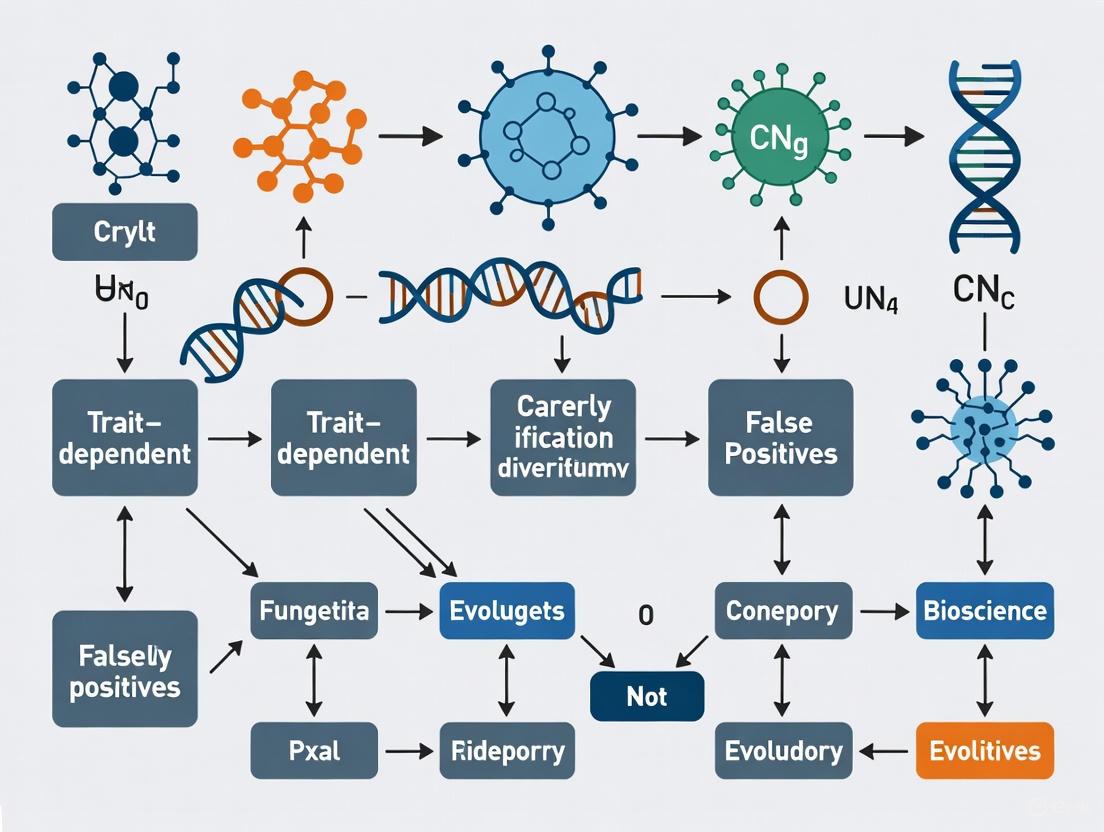
State-dependent speciation and extinction (SSE) models are powerful tools for testing hypotheses about whether specific traits drive diversification.
Avoiding False Positives in Trait-Dependent Diversification Analysis: A Comprehensive Guide for Biomedical Researchers
Abstract
State-dependent speciation and extinction (SSE) models are powerful tools for testing hypotheses about whether specific traits drive diversification. However, recent research reveals that false positives, where a trait is incorrectly inferred to influence diversification, are a significant risk, primarily driven by incomplete phylogenetic trees and mis-specified sampling fractions. This article provides a comprehensive framework for researchers and drug development professionals to understand, detect, and avoid these pitfalls. We cover the foundational principles of SSE models, methodological best practices, targeted troubleshooting for common data issues, and validation techniques to ensure robust, reliable results in evolutionary and biomedical studies.
The False Positive Problem: Understanding Trait-Dependent Diversification and SSE Models
Defining Trait-Dependent Diversification and Its Biomedical Relevance
Frequently Asked Questions (FAQs)
1. What is trait-dependent diversification and why is it important in evolutionary biology? Trait-dependent diversification examines how specific biological characteristics of lineages influence their rates of speciation and extinction. Understanding these patterns helps explain why some groups evolve into many species while others remain species-poor. In biomedical contexts, these principles can inform how disease mechanisms diversify and evolve across populations.
2. Why do trait-dependent diversification models sometimes produce false positives? Early models like MuSSE (Multiple State Speciation and Extinction) often detect spurious correlations between traits and diversification rates because they cannot separate the effect of your observed trait from other unmeasured (hidden) traits that may be the true drivers of diversification rate variation [1] [2]. This occurs when your observed trait is correlated with these hidden factors.
3. How can I avoid false positives when testing for trait-dependent diversification? Utilize newer modeling approaches that specifically account for unmeasured variables. The HiSSE (Hidden State Speciation and Extinction) and SecSSE (Several Examined and Concealed States-Dependent Speciation and Extinction) frameworks incorporate hidden states, allowing you to test whether diversification is better explained by your observed trait or by unmeasured factors [1] [2].
4. What is the difference between MuSSE, HiSSE, and SecSSE models?
Table 1: Comparison of Trait-Dependent Diversification Models
| Model | Key Features | Limitations | Best Use Cases |
|---|---|---|---|
| MuSSE | Tests dependence on a single observed trait with multiple states | High Type I error rate (false positives); cannot account for hidden traits | Preliminary screening (with caution) [1] |
| HiSSE | Accounts for hidden states affecting diversification; reduces false positives | Limited to binary observed traits [2] | Testing binary traits with suspected hidden drivers [1] [2] |
| SecSSE | Allows multiple examined AND concealed traits; handles traits with simultaneous states | More computationally intensive | Complex traits; testing multiple observed traits simultaneously [1] |
5. Can these evolutionary models be applied to biomedical research? Yes. While originally developed for macroevolutionary studies, these frameworks can analyze how disease-related traits or genetic variations diversify across populations. For instance, studies using high-diversity mouse populations (like Collaborative Cross or Diversity Outbred mice) effectively harness genetic variation to identify complex disease mechanisms, connecting evolutionary diversification principles to biomedical trait discovery [3].
6. How does the phylogenetic signal in traits affect my analysis? The mode of trait evolution significantly impacts your results. Traits with weak phylogenetic signal (evolving recently in diversification events) may produce different diversification patterns compared to highly conserved traits (with strong phylogenetic signal) [4]. Accounting for this in your model selection is crucial for accurate inference.
7. What experimental designs help validate trait-dependent diversification findings? Combine phylogenetic comparative methods with systems genetics approaches. Using genetically diverse reference populations (like Collaborative Cross mice) provides known genetic variation in a controlled framework, allowing you to test whether traits of interest genuinely affect diversification processes or are confounded by other factors [3].
Troubleshooting Guides
Problem 1: High False Positive Rates in Trait-Dependent Diversification Analysis
Symptoms: Your MuSSE analysis indicates a strong relationship between your focal trait and diversification, but you suspect this might be driven by unmeasured factors.
Solution: Implement hidden state models to account for unmeasured variables.
Step-by-Step Protocol:
- Run a HiSSE analysis [2]:
- Code your observed trait as binary (0 or 1)
- Specify models with hidden states (e.g., 0A, 0B, 1A, 1B where A and B are hidden)
- Compare models with and without hidden states using AIC or likelihood ratio tests
For complex traits with multiple states, use SecSSE [1]:
- Define all states for your observed trait
- Specify possible hidden states
- Allow for simultaneous states where appropriate (e.g., for generalist species)
Validate with simulations:
- Use the package to simulate data under your preferred model
- Check if you can recover known parameters
- Confirm your model has adequate power for your dataset size
Table 2: Key Research Reagent Solutions for Diversification Studies
| Reagent/Resource | Function | Application Example |
|---|---|---|
| SecSSE R Package | Implements several examined and concealed states-dependent speciation and extinction models | Testing multiple observed traits while accounting for hidden drivers [1] |
| HiSSE Model | Hidden State Speciation and Extinction framework | Testing binary traits with reduced false positives [2] |
| Collaborative Cross (CC) Mice | Genetically diverse recombinant inbred mouse panel | Studying how genetic variation influences trait diversification in disease models [3] |
| Diversity Outbred (DO) Mice | Outbred mouse population with high genetic diversity | High-precision mapping of traits and their evolutionary dynamics [3] |
| TreeSim R Package | Simulates phylogenetic trees under various diversification scenarios | Testing method performance and validating models [5] |
Problem 2: Distinguishing Between True Trait Effects and Mass Extinction Events
Symptoms: Your analysis detects apparent diversification rate shifts that might actually correspond to mass extinction events in the fossil record.
Solution: Implement models that simultaneously account for both lineage-specific shifts and mass extinction events.
Step-by-Step Protocol:
- Use a multi-framework approach [5]:
- First, run Medusa to detect lineage-specific rate shifts
- Then, apply TreePar to test for mass extinction events
- Compare results to identify conflicting signals
Simulate realistic scenarios:
- Use the TreeSim package with the
sim.rateshift.taxafunction - Incorporate both lineage-specific rate shifts and mass extinction events
- Set survival rate (ρ) for mass extinction events (e.g., ρ = 0.48 for 52% species loss)
- Use the TreeSim package with the
Check for temporal clustering of shifts:
- If multiple rate shifts occur simultaneously across the tree, this might indicate a mass extinction event rather than trait dependence
Problem 3: Analyzing Complex Traits with Multiple Simultaneous States
Symptoms: Your trait of interest doesn't fit neatly into single-state categories (e.g., generalist species, polymorphic traits).
Solution: Utilize SecSSE's capacity for simultaneous states.
Step-by-Step Protocol:
- Code your trait data appropriately:
- For a generalist species, code it as having both states simultaneously
- For polymorphic traits, assign all states present in the population
Specify the SecSSE model:
- Define the number of examined states
- Define the number of concealed states
- Set transition rate matrices between states
Implement the correct likelihood calculation:
- Ensure your analysis conditions on nonextinction (properly implemented in SecSSE, unlike earlier models)
- Use the package's built-in functions for likelihood calculation
Methodological Workflows
Analytical Workflow for Robust Trait-Dependent Diversification Analysis
Integrated Framework for Placing Traits in Evolutionary Context
Essential Software and Analytical Tools
Table 3: Key Software Packages for Trait-Dependent Diversification Analysis
| Software/Package | Primary Function | Implementation | Key Reference |
|---|---|---|---|
| SecSSE | Several examined and concealed states-dependent speciation and extinction | R package | [1] |
| HiSSE | Hidden State Speciation and Extinction | R package | [2] |
| MuSSE | Multiple State Speciation and Extinction | R package (diversitree) | [1] |
| TreeSim | Simulates phylogenetic trees under complex scenarios | R package | [5] |
| Medusa | Detects shifts in diversification rates | R package | [5] |
| TreePar | Identifies changes in speciation/extinction through time | R package | [5] |
Core Concepts and Common Issues
What are State-Dependent Speciation and Extinction (SSE) models, and what is their primary purpose? SSE models are a class of macroevolutionary models that link the diversification rates of lineages (speciation and extinction) to the state of a specific biological trait [6]. The primary purpose of these models is to test hypotheses about whether certain character states (e.g., having a specific morphological feature or ecological niche) are associated with higher or lower rates of speciation and extinction [6] [7].
What is the "False Positive" problem in SSE models, and why is it a significant concern? The false positive problem refers to the tendency of some SSE models to incorrectly detect a correlation between a trait and diversification rates when the trait is actually neutral—that is, when it does not influence speciation or extinction [8] [9]. This spurious correlation can occur when there is an unmeasured (hidden) trait that truly affects diversification rates, and its evolution is coincidentally correlated with your observed trait [7]. This is a major concern because it can lead to incorrect biological conclusions about the drivers of diversity [8].
How do more complex SSE models like HiSSE and SecSSE help mitigate false positives? Later-generation SSE models incorporate "concealed" or "hidden" states to account for the influence of unobserved traits [7] [9].
- HiSSE (Hidden-State Speciation and Extinction) incorporates a hidden state that affects diversification rates alongside the observed trait, allowing researchers to test if the observed trait has an effect beyond what can be explained by an unmeasured factor [9].
- SecSSE (Several Examined and Concealed States-Dependent Speciation and Extinction) extends this approach to traits with two or more observed states and can simultaneously account for the role of a hidden trait [7].
By comparing the fit of models that include trait-dependent diversification (ETD models) against models where only hidden states affect diversification (CTD or CID models), researchers can more rigorously test for genuine trait effects [9].
Technical Implementation and Troubleshooting
My analysis has low statistical power. What factors could be responsible? Low power in SSE analyses can stem from several sources, many of which are related to data quality and model specification [9]:
- Low Sampling Fraction: Incomplete phylogenetic trees (a low percentage of species included in the clade) severely reduce the accuracy of both model selection and parameter estimation [9].
- High Extinction Rates: It is inherently difficult to detect trait-dependent heterogeneity in extinction rates, especially with extant-only data [8].
- Similar Speciation Rates: The power to detect a difference decreases when the true speciation rates for different trait states are very similar [9].
- Few State Transitions: A lack of evolutionary transitions between character states in the tree provides little information for the model to work with [9].
How does the completeness and quality of the phylogenetic tree impact my results? Phylogenetic tree completeness and accuracy are critical for reliable SSE inference [9].
- Sampling Fraction: Accuracy declines with lower sampling fractions (tree completeness). It is recommended to use the best available estimate of the sampling fraction for each trait state [9].
- Taxonomic Bias: When sampling is imbalanced across sub-clades (e.g., tropical species are under-sampled compared to temperate ones), the risk of false positives increases, especially when overall tree completeness is ≤60% [9].
- Mis-specification of Sampling Fraction: Incorrectly specifying the sampling fraction (assuming a clade size different from the truth) severely biases parameter estimates. Over-estimating the sampling fraction increases false positive rates, while under-estimating it leads to over-estimated parameter values [9].
Can I include fossil data in an SSE analysis, and what are the benefits? Yes, it is possible and often beneficial to incorporate fossil data. Methods exist to combine SSE models with the fossilized birth-death (FBD) process [8].
- Primary Benefit: The inclusion of fossils has been shown to significantly improve the accuracy of extinction-rate estimates, which are notoriously difficult to estimate from extant-only phylogenies [8].
- Important Caveat: Even with fossil data, SSE models may still incorrectly identify correlations between diversification and neutral traits if the true driver is unobserved. Fossil data improves parameter estimation but does not fully solve the model mis-specification problem that leads to false positives [8].
Best Practices and Experimental Design
What is the recommended model comparison framework to avoid false conclusions? A robust model comparison framework is essential for reliable inference. You should compare a suite of models to determine the best-supported hypothesis [9]:
| Model Type | Description | Purpose in Model Comparison |
|---|---|---|
| Examined Trait Dependent (ETD) | Diversification depends on the observed trait. | The focal hypothesis to be tested. |
| Concealed Trait Dependent (CTD/CID) | Diversification depends on a hidden trait, not the observed one. | Controls for spurious correlations and false positives. Critical for model comparison. |
| Constant Rate (CR) | Diversification is constant across the tree and independent of any trait. | A simple null model. |
Your analysis should compare the fit of the ETD model against both the CTD and CR models. Strong support for an ETD model over a CTD model of equal complexity provides much more compelling evidence for a genuine effect of your observed trait [9].
What are some key reagents and computational tools for SSE analysis? The following table lists essential "research reagents" – in this case, software and data – required for conducting SSE analyses.
| Tool / Data Type | Function / Explanation |
|---|---|
| R Statistical Environment | The primary platform for many SSE packages. |
| SecSSE R Package | Implements models for multiple examined and concealed states, helping to reduce false positives [7]. |
| HiSSE & MiSSE Models | Used to model hidden states and trait-independent diversification heterogeneity [9]. |
| RevBayes Software | A Bayesian framework for phylogenetic inference that can implement various SSE models [6] [8]. |
| Phylogenetic Tree with Branch Lengths | The fundamental input data representing evolutionary relationships and time. |
| Trait Data | The observed character states (e.g., binary or multi-state) for the tips of the tree. |
| Sampling Fraction Estimate | The proportion of species in the entire clade included in your tree, per trait state [9]. |
What is the general workflow for a robust SSE analysis? The following diagram outlines a recommended workflow designed to minimize false positives.
Advanced Troubleshooting Scenarios
My analysis strongly supports trait-dependent diversification, but I am concerned it might be a false positive. What should I do?
- Check Your Sampling: Re-examine your sampling fraction estimates and ensure they are accurate for each trait state. Test the sensitivity of your results by running analyses with slightly different sampling fractions [9].
- Test with CTD Models: Verify that your ETD model is also strongly supported against an equally complex CTD model. If the CTD model fits equally well or better, the signal is likely spurious [9].
- Consider Fossils: If data is available, incorporate fossil information to improve the accuracy of your extinction-rate estimates and add temporal depth to your analysis [8].
- Use Bayesian Methods: In a Bayesian framework, you can specify a prior distribution on the sampling fraction to account for uncertainty in clade size estimates [9].
I have a trait with more than two states. What model should I use, and what pitfalls should I avoid? For multi-state traits, you can use the MuSSE (Multiple State Speciation and Extinction) model. However, MuSSE is also known to be prone to false positives [7]. The recommended approach is to use the SecSSE model, which is specifically designed for multiple examined states while also accounting for the potential influence of a concealed trait, thereby providing a more robust test [7].
In the field of macroevolution, accurately identifying the traits that drive species diversification is crucial. However, a significant challenge persists: statistical methods designed to detect these relationships can produce false positives, leading to incorrect conclusions about evolutionary drivers. Understanding the sources of these errors is the first step toward more robust scientific discoveries.
This guide addresses the primary causes of false positives in trait-dependent diversification studies, providing troubleshooting and best practices to enhance the reliability of your research.
FAQ: Understanding and Avoiding False Positives
What is a false positive in trait-dependent diversification analysis?
A false positive occurs when a statistical model incorrectly infers that a biological trait has a significant effect on speciation or extinction rates, when in reality no such relationship exists.
Why do false positives occur in MuSSE models?
The MuSSE (Multiple State-dependent Speciation and Extinction) model is prone to false positives because it cannot separate the true effect of an observed trait from the influence of other, unobserved (hidden) traits that also affect diversification rates [1] [7]. The model assumes the trait in question is the sole driver, an assumption often violated in biological systems.
How does the SecSSE model address this issue?
The SecSSE (Several Examined and Concealed States-dependent Speciation and Extinction) model incorporates the possibility of hidden traits [1] [7]. By accounting for these unmeasured variables, SecSSE significantly reduces false positives without sacrificing the statistical power to detect true trait-dependent diversification. When applied to previous studies that used MuSSE, SecSSE showed that the original conclusions were premature in five out of seven cases [1].
How does phylogenetic tree completeness affect my results?
Lower sampling fractions (i.e., less complete phylogenetic trees) reduce the accuracy of both model selection and parameter estimation (speciation, extinction, and transition rates) [10]. The table below summarizes the impact of sampling on false positive rates.
Table 1: Impact of Sampling Fraction on Model Accuracy
| Sampling Fraction (Tree Completeness) | Effect on False Positive Rate | Effect on Parameter Accuracy |
|---|---|---|
| Low (≤ 60%) | Increased | Reduced accuracy |
| Low (≤ 60%) with Taxonomic Bias | Further Increased | Less accurate |
| High | Lower | Improved accuracy |
Furthermore, how you account for sampling in your model matters. Mis-specifying the sampling fraction (providing an incorrect estimate) severely affects parameter accuracy [10]:
- Over-estimating the sampling fraction increases false positives.
- Under-estimating the sampling fraction leads to over-estimated parameter values.
Beyond simple traits, what other complexities can mislead models?
Traditional models often assume simple, linear relationships between a single trait and diversification rates. Biological reality is more complex. False inferences can arise from:
- Multiple Interacting Traits: The simultaneous effect of several traits on diversification [1] [11].
- Nonlinear Effects: The relationship between a trait and diversification rate may not be linear or monotonic [11]. For example, a trait might be advantageous only within a specific environmental context.
- Time-Varying Effects: The impact of a trait on diversification can change over macroevolutionary time due to shifting environmental conditions or ecological interactions [11].
Advanced models like the Birth-Death Neural Network (BDNN) are being developed to capture these complex, nonlinear, and interacting effects, providing a more realistic and less error-prone framework [11].
Troubleshooting Guide: Mitigating False Positives
Table 2: Common Issues and Recommended Solutions
| Problem | Symptoms | Solution & Best Practices |
|---|---|---|
| Unaccounted Hidden Traits | Significant trait effect in MuSSE, but not in HiSSE or SecSSE. | Use models that incorporate hidden states, such as HiSSE or SecSSE [1] [7]. |
| Low or Biased Sampling | Inaccurate parameter estimates; high false positive rates, especially in biased samples. | Strive for higher and more balanced taxonomic sampling. If sampling is incomplete (e.g., 60% or less), avoid heavy sampling biases across sub-clades [10]. |
| Mis-specified Sampling Fraction | Speciation/Extinction rates are consistently over- or under-estimated. | Accurately estimate your sampling fraction. If uncertain, a cautious under-estimation is preferable to over-estimation to avoid inflating false positives [10]. |
| Oversimplified Model of Trait Effects | Model fails to capture known biological complexity; poor fit. | Consider flexible models like BDNN for fossil data that can infer complex, nonlinear effects and interactions among multiple traits and environmental factors [11]. |
Essential Research Workflow
The following diagram illustrates a robust workflow for a trait-dependent diversification analysis, incorporating key checks to minimize false positives.
The Scientist's Toolkit: Key Reagent Solutions
Table 3: Essential Tools for Trait-Dependent Diversification Analysis
| Tool / Reagent | Function | Key Consideration |
|---|---|---|
| SecSSE R Package | Infers state-dependent diversification for multiple observed traits while accounting for hidden traits [1] [7]. | Allows a trait to be in multiple states simultaneously (e.g., for generalist species). Correctly implements the likelihood calculation. |
| HiSSE Model | Provides a framework for detecting trait-dependent diversification while accounting for hidden states [1]. | Limited to binary traits. Serves as a foundational method that inspired SecSSE. |
| BDNN (PyRate) | A Bayesian birth-death model using neural networks to infer complex, nonlinear effects on diversification from fossil data [11]. | Particularly powerful for analyzing fossil data and integrating multiple continuous/categorical traits and paleoenvironmental variables. |
| Robust Phylogeny | A time-calibrated phylogenetic tree of the study group. | Tree completeness and balanced sampling are critical. Incomplete or biased trees are a major source of error [10]. |
| Annotated Trait Data | Data on morphological, ecological, or behavioral traits for the species in the phylogeny. | Should be as complete and accurate as possible. Consider states for generalist species or uncertainty [1]. |
Troubleshooting Guides
How does phylogenetic tree completeness affect the detection of trait-dependent diversification?
Issue: Inaccurate model selection and parameter estimation in State-dependent Speciation and Extinction (SSE) models due to incomplete phylogenetic trees.
Explanation: Phylogenetic tree completeness refers to the percentage of extant species included in your phylogenetic tree compared to the known diversity of the clade. Lower sampling fractions reduce analytical power and increase error rates. When tree completeness falls below 60% and sampling is taxonomically biased (uneven across sub-clades), the risk of false positives increases significantly. Parameter estimates for speciation, extinction, and transition rates become less accurate with decreasing sampling fractions [12] [13].
Solution:
- Aim for the highest possible sampling fraction, ideally exceeding 60% for the entire tree.
- Ensure balanced sampling across all major sub-clades to minimize taxonomic bias.
- Use model comparison frameworks that account for uncertainty, such as AIC weights [14].
What are the consequences of mis-specifying the sampling fraction in SSE models?
Issue: Systematic biases in parameter estimates resulting from incorrect specification of the sampling fraction (the proportion of species included in the analysis relative to the total clade diversity).
Explanation: The sampling fraction is a critical parameter in SSE models that accounts for incomplete taxon sampling. Mis-specification occurs when researchers over-estimate or under-estimate this value. When the specified sampling fraction is lower than the true value, parameter estimates tend to be over-estimated. Conversely, when the specified sampling fraction is higher than the true value, parameters are under-estimated. False positive rates increase when sampling fractions are over-estimated [12] [13].
Solution:
- Carefully research and justify your sampling fraction based on authoritative taxonomic sources.
- When uncertain, cautiously under-estimate rather than over-estimate sampling efforts.
- Conduct sensitivity analyses to test how parameter estimates vary under different sampling fraction scenarios.
Table 1: Impact of Sampling Fraction on SSE Model Accuracy
| Sampling Fraction (Completeness) | Model Selection Accuracy | Parameter Estimate Accuracy | False Positive Rate |
|---|---|---|---|
| High (>80%) | High | High | Low |
| Moderate (60-80%) | Moderate | Moderate | Low to Moderate |
| Low (<60%) | Reduced | Reduced | Increased |
| Low (<60%) with Taxonomic Bias | Severely Reduced | Severely Reduced | High |
Table 2: Effects of Sampling Fraction Mis-specification
| Type of Mis-specification | Effect on Parameter Estimates | Effect on False Positives |
|---|---|---|
| Over-estimated Sampling Fraction | Parameters under-estimated | Increased |
| Under-estimated Sampling Fraction | Parameters over-estimated | Not significantly increased |
Experimental Protocols
Protocol for Assessing Sampling Fraction Impacts
Purpose: To evaluate how phylogenetic tree completeness and sampling fraction specification affect trait-dependent diversification inferences.
Methodology:
- Simulate phylogenetic trees with known parameters (speciation rate, extinction rate, trait transition rates) using software such as
TreeSimordiversitree[14]. - Generate trait data evolving along these trees under specified models of trait evolution.
- Create incomplete datasets by randomly or taxonomically-biased removing taxa to achieve specific sampling fractions (e.g., 90%, 70%, 50%, 30%).
- Fit SSE models to these incomplete datasets using multiple sampling fraction specifications.
- Compare results to known "true" parameters to quantify biases and error rates.
Key Considerations:
- Implement both random and taxonomically biased sampling regimes.
- Test a range of sampling fraction mis-specifications (from severe under-estimation to severe over-estimation).
- Repeat analyses across multiple simulated trees to account for stochastic variation.
Workflow Visualization
The Scientist's Toolkit
Table 3: Essential Research Reagents & Computational Tools
| Tool/Resource | Function/Purpose | Application Context |
|---|---|---|
diversitree R package |
Fits SSE models to phylogenetic data | Model fitting and comparison [14] |
BEAST 2 |
Bayesian evolutionary analysis | Phylogenetic tree estimation and dating [14] |
TreeSim |
Simulates phylogenetic trees | Method validation and power analysis [14] |
ape R package |
Phylogenetic analysis and manipulation | Data preparation and tree handling [14] |
| AIC model selection | Compares fit of alternative models | Model selection and weighting [14] |
Frequently Asked Questions
What minimum level of phylogenetic completeness should I aim for in my study?
Answer: While there's no absolute threshold, studies show that sampling fractions below 60% substantially increase error rates, particularly when sampling is taxonomically biased. Aim for the highest possible completeness, ideally exceeding 80% for reliable inferences. When completeness is between 60-80%, results should be interpreted with caution and include sensitivity analyses [12] [13].
Is it better to over-estimate or under-estimate sampling fractions when uncertain?
Answer: The research suggests it's safer to cautiously under-estimate sampling efforts. Over-estimating sampling fractions increases false positive rates, while under-estimating primarily affects parameter magnitudes without significantly increasing false inferences. However, the optimal approach is to invest time in accurately determining the sampling fraction through thorough literature review and taxonomic verification [12] [13].
How does taxonomic bias in sampling differ from simple low completeness?
Answer: Taxonomic bias occurs when some sub-clades are heavily under-sampled while others are well-sampled, creating an unrepresentative tree. This is particularly problematic because it can create spurious correlations between traits and diversification rates when the sampling imbalance coincides with trait distribution. Random sampling with low completeness is less likely to produce such systematic biases [12].
FAQs: Understanding SSE Models and Their Development
What is the core problem that motivated the development of the BiSSE model?
The Binary State Speciation and Extinction (BiSSE) model was developed to address two key problems identified in comparative methods [6]. First, inferences about character state transitions based on simple transition models (like Pagel's 1999 model) can be misled if the character affects speciation or extinction rates. Second, inferences about whether a character affects lineage diversification based on sister clade comparisons can be invalid if transition rates between character states are asymmetric [6]. Essentially, BiSSE provides a framework to jointly model trait evolution and diversification, testing whether specific character states are associated with differential diversification rates.
Why were more complex models like HiSSE and SecSSE developed after BiSSE?
HiSSE (Hidden State Speciation and Extinction) and SecSSE (Several Examined and Concealed States-Dependent Speciation and Extinction) were developed to address a critical flaw in BiSSE and its multistate extension MuSSE: their high rate of false positives [1] [15]. These models can incorrectly infer that a trait affects diversification when the pattern is actually driven by some unobserved (hidden) trait [16]. HiSSE accounts for this by incorporating a hidden state that affects diversification rates, while SecSSE extends this framework to multiple examined and concealed states, providing a more robust testing framework [1] [15].
What are the key parameterizations used in HiSSE to avoid overfitting?
Rather than optimizing speciation (λ) and extinction (μ) rates separately, HiSSE uses a transformed parameter space [17]. It defines:
- Net turnover: τᵢ = λᵢ + μᵢ
- Extinction fraction: εᵢ = μᵢ / λᵢ
This reparameterization alleviates problems with overfitting when λᵢ and μᵢ are highly correlated but both contribute to explaining diversity patterns [17].
How does SecSSE improve upon both MuSSE and HiSSE?
SecSSE combines features of both MuSSE and HiSSE while adding new functionality [1] [15]. It can simultaneously infer state-dependent diversification across two or more examined (observed) traits while accounting for possible concealed (hidden) traits. Additionally, it allows for:
- Traits to be in two or more states simultaneously
- Correct likelihood calculation when conditioned on non-extinction
- Reduced Type I error rates without sacrificing statistical power [1]
How does phylogenetic tree completeness affect SSE model performance?
Recent research shows that both model selection and parameter estimate accuracy are reduced at lower sampling fractions (tree completeness) [10]. When sampling is taxonomically biased and tree completeness is ≤60%, false positive rates increase significantly compared to random sampling. Mis-specifying the sampling fraction severely affects parameter accuracy: parameters are over-estimated when the sampling fraction is under-specified, and under-estimated when over-specified [10]. The study recommends cautiously under-estimating sampling efforts when uncertain, as false positives increase more when sampling fractions are over-estimated.
Troubleshooting Guides
Addressing False Positives in Trait-Dependent Diversification
Problem: Your BiSSE/MuSSE analysis detects significant trait-dependent diversification, but you're concerned it might be a false positive driven by an unobserved trait.
Solution:
- Use Hidden State Models: Implement HiSSE or SecSSE models that explicitly account for the potential influence of concealed traits [1] [15].
- Model Comparison: Compare models with and without hidden states using appropriate model selection criteria [17].
- Multiple Trait Testing: When possible, use SecSSE to simultaneously test multiple observed traits while accounting for hidden states [1].
Workflow:
Handling Low Phylogenetic Sampling and Biased Sampling
Problem: Your phylogeny has limited taxon sampling (completeness) or biased sampling across clades, potentially affecting SSE model accuracy.
Solution:
- Estimate Sampling Fractions: Accurately estimate and specify the proportion of sampled species in each clade or for each character state [10].
- Be Conservative: When uncertain, cautiously under-estimate rather than over-estimate sampling fractions to reduce false positives [10].
- Sensitivity Analysis: Conduct analyses under different sampling fraction scenarios to test robustness of conclusions.
Recommended Sampling Practices: Table 1: Impact of Sampling Fraction Mis-specification on Parameter Estimates
| Scenario | Effect on Parameter Estimates | Effect on False Positives |
|---|---|---|
| Sampling fraction specified lower than true value | Parameters are over-estimated | Minimal increase |
| Sampling fraction specified higher than true value | Parameters are under-estimated | Substantial increase |
| Random sampling with completeness ≤60% | Reduced accuracy | Moderate increase |
| Taxonomically biased sampling with completeness ≤60% | Severely reduced accuracy | High increase |
Specifying Transition Rate Models in HiSSE
Problem: Setting up appropriate transition rate models in HiSSE with proper parameter constraints.
Solution:
- Use Built-in Functions: Utilize the
TransMatMaker.old()function to create the basic structure [17]. - Remove Dual Transitions: Consider removing biologically implausible dual transitions (simultaneous changes in observed and hidden states) using
ParDrop()[17]. - Parameter Linking: Use
ParEqual()to link parameters when appropriate to reduce model complexity.
Example Transition Matrix Setup:
Common Transition Matrix Configurations:
Table 2: Common HiSSE Transition Rate Model Specifications
| Model Type | Dual Transitions Allowed? | Typical Number of Parameters | Use Case |
|---|---|---|---|
| Full HiSSE model | Yes | 12 | Most complex model |
| No dual transitions | No | 8 | Biologically more realistic |
| Equal transition rates | No | 1 | Reduced complexity |
| BiSSE equivalent | Not applicable | 2 | Simple trait-dependent diversification |
Implementing the SecSSE Framework for Multiple Traits
Problem: You need to test the influence of multiple traits on diversification while accounting for potential hidden states.
Solution:
- Install SecSSE: Install from CRAN (
install.packages("secsse")) or GitHub [15]. - Format Data: Prepare phylogenetic tree and trait data for multiple examined traits.
- Specify Concealed States: Define the structure of concealed states that may affect diversification.
- Run Analysis: Use SecSSE functions to simultaneously estimate parameters for examined and concealed states.
The Scientist's Toolkit: Essential Research Reagents
Table 3: Key Software Packages for SSE Analyses
| Tool/ Package | Primary Function | Key Features | Implementation |
|---|---|---|---|
| RevBayes | General phylogenetic inference | Implements BiSSE, MuSSE, and other SSE models; flexible model specification | [6] |
| hisse | Hidden-state SSE models | Accounts for hidden traits; reparameterized turnover and extinction fraction | [17] |
| diversitree | Multiple SSE frameworks | Implements BiSSE, MuSSE, HiSSE; useful for simulation studies | [17] |
| SecSSE | Multiple examined and concealed traits | Combines MuSSE and HiSSE features; reduces false positives | [1] [15] |
Experimental Protocols for SSE Model Testing
Protocol 1: Comparing SSE Models to Detect False Positives
- Data Preparation: Prepare phylogeny and trait data, estimating sampling fractions for each clade [10].
- Initial MuSSE Analysis: Run MuSSE model(s) for the observed trait(s) of interest.
- Hidden State Models: Run HiSSE or SecSSE models incorporating hidden states [1] [17].
- Model Comparison: Use appropriate information criteria (AIC, BIC) to compare model fits.
- Sensitivity Analysis: Test robustness under different sampling fraction scenarios [10].
Protocol 2: Simulation-Based Model Validation
- Parameterize Simulation: Use known parameter values (speciation, extinction, transition rates).
- Generate Trees: Simulate phylogenetic trees under the specified SSE model.
- Model Fitting: Fit competing models to the simulated data.
- Error Assessment: Calculate Type I and Type II error rates across multiple simulations.
- Power Analysis: Determine the sample size (number of tips) needed for reliable inference.
Best Practices for Robust SSE Model Implementation and Data Preparation
Selecting the Right SSE Model for Your Research Question
Frequently Asked Questions
What are SSE models in evolutionary biology? SSE (State-dependent Speciation and Extinction) models are a phylogenetic comparative framework used to determine if a specific biological trait influences diversification rates (speciation and extinction). They test whether different states of a trait (e.g., presence or absence of a morphological feature) are associated with different rates of species formation and extinction over evolutionary time [18] [9].
My analysis found a significant trait-diversification association. Could this be a false positive? Yes. False positives, where a trait appears to be associated with diversification but is not, are a significant risk. Key factors that increase this risk include [9]:
- Low phylogenetic tree completeness (low sampling fraction), especially at or below 60%.
- Taxonomically biased sampling, where some sub-clades are heavily under-sampled compared to others.
- Mis-specification of the sampling fraction in your model.
How does phylogenetic tree completeness affect my SSE model results? The completeness of your phylogenetic tree, known as the sampling fraction, is critical. Lower sampling fractions reduce the accuracy of both model selection and parameter estimation (like speciation and transition rates) [9]. The table below summarizes the quantitative effects of sampling fraction on false positive rates.
| Sampling Fraction (Tree Completeness) | Impact on False Positive Rate |
|---|---|
| ≤ 60% | Increased rate of false positives, especially when sampling is taxonomically biased [9]. |
| Random Sampling | More accurate parameter estimation compared to biased sampling at the same completeness [9]. |
| Taxonomically Biased Sampling | Less accurate parameter estimates and higher false positives at low completeness [9]. |
I am unsure of the exact sampling fraction for my clade. What should I do? When the total number of species in a clade is unknown, mis-specifying the sampling fraction severely affects results. It is better to cautiously under-estimate your sampling efforts. Over-estimating the sampling fraction increases false positives. If possible, using a Bayesian framework with a prior on the sampling fraction can help account for this uncertainty [9].
What are the different types of models within the SSE framework? It is crucial to compare different models to guard against false inferences [9]:
- Examined Trait Dependent (ETD) Models: Test if your focal trait is linked to diversification.
- Concealed Trait Dependent (CTD) Models: Account for the possibility that diversification is driven by some unmeasured (hidden) trait, not your focal trait. Comparing your ETD model to a CTD model helps reduce false positives.
- Constant Rate (CR) Models: Assume no variation in diversification rates.
Troubleshooting Guide: Avoiding False Positives
Problem: Inconsistent results when using different phylogenetic trees. Solution:
- Ensure High Tree Completeness: Aim for the highest possible sampling fraction. Be cautious when interpreting results from trees with completeness ≤60% [9].
- Account for Sampling Bias: Document and, if possible, correct for known taxonomic or geographic sampling biases in your phylogeny, as non-random sampling distorts parameter estimates [9].
Problem: The model selects a trait-dependent model, but I suspect an unmeasured trait is the real driver. Solution:
- Always Run Concealed Models: Do not just compare your ETD model against a constant rate model. A robust analysis must include a CTD (e.g., HiSSE) model of corresponding complexity. The best practice is to select the model with the strongest statistical support (e.g., based on AIC scores) among ETD, CTD, and CR models [9].
Problem: Parameter estimates (speciation, extinction, transition rates) seem biologically unrealistic. Solution:
- Check Sampling Fraction Specification: Mis-specifying the sampling fraction is a common cause of inaccurate parameter estimates. The following table shows the direction of the bias:
| Sampling Fraction Specification | Impact on Parameter Estimates |
|---|---|
| Specified lower than true value | Parameter values are over-estimated [9]. |
| Specified higher than true value | Parameter values are under-estimated [9]. |
Experimental Protocol for Robust SSE Analysis
This protocol outlines key steps for a reliable trait-dependent diversification analysis.
1. Phylogeny and Trait Data Preparation
- Curate a High-Quality Phylogeny: Use the most complete and robust phylogenetic tree available for your clade. Quantify its sampling fraction (number of tips in the tree / total described species in the clade).
- Source Trait Data: Gather trait data from databases or literature. Account for and report any missing trait data for species in your tree, as this adds uncertainty [9].
2. Model Selection and Comparison
- Select Appropriate Models: For a binary trait, define your ETD, CTD, and CR models. Use software that implements a full suite of models, such as
HiSSEorSecSSE[9]. - Run Analyses and Compare: Fit all models to your data. Compare model fits using standard statistical criteria like AIC or AICc. The model with the lowest score is best supported, but ensure differences in AIC (ΔAIC) are substantial (e.g., >2 or 4) [9].
3. Sensitivity Analysis
- Test the Impact of Sampling Fraction: Re-run your best-fitting model using a range of plausible sampling fractions (e.g., the estimated value, 10% higher, 10% lower) to see if your conclusions about trait-dependence hold [9].
- Explore Different Phylogenies: If multiple phylogenetic hypotheses exist, run your analysis on each to confirm the robustness of your findings.
Research Reagent Solutions
The following table lists the essential "research reagents" — the primary data and software components — needed for a robust SSE analysis.
| Item | Function in SSE Analysis |
|---|---|
| Time-Calibrated Phylogeny | The evolutionary scaffold for estimating diversification rates. Branch lengths represent time [9]. |
| Trait Dataset | The examined trait data (categorical or continuous) for the species in the phylogeny, used to test for association with diversification [18] [9]. |
| Sampling Fraction Estimate | A crucial correction factor that accounts for missing species in the phylogeny, specified per trait state to avoid biased parameter estimates [9]. |
| SSE Software Package (e.g., HiSSE, SecSSE) | The computational engine that fits the state-dependent speciation and extinction models to your data and performs statistical comparisons [9]. |
| Concealed Trait Models (CTD) | A control model that accounts for the influence of unmeasured traits, essential for reducing false positives in the analysis [9]. |
Workflow and Logical Relationships
The following diagram illustrates the logical workflow for a robust SSE model selection process, highlighting key decision points to avoid false positives.
SSE Model Selection Workflow
Accurately Calculating and Specifying the Sampling Fraction
Troubleshooting Guide
| Problem Area | Common Symptoms | Likely Causes | Recommended Solutions |
|---|---|---|---|
| Low Sampling Fraction | Inaccurate parameter estimates (speciation, extinction, transition rates); reduced model selection accuracy [12]. | The phylogenetic tree represents a small percentage (e.g., ≤60%) of the total known clade diversity [12]. | Increase taxon sampling where possible. If not, use a uniform prior on the sampling fraction (rho) to propagate uncertainty in your analysis [19]. |
| Mis-specified Sampling Fraction | Parameter values are systematically over- or under-estimated [12]. | The rho value used in the model is incorrect (e.g., based on outdated taxonomy or an improper calculation) [12] [19]. |
Carefully re-calculate the sampling fraction using current taxonomic databases. Conduct sensitivity analyses using a range of plausible rho values [19]. |
| Taxonomically Biased Sampling | High rates of false positives for trait-dependent diversification; inaccurate parameter estimates, even with moderate (e.g., 60%) sampling [12]. | Some sub-clades are heavily over-sampled while others are under-sampled, violating the assumption of random sampling in many models [12] [20]. | Re-sample to balance taxonomic coverage or use models that can incorporate clade-specific sampling fractions. Explicitly report and justify the sampling methodology [20]. |
| Uncertain Clade Size | Inability to calculate a precise sampling fraction; circular dependency between diversification rate (r) and clade size (m) [19]. |
The total number of species in the clade is poorly characterized or unknown [19]. | Use a uniform prior on the sampling fraction based on the plausible range of clade sizes. Report results with this uncertainty explicitly stated [19]. |
Frequently Asked Questions (FAQs)
Q1: What is the sampling fraction, and why is it critical for diversification models?
The sampling fraction (rho) is the proportion of species in a clade that are included in your phylogenetic tree (n) relative to the total number of known species in that clade (m), so rho = n / m [21]. It is critical because state-dependent speciation and extinction (SSE) models use this information to correctly estimate the number of missing speciation events. Mis-specifying this fraction severely affects the accuracy of parameter estimates [12]. If you assume perfect sampling (rho = 1) when it is incomplete, you will systematically under-estimate speciation and extinction rates [12] [21].
Q2: I am working on a poorly known clade where the total number of species is uncertain. How can I proceed?
This is a common challenge. Since you cannot calculate a single, precise rho, it is recommended to propagate the uncertainty through your analysis [19].
- Establish a plausible range for the total clade size (
m) based on expert knowledge and taxonomic resources. - Convert this range into a range for the sampling fraction (
rho). - Fit your diversification models across this range of
rhovalues, for instance, by using a uniform prior in a Bayesian framework [19]. - Report your results with the associated uncertainty. This approach is more robust and transparent than relying on a single, potentially incorrect, value.
Q3: My taxon sampling is imbalanced across different sub-clades. What are the risks?
This is a major source of risk for false positives [12]. Most models assume missing taxa are randomly distributed across the tree. When sampling is imbalanced (e.g., you have sequenced 90% of species in one sub-clade but only 10% in another), this assumption is violated. Simulations show that with ≤60% tree completeness, taxonomically biased sampling leads to higher rates of false positives and less accurate parameter estimates compared to random sampling [12]. You should aim for balanced sampling or use models that can account for this bias.
Q4: Is it better to over-estimate or under-estimate the sampling fraction in my model?
It is generally better to cautiously under-estimate your sampling efforts [12]. Research has shown that false positives increase when the sampling fraction is over-estimated (specified as higher than its true value). When in doubt, using a slightly conservative (lower) estimate of rho can be a safer practice [12].
Q5: How does an incorrect sampling fraction lead to a false positive in trait-dependent diversification?
A false positive in this context occurs when your model incorrectly infers a significant association between a trait and diversification rates. Incomplete or biased sampling can create branching patterns in a phylogeny that mimic the signal of trait-dependent diversification [12] [20]. For example, if a particular trait state is more common in a well-sampled, species-rich subclade, the model may interpret the high diversification of that subclade as being caused by the trait, when the pattern is actually an artifact of uneven sampling [12].
Experimental Protocol: Quantifying and Correcting for Sampling Fraction Effects
1. Define Your Initial Patient Population (The Total Clade)
- Action: Systematically define the total clade (
m) under investigation using authoritative taxonomic databases and recent systematic revisions. - Rationale: This establishes the denominator for your sampling fraction calculation and is a foundational step often overlooked [22].
2. Calculate the Exact Sampling Fraction
- Action: Count the number of taxa in your phylogenetic tree (
n). Calculate the sampling fraction asrho = n / m[21]. - Example: If your tree contains 201 species from a clade known to have 216 species, your sampling fraction is
201/216 = 0.93[21].
3. Account for Uncertainty (If Necessary)
- Action: If
mis uncertain, define a plausible range (e.g.,m_mintom_max). Calculate the corresponding range forrho[19]. - Implementation in Software: In Bayesian software like
RevBayes, you can specify a uniform prior onrho(e.g.,rho ~ Uniform(0.7, 0.95)) [19].
4. Incorporate the Fraction into Model Fitting
- Action: Use the
rhoargument (or equivalent) in your diversification model software. - Software Example in R:
5. Conduct Sensitivity Analysis
- Action: Re-run your analyses using the upper and lower bounds of your
rhorange. - Rationale: This tests the robustness of your conclusions (e.g., the trait-dependent diversification signal) to uncertainties in sampling [19] [20].
6. Document and Report
- Action: Explicitly state the total clade size (
m), the sample size (n), the calculated sampling fraction (rho), and the source of taxonomic information in your manuscript.
Methodological Framework for Sampling Fraction
The following diagram illustrates the decision-making process and methodological flow for handling the sampling fraction in diversification analyses.
Research Reagent Solutions
| Item / Resource | Function in Analysis | Implementation Notes |
|---|---|---|
| Taxonomic Databases (e.g., IUCN, GBIF, specialist databases) | Provides the best available estimate for the total clade size (m), the denominator for the sampling fraction [20]. |
Cross-reference multiple sources to account for synonymy and recent discoveries. |
phytools R Package |
Fits birth-death and Yule models of diversification, allowing for the direct specification of the sampling fraction via the rho argument [21]. |
The fit.bd and fit.yule functions are directly applicable. |
RevBayes / BAMM |
Bayesian software platforms for estimating diversification rates. They can model incomplete sampling and are less sensitive to moderate missing taxa, respectively [19] [20]. | Allows for the most flexible modeling of uncertainty via priors on the sampling fraction [19]. |
| Sensitivity Analysis Script | A custom script (e.g., in R or Python) to re-run analyses across a range of sampling fractions. | Essential for quantifying the robustness of your findings to sampling uncertainty [12] [20]. |
Strategies for Handling Incomplete Phylogenies and Missing Taxa
In phylogenetic comparative studies, particularly those focused on detecting trait-dependent diversification, incomplete taxon sampling is not merely an inconvenience—it is a potential source of significant bias. Real-world missing data are rarely random; they are often phylogenetically clumped or correlated with the trait of interest, which can, in turn, lead to false inferences about evolutionary processes [23]. This guide provides troubleshooting strategies to help researchers identify and mitigate these risks.
FAQs on Missing Data and Phylogenetic Inference
Q1: Why is random missing data assumption problematic in trait-dependent diversification studies? Assuming missing taxa are random is often biologically unrealistic. Taxa are more likely to be missing due to ecological traits that have phylogenetic signal, such as rarity, small geographical range, or specific habitat preferences. This creates "phylogenetically clumped" missing data. If the trait you are studying (e.g., range size) is itself correlated with the probability of being sampled, your dataset can become systematically biased, potentially leading to false positives in trait-dependent diversification tests [23].
Q2: What is the key difference between 'clumped' and 'correlated' missing taxa?
- Clumped Missing Taxa (cluMT): Taxa are absent from your dataset in a pattern that is not random across the phylogeny. For instance, an entire clade of rare species might be missing because they are difficult to collect. The missingness is related to the tree structure itself [23].
- Correlated Missing Taxa (corMT): The probability of a taxon being missing is directly linked to the value of the trait you are studying. For example, if you are studying body size, and smaller species are harder to find and are therefore systematically omitted, your missing data is correlated with the trait [23].
Q3: How can incomplete distance matrices be handled during tree inference? When dealing with incomplete distance matrices (e.g., from sequence data with gaps), a weighted least-squares approach can be used for phylogenetic inference. This method combines the four-point condition and the ultrametric inequality to handle missing entries, and has been shown to outperform other methods like the standard Ultrametric or Additive procedures when data is incomplete [24].
Q4: What tools can help visualize phylogenetic trees with associated data? Several tools are designed for visualizing and annotating phylogenetic trees, which is crucial for exploring data completeness and patterns:
- ggtree: An R package that uses the ggplot2 syntax to allow highly customizable visualization and annotation of phylogenetic trees with associated data. It supports various layouts (rectangular, circular, slanted, etc.) and is ideal for integrating analysis results [25].
- PhyloScape: A web-based application for interactive and scalable tree visualization. It supports multiple plug-ins for features like heatmaps and geographic maps and allows real-time editing and annotation [26].
Troubleshooting Guides
Guide 1: Diagnosing and Mitigating Bias from Non-Random Missing Taxa
Problem: Your analysis of trait-dependent diversification may be biased because your missing taxa are not random.
Solution Steps:
- Characterize Your Missing Data: Actively investigate the pattern of your missing taxa. Is the absence random, or is it clustered on certain parts of the tree? Could it be correlated with the trait you are studying or another trait (like range size) that influences sampling?
- Use Robust Models: Employ models that account for the role of hidden traits. For example, when testing for dependence of diversification on multiple traits, use the SecSSE (Several Examined and Concealed States-Dependent Speciation and Extinction) model. SecSSE combines features of MuSSE and HiSSE to infer state-dependent diversification across two or more observed traits while accounting for the influence of a possible concealed (hidden) trait, thereby reducing high Type I error rates [1].
- Perform Sensitivity Analyses: Simulate your data under different missing taxon scenarios (e.g., random, clumped, correlated) to see how your model selection and parameter estimates are affected. Research suggests that while performance is generally good under many scenarios, biases become notable under a very high percentage (e.g., 90%) of correlated missing taxa [23].
Guide 2: Handling Incomplete Data in Distance-Based Phylogenetics
Problem: You have an incomplete distance matrix due to missing sequence data or gaps, and you need to infer a reliable phylogeny.
Solution Steps:
- Choose an Appropriate Algorithm: Utilize software that implements methods designed for incomplete matrices. The weighted least-squares approach is one such method, which effectively solves the problem of missing entries [24].
- Use Specialized Software: Implement this method using available software packages. The T-Rex package includes this weighted least-squares algorithm and is freely available for phylogenetic reconstruction from partial distance matrices [24].
- Validate Your Tree: Compare the tree inferred from the incomplete matrix using this method to trees inferred from complete data or using other methods to assess robustness.
Experimental Protocols
Protocol 1: Simulation-Based Assessment of Missing Data Impacts
Objective: To evaluate how non-random missing taxa might bias the outcomes of a trait-dependent diversification analysis.
Methodology:
- Simulate Trait Data: Simulate a continuous trait (T) of interest under a known evolutionary model (e.g., Brownian Motion or an Ornstein-Uhlenbeck process) on a phylogenetic tree [23].
- Simulate Missingness: Generate a binary sampling trait (S) where state 0 represents "missing" and state 1 represents "sampled." This can be done under different schemes:
- Random (rMT): Tips are pruned randomly.
- Phylogenetically Clumped (cluMT): Use a threshold model on a simulated continuous liability trait (L) evolving via Brownian Motion to create phylogenetically clumped missingness [23].
- Correlated (corMT): The probability of being missing is directly correlated with the value of the simulated trait T [23].
- Prune the Tree: Remove tips from the tree and dataset based on the "missing" state (S=0) at different severity levels (e.g., 10%, 50%, 90%).
- Run and Compare Analyses: Fit your models of trait evolution (e.g., BM, OU) to the pruned dataset. Assess the performance of model selection and the bias in parameter estimates by comparing the results from the pruned datasets to the results from the complete tree [23].
The workflow for this assessment can be summarized as follows:
Protocol 2: Implementing the SecSSE Model to Control for False Positives
Objective: To test for trait-dependent diversification on multiple traits while accounting for hidden states, thereby reducing Type I errors.
Methodology:
- Input Data Preparation: Prepare your phylogenetic tree and trait data for the examined (observed) traits. SecSSE allows for traits with more than two states and for a taxon to be in two or more states simultaneously (e.g., for generalists) [1].
- Model Specification: Define your SecSSE model. This includes specifying the number of states for your examined traits and allowing for the possibility of a concealed (hidden) trait that might also affect diversification rates [1].
- Model Fitting: Fit the SecSSE model to your data. The method provides the correct likelihood when conditioned on non-extinction, a feature that was previously incorrectly implemented in some other SSE models [1].
- Model Comparison: Compare the fit of the SecSSE model against simpler models (e.g., MuSSE without hidden states) to determine if the dependence on the observed traits remains significant after accounting for potential hidden factors.
Software and Analytical Tools
| Tool/Package Name | Primary Function | Key Application in Addressing Missing Data |
|---|---|---|
| SecSSE [1] | State-dependent speciation & extinction model | Models diversification dependent on multiple observed traits while accounting for hidden traits, reducing false positives. |
| ggtree [25] | Phylogenetic tree visualization & annotation | Visually explores patterns of missing taxa and integrates associated data (e.g., traits) for diagnostic purposes. |
| PhyloScape [26] | Interactive web-based tree visualization | Allows scalable visualization and annotation for large trees, helping to identify clades with poor sampling. |
| T-Rex [24] | Phylogeny inference from distance matrices | Implements a weighted least-squares approach to infer trees from incomplete distance matrices. |
The following table summarizes key findings from simulation studies on the impacts of missing taxa, providing a benchmark for your own analyses [23].
| Scenario of Missing Taxa | Impact on Model Selection | Impact on Parameter Estimation |
|---|---|---|
| Random (rMT) | Minimal to no bias, even with sparse sampling (e.g., 50% missing). | Minimal to no bias. |
| Phylogenetically Clumped (cluMT) | Generally robust performance. | Generally robust performance. |
| Correlated with Trait (corMT) | Generally robust performance. | Notable bias can be introduced under very high proportions (e.g., 90%) of missing taxa. |
Accounting for Missing Trait Data and Its Impact on Transitions
Frequently Asked Questions
What is the core issue with missing trait data in diversification studies? Missing trait data can lead to two major problems: 1) it can reduce the statistical power of your models, and 2) more critically, it can introduce bias into parameter estimates, leading to incorrect conclusions about the relationship between a trait and diversification rates [27]. In State-dependent Speciation and Extinction (SSE) models, this can result in false positives, where a neutral trait is incorrectly identified as being linked to speciation or extinction [7] [8].
My MuSSE analysis shows a significant trait-diversification relationship. Should I trust it? You should be very cautious. Studies have shown that standard MuSSE models can erroneously detect correlations between neutral traits and diversification rates if a true, but unobserved (hidden), trait is the actual driver [7] [8]. It is recommended to use models that account for hidden states, such as SecSSE (Several Examined and Concealed States-Dependent Speciation and Extinction) or HiSSE, which are specifically designed to avoid these false positives [7]. In fact, a re-evaluation of seven MuSSE studies found that the original conclusions were premature in five cases once more robust models were applied [7].
Can I simply remove species with missing trait data from my analysis? While common, simply deleting species with missing data (list-wise deletion) is generally not recommended [27] [28]. This approach can discard valuable information and, if the data is not missing randomly, can skew the inferred phylogenetic relationships and trait dynamics, potentially distorting your results [27] [29].
Are there reliable methods to estimate missing trait values? Yes, several robust imputation methods are available. A key strategy is to use phylogenetic information, as closely related species often share similar traits due to shared evolutionary history—a property known as phylogenetic signal [28]. The missForest algorithm, especially when enhanced with phylogenetic eigenvectors, has been shown to accurately impute missing continuous trait values, with performance depending on the strength of the phylogenetic signal and correlation among traits [28].
Troubleshooting Guides
Problem 1: False Positives in Trait-Dependent Diversification
Symptoms: Your SSE model (e.g., BiSSE, MuSSE) indicates a strong relationship between a trait and diversification, but you suspect it might be spurious, perhaps driven by an unmeasured factor.
Solutions:
- Use a More Robust Model: Shift from MuSSE to a model that accounts for the potential influence of unobserved (hidden) traits. The SecSSE model is specifically designed for this, allowing analysis of two or more observed traits while accounting for a concealed trait [7].
- Incorporate Fossil Data: When possible, include fossil data in your analysis. Combining SSE models with the fossilized birth-death (FBD) process in a Bayesian framework has been shown to significantly improve the accuracy of extinction-rate estimates, which are often poorly estimated from extant-only data [8].
- Apply Model Testing: Follow a hypothesis-testing framework. Compare the fit of your trait-dependent model to a model with trait-independent but heterogeneous diversification rates to reduce the chance of spurious detection [8].
Problem 2: Incomplete Trait Datasets
Symptoms: Your functional trait dataset has gaps, and you are unsure how to proceed without biasing your analysis of community assembly or ecosystem functioning.
Solutions:
- Use Phylogenetic Imputation: Implement the missForest algorithm with Phylogenetic Eigenvector Regression (PVR). This method uses the random forest approach to predict missing values based on other traits and the phylogenetic relatedness of species [28].
- Follow a Step-by-Step Protocol:
- Prepare Your Data: Compile a matrix of species and their traits, along with a phylogeny of the species in your dataset.
- Calculate Phylogenetic Eigenvectors: Generate a set of phylogenetic eigenvectors from your tree that capture the phylogenetic structure among species.
- Run the Imputation: Use the
missForestfunction in R, including the phylogenetic eigenvectors as predictor variables alongside the other observed traits. - Validate the Model: The algorithm provides a Normalized Root Mean Square Error (NRMSE) to estimate imputation accuracy. You can also validate by artificially removing some known data and comparing imputed values to the actual values [28].
Table 1: Comparison of Methods for Handling Missing Trait Data
| Method | Key Principle | Best For | Key Advantage | Key Limitation |
|---|---|---|---|---|
| List-wise Deletion | Removes any species with missing data | Complete datasets with minimal, random missingness | Simple and fast | Can introduce severe bias and reduce statistical power [27] |
| Mean/Median Imputation | Fills gaps with the average value of the trait | Preliminary exploration | Very simple to implement | Ignores phylogenetic structure and uncertainty; can distort distributions [27] |
| Phylogenetic Imputation (missForest+PVR) | Predicts missing values using trait correlation and phylogenetic signal | Medium to large datasets with correlated and/or conserved traits | High accuracy when traits are phylogenetically conserved; handles complex relationships [28] | Requires a phylogeny; performance lower for traits with weak phylogenetic signal |
| Multiple Imputation (MICE, etc.) | Creates multiple plausible datasets by modeling relationships among all variables | Complex datasets with multiple variable types | Accounts for uncertainty in the imputation process [27] | Can be computationally intensive; requires careful model specification |
Table 2: Performance of Phylogenetic Imputation under Different Conditions [28]
| Level of Phylogenetic Signal in Traits | Level of Correlation Among Traits | Expected Imputation Accuracy (Inverse of Error) |
|---|---|---|
| High | High | Highest |
| High | Low | High |
| Low | High | Medium |
| Low | Low | Lowest |
Experimental Protocols
Protocol: Imputing Missing Trait Data Using Phylogenetic Information
Objective: To accurately estimate missing continuous trait values in an ecological or evolutionary dataset using the missForest algorithm combined with phylogenetic information [28].
Materials/Reagents:
- Trait Dataset: A species-by-trait matrix (e.g., in .csv format) with missing values coded as
NA. - Phylogenetic Tree: A time-calibrated phylogeny of all species in the trait dataset (e.g., in Newick format).
- Statistical Software: R programming environment.
- Key R Packages:
missForest,ape,PVR.
Methodology:
- Data Preparation: Load your trait data and phylogeny into R. Ensure the species names in the trait matrix match the tip labels on the tree.
- Compute Phylogenetic Eigenvectors:
- Use the
PVRpackage to decompose the phylogenetic distance matrix derived from your tree. - Select a subset of significant phylogenetic eigenvectors (PVRs) that capture the main phylogenetic structures. These vectors will serve as numerical descriptors of phylogenetic relatedness.
- Use the
- Combine Predictors: Merge the phylogenetic eigenvectors with your original trait dataset (excluding the response variable with missing data) to create a new, expanded predictor matrix.
- Run missForest:
- Execute the
missForestfunction using the combined predictor matrix. - The function will iteratively build random forest models to predict the missing values.
- Execute the
- Extract and Validate:
- Extract the completed dataset from the
missForestoutput. - The function provides a Normalized Root Mean Square Error (NRMSE) to help assess imputation quality. A lower NRMSE indicates better performance.
- Extract the completed dataset from the
Protocol: Mitigating False Positives with SecSSE
Objective: To test for trait-dependent diversification while accounting for the effect of unobserved (hidden) traits, thereby reducing false positives [7].
Materials/Reagents:
- Phylogenetic Tree: A dated, ultrametric tree of the study group.
- Trait Data: Data for two or more examined (observed) traits for the species in the tree.
- Software: R with the
SecSSEpackage installed.
Methodology:
- Model Specification: Define your SecSSE model. You will specify parameters for:
- Speciation (
lambda), extinction (mu), and transition rates (q) for the examined traits. - The number of possible concealed states (hidden traits) to test.
- Speciation (
- Likelihood Calculation: Use the
secsse_loglikfunction to calculate the likelihood of your data (tree + traits) under the specified model. SecSSE uses an improved likelihood calculation conditioned on non-extinction, correcting an error present in earlier SSE models [7]. - Model Comparison: Fit multiple SecSSE models with different configurations (e.g., varying numbers of concealed states) and compare them using information criteria like AIC or AICc to identify the best-supported model.
- Interpretation: Analyze the parameter estimates from the best-fitting model to infer the dependence of diversification rates on your examined traits, having accounted for the potential influence of hidden states.
Workflow Visualization
The Scientist's Toolkit
Table 3: Key Research Reagent Solutions for Handling Missing Data
| Item | Function in Research | Example Use-Case |
|---|---|---|
| SecSSE R Package | A state-dependent diversification model that infers the effect of multiple observed traits while accounting for hidden states to reduce false positives. | Testing if flowering time and seed size jointly affect plant diversification, while controlling for an unmeasured factor like pollinator shift [7]. |
| missForest R Package | A non-parametric imputation method using Random Forests to predict missing values; can be combined with phylogenetic data. | Estimating missing body mass values for a set of bird species using their phylogenetic relationships and other known traits like beak depth [28]. |
| Phylogenetic Eigenvectors (PVRs) | Numerical vectors derived from a phylogenetic distance matrix that quantify the phylogenetic relatedness among species for use in statistical models. | Used as predictors in the missForest algorithm to ensure that imputed trait values respect the evolutionary relationships among species [28]. |
| PyRate with BDNN | A Bayesian framework for analyzing fossil data that uses a Birth-Death Neural Network (BDNN) to model complex, non-linear effects of traits and environment on diversification. | Analyzing the proboscidean fossil record to disentangle the interacting effects of body size, diet, and paleoclimate on speciation and extinction [11]. |
| RevBayes Software | A Bayesian phylogenetic inference platform that can implement state-dependent speciation-extinction models combined with the fossilized birth-death process. | Estimating speciation and extinction rates for a clade using a tree that includes both extant species and fossil occurrences to improve parameter accuracy [8]. |
Data Curation and Management FAQs
What is data curation and why is it critical for phylogenetic trait analysis?
Data curation is a disciplined practice that ensures your data can be discovered, accessed, understood, and used now and into the future. For phylogenetic trait analysis, this process is essential because it anticipates inevitable changes in technology and research methods, ensuring that your data remains usable and understandable, even years later. Without proper curation, there are no guarantees that anyone, including you, will be able to use or even understand the data, regardless of where they are housed [30].
The Data Curation Network provides a standardized workflow for this process [31]:
- Check files/code and read documentation
- Understand the data (or try to)
- Request missing information or changes
- Augment metadata for findability
- Transform file formats for reuse
- Evaluate for FAIRness
- Document all curation activities
What are the different levels of data curation, and which should I target?
Data curation is performed at different levels of depth and involvement [32]:
| Level | Name | Description | Common Use in Repositories |
|---|---|---|---|
| Level 0 | No Curation | Data deposited as submitted | Varies |
| Level 1 | Record Level | Brief check of metadata to enhance FAIR-ness | Very common |
| Level 2 | File Level | Review file arrangement and suggest file type transformations | Less common |
| Level 3 | Document Level | Review documentation and add or request missing information | Very common |
| Level 4 | Data Level | Open data files and examine for accuracy and interoperability | Less common |
Most repositories perform a mixture of Levels 1-4, with Levels 1 and 3 being most common. For phylogenetic trait data aiming to avoid false positives, targeting at least Level 3 (Document Level) is recommended to ensure sufficient documentation for others to understand and reuse your data properly [32].
How does the CURATE(D) model help prevent false positives in trait-dependent diversification studies?
The CURATE(D) model provides a systematic approach to data curation that directly addresses issues leading to false positives in phylogenetic analyses [32]. The process includes specific quality control checks:
- Check files and metadata: Verify that trait data files and phylogenetic trees are properly formatted and in scope for your analysis [32]
- Understand and run files: Examine datasets closely to understand how files interrelate and check for quality assurance issues like missing data or ambiguous headings [32]
- Request missing information: Generate questions to fix issues or errors that could lead to analytical misinterpretation [32]
- Augment metadata: Ensure metadata conforms to disciplinary standards to improve findability and accessibility [32]
- Transform file formats: Convert files to more interoperable, reusable, and preservation-friendly formats when possible [32]
- Evaluate for FAIRness: Review data against FAIR principles and address any ethical concerns in data usage [32]
What are the most common data curation failures that lead to problematic model fitting?
| Failure Type | Impact on Model Fitting | Prevention Strategy |
|---|---|---|
| Insufficient documentation | Models cannot be properly replicated or understood | Implement Level 3 document-level curation [32] |
| Poor file organization | Interrelationships between trees and trait data are misunderstood | Apply file-level curation and clear naming conventions [32] |
| Inadequate metadata | Data lacks context for proper interpretation | Augment metadata using disciplinary standards [32] |
| Ignoring data quality issues | Missing data or errors propagate through analysis | Conduct thorough quality assurance checks [32] |
Model Fitting and Validation FAQs
What is model fitting and why is proper fitting crucial for detecting false positives?
Model fitting is the process of adjusting model parameters to best match your observed data [33]. In trait-dependent diversification studies, proper model fitting is crucial because poorly fit models can produce incorrect insights and should not be used for making scientific decisions [33].
A well-fit model follows the overall patterns in your data without matching every data point exactly. This balance is essential for avoiding both underfitting and overfitting [33]:
- Underfitting: Occurs when a model oversimplifies the data and fails to capture enough information about relationships within it [33]
- Overfitting: Occurs when a model is overly sensitive to the specific data used, resulting in poor performance with new data [33]
What are the practical steps for fitting models to trait diversification data?
The model fitting process follows three key steps [34]:
- Define the prediction function: Create a function that takes parameters and returns predicted data
- Establish an error function: Implement a function that quantifies the difference between your data and the model's prediction
- Minimize the difference: Find parameters that minimize the error function using optimization algorithms
For diversification analysis, this typically involves [7]:
- Using specialized R packages like SecSSE
- Implementing likelihood functions for state-dependent speciation and extinction
- Applying numerical optimization to find best-fitting parameters
- Validating results with simulation studies
How does SecSSE address the false positive problem in MuSSE analyses?
SecSSE (Several Examined and Concealed States-Dependent Speciation and Extinction) combines features of HiSSE and MuSSE to simultaneously infer state-dependent diversification across two or more examined traits while accounting for possible concealed traits [7]. This approach directly addresses the false positive problem identified in MuSSE analyses.
Key improvements in SecSSE include [7]:
- Allowing for observed traits being in two or more states simultaneously
- Providing correct likelihood calculation when conditioned on non-extinction
- Accounting for the role of possible concealed traits that might drive diversification
- Maintaining statistical power while reducing Type I error rates
What troubleshooting steps should I take when model fitting fails or produces unexpected results?
| Problem | Possible Causes | Solutions |
|---|---|---|
| Failure to converge | Poor starting parameters, model misspecification | Try multiple starting points, simplify model structure |
| Unrealistic parameter estimates | Identifiability issues, data insufficient | Check parameter identifiability, increase data quality |
| Poor model performance | Underfitting or overfitting | Adjust model complexity, cross-validation |
| Computational bottlenecks | Large trees, complex models | Optimize code, use approximate methods |
Essential Research Reagent Solutions
| Reagent/Tool | Function | Application in Trait Analysis |
|---|---|---|
| SecSSE R Package | Several examined and concealed states-dependent speciation and extinction | Detecting trait-dependent diversification while accounting for hidden traits [7] |
| Phylogenetic Trees | Evolutionary relationships among taxa | Foundation for diversification rate analysis [7] |
| Trait Data Matrix | Character states for examined traits | Input for state-dependent diversification models [7] |
| CURATE(D) Checklist | Systematic data curation framework | Ensuring data quality before analysis [32] [31] |
| FAIR Principles | Findable, Accessible, Interoperable, Reusable data guidelines | Enhancing data reproducibility and reuse [30] |
Workflow Visualization
Data Curation to Model Fitting Workflow
Model Fitting Optimization Process
Identifying and Correcting Common Pitfalls in Diversification Analysis
Troubleshooting Guides
Issue: Unexpected Trait-Dependent Diversification Signal
Problem Description Researchers are detecting a statistically significant signal of trait-dependent diversification in their SSE (State-dependent Speciation and Extinction) model analysis, but suspect it might be a false positive driven by issues with their phylogenetic tree.
Diagnostic Steps
- Check Sampling Fraction: Calculate the percentage of known species in your clade that are actually included in your phylogenetic tree. This is your sampling fraction [9].
- Evaluate Sampling Bias: Determine if sampling is balanced across all sub-clades and trait states. Visually inspect your tree for obviously under-sampled groups.
- Run Sensitivity Analyses: Re-run your SSE analysis (e.g., using SecSSE or HiSSE) while systematically varying the specified sampling fraction to see if the trait-dependent signal disappears when using a more conservative (lower) sampling fraction estimate [9].
Solutions
- If sampling fraction is ≤ 60% and biased: The false positive risk is high. The strongest remedy is to improve the phylogenetic tree by adding more taxa, particularly from the under-sampled sub-clades [9].
- If tree expansion is impossible: Specify a more conservative (lower) sampling fraction in your SSE model. It is better to cautiously under-estimate sampling efforts than to over-estimate them, as over-estimation increases false positive rates [9].
- Always use robust models: Ensure you are comparing Examined Trait Dependent (ETD) models against Concealed Trait Dependent (CTD) models, which account for the influence of unmeasured traits and significantly reduce false inferences [9] [1].
Issue: Inaccurate Parameter Estimates
Problem Description Estimated parameters for speciation, extinction, and transition rates from SSE models seem biologically implausible or shift dramatically with small changes to the model.
Diagnostic Steps
- Audit Sampling Fraction Specification: Incorrect sampling fraction is a primary source of parameter estimate inaccuracy. Verify that the sampling fraction used in the model matches the true completeness of your tree for each trait state [9].
- Check for Trait Imperfection: Assess the completeness of your trait data. Missing trait information for extant species adds uncertainty to the model [9].
- Test for Model Overfitting: Use model comparison techniques (e.g., AIC) to ensure you are not using an overly complex model for your data.
Solutions
- Correct sampling fraction mis-specification: Parameter values are over-estimated when the sampling fraction is specified as lower than its true value and under-estimated when it is specified as higher [9]. Use the most accurate sampling fraction available.
- Account for missing traits: Use tools like SecSSE that can handle partial or incomplete trait state data, which reduces the negative effect of missing information [1].
- Consider Bayesian frameworks: Where possible, use Bayesian analysis to account for uncertainty in the sampling fraction by providing a range of possible values as a prior distribution [9].
Frequently Asked Questions (FAQs)
Q1: What is "tree completeness" and why is it critical for SSE models? Tree completeness, or sampling fraction, is the percentage of known taxa in a clade included in your phylogenetic tree. It is critical because SSE models use this information to estimate true diversification rates. Low or mis-specified sampling fractions can lead to both inaccurate parameter estimates and false inferences of trait-dependent diversification, making it appear that a trait influences speciation or extinction when it does not [9].
Q2: At what threshold of tree completeness does false positive risk become a major concern? False positive risk is significantly elevated when tree completeness is 60% or lower, especially if the missing species are not random but clustered in specific sub-clades (taxonomic bias). At this low completeness, the rate of false positives increases and parameter estimates become substantially less accurate [9].
Q3: How does biased sampling differ from simple low sampling, and why is it worse? Low sampling means many species are missing randomly from the entire tree. Biased sampling means species are missing non-randomly, often from specific sub-clades (e.g., tropical species are under-sampled compared to temperate ones). Biased sampling is worse because it can create spurious correlations that mimic a true trait-dependent diversification signal, making false positives more likely than with random sampling at the same overall completeness level [9].
Q4: My phylogenetic tree is incomplete and cannot be improved. How should I proceed with my analysis? You should:
- Estimate a reasonable sampling fraction based on known taxonomy.
- Run sensitivity analyses using a range of sampling fractions, cautiously leaning towards under-estimation rather than over-estimation to be more conservative [9].
- Use the most robust SSE models available, specifically those that include Concealed Trait Dependent (CTD) models to account for hidden traits, such as HiSSE or SecSSE [9] [1].
- Clearly report all assumptions and the results of your sensitivity analyses, acknowledging the uncertainty introduced by low tree completeness.
Q5: What is the single most important practice to reduce false positives from low tree completeness? The most important practice is to correctly specify your sampling fraction and to use SSE models that incorporate concealed states (CTD models). These models explicitly test whether the diversification pattern is better explained by your observed trait or by some unmeasured, hidden trait, thereby dramatically reducing false positives [1].
The following tables consolidate key quantitative findings from simulation studies on how tree completeness affects SSE model outcomes.
Table 1: Impact of Sampling Fraction and Bias on False Positive Rates
| Sampling Fraction (Completeness) | Sampling Regime | Key Impact on Model Selection & False Positives |
|---|---|---|
| ≤ 60% | Random | Accuracy of model selection and parameter estimates is significantly reduced [9]. |
| ≤ 60% | Taxonomic Bias | Rates of false positives increase markedly; parameter estimates are less accurate compared to random sampling [9]. |
| > 60% | Random | Lower risk of false positives; more reliable parameter estimation [9]. |
Table 2: Consequences of Mis-specifying the Sampling Fraction
| Type of Mis-specification | Impact on Parameter Estimation |
|---|---|
| Specified fraction < True fraction | Parameter values are over-estimated [9]. |
| Specified fraction > True fraction | Parameter values are under-estimated; also leads to an increase in false positives [9]. |
Experimental Protocols
Protocol: Simulating Phylogenetic Trees and Trait Data for Validation
This methodology is used to generate synthetic datasets to test the performance of SSE models under controlled conditions, including known levels of tree incompleteness and sampling bias [9] [5].
Workflow Diagram Title: Simulation and Validation Workflow for SSE Models
Materials and Reagents
- Software: R statistical environment.
- R Packages:
TreeSim[5] orTESS[5] for simulating phylogenetic trees;SecSSE[1] or similar for fitting SSE models. - Computing Resources: A computer with sufficient processing power and memory to handle multiple simulations and model fittings.
Step-by-Step Procedure
- Parameter Definition: Define the true parameters for the simulation, including speciation rates (λ), extinction rates (μ), and transition rates between trait states (q). Decide on the number of species for the complete tree [9] [5].
- Tree and Trait Simulation: Simulate phylogenetic trees and associated binary trait data under different models:
- Constant Rate (CR): No trait-dependent diversification.
- Examined Trait Dependent (ETD): Diversification depends on the observed trait.
- Concealed Trait Dependent (CTD): Diversification depends on a hidden trait [9].
- Apply Sampling: From the complete simulated tree, randomly remove a predefined percentage of tips to achieve the target sampling fraction (e.g., 30%, 60%, 90%). For biased sampling, selectively remove tips from specific sub-clades to mimic taxonomic bias [9].
- Model Fitting: Fit a set of SSE models (e.g., CR, ETD, CTD) to the incompletely sampled tree and trait data.
- Performance Evaluation: Record how often the correct model is selected (e.g., based on AIC). Compare the estimated parameters from the model against the known true parameters used in the simulation to assess accuracy [9].
Protocol: Conducting a Sensitivity Analysis for Sampling Fraction
Workflow Diagram Title: Sensitivity Analysis for Sampling Fraction
The Scientist's Toolkit: Essential Research Reagents & Solutions
Table 3: Key Software Solutions for SSE Analysis
| Tool Name | Primary Function | Key Feature for Addressing False Positives |
|---|---|---|
| SecSSE [1] | Several Examined and Concealed States-dependent Speciation and Extinction. | Simultaneously infers diversification dependence on multiple observed traits while accounting for the role of a possible concealed trait, directly reducing Type I error. |
| HiSSE [9] | Hidden-State-dependent Speciation and Extinction. | Includes concealed/hidden states in the model, which allows it to separate the effect of an observed trait from that of an unmeasured trait. |
| TreeSim [5] | Phylogenetic Tree Simulation. | Simulates trees under complex scenarios (e.g., with mass extinctions, rate shifts) for method validation and power analysis. |
| Medusa [5] | Modeling Evolutionary Diversification Using Stepwise AIC. | Detects lineage-specific shifts in diversification rates on a phylogenetic tree. |
Mitigating Taxonomic and Geographic Sampling Biases
Frequently Asked Questions
1. What are the main types of sampling bias in biodiversity data? Sampling biases are primarily categorized into geographic and taxonomic biases. Geographic bias occurs when data are unevenly distributed across a landscape, often clustered near roads, cities, and other accessible areas, leaving remote regions undersampled [35]. Taxonomic bias describes the disproportionate focus on certain charismatic or well-known species groups (e.g., birds and mammals) while neglecting others (e.g., insects and arachnids) [36]. A third, critical type is environmental bias, where the collected data do not represent the full range of environmental conditions in the study area. It's important to note that correcting for geographic bias does not automatically correct for environmental bias [35].
2. Why is sampling bias a critical problem for trait-dependent diversification research? In trait-dependent diversification research, the goal is to determine if a specific trait influences speciation and extinction rates. Sampling bias can create false positives by causing a spurious correlation between a trait and diversification rates. For instance, if a lineage is both more dispersive and better studied, it might appear to have higher diversification rates simply because its species are more completely documented. Methods like MuSSE can produce false positives if they do not account for hidden traits or sampling biases [7]. Newer methods like SecSSE are designed to account for this by including both examined (observed) and concealed (hidden) traits in the model [7].
3. How can I quantify the geographic and environmental bias in my dataset? A robust method involves analyzing the relationship between sampling probability and accessibility factors (for geographic bias) and climatic variables (for environmental bias). You can fit a model, for example in a Bayesian framework, where sampling rate is a function of distance from roads, cities, etc. [35]. For environmental bias, calculate the multivariate climatic distance between your species occurrence points and the entire study area. A Local Indicator of Multivariate Spatial Association (LISA) can then be used to identify areas where geographic and environmental biases are misaligned [35].
4. What is "co-location" and how can it help mitigate bias? Co-location is the strategic use of a single in-situ research facility by multiple Research Infrastructures (RIs). This is a cost-efficient way to densify a research network and improve its geographic and environmental representativeness. For example, adding 50 candidate facilities from other RIs to the eLTER RI in Europe reduced sampling bias for future climate scenarios by up to 40%. However, co-location alone cannot completely overcome bias, especially in severely underrepresented regions like the Iberian Peninsula [37] [38].
5. How can I use causal theory to correct for sampling bias? You can frame data gaps as a missing data problem. The key is to identify and condition on variables that render the sampling process independent of your variable of interest (e.g., species abundance). Construct a causal diagram that includes all known factors affecting both sampling probability and your study variable. By conditioning on the correct variables (e.g., protected area status), you can break the spurious correlation and eliminate the bias [39] [40].
Troubleshooting Guides
Problem: My species distribution model is overfitted due to spatially clustered occurrence records.
- Potential Cause: Strong geographic sampling bias, with records clustered in easily accessible areas.
- Solution: Apply spatial filtering or thinning to reduce spatial autocorrelation [35]. Alternatively, use a target-group background selection when building your model, where background points are sampled from areas with similar sampling effort for a related group of organisms [35].
Problem: I suspect my diversification analysis is yielding a false positive for a trait.
- Potential Cause: The observed trait is correlated with an unaccounted-for hidden trait or with sampling probability itself.
- Solution: Move beyond simple MuSSE models. Use a method like SecSSE (Several Examined and Concealed States-Dependent Speciation and Extinction), which can simultaneously test the effect of multiple observed traits while accounting for the influence of a hidden trait [7].
Problem: Despite my efforts, significant geographic and taxonomic bias remains in my dataset.
- Potential Cause: Certain regions or organism groups are fundamentally undersampled, and statistical corrections have limits.
- Solution:
- For Geographic Bias: Prioritize co-location with other research infrastructures to establish sites in underrepresented regions [37] [38].
- For Taxonomic Bias: Actively advertise less charismatic species and develop citizen science initiatives that specifically target these neglected organisms [36]. During fieldwork, record and report "by-catch" (non-target organisms) at least to a broad taxonomic level [41].
Problem: I need to analyze temporal trends, but my data has many gaps in time and space.
- Potential Cause: Unplanned gaps in monitoring schemes due to changing participation or external events.
- Solution: Conceptualize the gaps as a missing data problem. Use methods like weighting, subsampling, or imputation to correct for bias. The effectiveness of any method depends on knowing and having data on the factors that caused the gaps (e.g., distance to roads, land use change) [40].
Quantitative Data on Sampling Biases
Table 1: Taxonomic Bias in GBIF Data (Adapted from Scientific Reports, 2017) [36]
| Class | Total Occurrences | Percent of GBIF Data | Median Records per Species | Representation Status |
|---|---|---|---|---|
| Aves (Birds) | 345 million | 53% | 371 | Over-represented |
| Insecta (Insects) | Not Provided | Not Provided | <7 | Severely Under-represented |
| Arachnida (Spiders, Mites) | 2.17 million | ~0.3% | 3 | Severely Under-represented |
| Magnoliopsida (Flowering Plants) | Not Provided | Not Provided | Not Provided | Over-represented |
| Amphibia (Amphibians) | Not Provided | Not Provided | >20 | Over-represented |
Table 2: Effectiveness of Co-Location in Mitigating Geographic Bias [37] [38]
| Scenario | Number of Candidate Facilities Needed to Reduce Bias | Remaining Bias After Adding 50 Sites | Regions with Best Improvement |
|---|---|---|---|
| Current Conditions | 25 | 80% | Eastern Europe, Fennoscandia |
| Future Climate (RCP4.5) | 10 | 60% | Eastern Europe, Fennoscandia |
| Future Climate (RCP8.5) | 5 | Not Specified | Eastern Europe, Fennoscandia |
Experimental Protocols & Workflows
Protocol 1: Assessing and Correcting Geographic and Environmental Bias
- Data Collection: Download species occurrence data from repositories like GBIF. Gather raster data for accessibility factors (distance to roads, cities, waterbodies, coastline) and bioclimatic variables for your study region [35].
- Model Sampling Bias: In a statistical software (e.g., R), model the sampling rate as a function of the accessibility factors. This can be done using logistic regression or in a Bayesian framework to create a sampling bias surface [35].
- Calculate Environmental Bias: For your occurrence points, extract the bioclimatic variables. Calculate the multivariate environmental distance between the climate at occurrence locations and the climate across the entire study area [35].
- Spatial Correlation Analysis: Use a Local Indicator of Multivariate Spatial Association (LISA) to map clusters where geographic and environmental bias are correlated or show opposite patterns. This reveals where geographic correction alone would be insufficient [35].
- Bias Correction: Based on the analysis, apply a correction method such as spatial thinning, using the bias surface to weight background points in an SDM, or using environmental stratification to ensure representative sampling [35].
Protocol 2: Testing for Trait-Dependent Diversification with SecSSE
- Input Data: Prepare a time-calibrated phylogenetic tree and a dataset of trait states for the examined (observed) traits for all taxa in the tree [7].
- Model Specification: Set up the SecSSE model. Define the number of states for each examined trait and for the concealed trait. The model will estimate separate speciation and extinction rates for each combination of observed and hidden states [7].
- Likelihood Calculation: The SecSSE algorithm calculates the likelihood of the tree and trait data under the model, correctly conditioning on non-extinction [7].
- Model Comparison: Compare the fit of the SecSSE model against simpler models (e.g., where diversification is independent of the observed traits) using likelihood ratio tests or information criteria (AIC) [7].
- Interpretation: If the SecSSE model with your examined trait provides the best fit, and the parameters show meaningful differences in diversification rates between trait states, you have evidence for trait-dependent diversification that is robust to the influence of hidden traits [7].
Research Reagent Solutions
Table 3: Essential Tools for Bias-Aware Macroecological Research
| Tool / Resource | Type | Function in Research |
|---|---|---|
| GBIF (Global Biodiversity Information Facility) | Data Repository | Provides massive, open-access species occurrence data; also used to quantify and study taxonomic and geographic biases themselves [36]. |
| SecSSE R Package | Software / Statistical Tool | Models trait-dependent diversification while accounting for hidden traits, reducing false positives [7]. |
| Causal Diagram | Conceptual Framework | A graphical model used to identify variables that, when conditioned on, can eliminate sampling bias by breaking correlations between sampling probability and the study variable [39]. |
| RCP (Representative Concentration Pathway) Scenarios | Climate Data | Projections of future climate used to assess the representativeness of research infrastructures under future conditions and guide strategic network planning [37]. |
| DoPI (Database of Pollinator Interactions) | Thematic Database | Example of a curated database aiming to consolidate interaction data, helping to overcome information gaps and biases for specific ecological groups [41]. |
Methodological Workflow Diagram
Frequently Asked Questions
1. What is the sampling fraction and why is it critical for SSE models? The sampling fraction represents the proportion of species included in your phylogenetic tree relative to the total number of species in the clade. In State-dependent Speciation and Extinction (SSE) models, it is a critical parameter for accurately estimating speciation, extinction, and trait transition rates. Mis-specifying this parameter can lead to severely biased results, including false positives for trait-dependent diversification [12] [14].
2. How does mis-specifying the sampling fraction lead to false positives? Mis-specification creates a mismatch between the model and the true evolutionary process. When the sampling fraction is incorrect, the model may incorrectly attribute patterns of diversity to an observed trait, when in fact the pattern was caused by the uneven sampling of the tree or other unobserved (hidden) traits [7] [12]. This is a serious form of model misspecification, where the assumed data-generating process does not match reality [42].
3. Is it better to over-estimate or under-estimate the sampling fraction? Simulation studies suggest it is better to cautiously under-estimate your sampling efforts. Over-estimating the sampling fraction (i.e., assuming your tree is more complete than it really is) leads to a significant increase in false positive rates. Under-estimating it may cause parameter values to be over-estimated, but it is considered the less risky approach [12] [14].
4. Beyond the overall fraction, what other sampling issues should I worry about? Taxonomically biased sampling, where some sub-clades are heavily under-sampled while others are well-sampled, is a major concern. This type of uneven sampling is particularly dangerous when overall tree completeness is 60% or less, as it can dramatically increase false positive rates and reduce parameter accuracy compared to random sampling [12].
5. Can including fossil data solve these problems? Incorporating fossil data can improve the accuracy of extinction-rate estimates, which are traditionally difficult to estimate from extant-only trees. However, even with fossils, SSE models can still incorrectly identify correlations between diversification rates and neutral traits if the true driver of diversification is not observed. Therefore, fossils are a valuable tool but not a complete solution to the model misspecification problem [8].
Troubleshooting Guide: Diagnosing and Correcting Sampling Fraction Errors
| Problem Symptom | Potential Cause | Diagnostic Checks | Corrective Actions |
|---|---|---|---|
| High false positive rate for trait-diversification correlation. | Sampling fraction is over-estimated; taxonomic sampling is biased [12] [14]. | Check for clade-specific sampling heterogeneity. Compare model fits between HiSSE/SecSSE and MuSSE [7]. | Re-calculate clade-specific sampling fractions. Use a model that accounts for hidden states [7]. |
| Parameter estimates are consistently too high (e.g., speciation, extinction). | Sampling fraction is under-estimated [12] [14]. | Compare analysis results using a range of plausible sampling fractions. | Use the most accurate, evidence-based sampling fraction, even if it is a cautious under-estimate [12]. |
| Poor model fit and unreliable parameter estimates. | Overall low tree completeness (low sampling fraction) [12]. | Assess the completeness of your phylogenetic tree. | Consider analyses that are robust to incomplete sampling. Be transparent about uncertainty. |
| Spurious trait association is detected. | The true trait driving diversification is unobserved (a concealed trait) [7] [8]. | Test multiple trait hypotheses. Use models like SecSSE that include a hidden state [7]. | Incorporate fossil data to improve extinction estimates, but remain cautious in interpretation [8]. |
Experimental Protocols for Assessing Sampling Fraction Impact
Protocol 1: Testing Robustness to Sampling Fraction Mis-specification
This protocol uses sensitivity analysis to evaluate how uncertainty in the sampling fraction affects your study's conclusions.
- Define a Plausible Range: Establish a range of possible sampling fractions for your clade. The lower bound should be a conservative (cautious) under-estimate, and the upper bound should be a realistic over-estimate.
- Re-run SSE Analyses: Conduct your primary SSE analysis (e.g., using SecSSE or HiSSE) across this range of sampling fractions.
- Compare Key Outputs: Create a table to track how parameter estimates (speciation, extinction) and model support (e.g., AIC values) change with different sampling fractions. A table structure like the one below is recommended for organizing results:
| Sampling Fraction Scenario | Speciation Rate (λ) | Extinction Rate (μ) | Trait-Dependent Diversification Support |
|---|---|---|---|
| Baseline (Best Estimate) | 0.3 | 0.1 | Strong |
| Cautious Under-Estimate | 0.35 | 0.12 | Strong |
| Over-Estimate | 0.25 | 0.08 | Weak |
- Interpret Results: If your core conclusions (e.g., the presence of trait-dependent diversification) hold across the plausible range, your results are robust. If conclusions change, you must report this sensitivity and interpret findings with caution.
Protocol 2: Designing a Simulation to Validate Your Workflow
This methodology, based on Mynard et al. [12] [14], uses simulated data to verify your analytical pipeline.
- Simulate Ground-Truth Trees: Use an R package like
secsseorTreeSimto generate phylogenetic trees under a known model. This can include:- A trait-dependent diversification scenario (e.g., one state has higher speciation).
- A neutral trait scenario (no effect on diversification).
- Impose Sampling Schemes: From the simulated "complete" trees, create "empirical" trees by randomly removing taxa to achieve specific sampling fractions (e.g., 40%, 70%, 90%). Also create trees with taxonomically biased sampling.
- Run SSE Models: Analyze the incomplete simulated trees using your chosen SSE model, specifying the sampling fraction you used to create them.
- Evaluate Performance: Assess the statistical power (how often you correctly detect a true effect) and type I error rate (how often you incorrectly infer an effect from a neutral trait). This directly tests how your methods perform under imperfect sampling.
Workflow for Managing Sampling Fraction
The following diagram outlines a systematic workflow to minimize errors related to sampling fraction in SSE analyses.
The Scientist's Toolkit: Key Research Reagent Solutions
| Tool / Reagent | Function in Analysis | Technical Notes |
|---|---|---|
| SecSSE R Package [7] | Simultaneously infers state-dependent diversification across multiple observed traits while accounting for the role of a possible hidden trait. | Allows for traits to be in more than one state simultaneously (e.g., for generalist species). Correctly implements the likelihood conditional on non-extinction. |
| HiSSE Model [8] | Infers diversification rates that depend on hidden states, helping to avoid false positives driven by unobserved traits. | A foundational model for addressing the limitations of MuSSE. Typically limited to binary observed traits. |
| TensorPhylo Plugin (RevBayes) [8] | A Bayesian framework that integrates SSE models with the fossilized birth-death process, allowing for the inclusion of fossil data. | Improves the accuracy of extinction-rate estimates. Requires more sophisticated statistical setup but is highly powerful. |
| Clade-Specific Sampling Fractions [12] | A set of proportions reflecting the completeness of sampling for individual sub-clades within a larger phylogeny. | Critical for avoiding false positives when sampling is taxonomically biased. Should be used instead of a single overall fraction whenever possible. |
| FiSSE Method [8] | A non-parametric approach that tests for a correlation between a trait and diversification rates before applying complex SSE models. | Serves as a useful preliminary check to frame subsequent hypothesis testing. |
Frequently Asked Questions (FAQs)
FAQ 1: What is "tree completeness" and why is it critical for phylogenetic analysis? Tree completeness refers to the proportion of known or extant species included in a phylogenetic tree relative to the total number in the clade of interest. Reaching a critical threshold of completeness (often around 60% or higher) is vital because incomplete trees can lead to biased parameter estimates in downstream analyses. Under-sampled phylogenies can misrepresent evolutionary relationships and processes, significantly impacting the accuracy of trait-dependent diversification analyses [43] [8].
FAQ 2: How can incomplete trees lead to false positives in trait-dependent diversification studies? Incomplete trees can create spurious correlations between neutral traits and diversification rates. When the true source of diversification rate variation is not observed (a "hidden state"), models may incorrectly identify an observed but neutral trait as the driver. This is a known issue with State-dependent Speciation and Extinction (SSE) models like BiSSE and MuSSE. The problem is exacerbated when phylogenetic trees are incomplete, as the model has less information to correctly infer the underlying evolutionary process [7] [8].
FAQ 3: What methods can help reduce false positives when my tree is not fully complete? To mitigate false positives, use models that account for unobserved traits. The SecSSE (Several Examined and Concealed States-Dependent Speciation and Extinction) model is specifically designed to infer state-dependent diversification across multiple observed traits while accounting for the role of a possible concealed (hidden) trait. Additionally, incorporating fossil data where possible using the Fossilized Birth-Death (FBD) process can significantly improve extinction rate estimates, which are often poorly estimated from extant-only trees [7] [8].
FAQ 4: Are there specific thresholds for tree completeness I should aim for? While a universal threshold is difficult to define, simulation studies suggest that accuracy improves significantly with higher sampling. The "critical 60% threshold" is a practical benchmark. Below this level of completeness, the error in parameter estimation (like extinction rates) can become substantial. However, the exact required completeness can vary based on tree size, the strength of the trait-diversification relationship, and the complexity of the model used [43].
Troubleshooting Guides
Problem: Suspected False Positive in Trait-Diversification Analysis
Symptoms:
- A statistically significant association is found between a trait and diversification, but the biological explanation seems weak or non-existent.
- The trait is sparsely distributed across the tree and is concentrated in a few large clades.
- Extinction rate estimates are unrealistically high or low, or have very wide confidence intervals.
Diagnostic Steps:
- Check Tree Completeness: Quantify the percentage of known species in your clade that are included in your phylogenetic tree. If it is substantially below 60%, your results should be treated with caution [43].
- Test with a Hidden State Model: Re-run your analysis using a method like HiSSE or SecSSE. If the significant association disappears when a hidden state is included, the original result was likely a false positive [7].
- Perform a Power Analysis: Use simulation tools to generate data under a known model (e.g., no trait-dependent diversification) and see how often your analysis method incorrectly infers a significant relationship. A high false-positive rate indicates low power or a biased method [8].
Solutions:
- If tree completeness is low, prioritize adding more taxa to your phylogeny before conducting trait-dependent diversification analyses.
- Shift from simpler models (e.g., BiSSE, MuSSE) to more robust models that account for unobserved heterogeneity (e.g., SecSSE, HiSSE) [7].
- Where data is available, integrate fossil information into your analysis using FBD-based SSE models to improve the accuracy of extinction and speciation rate estimates [8].
Problem: Inaccurate Gene Tree Estimation Affecting Species Tree Inference
Symptoms:
- Independently inferred gene trees are highly discordant with each other and with the species tree.
- "Error correction" methods like TreeFix or TRACTION make gene trees more like the species tree but do not make them more accurate to the true gene tree [43].
Diagnostic Steps:
- Quantify Gene Tree Error: Calculate the normalized Robinson-Foulds (RF) distance between your inferred gene trees and a trusted species tree or a simulated true gene tree [43].
- Evaluate Sequence Informativeness: Check the number of parsimony-informative sites in your alignments. Low numbers (e.g., fewer than 10 for a population mutation rate θ of 0.001) indicate that sequences may not contain enough signal for reliable gene tree estimation [43].
Solutions:
- For highly informative loci (many parsimony-informative sites), error correction methods may be effective.
- For loci with low informativeness, avoid simplistic error correction methods that force gene trees to resemble the species tree. Instead, use full Bayesian inference under the multispecies coalescent model (e.g., StarBEAST2), which jointly estimates gene and species trees and is more accurate, though computationally intensive [43].
Experimental Protocols & Data
Protocol 1: Assessing the Impact of Tree Completeness via Simulation
This protocol allows researchers to quantify how tree incompleteness affects their specific analyses.
- Simulate a Complete Tree: Simulate a large, complete species tree and a binary trait under a known model (e.g., with a true trait-dependent diversification effect) using software like
TreeSimin R or withinRevBayes. - Create Incomplete Trees: Randomly prune tips from the complete tree to create a series of datasets with varying levels of completeness (e.g., 90%, 75%, 60%, 45%, 30%).
- Re-run Analyses: On each pruned tree, run your chosen SSE model (e.g., BiSSE) to re-estimate the parameters of trait-dependent diversification.
- Compare Results: Compare the parameter estimates (speciation, extinction) from the incomplete trees to the known values from the complete tree. This will reveal the bias introduced at different levels of incompleteness [43] [8].
Protocol 2: Robust Analysis of Trait-Dependent Diversification
A methodological workflow for minimizing false positives.
- Data Collection: Gather a phylogenetic tree and trait data. Assess tree completeness.
- Model Selection: Do not default to simple SSE models. Consider models with hidden states (HiSSE, SecSSE) from the outset, especially if completeness is suboptimal [7].
- Model Fitting & Comparison: Fit several competing models to the data (e.g., BiSSE, HiSSE, SecSSE). Use model comparison techniques like AIC or BFs to select the best-fitting model.
- Sensitivity Analysis: If possible, incorporate fossil data using an FBD-SSE model to improve parameter estimates, particularly for extinction rates [8].
- Interpretation: If a trait-dependent model is selected, verify that the estimated parameters are biologically plausible. Be more cautious in interpreting results from trees with lower completeness.
Quantitative Data on Tree Completeness and Error
The table below summarizes key quantitative findings from simulation studies on the effects of data quality and correction methods.
Table 1: Impact of Data Quality and Correction Methods on Phylogenetic Inference
| Condition / Method | Key Metric | Performance / Finding | Reference |
|---|---|---|---|
| Low Sequence Informativeness (θ=0.001, 200 sites) | Average Gene Tree Estimation Error (GTEE) | 0.794 (High error) | [43] |
| High Sequence Informativeness (θ=0.01, 2000 sites) | Average Gene Tree Estimation Error (GTEE) | 0.135 (Low error) | [43] |
| TRACTION Error Correction (High ILS) | % of cases where corrected tree is closer to true gene tree | As low as 0.485% | [43] |
| TreeFix Error Correction (Low informativeness) | % of cases where corrected tree is closer to true gene tree | As low as 5.34% | [43] |
| SSE Models with Extant-Only Data | Accuracy of extinction rate estimates | Low power and accuracy; high false-positive risk from hidden states | [8] |
| SSE Models with Fossil Data (FBD) | Accuracy of extinction rate estimates | Improved accuracy, but does not fully eliminate false positives from neutral traits | [8] |
Table 2: Research Reagent Solutions for Phylogenetic Analysis
| Reagent / Software | Primary Function | Application in Trait-Diversification Research |
|---|---|---|
| SecSSE (R package) | State-dependent diversification analysis | Infers dependence on multiple observed traits while accounting for hidden traits to reduce false positives [7]. |
| RevBayes + TensorPhylo | Bayesian phylogenetic inference | Implements FBD-based SSE models to integrate fossil data, improving extinction rate estimates [8]. |
| FastTree | Phylogeny inference for large alignments | Computes approximately-maximum-likelihood trees quickly; useful for building large gene trees as input for species tree estimation [44]. |
| HiSSE | State-dependent diversification analysis | Models the influence of a hidden state on diversification rates, a key strategy for mitigating false positives [7]. |
| TreeFix | Gene tree error correction | Adjusts gene trees to be more consistent with a species tree and sequence alignment; use with caution as it can increase error under high ILS [43]. |
Workflow Visualization
Robust Trait-Diversification Analysis Workflow
False Positive Causation Path
## Frequently Asked Questions (FAQs)
1. Why is accounting for sampling fraction uncertainty critical in trait-dependent diversification studies?
Inaccurate sampling fractions can lead to false positives when testing for trait-dependent diversification [1]. Methods like MuSSE are known to produce false positives because they cannot separate the true effect of a trait from underlying, unobserved (hidden) diversification rate variation [1]. By incorporating uncertainty about the sampling process through Bayesian priors, you explicitly model this source of error, leading to more robust parameter estimates and reducing the risk of spurious conclusions.
2. What is the fundamental difference between a global sampling fraction and clade-specific sampling probabilities?
A global sampling fraction assumes that species across your entire phylogeny are missing at random. You use a single value (e.g., globalSamplingFraction = 0.73) to indicate that 73% of all species in the clade are included in your tree [45]. In contrast, clade-specific sampling probabilities are used when sampling is non-random and varies significantly between different subclades. This approach allows you to assign a unique sampling fraction to each major group in your phylogeny (e.g., 0.2 for one genus and 0.8 for another) within the same analysis [45].
3. My phylogeny is highly incomplete (e.g., <10% of species sampled). What is the best practice?
For phylogenies that are extremely incomplete, the analytical correction for incomplete sampling may be insufficient. The BAMM project strongly recommends using a stochastic polytomy resolver, such as the PASTIS method and its associated R package, to place missing species into the tree. Even with the inherent uncertainty this introduces, it often yields better results than the standard analytical correction for highly incomplete phylogenies [45].
4. How do I set appropriate priors for rate parameters to minimize bias?
Specifying inappropriate priors can significantly influence your results. The scale of your phylogenetic tree (its branch lengths) should inform your prior choices. It is recommended to use helper functions like setBAMMpriors from the BAMMtools R package. This function automatically sets priors for parameters like lambdaInit and muInit based on the properties of your tree, making the analysis less sensitive to the absolute scale of your data and helping to prevent the detection of spurious rate shifts [45].
5. When should I consider using the SecSSE model over other trait-dependent models?
You should consider using SecSSE (Several Examined and Concealed States-Dependent Speciation and Extinction) when your analysis involves:
- More than two observed (examined) trait states.
- The simultaneous effect of multiple traits on diversification rates.
- Scenarios where a taxon can be in two or more trait states simultaneously (e.g., generalist species). SecSSE is specifically designed to account for the role of concealed (hidden) traits while analyzing multiple observed traits, thereby mitigating the high false-positive rates associated with earlier methods like MuSSE [1] [7].
## Troubleshooting Guides
### Problem 1: Inconsistent or Biased Parameter Estimates Due to Non-Random Sampling
Symptoms: Diversification rate estimates seem biologically implausible or vary wildly between subclades without a clear reason. Shifts in diversification are detected in clades with poor sampling.
Solution: Implement clade-specific sampling probabilities in your Bayesian analysis.
Create a Sampling Data File: This file informs the software of the varying sampling effort across your tree.
- The first line of the file should specify the backbone sampling probability. This is the fraction of sampled lineages that fall outside your defined subclades. If you are confident your backbone is complete, set this to
1.0[45]. - Each subsequent line corresponds to one sampled species (tip) in your phylogeny and contains three tab-separated columns:
speciesName,cladeName, andsamplingFraction[45].
- The first line of the file should specify the backbone sampling probability. This is the fraction of sampled lineages that fall outside your defined subclades. If you are confident your backbone is complete, set this to
Example Sampling Data File Structure:
In this example, the two species from "Genus_fu" are from a clade where only 20% of species were sampled, while the two from "Genus_bar" are from a clade with 80% sampling. [45]
Configure Software: In your analysis control file (e.g., for BAMM), set the parameter
useGlobalSamplingProbability = 0and provide the path to your sampling data file usingsampleProbsFilename[45].
### Problem 2: Handling a Poorly Resolved Backbone Sampling Fraction
Symptoms: You have unsampled lineages that do not belong to any of the defined subclades in your sampling file, making it difficult to set the backbone sampling probability.
Solution: Use a total-clade-based estimate for the backbone fraction.
- Calculate the total number of sampled species in your tree (e.g., 6).
- Calculate the total number of actual species in the entire focal clade, including all sampled and unsampled species from all subclades and the backbone (e.g., 15 + 7 = 22).
- Set the backbone sampling fraction to the overall sampling fraction:
6 / 22 = 0.27[45]. - While not a perfect solution, this is generally better than ignoring the issue of non-random sampling altogether.
### Problem 3: High False Positive Rates in Trait-Dependent Diversification
Symptoms: Your analysis strongly suggests a trait influences diversification, but you suspect the signal might be driven by an unmeasured confounding variable.
Solution: Use a method that accounts for hidden states.
- Adopt the SecSSE Model: Transition from a MuSSE framework to a SecSSE framework. SecSSE incorporates both examined (observed) traits and concealed (hidden) traits into the model, which helps to separate the true trait effect from other sources of rate variation [1] [7].
- Model Design: In your SecSSE analysis, explicitly model the states of your observed trait(s) while allowing for the existence of at least one hidden state that can also influence speciation and extinction rates. This model structure is inherently more complex but provides a much more robust test for trait-dependent diversification [1].
### Problem 4: Specifying Priors for Phylogenetic Scale
Symptoms: Analyses on the same data but with rescaled branch lengths (e.g., from units of million years to time units) produce different estimates of rate heterogeneity.
Solution: Use tools to set scale-aware priors automatically.
- Prior to your main Bayesian analysis (e.g., in BAMM), use the
setBAMMpriorsfunction from theBAMMtoolsR package on your phylogeny. - This function calculates a preliminary pure-birth speciation rate for your tree and uses it to set exponential priors for the initial speciation (
lambdaInit) and extinction (muInit) parameters. This ensures that the ratio of estimated rates remains consistent even if the tree's scale is changed [45]. - The function also applies a separate, more conservative prior to the root process, which is often more sensitive to prior specification, to reduce the chance of detecting spurious rate declines [45].
## Experimental Protocols & Data Presentation
### Key Reagent Solutions for Diversification Analysis
Table 1: Essential computational tools and their functions for analyzing diversification with sampling uncertainty.
| Tool/Package Name | Primary Function | Key Application in Context |
|---|---|---|
| SecSSE (R package) | Several Examined and Concealed States-Dependent Speciation and Extinction | Simultaneously tests dependence of diversification on multiple observed traits while accounting for hidden states to reduce false positives [1] [7]. |
| BAMM / BAMMtools | Bayesian Analysis of Macroevolutionary Mixtures | Estimates complex models of speciation, extinction, and rate shifts through time and among lineages, with robust options for incorporating sampling fractions [45]. |
| PASTIS (R package) | Stochastic Polytomy Resolver | Places missing taxa into a phylogeny via stochastic resolution, recommended for highly incomplete datasets (<10% sampling) [45]. |
| TreeSim (R package) | Simulating Phylogenetic Trees | Generates trees under various diversification scenarios (e.g., with mass extinctions and rate shifts) for method testing and validation [5]. |
| Medusa | Modeling Evolutionary Diversification Using Stepwise AIC | A maximum likelihood framework for detecting shifts in diversification rates across a phylogeny [5]. |
### Protocol: Implementing a SecSSE Analysis with Informed Priors
This protocol outlines the steps to run a robust trait-dependent diversification analysis using SecSSE.
Step 1: Data Preparation
- Phylogenetic Tree: Prepare a time-calibrated ultrametric tree of your study group.
- Trait Data: Code the states of your examined trait(s) for the tip species. SecSSE allows for a trait to be in two or more states simultaneously (e.g., for generalist species) [1].
- Sampling Fractions: Determine the sampling fraction for each major subclade in your tree.
Step 2: Model Specification
- Define the number of states for your examined trait(s).
- Specify the number of concealed states to include. Starting with one hidden state is a common choice.
- Set the initial parameter values for speciation, extinction, and trait transition rates. These can be informed by preliminary, simpler models.
Step 3: Prior Selection
- While SecSSE uses likelihood-based inference, the principle of incorporating prior knowledge is key. Use the sampling fractions from Step 1 to correct the likelihood calculation for non-random sampling.
- For fully Bayesian methods (like BAMM), follow the scale-aware prior-setting procedures described in the troubleshooting guide [45].
Step 4: Model Execution & Comparison
- Execute the SecSSE model. The software will calculate the likelihood of the data (tree + traits) given the model.
- It is critical to compare the fit of your model against simpler alternatives, including:
- A model with no trait-dependence.
- A model with only hidden states (no effect of the observed trait).
- Use likelihood ratio tests or AIC values to select the best-supported model [1].
Step 5: Interpretation
- If the model including the observed trait is the best fit, you have evidence for trait-dependent diversification that is robust to the presence of potential hidden factors.
- As demonstrated in previous studies, re-analyzing data with SecSSE that was originally analyzed with MuSSE can show that initial conclusions of trait-dependence were premature [1].
### Workflow for Robust Diversification Analysis
The diagram below visualizes the integrated workflow for conducting a robust diversification analysis that accounts for sampling fraction and hidden states.
Ensuring Robust Inference: Model Comparison, Validation, and Sensitivity Analysis
Frequently Asked Questions (FAQs)
Q1: What is the core purpose of comparing ETD, CTD, and CR models? The comparison aims to reliably determine if a specific observed trait has influenced species diversification rates. This framework tests the hypothesis of trait-dependent diversification against two alternative explanations: that diversification is driven by some unobserved, "concealed" trait (CTD) or that it has occurred at a constant rate, independent of any trait (CR) [9] [1].
Q2: Why might my analysis falsely identify a trait as driving diversification? A common cause of false positives is taxonomically biased sampling, where some sub-clades in your phylogenetic tree are heavily under-sampled. This risk is particularly high when overall tree completeness is 60% or lower [9]. Earlier models like MuSSE were also known for high false positive rates, a problem that newer models like HiSSE and SecSSE were designed to reduce by accounting for hidden traits [1] [7].
Q3: How does an incomplete phylogenetic tree impact my results? Lower sampling fractions (i.e., lower tree completeness) reduce the accuracy of both model selection and parameter estimation (like speciation and extinction rates) [9]. The table below summarizes the key impacts of sampling fraction and bias based on simulation studies [9].
| Issue | Impact on Model Selection | Impact on Parameter Estimation |
|---|---|---|
| Low Sampling Fraction (e.g., ≤ 60%) | Reduced accuracy in selecting the correct model (ETD, CTD, CR). | Speciation, extinction, and transition rates are estimated less accurately. |
| Taxonomically Biased Sampling (e.g., under-sampling tropical species) | Increased rate of false positives for trait-dependent diversification. | Parameter estimates are less accurate compared to random sampling at the same completeness level. |
| Mis-specified Sampling Fraction (Using wrong clade size) | False positives increase if the sampling fraction is over-estimated. | Parameters are over-estimated if sampling is under-specified; parameters are under-estimated if sampling is over-specified. |
Q4: I have multiple traits of interest. Which model should I use? For a single trait, you can use HiSSE. However, if you need to analyze two or more observed traits simultaneously while also accounting for the possible effect of a hidden trait, you should use the SecSSE (Several Examined and Concealed States-dependent Speciation and Extinction) model [1] [7].
Q5: What is the best practice for specifying the sampling fraction when the true clade size is uncertain? If the total number of species in the clade is unknown, it is better to cautiously under-estimate the sampling fraction. Over-estimating the sampling fraction (specifying it as higher than it truly is) leads to a greater increase in false positives [9]. Using a Bayesian framework with a prior distribution on the sampling fraction can also help account for this uncertainty [9].
Troubleshooting Guides
Problem: Inconsistent or Spurious Model Selection
Potential Causes and Solutions:
Cause: Low or Biased Phylogenetic Sampling
- Solution: Perform a power analysis if possible. Be acutely aware of the sampling fraction in different sub-clades. The results of an analysis with a very incomplete tree (e.g., ≤ 60% completeness) or strong taxonomic bias should be interpreted with extreme caution [9].
- Action Plan:
- Calculate the sampling fraction for your entire tree and for major sub-clades.
- If bias is suspected, see if you can improve taxon sampling.
- Clearly report sampling fractions and potential biases when presenting results.
Cause: Mis-specification of the Sampling Fraction
- Solution: Use the most accurate estimate for the total number of species in your clade. Conduct a sensitivity analysis by running your models with a range of plausible sampling fractions to see if your conclusions are robust [9].
- Action Plan:
- Consult taxonomic databases for the best available estimate of total species diversity.
- Re-run the analysis with the sampling fraction set to 5-10% above and below your best estimate.
- If model support (e.g., AIC scores) shifts dramatically, your results may be sensitive to this parameter.
Cause: Using a Model Prone to False Positives
- Solution: For complex scenarios, use modern models that account for hidden states. Avoid using older models like MuSSE without comparison to CTD or CR models. SecSSE is recommended for multi-trait analysis as it maintains statistical power without inflating Type I error rates [1] [7].
- Action Plan:
- For a single trait, use the HiSSE framework (or similar) which includes CTD models.
- For multiple traits, use the SecSSE framework.
- Always compare your examined trait model (ETD) against a concealed trait model (CTD) and a constant rate model (CR).
Problem: Inaccurate Parameter Estimates (Speciation, Extinction, Transition Rates)
Potential Causes and Solutions:
Cause: Low Overall Sampling Fraction
Cause: Incorrect Sampling Fraction Parameter
- Solution: Ensure the
sampling.fargument in your SSE function (e.g., inhisseorSecSSE) correctly reflects the proportion of species included in the tree for each trait state. As shown in the table below, mis-specification directly and predictably biases parameter estimates [9].
- Solution: Ensure the
| Mis-specification Scenario | Effect on Parameter Estimates |
|---|---|
| Sampling fraction specified lower than true value. | Parameter values are over-estimated. |
| Sampling fraction specified higher than true value. | Parameter values are under-estimated. |
Experimental Protocol: Model Comparison Workflow
The following workflow outlines a robust methodology for comparing ETD, CTD, and CR models, incorporating best practices to minimize false inferences [9] [1].
The Scientist's Toolkit: Essential Research Reagents
The following table details key software and methodological "reagents" for implementing the ETD/CTD/CR model comparison framework [1] [7].
| Item Name | Type | Function / Application |
|---|---|---|
| HiSSE | R Package | Models trait-dependent diversification for a single binary trait while accounting for hidden states via the CTD model, reducing false positives. |
| SecSSE | R Package | Extends the framework to multiple examined traits and states, allowing simultaneous analysis while accounting for a concealed trait. |
| Sampling Fraction (sampling.f) | Model Parameter | A critical correction factor that accounts for incomplete taxon sampling in the phylogenetic tree, specified per trait state. |
| Concealed Trait Model (CTD/CID) | Model Structure | A null model that tests whether diversification is better explained by a hidden trait rather than the observed trait of interest. |
| Akaike Information Criterion (AIC) | Statistical Metric | Used for model selection, penalizing model complexity to identify the best-fitting model among ETD, CTD, and CR. |
| Constant Rates Model (CR) | Model Structure | The simplest null model assuming no change in diversification rates across the tree, used as a baseline for comparison. |
Interpreting Model Selection Outputs and Support Values
Troubleshooting Guide: Avoiding False Positives in Trait-Dependent Diversification Analyses
Common Issues and Solutions
Q: My SSE analysis strongly supports trait-dependent diversification, but I suspect it might be a false positive. What could be wrong?
A: False positives in State-dependent Speciation and Extinction (SSE) models frequently arise from inadequate phylogenetic sampling and mis-specified sampling fractions. When your phylogenetic tree contains ≤60% of known species and sampling is taxonomically biased (e.g., uneven across sub-clades), the risk of incorrectly inferring trait-dependent diversification increases substantially [9].
- Recommended Action: Always report sampling fraction (percentage of taxa included relative to the known clade) and test for taxonomic biases in your sampling.
- Diagnostic Check: Re-run analyses with different sampling fraction estimates. If support for trait-dependence disappears with minor sampling adjustments, your results may not be robust.
Q: How reliable is "background knowledge" from previous studies for informing my model selection?
A: Background knowledge derived from preceding studies often proves unreliable. Simulation studies demonstrate that variables identified as "known predictors" from previous research are often false positives, especially when those studies used inappropriate selection methods like univariable preselection [46].
- Recommended Action: Critically evaluate the methodological quality of studies generating "background knowledge," particularly whether they used univariable selection methods.
- Diagnostic Check: Conduct sensitivity analyses comparing models with and without supposedly "known" predictors.
Q: What are the most critical factors affecting accuracy in SSE model selection?
A: Key factors include phylogenetic tree completeness, accuracy of sampling fraction specification, and whether sampling is random or taxonomically biased. Mis-specifying the sampling fraction severely affects parameter estimation accuracy [9].
- Recommended Action: For Bayesian analyses, incorporate uncertainty by using a prior distribution for sampling fraction rather than a fixed value.
- Diagnostic Check: Compare results across a range of plausible sampling fractions rather than relying on a single point estimate.
Experimental Protocols for Robust Model Selection
Simulation-Based Validation Protocol
This methodology evaluates whether SSE model support reflects true biological patterns or statistical artifacts [9]:
Data Generation: Simulate phylogenetic trees and trait data under three scenarios: Examined Trait Dependent (ETD), Concealed Trait Dependent (CTD), and Constant Rate (CR) models.
Sampling Manipulation:
- Apply varying sampling fractions (20%, 40%, 60%, 80%)
- Implement both random and taxonomically biased sampling regimes
- Test accurate and mis-specified sampling fractions
Model Fitting: Apply SSE models to each simulated dataset using appropriate concealed/hidden trait models.
Performance Assessment:
- Calculate false positive rates for trait-dependent diversification
- Measure accuracy of parameter estimates (speciation, extinction, transition rates)
- Compare model selection frequencies against known data-generating mechanisms
Table 1: Impact of Sampling Fraction on SSE Model Accuracy
| Sampling Fraction | False Positive Rate (Random Sampling) | False Positive Rate (Biased Sampling) | Parameter Estimate Accuracy |
|---|---|---|---|
| 20% | High (>40%) | Very High (>60%) | Poor (<50%) |
| 40% | Moderate (20-40%) | High (40-60%) | Fair (50-70%) |
| 60% | Low (10-20%) | Moderate (20-40%) | Good (70-85%) |
| 80%+ | Very Low (<10%) | Low (10-20%) | Excellent (>85%) |
Best Practices for Empirical Studies
Sampling Documentation: Explicitly report sampling fractions for each trait state and describe any taxonomic or geographic sampling biases [9].
Model Comparison Framework: Always compare Examined Trait Dependent (ETD) models against appropriate null models including Constant Rate (CR) and Concealed Trait Dependent (CTD) models [9].
Sensitivity Analyses: Conduct comprehensive sensitivity tests for sampling fraction specification, as over-estimation increases false positives while under-estimation provides more conservative results [9].
Research Reagent Solutions
Table 2: Essential Computational Tools for Trait-Dependent Diversification Analysis
| Tool Name | Functionality | Application Context |
|---|---|---|
| HiSSE | Hidden-State-Dependent Speciation and Extinction | Accounting for unmeasured traits |
| GeoHiSSE | Biogeographical trait-dependent diversification | Spatial analyses of diversification |
| MuHiSSE | Multi-trait state diversification analysis | Complex trait interactions |
| SecSSE | Several Examined and Concealed States | Partial trait state data accommodation |
| BISSE | Binary State Speciation and Extinction | Basic binary trait analyses |
Workflow Visualization
SSE Analysis Decision Framework
Frequently Asked Questions
Q: What sampling fraction is sufficient to minimize false positives in SSE analyses?
A: Based on simulation studies, sampling fractions ≥80% provide the most reliable results, while fractions ≤60% significantly increase false positive risks, especially with taxonomically biased sampling [9]. When sampling is imbalanced across sub-clades and tree completeness is ≤60%, false positive rates increase substantially compared to random sampling scenarios.
Q: How does mis-specification of sampling fraction affect parameter estimates?
A: Mis-specifying sampling fractions systematically biases parameter estimates:
- Over-estimation of sampling fraction → Parameter under-estimation
- Under-estimation of sampling fraction → Parameter over-estimation
Table 3: Sampling Fraction Mis-specification Effects
| Mis-specification Type | Effect on Speciation Rates | Effect on Transition Rates | False Positive Risk |
|---|---|---|---|
| Over-estimated (80% vs true 60%) | Under-estimated | Under-estimated | Increased |
| Under-estimated (60% vs true 80%) | Over-estimated | Over-estimated | Decreased |
Q: What are the key differences between ETD, CTD, and CR models in SSE analyses?
A: These models represent different hypotheses about diversification drivers [9]:
- ETD (Examined Trait Dependent) models: Test whether your focal trait affects diversification rates
- CTD (Concealed Trait Dependent) models: Account for diversification rate variation due to unmeasured traits
- CR (Constant Rate) models: Assume constant diversification rates across the tree
The CTD model is particularly important as it controls for the fact that diversification rates might vary with some unmeasured trait rather than your focal trait, thereby reducing false inferences of trait-dependent diversification.
Q: How can I determine if my model selection results are robust?
A: Implement these validation steps:
- Conduct sampling fraction sensitivity analyses across plausible ranges
- Compare results across multiple SSE methods (HiSSE, SecSSE, etc.)
- Use Bayesian approaches with priors on sampling fraction to incorporate uncertainty
- Validate with simulation studies mimicking your empirical system
Designing and Implementing Effective Sensitivity Analyses
Frequently Asked Questions (FAQs)
1. What is sensitivity analysis in the context of evolutionary biology research? Sensitivity Analysis is the study of how uncertainty in the output of a model can be apportioned to different sources of uncertainty in the model input [47] [48]. In phylogenetic studies of trait-dependent diversification, it examines how changes in model assumptions, parameters, or input data affect the detection of speciation and extinction rates, helping to validate findings and identify false positives [1].
2. Why is global sensitivity analysis preferred over local methods for complex diversification models? Local sensitivity analysis varies parameters around specific reference values and can be heavily biased for nonlinear models or where factors interact, as it underestimates their importance and only partially explores the parametric space [48]. Global sensitivity analysis varies uncertain factors within the entire feasible space, revealing the global effects of each parameter on the model output, including any interactive effects, and is therefore preferred for non-linear models common in diversification research [47] [48].
3. What is the difference between sensitivity analysis and scenario analysis? Sensitivity analysis typically changes one or two variables at a time to isolate their individual impact on the outcome. In contrast, scenario analysis changes multiple variables simultaneously to create coherent, realistic scenarios, such as modeling a "recession" scenario that affects several assumptions at once [49]. They are often used together, with sensitivity analysis identifying critical variables for inclusion in broader scenario analysis [50] [49].
4. My sensitivity analysis results show the same value in every cell of the data table. What is wrong? This common issue in tools like Excel can stem from several causes [51]:
- The calculation mode is set to
Manualinstead ofAutomatic. - The figure at the top-left corner of a two-way data table is a hard-coded value instead of a formula linked to the model's output cell.
- A circular reference exists somewhere in the workbook. Ensure your input cells and model logic are correctly configured to resolve this [51].
5. How can sensitivity analysis help reduce false positives in trait-dependent diversification studies? Methods like MuSSE (multiple-states dependent speciation and extinction) are known to yield false positives because they cannot separate differential diversification rates from dependence on the observed traits [1]. Techniques like HiSSE and SecSSE (several examined and concealed states-dependent speciation and extinction) address this by incorporating a hidden state that affects diversification, providing a more robust framework to confirm whether an observed trait genuinely influences diversification rates [1].
Troubleshooting Guides
Issue 1: Inability to Detect Mass Extinction Events in Complex Scenarios
Problem Simulation studies indicate that under complex diversification scenarios involving both lineage-specific rate shifts and mass extinction events, phylogenetic methods have better performance detecting lineage shifts than mass extinctions [5]. There is a tendency to over-predict rate-shift events as scenario complexity increases, while mass extinction events remain under-detected [5].
Solution
- Method Selection: Use methods specifically designed to detect mass extinctions (e.g., single-pulse or time-slice models) rather than relying solely on lineage-shift detection algorithms [5].
- Model Complexity: Be cautious of model misspecification. When a model only tests for lineage-specific shifts, it may incorrectly attribute the signal of a mass extinction to a shift, and vice versa [5].
- Simulation-Based Validation: As a best practice, use simulations to test the statistical power of your chosen method to detect both mass extinctions and rate shifts under conditions similar to your empirical data [5].
Issue 2: Data Table Functionality Errors in Excel
Problem When performing a "What-If" analysis using Data Tables in Excel, the resulting matrix populates with the same value in every cell, failing to show how the output varies with different inputs [51].
Resolution Steps
- Check Calculation Settings: In Excel, go to
Formulas>Calculation Optionsand ensure it is set toAutomatic. If it was set toManual, switching toAutomaticwill recalculate the table [51] [52]. - Verify the Data Table Formula:
- For a two-way data table, the top-left cell of the table range must contain a formula that references the model's output cell you wish to analyze.
- Do not hard-code a value in this cell. It must be a live formula link (e.g.,
=B20, where B20 contains your model's result like EPS or Net Present Value) [51] [52].
- Check for Circular References: Excel will warn of circular references via the status bar. Investigate and correct any circular references in your workbook, as they can prevent data tables from calculating correctly [51].
- Force Recalculation: If the table still does not update, press
F9to force a recalculation of the entire worksheet [52].
Issue 3: Incorrect Parameter Sampling Leading to Biased Results
Problem The results of a global sensitivity analysis are unreliable or do not adequately represent the model's behavior across the entire parameter space.
Resolution Steps
- Define the Uncertainty Space: Clearly identify all uncertain factors (parameters, model structures, inputs) and their plausible ranges based on expert opinion, literature, or physical meaning [48].
- Use Appropriate Sampling: Avoid one-at-a-time sampling for global analysis. Instead, use experimental design principles to generate a representative sample.
- Employ Monte Carlo Techniques: Use Monte Carlo simulation to evaluate the model cost function or output across thousands of iterations with randomly sampled input values. This builds a comprehensive picture of how inputs affect outputs [47] [49].
Comparison of Sensitivity Analysis Methods
The table below summarizes key methods used in sensitivity analysis, which can be applied to models in evolutionary biology and drug development.
Table 1: Key Sensitivity Analysis Methods and Applications
| Method | Core Principle | Best Use Cases | Common Visualizations |
|---|---|---|---|
| Local Sensitivity Analysis [47] [48] | Varies one parameter at a time (OAT) around a base value, often using derivatives. | Understanding the immediate impact of minor variations in assumptions near expected values. | Spider/Radar Charts, Bar Charts showing percentage change [49]. |
| Global Sensitivity Analysis [47] [48] | Varies multiple parameters simultaneously across their entire range of uncertainty. | Exploring model behavior under extreme conditions and understanding interactive effects between parameters. | Scatter Plot Matrices, Sensitivity Indices Charts (e.g., Sobol indices), Heatmaps [47] [49]. |
| One-Way Analysis [49] [53] | Changes a single input variable across a range while holding all others constant. | Identifying which individual variables have the most significant influence on the output. | Tornado Diagrams, Line Plots [49]. |
| Two-Way Analysis [52] [49] | Examines how simultaneous changes in two specific variables affect the outcome. | Uncovering interactions between two key variables that might not be apparent from one-way analysis. | Heatmaps, Contour Plots, 3D Surface Plots [49]. |
| Probabilistic (Monte Carlo) Analysis [47] [49] | Uses probability distributions for inputs and runs thousands of iterations to create a probability distribution for the output. | Quantifying risk and uncertainty, providing a full probability distribution of outcomes rather than a single value. | Histograms/Probability Density Functions, Cumulative Distribution Functions (CDFs), Box Plots [49]. |
Experimental Protocols
Protocol 1: Implementing a Global Sensitivity Analysis for a Diversification Model
This protocol is adapted from general global sensitivity analysis workflows for use with complex evolutionary models like those detecting trait-dependent diversification [47] [48].
1. Define Model and Objective
- Identify the Model: Clearly define the mathematical model or algorithm (e.g., a SecSSE implementation) [1].
- Define the Output (Y): Specify the model output or metric of interest (e.g., AIC score, log-likelihood, estimated speciation rate, or a specific p-value).
- Define the Inputs (X): List all uncertain input parameters (e.g., speciation rate λ, extinction rate μ, hidden state transition rates, sampling fraction). Denote them as a vector (x = [x1, x2, ..., x_N]) [48].
2. Set Up the Experimental Design
- Assign Distributions: For each input parameter (x_i), specify a plausible probability distribution (e.g., Uniform, Log-normal, Beta) based on prior knowledge or literature [47].
- Generate Sample Matrix: Using a sampling method (e.g., Latin Hypercube Sampling), generate an (N \times M) matrix, where (N) is the number of parameters and (M) is the number of simulation runs (typically thousands for Monte Carlo analysis). This creates (M) distinct parameter sets [47].
3. Execute Model and Compute Output
- Run the model (e.g., the SecSSE analysis) for each of the (M) parameter sets.
- Record the corresponding output value (Y) for each run, creating a vector (y = [y1, y2, ..., y_M]) [47].
4. Analyze the Relations
- Visual Analysis: Create scatter plots of each input parameter against the output to visualize trends and non-linearities [49].
- Formal Analysis: Calculate sensitivity indices to quantify each parameter's influence.
- Correlation/Regression Analysis: Fit a linear or multivariate regression model between inputs and output. Standardized regression coefficients can indicate influence [47] [53].
- Variance-Based Methods: Compute indices like Sobol indices, which decompose the total variance of the output into fractions attributable to individual parameters and their interactions [48].
5. Interpret Results
- Factor Prioritization: Rank parameters by their influence on the output. Parameters with higher sensitivity indices are the most influential and should be the focus of further measurement or research to reduce output uncertainty [48].
- Factor Fixing: Identify parameters with negligible influence (very low sensitivity indices). These can be fixed to nominal values in future analyses to reduce computational cost without significantly affecting output accuracy [48].
Global Sensitivity Analysis Workflow
Protocol 2: Building and Troubleshooting a Two-Way Data Table in Excel
This protocol provides a detailed methodology for creating a two-way data table, a common tool for local sensitivity analysis, and addresses the common "same value" error [51] [52].
1. Initial Set-Up and Structure
- Build the Base Model: Ensure your financial or biological model is complete and calculates a key output (e.g., Net Present Value, probability of a diversification model).
- Identify Input Cells: Designate two specific cells in your worksheet as the variable inputs you wish to test (e.g.,
E33for Revenue Growth,E35for EBIT Margin) [52]. - Link Output Cell: In a separate cell (e.g.,
D208), create a formula that calculates your desired output and directly links to the two input cells. This cell will be the top-left corner of your data table [52].
2. Construct the Data Table Matrix
- Column Inputs: In the cells below the output cell (
D209,D210, etc.), list the different values you want to test for your first variable (e.g., varying growth rates: 10%, 13%, 14%, etc.) [51] [52]. - Row Inputs: In the cells to the right of the output cell (
E208,F208, etc.), list the different values for your second variable (e.g., varying margin percentages: 0%, 1%, 2%, etc.) [51] [52].
3. Execute the Data Table Function
- Select the Range: Highlight the entire matrix, including the output cell, the row of values, and the column of values (e.g.,
D208:I214) [52]. - Open Data Table Dialog: Go to the
Datatab, clickWhat-If Analysis, and selectData Table. Alternatively, use the keyboard shortcutAlt-D-T(orAlt-A-W-Tin newer Excel versions) [52]. - Specify Input Cells:
- In the
Row input cellbox, enter the cell reference for the variable you listed in the row (e.g.,E35). - In the
Column input cellbox, enter the cell reference for the variable you listed in the column (e.g.,E33) [52]. - Click
OK.
- In the
4. Sanity Check and Troubleshooting
- Check Results: The table should now be populated with different output values. Verify that the results follow a logical pattern (e.g., EPS increases as growth or margins increase) [52].
- If Values Are Identical: If every cell shows the same value, perform these checks [51]:
a. Ensure
Formulas>Calculation Optionsis set toAutomatic. b. Confirm the top-left cell of your table range contains a formula, not a hard-coded value. c. PressF9to force a manual recalculation. d. Check the status bar for circular reference warnings.
Data Table Troubleshooting Logic
The Scientist's Toolkit: Research Reagent Solutions
Table 2: Essential Computational Tools and Packages for Sensitivity Analysis
| Tool / Software Package | Function / Application | Relevant Context |
|---|---|---|
| R Statistical Environment | A free software environment for statistical computing and graphics, used as the primary platform for many specialized phylogenetic and sensitivity analysis packages. | Core platform for running analyses [1] [5]. |
| SecSSE (R package) | Several Examined and Concealed States-Dependent Speciation and Extinction. Used to infer state-dependent diversification across multiple observed traits while accounting for the possible role of a hidden trait. | Directly addresses false positives in trait-dependent diversification research [1]. |
| TreeSim (R package) | Simulates phylogenetic trees under defined speciation and extinction rates, including models with mass extinction events and rate shifts. | Generating simulated data to test model performance and power [5]. |
| Sobol Sensitivity Indices | A variance-based global sensitivity analysis method that quantifies the contribution of each input parameter to the output variance, including interaction effects. | Quantifying parameter influence in complex, non-linear models [48]. |
| Monte Carlo Simulation Engine | A computational algorithm that relies on repeated random sampling to obtain numerical results. Can be implemented in R, Python, or specialized software. | Probabilistic sensitivity analysis and uncertainty quantification [47] [49]. |
| Microsoft Excel Data Tables | A built-in "What-If Analysis" tool for performing local, one-way or two-way sensitivity analysis on financial or mathematical models. | Quick, accessible local sensitivity testing and presentation of results [50] [52]. |
How can sampling bias affect my analysis of trait-dependent diversification?
Sampling bias can lead to severe false positives in trait-dependent diversification analysis. When you use a model like MuSSE (Multiple-State Speciation and Extinction) without accounting for unobserved, or "hidden," traits, you may incorrectly conclude that an observed trait affects diversification rates. The bias occurs because the model cannot distinguish whether the differential diversification is truly caused by your trait of interest or by another, unmeasured factor that is correlated with it [7].
This was confirmed by applying a more robust method, SecSSE (Several Examined and Concealed States-Dependent Speciation and Extinction), to previous studies that used MuSSE. The conclusion was that in 5 out of 7 cases, the original findings based on MuSSE were premature and likely false positives. SecSSE avoids this pitfall by explicitly modeling the potential influence of a concealed trait [7].
What is a real-world example of sampling bias in biological data?
A classic example comes from research on protein-protein interaction networks (PINs). These networks are often incomplete and subject to "ba it selection bias" [54]. This means that researchers frequently focus their experiments on a specific, small subset of proteins that are already well-known.
- Effect: This practice leads to a severe underrepresentation of the vast majority of proteins in the network.
- Consequence: When you calculate centrality measures (like degree or betweenness centrality) to identify "hub" proteins that are essential for the network, the results can be misleading. The identified hubs might simply be the proteins that have been studied most intensely, not necessarily the ones that are truly most important in the actual, complete biological system [54].
What specific methodological error causes false positives in diversification studies?
The primary error is using a model that relies solely on observed traits without testing for the influence of hidden traits. The MuSSE model is particularly prone to this. The false positive arises because the model attributes all variation in diversification rates to the trait you have data for, even if that variation is actually caused by a factor you did not measure [7].
How can I correct for sampling bias in my research?
The following table summarizes the primary causes of sampling bias and strategies to avoid them, applicable across biological research fields [55] [56] [57].
| Bias Type | Cause | Mitigation Strategy |
|---|---|---|
| Observer Bias | Researcher's expectations influence observations or data interpretation [55] [58]. | Use blinding methods; ensure inter-rater reliability; use automated data collection where possible [55] [58]. |
| Self-Selection Bias | Participants/units with specific characteristics are more likely to be included [55] [56]. | Use random or stratified sampling instead of convenience or volunteer-based sampling [55] [57]. |
| Undercoverage Bias | A subgroup of the population is systematically excluded from the sampling frame [59] [56]. | Use an up-to-date and comprehensive sampling frame; employ oversampling for underrepresented groups [59] [56]. |
| Non-Response Bias | Individuals who do not respond systematically differ from those who do [56] [57]. | Follow up with non-responders; simplify study protocols to improve accessibility and completion rates [56] [57]. |
| Ascertainment Bias | The sample is collected from a source that does not represent the target population (e.g., only using clinical records) [60] [56]. | Clearly define the target population and ensure the data source matches it as much as possible [56]. |
What is the experimental workflow for robust trait-dependent diversification analysis?
The diagram below outlines a robust workflow to avoid false positives when testing for trait-dependent diversification, incorporating the key methodological upgrade from MuSSE to HiSSE/SecSSE.
What are the essential tools and reagents for this field?
The table below lists key solutions and resources for researchers conducting phylogenetic analyses of trait-dependent diversification.
| Tool/Reagent | Function/Description |
|---|---|
| SecSSE (R package) | Several Examined and Concealed States-Dependent Speciation and Extinction. A primary tool for testing the dependence of diversification on multiple observed traits while accounting for hidden traits to avoid false positives [7]. |
| HiSSE (R package) | Hidden-State Speciation and Extinction. The predecessor to SecSSE, designed to model the effect of a hidden trait on diversification rates. Best for binary traits [7]. |
| Phylogenetic Tree | The essential input data representing the evolutionary relationships of the species group under study. |
| Trait Dataset | The compiled data for the observed morphological, ecological, or molecular traits hypothesized to influence diversification rates. |
| MuSSE (R package) | Multiple-State Speciation and Extinction. Used with caution for initial exploration but should not be used for final inference due to its high false positive rate [7]. |
Frequently Asked Questions
Q1: What are the most common symptoms of an unreliable parameter estimation result? You may be dealing with an unreliable result if you observe several of the following issues:
- Non-convergence: The optimization algorithm fails to converge or terminates with errors.
- Sensitivity to initial values: Different initial parameter guesses lead to significantly different final estimates.
- Uncertainty inestimable: The software fails to compute standard errors for the parameters.
- Biologically implausible values: The estimated parameters are outside reasonable biological bounds (e.g., negative rate constants) [61].
- Large condition number: This indicates high sensitivity of the model output to small changes in parameters, a sign of ill-conditioning [61].
- Inconsistent rankings: Minor changes to benchmark inputs, like prompt phrasing, lead to major changes in model performance rankings [62].
Q2: My model fails to converge. Where should I start troubleshooting? Model instability often stems from a mismatch between model complexity and the information content of your data [61]. Follow this workflow:
- Confirm and Verify: First, ensure your code correctly implements your intended model structure (verification) and that the structure is biologically appropriate for your system (confirmation) [61].
- Profile Your Data: Check your data for quality issues, outliers, and sufficient sample size. Data that is uninformative for certain parameters will prevent their accurate estimation [61] [63].
- Simplify the Model: If the data lacks information, consider simplifying the model mechanism. For instance, a full target-mediated drug disposition (TMDD) model might be approximated with a simpler linear or time-varying model if the data does not support the more complex structure [61].
- Re-evaluate Optimization: Try different optimization algorithms and multiple sets of initial values. A hybrid metaheuristic (combining a global and a local method) can sometimes be more successful than a simple multi-start approach [64] [65] [66].
Q3: How can I design a benchmark to avoid false positives in trait-dependent diversification studies? Traditional methods like MuSSE (Multiple-State dependent Speciation and Extinction) are known to produce false positives because they cannot separate the effect of an observed trait from the effect of a hidden trait on diversification rates [7] [1]. To avoid this:
- Use a Method that Accounts for Hidden States: Employ the SecSSE (Several Examined and Concealed States-Dependent Speciation and Extinction) method. SecSSE can test the dependence of diversification on two or more observed traits while simultaneously accounting for the influence of a possible unobserved (concealed) trait, thereby controlling the false positive rate [7] [1].
- Validate with Simulations: Use simulation studies to confirm that your benchmarking pipeline has sufficient statistical power to detect true effects and does not suffer from a high Type I error rate [7] [1].
Troubleshooting Guides
Guide 1: Resolving Model Instability in Parameter Estimation
This guide addresses the "unstable model" diagnosis, a common problem in pharmacometrics and systems biology.
Required Expertise: Intermediate to Advanced.
Background: Model instability manifests as failed runs, inconsistent parameter estimates, or biologically unreasonable results. The root cause is often a combination of data quality and an imbalance between model complexity and data information content [61].
Protocol: A Heuristic Workflow for Stable Parameter Estimation
Problem Identification & Reproduction
- Clearly document the instability (e.g., "minimization fails 8 out of 10 times with different initial values").
- Confirm the model code is verified and the structure is confirmed for the biological system.
Data Quality and Information Content Check
- Action: Profile your dataset. Check for missing values, outliers, and sufficient dynamic range in the observed states.
- Diagnosis: Use data visualization and summary statistics. If the data for an output variable is flat or has very high noise, it will not inform the parameters governing that variable.
- Solution: If possible, collect more informative data. If not, simplify the model to match the data's information content [61].
Model Complexity Reduction
- Action: Systematically simplify your model.
- Diagnosis: A model is likely over-parameterized if parameters are non-identifiable or confidence intervals are extremely large.
- Solution:
- Fix weakly identifiable parameters to literature values.
- Reduce the number of compartments or reactions.
- Replace a complex mechanistic subroutine with a simpler empirical function [61].
- The table below illustrates the trade-off in model selection for a compound with TMDD properties:
Table: Model Selection Trade-Off Based on Data Information Content
| Model Choice | Data Information Requirement | Risk of Instability | extrapolation Potential |
|---|---|---|---|
| Linear PK model | Low | Low | Low |
| Time-varying model | Medium-Low | Low-Medium | Low-Medium |
| Equilibrium binding | Medium-High | Medium | Medium-High |
| Full kinetic TMDD | High | High | High |
- Robust Optimization Strategy
- Action: Implement a robust, multi-phase optimization strategy.
- Solution:
- Global Phase: Use a stochastic global optimizer (e.g., Genetic Algorithm, Particle Swarm Optimization) or a multi-start of local optimizers to broadly explore the parameter space [64] [65] [66].
- Local Refinement: Use the best solutions from the global phase as initial guesses for a deterministic, gradient-based local optimizer (e.g., quasi-Newton, interior-point) [64] [66].
- Parameter Scaling: Optimize parameters on a log-scale to handle parameters that span several orders of magnitude [66].
Guide 2: Benchmarking Optimization Algorithms for Medium- to Large-Scale Kinetic Models
This guide provides a methodology for fairly comparing optimization methods, relevant for systems biology models with dozens to hundreds of parameters.
Required Expertise: Advanced.
Background: Contradictory recommendations exist on the best optimization strategy. A fair comparison requires a collaborative effort and multiple performance metrics to evaluate the trade-off between computational efficiency and robustness [64] [66].
Experimental Protocol for Benchmarking
Select a Representative Benchmark Suite:
- Use a collection of previously published estimation problems. An example suite includes models like B2 (116 parameters), B3 (178 parameters), and BM1 (383 parameters) to cover a range of sizes and complexities [64].
Choose the Methods for Comparison:
- Select state-of-the-art methods from different families. Essential candidates include:
Define Performance Metrics:
- To ensure a fair comparison, use multiple metrics. The table below summarizes key metrics:
Table: Key Performance Metrics for Benchmarking Optimization Methods
| Metric | What It Measures | Interpretation |
|---|---|---|
| Success Rate | The proportion of runs that converge to an acceptable optimum. | Measures robustness. |
| Convergence Speed | The average number of function evaluations or wall time to reach the solution. | Measures computational efficiency. |
| Solution Quality | The best objective function value achieved. | Measures accuracy. |
| Sensitivity to Initial Guesses | The variance in solution quality from different starting points. | Measures reliability. |
- Execute the Benchmark and Analyze Results:
- Run each optimization method multiple times on each benchmark problem from different initial guesses.
- Analyze the results using performance profiles or trade-off plots (e.g., solution quality vs. computational time) to identify the best-performing methods across the suite of problems [64] [66]. A previous study found that a hybrid scatter search and interior-point method often achieved better performance than a pure multi-start strategy [64].
Visualization of Workflows and Relationships
Diagram 1: Parameter Estimation Workflow
This diagram outlines a robust, multi-stage workflow for parameter estimation, emphasizing steps that improve reliability.
Diagram 2: SecSSE Model Structure for Diversification Analysis
This diagram illustrates the conceptual structure of the SecSSE model, which helps detect false positives in trait-dependent diversification studies.
The Scientist's Toolkit
This table details key computational and methodological "reagents" essential for robust parameter estimation and benchmarking.
Table: Essential Research Reagents for Reliable Parameter Estimation
| Item Name | Function / Purpose | Field of Application |
|---|---|---|
| SecSSE R Package | Infers state-dependent diversification across multiple observed traits while accounting for hidden traits to control false positives. | Evolutionary Biology, Phylogenetics [7] [1] |
| Clustered Bootstrapping | A statistical method to estimate accuracy and confidence intervals, accounting for dependencies in data (e.g., multiple perturbations of the same benchmark question). | AI Evaluation, Psychometrics [62] |
| Hybrid Metaheuristics | Optimization methods that combine a global search strategy (e.g., scatter search) with a local, gradient-based method for efficient and robust parameter estimation. | Systems Biology, Kinetic Modeling [64] |
| Adjoint Sensitivities | An efficient method for calculating gradients (derivatives) of an objective function with respect to parameters, crucial for gradient-based optimization of large models. | Systems Biology, PBPK/QSP Modeling [64] [66] |
| Item Response Theory (IRT) | A latent trait framework that models the probability of a correct response as a function of underlying ability and item difficulty, enabling more robust ability estimation. | AI Evaluation, Psychometrics [62] |
Conclusion
Accurately detecting trait-dependent diversification requires meticulous attention to phylogenetic data quality and analytical parameters. The key to minimizing false positives lies in understanding that low phylogenetic tree completeness, particularly below 60%, and taxonomically biased sampling severely compromise SSE model accuracy. Crucially, mis-specifying the sampling fraction—especially over-estimating it—directly inflates false positive rates. Researchers should adopt a conservative approach, ideally using Bayesian methods to account for sampling uncertainty, and always include concealed trait models (CTD) in their comparisons. Future directions should focus on integrating genomic data to build more complete phylogenies and developing more robust models that explicitly account for common empirical data imperfections, thereby strengthening the biological inferences drawn from these powerful comparative methods.
References
- 1. Detecting the Dependence of Diversification on Multiple ... [https://pubmed.ncbi.nlm.nih.gov/30257005/]
- 2. Detecting Hidden Diversification Shifts in Models of Trait ... [https://pubmed.ncbi.nlm.nih.gov/27016728/]
- 3. High-diversity mouse populations for complex traits - PMC [https://pmc.ncbi.nlm.nih.gov/articles/PMC6571031/]
- 4. The role of evolutionary modes for trait-based cascades in ... [https://www.sciencedirect.com/science/article/pii/S0304380022000989]
- 5. Detecting patterns of species diversification in the presence of ... [https://bmcecolevol.biomedcentral.com/articles/10.1186/s12862-015-0432-z]
- 6. Background on state-dependent diversification rate estimation [https://revbayes.github.io/tutorials/sse/bisse-intro]
- 7. Detecting the dependence of diversification on multiple ... [https://research.rug.nl/en/publications/detecting-the-dependence-of-diversification-on-multiple-traits-fr/]
- 8. Fossils improve extinction-rate estimates under state ... [https://pmc.ncbi.nlm.nih.gov/articles/PMC11867151/]
- 9. Impact of Phylogenetic Tree Completeness and Mis- ... [https://pmc.ncbi.nlm.nih.gov/articles/PMC10198648/]
- 10. Impact of Phylogenetic Tree Completeness and Mis- ... [https://www.ovid.com/journals/sybio/pdf/10.1093/sysbio/syad001~impact-of-phylogenetic-tree-completeness-and]
- 11. Trait-mediated speciation and human-driven extinctions in ... [https://pmc.ncbi.nlm.nih.gov/articles/PMC11268411/]
- 12. Impact of Phylogenetic Tree Completeness and Mis ... [https://pubmed.ncbi.nlm.nih.gov/36645380/]
- 13. Impact of Phylogenetic Tree Completeness and ... [https://research.bangor.ac.uk/en/publications/impact-of-phylogenetic-tree-completeness-and-misspecification-of-/]
- 14. Impact of Phylogenetic Tree Completeness and Mis- ... [https://scispace.com/papers/impact-of-phylogenetic-tree-completeness-and-mis-1wqc8a4y]
- 15. rsetienne/secsse: Several Examined and Concealed ... [https://github.com/rsetienne/secsse]
- 16. Chapter 12 SSE methods | Comparative Methods [https://bookdown.org/bomeara/comparative-methods/sse-methods.html]
- 17. Running the old HiSSE function [https://speciationextinction.info/articles/hisse-vignette.html]
- 18. Trait-dependent diversification in angiosperms [https://pubmed.ncbi.nlm.nih.gov/36829296/]
- 19. Diversification rates and sampling fraction [https://www.phylobabble.org/t/diversification-rates-and-sampling-fraction/916/]
- 20. Estimating rates and patterns of diversification with incomplete sampling: a case study in the rosids - PMC [https://www.ncbi.nlm.nih.gov/pmc/articles/PMC7384126/]
- 21. Phytools [http://phytools.org/mexico2018/ex/10/Diversification-models.html]
- 22. Population and Sampling Specifications [https://manual.jointcommission.org/releases/TJC2025A1/SamplingChapterTJC.html]
- 23. Realistic scenarios of missing taxa in phylogenetic ... [https://pmc.ncbi.nlm.nih.gov/articles/PMC6791351/]
- 24. A weighted least-squares approach for inferring phylogenies from... [https://pubmed.ncbi.nlm.nih.gov/15059836/]
- 25. Chapter 4 Phylogenetic Tree Visualization [https://yulab-smu.top/treedata-book/chapter4.html]
- 26. PhyloScape: interactive and scalable visualization platform for ... [https://bmcbioinformatics.biomedcentral.com/articles/10.1186/s12859-025-06203-3]
- 27. Handling missing data in ecological studies: Ignoring gaps ... [https://www.sciencedirect.com/science/article/abs/pii/S0304380022000825]
- 28. Using phylogenetic information to impute missing ... [https://www.sciencedirect.com/science/article/abs/pii/S1574954121001060]
- 29. Uneven Missing Data Skew Phylogenomic Relationships ... [https://pmc.ncbi.nlm.nih.gov/articles/PMC7486955/]
- 30. RDMC Data Management Guide: Data Curation [https://tdx.unc.edu/TDClient/33/Portal/KB/PrintArticle?ID=426]
- 31. The DCN CURATE(D) Steps [https://datacuration.network/outputs/workflows/]
- 32. How to Curate Your Data - Data Management [https://libguides.chapman.edu/data_management/curation]
- 33. What is model fitting and why is it important? [https://h2o.ai/wiki/model-fitting/]
- 34. Model Fitting [https://courses.washington.edu/matlab1/ModelFitting.html]
- 35. Is geographic sampling bias representative of ... [https://www.sciencedirect.com/science/article/abs/pii/S1574954121001606]
- 36. Taxonomic bias in biodiversity data and societal preferences [https://www.nature.com/articles/s41598-017-09084-6]
- 37. The potential of co-location to mitigate sampling bias in ... [https://www.sciencedirect.com/science/article/pii/S1470160X25013081]
- 38. New Research Highlights Co-Location as Key to Reducing ... [https://elter-ri.eu/news/new-research-highlights-co-location-key-reducing-sampling-bias-elter-research-infrastructure]
- 39. It is only by understanding what causes sampling bias that ... [https://methodsblog.com/2025/01/29/it-is-only-by-understanding-what-causes-sampling-bias-that-we-can-correct-it/]
- 40. Treating gaps and biases in biodiversity data as a missing ... [https://pmc.ncbi.nlm.nih.gov/articles/PMC11718628/]
- 41. Global Biases in Ecology and Conservation Research [https://pmc.ncbi.nlm.nih.gov/articles/PMC11687349/]
- 42. Model misspecification | Definition, consequences, examples [https://www.statlect.com/glossary/model-misspecification]
- 43. “Correcting” Gene Trees to be More Like Species ... [https://pmc.ncbi.nlm.nih.gov/articles/PMC10263008/]
- 44. FastTree 2.2: Approximately-Maximum-Likelihood Trees for ... [https://morgannprice.github.io/fasttree/]
- 45. 9. Advanced analysis options [http://bamm-project.org/advanced.html]
- 46. Statistical model building: Background “knowledge” based on ... [https://bmcmedresmethodol.biomedcentral.com/articles/10.1186/s12874-021-01373-z]
- 47. What Is Sensitivity Analysis? - MATLAB & Simulink [https://www.mathworks.com/help/sldo/ug/what-is-sensitivity-analysis.html]
- 48. 3. Sensitivity Analysis: The Basics [https://uc-ebook.org/docs/html/3_sensitivity_analysis_the_basics.html]
- 49. What is Sensitivity Analysis? Evaluating Risk and Uncertainty [https://www.quadratichq.com/blog/what-is-sensitivity-analysis-evaluating-risk-and-uncertainty]
- 50. What is Sensitivity Analysis? [https://corporatefinanceinstitute.com/resources/financial-modeling/what-is-sensitivity-analysis/]
- 51. Sensitivity Analysis showing same values in each cell [https://learn.microsoft.com/en-us/answers/questions/4979492/sensitivity-analysis-showing-same-values-in-each-c]
- 52. Sensitivity Analysis (What-If) | Excel Tutorial Lesson [https://www.wallstreetprep.com/knowledge/financial-modeling-techniques-sensitivity-what-if-analysis-2/]
- 53. What is a Sensitivity Analysis? Definition, Examples & How to [https://chartexpo.com/blog/sensitivity-analysis]
- 54. Assessing the impact of sampling bias on node centralities ... [https://www.nature.com/articles/s41540-025-00526-w]
- 55. Sampling Bias: Types, Examples & How to Avoid It [https://www.simplypsychology.org/sampling-bias-types-examples-how-to-avoid-it.html]
- 56. Sampling Bias and How to Avoid It | Types & Examples [https://www.scribbr.com/research-bias/sampling-bias/]
- 57. Sampling Bias And How To Avoid It [https://www.surveymonkey.com/market-research/resources/sampling-bias/]
- 58. How to Avoid Sampling Bias | Causes, Types & Examples [https://atlasti.com/research-hub/sampling-bias]
- 59. Sampling Bias | Definition, Types & Examples [https://quillbot.com/blog/research/sampling-bias/]
- 60. Big Data and Large Sample Size: A Cautionary Note on the ... [https://pmc.ncbi.nlm.nih.gov/articles/PMC5439816/]
- 61. A Pharmacometric Workflow for Resolving Model Instability in ... [https://pmc.ncbi.nlm.nih.gov/articles/PMC12521063/]
- 62. What Does Your Benchmark Really Measure? A ... [https://arxiv.org/html/2509.19590v1]
- 63. Extensive benchmarking of a method that estimates ... [https://www.nature.com/articles/s41746-024-01414-z]
- 64. Benchmarking optimization methods for parameter estimation ... [https://pmc.ncbi.nlm.nih.gov/articles/PMC6394396/]
- 65. A deep dive into parameter estimation for advanced PBPK ... [https://www.sciencedirect.com/science/article/pii/S134743672400017X]
- 66. Guidelines for benchmarking of optimization-based ... [https://genomebiology.biomedcentral.com/articles/10.1186/s13059-019-1887-9]