Rethinking Evolution: The Hidden Networks of Life's Family Tree
How lateral and vertical transfer mechanisms are reshaping our understanding of evolution across biology, linguistics, and anthropology
Beyond the Darwinian Tree
Imagine everything you know about evolution is wrong. Not completely wrong, but missing something fundamental—the connections between the branches. We've all seen the classic tree of life diagrams showing species diverging from common ancestors like branches on an oak tree. But what if life's history looks less like a mighty oak and more like an entangled web? What if organisms don't just inherit traits from their ancestors but also borrow them from distant relatives?
This is the story of lateral and vertical transfer—two powerful evolutionary mechanisms that have shaped everything from bacteria to human languages. For over a century, biology textbooks have emphasized vertical transfer, where traits pass from parents to offspring. Meanwhile, the equally important phenomenon of lateral transfer—the movement of traits between unrelated organisms—has been hiding in plain sight. Recent research reveals that this evolutionary "cross-talk" occurs not just in microorganisms but across the entire spectrum of life and human culture 1 .
The implications are profound: by understanding both lateral and vertical transfer, we're rewriting the narrative of how evolution works and recognizing that life's history is filled with unexpected connections that challenge our traditional family trees.

The Two Engines of Evolution
Vertical transfer represents the classic inheritance we're most familiar with—the passage of genetic information from parent to offspring. This Darwinian model depicts evolution as a branching tree, with each species representing a distinct lineage that diverges from common ancestors. In biology, this occurs through reproduction; in linguistics, through languages splitting from parent tongues; and in anthropology, through cultural traditions passed down generations 1 .
The strength of vertical transfer lies in its cumulative nature—each generation builds upon the adaptations of previous ones. This gradual, step-by-step process allows complex traits to evolve over millennia, from the vertebrate eye to the intricate grammar of human languages.
Lateral transfer (also called horizontal transfer) operates differently—it enables the direct exchange of traits between unrelated contemporary organisms or systems. Rather than moving "down" through generations, it moves "across" between peers 1 .
In biology, this occurs when bacteria share antibiotic resistance genes, potentially turning harmless bacteria into superbugs almost overnight. In linguistics, it happens when languages borrow words—like how English acquired "rendezvous" from French without being descended from it. In anthropology, it explains how cultural practices like coffee drinking spread from the Middle East to Europe without population replacement 1 .
Comparison Across Disciplines
| Discipline | Vertical Transfer | Lateral Transfer |
|---|---|---|
| Biology | Genetic inheritance from parents to offspring | Transfer of genes between unrelated organisms (e.g., antibiotic resistance) |
| Linguistics | Languages splitting from common ancestors (e.g., Spanish from Latin) | Borrowing words between contemporary languages (e.g., English borrowing "sushi" from Japanese) |
| Anthropology | Cultural traditions passed through generations | Diffusion of cultural traits between societies (e.g., spread of writing systems) |
Breaking Boundaries: How Transfer Reshapes Disciplines
Biological Revelations: More Than Just Inheritance
The discovery of widespread lateral gene transfer has fundamentally transformed biology. For decades, scientists assumed genes mostly moved vertically. But we now know that bacteria and other microorganisms constantly exchange genetic material through mechanisms like conjugation—a process where a bacterium transfers DNA to another through a special connection .
This isn't merely academic—lateral transfer explains the frighteningly rapid spread of antibiotic resistance, potentially creating "superbugs" that render our medicines ineffective. A 2022 study published in Molecular Systems Biology demonstrated that plasmids (small DNA circles) face a fundamental tradeoff between vertical and horizontal transfer—they can't optimize for both simultaneously . This discovery helps explain why some plasmids spread rapidly while others remain stable in populations.
Linguistic Connections: The Hidden Networks of Language
Language evolution has long been modeled as a tree—the Indo-European family tree being the most famous example. But linguists have recognized that languages also influence each other horizontally through what they call "areal typology" or "Sprachbünde" (language unions) 1 .
The Balkan Sprachbund exemplifies this phenomenon—languages from different branches (Albanian, Bulgarian, Greek, Romanian) have converged grammatically through centuries of contact, despite not sharing a recent common ancestor. They've effectively "borrowed" grammatical structures from one another, creating a linguistic mosaic that a simple family tree cannot explain.
Anthropological Insights: How Cultures Really Evolve
Early anthropologists like Lewis Henry Morgan and Edward Tylor proposed universal stages of cultural evolution through which all societies supposedly progress. This vertical model suggested cultures develop in isolation from savagery to civilization.
Franz Boas and his students challenged this view, emphasizing cultural diffusion—the lateral spread of technologies, beliefs, and practices between societies 1 . A classic example is the rapid spread of the horse from Spanish invaders to Native American tribes, which fundamentally transformed Plains Indian culture within decades—far too quickly for vertical transmission alone.
A Closer Look: The Plasmid Transfer Experiment
Uncovering the Tradeoff Between Transfer Modes
A groundbreaking 2022 study published in Molecular Systems Biology directly investigated the relationship between vertical and horizontal transfer using 40 diverse plasmids from clinical E. coli pathogens . Researchers asked a fundamental question: Do plasmids face a tradeoff between optimizing for conjugation (horizontal spread) and host growth (vertical transmission)?
The experimental design was elegant in its simplicity—measure how efficiently each plasmid transferred horizontally versus how much it impacted its host's growth rate (vertical success). The results revealed a fundamental constraint that shapes plasmid evolution.
Key Experimental Findings
| Conjugation Efficiency | Growth Effect on Host | Interpretation |
|---|---|---|
| Low (10^-16 to 10^-13 (cells/ml)^{-1} h^{-1}) | Minimal burden | Plasmids optimized for vertical transfer |
| Intermediate (10^-13 to 10^-10 (cells/ml)^{-1} h^{-1}) | Moderate burden | Balanced transfer strategy |
| High (>10^-10 (cells/ml)^{-1} h^{-1}) | Significant burden | Plasmids optimized for horizontal spread |
| Key Finding: A clear tradeoff emerges—plasmids cannot optimize for both horizontal and vertical transfer simultaneously. | ||
Methodology: Tracking Bacterial Gene Swapping
The research team employed several sophisticated approaches to unravel this evolutionary tradeoff:
- Strain Collection: They worked with 40 unique E. coli strains, each carrying distinct antimicrobial-resistant plasmids from clinical infections .
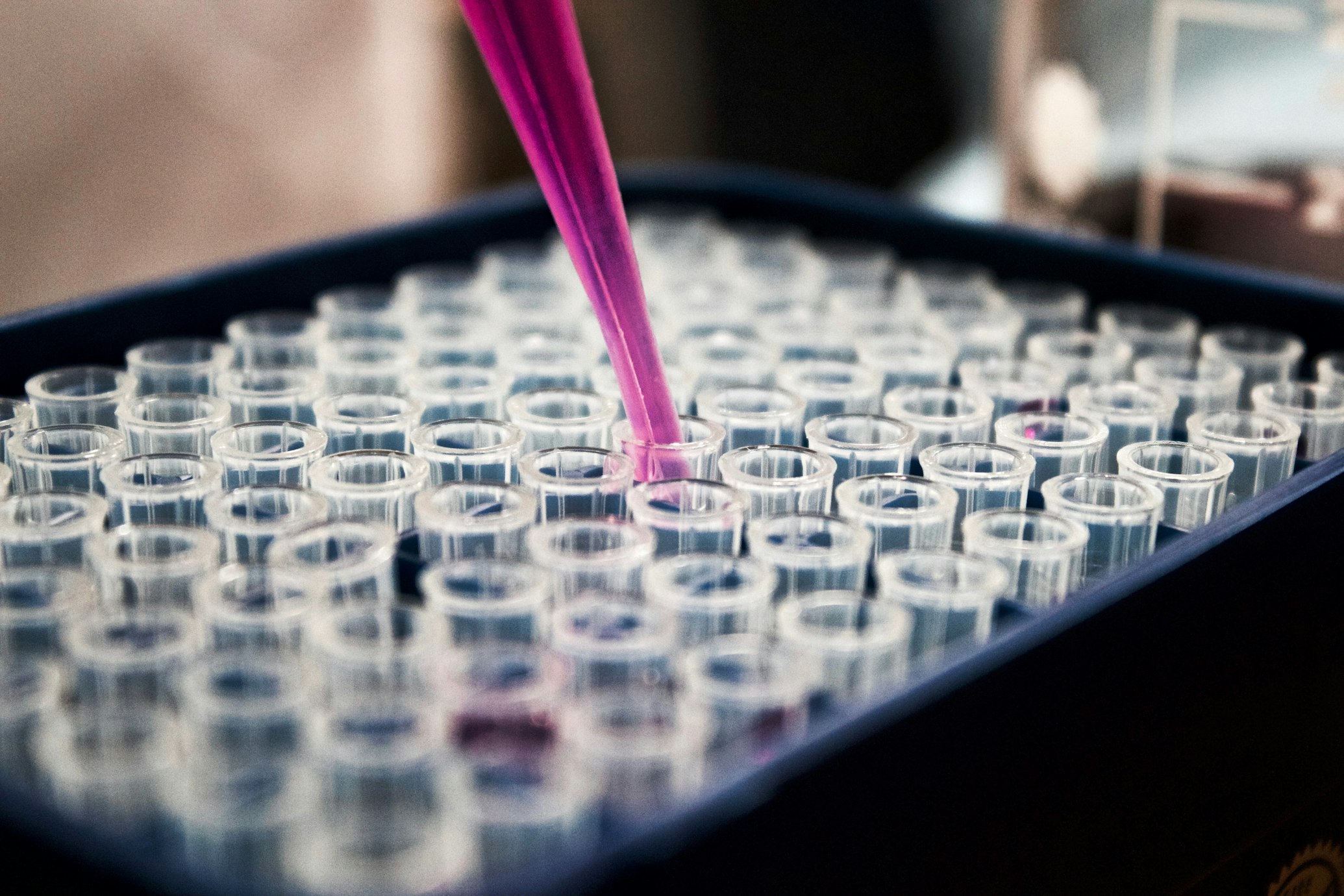
- Growth Measurements: Using plate readers to precisely measure optical density at 600nm (OD600), they quantified how much each plasmid impacted its host's maximum growth rate in three different nutrient environments .
- Conjugation Efficiency: Researchers measured conjugation rates during one-hour periods under growth-restricted conditions to separate conjugation effects from growth effects .
- Genomic Analysis: Long-read PacBio sequencing helped identify the specific genetic elements that made some plasmids more efficient at horizontal transfer .
Results and Implications: The Transfer Seesaw
The findings were striking—plasmids clearly face a fundamental tradeoff between horizontal and vertical transfer success. Those with high conjugation efficiency typically imposed greater growth burdens on their hosts, while plasmids with minimal growth effects tended to transfer less efficiently between cells .
Even more fascinating was the discovery of a conjugation efficiency threshold—below this threshold, host bacteria tolerated plasmids with minimal growth effects across four orders of magnitude of conjugation efficiency. But beyond this threshold, further increases in conjugation came at a steep cost to host growth .
This tradeoff helps explain why we don't see "super-plasmids" that are both highly contagious and virtually cost-free—evolution must balance these competing demands.
Visualizing the Transfer Tradeoff
The Scientist's Toolkit: Investigating Evolutionary Transfer
Understanding lateral and vertical transfer requires specialized research approaches and materials. The table below outlines key reagents and methods used in this fascinating field of research:
| Tool/Reagent | Function/Application |
|---|---|
| Clinical bacterial isolates | Source of diverse plasmids from natural environments |
| PacBio long-read sequencing | Determines complete genetic structure of mobile elements |
| Selective antibiotics | Tracks plasmid inheritance and spread |
| Liquid conjugation assays | Measures horizontal transfer efficiency between cells |
| Plate reader growth curves | Quantifies vertical transfer success through host growth impact |
| Bioinformatic networks | Maps complex evolutionary relationships beyond simple trees 1 |
| Areal typology methods | Identifies linguistic convergence zones 1 |
Genomic Analysis
Advanced sequencing technologies reveal horizontal gene transfer events across species boundaries.
Network Modeling
Computational approaches map the complex web of evolutionary relationships.
Linguistic Analysis
Comparative methods identify borrowed elements across language families.
Conclusion: The Web of Life
"The recognition of both lateral and vertical transfer has transformed our understanding of evolution across biology, linguistics, and anthropology."
We now see that life's history isn't just a branching tree but an intricate web with connections running sideways as well as downward. This reticulate evolution model acknowledges that organisms and cultures are mosaics shaped by both ancestry and interaction.
This paradigm shift has practical implications too—understanding lateral transfer helps us combat antibiotic resistance, trace language origins, and appreciate how cultural innovations spread. The evolutionary tradeoffs between vertical and horizontal transfer create constraints that shape the diversity we see around us.
Future Research Directions
- How extensive is lateral transfer in complex organisms?
- Can we map the complete network of gene sharing in natural environments?
- How do vertical and lateral processes interact across timescales?
- What computational models best represent reticulate evolution?
What makes this field so exciting is its interdisciplinarity—the same patterns appear whether we're studying genes, words, or cultural practices. The story of life is ultimately about connection—both through the deep roots of ancestry and the surprising bridges that span across branches.